battery AUDI Q5 2015 Owner's Guide
[x] Cancel search | Manufacturer: AUDI, Model Year: 2015, Model line: Q5, Model: AUDI Q5 2015Pages: 302, PDF Size: 75.01 MB
Page 235 of 302
M N
co
a:
co
,...., \!) 1.1'1
N 1.1'1 ,....,
~ Connect the charger connectors according to
the instructions to the
j u mp st a rt b olt s. (Bo lts
under the cover= "posit ive", Bo lts with hex
head = "negat ive").
~ Only now plug the mains lead for the charging
equipment into the wall outlet and turn it on
c::> &_ .
~ Ma ke sur e th e chargin g rat e is not o ver
30 amp s/14 .8 Volt .
~ When the batte ry is f ully charged: Tu rn the
charging equ ipment
off and remove the mains
lead from the wall outlet .
~ Now remove the clamps for the charging equip
ment.
~ Close the cover@on the positive term inal and
re-install the
cover (D .
~ Close the hood c::> page 221 .
A discharged battery can freeze at temperatures
of only 32 °F (0 °C). Allow a frozen battery to
thaw completely before attempting to charge it
c::> ,& . However, we recommend not using a
thawed battery again because the battery casing
can be cracked due to ice formation and ca n leak
battery acid.
B attery ch arging (Maximum charging rate of
30 amps /14.8 Volt )
When charging at
Low voltages (e.g. w ith a tri ckl e
c har ger ),
the bat tery cables do not have to be
d isconnected first. The ba ttery caps shou ld
not
be opened when charg ing a battery .
I t is not necessary to
remove the batte ry from
t he luggage compa rtment.
F a st charging the b attery (charging rate
above 14.8 Volts )
F or technica l reasons do not use a battery charg
e r that uses voltage greater than 14.8 Vol ts to
charge your veh icle's batte ry.
A WARNING
Charging a batte ry can be dangerous.
- Always fo llow the oper ating instructions
provided by the battery charge r manufactur
er when charging your battery.
Checking and Fillin g
-Never charge a frozen battery. It may ex
plode because of gas trapped in the ice . Al
low a frozen battery to thaw out first.
- Do not reuse batteries wh ich were frozen.
The battery housing may have cracked and
weakened whe n the battery froze.
- Charge the battery in a well ventilated area. Keep away from open flame or electrical
spark. Do not smoke. Hydrogen gas generat
ed by the batte ry is explosive .
- To reduce the danger of explosion, never
connect or d isconnect charger cab les wh ile
the charger is operating.
- Fast charging a battery is dangerous and
should only be attempted by a competent
technician w ith the proper eq uipment.
- Battery acid that may sp ill dur ing cha rging
should be washed
off with a solut ion of
warm water and baking soda to neutralize the acid .
@ Note
Never use a fast charger as a booster to start
the eng ine . T his w ill ser iously damage sensi
tive elec tronic components, s uch as control
units, relays, radio, etc., as we ll as the battery
cha rger.
Battery replacement
The new battery must have the same specifica
tions and dimensions as the original equipmen t
battery.
Intelligent energy management in your vehicle is
r esponsible for distributi ng the elect rical energy
t h ro ugh out your vehicle
c::> page 196. T he intelli
gen t energy management system w ill keep the
engi ne battery charged better then vehicles with
out this system . To make s ure the additiona l elec
trical energy is avai lab le once again after you
have changed the battery, we recommend that
you install batteries of the same type and manu
facture on ly (the same as those installed at the
t ime you r vehicle was del ivered) . Specificat ions
are listed on the battery hous ing . Your autho r-
ized dea ler must code the battery in the ene rgy ..,.
233
Page 236 of 302
Checking and F ill in g
management system to enable you to use the en
ergy management functions correctly after re p lacing the battery .
If i t is not poss ible to use a battery of this type,
the new battery must have the same capacity,
voltage (12 vo lts), amperage, construction and
p lug sealing .
When insta lling the ba ttery, make sure the igni
tion and all electrical consumers are t urned
off .
(D Note
- M ake sure the ven tilat ion hose on the side
of the ba tte ry is co nne cte d, o therw ise
fumes o r batte ry acid can lea k out .
- Vehicles wi th the Start-Stop-System* are
equipped with a special cycle-proof AG M
b attery. Installing a different type of bat
tery can cause prob lems in the vehicle elec
trica l system. When replacing the vehicle
battery, always install one with the same
spec ificat ions as the or iginal battery.
@ For the sake of the environment
Because of the problem of proper disposa l of
a battery, we recommend your author ized
Aud i dea ler change the battery for you. Bat
teries conta in su lfuric ac id and lead and must
always be disposed of properly in compliance
w it h all environmental reg ulations. Disposing
of vehicle batte ries imprope rly is very dange r
ous to the e nvironme nt.
Windshield/headlight
washer container
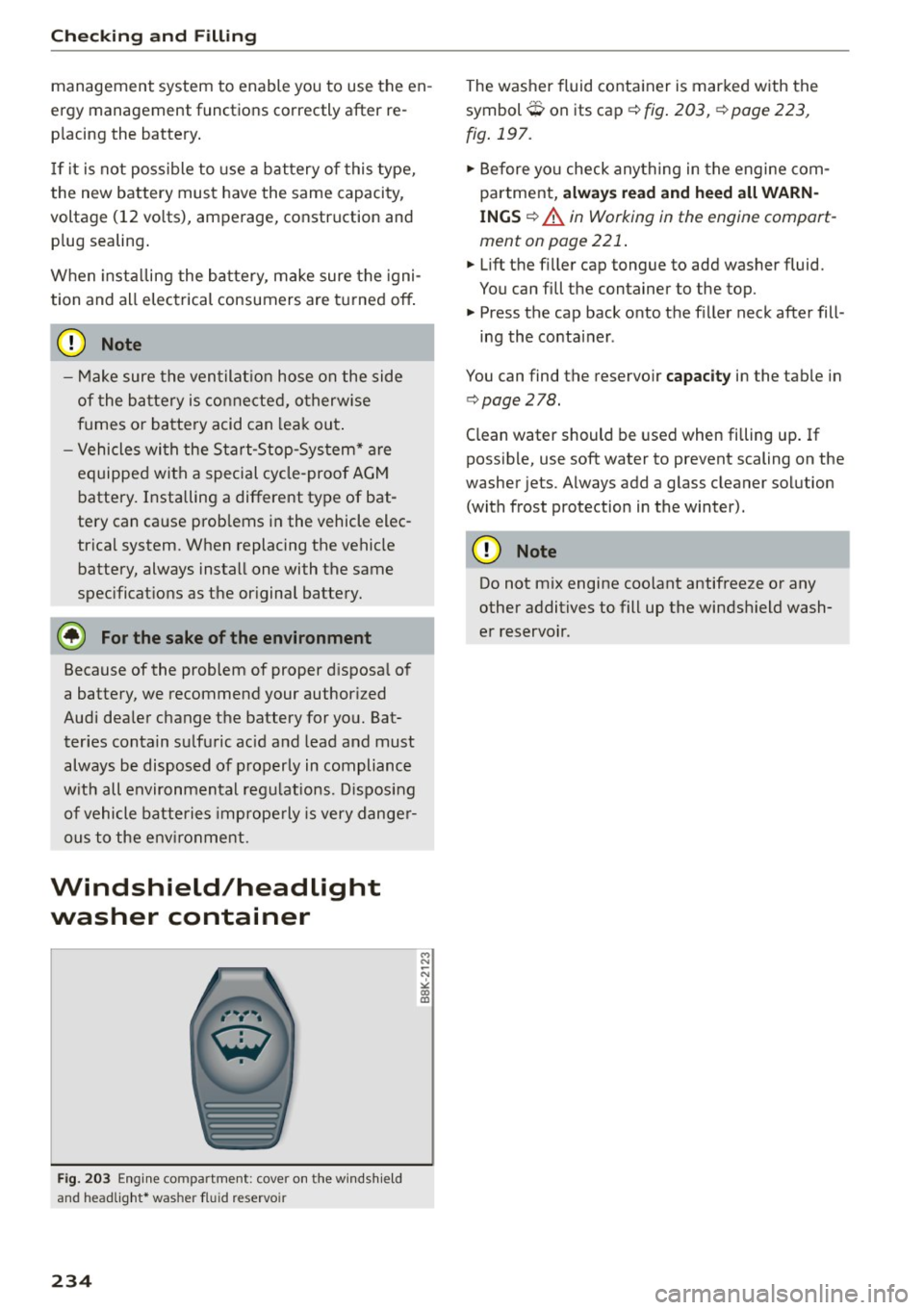
F ig . 20 3 En gin e compart ment: cover o n the w inds hield
and headlig ht* w ash er flui d reservo ir
234
M N
-N
>< a, al
The washer fluid conta iner is mar ked w ith the
symbol
O on its cap ¢ fig . 203, ¢page 223,
fig . 197 .
.. Before yo u check any thing in the engine com
partment,
always re ad and heed all WARN
INGS ¢ A in Working in the engine compart
ment on page 221 .
.. Lift the f iller cap tongue to add washer fluid.
You can fill the container to the top.
.. Press the cap back o nto the f iller neck afte r fill -
ing the conta iner.
You can find the reservo ir
capacity in the table in
<=> page 2 78.
Clean water should be used when fi lling up . If
possib le, use soft water to prevent scaling on the
washer jets . Always add a g lass cleaner solution
(with frost protection in the winter).
(D Note
Do not mix engine coolant antifreeze o r any
other additives to fill up the winds hield wash
e r reservo ir .
Page 257 of 302
M N
co ~ co
rl I.O
"' N
"' rl
Emergency assistance
Vehicle jack, vehicle tool kit and collapsible spare
tire
Onboard tool kit and vehicle jack
The vehicle tools ond vehicle jack* are stored in
the luggage compartment under the floor cover.
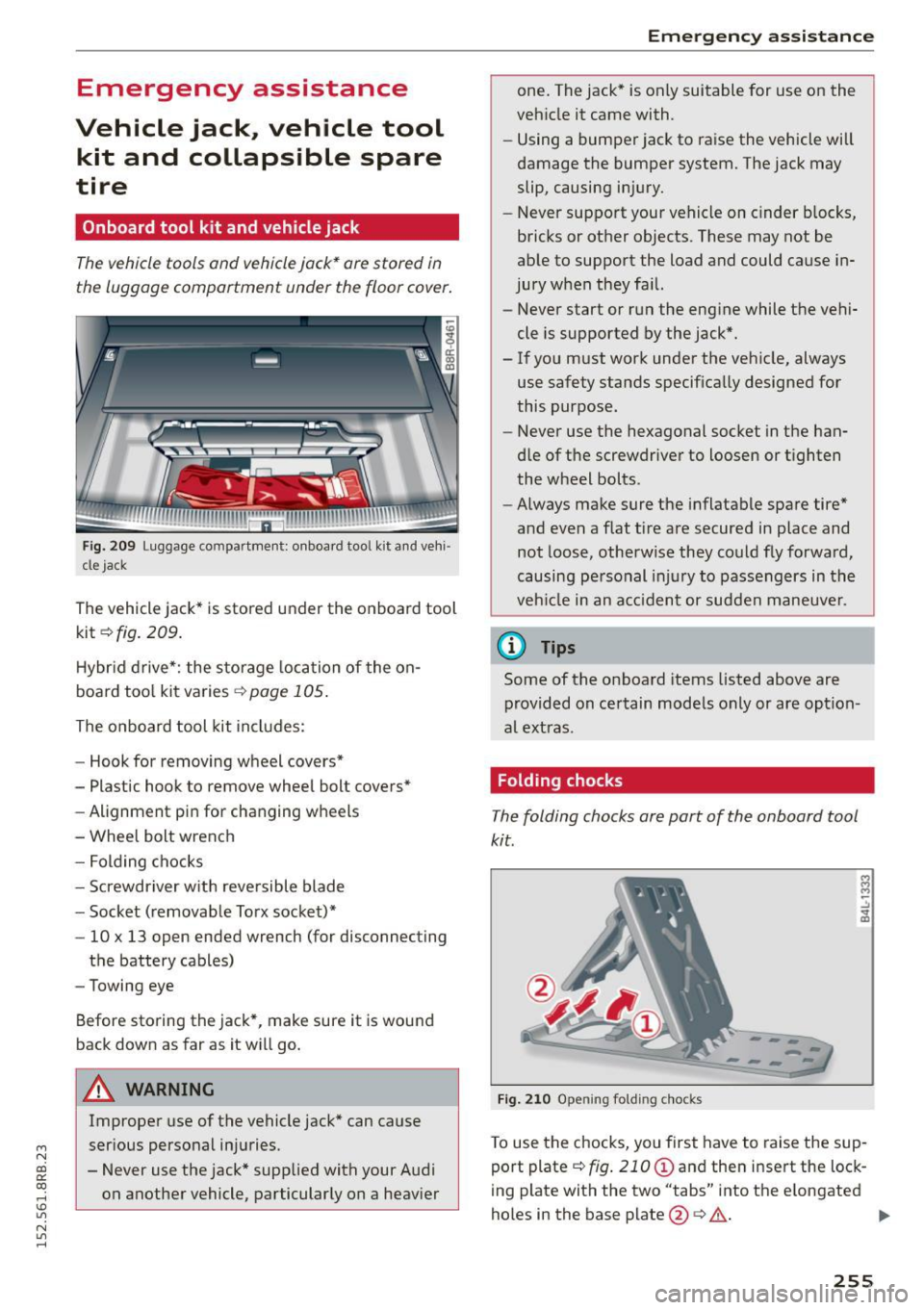
Fig. 209 Luggage compartme nt: on board tool kit and vehi·
cle jack
The vehicle jack* is stored under the on board tool
ki t¢ fig.
209.
Hybrid drive*: the storage location of the on
board too l kit varies ¢
page 105.
The on board tool kit includes:
- Hook for removing wheel covers*
- Plastic hook to remove wheel bolt covers*
- Alignment p in for cha nging wheels
- Wheel bolt wrench
- Folding chocks
- Screwdriver w ith reversible blade
- Socket (removable Torx socket)*
- 10 x 13 open ended wrench (for disconnecting
the battery cables)
- Towing eye
Befo re storing the jack*, make sure it is wound
back down as far as it will go.
A WARNING
Improper use of the vehicle jack* can cause
ser ious personal injuries.
- Never use the jack* supplied with your Audi
on another vehicle, particularly on a heav ier
-
Emergen cy assistance
one. The jack * is only suitable for use on the
veh icle it came with.
- Using a bumper jack to raise the vehicle will
damage the bumper system. The jack may
slip, causing injury.
- Never support your vehicle on c inder b locks,
bricks or other objects. These may not be
able to support the load and could cause in·
jury when they fa il.
- Never start or run the engine while the vehi
cle is supported by the jack*.
- If you must work under the vehicle, always
use safety stands specifically designed for
this purpose.
- Never use the hexagonal socket in the han
dle of the screwdriver to loosen or tighten
the wheel bolts.
- Always make sure the inflatable spare tire*
and even a flat tire are secured in place and
not loose, otherwise they could fly forward,
causing personal injury to passengers in the
veh icle in an acc ident or sudden maneuver.
(D Tips
Some of the on board items listed above are
provided on certain models only or are option
al extras.
Folding chocks
The folding chocks are part of the on board tool
kit.
--.. ,..
Fig. 210 Open ing foldi ng chock s
To use the chocks, you first have to rais e the sup ·
port plate r::!,>
fig. 210 (!) and then i nsert the lock
ing plate with the two "tabs" into the e longated
holes in the base pl ate@¢
A. .,.
255
Page 269 of 302

M N
co ~ co
rl I.O
"' N
"' rl
Left cockpit fuse assignment
Fig. 224 Left side of the cockpit: fuse panel with plastic
clip
Fuse panel @ (black )
No. Equipment
1 Dynamic steering
2 ESC control module
A/C system pressure sensor, electrome-
3 chanical park
ing brake, Homelink, auto-
matic dimming interior rearview mirror, air
quality/outside air sensor, ESC button
5 Sound
actuator/exhaust sound tuning
6 Headlight range contro l/cornering light
7 Headlight (cornering light)
Control modu les (e lectromechanical park-
8 ing brake, shock absorber, quattro Sport,
trailer hitch), DCDC converter
9
Adaptive cruise control or high voltage
battery (hybrid drive)
11 Side assist
12 Headlight range control, parking system
13 Airbag
14 Rear w iper
15 Auxi
liary fuse (instrument panel)
1 6 Auxiliary fuse terminal 15 (engine area) Fuses
and bulbs
Fuse panel @ (brown)
No . Equipment
1 Electric exhaust door
2 Brake light sensor or brake pedal
move-
ment sensor (hybr id drive)
3 Fuel pump
4 AdBlue pumps
or brake booster power
supply (hybrid dr ive)
5 Left seat heating with/without seat venti-
lation
6 ESC
7 Horn
8 Left
front door (window regulator, central
locking, mirror, switch, lighting)
9 Wiper motor
10 ESC
11 Left
rear door (window regu lator, switch,
lighting)
12 Rain and light sensor
Fu
se panel © (re d)
No . Equipment
3 Lumbar support
4 Dynamic steering
5 Climatized cupholder
6 Windshie
ld washer system, headlamp
washer system
7 Vehicle electr ical system control module 1
8 Vehicle e
lectrica l system control module 1
9 Panorama sunroof
10 Vehicle e lectrica l system control module 1
11 Sun shade (pano rama sunroof)
12 Anti-theft a
larm system
267
Page 271 of 302
M N
co
a:
co
,...., \!) 1.1'1
N 1.1'1 ,....,
Fuse panel© (brown)
No. Equipment
1 Luggage compartment lid control module
2 12 V socket, c igarette lighter
3
DCDC converter path 1 or high vo ltage bat-
tery blower (hybrid drive)
4 DCDC converter path 2, DSP amplifier, ra-
dio
7 Electromechanical parking brake
9
Right front doo r (window reg ulator, cen-
tral locking, mirror, switch, lighting)
11 Rear r
ight door (window regulator, switch,
lighting)
12 Cell phone
preparation
Fuse panel ® (black)
No. Equipment
1 Right front seat heating
2 Automatic dimming rearview mirror
3 Instrument panel terminal 30
4 MMI
5 Radio
6 Rearview came
ra
7 Rear window defogger
8 Rear Seat Entertainment
11 AdBlue heating
12 Ad
Blue supply or high voltage battery (hy-
brid drive)
Bulbs
Replacing light bulbs
For your safety, we recommend that you have
your authorized Audi dealer replace burned out bulbs for you.
It is becoming increasingly more and more diffi
cult to replace vehicle light bulbs since in many
cases, other parts of the car must first be re
moved before you are ab le to get to the bulb.
This applies espec ially to the light bulbs in the
front of you r car which you can only reach
through the engine compartment.
Fuses and bulbs
Sheet metal and bulb holders can have sharp
edges that can cause serious cuts, and parts
must be correctly taken apart and then properly
put back together to help prevent breakage of
parts and long term damage from water that can
enter housings that have not been proper ly re
sealed .
For your safety, we recommend that you have
your authorized Aud i dealer replace any bulbs for
you, since your dealer has the proper too ls, the
correct bulbs and the expertise .
Gas discharge lamps (Xenon lights )*:
Due to the high e lectrica l voltage, have the bulbs
replaced by a qualified technician. Headlights
with Xenon light can be identif ied by the high
vo ltage sticker.
A WARNING
Contact with high-voltage components of the
electr ical system and improper replacement
of gas discharge (Xenon) headlight bulbs can
cause ser ious personal injury and death.
- Xenon bulbs are pressur ized and can ex-
plode when being changed.
- Changing Xenon lamps requ ires the special
train ing, instructions and equipment.
- Only an authorized Audi dealer or other
qualified workshop should change the bulbs
in gas discharge lamps.
A WARNING "'--
There are parts with sharp edges on the open-
in gs and on the bulb holders that can cause
serious cuts.
- If you are uncertain about what to do, have
the wor k performed by an authorized Aud i
dealer or other qualified workshop. Serious
personal injury may resu lt from improperly
performed work .
(D Tips
-If you must replace the light bulbs yourself,
always remember that the engine compart
ment of any vehicle is a hazardous area to
work in . Always read and heed all WARN
INGS¢ page 221 ¢ .&,.
269
Page 273 of 302
M N
co
a:
co
,...., \!) 1.1"1
N 1.1"1 ,....,
Emergency situations
General
This chapter is intended for trained emergency
crews and working personnel who have the nec
essary tools and equipment to perform these
operations.
Starting by pushing or
towing
(D Note
Vehicles with an automatic transmission
cannot be started by pushing or towing.
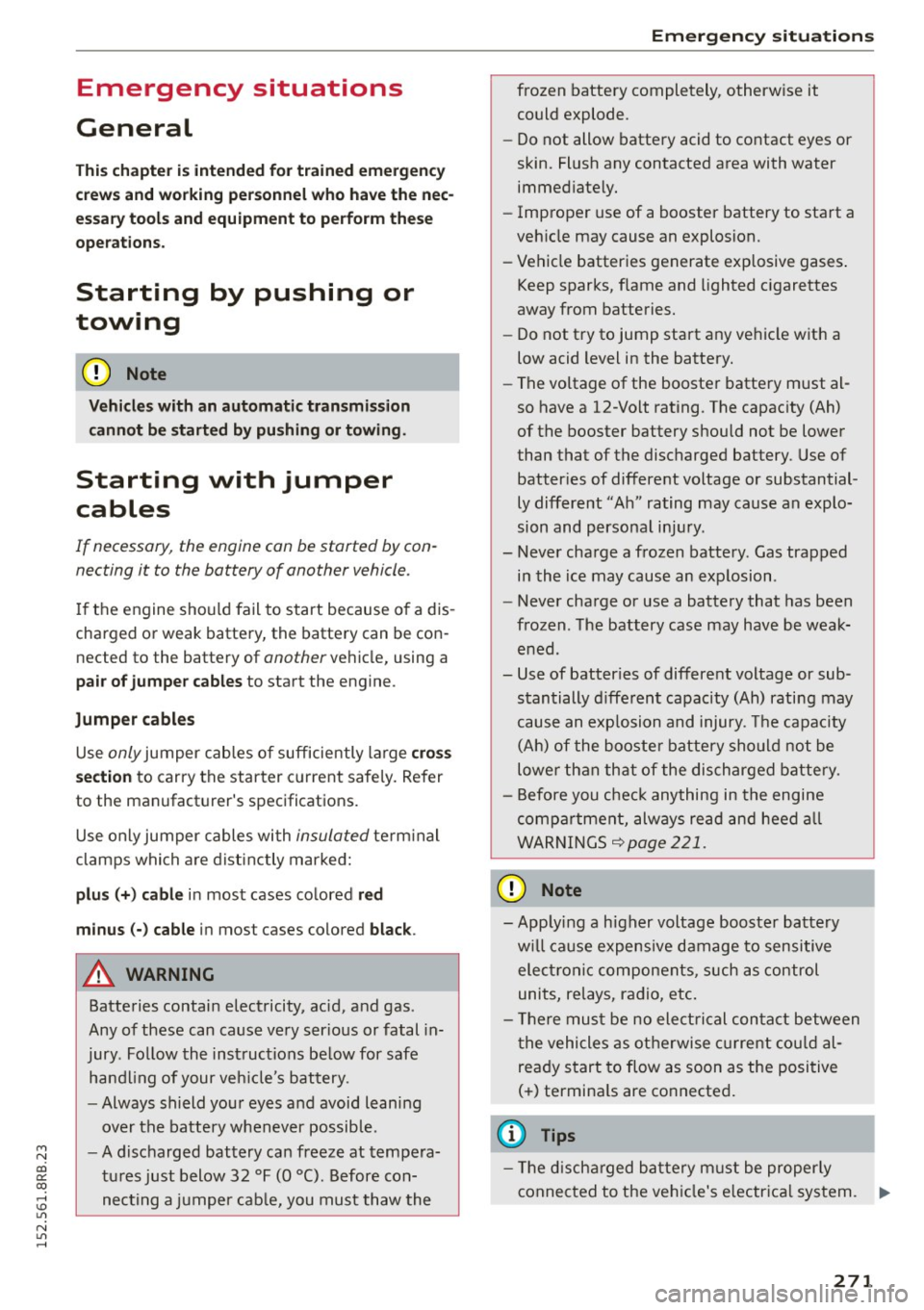
Starting with jumper
cables
If necessary, the engine can be started by con
necting it to the battery of another vehicle.
If the engine should fail to start because of a dis
charged or weak battery, the battery can be con
nected to the battery of
another vehicle, using a
pair of jumper cables to start the engine .
Jumper cables
Use only jumper cables of sufficiently large cross
section
to carry the starter current safely. Refer
to the manufacturer's specifications.
Use only jumper cables with
insulated terminal
clamps which are distinctly marked:
plus(+) cable in most cases colored red
minus(-) cable
in most cases colored black.
A WARNING
Batteries contain electricity, acid, and gas.
Any of these can cause very serious or fatal in
jury . Follow the instructions below for safe
handling of your vehicle's battery.
-Always shield your eyes and avoid leaning
over the battery whenever possible.
-A discharged battery can freeze at tempera
tures just below 32 °F (0 °C). Before con
necting a jumper cable, you must thaw the
Emergency situations
frozen battery completely, otherwise it
could explode.
- Do not allow battery acid to contact eyes or
skin. Flush any contacted area with water immediately.
- Improper use of a booster battery to start a
vehicle may cause an explosion.
- Vehicle batteries generate explosive gases.
Keep sparks, flame and lighted cigarettes
away from batteries.
- Do not try to jump start any vehicle with a
low acid level in the battery.
- The voltage of the booster battery must al
so have a 12-Volt rating. The capacity (Ah)
of the booster battery should not be lower
than that of the discharged battery. Use of
batteries of different voltage or substantial
ly different" Ah" rating may cause an explo
sion and personal injury.
- Never charge a frozen battery. Gas trapped
in the ice may cause an explosion.
- Never charge or use a battery that has been
frozen. The battery case may have be weak
ened ,
- Use of batteries of different voltage or sub stantially different capacity (Ah) rating may
cause an explosion and injury. The capacity
(Ah) of the booster battery should not be
lower than that of the discharged battery.
- Before you check anything in the engine
compartment, always read and heed all
WARNINGS
q page 221.
(D Note
-Applying a higher voltage booster battery
will cause expensive damage to sensitive
electronic components, such as control
units, relays, radio, etc.
- There must be no electrical contact between
the vehicles as otherwise current could al
ready start to flow as soon as the positive
(+) terminals are connected.
(D Tips
- The discharged battery must be properly
connected to the vehicle's electrical system. .,..
271
Page 274 of 302
Emergency situation s
When jump starting or charging the battery,
never connect the negative ground cable to
the battery negative post because the bat
tery manager system must be able to detect
the battery's state of charge. Always con nect the negative ground cable to the nega
tive ground post of the battery manager
control un it.
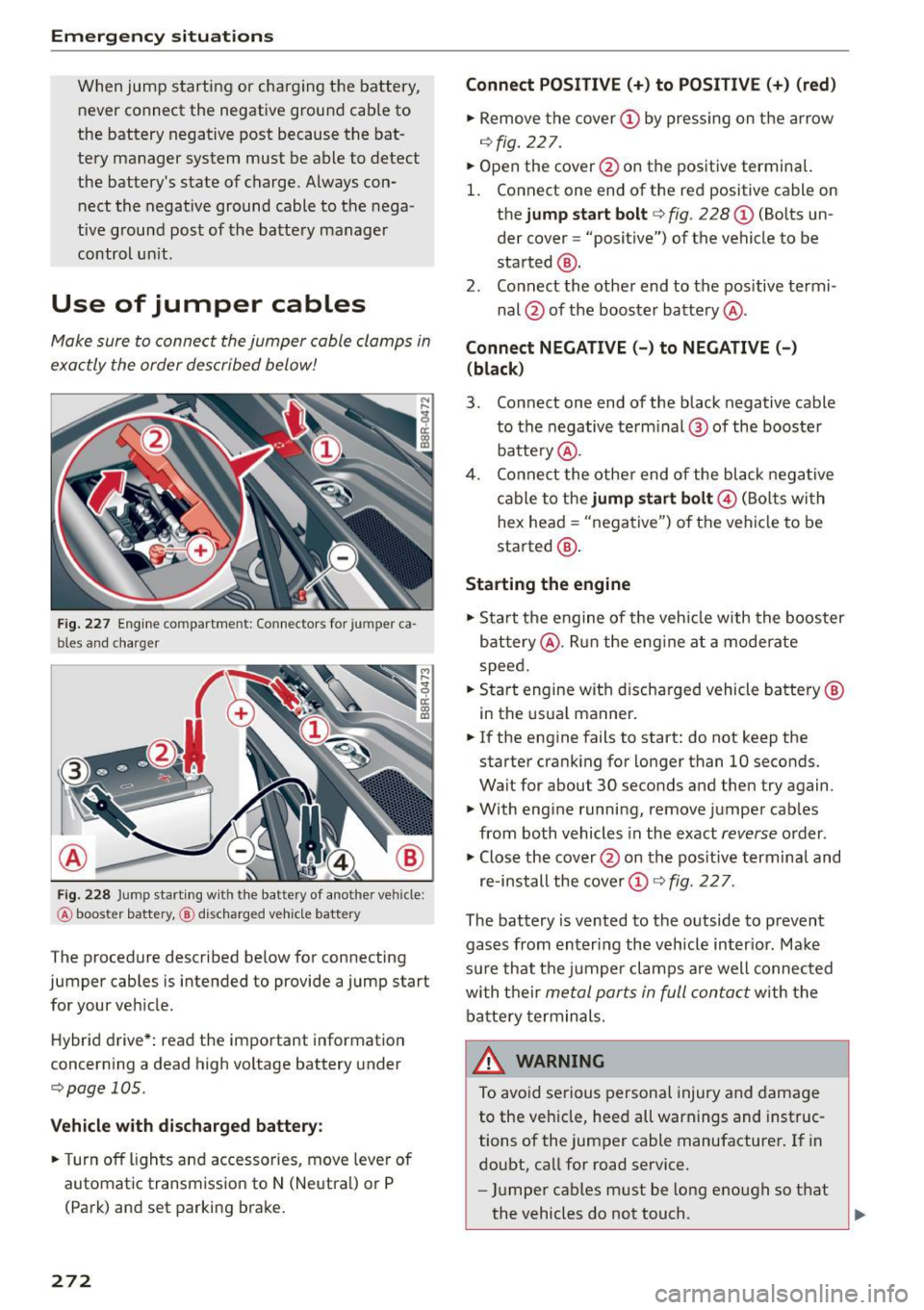
Use of jumper cables
Make sure to connect the jumper cable clamps in
exactly the order described below!
Fig. 227 Engine co mpar tment : Connectors for ju mp er ca
bl es and charger
Fig. 228 Jum p starting wi th the battery of anot her ve hicl e:
@ booste r batte ry ,@ discharged vehicle battery
The procedure described be low for connecting
jumper cables is intended to provide a jump start for your vehicle.
Hybrid drive*: read the important information
concerning a dead high voltage battery under
c;,page 105.
Vehicle with discharged battery:
• Turn off lights and accessories, move lever of
automatic transmission to N (Neutral) or P
(Park) and set parking brake.
272
Connect POSITIVE(+) to POSITIVE (+) (red)
• Remove the cover (!) by pressing on the arrow
¢fig. 227.
• Open the cover @on the positive terminal.
1. Connect one end of the red positive cable on
the
jump start bolt c::> fig. 228 @ (Bolts un
der cover = "positive") of the vehicle to be
started @.
2 . Connect the other end to the positive termi-
nal @ of the booster battery @.
Connect NEGATIVE (-) to NEGATIVE (-)
(black)
3 . Connect one end of the black negative cable
to the negative terminal @ of the booster
battery @.
4. Connect the other end of the black negative
cable to the
jump start bolt © (Bolts with
hex head= "negative") of the vehicle to be
started @.
Starting the engine
• Start the engine of the vehicle with the booster
battery @. Run the eng ine at a moderate
speed.
• Start engine with discharged vehicle battery @
in the usual manner.
• lfthe engine fails to start: do not keep the
starter cranking for longer than 10 seconds.
Wait for about 30 seconds and then try again.
• With engine running, remove jumper cables
from both vehicles in the exact
reverse order .
• Close the cover @on the positive terminal and
re-install the cover@¢
fig. 22 7.
The battery is vented to the outside to prevent
gases from entering the vehicle interior . Make
sure that the jumper clamps are well connected
with their
metal parts in full contact with the
batte ry terminals.
& WARNING
To avoid serious personal injury and damage
to the veh icle, heed all warnings and instruc
tions of the jumper cable manufacturer. If in
doubt, call for road service.
- Jumper cables must be long enough so that
the vehicles do not touch. ..,.
Page 275 of 302
M N
co ~ co
rl I.O
"' N
"' rl
-When conne cting jump er cabl es, make sur e
that they cannot get caught in any moving
parts in the engine compartment.
- Do not bend over the batteries -danger of
chemical burns!
- The battery cell locking screws must be
tightened securely .
- Before you check anything in the engine
compa rtment, always read and heed all
WARNINGS
¢ page 221.
(D Note
Improper hook-up of jumper cables can ruin
the generator.
- Always connect POSITIVE(+) to POSITIVE
(+), and NEGATIVE(-) to NEGATIVE(-)
ground post of the battery manager control
unit.
- Check that all screw plugs on the battery
cells are screwed in firmly . If not, tighten
plugs prior to connecting clamp on negative
battery terminal.
- Please note that the procedure for connect
ing a jumper cable as described above ap
plies specifically to the case of your vehicle
being jump started . When you are giving a
jump start to another vehicle, do
not con
nect the negative(-) cable to the negative
(-) terminal on the discharged battery@
¢
fig. 228. Instead, securely connect the
negative (-) cable to either a solid metal
component that is firmly bolted to the en
gine block or to the engine block itself. If
the battery that is being charged does not
vent to the outside, escaping battery gas
could ignite and explode !
Towing with a tow truck
General hints
Your Audi requires special handling for towing .
The following information is to be used by com
mercial tow truck operators who know how to op
e rate their equipment safely .
-Never tow your Audi, towing will cause dam
age to the engine and transmission.
Emergency situations
- Never wrap the safety chains or winch cables
around the brake lines.
- To prevent unnecessary damage, your Audi
must be transported with a flat bed truck.
- To load the vehicle on to the flat bed, use the
towing loop found in the vehicle tools and at
tach to the front or rear anchorage
¢ pag e 273 and ¢ pag e 274.
A WARNING
--
A vehicle being towed is not safe for passen
gers. Never allow anyone to ride in a vehicle
being towed, for any reason .
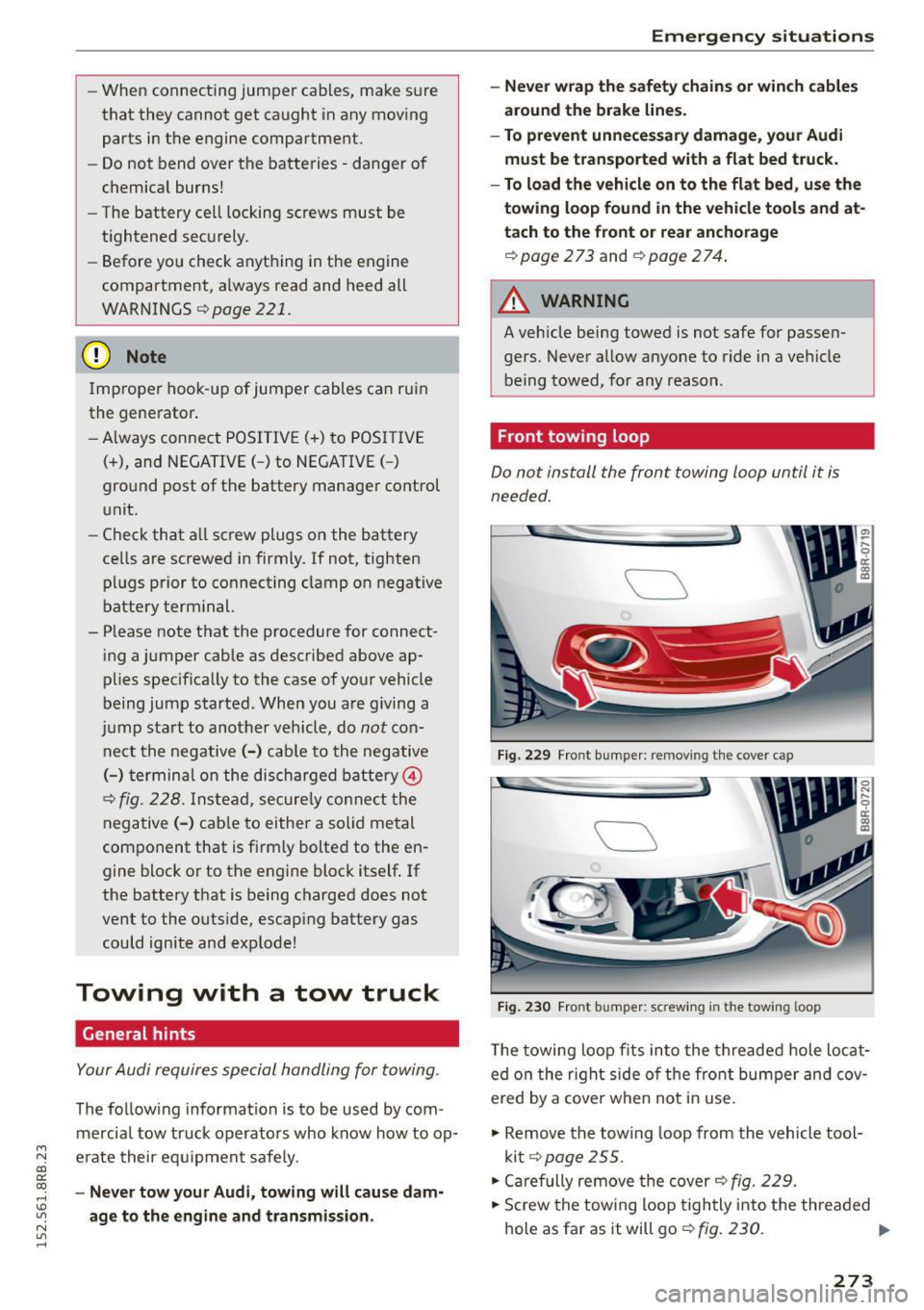
Front towing loop
Do not install the front towing loop unt il it is
needed.
Fig. 229 Fro nt bump er: r em oving th e cover ca p
.·~G
' -
Fig. 230 Fro nt bumper: s crewing in th e tow in g l oo p
The towing loop fits into the threaded hole locat
ed on the right side of the front bumper and
cov
ered by a cover when not in use.
.,. Remove the towing loop from the vehicle tool
kit ¢
page 255.
"' Carefully remove the cover ¢ fig. 229 .
.,. Screw the towing loop tightly into the threaded
hole as far as it will go¢
fig. 230. IJi,,
273
Page 281 of 302
M N
co
a:
co
,...., \!) 1.1'1
N 1.1'1 ,....,
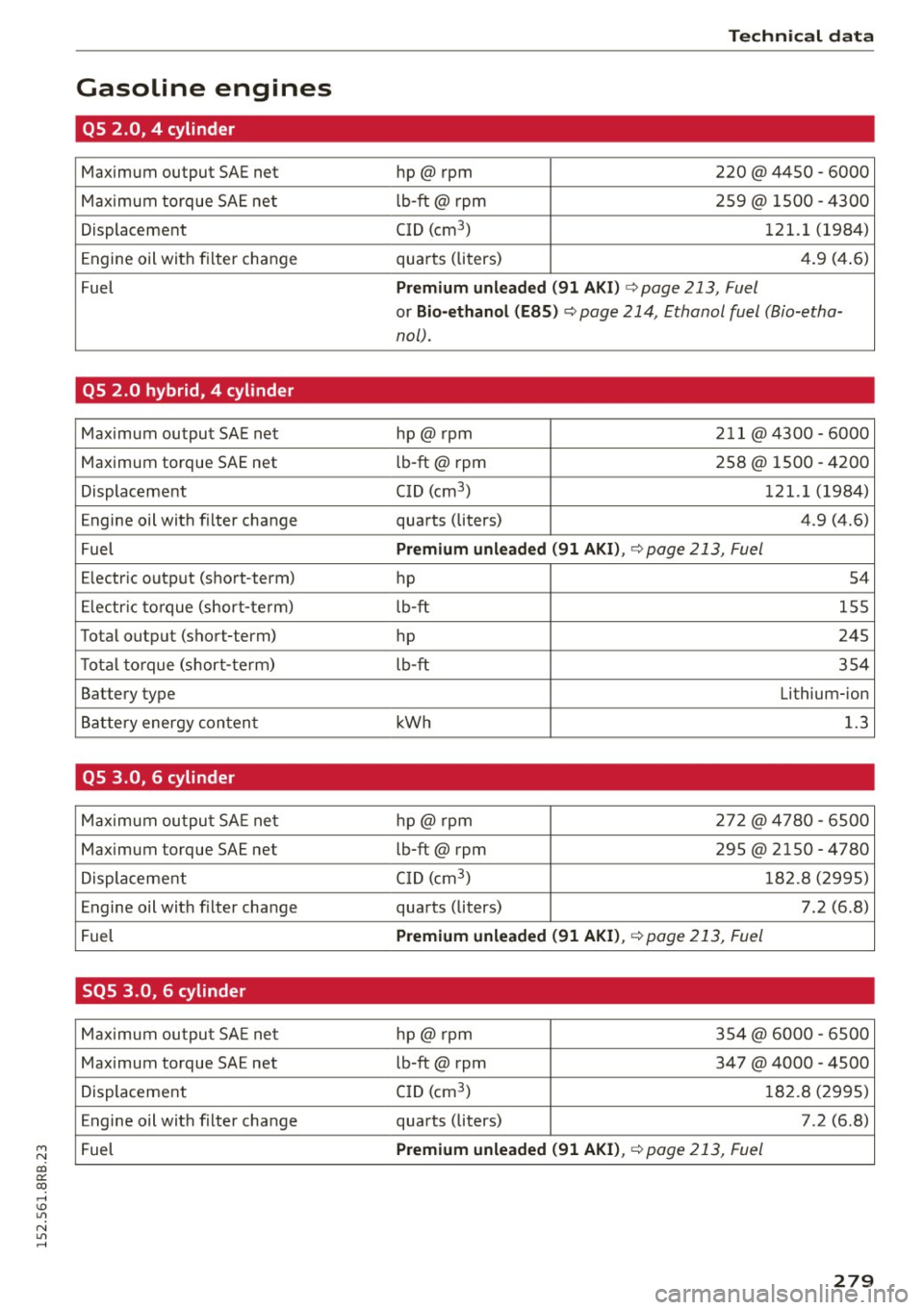
Gasoline engines
QS 2.0, 4 cylinder
Maximum output SAE net
Maximum torque SAE net
Displacement
Engine oil with filter change
Fuel
QS 2 .0 hybrid, 4 cylinder
Maximum output SAE net
Maximum torque SAE net
Displacement
Engine oil with filter change
Fuel
E lectric output (short-term)
E lectr ic torque (short-term)
Total output (short-term)
T otal torque (short-term)
Battery type
Battery energy content
QS 3.0, 6 cylinder
Maximum output SA E net
Maximum torque SAE net
Displacement
Engine oil with f ilter change
Fuel
SQS 3.0, 6 cylinder
Maximum output SA E net
Maximum torque SAE net
Displacement
Engine oil with filter change
Fuel
Techni cal d at a
hp@rpnn 220 @4450 -6000
lb -ft@ rpm 259@ 1500 -4300
CID (cm
3 ) 121.1 (1984)
quarts (liters) 4.9 (4.6)
Premium un lead ed (9 1 A KI) <=:>pag e 213, Fuel
or
Bi o-e tha no l (E B S) ¢ page 214, Ethanol fuel (Bio-etha-
no[) .
hp@rpnn 211 @4300 -6000
lb -ft@ rpm 258 @ 1500 -4200
CID (cm
3 ) 121.1 (1984)
quarts (liters) 4.9 (4.6)
Premium unl ead ed (91 AKI) , <=:>page 213, Fuel
hp 54
lb -ft 155
hp 245
lb-ft 354
Lithium-ion
kWh 1.3
hp@ rpnn 272@ 4780 -6500
lb-ft@ rpm 295@ 2150 -4780
C ID (cm
3
') 182.8 (2995)
quarts (liters) 7.2 (6.8)
Pre mi um unl ead ed (9 1 AKI) , <=:>page 213, Fuel
hp@ rpnn 354@ 6000 -6500
lb-ft@ rpm 347 @4000 -4500
C ID (cm
3
) 182.8 (2995)
quarts (liters) 7.2 (6.8)
Pre mium unlea ded (91 A KI) , <=:> page 213, Fuel
279
Page 288 of 302
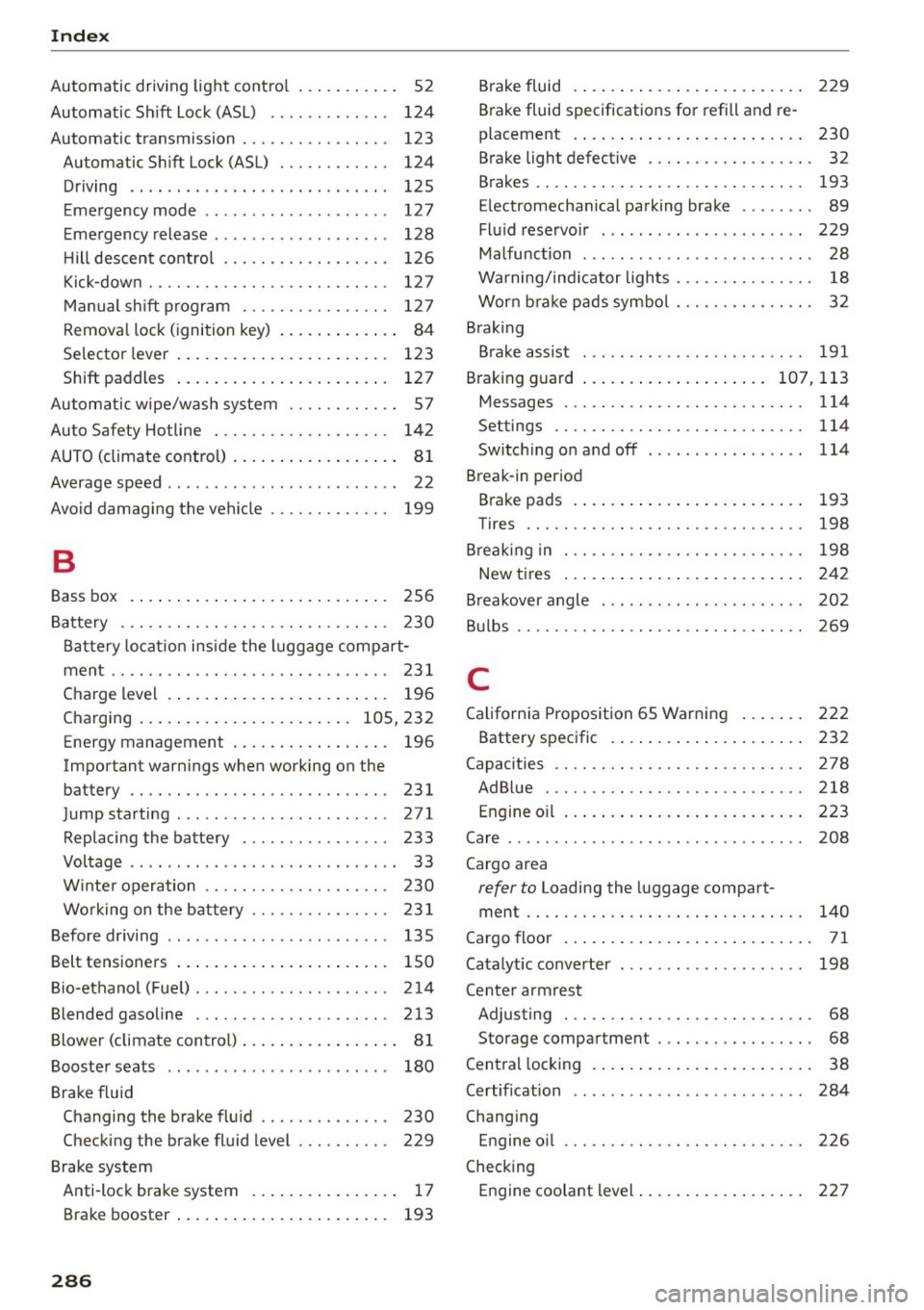
Index
Automatic driv ing light contro l . . . . . . . . . . . 52
Automatic Sh ift Lock (ASL) . . . . . . . . . . . . . 124
Automatic transmission . . . . . . . . . . . . . . . . 123
Automatic Shift Lock (ASL) . . . . . . . . . . . . 124
Driving ...... .................. ... . 125
Emergency mode . . . . . . . . . . . . . . . . . . . . 127
Emergency release . . . . . . . . . . . . . . . . . . . 128
H ill descent control . . . . . . . . . . . . . . . . . . 126
Kick -down . . . . . . . . . . . . . . . . . . . . . . . . . . 127
Manual sh ift program . . . . . . . . . . . . . . . . 127
Remova l lock (ignition key) . . . . . . . . . . . . . 84
Selector lever . . . . . . . . . . . . . . . . . . . . . . . 123
Shift paddles . . . . . . . . . . . . . . . . . . . . . . . 127
Automatic wipe/wash system . . . . . . . . . . . . 57
Auto Safety Hotline . . . . . . . . . . . . . . . . . . . 142
AUTO (climate control) . . . . . . . . . . . . . . . . . . 81
Average speed . . . . . . . . . . . . . . . . . . . . . . . . . 22
Avoid damaging the vehicle . . . . . . . . . . . . . 199
B
Bass box . . . . . . . . . . . . . . . . . . . . . . . . . . . . 256
Battery . . . . . . . . . . . . . . . . . . . . . . . . . . . . . 230
Battery locat ion inside the luggage compa rt-
ment .............................. 231
Charge level . . . . . . . . . . . . . . . . . . . . . . . . 196
Charging . . . . . . . . . . . . . . . . . . . . . . . 105, 232
Energy management . . . . . . . . . . . . . . . . . 196
Important warnings when working on the
battery . . . . . . . . . . . . . . . . . . . . . . . . . . . . 231
Jump starting . . . . . . . . . . . . . . . . . . . . . . . 271
Replacing the battery . . . . . . . . . . . . . . . . 233
Voltage . . . . . . . . . . . . . . . . . . . . . . . . . . . . . 33
W inte r operation . . . . . . . . . . . . . . . . . . . . 230
Working on the battery . . . . . . . . . . . . . . . 231
Before driving . . . . . . . . . . . . . . . . . . . . . . . . 135
Belt tensioners . . . . . . . . . . . . . . . . . . . . . . . 150
B io-ethanol (Fue l) . . . . . . . . . . . . . . . . . . . . . 214
Blended gasoline . . . . . . . . . . . . . . . . . . . . . 213
Blower (climate control) . . . . . . . . . . . . . . . . . 81
Booster seats . . . . . . . . . . . . . . . . . . . . . . . . 180
Brake fl uid
Changing the brake flu id . . . . . . . . . . . . . . 230
Checking the brake fluid level . . . . . . . . . . 229
Brake system Anti-lock brake system . . . . . . . . . . . . . . . . 17
Brake booster . . . . . . . . . . . . . . . . . . . . . . . 193
286
Brake fluid . . . . . . . . . . . . . . . . . . . . . . . . . 229
Brake fluid specifications for refill and re
placement . . . . . . . . . . . . . . . . . . . . . . . . . 230
Brake light defective . . . . . . . . . . . . . . . . . . 32
Brakes . . . . . . . . . . . . . . . . . . . . . . . . . . . . . 193
E lectromechanical parking brake . . . . . . . . 89
Fluid reservo ir . . . . . . . . . . . . . . . . . . . . . . 229
Malfunction . . . . . . . . . . . . . . . . . . . . . . . . . 28
Wa rning/indicator lights . . . . . . . . . . . . . . . 18
Worn b ra ke pads symbo l . . . . . . . . . . . . . . . 32
Brak ing
Brake assist . . . . . . . . . . . . . . . . . . . . . . . . 191
Braking guard ..... .. .. ... . .... ... 107, 113
Messages . . . . . . . . . . . . . . . . . . . . . . . . . . 114
Settings . . . . . . . . . . . . . . . . . . . . . . . . . . . 114
Switching on and
off . . . . . . . . . . . . . . . . . 114
Break-in period Brake pads . . . . . . . . . . . . . . . . . . . . . . . . . 193
Tires . . . . . . . . . . . . . . . . . . . . . . . . . . . . . . 198
B reak ing in . . . . . . . . . . . . . . . . . . . . . . . . . . 198
New tires . . . . . . . . . . . . . . . . . . . . . . . . . . 242
B reakover angle . . . . . . . . . . . . . . . . . . . . . . 202
Bul bs . . . . . . . . . . . . . . . . . . . . . . . . . . . . . . . 269
C
Californ ia Proposition 65 Warning . . . . . . . 222
Battery specific . . . . . . . . . . . . . . . . . . . . . 232
Capacities . . . . . . . . . . . . . . . . . . . . . . . . . . . 278
AdBlue ... .. .... .. .. .. ........... .. 218
Engine oi l . . . . . . . . . . . . . . . . . . . . . . . . . . 223
Care . . . . . . . . . . . . . . . . . . . . . . . . . . . . . . . . 208
Cargo area
refer to Loading the l uggage compart-
ment..... .. .... .. .. .. ........... .. 140
Cargo floor . . . . . . . . . . . . . . . . . . . . . . . . . . . 71
Catalytic converter . . . . . . . . . . . . . . . . . . . . 198
Center armrest
Adjusting . . . . . . . . . . . . . . . . . . . . . . . . . . . 68
Storage compar tment . . . . . . . . . . . . . . . . . 68
Central locking . . . . . . . . . . . . . . . . . . . . . . . . 38
Certification . . . . . . . . . . . . . . . . . . . . . . . . . 284
Chang ing
Engine oil . . . . . . . . . . . . . . . . . . . . . . . . . . 226
Checking Engine coolant level . . . . . . . . . . . . . . . . . . 227