brake light AUDI Q5 2015 Owner's Guide
[x] Cancel search | Manufacturer: AUDI, Model Year: 2015, Model line: Q5, Model: AUDI Q5 2015Pages: 302, PDF Size: 75.01 MB
Page 197 of 302
M N
co
a:
co
,...., \!) 1.1'1
N 1.1'1 ,....,
brake. This may cause the brakes to over
heat, premature wear and increased stop
ping distance.
- Under certain climatic and operating condi
tions such as passing through wate r, driving
in heavy rain o r after washing the vehicle,
the effectiveness of the brakes can be re duced. In w inter, ice can accumulate on the
brake pads, linings, discs and drums . Care
fully apply b rakes for a test. B rakes wi ll dry
and ice coatings wi ll be cleaned off after a
f ew caref ul bra ke applications .
- Dr iv ing for an extended period of time on
salt-covered roads w ithout using you r
brakes can also affect braking efficiency .
Clean off accumulated salt coating from
brake discs and pads w ith a few caref ul
brake applicat ions.
- If you damage the front spoiler, or if you in
stall a different spoi ler, be sure the air flow
to the front brakes is not obstructed. Other
wise the brake system could overheat reduc ing the effectiveness of the ent ire brake sys
tem .
- Failure of one brake c ircuit will impair the
braking capab ility result ing in an increased
stopp ing distance. Avoid driv ing the veh icle
and have it towed to the nearest authori zed
Audi dealer or qu alified workshop.
- Never let the vehicle roll to a stop w ith the
eng ine shut off.
- If the brake booster is not work ing, the
brake pedal must be pressed conside rably
harder to make up fo r the lack of booste r as
sist ance.
Electromechanical power
assist, Dynamic steering
The electromechanical power assist helps the
driver when steering.
Power stee ring adapts electronically based on
the vehicle speed.
Indicator light s and mess age s
• Stee ring def ective! Do not drive vehicle!
Smart T echno log y
If this indicato r light turns on and stays on and
t h is message appears, the power steering may
have failed.
Stop the vehi cle in a sa fe location as soo n as pos
s ible . Do
not cont inue driving . See yo ur author
ized Audi dea ler or other qualified repair facility
for assistance .
'Iij Dynamic steering: Sy stem fault! You c an
continue dri ving
If the indicato r light turns on and the message
appea rs, the stee ring may be more d ifficult to
move o r more sensit ive th an usua l. The steering
may also be at an angle when driving straight .
Drive slowly to you r authorized Audi dea le r o r
qualified wo rkshop to have the ma lf u nct ion co r
re cted.
,~n D ynamic steering: Initializing
Audi drive select*: if the indicator light blinks and
the driver message appears, the dynamic steer
i ng* is reinitialized. After starting the engine, the
stee ring wheel will move slightly . Re-in itia liza
t ion m ight be necessa ry if the stee ring wheel was
moved h ard to the left and r ight while the veh icle
was not moving. The disp lay t urns off if the ini ti
alization was success ful.
(D Tips
- If the . or
(~fl indica tor light only stays on
for a sho rt time, you may cont inue driving.
- T he dynamic s teering* stab ility systems
<:!> page 191 are no t available in the event of
a system mal func tion .
- For add ition al information on dynamic
steer ing*
<:!> page 120.
Driving with your quattro
With all -wheel drive, all four wheels are driven.
General information
With a ll-wheel d rive, power is distr ibuted to a ll
fo ur wheels. This happens automati ca lly depend
i ng on your d riving s tyle and the road condi tions
a t t he t ime . See a lso <:!>
page 191. .,.
195
Page 202 of 302
Driving and th e environment
consumption by 10-15 percent. This section will
give you some tips on how you can help the envi ronment and your pocketbook.
(D Tips
The consumption estimates as published by ENVIRONMENTAL PROTECTION AGENCY (EPA)
and Transport Canada may not correspond to
your actual consumption on the road, wh ich
w ill vary depend ing upon vehicle load and
speed, road and weather conditions, trip
length, etc .
Drive smoothly and keep a lookout ahead
Vehicles use the most fuel when they are acceler
ating .
"'Avoid unnecessary accelerating and braking.
Vehicles use the most fuel when they are acceler
ating . If you anticipate what is going to happen
next, you will need to brake less and, thus, accel
erate less. Let the vehicle coast whenever possi
ble -for example when you see that the next traf
fic light is red .
Avoid full throttle
Driving at moderate speeds saves fuel and im
proves your mileage.
"' Try and keep well be low your car's max imum
speed.
Accelerating gently reduces fuel consumption,
engine wear, and does not disturb the environ
ment.
Fue l consumption, exhaust emissions and engine
noise increase disproportionately at high speeds.
If you drive at approximately three quarters of
top speed, fuel consumpt ion w ill be reduced by
one half. Never dr ive faster than the posted
speed lim it and weather conditions permit .
200
· Reducing unnecessary idling
Even when your car is just idling it burns up fuel .
"'Shut the engine off when you are not driving
the vehicle.
"' Do not warm up the vehicle by letting the en-
gine run at idle .
The idling phase is automatically reduced for
vehicles with the Start-Stop-System*. It is effi c ient to sw itch off the eng ine in vehicles w ithout
the Start-Stop-System* when stopped at railroad
crossings and long red lights. Turn ing the engine
off for just 30-40 seconds saves more fuel than is
burned by start ing the eng ine again.
It takes a long t ime for the engine to warm up
fully when it is runn ing at id le . However, wear
and noxious emissions are especia lly high when
the engine is warming up. So you sho uld drive
away as soon as you start the eng ine and avoid
running at high rpms whi le the engine is s till
warming up.
Q) Note
Do not leave engine id ling unattended after
starting. If warning lights should come on to
indicate improper operation, they would go
unheeded. Extended idling also produces
heat, which could result in overheating or oth
er damage to the veh icle or other property.
· Regular maintenance
A badly tuned engine unnecessarily wastes a lot
of fuel.
"' Have your vehicle serviced at regu lar intervals.
By having your veh icle reg ularly serv iced by an
authorized Aud i dea le r helps to ensure that i t
runs proper ly and economica lly. The condition of
your vehicle not on ly affects its safety and ability
to hold its value, it also affects
fuel consump
t ion .
Chec k your oil ea ch t ime y ou fill your tank.
The amount of o il used is re lated to engine load
and speed. .,.
Page 204 of 302
Offroad driving
Off road driving
Driving under difficult
conditions and off-road
General information
The opera tion of the E lectronic Stabilization Con
trol (ESC) is expanded for operation away from paved roads. In situat ions where s lip or a differ
ential locking function is required, the offroad mode can be activated
<=> page 191. Your Aud i al
so has permanent a ll-wheel drive in addition .
However, your Audi is not a pure offroad veh icle.
It was not bu ilt for driving under extreme condi
tions, e.g. for trips that are in the nature of an ex
pedit io n.
Dri ve o nly on roads and offro ad sections which
match the des ign of you r vehicle and your abil i
ties as a dr iver. Neve r take r isks!
B efo re driving offroad
- Check the eng ine oil level, tire p ressure, cool
ant leve l, and the fluid level i n the windshield
washer reservo ir.
- Stow luggage items and other objects in the
lu ggage compartment, and sec ure them
against slid ing aro und.
After dri ving off road
- After trips offroad, remove any twigs and othe r
f oreign objects from the grill, the unde rbody
and the wheels . Pay special attention to foreign
objects (stones) which have become lodged in
the tire tread.
- Clean the body and the vehicle unders ide, and
inspect the vehicle for poss ible damage.
- Clean dirty windows, headlamp lenses, rear
lights, and license p lates.
- Perform a brake check (particularly after t ravel
li ng through water).
A WARNING
- Drive especia lly attentive ly and plan ahead
in diffic ult road cond itions and w hen
off
road. Excessive speed or incorrect mane u
vers can cause in ju ries and damage to the
vehicle.
202
- Always adapt your speed and driving sty le to
road, off road, traffic, and weather cond i
tions. Dr ive espec ially slowly offroad w hen
your view is restricted.
- Please be aware that in offroad mode, par
ticularly on a smooth and slippery road, the
wheels may have an increased tendency to
spin and the vehicle may break away -dan
ge r of skidding!
- Stability is limited in the offroad mode .
® For the sake of the environment
Avoid damage to the environment and respect
nature.
(D Tips
Only drive where it is permitte d and stay on
marked roads and paths .
Explanation of some technical terms
The following data refer to ideal cond itions. De
pend ing on veh icle load a nd gro und cond itions
and the env ironment, the numbe rs may vary.
It is
the d river 's responsibility to decide whethe r ave
h icle can overcome a specific s ituation
<=> .&, .
Gradient angle
The number of meters in alt itude ga ined over a
distance of 109 .4 yards or 100 meters (grade)
are given as a pe rcentage o r degrees . Info rma
tion about the gradient the ve hicle can climb un
der i ts own power (depends in part on the road
s ur fa ce and eng ine power). M axim um permi tted
grade: 31°
Ground clearance
The distanc e between the road s urface and the
l owest poi nt of the veh icle underbody . G round
cl ear ance 7.9 in ( 20 0 mm)
A WARNING
Exceed ing the s tated max imum figur es c an
res ult in seve re injuries or vehicle damage .
- All the info rm ation w as g athered on level,
-
fi rm and non -slip pery road s urfaces, and un-
de r dry weather conditions .
llll>
Page 206 of 302
Trailer mode
Trailer mode
Driving with a trailer
General information
Your Audi was designed primarily for passenger
transportation.
If you plan to tow a trai ler, please remember that
the additional load will affect durability, econo my and performance.
Trailer towing not on ly places more stress on the
vehicle, it also calls for more concentration from the driver .
F or this reason, always follow the operating and
driving instructions provided and use common
sense.
Technical requirements
Tr aile r h itch
Use a weight-carrying hitch conforming to the
gross trailer weight. The hitch must be suitable
for your vehicle and trailer and must be mounted
securely on the veh icle's chassis at a technically
sound
location . Use only a trai ler hitch w ith a re
movable bal l mount . Always check with the tra il
er h itch man ufacturer to make sure that you are
using the co rrect hitch.
D o not u se a bump er hit ch.
The hitch must be installed in such a way that it
does not interfere with the impact -absorbing
bumper system. No mod ificat ions should be
made to the vehicle exhaust and brake systems .
From time to time, check that all hitch mounting
bolts remain securely fastened .
When you are not towing a trailer, remove the
trailer h itch ball mount. This prevents the hitch
from causing damage should your vehicle be struck from behind ¢ .&, .
Trailer bra kes
If your trailer is equipped with a braking system,
check to be sure that it conforms to all regula
tions.
204
The trailer hydraulic brake system must not be di
rect ly connected to the vehicle's hydraulic brake
system ¢.&, .
Safet y ch ain s
Always use safety chains betwee n your veh icle
and the trai ler .
Tr aile r lights
Trailer lights must meet all regulations. Be sure
to check w ith your author ized Audi dealer for cor
rect w iring, sw itches, and relays .
Mirro rs
If you are unable to see the traffic behind you us
ing the regular outside mirrors, then you
must in
stall extended mirrors .
It is important that you
always have clear vision to the rear.
&, WARNING
-If a trailer has electrical brakes p lease note
that these brakes are not activated by the
factory -fitted contro l unit -risk of accident!
- After removing the t railer hitch, do not store
it in your vehicle . In case of sudden braking,
the hitch could fly forward and injure you or
your passengers.
- Never install a "weight distributing" or "load equalizing" trailer hitch on your vehi
cle. The vehicle was not designed for these
kinds of tra iler hitches. The hitch attach
ment can fail, causing the tra iler to tear
loose from the veh icle.
- The Gross Vehicle Weight Rating for your ve
hicle, found on the safety compliance label
on the driver's side B-p illar, must never be
exceeded under any circumstances . Exceed
ing the Gross Vehicle We ight Rating of your
veh icle is likely to damage your vehicle, and
such damage will not be covered by your Limited New Vehicle Warranty. Exceeding
the Gross Vehicle Weight Rating will also
change the performance and handling char
acteristics of your vehicle, wh ich could cause
a crash resulting in serious injury or death .
Page 207 of 302
M N
co
a:
co
,...., \!) Ll"I
N Ll"I ,....,
Operating instructions
6"
~
a
2
. 1/2"
'
-{ I} 1-1/2"
-
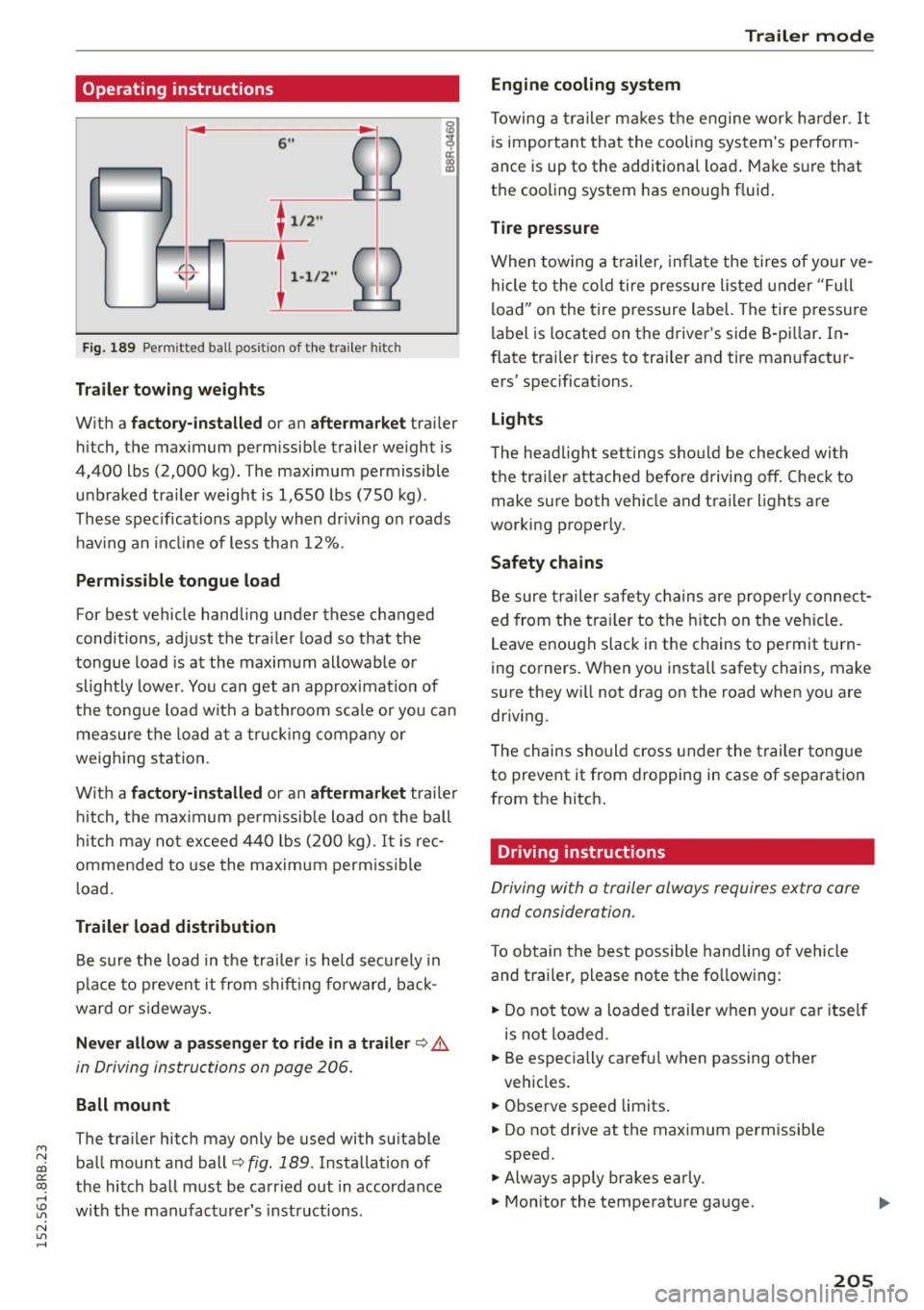
Fig. 189 Pe rmi tted ba ll pos it ion of the trailer hitc h
Trailer towing weights
With a factory-installed or an aftermarket trailer
hitch, the maximum permissible trailer weight is
4,400 lbs (2,000 kg) . T he maximum permissible
unbraked trailer weight is 1,650 lbs (750 kg) .
These specifications apply when dr iv ing on roads
having an inclin e of less than 12%.
Permissible tongue load
For best vehicle handling under these changed
conditions, adjust the traile r load so that the
tongue load is at the maximum allowable or
slightly lower. You can get an approximat ion of
the tongue load w ith a bathroom scale or you can
measure the load at a trucking company or
weighing station.
With a
factory-installed or an aftermarket trailer
hitch, the maximum permissible load on the ball
hitch may not exceed 440 lbs (200 kg). It is rec
ommended to use the maximum permissible
l oad.
Trailer load distribution
Be sure the load in the tra iler is held securely in
place to prevent it from shifting forward, back
ward or sideways .
Never allow a passenger to ride in a trailer c::> .&.
in Driving instructions on page 206.
Ball mount
The trailer hitch may only be used with suitable
ball mount and ball
c::> fig. 189 . Installation of
the hitch ball must be carr ied out in accordance
with the manufacturer's instructions .
Trailer mode
Engine cooling system
Towing a trailer makes the engine work harder . It
is important that the cooling system's perform
ance is up to the additional load . Make s ure that
the cooling system has enough fluid .
Tire pressure
When towing a trailer, inflate the tires of your ve
hicle to the cold tire pressure listed under "Full
load" on the tire pressure label. The tire pressure
label is located on the driver's side B·pillar. In·
flate trailer tires to trailer and tire manufactur
ers' specifications.
Lights
T he headlight settings sho uld be checked with
the trai ler attached before driving off. Check to
make sure both vehicle and trailer lights are
working properly.
Safety chains
Be sure trailer safety chains are properly connect
ed from the trailer to the hitch on the vehicle.
Leave enough slack in the chains to permit turn
ing corners. When you install safety chains, make
sure they w ill not drag on the road when you are
driving.
The chains should cross under the trailer tongue
to prevent it from dropping in case of separation
from the hitch.
Driving instructions
Driving with o trailer always requires extra core
and consideration .
To obtain the best possible handling of vehicle
and trailer, please note the fo llowing :
.. Do not tow a loaded trailer when your car itse lf
is not loaded.
.. Be especially careful when passing other
vehicles .
.. Observe speed lim its .
.. Do not drive at the maximum permissible
speed.
.. Always apply brakes early .
.. Mon itor the temperature gauge .
205
Page 208 of 302
Trailer mode
Weight distribution
Towing a loaded trai ler with an empty car res ults
in a high ly unstable distribution of weight. If this
cannot be avoided , drive at very low speeds only
to avoid the risk of losing steering contro l.
A "balanced" rig is easier to operate and control.
This means that the tow vehicle should be loaded
to the extent possible and permissible, while
keeping the trailer as light as possible under the
circumstances. Whenever possible, transfer
some cargo to the luggage compartment of the
tow vehicle while observing tongue load require
ments and vehicle loading considerations .
Speed
The higher the speed, the more difficult it be
comes for the driver to control the rig . Do not
drive at the maximum permiss ible speed. Reduce
your speed even more if load, weathe r or wind
conditions are unfavorable - particularly when
going downhill.
Reduce vehicle speed
immediately if the trailer
shows the s lightest sign of swaying .
Do not try
to stop the swaying by accelerating.
Observe speed limits. In some areas, speeds for
veh icles towing trailers are lower than for regular
ve hicles .
A lways app ly brakes ear ly. When driving down
hill, shift into a lower gear to use the engine
brak ing effect to slow the vehicle. Use of the
brakes alone can cause them to overheat and fa il.
Coolant temperature
The coolant temperature gauge c::> page 10 must
be observed carefully.
If the need le moves close
to the upper end of the scale, reduce speed im
mediately and/or turn off the a ir condit ioner.
If the coo lant temperature warning light in the
instr ument cluster starts flashing •• pu ll off
the road, stop and let the engine
idle for about
two minutes to prevent heat build-up.
A WARNING
Anyone not properly restrained in a moving
vehicle is at a much greater r isk in an acc i-
206
-
dent. Never let anyone ride in your car who is
not properly wearing the restraints provided
by Audi.
Trailer mode notes
Important to know
Your vehicle handles differently when towing a
trai ler because of the additiona l weight and dif
ferent we ight distribution . Safety, performance
and economy will greatly depend on how careful
l y you load your trailer and operate your rig.
Before you actua lly tow your trai ler, practice
turning, stopping and backing up in an area away
from traffic . Keep practicing until you have be
come comp lete ly familiar with the way your vehi
cle-trailer comb inat ion behaves and responds.
Backing up is difficult and requires practice. Back
ing up with a trai ler generally requires steering
action opposite to that when backing up your ve
hicle without a tra iler.
Maintain a greater distance between your vehicle
and the one in front of you. Yo u will need more
room to stop. To compensate for the trailer, you
will need a larger than normal turn ing radius.
When passing, remember that you cannot accel
erate as fast as you norma lly wou ld because of
the added load. Make sure you have enough room
to pass. After passing, allow plenty of room for
your tra iler before changing lanes again.
Avoid jerky starts , sharp t urns or rapid lane
changes.
@ Tips
- Do not tow a trailer during the break-in peri
od of your vehicle.
- If you tow a trailer, your Audi may requi re
more frequent maintenance due to the ex
tra load
c::> page 281.
Page 211 of 302

M N
co
a:
co
,...., \!) ..,.,
N ..,., ,....,
wash operator to reduce the risk of acci
dents.
- To reduce the risk of cuts, protect yourself
from sharp metal components when wash
ing the underbody or the inside of the wheel
housings.
- After washing the vehicle, the braking effect
may be delayed due to moisture on the
brake rotors or ice in the w inter. The brakes
must be dried first w ith a few careful brake
applications.
- If you wash the vehicle in an automatic car
wash, you must fold the exterior m irrors in
to reduce the risk of damage to the mirrors.
Power folding exterior mirrors* must only
be fo lded in and out us ing the power folding
funct ion.
- To reduce the risk of damage to the rims
and tires, compare the width between the
whee ls on your vehicle w ith the distance be
tween the g uide rails in the car wash .
- To red uce the risk of damage, compare the
height and width of yo ur vehicle with the
Care and cleaning
height and w idth of the inside of the car
was h.
- T o prevent paint damage, do not wash the
vehicle in direct sunlight.
- To reduce the ris k of damage to the sur face,
do not use insect remov ing sponges, kitchen
sponges o r similar items.
- Matte finish painted veh icle components:
- To reduce the risk of damage to the sur-
face, do not use polishing agents or hard
wax.
- Never use protective wax. It can destroy
the matte finish effect.
- Do not place any stickers or magnetic
signs on vehicle parts painted w ith matte
finish paint. The paint could be damaged
when the stickers or magnets are re moved.
@ For the sake of the environment
Only wash the vehicle in facilities spec ially de
s igned for that purpose. Th is w ill reduce the
r isk of dirty water contaminated w ith oil from
entering the sewe r system.
Cleaning and care information
When clea ning and caring for individual vehicle
components, refer to the following tables. The
information conta ined there is simply recommen -dations. For questions or for components that
are not listed, refer to an authorized A
udi dealer.
Also follow the information found in
¢ A.
Ext erior cl eaning
Component Situation Solution
Wind shi eld wiper
Deposits ¢ page 58, Cleaning windshield wiper blades
blades
H eadlight s/
Deposits Soft sponge with a mild soap solutional
tail light s
S ensors /
Deposits Sensors: soft cloth with solvent-free cleaning solution
camera le nses Camera lenses: soft cloth with alcohol-free clean ing solu-
tion
Snow/ice Hand brush/solvent-free de -ic ing spray
Whe els Road salt Water
Brake dust Acid-free special cleaning
solution
Exhau st tail p ipe s Road salt Water, cleaning solution suitable for stainless steel, if nee-
essary
209
Page 223 of 302
M N
Checking and Filling Hood
Releasing the engine hood
The engine hood is released from inside the vehi
cle .
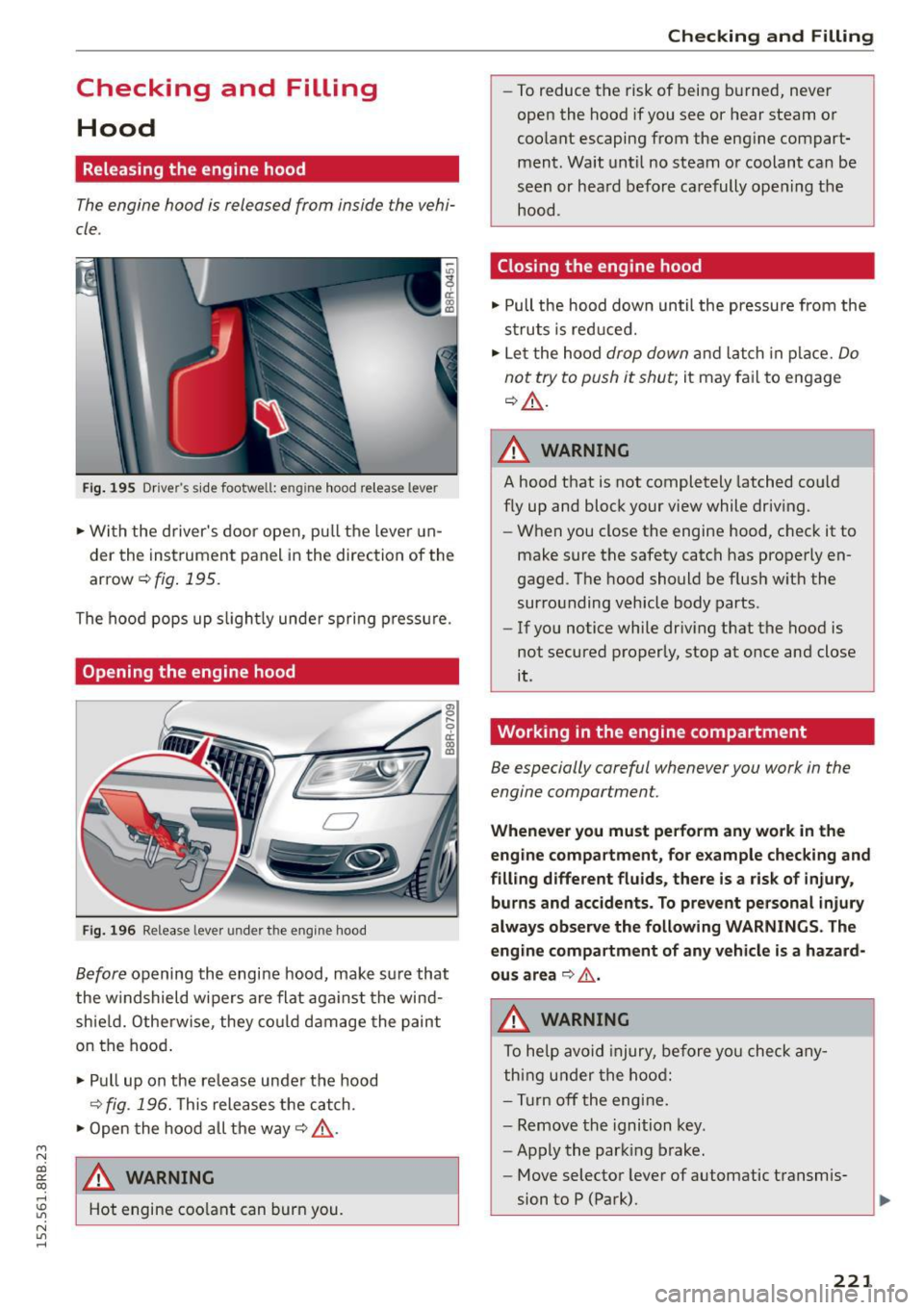
Fig . 195 Drive r's side footwe ll: e ng ine hood re lease lever
"' Wi th the driver's door open, pu ll the leve r un
der the instrument panel in the direction of the
arrow
c::> fig . 195.
The hood pops up s light ly under spri ng press ure.
Opening the engine hood
Fig. 196 Relea se leve r un der the eng ine hood
Before opening the engine hood, make su re that
the w indshield wipers are flat aga inst the wind
shield. Otherwise, they could damage the paint
on the hood .
"' Pull up on the release under the hood
c:> fig . 196. This releases the catch.
"' Open the hood all the way
c::> A.
~ _&. WARNING
rl
:5: Hot engine coo lant can burn you.
N l/1 rl
Ch eck in g and Fillin g
-To reduce the risk of being burned, never
open the hood if you see or hear steam or
coolant escaping from the eng ine compart
ment. Wait until no steam or coolant can be
seen or heard before carefully opening the hood.
Closing the engine hood
"' Pull the hood down until the pressu re from the
struts is reduced.
"' Le t the hood
drop down and latch in p lace. Do
not try to push it shut;
it may fa il to engage
c::> A .
A WARNING
-
A hood that is not completely latched cou ld
fly up and block your view while driv ing.
-
- When you close the engine hood, check it to
make sure the safety catch has properly en
gaged . The hood should be flush with the
surrounding vehicle body parts .
- If you notice while driv ing that the hood is
not secured properly, stop at once and close
it .
Working in the engine compartment
Be especially careful whenever you work in the
engine compartment.
Wheneve r you must pe rfo rm an y wo rk in the
eng ine comp artment , for e xample chec king and
fi lling differen t fluids , ther e is a ri sk of i nju ry,
bu rn s and acci den ts. To p re ve nt pe rsonal injur y
al way s ob serve the follo wing WARN INGS . The
e ngi ne compartm ent of an y ve hicle is a haza rd
ou s area
~ ,&..
A WARNING
To help avoid injury, before you check any
thing under the hood:
- Turn off the eng ine.
- Remove the ignition key.
- Apply the parking brake.
-
- Move selector lever of automatic transmis-
sion to P (Park).
221
Page 225 of 302
M N
co ~ co
rl I.O
"' N
"' rl
Checking and Filling
Engine compartment
Engine compartment
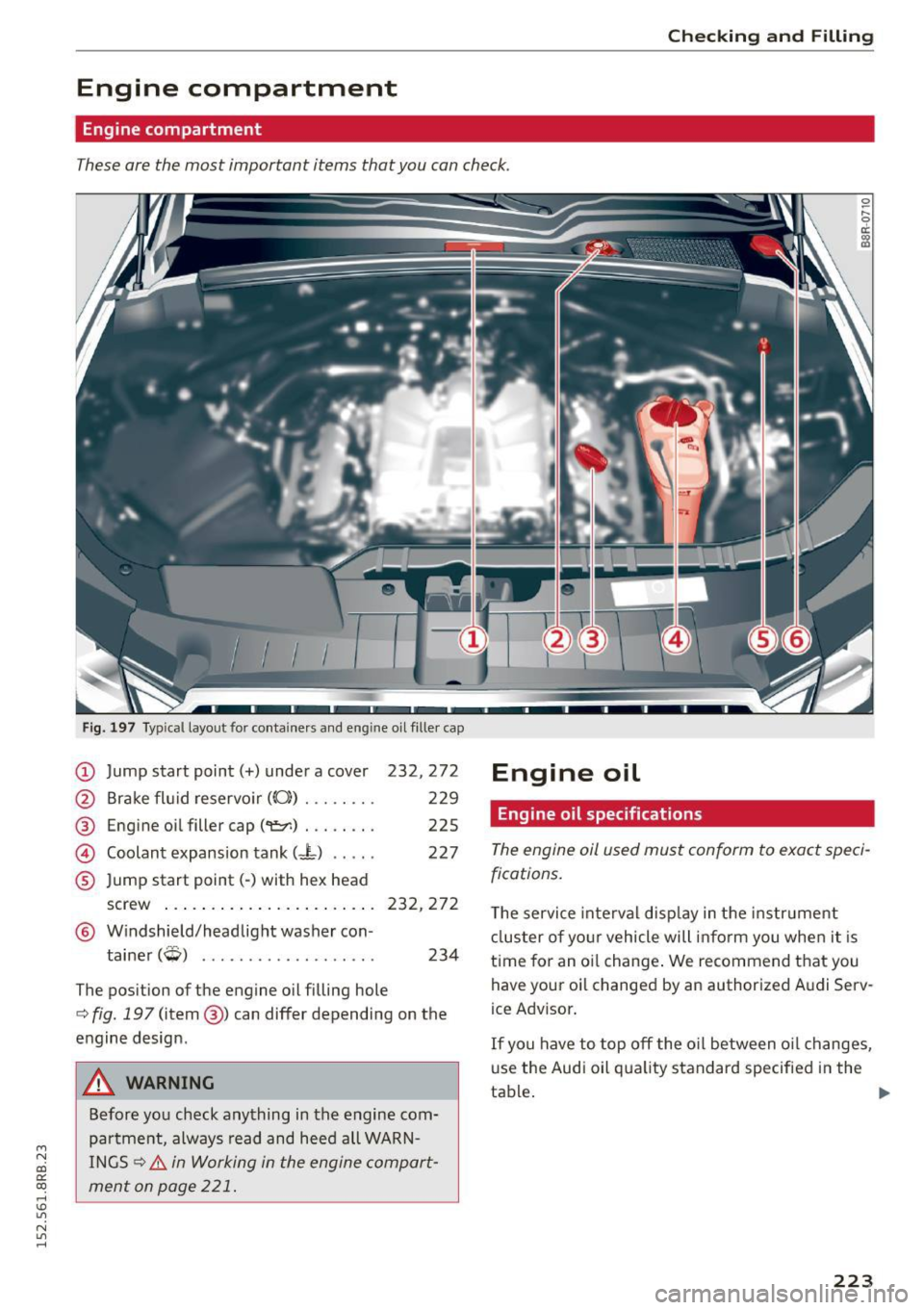
These are the mos t important item s that you can check .
Fig. 197 Typical layou t fo r container s and e ngine oil filler ca p
(D Jump start point(+) under a cover 23 2, 272
@ Brake fluid reservoir (0) . . . . . . . . 229
@ Engine oil filler cap(~) . . . . . . . . 225
@ Coolant expansion tank (- L) . . . . . 227
® Jump start point(-) w ith hex head
s crew . . . . . . . . . . . . . . . . . . . . . . . 232, 272
@ Windshield/headlight washer con -
tainer
(Q) . . . . . . . . . . . . . . . . . . . 234
T he po sit ion of the engine oil filling hole
c:> fig. 197 (item @) can differ depending on the
engine design .
A WARNING
Before you check anything in the engine com
partment, always read and heed all WARN
INGS
c:> &. in Working in the engine compart
ment on page 221.
Engine oil
Engine oil specifications
The engine oil used must conform to exact sp eci
f ications.
T he service interval disp lay in the instrument
cluster of your vehicle will inform you when it is
time for an oi l chang e. We recommend that you
hav e your oil chang ed by an authori zed A udi Serv
ic e Advi sor .
If you have to top off the oil between oil changes,
use the Audi oil qua lity standa rd specified in the
tab~ .
~
223
Page 231 of 302
M N
co ~ co
rl I.O
"' N
"' rl
-To avoid being burned, do not spi ll anti
freeze or coolant on the exhaust system or hot engine parts. Under certain condi
tions, the ethylene glycol in engine cool ant can catch fire.
- Antifreeze is poisonous. Always store anti
freeze in its original conta iner and well out
of the reach of ch ildren .
-If you drain the coolant, it must be caught
and safely stored in a proper container
clearly marked "poison" .
(D Note
-Do not add coolant if the expansion tank is
empty . Air could enter the cooling system
and damage the eng ine .
If this is the case,
do not continue driving. Seek profess ional
ass istance.
- Coolant pollutes the env ironment and could
cause an eng ine fire . Excess coolant will be
fo rced out through the pressure relief valve
i n the cap when the eng ine becomes hot.
- If, i n an emergency , only water can be add
ed, the correct ratio between wa ter and an
tifreeze
~ page 22 7 must be restored as
soon as possib le .
@) For the sake of the environment
Drained coolant should not be reused. Always
dispose o f used coolant while observ ing all
environmental regulations .
Radiator fan
The radiator fan switches on automatically by it
self.
The radiator fan is driven by the engine via the V
be lt . The viscous clu tch regulates the speed of
the fan ac cording to the temperature of the cool
ant.
An auxiliary e lectr ic rad iator fan* switches on and
off depend ing on coolant temperat ure and othe r
veh icle operating conditions.
Afte r you switch the engine off, the auxiliary fan
can continue runn ing for up to 10 minutes -even
Ch eck in g and Fillin g
with the ignition off . It can even switch on again
later by itself¢& , if
- the temperatu re of the engine coo lant rises due
to the heat build- up from the engine in the en
gine compartment, or
- the engine compartment heats up because the
veh icle is parked in intense sun light .
A WARNING
-To reduce the risk of persona l injury never
touch the radiator fan .
- The auxiliary electric fan is temperature con trolled and can switch on suddenly even
when the engine is not running.
- The a uxiliary radiator fan sw itches on auto
matica lly when the engine coolant reaches a
certain temperature and will continue to run
until the coolant temperature drops.
Brake fluid
Checking brake fluid level
The brake fluid level can be checked with a quick
glance .
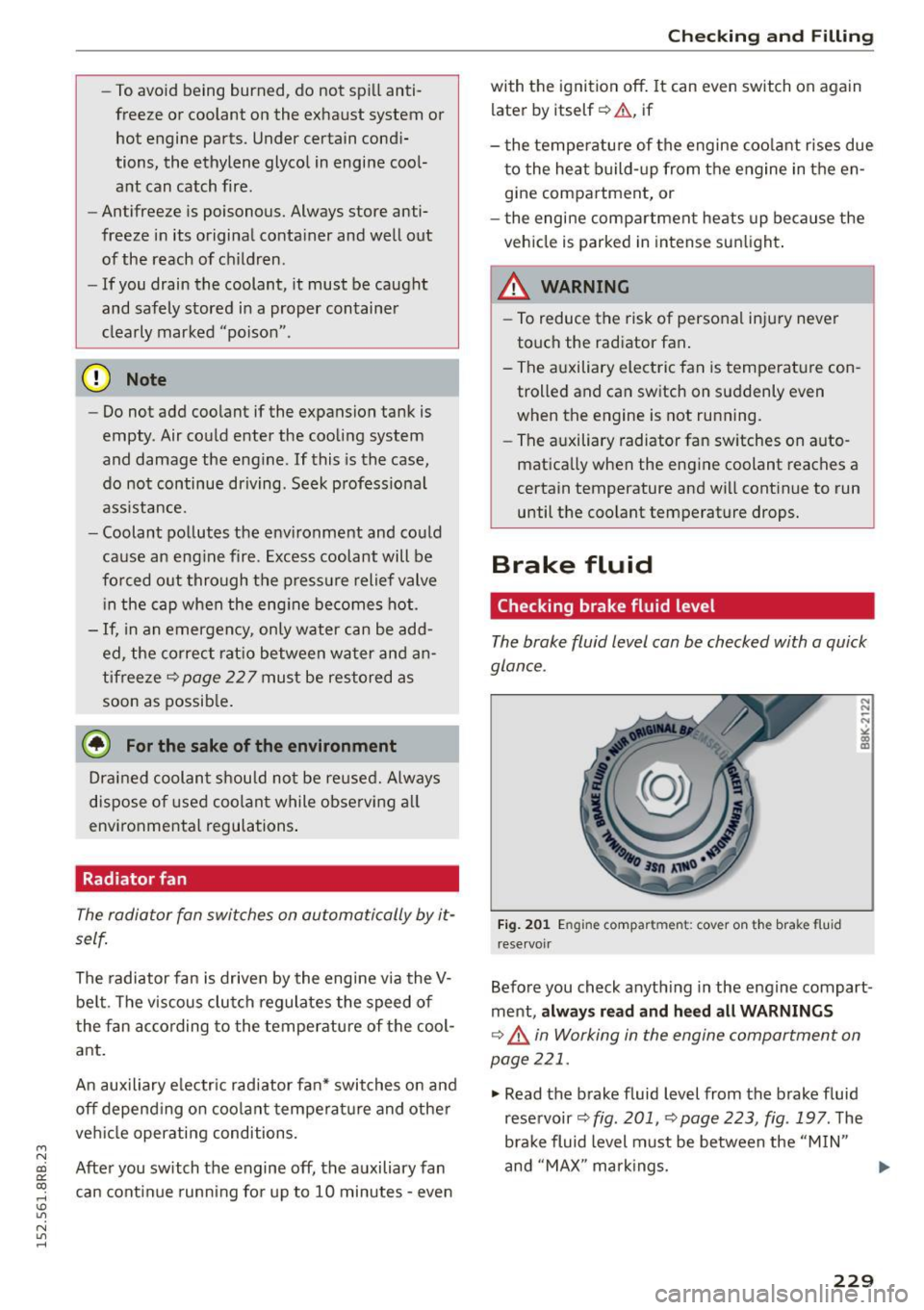
Fig. 201 Engine compar tment : cov er on th e bra ke fluid
r e servoir
Before you check anyth ing in the engine compart
ment,
al way s read and h eed all WARNIN GS
¢ _.& in Working in the engine compartment on
page 221 .
.,. Read the brake fluid level from the b rake fluid
reservoir ¢
fig. 201, ¢ page 223, fig . 197 . The
brake fluid level must be between the
"MIN "
and "MAX " markings.
229