fuel AUDI Q5 2015 Owner's Guide
[x] Cancel search | Manufacturer: AUDI, Model Year: 2015, Model line: Q5, Model: AUDI Q5 2015Pages: 302, PDF Size: 75.01 MB
Page 224 of 302
Checking and Filling
-Always let the engine cool down. Hot com
ponents will burn skin on contact .
- To reduce the risk of being burned, never
open the hood if you see or hear steam or
coolant escaping from the engine compart
ment . Wait until no steam or coolant can be
seen or heard before carefully opening the
hood.
- Keep children away from the engine com
partment .
- Never spill fluids on hot engine compo
nents . They can cause a fire .
- Never touch the radiator fan. The auxiliary
electric fan is temperature controlled and
can switch on suddenly.
- Never open the coolant reservoir cap when
the engine is still warm. The coolant system
is pressurized and hot coolant could spray
out .
- Protect your face, hands and arm from steam or hot engine coolant by placing a
thick rag over the cap when you open the coolant reservoir .
- Do not remove the engine cover under any
circumstances. This increases the risk of
burns.
- If work on the fuel system or the electrical
system is necessary :
- Always disconnect the battery.
- Never smoke or work near heaters or open
flames . Fluids in the engine compartment
could start a fire.
- Keep an approved fire extinguisher imme
diately available.
- To avoid electrical shock and personal injury
while the engine is running or being started, never touch:
- Ignition cables
- Other components of the high voltage
electronic ignition system.
- If you must perform a check or repair with
the engine running:
- First, fully apply the parking brake , move
selector lever of automatic transmission
to P (Park).
222
- Always use extreme caution to prevent
clothing, jewelry, or long hair from getting
caught in the radiator fan, V-belts or other
moving parts, or from contacting hot
parts . Tie back hair before starting, and do
not wear clothing that will hang or droop
into the engine.
- Minimize exposure to emission and chemi
cal hazards
~ ,&. .
&, WARNING
California Proposition 65 Warning:
- Engine exhaust , some of its constituents,
and certain vehicle components contain or
emit chemicals known to the State of Cali
fornia to cause cancer and birth defects and
reproductive harm. In addition, certain flu
ids contained in vehicles and certain prod
ucts of component wear contain or emit
chemicals known to the State of California
to cause cancer and birth defects or other
reproductive harm.
- Battery posts, terminals and related acces sories contain lead and lead compounds,
chemicals known to the State of California
to cause cancer and reproductive harms .
Wash hands after handling .
('.!) Note
When adding fluids, always make sure that
they are poured into the proper container or
filler opening, otherwise serious damage to
vehicle systems will occur.
@ For the sake of the environment
To detect leaks in time, inspect the vehicle
floor pan from underneath regularly. If you
see spots from oil or other vehicle fluids, have
your vehicle inspected by an authorized Audi dealer.
Page 226 of 302
Checking and F ill in g
Audi oil quality standard
Gas oline VW 502 00 or
engi ne
vw 504 00
Die sel
vw 50 7 00
e n g in e
Using the proper engine o il is important for the
functionality and serv ice life of the engine. Your
engine was facto ry-filled with a high-qua lity oil
which can usually be used throughout the entire
year.
(D Note
Your Limited New Vehicle Warranty does not
cover damage or malfunctions due to failure
to follow recommended maintenance and use
requirements as set forth in the Audi Owner's Manual and Warranty
& Ma intenance booklet.
- Use only a high qua lity eng ine oil that ex-
pressly complies w ith the Audi o il quality
standard specified for your vehicle's engine.
Using any other oil can cause serious engine
damage.
- Do not mix any lubricants or other additives
into the engine oil. Doing so can cause en
gine damage.
(D Tips
If you need to add oil and there is none availa
ble that meets the Audi o il quality standard
your eng ine requires, you may add a total of
no more than 0.5 quart/liter of a h igh-quality
"synthe tic"oil that meets the followi ng speci
fications.
- Vehicles with gasoli ne engine: AC EA A3 o r
API SM wi th a viscosity g rade of SAE OW-30,
SA E SW-30 or SAE SW-40 .
- Vehicles wi th d iesel engine: AC EA C3 o r
API CF wi th a v iscosi ty grade of SA E OW-30
or SAE SW-30.
- Fo r more information abo ut eng ine oil t hat
has been approved for your vehicle, please
contact eithe r your a uthorized Audi dea le r
or A udi Customer Relations at
1 (800) 822-2834 or visit our web site at
www.aud iusa.com or www .aud icanada.ca.
224
· Eng ine oil consumption
The engine in your vehicle depends on an ade
quate amount of oil to lubricate and cool all of
its moving parts.
In order to prov ide effective lubrication and coo l
i ng of internal engine components, all internal
combust ion engines consume a certa in amount
of oil. Oil consumpt ion va ries from engine to en
gine and may change sig nificantly over the life of
the engine. Typically, eng ines wi th a specified
break -in period (see¢
page 198) consume mo re
o il during t he b reak-in period than they co nsume
after oil consumption has stabilized .
Un der normal cond itions, the rate o f oi l con
sumption depends on the q uality and viscos ity o f
the oil, the RPM (revolutions per min ute) at
which the engine is operated, the ambient tem perature and road condit ions. Further factors are
the amount of o il dilution from water condensa
tion or fuel residue and the ox idat ion leve l of the
o il. As any engine is subject to wear as mileage
builds up, the oil consumption may inc rease over
time unt il rep lacement of worn compone nts may
become necessary.
With a ll these variab les coming into p lay, no
standard rate of oil consumpt ion can be estab
li shed or spec ified. There is no alte rnative to reg
u lar and frequent checking of the oil leve l, see
Note .
If the yellow engine oil leve l warning symbo l in
the i nstrument cluster
II lights up, you should
c h ec k t he o il level as soon as poss ible
cf> page 2 25. Top off the oil at your ear liest con
venience
r:!> page 225.
A WARNING
Before you check anything in the engine com
partment, always read and heed a ll WARN
INGS¢ .&.
in Working in the engine compart
ment on page 221.
(D Note
Driving wit h an insufficient oi l level is likely to
cause severe damage to the engine.
liJJ,
Page 227 of 302
M N
co ~ co
rl I.O
"' N
"' rl
@ Tips
-The oil pressure warning display. is not
an indicator of the oil level. Do not rely on
it. Instead, check the oil level in your en
gine at regular intervals, preferably each
time you refuel , and always before going
on a long trip .
-If you have the impression your engine con
sumes excess ive amounts of o il, we recom
m end th at you cons ult an a uthorized Aud i
deal er to have th e cau se of yo ur co nc ern
p ro perly di ag no se d . Keep i n mi nd th at the
a ccurate meas ureme nt o f oil c onsu mpti on
r equires great care and m ay ta ke some time.
An a uthorized Audi dea ler has i nstr uctions
abo ut how to meas ure o il cons umption ac
curate ly.
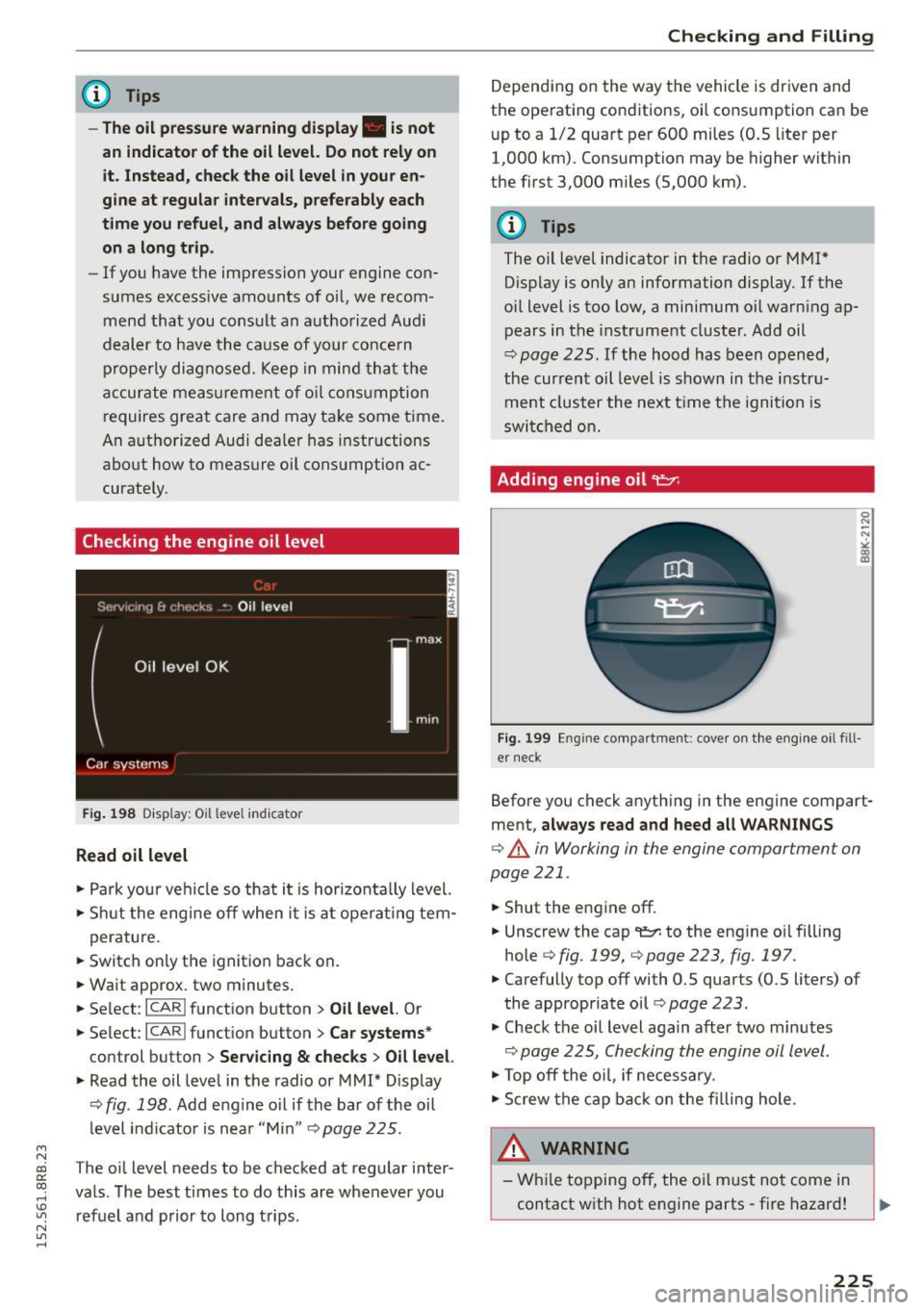
Checking the engine oil level
F ig. 19 8 Disp lay: O il level indicator
Read oil level
.. Pa rk your vehicle so that i t is hor izont ally level.
.. Shu t the engine off when i t is at oper ating te m-
perature.
.. Switc h on ly the ignition back on.
.. Wa it approx. two minutes .
.. Se lect:
I CARI funct ion button > Oil level. Or
.. Select:
ICARI funct ion button> Car systems *
control button > Servicing & checks > Oil level.
.. Read the oil leve l in the radio or MMI* Display
¢ fig . 198. Add e ng in e oil if the bar of the oil
l evel i ndicator is nea r "M in"
9page 225.
The oil level needs to be c hec ked at regular inter
va ls. The best t im es to do this are whenever you
ref uel and prior to long t rips.
Checking and Filling
D epend ing on the way t he vehicle is dr iven and
the ope rat ing cond itions, oil consumption ca n be
u p to a 1/2 quart pe r 600 miles (0 .5 liter per
1,000 km). Consumption may be higher within
the fi rst 3,000 mi les (5,000 km).
(D Tips
The oil leve l indicator in t he ra dio or MMI*
D isp lay is only an information display. If t he
o il level is too low , a minimum oi l warn ing ap
p ears in the instrume nt cl uster. Add oil
¢ page 225. If the hood has been o pen ed,
t h e cur ren t oil leve l is shown in t he instru
m ent cl uster the n ext tim e the ig niti on i s
sw itch ed on.
Adding engine oil
Fig . 199
Engine compa rtment: cove r on th e e ng in e oi l fill
er neck
Befo re you check a nyth ing in the engine compart
ment ,
always read and heed all WARNINGS
¢ & in Working in the engine compartment on
page 221 .
.. Shut the eng ine off .
.. Unscrew the cap
'l!:7-to the eng ine o il filling
hole
¢ fig. 199, 9page223, fig.197 .
.. Carefully top off with 0.5 quarts (0.5 liters) of
the appropriate oil ¢
page 223 .
.. Check t he oil level aga in after two m inutes
<:> page 225, Checking th e e ngin e oil l eve l.
.. Top off the o il, if necess ary .
.. Scr ew the cap back on the filling hole.
& WARNING
-
- W hile to p pin g off , the o il m ust not come in
contact w ith hot e ngine parts - fire hazar d!
225
Page 237 of 302
M N ai
"' ~
-"' "' N
"' ...,
Wheels
Wheels and Tires
General information
.,.Che ck your tires regularly for
damage (punctures, cuts, cracks
and bulges). Remove foreign ob
jects from the tire tread.
.,. If driving over curbs or similar
obstacles, drive slowly and ap
proach the curb at an angle.
.,.Have faulty tires or rims re
placed immediately.
"'Protec t your tires from oil,
grease and fuel.
.,.Ma rk tires before removing
them so that the same running direction can be maintained if
they are reinstalled .
.,.Lay tires flat when storing and
store them in a cool, dry location
with as little exposure to light as
possible.
(D Note
-Please note that summer and
winter tires are designed for
the conditions that are typical
in those seasons. Audi recom
mends using winter tires dur
ing the winter months . Low
temperatures significantly de crease the elasticity of summ
er tires, which affects traction
Wheels
and braking ability. If summer
tires are used in very cold tem
peratures, cracks can form on
the tread bars, resulting in
permanent tire damage that
can cause loud driving noise
and unbalanced tires.
-Burnished, polished or
chromed rims must not be
used in winter driving condi
tions. The surface of the rims
does not have sufficient corro
sion protection for this and
could be permanently dam
aged by road salt or similar
substances.
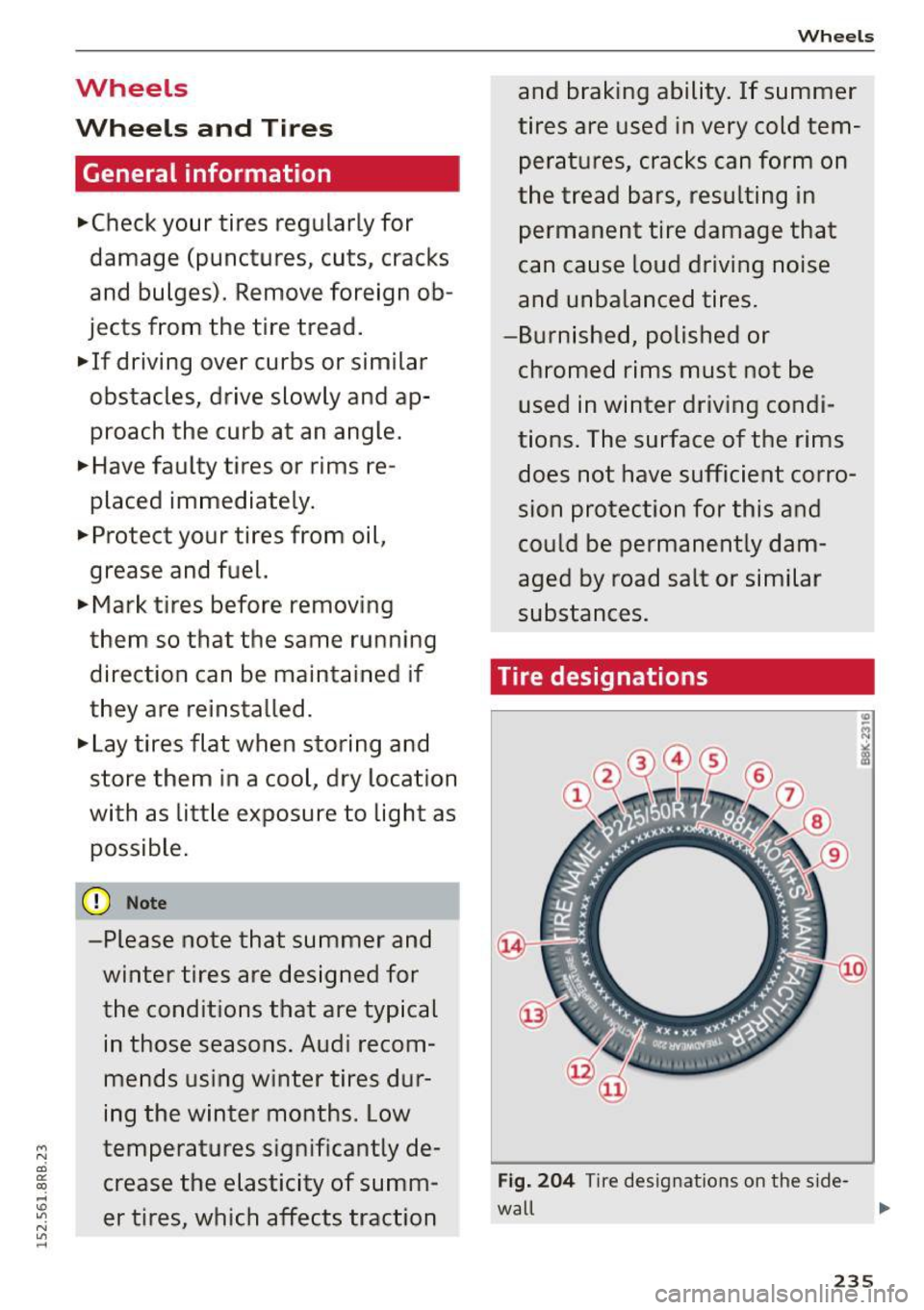
Tire designations
Fig. 204 T ir e designations on the sid e-
wall ,..
235
Page 240 of 302
Wheels
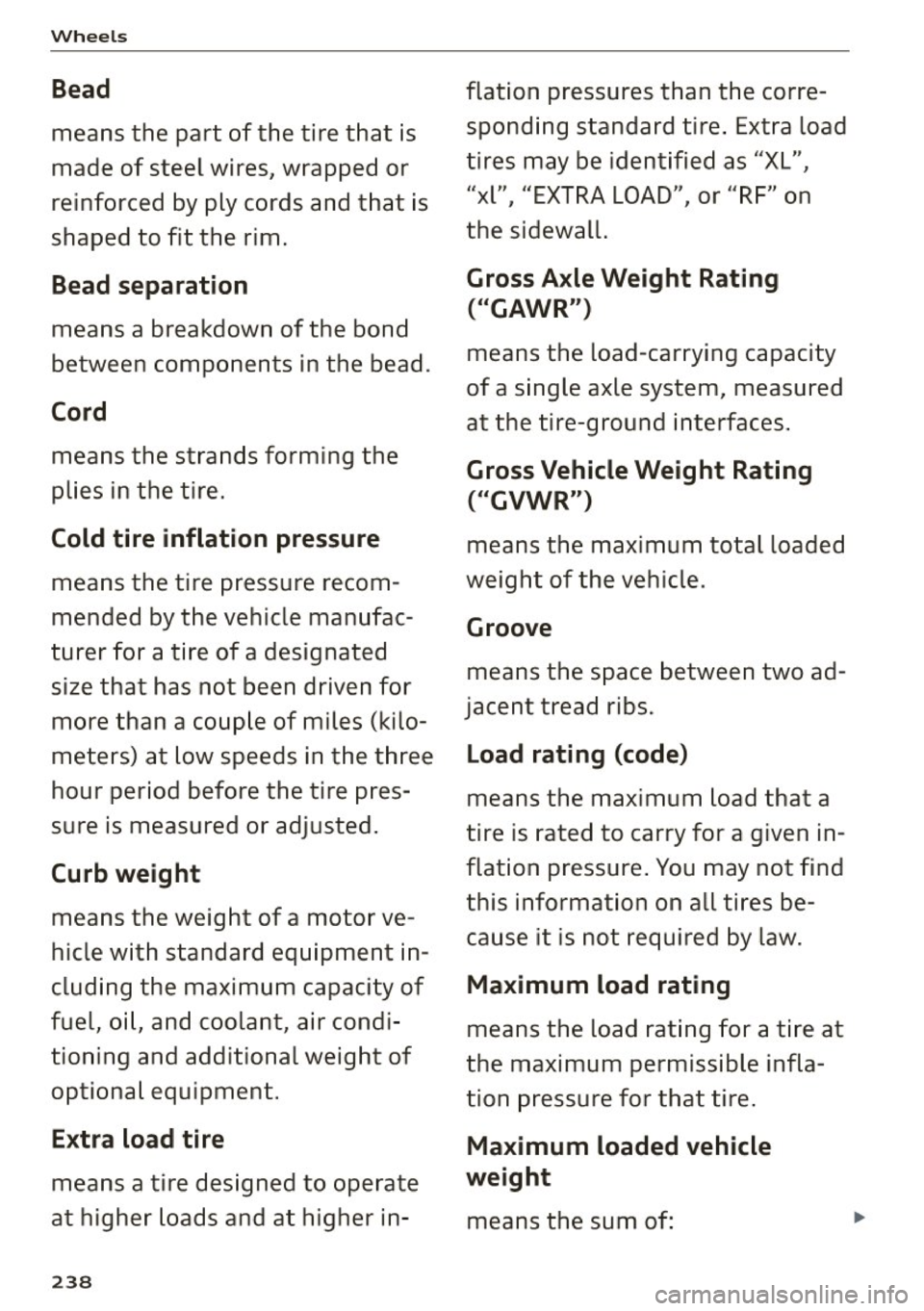
Bead
means the part of the tire that is
made of steel wires, wrapped or
reinforced by ply cords and that is
shaped to fit the rim .
Bead separation
means a breakdown of the bond
between components in the bead.
Cord
means the strands form ing the
plies in the tire.
Cold tire inflation pressure
means the tire pressure recom
mended by the vehicle manufac
turer for a tire of a designated
size that has not been driven for
more than a coup le of miles (kilo
meters) at low speeds in the three
hour period before the tire pres
sure is measured or adjusted .
Curb weight
means the weight of a motor ve
hicle with standard equipment in
cluding the maximum capacity of
fuel, oi l, and coolant , air condi
tioning and additional weight of optional equipment.
E x tra load tire
means a tire des igned to operate
at higher loads and at higher in-
238
flation pressures than the corre
sponding standard tire . Extra load
tires may be identified as "XL",
"xl", "EXTRA LOAD", or "RF" on
the sidewall.
G ross A xle Weight Rating
("GAWR ")
means the load-carrying capacity
of a single axle system , measured
at the tire-ground interfaces .
Gross Vehicle Weight Rating
( "GVWR" )
means the max imum total loaded
weight of the vehicle .
Groove
means the space between two ad
jacent tread ribs .
Load rating (code )
means the max imum load that a
tire is rated to carry for a given in
flation pressure . You may not find
this information on all tires be cause it is not required by law.
Ma ximum load rating
means the load rating for a tire at
the maximum permissible infla
tion pressure for that tire .
Maximum loaded vehicle
w eight
means the sum of: ...
Page 248 of 302
Wheels
and follow the important
safety precautions in
c::> page 247, Tires and vehicle
load limits.
-The tire must flex more if the
tire pressure is too low or if
the vehicle speed or load are
too high. This heats the tire up
too much. This increases the
risk of an accident because it
can cause the tire to burst and
result in loss of vehicle con
trol.
-Incorrect tire pressure increas
es tire wear and has a negative
effect on driving and braking
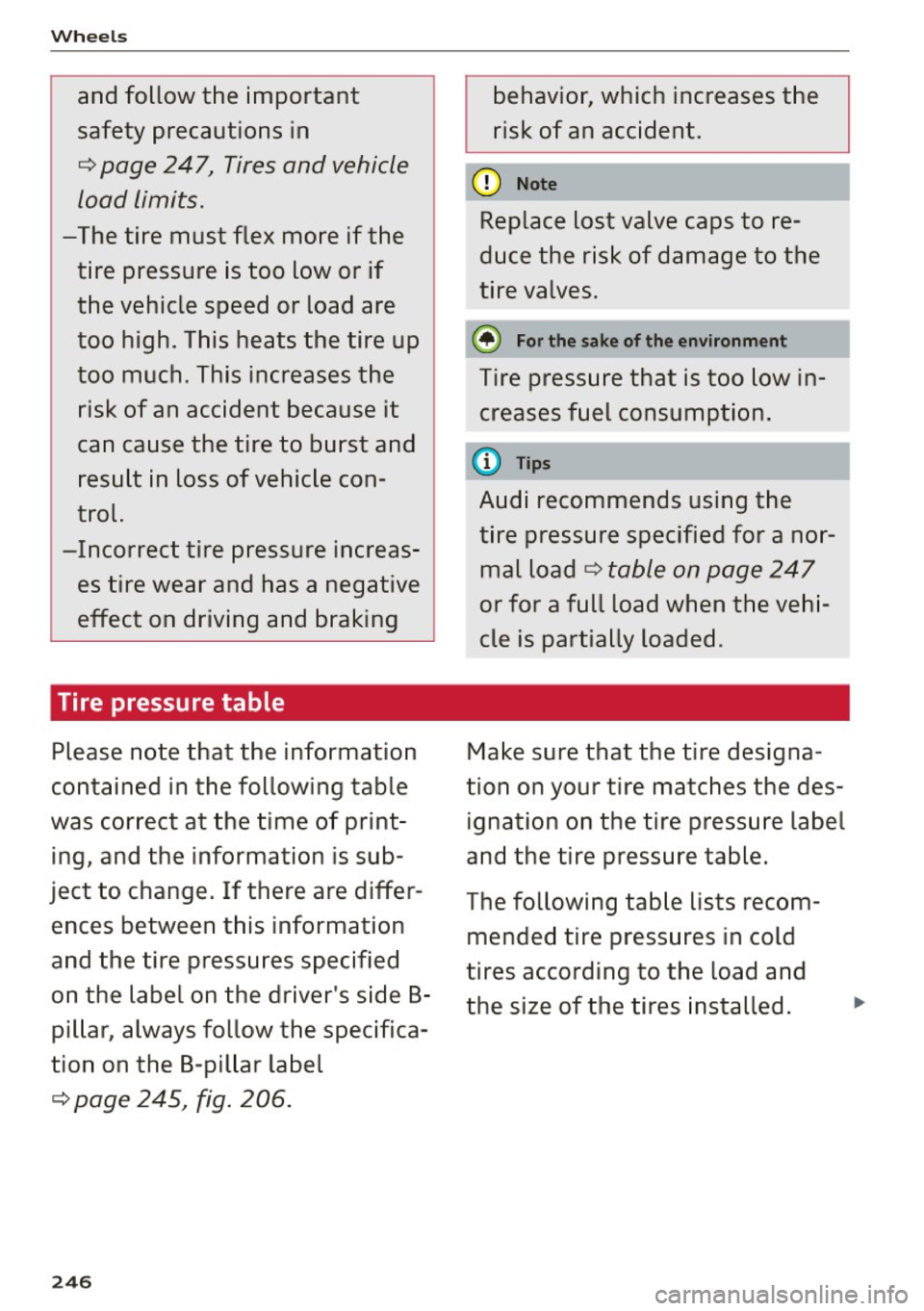
Tire pressure table
Please note that the information
contained in the following table
was correct at the time of print
ing, and the information is sub
ject to change. If there are differ
ences between this information
and the tire pressures specified
on the label on the driver's side 8-pillar, always follow the specifica
tion on the 8-pillar label
c::> page 245, fig. 206.
246
behavior, which increases the
risk of an accident.
(D Note
Replace lost valve caps to re
duce the risk of damage to the
tire valves.
@ For the sake of the environment
Tire pressure that is too low in
creases fuel consumption.
(D Tips
Audi recommends using the
tire pressure specified for a nor
mal load
c::> table on page 247
or for a full load when the vehi
cle is partially loaded.
Make sure that the tire designa
tion on your tire matches the des ignation on the tire pressure label
and the tire pressure table.
The following table lists recom
mended tire pressures in cold
tires according to the load and the size of the tires installed. .,.
Page 249 of 302
M N
co
a:
co
,...., \!) 1.1'1
N 1.1'1 ,....,
Wheels
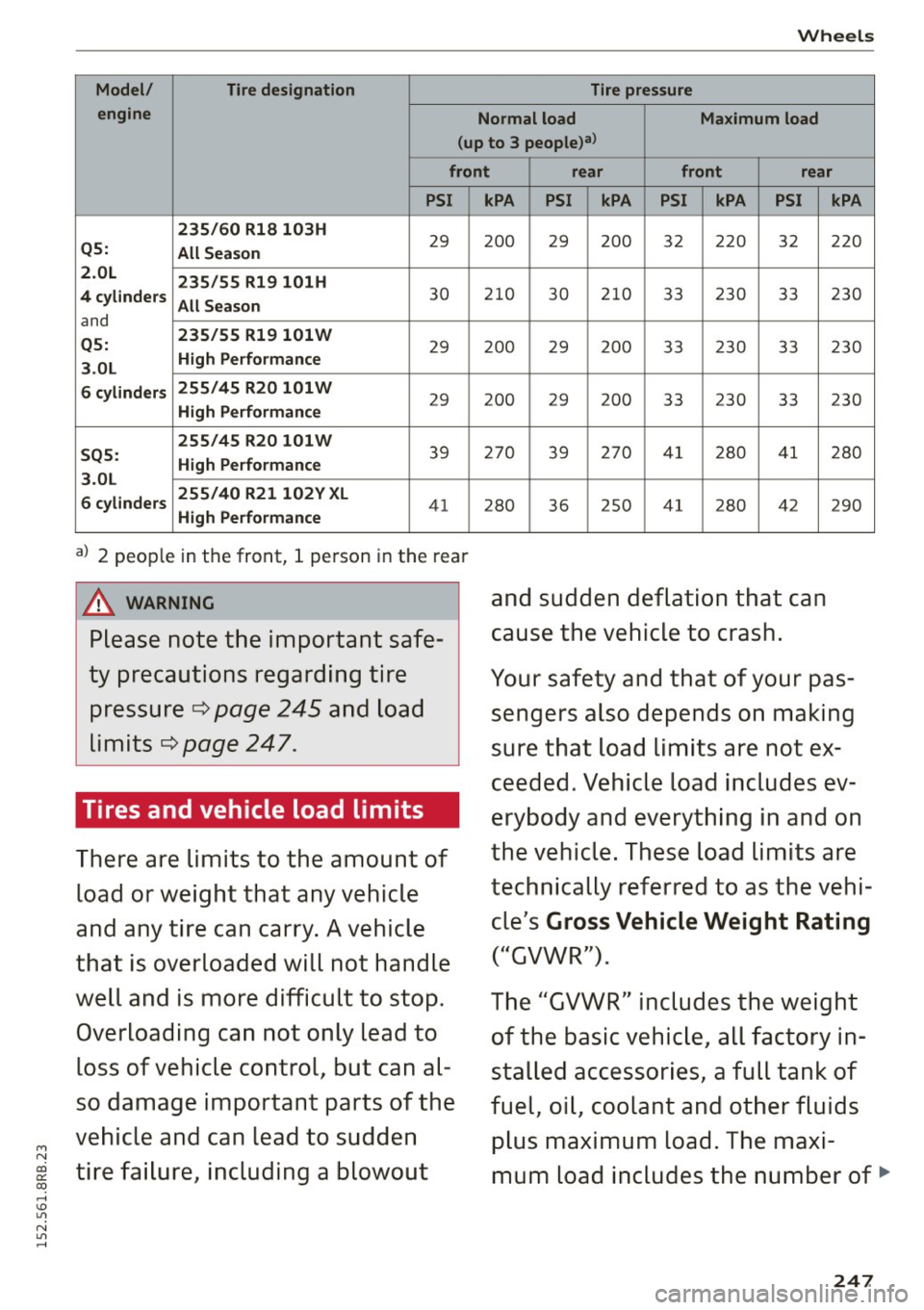
Model/ Tire designation Tire pressure
engine Normal load Maximum load
(up to 3 people)a)
front rear front rear
PSI
235/60 Rl8 103H
29 Q5: All Season
2.0L 235/55 Rl9 101H
4 cylinders All Season
30
and
Q5: 235/55 Rl9 101W 2
9 High Performance
3.0L
6 cylinders 255/45 R20 101W
29 High Performance
255/45 R20 101W
3
9 SQ5:
High Performance
3.0L
6 cylinders 255/40 R21 102Y XL
41
High Performance
a) 2 p
eopl e in th e fron t, 1 p ers on i n th e re arr
A WARNING
Please note the important safe
ty precautions regarding tire pressure
¢ page 245 and load
limits
¢ page 247 .
Tires and vehicle load limits
There are limits to the amount of
load or weight that any vehicle
and any tire can carry. A vehicle
that is overloaded will not handle
well and is more difficult to stop.
Overloading can not only lead to
lo ss of vehicle control , but can al
so damage important parts of the
vehicle and can lead to sudden
tire failure, including a blowout
kPA PSI kPA PSI kPA PSI
20 0 29 2 00 32 220 32
2 10 30 210 33 230 33
200 2 9 200
33 2
30 33
2 00 29 2 00 33 230 33
270 39 270 41 280 41
280 36 2
50 41 2 80 42
and sudden deflation that can
cause the vehicle to crash.
kPA
220
230
2 30
230
280
2 90
Your safety and that of your pas
sengers also depends on making
sure that load limits are not ex
c eeded. Vehicle load includes ev
erybody and everything in and on
the vehicle. These load limits are te chnically referred to as the vehi
cle 's
Gross Vehicle Weight Rating
("GVWR") .
The "GVWR " includes the weight
of the basic vehicle, all factory in
stalled accessories, a full tank of
fuel, oil, coolant and other fluids
plus maximum load. The maxi
mum load includes the number of""
247
Page 252 of 302
Wheels
A WARNING
Wheel bolts that are tightened or repaired in
correctly can become loose and resu lt in loss
of vehicle control , which increases the risk of
an acc ident. For the correct tightening specifi
cat ion, refer to
c:> page 261, After changing a
wheel.
- Always keep the wheel bolts and the threads
in the wheel hub clean and free of grease.
- Only use wheel bo lts that fit the r im .
- Always have damaged rims repaired by an
authorized Aud i dealer or authorized repair
facility. Never repair or disassemble rims
you rself, because this increases the risk of
an accident.
Winter tires
W inter tires sign ificantly improve the vehicle's
handling when driving in w inter condit ions . Be
cause of the ir construction (width, compo und,
tread pattern), summer t ires prov ide less traction
on ice and snow.
.., Use winte r tir es on all four whee ls .
.., Only use winter t ires that are approved for your
vehicle.
.., Please note that the maximum permitted
speed may be lower with winter tires
c:> .&,.
Your authorized Audi dealer or authorized re
pai r facility can inform you about the maximum
permitted speed for your tires.
.., Check the tire pressure after installing wheels
c:> page 245.
The effectiveness of winter tires is reduced great
ly when the tread is worn down to a depth of
0 .1S7 inch (4 mm). The characteristics of w inter
tires also decrease greatly as the tire ages, re
gardless of the remaining tread.
A WARNING
-Never dr ive faste r than the maximum per
mitted speed for your t ires. This could cause
the tires to heat up too much . Th is increases
the risk of an accident because it can cause
the tire to burst .
250
-Always adapt your driving to the road and
traffic cond itions. Drive carefully and reduce
your speed on icy or slippery roads. Even
w inter t ires can lose traction on black ice.
@ For the sake of the environment
Reinstall summer tires at the appropriate
time, beca use they provide better handling
when roads are free of snow and ice. Summer
tires cause less road noise, tire wear and fuel
consumpt ion.
(D Tips
You can a lso use all season tires instead of
winter tires. Please note that in some coun
tries where w inter t ires are required, only win
ter tires with the
& symbol may be permit
ted.
· Snow chains
Snow chains improve traction in the snow .
.., Only install snow chains on the rear wheels .
.., Check and correct the seating of the snow
chains if necessary after driving a few feet. Fol
low the instruct ions from the manufacture r.
.., Note the maximum permitted speed when dr iv
ing w ith snow chains . Do not exceed 30 mph
(SO km/h) .
Snow cha ins not onl y improve the
driving in w in
ter road conditions , but also the
braking .
Use of snow chains is only permitted with certain
rim/tire combinations due to technical reasons .
Check with a n author ized Audi dealer or author
iz ed repair facility to see if you may use snow
c hains.
Use
fine-mesh snow chains. They must not add
more than 0.53 inch (13.5 mm) in he ight, includ
i ng the cha in lock.
You must remove the chains when driving on
roads that are
free of snow. When roads are free
of snow , snow cha ins can impair hand ling and
damage the tires, and the chains will quick ly be
destroyed. .,.
Page 255 of 302

M N
co
a:
co
,...., \!) ..,.,
N ..,., ,....,
also reduces fuel efficiency and tire tread life,
and may affect the vehicle's handling and stop
ping ability .
Please note that the TPMS is not a substitute for
proper tire maintenance, and it is the driver's re
sponsibility to maintain correct tire pressure,
even if under-inflation has not reached the level
to trigger illumination of the TPMS low tire pres
sure telltale.
Your vehicle has also been equipped with a TPMS malfunction indicator to indicate when the sys
tem is not operating properly. The TPMS mal
function indicator is combined with the low tire pressure telltale . When the system detects a
malfunct ion, the telltale will flash for approxi
mately one minute and then remain continuously
illuminated. This sequence will continue upon
subsequent veh icle start-ups as long as the mal
function exists.
When the malfunction indicator is illuminated,
the system may not be able to detect or signal
low tire pressure as intended. TPMS malfunctions
may occur for a variety of reasons, including the
installation of replacement or alternate tires or
wheels on the vehicle that prevent the TPMS
from functioning properly. Always check the
TPMS malfunction telltale after replacing one or more tires or wheels on your vehicle to ensure
that the replacement or alternate tires and
wheels allow the TPMS to continue to function properly.
Wheels
If the Tire Pressure Monitoring System
indicator appears
Appl ies to vehicles : wi th t ir e p ress ure mo nito rin g system
The tire pressure indicator in the instrument
cluster informs you if the tire pressure is too low
or if there is a system malfunction.
Fig. 208 Instrument cluster: i ndicator light with message
Using the ABS sensors, the tire pressure monitor
ing system compares the tire tread circumference
and vibration characteristics of the individual
tires .
If the pressure changes in one or more
tires, this is indicated in the instrument cluster
display with an indicator light
RIJ and a message
¢fig. 208. If only one tire is affected, the loca
tion of that tire will be indicated.
The tire pressures must be stored in the Infotain
ment system again each time the pressures
change (switching between partial and full load
pressure) or after changing or replacing a tire on
your vehicle ¢
page 254. The tire pressure moni
toring system only monitors the tire pressure you have stored. Refer to the tire pressure label for
the recommended tire pressure for your vehicle
¢ page 245, fig . 207.
Tire tread circumference and vibration character
istics can change and cause a tire pressure warn
ing if:
- the tire pressure in one or more tires is too low .
- the tire has structural damage.
- the tir e was replaced or the tire pressure
changed and it was not stored again
c:!;> page 254.
-the collapsible spare* tire is installed.
253
Page 269 of 302

M N
co ~ co
rl I.O
"' N
"' rl
Left cockpit fuse assignment
Fig. 224 Left side of the cockpit: fuse panel with plastic
clip
Fuse panel @ (black )
No. Equipment
1 Dynamic steering
2 ESC control module
A/C system pressure sensor, electrome-
3 chanical park
ing brake, Homelink, auto-
matic dimming interior rearview mirror, air
quality/outside air sensor, ESC button
5 Sound
actuator/exhaust sound tuning
6 Headlight range contro l/cornering light
7 Headlight (cornering light)
Control modu les (e lectromechanical park-
8 ing brake, shock absorber, quattro Sport,
trailer hitch), DCDC converter
9
Adaptive cruise control or high voltage
battery (hybrid drive)
11 Side assist
12 Headlight range control, parking system
13 Airbag
14 Rear w iper
15 Auxi
liary fuse (instrument panel)
1 6 Auxiliary fuse terminal 15 (engine area) Fuses
and bulbs
Fuse panel @ (brown)
No . Equipment
1 Electric exhaust door
2 Brake light sensor or brake pedal
move-
ment sensor (hybr id drive)
3 Fuel pump
4 AdBlue pumps
or brake booster power
supply (hybrid dr ive)
5 Left seat heating with/without seat venti-
lation
6 ESC
7 Horn
8 Left
front door (window regulator, central
locking, mirror, switch, lighting)
9 Wiper motor
10 ESC
11 Left
rear door (window regu lator, switch,
lighting)
12 Rain and light sensor
Fu
se panel © (re d)
No . Equipment
3 Lumbar support
4 Dynamic steering
5 Climatized cupholder
6 Windshie
ld washer system, headlamp
washer system
7 Vehicle electr ical system control module 1
8 Vehicle e
lectrica l system control module 1
9 Panorama sunroof
10 Vehicle e lectrica l system control module 1
11 Sun shade (pano rama sunroof)
12 Anti-theft a
larm system
267