fuel AUDI Q5 2015 Owner's Manual
[x] Cancel search | Manufacturer: AUDI, Model Year: 2015, Model line: Q5, Model: AUDI Q5 2015Pages: 302, PDF Size: 75.01 MB
Page 203 of 302
M N
co
a:
co
,...., \!) 1.1'1
N 1.1'1 ,....,
It is normal for the oil consumption of a new en
gine to reach its lowest va lue after a certain mile
age has been driven.
You must d rive yo ur vehicle about 3,000 miles
(5,000 kilometers) before you can properly as
sess oi l consumption.
This also applies to fuel consumption and engine
output.
(y Note
- Have you r vehicle maintained properly and
in accordance with the service recommenda
tions in your Warranty
& Maintenance book
l et. Lack of proper maintenance as well as
improper use of the vehicle will impair the
funct ion of the emission control system and
could lead to damage.
- Do not alter or remove any component of
the Emission Contro l System unless ap
proved by the manufacturer.
- Do not alter or remove any device, such as
heat shields, switches, ign it ion w ires,
valves, wh ich are designed to protect your
vehicle's Emission Control System and other i mportant vehicle components.
Fewer short trips
Fuel consumption will always be relatively high
on short trips .
.. Try to avoid driving short distances with a cold
engine.
The engine and catalytic converter have to reach
their optimal
operating temperature to reduce
fuel consumption and noxious emissions effec
tively.
Just after starting, a cold engine in a mid-size car
only achieves a fuel economy of 6-8 miles per
gallon (30-40 l/100 km). After about a half a
mile, fuel economy cl imbs to 12 mpg (20 l/100
km) . After about
2.5 miles (4 km), the engine is
at its proper operating temperature and fuel
economy has reached a normal level. So you can
see that you should avoid short trips whenever
possib le.
Driving and the environment
The outside temperature is also critical in this re
gard. Your car consumes more fuel in the winter
than in the summer.
201
Page 212 of 302
Care and cleaning
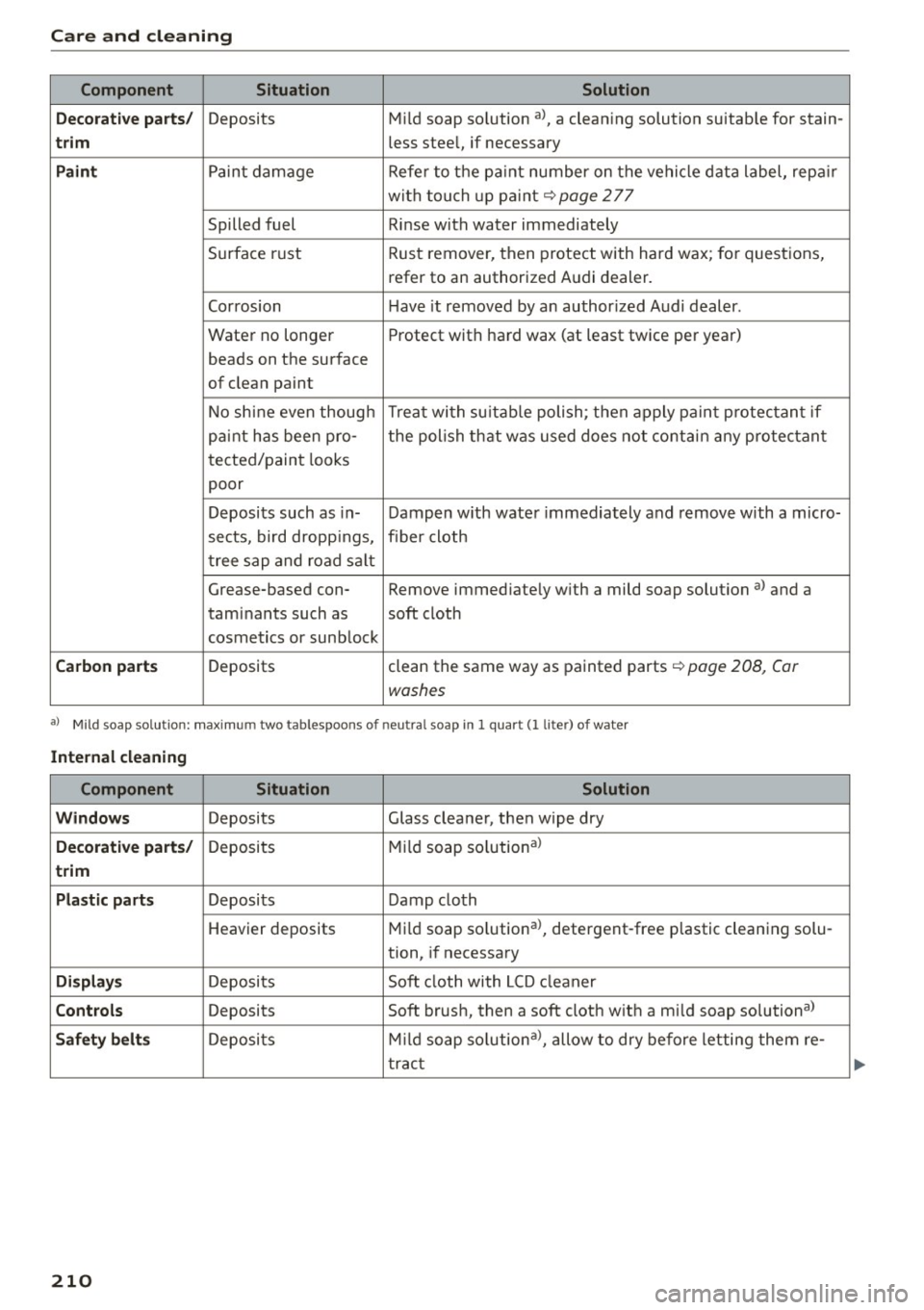
Component Situation Solution
Deco ra ti ve part s/
Deposits Mild soap solution al, a cleaning solution suitable for stain-
trim less stee l,. if necessary
P ain t Paint damage Refe r to the pa int number on the vehicle data label, repair
with touch up pa int
r=;, page 277
Spilled fuel Rinse with water immediately
Surface rust Rust remover, then protect with hard wax; for questions,
refer to an authorized A udi dealer.
Corrosion Have it removed by an author ized Audi dealer .
Water no longer Protect w ith hard wax (at least twice per year)
beads on the surface
of clean paint
No shine even though Trea t wi th su itab le polish; then apply paint p rotectant if
paint has been pro- the polish that was used does not conta in any protectant
tected/paint looks
poor
Deposits such as in- Dampen w ith water immediately and remove with a micro-
sects, bird dropp ings, fiber cloth
t ree sap and road sa lt
Grease-based con-Remove immediate ly w ith a mild soap solution a) and a
taminants such as soft cloth
cosmetics or sunblock
Carb on part s Deposits clean
the same way as painted parts r=;, page 208, Car
washes
aJ Mild soa p solut ion: maxim um two tablespoons of neutral soap in 1 quar t (l liter) of water
Internal cleani ng
Component Situation Solution
W indows
Deposits Glass cleaner, then wipe dry
Decorati ve parts / Deposits M
ild soap so lution al
trim
Pla stic part s
Deposits Damp clo1th
Heavier deposits Mild
soap solution a>, detergent-free plastic cleaning solu-
tion, if necessary
Di sp lay s Deposits Soft cloth with LCD cleaner
Cont ro ls Deposits Soft brush, then a soft cloth with a mi ld soap solutional
Safet y belt s Deposits Mild soap solutiona >, allow to dry before letting them re-
tract
210
Page 215 of 302
M N
co
a:
co
,...., \!) 1.1'1
N 1.1'1 ,....,
Fuel and Refueling
Fuel
Gasoline
Applies to vehicles: with gasoline engine
Using the right fuel helps keep the environment
clean and prevents engine damage .
Fuel recommendation
The fuel recommended for your vehicle is unlead
ed premium
grade gasoline. Audi recommends
using TOP TIER Detergent Gasoline with a mini
mum octane rating of 91 AKI (95 RON). For more
information on TOP T IER Detergent Gasoline ,
please go to the official website
(www.toptiergas.com).
The recommended gasoline octane rating for
your engine can also be found on a label located
on the inside of the fuel filler flap. This rating
may be specified as AKI or RON .
Your vehicle may also be operated using unlead
ed regular gasoline with a minimum octane rat
ing of 87 AKl/91 RON . However , using 87 AKl/91
RON octane fue l wi ll slight ly reduce engine per
formance.
Use unleaded gasoline only. Unleaded gasoline
is available throughout the USA, Canada, and in
most European countries. We recommend that
you do not take your vehicle to areas or countries
where unleaded gasoline may not be available.
For more informat ion on refueling your vehicle,
see
~ page 215.
Octane rating
Octane rating indicates a gasoline's ability to re
sist engine damaging "knock" caused by prema
ture ignition and detonation . Therefore, buying
the correct grade of gasoline is very important to
help prevent possible engine damage and a loss
of eng ine performance.
Gasoline most commonly used in the United
States and Canada has the following octane rat
ings that can usually be found on the filler pump:
- Prem ium Grade : 91- 96 AKI
Fuel and Refueling
- Regular Grade: 87 -90 AKI
Ex planation of the abbreviations:
AKI =
Anti Knock Index = (R +M)/2 = (RON+MON)/
2
RON= Research Octane Number
MON = Motor Octane Number.
(D Note
- Do not use any fuel w ith octane ratings low
er than 87 AKI or 91 RON otherwise expen
sive engine damage wi ll occur.
- Do
not us e leaded gasoline. The use of lead
ed gasoline will severely damage your veh i
cle's catalytic converter and its ability to
contro l exha ust emissions.
Blended gasoline
App lies to vehicles: wit h gasoli ne e ngi ne
Use of gasoline containing alcohol or MTBE
(methyl tertiary butyl ether)
You may use unleaded gasoline blended with al
cohol or MTBE (commonly referred to as oxygen
ates) if the blended mixture meets the following
criteria:
Blend of gasoline methanol (wood alcohol or
methyl alcohol)
-Anti -knock index must be 87 AKI or higher.
- Blend must contain no more than 3% metha-
nol.
- Blend must contain more than 2% co-solvents.
Blend of gasoline and ethanol (grain alcohol or
ethyl alcohol)
- Anti-knock index must be 87 AKI or higher.
- Blend must not contain more than 15% etha-
nol.
- Vehicles w ith flexible fuel* engine: blend must
not contain more than 85% ethanol.
Blend of gasoline and MTBE
-Anti-knock index must be 87 AKI or higher.
- Blend must contain not more than 15% MTBE.
Seasonally adjusted gasoline ..,.
213
Page 216 of 302
Fuel and Refu elin g
Many gasoline grades are blended to perform es
pecially we ll for winter or summer driving . Dur
ing seasona l change-over, we suggest that you
fill up at busy gas stations where the seasonal
adjustment is more likely to be made in time.
@) Note
-Fuels containing a high percentage of etha
nol such as ESO and E85 may only be used in
vehicles with flexible fuel* engines. Using
high ethanol fuel in vehicles not equipped
with flexible fuel* engines can cause severe
engine damage.
- Methanol fuels which do not meet these re quirements may cause corros ion and dam
age to plastic and rubber components in the
fuel system.
- Do not use fuels that fail to meet the spec i
fied criter ia in this chapter.
- If you are unable to determine whether or
not a particular fue l blend meets the speci
ficat ions, as k your service station o r its fuel
supplier.
- Do not use fuel for wh ich the contents can
not be identified.
- Fuel system damage and performance prob
lems resu lting from the use of fue ls differ
ent from those specified are not the respon
sibility o f Audi and are not covered unde r
the New Vehicle or the Emission Control
System Warranties .
- If you experience a loss of fue l economy or
driveability and performance problems due
to the use of one of these fuel b lends we
'
recommend that you switch to unblended
fuel.
Ethanol fuel (Bio -ethanol)
App lies to vehicles: with flex ible fuel engine
You con recognize vehicles with a flexible fuel
engine by looking at the label on the inside of
the fuel filler flop.
Vehicles with flexible fuel engines may be operat
ed with bio-ethanol fuels such as E85 (85% etha
nol and 15% gasoline) or with unleaded gasoline
(91 AKI/ROZ 95). The vehicle may also be operat
ed w ith a m ixture of these fuels.
214
Your fuel consumption wi ll increase when using
bio -ethano l fue ls due to the lower amount of en
ergy contained per unit volume in ethano l.
Warming up the fle xible fuel engin e in low
t e mperatu res
Due to the chemical composition of bio -ethanol,
a certain amount of fuel ends up in the engine oil
when driving short distances in very low temper
atures. This fuel evaporates again when the en
gine is warmed up.
II Please war m up e ngi ne .
If the driver message appears in the instrument
cluster disp lay, drive with a warm engine to re
duce the oil leve l.
(D Note
-Never fill with methanol or with a h igher
percentage of bio-ethanol than 85% (E85).
A higher percentage of bio-ethanol in the
fuel can cause damage to the engine or to
the fuel system.
- If you use only E85, it is recommended to
fill the fue l tank comp lete ly with unleaded
premium grade gasoline every 5,000 miles.
- If you experience starting, rough id le or hes
itat ion driveab ility problems, fill the fuel
tank comp letely with unleaded premium
grade gasoline and drive it normally until
the gaso line is used. See your author ized
Audi dealer if the problem persists .
- Inform your author ized Audi dealer that you
are operating or have operated the vehicle
with E8S.
- Read and follow the information and t ips
about gasoline~
page 213 .
(D Tips
It may take longer to start the engine when
the outs ide temperature is very cold. If poss i
ble, use winterized fue l if tempe ratures are
below freezi ng.
Page 217 of 302
M N
co
a:
co
,...., \!) 1.1'1
N 1.1'1 ,....,
Gasoline additives
Appl ies to vehicles: with gaso line engine
A major concern among many auto manufactur
ers is carbon deposit build-up caused by the type
of gasoline yo u use.
Although gasoline grades differ from one manu
facture r to another, they have certa in things in
common. A ll gasoline grades contain substances
that can cause deposits to collect on v ita l engine
parts, such as fue l injectors and intake va lves. A l
though most gasoline brands include additives to
keep engine and fuel systems clean, they are not
equally effective.
Audi recommends using TOP TIER Detergent Gas
oline. For more information on TOP TIER Deter
gent Gasoline, please go to the official website
(www.toptiergas.com).
After an extended period of using inadequate
fuels, built-up carbon deposits can rob your en
gine of peak performance .
CD Note
-Damage or malf u nction due to poor fuel
quality is not covered by the Audi New Vehi
cle Limited Warranty.
- Do not add aftermarket fuel additive prod
ucts to your fuel tank.
Diesel fuel
Applies to veh icles: with d iesel e ng in e
Always use ULSD (Ultra Low Sulfur Diesel) No. 2.
The ULSD No. 2 meets the ASTM O97S.
Diesel fuel with concentrat ions of biodiesel high
er than S
% such as B11, B2O or B1OO are strictly
prohibited.
Service station fuel pumps are labeled w ith the
correct fuel information for easy recognition by
the user .
If the diesel fuel pump is not labeled
ask the station operator what fuel is being d is
pensed before filling up your vehicle.
ULSD No. 2 may not be ava ilab le outside the USA
and Canada. Be sure to check before traveling to
other countries .
Fuel and Refueling
ULSD No. 2 can become thicker in very cold tem
peratures, and this can impair the engine's start
ing and running. Depend ing on the season, gas
stations provide ULSD No. 2 that flows better in cold temperatures so that you can cont inue oper
ating your vehicle as usual.
CD Note
- Your vehicle's diesel engine was designed
soley for use w ith ULSD No. 2. Therefore,
never use gasoline, heating oil, other fuels
or flow improvers. These contain substances
that will severe ly damage the fuel system
and the engine. Such damage will not be
covered by your New Vehicle Limited War
ranty.
- If you put any amount of incorrect fuel in
the fuel tank, do not start the engine under
any circumstances. Immediately contact the
nearest authorized Audi dealer or author
ized Aud i Service Facility for assistance .
These fuels contain substances that can se
vere ly damage the fuel system and the en
gine if the engine is started.
Refueling
Fuel filler neck
The fue l filler neck is located on the right rear
side panel behind the fuel filler flap .
If the power lock ing system should fail, you can
still open the flap manually -for detailed instruc
tions see
¢ page 217.
You can find the fuel tank capacity of your vehicle
in
¢ page 278.
The label on the inside of the fuel f iller flap tells
you the correct fuel for your veh icle. For more in
formation about fuel specifications, see
¢page 213.
Your vehicle fuel tank has an on-board refuelling
vapor recovery system. This feature helps to pre
ven t fu el vapors from escap ing from the tank and
polluting the environment while yo u refuel your
vehicle. In order to fill the tank properly while
protecting the environment, please follow this
refueling procedure carefully .
215
Page 218 of 302
Fuel and R efue lin g
_& WARNING
Under normal operating conditions, never car
ry additional fuel containers in your car. Gas
canisters and other containers used to trans
port fuel can be dangerous. Such containers,
full or empty, may leak and could cause a fire
in a collision. If you must transport fuel to
use for your lawn mower, snow blower, etc.,
be very careful and a lways observe loca l and
state laws rega rding the use, transportation
and sto rage of such fuel containers. Make cer
tain the container meets industry standards
(ANSI/ASTM F852 -86) .
(D Note
Never d rive you r vehicle unt il the fuel tank is
comp letely empty. The irreg ular supply of
fue l can cause m isfiring. Gasoline cou ld enter
the exhaust system and damage the catalytic
converter.
Refuelling
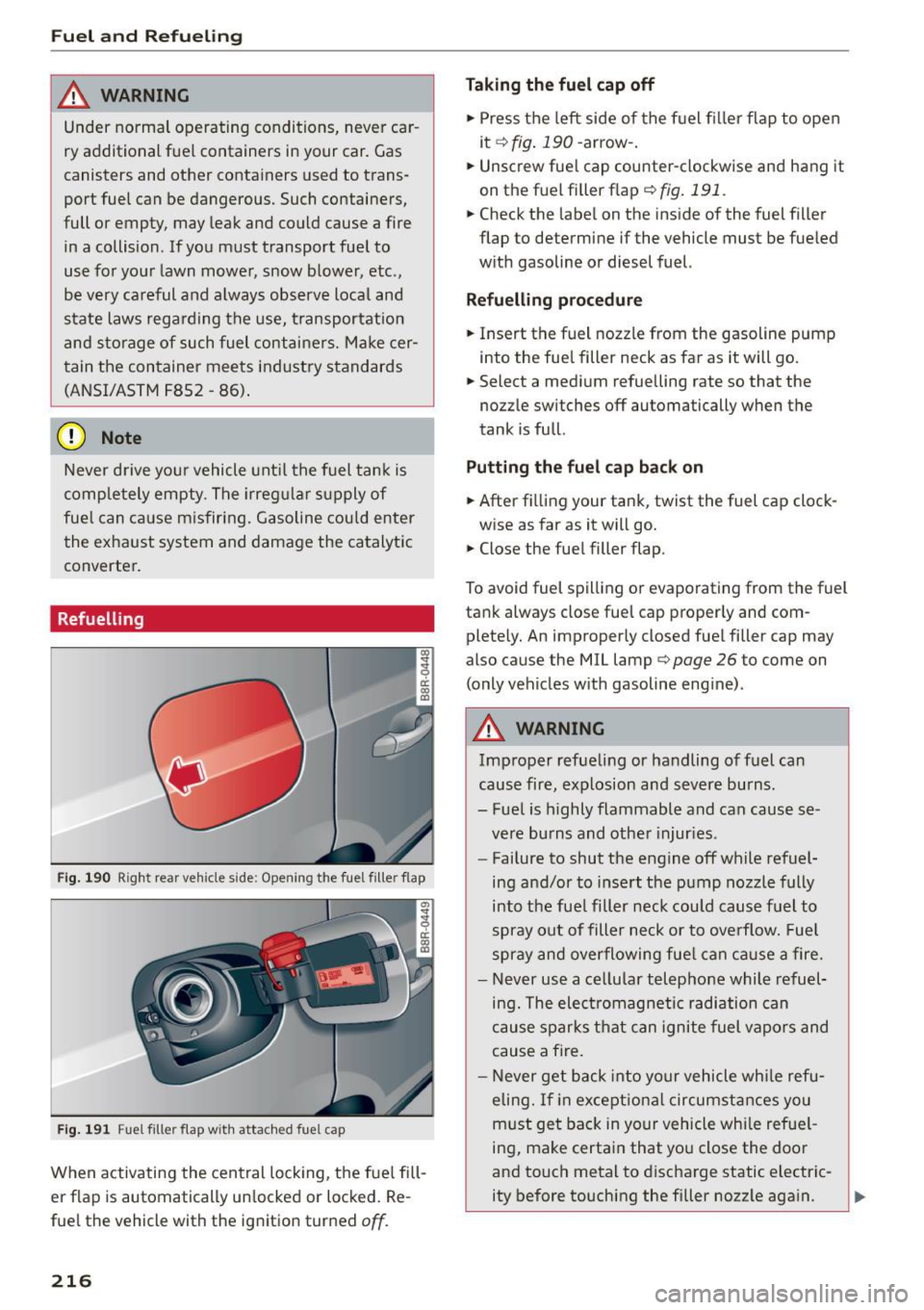
Fig . 190 Right rear vehicle s ide: Opening the fuel fill er flap
Fi g. 191 Fuel filler flap with attached fuel cap
When activating the central lock ing, the fue l fill
er flap is automatically un locked or locked. Re
fue l the vehicle with the ignition turned
off.
216
Tak ing the fu el cap off
.. Press the left side of the fuel fi ller flap to open
it
¢ fig . 190 -arrow-.
.. Unscrew fue l cap counter-clockwise and hang it
on the fuel filler f lap
c;, fig. 191.
.. Check the label on the inside of the fuel filler
flap to determine if the vehicle must be fueled
w ith gasoline or diesel fuel.
Re fuelling proce dure
.. Insert the fuel nozzle from the gasoline pump
into the fue l filler neck as far as it will go.
.. Select a medium refuelling rate so that the
nozzle switches off automatically when the
tank is full.
Putting t he fu el cap b ack on
.. After f illing your tank, twist the fuel cap clock-
wise as far as it will go.
.. Close the fuel filler flap.
To avoid fuel spilling or evaporating from the fuel
tank always close fue l cap proper ly and com
plete ly. An improper ly closed fue l filler cap may
also cause the MIL lamp
c;, page 26 to come on
(only vehicles w ith gasoline eng ine) .
_& WARNING
Imp roper refueling or handling of fuel can
cause fire, explosion and severe burns.
- Fue l is highly flammable and can cause se
vere burns and other injur ies.
-
- Failure to shut the engine off while refuel
ing and/or to insert the pump nozzle fully
into the fue l filler neck could cause fuel to
spray out of filler neck or to overflow. Fue l
spray and overflowing fue l can cause a fire.
- Never use a ce llular telephone while refuel
ing. The electromagnetic radiation can
cause sparks that can ignite fuel vapors and
cause a fire.
- Never get back into your vehicle wh ile refu
eling. If in except iona l circumstances you
m ust get back in your vehicle whi le refue l
ing, make certain that yo u close the door
and touch metal to discharge static electric-
ity before touching the filler nozz le aga in.
IJJ,,,
Page 219 of 302
M N
co ~ co
rl I.O
"' N
"' rl
Static electricity can cause sparks that can ignite fuel vapors released during refueling.
- Never smoke or have an open flame any
where in or near your vehicle when refueling or filling a portable fuel container.
- For your safety, we strong ly recommend
that you do not travel with a portable fuel
container in your vehicle. The container, full
or empty may leak and could cause a fire,
especially in a crash.
- If, under exceptional circumstances, you
must transport a portable fuel container,
please observe the following:
- Never fill a portable fuel container whi le it
is anywhere in or on the vehicle (for exam
ple, in the luggage compartment, or on
the trunk). Static electricity can bui ld up
while filling and can ignite fuel vapors causing a fire.
- Always place a portable fuel container on
the ground before filling.
-Always keep the fi ller nozzle complete ly
ins ide the portable container before and
during filling.
- If filling a portable container made of
metal, the filler nozz le must always be in
contact w ith the container . Th is will help
prevent static e lectricity from discharg ing
and cause a fire .
- Never sp ill fuel inside the vehicle or lug
gage compartment. Fue l vapors are highly
flammab le.
- Always observe local and state/provincial laws rega rding the use, storage and trans
portat ion of fuel contai ners.
- Make certa in the fuel container meets in
dustry standards (ANSI/ ASTM F852 -86) .
(D Note
If any fuel has spilled onto the car, it shou ld
be removed immediately to prevent damage
to the paint .
@ For the sake of the environment
As soon as the correctly operated nozzle sw itches off automatically for the first time,
the tank is full . Do not try to add more fuel
Fu el a nd R efu elin g
because f uel may spill out. In addition, the
expansion space in the fuel tank will be fi lled -
causing the fue l to overflow when it becomes
warm and pollute the environment.
@ Tips
- Running your engine whi le refue lling may
cause vapors to escape or even cause fue l to
spill out of the tank. This would then sh ut
off the fuel nozzle before the tank is full.
- Do not refuel your vehicle with the ignition turned on. The fuel gauge may otherwise not indicate the correct fuel level after refu
elling .
- Diesel vehicles* are equipped with a diesel
m isfueling protector .
It allows the vehicle to
be fueled only with a d iesel fue l pump noz
zle . A wo rn o r damaged nozzle o r a nozz le
that is too small may not be able to open
the diesel misfueling protector.
If this is the
case , try turning the nozzle before insert ing
it in the fuel filler neck, use a different fuel
pump or see your authorized A udi dealer or
authorized repair facility for assistance.
- The fuel fi ller f lap of your vehicle is not
locked when you lock the vehicle from the
inside.
Unlocking the fuel filler flap
by hand
You can open the fuel filler flap by hand if the
power locking system should fail.
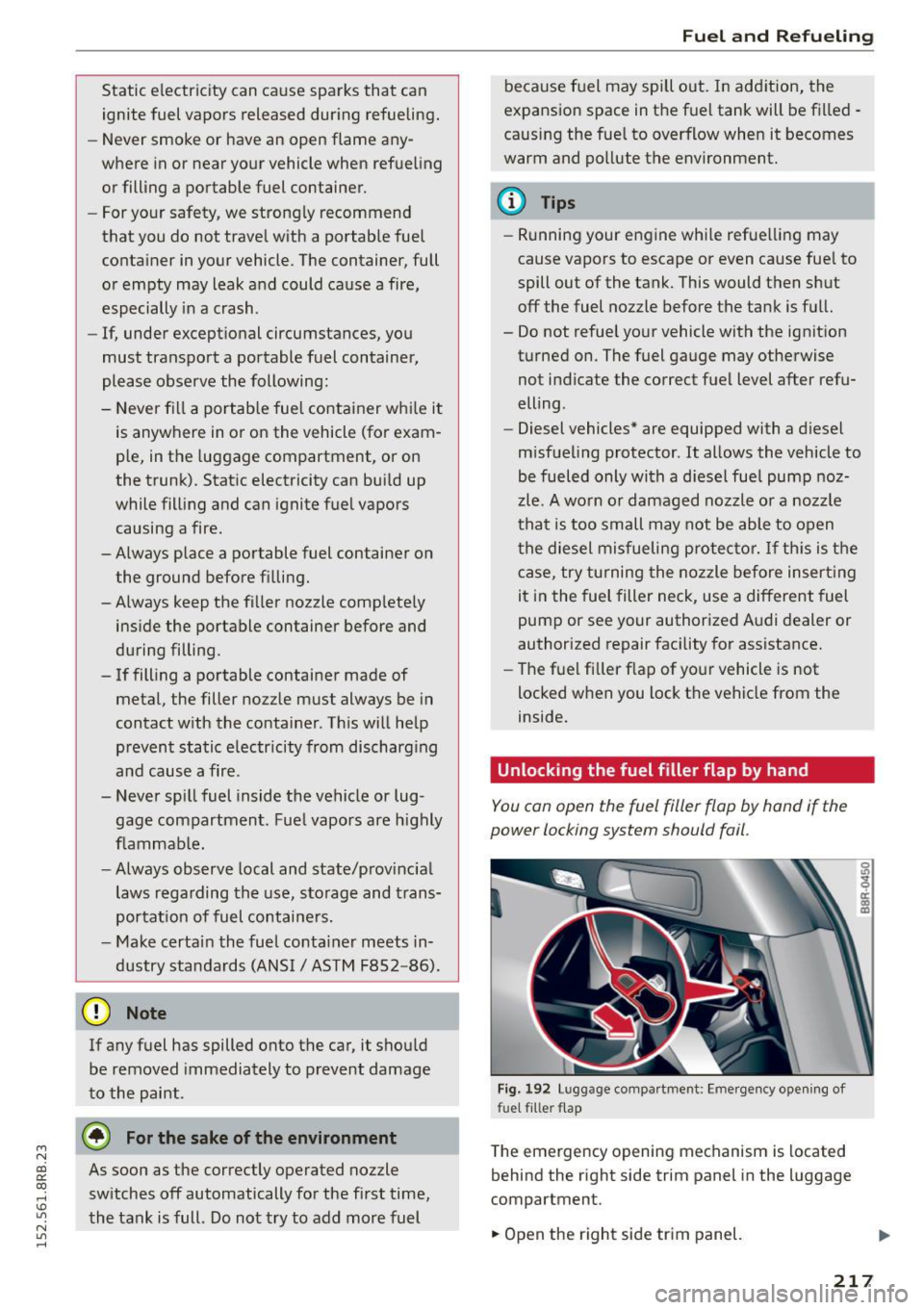
Fig. 192 L u ggage compa rtm en t: Em erge ncy ope ning of
fue l fille r flap
The emergency op ening mechanism is located
behind the right side trim panel in the luggage
compartment.
• Open the right side trim panel.
217
Page 220 of 302
Fuel and Refueling
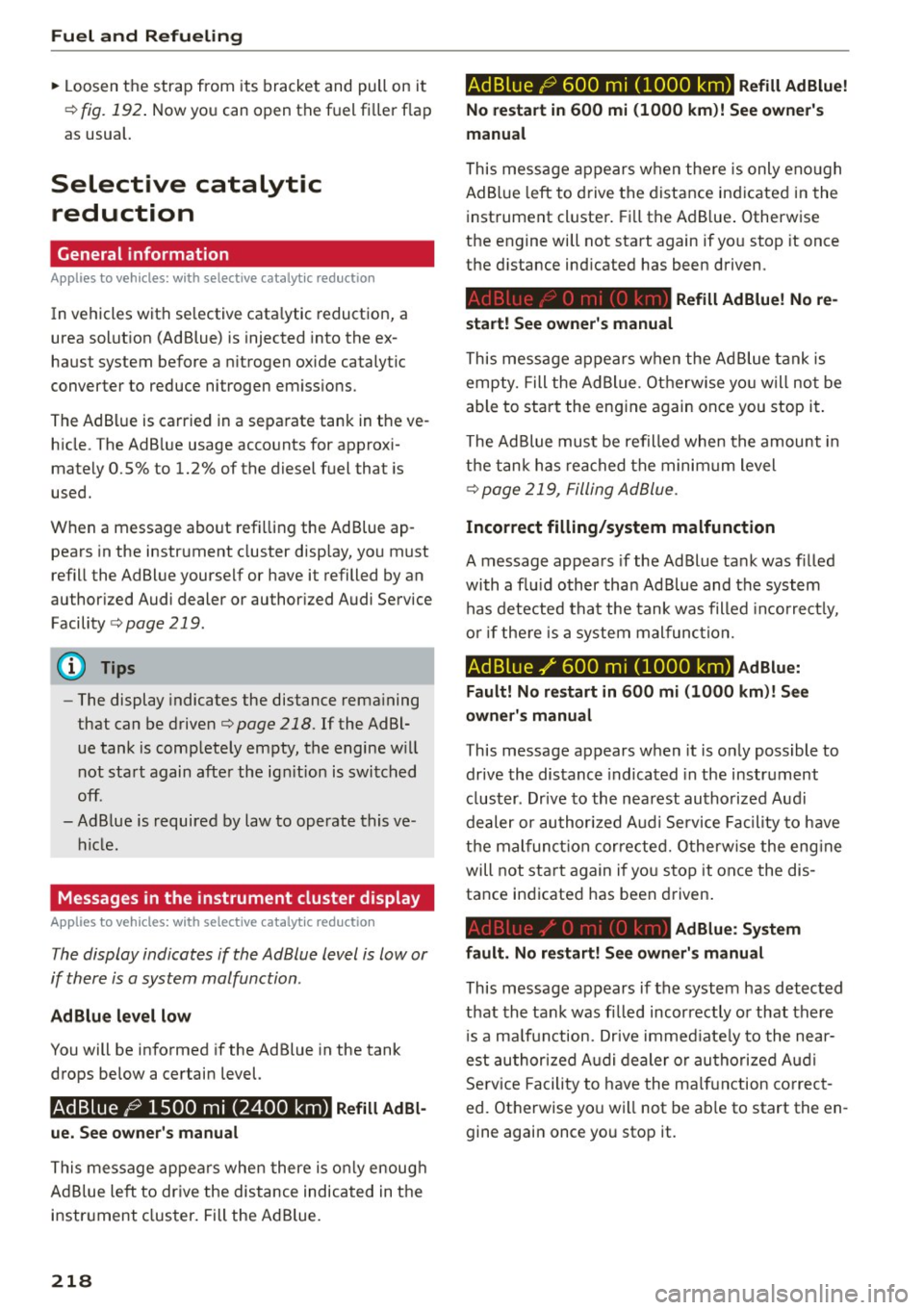
"' Loosen the strap from its bracket and pull on it
¢
fig. 192 . Now you can open the fuel filler flap
as usual.
Selective catalytic reduction
General information
Applies to vehicles: with selective catalytic reduct ion
In vehicles with selective catalytic reduction, a
urea solution (Ad Blue) is injected into the ex
haust system before
a nitrogen oxide catalytic
converter to reduce nitrogen emissions .
The AdBlue is carried in a separate tank in the ve
hicle. The AdB lue usage accounts for approxi
mately 0.5% to 1.2% of the diesel fuel that is
used.
When a message about refilling the Ad Blue ap
pears in the instrument cluster disp lay, you must
refill the Ad Blue yourself or have it refilled by an
authorized Audi dealer or authorized Audi Service
Facility ¢
page 219.
(1) Tips
-The display indicates the distance remaining
that can be driven¢
page 218. If the Ad Bl
ue tank is completely empty, the engine will
not start again after the ignition is switched
off.
-Ad Blue is required by law to operate this ve
hicle .
Messages in the instrument cluster display
Applies to vehicles: with selective catalytic reduct ion
The display indicates if the Ad Blue level is low or
if there is a system malfunction.
AdBlue level low
You will be informed if the Ad Blue in the tank
drops below a certain level.
Ad Blue /9 1500 mi (2400 km) Refill Ad Bl-
ue. See owner's manual
This message appears when there is only enough
Ad Blue left to drive the distance indicated in the
instrument cluster. Fill the Ad Blue.
218
Ad Blue /9 600 mi (1000 km) Refill Ad Blue!
No restart in 600 mi (1000 km)! See owner's
manual
This message appears when there is only enough
Ad Blue left to drive the distance indicated in the
instrument cluster. Fill the AdB lue . Otherwise
the engine will not start again if you stop it once
the distance indicated has been driven.
Refill Ad Blue! No re
start! See owner's manual
This message appears when the Ad Blue tank is
empty. Fill the Ad Blue . Otherwise you will not be
able to start the engine again once you stop it.
The Ad Blue must be refilled when the amount in
the tank has reached the minimum level
¢ page 219, Filling AdBlue .
Incorrect filling/system malfunction
A message appears if the Ad Blue tank was filled
with a flu id other than Ad Blue and the system
has detected that the tank was filled incorrect ly,
or if there is a system malfunction.
AdBlue ./' 600 mi (1000 km) AdBlue:
Fault! No restart in 600 mi (1000 km)! See
owner's manual
This message appears when it is only possible to
drive the distance indicated in the instrument
cluster. Drive to the nearest authorized Audi
dealer or authorized Audi Service Facility to have
the malfunction cor rected. Otherwise the engine
will not start again if you stop it once the dis
tance indicated has been driven.
AdBlue: System
fault. No restart! See owner's manual
This message appears if the system has detected
that the tank was fi lled incorrectly or that there
i s a malfunction. Drive immediate ly to the near
est authorized Audi dealer or authorized Audi
Service Facility to have the malfunction correct
ed. Otherwise you will not be ab le to start the en
gine again once you stop it .
Page 221 of 302
M N
co ~ co
rl I.O
"' N
"' rl
Filling AdBlue
Applies to vehicles: with selective catalytic reductio n
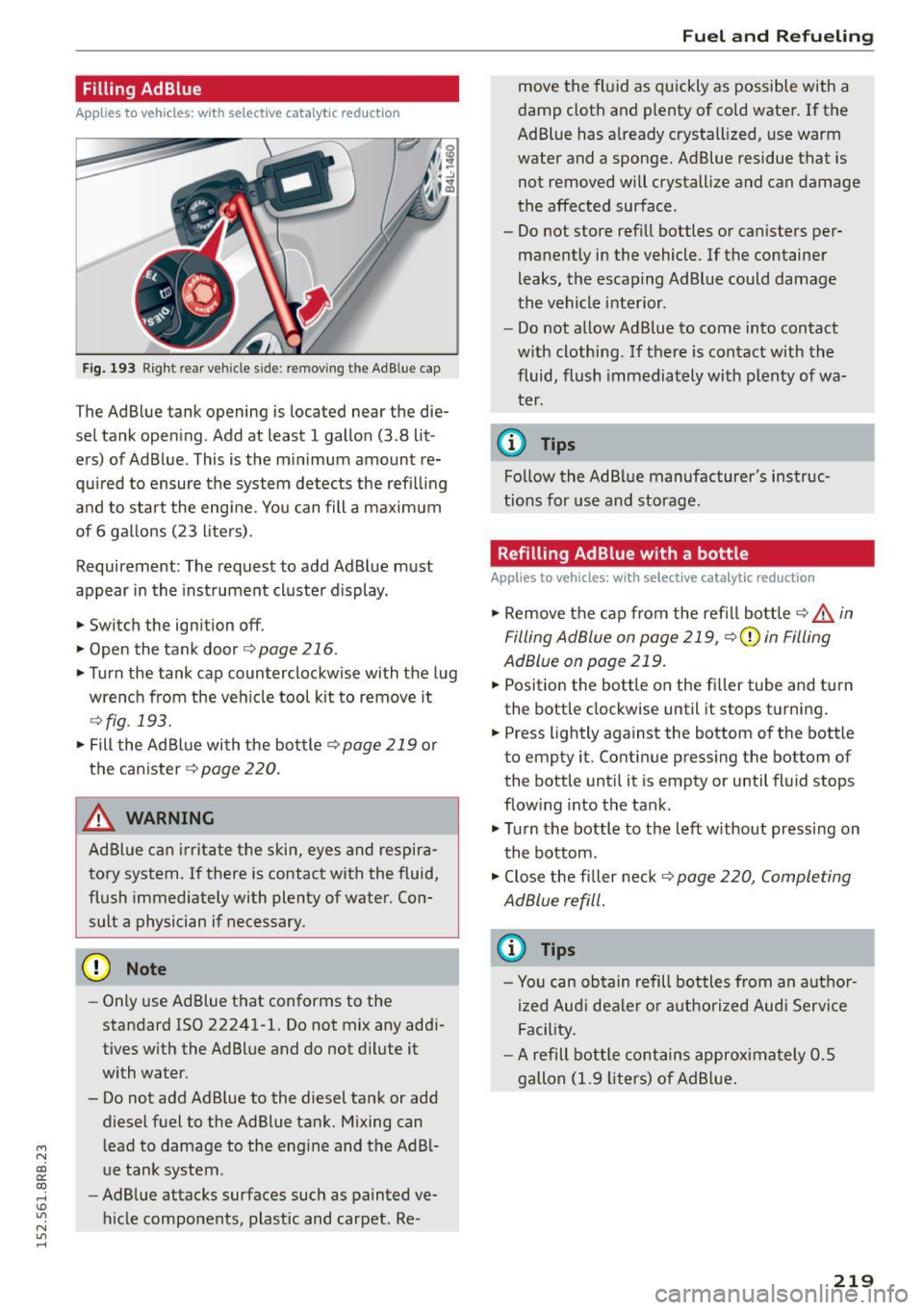
Fig. 193 Right rear vehicle s ide: remov ing the Ad Blue cap
The Ad Blue tank opening is located near the die
sel tank opening . Add at least 1 gallon (3 .8 lit
ers) of AdBlue. This is the m inimum amount re
qu ired to ensure the system detects the ref illing
and to start the eng ine. You can fill a maximum
of 6 ga llons (23 l iters).
Requirement: The request to add Ad Blue must
appear in the instrument cluster display.
.,. Switch the ign ition off.
.,. Open the tank door¢
page 216 .
.,. Turn the tank cap counterclockwise with the lug
wrench from the veh icle tool kit to remove it
9fig. 193.
.,. Fill the Ad Blue with the bottle¢ page 219 or
the canister
¢ page 220.
A WARNING
Ad Blue can irritate the skin, eyes and respira
tory system. If there is contact with the fluid,
flush immediately with plenty of water. Con sult a physician if necessary.
CI) Note
- Only use Ad Blue that conforms to the
standard ISO 22241-1. Do not mix any addi
tives with the AdBlue and do not dilute it
with water.
- Do not add Ad Blue to the diesel tank or add
diesel fuel to the Ad Blue tank. Mixing can
lead to damage to the eng ine and the Ad B l
ue tank system.
- AdBlue attacks surfaces such as painted ve
hicle components, plastic and carpet. Re-
Fuel and Refueling
move the fluid as quickly as possible with a
damp cloth and plenty of cold water. If the
Ad Blue has already crystall ized, use warm
water and a sponge. Ad Blue residue that is
not removed will crystallize and can damage
the affected surface.
- Do not store refill bottles or can isters per
manently in the vehicle. If the container
leaks, the escaping AdBlue could damage
the vehicle interior.
- Do not allow Ad Blue to come into contact
with clothing. If there is contact w ith the
fluid, flush immediately with plenty of wa
ter .
@ Tips
Follow the AdBlue manufacturer's instruc
tions for use and storage.
Refilling Ad Blue w ith a bottle
Applies to vehicles: with selective catalytic reduction
.,. Remove the cap from the ref ill bott le 9 _& in
Filling AdBlue on page
219, ¢(Din Filling
AdBlue on page
219 .
.,. Posit ion the bottle on the filler tube and t urn
the bottle clockwise until it stops turning.
.,. Press lightly against the bottom of the bottle
to empty it . Continue pressing the bottom of
the bottle until it is empty or until fluid stops
flow ing into the tank.
.,. Turn the bottle to the left without pressing on
the bottom.
.,. Close the filler neck
9 page 220, Completing
AdBlue refill.
{i) Tips
- You can ob tain refill bottles from an author
ized Aud i deale r or authorized Audi Service
Facility.
- A refill bottle contains approximately 0 .5
gallon (1.9 liters) of AdBlue.
219
Page 222 of 302
Fuel and Refu elin g
Refilling AdBlue with a canister
App lies to veh icles: w ith selective cata lyt ic red uctio n
@
+®
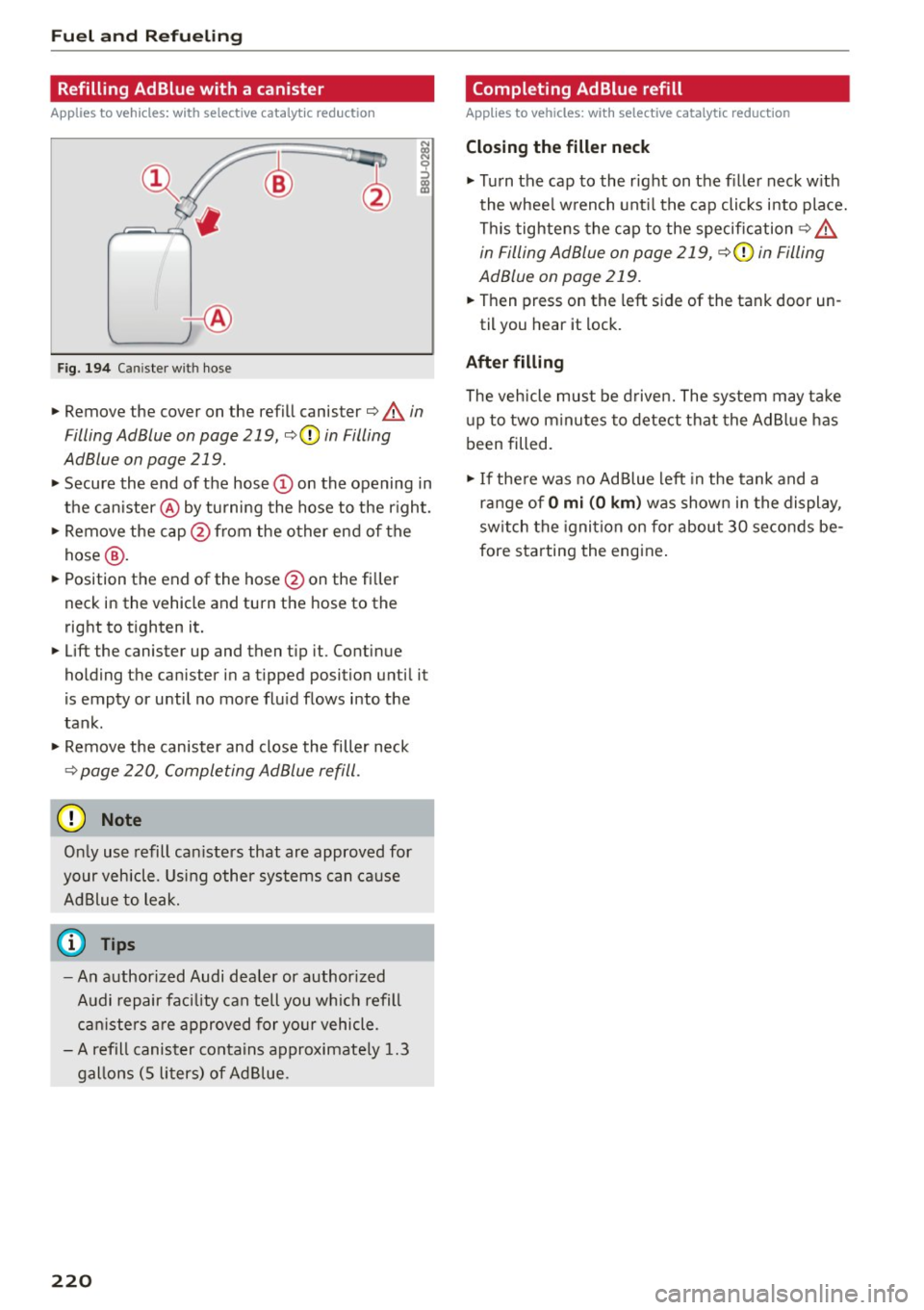
Fig. 194 Canister with hose
"' Remove the cover on the refill canister c:::> A in
Filling Ad Blue on page 219,
c:::> 0 in Filling
AdBlue on page 219 .
"' Secure the end of the hose(!) on the opening in
the canister @ by turning the hose to the r ight.
"' Remove the cap @from the other end of the
hose @.
"' Position the end of the hose @on the fi ller
neck in the vehicle and turn the hose to the
right to tighten it.
"'Lift the canister up and then tip it. Continue
holding the canister in a tipped position until it
is empty or until no more flu id flows into the
tank .
"' Remove the canister and close the filler neck
c:::> page 220, Completing AdBlue refill .
0 Note
Only use refill canisters that are approved for
your vehicle. Us ing other systems can cause
Ad Blue to leak.
@ Tips
- An authorized Audi dealer or author ized
Audi repair facility can tell you w hich refill
can iste rs a re approved for your vehicle.
- A refill canister contains approximate ly 1. 3
gallons (5 liters) of Ad Blue.
220
Completing AdBlue refill
App lies to vehicles: wit h selective cata lyt ic reduction
C losin g the filler neck
"'Turn the cap to the right on the filler neck w ith
the wheel w rench until the cap clicks i nto place.
This tightens the cap to the specification
c:::> A
in Filling AdBlue on page 219, c:::> 0 in Filling
AdBlue on page 219.
"'Then press on the left side of the tank door un-
til you hear it lock.
Aft er filling
The vehicle must be driven. The system may take
up to two m inutes to detect that the Ad Blue has
been filled.
"' If there was no AdBlue left in the tank and a
range of
O mi (0 km ) was shown in the display,
sw itch the ignition on for about 30 seconds be
fore starting the engine.