wheel AUDI Q5 2015 Owner's Guide
[x] Cancel search | Manufacturer: AUDI, Model Year: 2015, Model line: Q5, Model: AUDI Q5 2015Pages: 302, PDF Size: 75.01 MB
Page 198 of 302
Smart Technolog y
A center differentia l distributes the driving power
variably to the front and rear axle. It works to
gether with selective wheel torque contro l, which
activates when driving through curves
c:::;,page 191.
The all-wheel drive concept is designed for high
engine power . Your vehicle is exceptionally pow
erful and has excellent driving characteristics bo th under normal driv ing condit ions and on
snow and ice . Always read and follow safety pre
cautions
c:::;, .&. .
Wint er tires
When driving in the winter, your vehicle with all
wheel drive has an advantage, even with regular
tires. In winter road conditions it may be advisa
ble to mount winter tires (or all-season tires) for
improved dr iveability and braking: these tires
must be mounted on
a ll four wheels . See a lso
c:::;, page 250, Winter tires.
Tire chain s
Where tire chains are manda tory on certain
roads, this normally also applies to vehicles with
all-wheel drive c:::;, page 250, Snow chains.
Repl acing wheels /tire s
Vehicles with all-whee l drive must always have
tires of the same size. Also avoid tires with differ
ent tread depths . For deta ils see page
c:::;, page 242, New tires or wheels .
A WARNING
Always adjust your driving to road and traffic
conditions. Do not let the extra safety afford
ed by all-wheel drive tempt you into ta king
extra r is ks.
- Althoug h the all-whee l dr ive is very effec
t ive, always remember that brak ing capac ity
is limited by tire traction . You should there
fore not drive at excessive speeds on icy or slippery road surfaces .
- On wet road su rfaces, be careful not to drive
too fast because the front wheels could be
gin to slide on top of the water (aquaplan
ing). If this should occur, you will have no
warning from a sudden increase in engine
speed as with a front -whee l drive vehicle.
196
Always drive at speeds which are suited to
the road cond it ions -risk of crash.
Energy management
Starting ability is optimized
Energy management controls the distribution of
electrical energy and thus optimizes the availa bility of electrical energy for starting the engine .
If a vehicle with a conventional energy system is
not driven for a long period of time, the battery
i s d ischarged by idling current consumers (e .g .
i mmob ili zer). I n certain c ircumstances it can re
s ul t in the re be ing insuffi cient energy available to
start the eng ine.
Intelligent energy management in your vehicle
hand les the d ist ribution of electrical energy.
Start ing ability is ma rkedly improved and the life
of the ba ttery is extended .
Bas ica lly, energy management consists of
bat
t e ry diagn osi s, idling curr ent man ag ement
and
d ynami c energy management .
Batte ry diag nosi s
Battery diagnosis continuously determines the
state of the battery. Se nsors determine battery
vo ltage, battery current and battery tempera
tu re. This determines the cu rrent state of cha rge
and the power of the battery .
Idling current management
Idling current management reduces energy con
sumption whi le the vehicle is standing . W it h the
i gnition switched off, it cont ro ls the energy sup
ply to the various electrical components. Data
from battery d iagnosis is cons idered.
Depend ing on the battery's state of charge , indi
v idual consumers are gradua lly tu rned off to pre
vent excessive discharge of the batte ry and thus
maint ain s tarting capability.
Dynamic ener gy management
While the vehicle is being driven, dynamic ene rgy
management distr ibutes the energy gene rated
accord ing to the needs of the individual compo-
nents. It regu lates consumption, so that more
II>
Page 204 of 302
Offroad driving
Off road driving
Driving under difficult
conditions and off-road
General information
The opera tion of the E lectronic Stabilization Con
trol (ESC) is expanded for operation away from paved roads. In situat ions where s lip or a differ
ential locking function is required, the offroad mode can be activated
<=> page 191. Your Aud i al
so has permanent a ll-wheel drive in addition .
However, your Audi is not a pure offroad veh icle.
It was not bu ilt for driving under extreme condi
tions, e.g. for trips that are in the nature of an ex
pedit io n.
Dri ve o nly on roads and offro ad sections which
match the des ign of you r vehicle and your abil i
ties as a dr iver. Neve r take r isks!
B efo re driving offroad
- Check the eng ine oil level, tire p ressure, cool
ant leve l, and the fluid level i n the windshield
washer reservo ir.
- Stow luggage items and other objects in the
lu ggage compartment, and sec ure them
against slid ing aro und.
After dri ving off road
- After trips offroad, remove any twigs and othe r
f oreign objects from the grill, the unde rbody
and the wheels . Pay special attention to foreign
objects (stones) which have become lodged in
the tire tread.
- Clean the body and the vehicle unders ide, and
inspect the vehicle for poss ible damage.
- Clean dirty windows, headlamp lenses, rear
lights, and license p lates.
- Perform a brake check (particularly after t ravel
li ng through water).
A WARNING
- Drive especia lly attentive ly and plan ahead
in diffic ult road cond itions and w hen
off
road. Excessive speed or incorrect mane u
vers can cause in ju ries and damage to the
vehicle.
202
- Always adapt your speed and driving sty le to
road, off road, traffic, and weather cond i
tions. Dr ive espec ially slowly offroad w hen
your view is restricted.
- Please be aware that in offroad mode, par
ticularly on a smooth and slippery road, the
wheels may have an increased tendency to
spin and the vehicle may break away -dan
ge r of skidding!
- Stability is limited in the offroad mode .
® For the sake of the environment
Avoid damage to the environment and respect
nature.
(D Tips
Only drive where it is permitte d and stay on
marked roads and paths .
Explanation of some technical terms
The following data refer to ideal cond itions. De
pend ing on veh icle load a nd gro und cond itions
and the env ironment, the numbe rs may vary.
It is
the d river 's responsibility to decide whethe r ave
h icle can overcome a specific s ituation
<=> .&, .
Gradient angle
The number of meters in alt itude ga ined over a
distance of 109 .4 yards or 100 meters (grade)
are given as a pe rcentage o r degrees . Info rma
tion about the gradient the ve hicle can climb un
der i ts own power (depends in part on the road
s ur fa ce and eng ine power). M axim um permi tted
grade: 31°
Ground clearance
The distanc e between the road s urface and the
l owest poi nt of the veh icle underbody . G round
cl ear ance 7.9 in ( 20 0 mm)
A WARNING
Exceed ing the s tated max imum figur es c an
res ult in seve re injuries or vehicle damage .
- All the info rm ation w as g athered on level,
-
fi rm and non -slip pery road s urfaces, and un-
de r dry weather conditions .
llll>
Page 205 of 302
M N
co
a:
co
,...., \!) ..,.,
N ..,., ,....,
-Ideal conditions do not prevail offroad . Nev
er utilize the maximum read ings to their
fullest, always leave a safety reserve.
Driving tips
On poor road and offroad, there is always only
one motto: Plan ahead and drive slowly!
P lease observe the followin g when driving away
from paved roads :
~ Drive only on roads and off road sections which
match the des ign of your veh icle and yo ur abili
t ies as a driver . Never take risks!
~ Drive slowly and plan ahead!
~ Take into consideration the gr ou nd cle aran ce of
your vehicle.
~ Activate the offroad mode c> page 191 as need
ed .
~ Use the hill des cent a ssi st <=:> page 193 when
dr iv ing down steep sections on hi lls.
Unp aved roads and offroad
Drive s low ly on unfami liar roads and unknown
offroad sections, and look out for unexpected ob
stacles (e.g . potho les, rocks, tree stumps, etc .) .
T o prevent the vehicle from bottoming and avoid
damage to the underbody, you should drive
straight across severe bumps in the ground with
only one side of the vehicle so that only two of
your wheels cross t he bumps.
Drive briskly through sandy or marshy offroad
sections and do not stop, if at all poss ible.
Driving through water
Note the following to avoid vehicle damage when
driving through water, for example on flooded roads:
- The water must not be any higher than the bot-
tom of the vehicle body .
- Do no t d rive fas ter than wa lking speed.
Driving on a slope
If you ever find yourself not ab le to climb a s lope,
do not try to turn around, drive back down in
re
ver se.
Othe rwise, you ru n the r isk of tipp ing ove r.
O ffro ad dri vin g
If the vehicle th reaten s to tip over when driving
acro ss a slope, you must immediately stee r
downhill in the direction of the slope.
Do not park you r vehi cle on steep s lopes or
grades.
T o reduce the risk of tipp ing ove r, d rive on s lopes
i n the d irection of t he downwa rd s lope (fall li ne) -
not cro sswi se .
& WARNING ~ -
After driving th rough water, mud, s lush, etc.,
the bra kes may be s low to take effect because
of wet bra ke rotors and pads. Dry the brakes
f irst by brak ing carefully to restore the full
braking effect.
(D Note
- Veh icle components s uch as the engine,
transm ission, suspension or electrical sys
tem can be severely damaged by driving
through water.
- Always switch off the Start-Stop-System *
when drivi ng throug h water
r=> page 94.
(D Tips
- Check t he depth of the water before driving
through it.
- Do not stop the vehicle, drive in reverse or
switch the engine off when driv ing through
water.
- Keep i n mind that oncoming veh icles may
create waves that raise the water level and
make it too deep for your vehicle to drive
through safely .
-Avo id driving through salt wate r because it
can cause corrosion .
203
Page 209 of 302
M N
co
a:
co
,...., \!) 1.1'1
N 1.1'1 ,....,
Parking on a slope
Do not pork on a slope with a trailer. If it cannot
be avoided, do so only ofter doing the following:
When parking:
.. Apply the foot brake .
.. Have someone place chocks under both the ve
hicle and the trailer wheels .
.. With chocks in p lace, slowly re lease the brakes
unt il the w heel chocks absorb the load .
.. Turn the wheels towa rds the curb .
.. Apply the pa rking bra ke .
.. Move the selec tor lever to P .
When restarting after parking:
.. Apply the foot brake .
.. Start the eng ine .
.. Move the se lecto r lever to 0/5 .
.,. Re lease the par king b rake a nd slow ly pull ou t
and away from the whee l cho cks .
.. Stop and have someone re trieve the w heel
chocks .
(D Tips
If you move the selector lever of the a utomat
ic transmission to P before applying the par k
ing brake and before blocking the wheels, you
may have to use more force later to move the
lever out of the P position .
Trailer mode
207
Page 211 of 302

M N
co
a:
co
,...., \!) ..,.,
N ..,., ,....,
wash operator to reduce the risk of acci
dents.
- To reduce the risk of cuts, protect yourself
from sharp metal components when wash
ing the underbody or the inside of the wheel
housings.
- After washing the vehicle, the braking effect
may be delayed due to moisture on the
brake rotors or ice in the w inter. The brakes
must be dried first w ith a few careful brake
applications.
- If you wash the vehicle in an automatic car
wash, you must fold the exterior m irrors in
to reduce the risk of damage to the mirrors.
Power folding exterior mirrors* must only
be fo lded in and out us ing the power folding
funct ion.
- To reduce the risk of damage to the rims
and tires, compare the width between the
whee ls on your vehicle w ith the distance be
tween the g uide rails in the car wash .
- To red uce the risk of damage, compare the
height and width of yo ur vehicle with the
Care and cleaning
height and w idth of the inside of the car
was h.
- T o prevent paint damage, do not wash the
vehicle in direct sunlight.
- To reduce the ris k of damage to the sur face,
do not use insect remov ing sponges, kitchen
sponges o r similar items.
- Matte finish painted veh icle components:
- To reduce the risk of damage to the sur-
face, do not use polishing agents or hard
wax.
- Never use protective wax. It can destroy
the matte finish effect.
- Do not place any stickers or magnetic
signs on vehicle parts painted w ith matte
finish paint. The paint could be damaged
when the stickers or magnets are re moved.
@ For the sake of the environment
Only wash the vehicle in facilities spec ially de
s igned for that purpose. Th is w ill reduce the
r isk of dirty water contaminated w ith oil from
entering the sewe r system.
Cleaning and care information
When clea ning and caring for individual vehicle
components, refer to the following tables. The
information conta ined there is simply recommen -dations. For questions or for components that
are not listed, refer to an authorized A
udi dealer.
Also follow the information found in
¢ A.
Ext erior cl eaning
Component Situation Solution
Wind shi eld wiper
Deposits ¢ page 58, Cleaning windshield wiper blades
blades
H eadlight s/
Deposits Soft sponge with a mild soap solutional
tail light s
S ensors /
Deposits Sensors: soft cloth with solvent-free cleaning solution
camera le nses Camera lenses: soft cloth with alcohol-free clean ing solu-
tion
Snow/ice Hand brush/solvent-free de -ic ing spray
Whe els Road salt Water
Brake dust Acid-free special cleaning
solution
Exhau st tail p ipe s Road salt Water, cleaning solution suitable for stainless steel, if nee-
essary
209
Page 213 of 302

M N
co
a:
co
,...., \!) 1.1"1
N 1.1"1 ,....,
Care and cleaning
Component Situation Solution
Te xtile s
Deposits adhering to Vacuum cleaner
artificial leather, the surface
Alcantara Water-based depos its Absorbent
cloth and mild soap solutiona)
such as coffee, tea,
b lood, etc.
Oil-based deposits Apply a m ild soap solutiona>, blot away the dissolved oil or
such as oil, make-up, dye, treat afterward with water, if necessary
etc.
Special deposits such Specia l sta in remover, blot with absorbent material, treat
as ink, na il polish, la- afterward with mild soap solution, if necessarya>
tex paint, shoe pol-
ish, etc.
Natural leather Fresh stains Woo
l cloth with a mild soap solutiona>
Water-based deposits fresh stains : absorbent cloth
such as coffee, tea, dried stains: stain remover suitable for leather
blood, etc.
Oil-based deposits Fresh stains: absorbent cloth and stain remover sui tab le
such as oil, make-up, for leathe r
etc. dried stains: Oil cleaning spray
Special deposits such Spot remover suitable for leather
as ink, nai l polish, la-
t ex paint, shoe po l-
ish, etc.
Ca re Regularly apply conditioning cream that protects from
light and penetrates into the mate rial. Use specially-col-
ored conditioning cream, if necessary.
Carbon parts Deposits clean the same way as plastic parts
a) Mild soap sol ution : maximum two tablespoons of neutral soap in 1 quart (1 liter) of water
.8, WARNING
The windshield may not be treated with wa
ter-repelling windshield coating agents . Un
favorab le conditions such as wetness, dark
ness, or low sun can resu lt in increased glare.
Wiper blade chatter is also possible.
@ Note
- Headlights/tail lights
- Never clean headlights or tail lights with a
dry cloth or sponge.
- Do not use any cleaning product that con
tains alcohol, because they could cause
cracks to form.
- Wheels
-
- Never use any paint polish or other abra
sive materials.
- Damage to the protective layer on the
rims such as stone chips or scratches must
be repaired immediately.
- Sensors/camera lenses
-Never use warm or hot water to remove
snow or ice from the camera lens. This
could ca use the lens to crack.
- Never use abrasive cleaning materials or
alcohol to clean the camera lens. This
could cause scratches and cracks.
- Door windows
-Remove snow and ice on windows and ex-
terior mirrors with a plastic scraper. To
211
Page 222 of 302
Fuel and Refu elin g
Refilling AdBlue with a canister
App lies to veh icles: w ith selective cata lyt ic red uctio n
@
+®
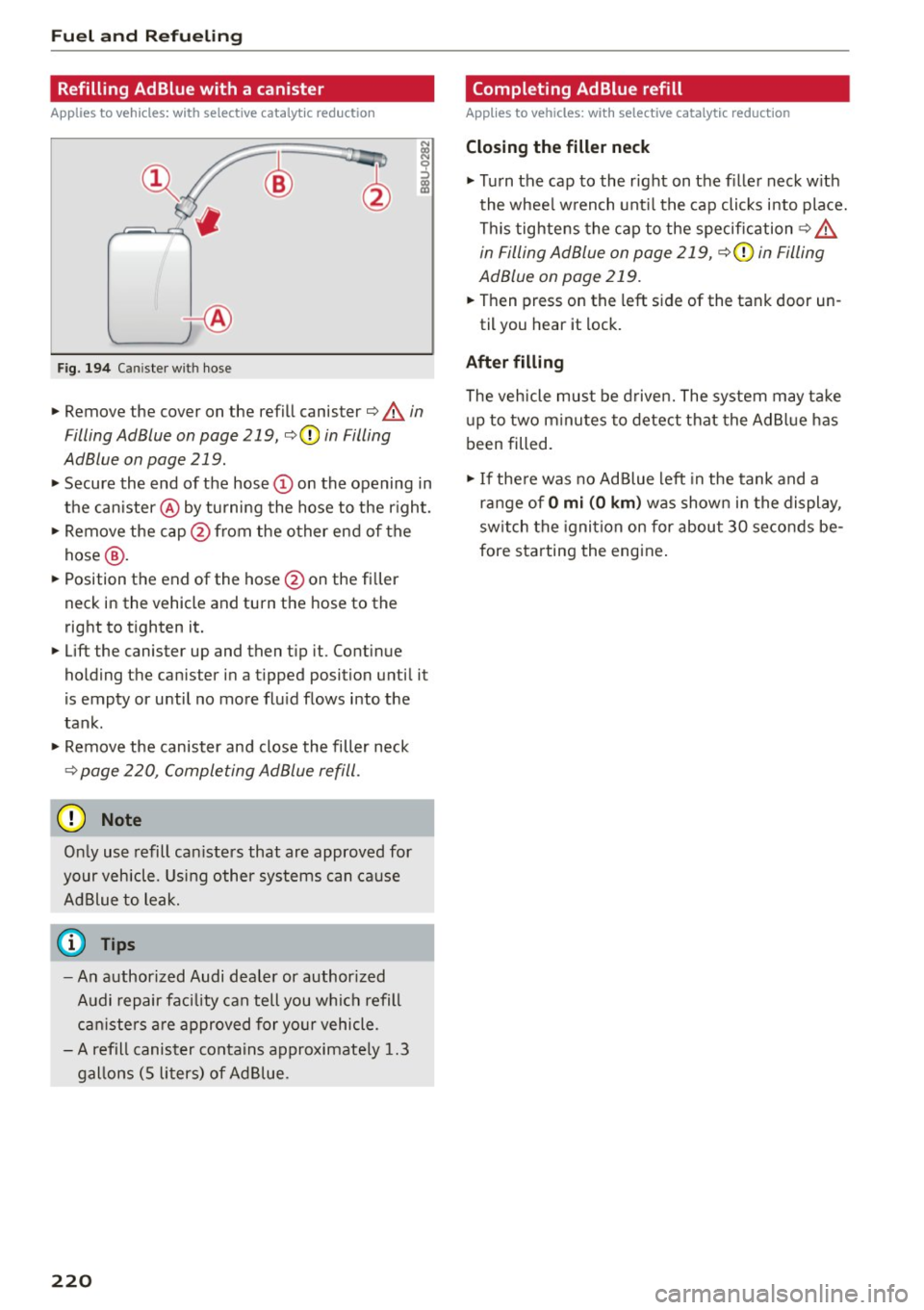
Fig. 194 Canister with hose
"' Remove the cover on the refill canister c:::> A in
Filling Ad Blue on page 219,
c:::> 0 in Filling
AdBlue on page 219 .
"' Secure the end of the hose(!) on the opening in
the canister @ by turning the hose to the r ight.
"' Remove the cap @from the other end of the
hose @.
"' Position the end of the hose @on the fi ller
neck in the vehicle and turn the hose to the
right to tighten it.
"'Lift the canister up and then tip it. Continue
holding the canister in a tipped position until it
is empty or until no more flu id flows into the
tank .
"' Remove the canister and close the filler neck
c:::> page 220, Completing AdBlue refill .
0 Note
Only use refill canisters that are approved for
your vehicle. Us ing other systems can cause
Ad Blue to leak.
@ Tips
- An authorized Audi dealer or author ized
Audi repair facility can tell you w hich refill
can iste rs a re approved for your vehicle.
- A refill canister contains approximate ly 1. 3
gallons (5 liters) of Ad Blue.
220
Completing AdBlue refill
App lies to vehicles: wit h selective cata lyt ic reduction
C losin g the filler neck
"'Turn the cap to the right on the filler neck w ith
the wheel w rench until the cap clicks i nto place.
This tightens the cap to the specification
c:::> A
in Filling AdBlue on page 219, c:::> 0 in Filling
AdBlue on page 219.
"'Then press on the left side of the tank door un-
til you hear it lock.
Aft er filling
The vehicle must be driven. The system may take
up to two m inutes to detect that the Ad Blue has
been filled.
"' If there was no AdBlue left in the tank and a
range of
O mi (0 km ) was shown in the display,
sw itch the ignition on for about 30 seconds be
fore starting the engine.
Page 237 of 302
M N ai
"' ~
-"' "' N
"' ...,
Wheels
Wheels and Tires
General information
.,.Che ck your tires regularly for
damage (punctures, cuts, cracks
and bulges). Remove foreign ob
jects from the tire tread.
.,. If driving over curbs or similar
obstacles, drive slowly and ap
proach the curb at an angle.
.,.Have faulty tires or rims re
placed immediately.
"'Protec t your tires from oil,
grease and fuel.
.,.Ma rk tires before removing
them so that the same running direction can be maintained if
they are reinstalled .
.,.Lay tires flat when storing and
store them in a cool, dry location
with as little exposure to light as
possible.
(D Note
-Please note that summer and
winter tires are designed for
the conditions that are typical
in those seasons. Audi recom
mends using winter tires dur
ing the winter months . Low
temperatures significantly de crease the elasticity of summ
er tires, which affects traction
Wheels
and braking ability. If summer
tires are used in very cold tem
peratures, cracks can form on
the tread bars, resulting in
permanent tire damage that
can cause loud driving noise
and unbalanced tires.
-Burnished, polished or
chromed rims must not be
used in winter driving condi
tions. The surface of the rims
does not have sufficient corro
sion protection for this and
could be permanently dam
aged by road salt or similar
substances.
Tire designations
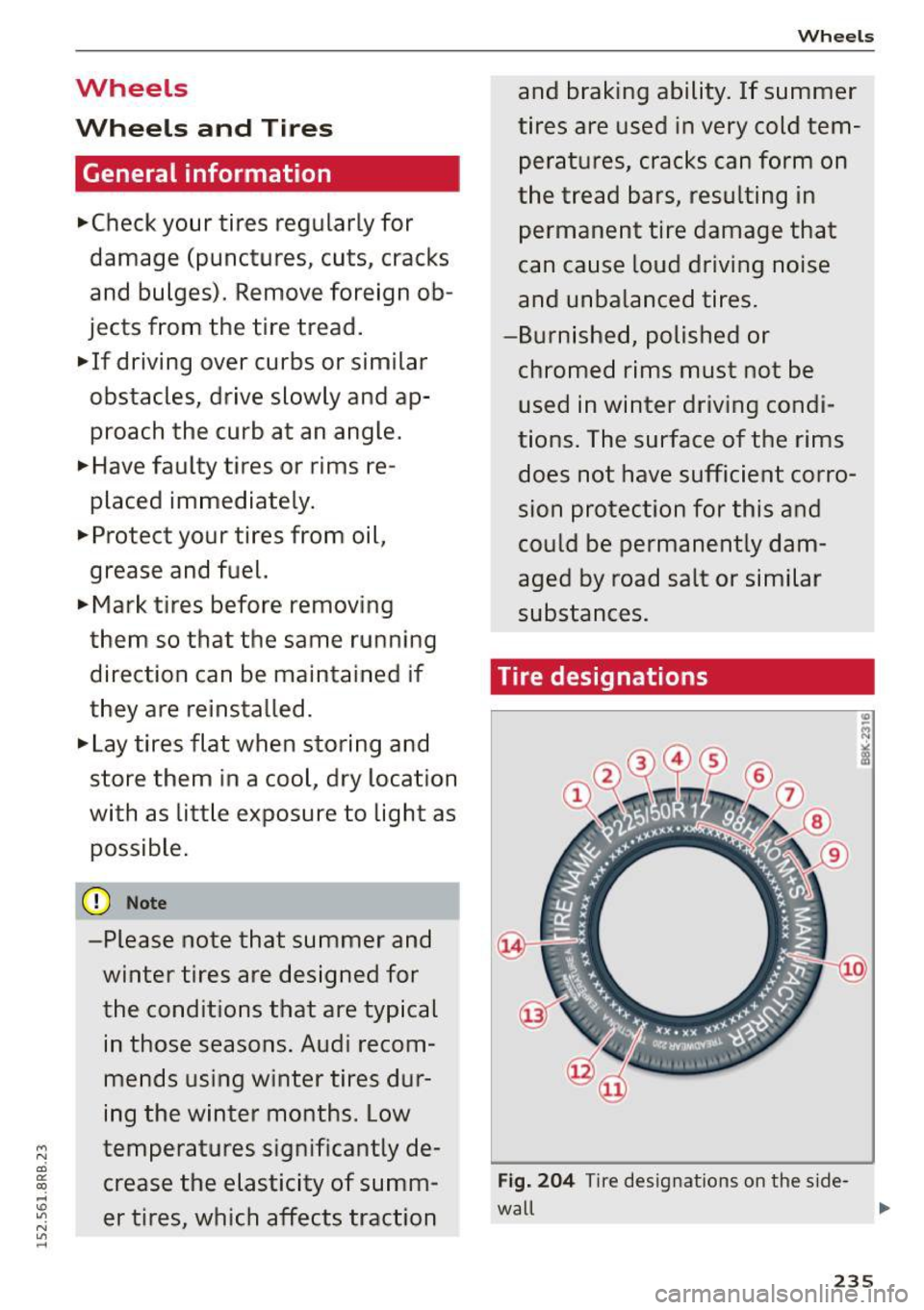
Fig. 204 T ir e designations on the sid e-
wall ,..
235
Page 238 of 302
Wheels
(D Tires for passenger vehicles
(if applicable)
P indicates a tire for a passenger
vehicle. T indicates a tire desig
nated for temporary use .
@ Nominal width
Nominal width of the tire be
tween the sidewalls in millime
ters . In general: the larger the
number, the wider the tire.
@ Aspect ratio
Height/width ratio expressed as a
percentage.
@ Tire construction
R indicates a radial tire.
® Rim diameter
Size of the rim diameter in inches .
@ Load index and speed rating
The load index indicates the tire's
load-carrying capacity.
The speed rating indicates the
maximum permitted speed
¢ & in
W inter tires on page 250 .
"EXTRA LOAD", "xl" or "RF" indi
cates that the tire is reinforced or
is an Extra Load tire.
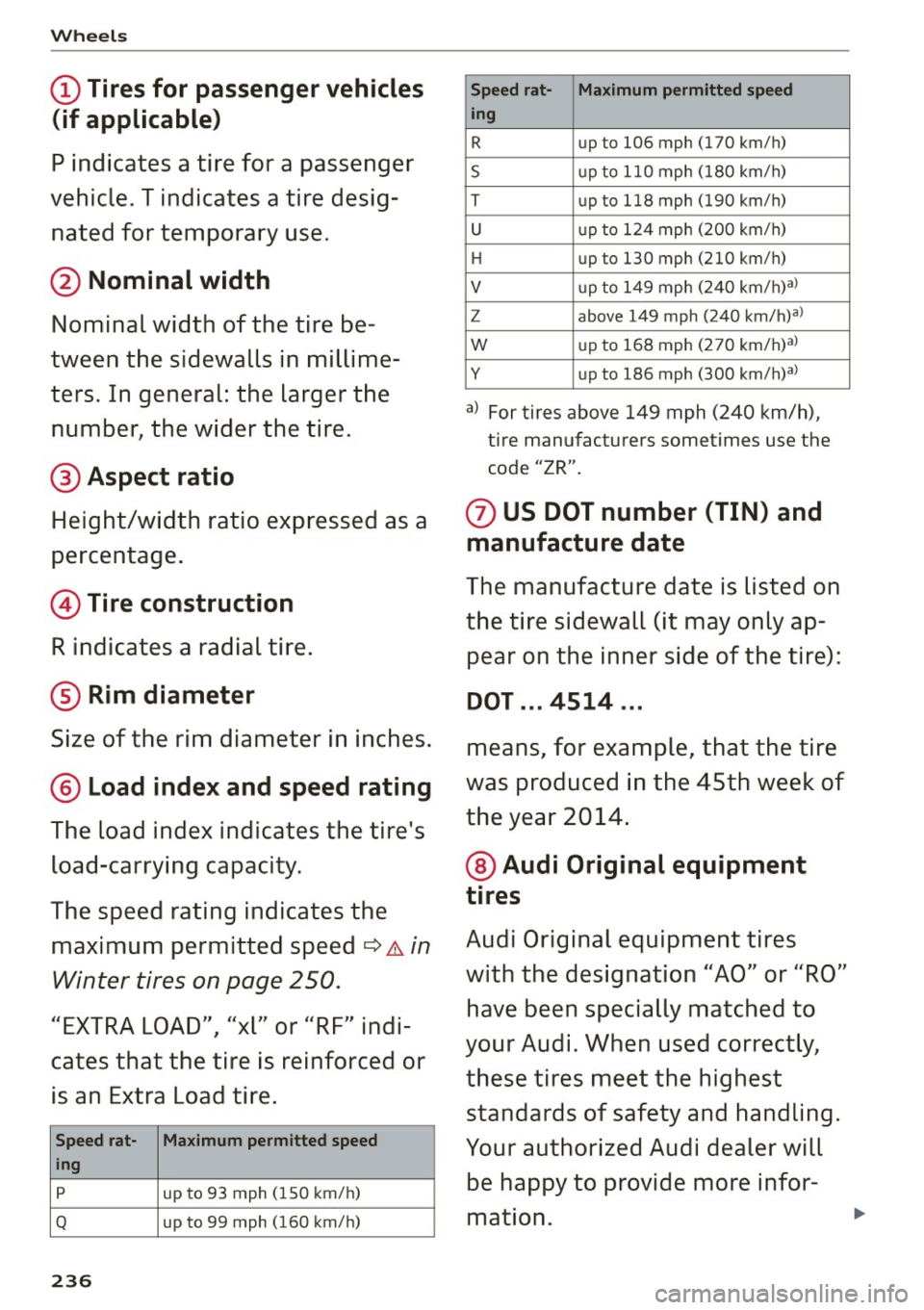
Speed rat- Maximum permitted speed
ing
p
up to 93 mph (150 km/h)
Q up to 99 mph (160 km/h)
236
Speed rat- Maximum permitted speed
Ing
R up t o 106 mph (170 km/h)
s up to 110 mph (180 km/h)
T up to 118 mph (190 km/h)
u up to 124 mph (200 km/h)
H up to 130 mph (210 km/h)
V up to 149 mph (240 km/h)a>
z above 149 mph (240 km/h)a)
w up to 168 mph (270 km/h)a)
y up to 186 mph (300 km/h)a)
a) For tires above 149 mph (240 km/h),
tire manufacturers sometimes use the
code "ZR".
(J) US DOT number (TIN) and
manufacture date
The manufacture date is listed on
the tire sidewall (it may only ap
pear on the inner side of the tire) :
DOT ... 4514 ...
means , for example, that the tire
was produced in the 45th week of
the year 2014.
@ Audi Original equipment
tires
Audi Original equipment tires
with the designation "AO" or "RO"
have been specially matched to
your Audi. When used correctly,
these tires meet the highest standards of safety and handling.
Your authorized Audi dealer will
be happy to provide more infor
mation.
Page 240 of 302
Wheels
Bead
means the part of the tire that is
made of steel wires, wrapped or
reinforced by ply cords and that is
shaped to fit the rim .
Bead separation
means a breakdown of the bond
between components in the bead.
Cord
means the strands form ing the
plies in the tire.
Cold tire inflation pressure
means the tire pressure recom
mended by the vehicle manufac
turer for a tire of a designated
size that has not been driven for
more than a coup le of miles (kilo
meters) at low speeds in the three
hour period before the tire pres
sure is measured or adjusted .
Curb weight
means the weight of a motor ve
hicle with standard equipment in
cluding the maximum capacity of
fuel, oi l, and coolant , air condi
tioning and additional weight of optional equipment.
E x tra load tire
means a tire des igned to operate
at higher loads and at higher in-
238
flation pressures than the corre
sponding standard tire . Extra load
tires may be identified as "XL",
"xl", "EXTRA LOAD", or "RF" on
the sidewall.
G ross A xle Weight Rating
("GAWR ")
means the load-carrying capacity
of a single axle system , measured
at the tire-ground interfaces .
Gross Vehicle Weight Rating
( "GVWR" )
means the max imum total loaded
weight of the vehicle .
Groove
means the space between two ad
jacent tread ribs .
Load rating (code )
means the max imum load that a
tire is rated to carry for a given in
flation pressure . You may not find
this information on all tires be cause it is not required by law.
Ma ximum load rating
means the load rating for a tire at
the maximum permissible infla
tion pressure for that tire .
Maximum loaded vehicle
w eight
means the sum of: ...