belt AUDI Q5 2015 Workshop Manual
[x] Cancel search | Manufacturer: AUDI, Model Year: 2015, Model line: Q5, Model: AUDI Q5 2015Pages: 302, PDF Size: 75.01 MB
Page 184 of 302
Child safety
A WARNING
Improperly installed child safety seats in
crease the risk of serious personal injury and
death in a collision.
- Always make sure that the safety belt re
tractor is locked when installing a child safe
ty seat . An unlocked safety belt retractor
cannot hold the child safety seat in place
during normal driving or in a crash.
- Always buckle the child safety seat firmly in
place even if a child is not sitting in it. A
loose child safety seat can fly around during
a sudden stop or in a collision.
- Always make sure that the rear seat back
rest to which the center rear safety belt is
attached is securely latched whenever the
rear center safety belt is being used to se
cure a child restraint.
- If the backrest is not securely latched, the
child and the child restraint will be thrown
forward together with the backrest and will
strike parts of the vehicle interior. The child
can be seriously injured or killed.
- Never install rear-facing child safety seats or
infant carriers on the front passenger seat.
A child will be seriously injured and can be
killed when the passenger airbag inflates .
- The inflating airbag will hit the child safety
seat or infant carrier with great force and
will smash the child safety seat and child
against the backrest, center armrest, door
or roof.
-Always install rear-facing child safety seats
or infant carriers on the rear seat.
- Forward-facing child safety seats or infant
carriers installed on the front passenger's
seat may interfere with the deployment of
the airbag and cause serious injury to the
child.
- It is safer to install a forward-facing child
safety seat on the rear seat.
- Always read and heed all WARNINGS when
ever using a child restrained in a vehicle is
being used
~page 172. Special precautions
apply when installing a child safety seat on
the front passenger seat~
page 153, Child
182
restraints on the front seat -some impor
tant things to know.
A WARNING
Always take special precautions if you must
install a forward or rearward-facing child re
straint on the front passenger's seat in excep
tional situations:
- Whenever a forward or rearward-facing
child restraint is installed on the front pas
senger seat, the
PASSENGER AIR BAG OFF
light must come on and stay on whenever
the ignition is switched on.
- If the PASSENGER AIR BAG OFF light does
not come on and stay on, perform the
checks described
~ page 162, Monitoring
the Advanced Airbag System.
-Take the child restraint off the front passen
ger seat and install it properly at one of the
rear seat positions if the
PASSENGER AIR
BAG OFF
light does not stay on whenever
the ignition is switched on.
- Improper installation of child restraints can
reduce their effectiveness or even prevent
them from providing any protection.
- An improperly installed child restraint can
interfere with the airbag as it deploys and
seriously injure or even kill the child .
- Always carefully follow the manufacturer's
instructions provided with the child safety
seat or carrier.
- Never place additional items on the seat
that can increase the total weight registered
by the weight-sensing mat and can cause in
jury in a crash.
A WARNING
Forward-facing child restraints:
-Always make sure the forward-facing seat
has been designed and certified by its man
ufacturer for use on a front seat with a pas
senger front and side airbag.
- Never put the forward-facing child restraint
up, against or very near the instrument pan
el.
-
.__ ________________ __J ...
Page 185 of 302
M N
co
a:
co
,...., \!) 1.1'1
N 1.1'1 ,....,
-Always move the passenger seat into its
rearmost position in the seat's fore and aft
adjustment range, as far away from the air
bag as possible before installing the for
ward-facing child restraint. The backrest must be adjusted to an upright position.
- Make sure that the
PASSENGER AIR BAG
OFF
light comes on and stays on all the time
whenever the ignition is switched on.
A WARNING
Rearward-facing child restraints:
-A child in a rearward-facing child safety seat
installed on the front passenger seat will be
seriously injured and can be killed if the
front airbag inflates - even with an Ad
vanced Airbag System.
- The inflating airbag will hit the child safety
seat or infant carrier with great force and
will smash the child safety seat and child
against the backrest, center armrest, door
or roof.
- Always be especially careful if you must in
stall a rearward facing child safety seat on
the front passenger seat in exceptional cir cumstances.
- A tight tether strap on a rearward-facing
child restraint attached to the front passen
ger seat can put too much pressure on the
weight-mat in the seat and register a heavi er weight in the Advanced Airbag System.
The heavier weight registered can make the
system work as though an adult were on the
seat and deploy the Advanced Airbag when
it must be suppressed causing serious or
even fatal injury to the child.
- Make sure that the
PASSENGER AIR BAG
OFF
light comes on and stays on all the time
whenever the ignition is switched on.
- If the
PASSENGER AIR BAG OFF light does
not come on and stay on, immediately in
stall the rear-facing child safety seat in a
rear seating position and have the airbag
system inspected by your Audi dealer.
Child safety
Activating the convertible locking retractor
Use the convertible locking retractor to secure a
child restraint .
Always heed the child safety seat manufacturer's
instructions when installing a child restraint in
your vehicle . To activate the convertible locking
retractor:
.. Place the child restraint on a sea t, preferably on
the rear seat.
.. Slowly pull the belt all the way out.
.. Route it around or through the child restraint
belt path
~ . & .
.. Push the child safety seat down with your full
weight to get the safety belt really tight.
.. Insert the belt tongue into the buckle for that
seating position.
.. Guide the safety belt back into the retractor un
til the belt lies flat and snug on the child safety
seat .
.. You should hear a "clicking" noise as the belt
winds back into the inertia reel. Test the con
vertible locking retractor by pulling on the belt .
You should no longer be able to pull the belt
out of the retractor. The convertible locking re
tractor is now activated .
.. Make sure that the red release button is facing
away from the child restraint so that it can be
unbuckled quickly.
.. Pull on the belt to make sure the safety belt is
properly tight and fastened so that the seat
cannot move forward or sideways more than
one inch (2 .5 cm) .
A WARNING
Using the wrong child restraint or an improp
erly installed child restraint can cause serious
personal injury or death in a crash .
- Always make sure that the safety belt re
tractor is locked when installing a child safe
ty seat. An unlocked safety belt retractor
cannot hold the child safety seat in place
during normal driving or in a crash.
- Always buckle the child safety seat firmly in place even if a child is not sitting in it. A
loose child safety seat can fly around during
a sudden stop or in a crash. ..,.
183
Page 186 of 302
Child safet y
-Always make sure the seat backrest to which
the chi ld restraint is installed is in an up
right position and secure ly latched into
place and cannot fold forward. Otherw ise,
the seatback with the ch ild safety seat at
tached to it co uld fly forward in the event of
an accident or other emergency sit uat ion.
- Always read and heed all WARN INGS when
ever using a child restrained in a vehicle is
being used ¢
page 172. Special precautions
apply when installing a child safety seat on
the front passenger seat¢
page 153, Child
restraints on the front seat -some impor
tant things to know.
Deactivating the convertible locking
retractor
The convertible locking retractor for child re
straints will be deactivated automatically when
the belt is wound all the way back into the re
tractor .
~ Press the red button on the safety be lt buck le.
Th@ belt tongue will pop out of the buckle.
~ Guide the safety belt all the way back into its
stowed position .
A lways let the safety belt retract complete ly into
its stowed position . The safety belt can now be
used as an ordinary safety be lt without the con
vertible locking retractor for child restra ints .
If the convert ible locking retractor should be ac
tivated inadvertently, the safety belt must be un
fastened and guided completely back into its
stowed position to deact ivate this feature .
If the
convert ible locking retractor is not deactivated,
the safety belt wi ll gradua lly become t ighter and
uncomfo rtable to wear.
_& WARNING
Imprope rly installed child safety seats in
crease the risk of serious persona l injury and
death in a collision .
-
-Never unfasten the sa fety belt to deac tivate
the convertible locking retractor for child re
straints while the vehicle is moving. You
184
wou ld not be restrained and could be seri
ously inj ured in an accident.
- Always read and heed a ll WARNINGS when
ever us ing a child restrained in a vehicle is
be ing used
¢page 172. Special precaut ions
apply when installing a child safety seat on
the front passenger seat
r=> page 153, Child
restraints on the front seat -some impor
tant things to know.
LATCH system (Lower
anchorages and tethers
for children)
' Child Restraint System anchors and how
are they related to child safety
To provide a simpler and more practicable way to
attach the ch ild restraint on the vehicle seat, Fed
eral regulat ions require spec ial lower anchorages
i n vehicles and devices on new child restraints to
attach to the vehicle anchorages.
The combination of the tether anchorages and
the lower anchorages is now generally called the
LATCH system for " Lower Anchorages and
Tethers for C hildren ."
Forward-facing chi ld restraints manufactured af
ter September 1, 1999, are required by U.S. fed eral regulat ions to comp ly w ith new ch ild head
movement performance requirements . These
new performance requirements make a tether
necessary on most new child seats .
Installing a ch ild restraint that requires a top
tether without one can seriously impair the per
formance of the ch ild restra int and its ability to
protect the ch ild in a collision . Install ing a chi ld
r est raint that requi res a top tether w it h out t he
top tether m ay be a v io la tion of state law.
Child rest raint manufacturers offer LATCH lower
anchorages on the ir chi ld seats with hook-on or
push-o n connectors attached to adjustable
straps.
In add ition to the LATCH lower anchorages, these
c hi ld restra int systems usually requ ire the use of
tethe r straps to he lp keep the ch ild restrai nt
firmly i n place. .,.
Page 187 of 302
M N
co ~ co
rl I.O
"' N
"' rl
,&_ WARNING
Improper insta llation of chi ld restraints will
increase the risk of injury and death in a crash.
- Always follow the instructions prov ided by
the manufacturer of the child restraint you intend to install in your vehicle.
- Never install a child restraint witho ut a
properly attached top tether strap if the
child restraint manufacturer's instructions
requ ire the top tether strap to be used.
- Improper use of child restraint LATCH lower
anchorage points can lead to injury in a colli
sion. The LATCH lower anchorage po ints are
designed to withstand only those loads im
posed by correctly fitted ch ild restraints.
- Never mount two child restraint systems on
one LATCH lower anchorage point .
- Never secure or attach any luggage or other
item to the LATCH lower anchorages.
(D Tips
- In Canada, the terms "top tether" with
"lower universa l anchorages" (or "lower uni
versal anchorage bars") are used to describe
the system.
- In other countries, the term "ISO FIX" is used to describe the lower anchorages.
Location
i
"' m
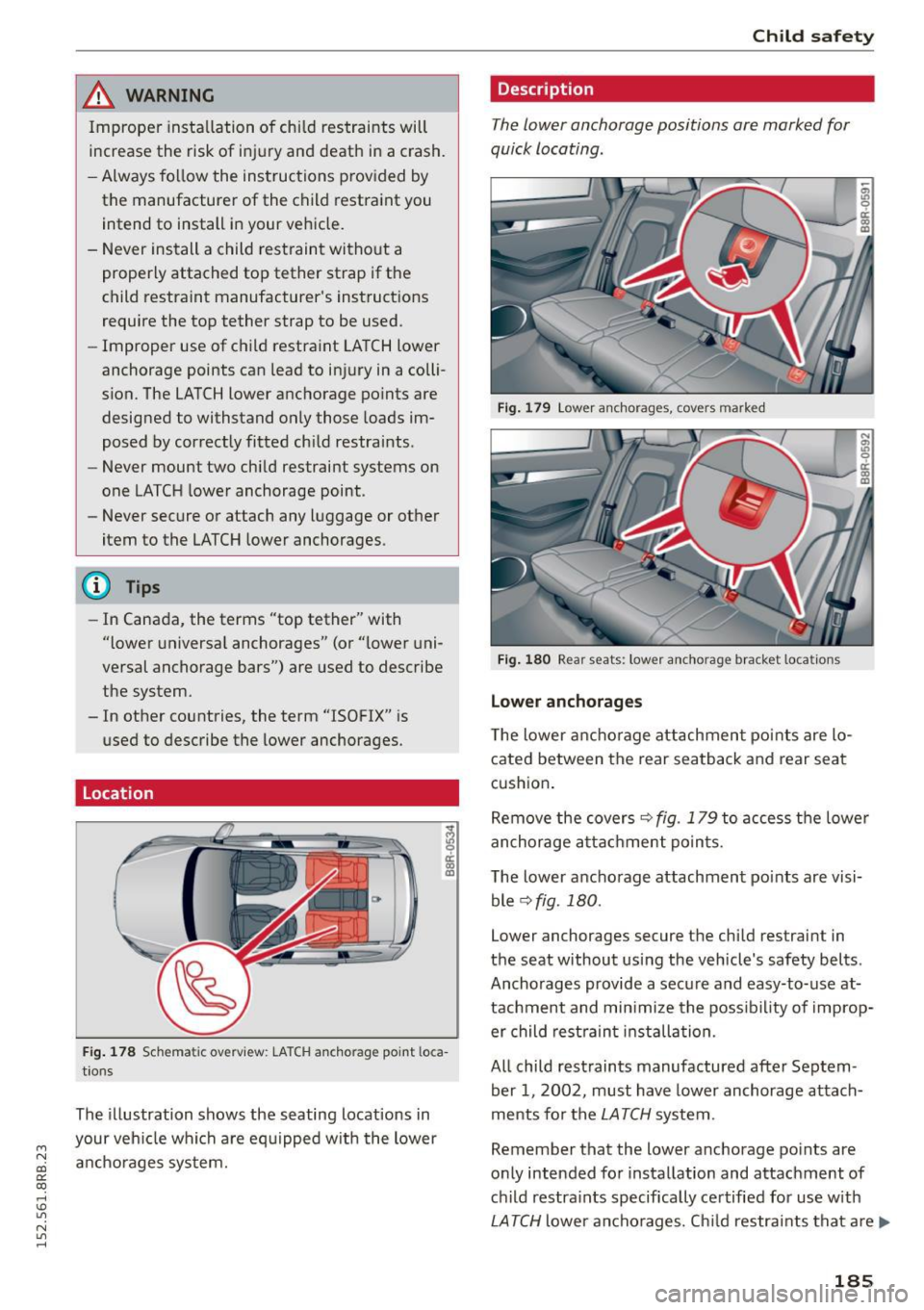
Fig . 178 Schematic overview : LATCH anc ho rage point loca
tions
The illustration shows the seating locations in
your ve hicle which are eq uipped w ith the lower
anchorages system.
Chil d sa fe ty
Description
The lower anchorage positions are marked for
quick locating .
Fig. 179 Lower anchorages, cove rs m arked
Fig . 1 80 Rea r seats: lower ancho rage bracket locat ions
Lower anch orages
The lower a nch o rage attachmen t po ints are lo
cated between the rear seatback and rear seat
cushion .
Remove the covers
Q fig . 179 to access the lowe r
anchorage a ttac hment po in ts.
The lower anchorage attachment points are visi ble
9 fig. 180.
Lower anchorages secure the child restraint in
the seat without using the vehicle's safety belts.
Anchorages provide a secure and easy-to-use at
tachment and min imize the poss ibi lity of improp
er child restrain t installation.
All child restraints manufactured after Septem ber 1, 2002, must have lower anchorage attach
ments for the
LATCH system .
Remember that the lower anchorage points are
only intended fo r installation and attachment of
ch ild restra ints specifically certified for use w ith
LATCH lower anchorages. Ch ild restra ints that are..,_
185
Page 188 of 302
Child safety
not equipped with the lower anchorage attach
ments can still be installed in compliance with
the child restraint manufacturer's instructions on
using vehicle safety bel ts .
A WARNING
Improper use of LATCH lower anchorages can
cause serious personal injury in an accident.
- Always carefully follow the child restraints
manufacturer's instructions for proper in
stallation of the child restraint and proper
use of the lower anchorages or safety belts
in your vehicle.
- Never secure or attach any luggage or other
items to the
LATCH lower anchorages.
-Always read and heed the important infor
mation about child restraints in this chapter
and WARNINGS
¢ page 172, Child safety.
Installing a child restraint with LATCH
lower anchorages
Whenever you install a child restraint always fol
low the child restraint manufacturer's instruc tions.
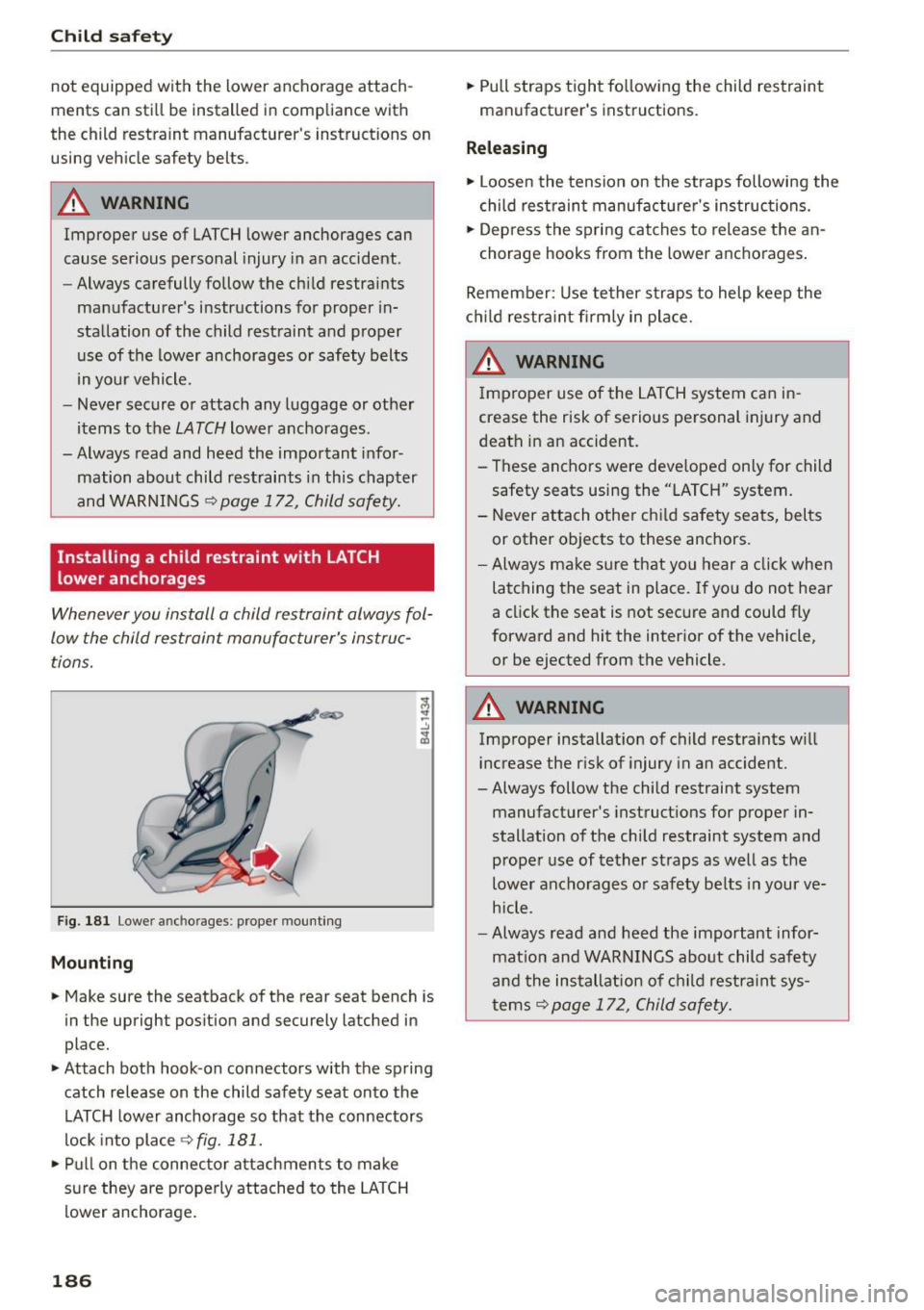
Fig. 181 L owe r an ch orages : proper mounting
Mounting
~ Make sure the seatback of the rear seat bench is
in the uprigh t position and securely latched in
place.
~ Attach both hook-on connectors with the spring
catch release on the child safety seat onto the
LATCH lower anchorage so that the connectors
lock into place
¢fig. 181.
~ Pull on the connector attachments to make
sure they are properly attached to the LATCH
lower anchorage.
186
~ Pull straps tight following the child restraint
manufacture r's instructions.
Releasing
~ Loosen the tension on the straps following the
child restraint manufacturer's instructions.
~ Depress the spring catches to release the an
chorage hooks from the lower anchorages.
Remember : Use tether straps to help keep the
child restraint firmly in place.
A WARNING
Improper use of the LATCH system can in
crease the risk of serious personal injury and
death in an accident .
-
-These anchors were developed only for child
safety seats using the "LATCH" system.
- Never attach other child safety seats, belts
or other objects to these anchors.
- Always make sure that you hear a click when
latching the seat in place. If you do not hear
a click the seat is not secure and could fly
forward and hit the interior of the vehicle, or be ejected from the vehicle.
A WARNING
Improper installation of child restraints will increase the risk of injury in an accident.
- Always follow the child restraint system manufacturer's instructions for proper in
stallation of the child restraint system and
proper use of tether straps as well as the
lower anchorages or safety belts in your ve
hicle .
- Always read and heed the important infor
mation and WARNINGS about child safety
and the installation of child restraint sys
tems
~ page 172, Child safety.
Page 189 of 302
M N
co ~ co
rl I.O
"' N
"' rl
Tether anchors and tether straps
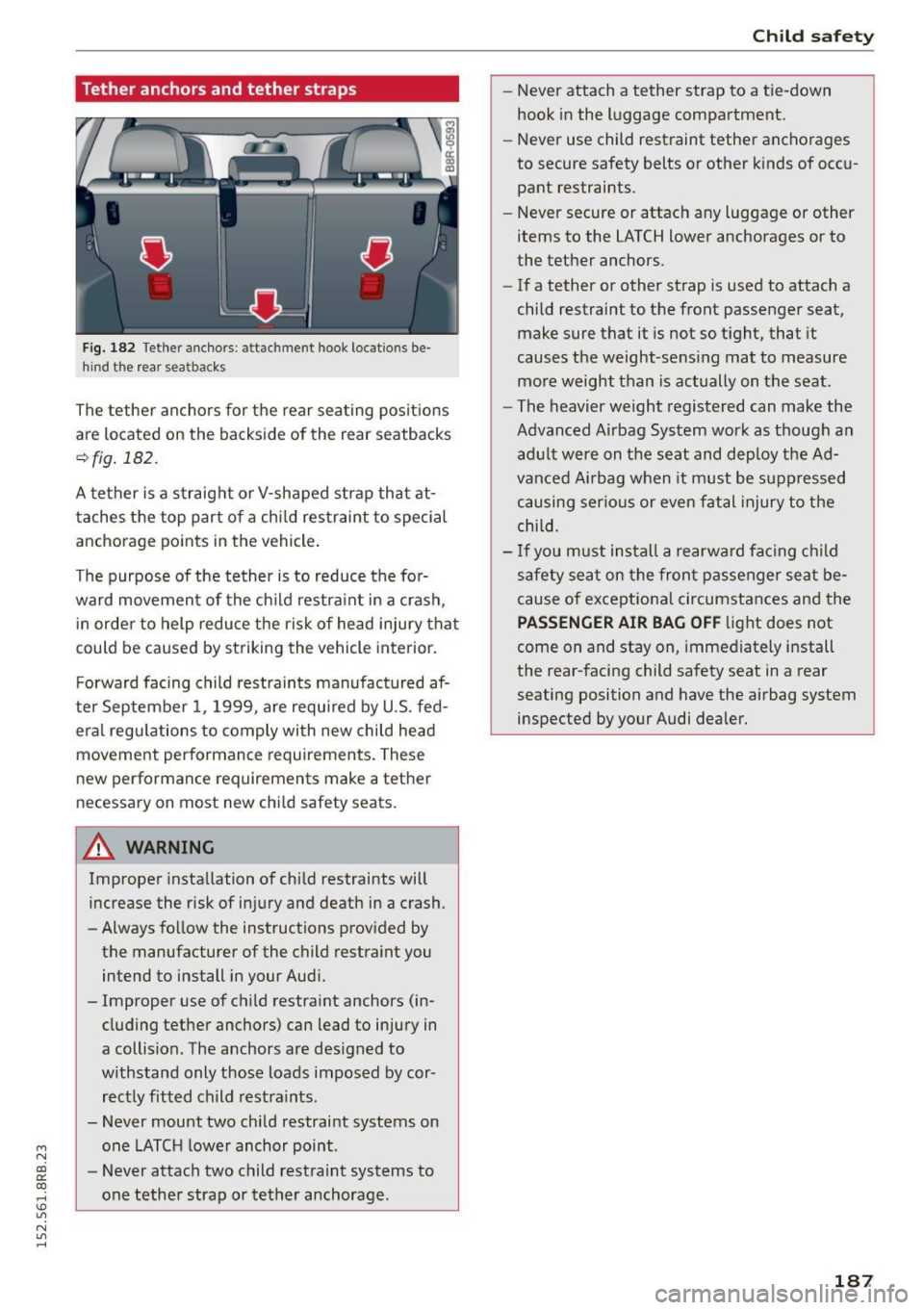
Fig. 182 Tether ancho rs: attach ment hook locatio ns be·
h ind t he rear sea tbacks
The tethe r anchors for the rear seating posit ions
are located on the backside of the rear seatbacks
¢ fig . 182 .
A tether is a s traig ht or V-shaped strap that at
taches the top part o f a ch ild restraint to special
anchorage points in the vehicle .
The purpose of the tether is to reduce the fo r
ward movemen t of the ch ild restra int in a crash ,
i n orde r to help reduce the ris k of head injury that
could be caused by striking the vehicle interior.
F orward facing child restra ints manufact ured af
ter September 1, 1999, are requ ired by U.S. fed
eral reg ulations to comply with new child head
movement performance requirements . These
new performance requirements make a tether
necessary on most new chi ld safety seats.
A WARNING
Improper installation of chi ld restraints will
increase the risk of i nju ry and death in a crash.
- Always fo llow the instructions prov ided by
the manufacturer of the child restra int you
intend to install in your Aud i.
- Improper use of ch ild restraint anchors (in
cluding tether anchors) can lead to injury in
a collision . The anchors are des igned to
withstand only those loads imposed by cor
rectly fitted child restra ints .
- Never mount two chi ld restraint systems on
one LATC H lower anchor point .
- Never attach two child restraint systems to
one tether strap or tether anchorage .
Child sa fe ty
- Never attach a tether strap to a tie-down
hook in the luggage compa rtment.
- Never use child restraint tether ancho rages
to secure safety belts or other k inds of occ u
pant restraints.
- Never secure or attach any luggage or other
items to the LATCH lower anchorages or to
the tether anchors.
- If a tether or other strap is used to attach a
child restraint to the front passenger seat,
make sure that it is not so t ight, that it
causes the weight -sens ing mat to measure
mo re weight than is actually on the seat .
- The heavier weight registered can make the
Advanced A irbag System work as though an
adult were on the seat and dep loy the Ad
vanced Ai rbag when it must be suppressed
causing ser ious or even fatal injury to the
child.
- If you m ust ins tall a rearwa rd fa cing c hild
safety sea t on the fron t passenger se at be
cause of except iona l circumstances and the
PASSENGER AIR BAG OFF light does not
come on and stay on , immediately install
the rear-facing child safety seat in a rear
seating position and have the airbag system
inspected by your Audi dealer.
187
Page 191 of 302
M N
co
a:
co
,...., \!) 1.1'1
N 1.1'1 ,....,
-If you must install a rearward facing child
safety seat on the front passenger seat be
cause of exceptional circumstances and the
PASSENGER AIR BAG OFF light does not
come on and stay on, immediately install
the rear-fac ing ch ild safety seat in a rea r
seating pos it ion and have the airbag system
inspec ted by your A udi dealer.
Additional information
Sources of information about child
restraints and their use
There are a numbe r of sources of additional infor
mat ion about ch ild restra int select ion, installa
tion and use:
NHTSA advises that the best child safety seat is
the one t hat fits your ch ild and f its in your vehi
cle, and that you will use co rrectly and consis
tently.
T ry before you buy!
U.S National Highway T raffic Safety Administra
tion
Te l.: 1-888-327-4236 (TTY: 1-800-424-9153)
http :/ /www .nhtsa .gov
National SAFE KIDS Campaign
Te l.: (202) 662-0600
h ttp://www.safekids.org
Safety BeltS afe U .S .A
T e l. : (800) 745-SAFE (English)
Te l.: (800) 747-SANO (Spanish)
h ttp://www.carseat.org
T ran spo rt Canada Info rm ation Cent re
T e l. : 1-800-333-0371 or call 1-613-998-8616 i f
you are in t he Ottawa area
h ttp://www.tc.gc.ca/eng/roadsafety/menu. htm
Audi Customer Relations
Te l. : (800) 822 -2834
Child sa fety
189
Page 192 of 302
Smart Technology
Smart Technology Notice about data
recorded by the Event
Data Recorder and
vehicle control modules
Event Data Recorder
This vehicle is equipped with an Event Data Re
corder (EDR) . The main purpose of an EDR is to
record, in certain crash or near crash-like situa
tions, such as an airbag deployment or hitting a
road obstacle, data that will assist in understand
ing how a vehicle 's systems performed . The EDR
is designed to record data related to vehicle dy
namics and safety systems for a short period of
time, typically 30 seconds or less . The EDR in this
veh icle is designed to record such data as:
- How various systems in your vehicle were oper
at ing;
- Whe ther or not the driver and passenger safety
belts were buckled/fastened;
- How far (if at all) the driver was depressing the
accelerator and/or brake pedal; and,
- How fast the vehicle was traveling.
These data can help provide a better understand
ing of the circumstances in which crashes and in
juries occur. NOT E: EDR data are recorded by your
vehicle only if a non-trivial crash situation occurs;
no data are recorded by the EDR under normal
driving conditions and no personal data (e.g .,
name, gender , age, and crash location) are re
corded. However, other part ies, such as law en
forcement, could combine the EDR data with the
type of personally identify ing data routinely ac
qui red during a crash investigation.
To read data recorded by an EDR, special equip
ment is requ ired, and access to the vehicle or the
E DR is needed. In addition to the vehicle manu
facturer, other parties, such as law enforcement,
that have the specia l equipment , can read the in
formation if they have access to the vehicle or the E DR.
Some state laws restrict the retrieval or down
loading of data stored by EDRs installed in a vehi
cle for the express purpose of retrieving data af-
190
ter an accident or crash event without the own
er's consent.
Audi will not access the EDR and/or similar data
o r g ive it to others -
- unless the veh icle owner (or lessee if the veh i
cle has been leased) agrees; or
- upon the official request by the police; or
- upon the order of a court of law or a govern-
ment agency; or
- for the defense of a lawsuit through the judicial
discovery process .
- Audi may also use the data for research about
veh icle operation and safety performance or
provide the data to a third party for research
purposes without identifying the spec ific vehi
cle or information about the ident ity of its own
er or lessee and only after the recorded vehicle
data has been accessed.
Vehicle control modules
Your vehicle is also equipped with a number of
electronic control modules for var ious vehicle
systems, such as engine management, emission
control, airbags, and safety belts .
These electronic control modules record data dur ing norma l vehicle operation that may be
needed by trained technicians for diagnostic and
repair purposes. The recording capabil ity of these
modules is lim ited to data (no sound is recorded).
Only a small amount of data is actua lly recorded
over a very limited period of time, or stored when
a system fau lt is detected by a contro l modu le.
Some of the data stored may relate to vehicle
speed, direction, or braking, as well as restraint
system use and performance in the event of a crash. Stored data can also only be read and
down loaded w ith specia l equipment that is di
rectly connected to the vehicle.
(D Tips
Your vehicle may be equipped with Audi con
nect . Your use of certain Audi connect fea
tures requires wireless serv ices that are p ro
v ided by a third party wireless telecommuni
cations provider . For details regarding how in
formation obtained through Audi connect is
collected, processed, transmitted, used, and ..,..
Page 212 of 302
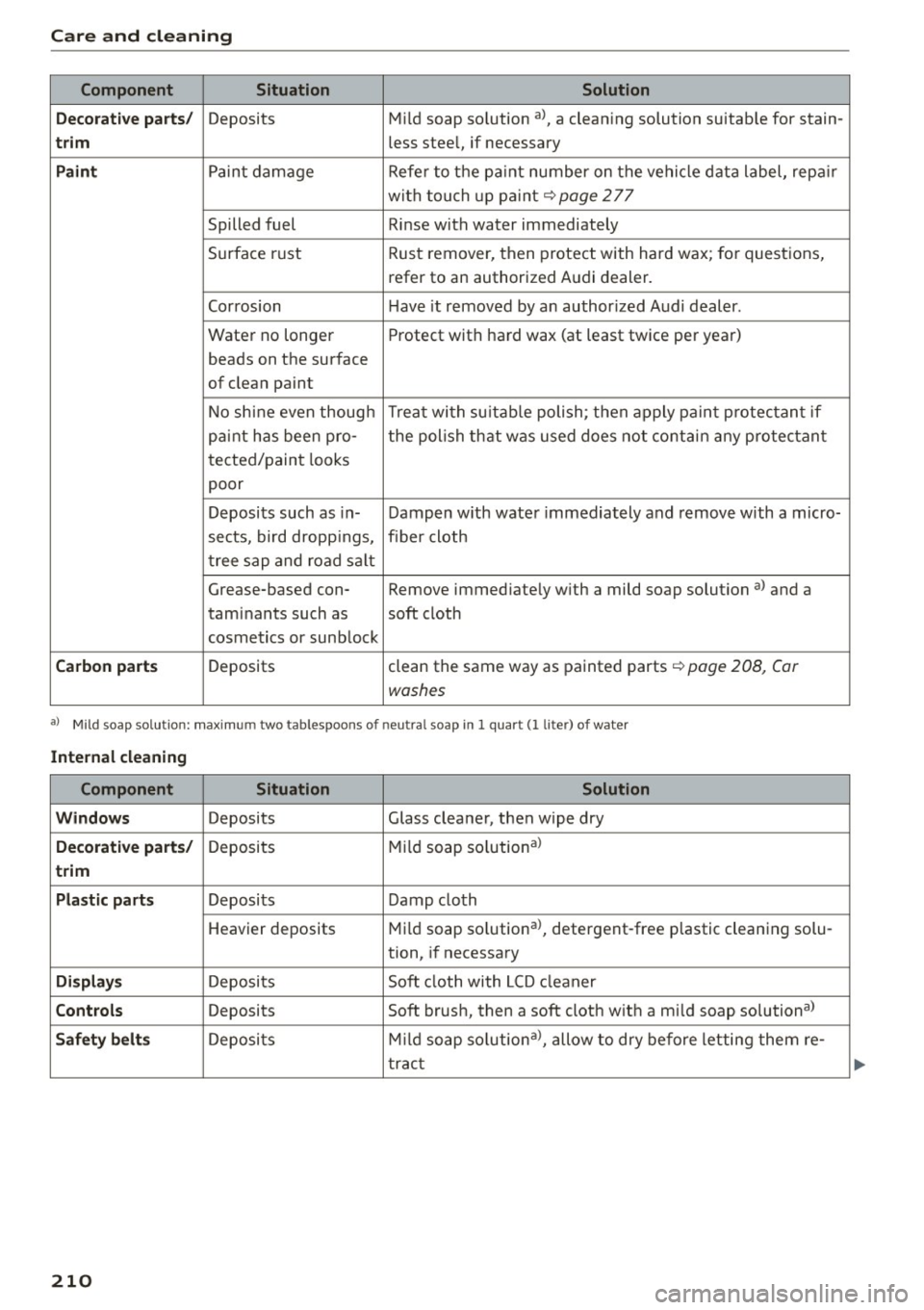
Care and cleaning
Component Situation Solution
Deco ra ti ve part s/
Deposits Mild soap solution al, a cleaning solution suitable for stain-
trim less stee l,. if necessary
P ain t Paint damage Refe r to the pa int number on the vehicle data label, repair
with touch up pa int
r=;, page 277
Spilled fuel Rinse with water immediately
Surface rust Rust remover, then protect with hard wax; for questions,
refer to an authorized A udi dealer.
Corrosion Have it removed by an author ized Audi dealer .
Water no longer Protect w ith hard wax (at least twice per year)
beads on the surface
of clean paint
No shine even though Trea t wi th su itab le polish; then apply paint p rotectant if
paint has been pro- the polish that was used does not conta in any protectant
tected/paint looks
poor
Deposits such as in- Dampen w ith water immediately and remove with a micro-
sects, bird dropp ings, fiber cloth
t ree sap and road sa lt
Grease-based con-Remove immediate ly w ith a mild soap solution a) and a
taminants such as soft cloth
cosmetics or sunblock
Carb on part s Deposits clean
the same way as painted parts r=;, page 208, Car
washes
aJ Mild soa p solut ion: maxim um two tablespoons of neutral soap in 1 quar t (l liter) of water
Internal cleani ng
Component Situation Solution
W indows
Deposits Glass cleaner, then wipe dry
Decorati ve parts / Deposits M
ild soap so lution al
trim
Pla stic part s
Deposits Damp clo1th
Heavier deposits Mild
soap solution a>, detergent-free plastic cleaning solu-
tion, if necessary
Di sp lay s Deposits Soft cloth with LCD cleaner
Cont ro ls Deposits Soft brush, then a soft cloth with a mi ld soap solutional
Safet y belt s Deposits Mild soap solutiona >, allow to dry before letting them re-
tract
210
Page 214 of 302
Care and cleaning
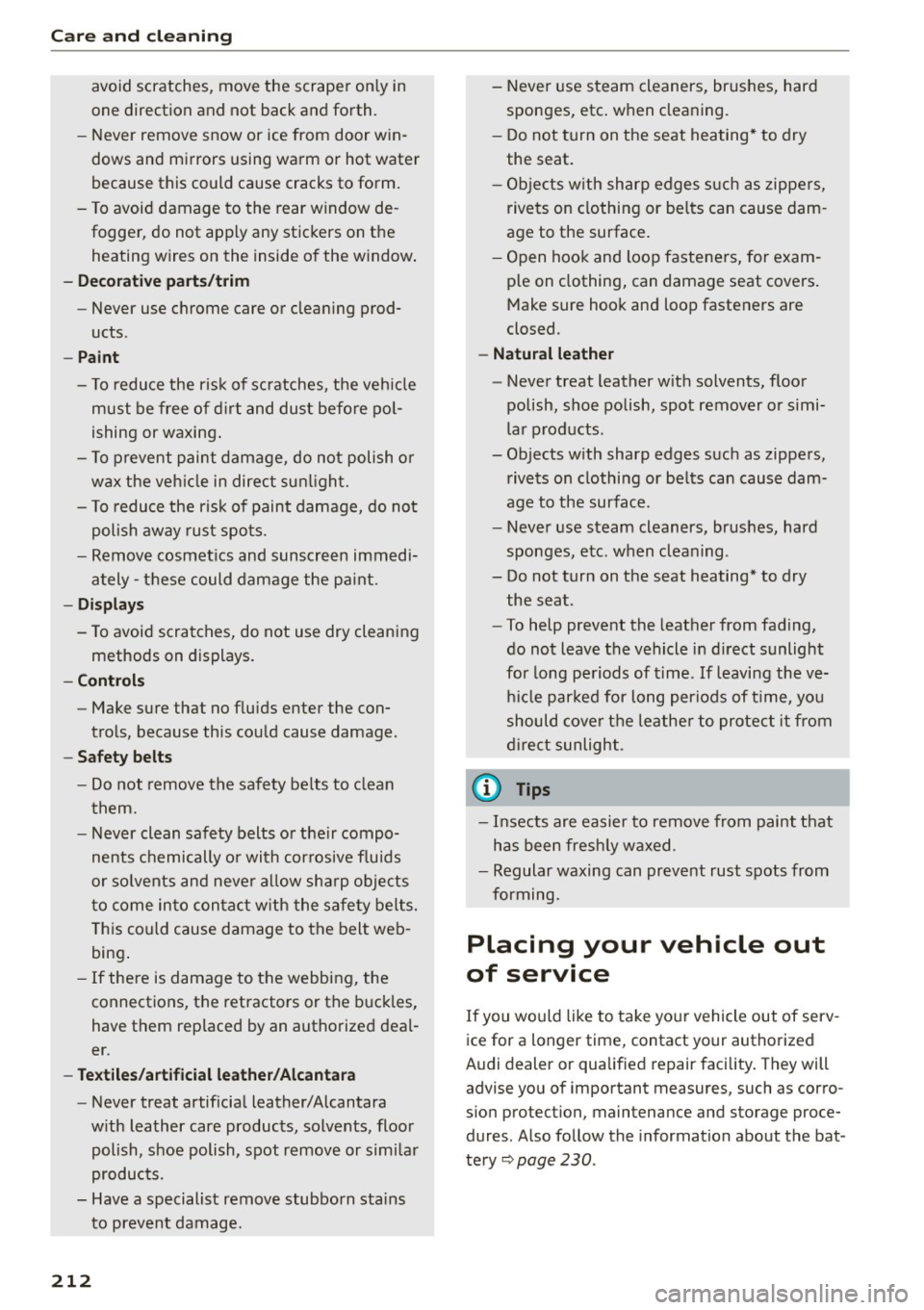
avoid scratches, move the scraper on ly in
one direction and not back and forth.
- Never remove snow or ice from door win
dows and mirrors using warm or hot water
because this could cause cracks to form.
- To avoid damage to the rear window de fogger, do not apply any stickers on the
heating wires on the inside of the window .
- Decorati ve p art s/ trim
- Never use chrome care or clean ing prod-
ucts .
- Paint
- To reduce the ris k of sc ratches, the veh icle
must be free of d irt and dust befo re po l
ishing or waxing .
- T o prevent paint damage, do not polish o r
wax the veh icle in direct sun light.
- To reduce the ris k of paint damage, do not
polish away rust spots.
- Remove cosmet ics and sunscreen immedi
ately -these could damage the paint.
- Di spla ys
- To avoid scratches, do not use dry cleaning
methods on displays.
- Control s
- Make sure that no flu ids enter the con-
tro ls, because this cou ld cause damage.
- Safety belt s
- Do not remove the safety be lts to clean
them.
- Never clean safety belts or the ir compo
nents chemically or wi th cor rosive f luids
or so lvents and never al low sha rp objects
t o come into con ta ct w ith the safe ty belts.
T his could cause damage to the belt web
bing .
-If there is damage to the webbing, the
connections, the retractors or the b uckles,
have them replaced by an autho rized deal
er.
- Textiles /artificial le athe r/Alcantara
- Never treat artificia l leather/Alcantara
w ith leather care products, solvents, floor
polish, shoe polish, spot remove or simi lar
products.
- Have a specialist remove stubborn stains
to prevent damage.
212
- Neve r use steam cleaners, brushes, hard
sponges, etc . when cleaning .
- D o not turn on the seat heating* to dry
the seat.
- Objects w ith sharp edges s uch as zippe rs,
rivets on clothing or be lts can cause dam
age to the surface.
- Open hook and loop fasteners, for exam
p le on clothing, can damage seat covers .
Make sure hook and loop fasteners are
closed.
- Natu ral leathe r
- Never treat leather w ith solvents, floor
polish, shoe polish, spot remover or simi
lar p roducts .
- Objects w ith sharp edges such as zippers,
rivets on clothing or be lts can cause dam
age to the surface .
- Neve r use steam cleaners, brushes, hard
sponges, etc. when cleaning .
- Do not turn on the seat heating * to dry
the seat.
- To help prevent the leather from fad ing,
do not leave the vehicle in d irect sunlight
for long periods of time . If leaving the ve
h icle parked for long periods of t ime, you
should cove r the leathe r to protect it from
d irect sunlight.
{D Tips
- Insects are easier to remove from paint that
has been fresh ly waxed.
- Regular waxing can prevent rust spots from
forming.
Placing your vehicle out
of service
If you would like to take your vehicle out of serv
ice for a longer time, contact your authorized
A udi dealer or qualified repair facility. They will
advise you of important measures, such as corro
s ion protection, maintenance and storage proce
dures. Also follow the information about the bat
tery~
page 230 .