warning light AUDI Q5 2015 Manual Online
[x] Cancel search | Manufacturer: AUDI, Model Year: 2015, Model line: Q5, Model: AUDI Q5 2015Pages: 302, PDF Size: 75.01 MB
Page 185 of 302
M N
co
a:
co
,...., \!) 1.1'1
N 1.1'1 ,....,
-Always move the passenger seat into its
rearmost position in the seat's fore and aft
adjustment range, as far away from the air
bag as possible before installing the for
ward-facing child restraint. The backrest must be adjusted to an upright position.
- Make sure that the
PASSENGER AIR BAG
OFF
light comes on and stays on all the time
whenever the ignition is switched on.
A WARNING
Rearward-facing child restraints:
-A child in a rearward-facing child safety seat
installed on the front passenger seat will be
seriously injured and can be killed if the
front airbag inflates - even with an Ad
vanced Airbag System.
- The inflating airbag will hit the child safety
seat or infant carrier with great force and
will smash the child safety seat and child
against the backrest, center armrest, door
or roof.
- Always be especially careful if you must in
stall a rearward facing child safety seat on
the front passenger seat in exceptional cir cumstances.
- A tight tether strap on a rearward-facing
child restraint attached to the front passen
ger seat can put too much pressure on the
weight-mat in the seat and register a heavi er weight in the Advanced Airbag System.
The heavier weight registered can make the
system work as though an adult were on the
seat and deploy the Advanced Airbag when
it must be suppressed causing serious or
even fatal injury to the child.
- Make sure that the
PASSENGER AIR BAG
OFF
light comes on and stays on all the time
whenever the ignition is switched on.
- If the
PASSENGER AIR BAG OFF light does
not come on and stay on, immediately in
stall the rear-facing child safety seat in a
rear seating position and have the airbag
system inspected by your Audi dealer.
Child safety
Activating the convertible locking retractor
Use the convertible locking retractor to secure a
child restraint .
Always heed the child safety seat manufacturer's
instructions when installing a child restraint in
your vehicle . To activate the convertible locking
retractor:
.. Place the child restraint on a sea t, preferably on
the rear seat.
.. Slowly pull the belt all the way out.
.. Route it around or through the child restraint
belt path
~ . & .
.. Push the child safety seat down with your full
weight to get the safety belt really tight.
.. Insert the belt tongue into the buckle for that
seating position.
.. Guide the safety belt back into the retractor un
til the belt lies flat and snug on the child safety
seat .
.. You should hear a "clicking" noise as the belt
winds back into the inertia reel. Test the con
vertible locking retractor by pulling on the belt .
You should no longer be able to pull the belt
out of the retractor. The convertible locking re
tractor is now activated .
.. Make sure that the red release button is facing
away from the child restraint so that it can be
unbuckled quickly.
.. Pull on the belt to make sure the safety belt is
properly tight and fastened so that the seat
cannot move forward or sideways more than
one inch (2 .5 cm) .
A WARNING
Using the wrong child restraint or an improp
erly installed child restraint can cause serious
personal injury or death in a crash .
- Always make sure that the safety belt re
tractor is locked when installing a child safe
ty seat. An unlocked safety belt retractor
cannot hold the child safety seat in place
during normal driving or in a crash.
- Always buckle the child safety seat firmly in place even if a child is not sitting in it. A
loose child safety seat can fly around during
a sudden stop or in a crash. ..,.
183
Page 189 of 302
M N
co ~ co
rl I.O
"' N
"' rl
Tether anchors and tether straps
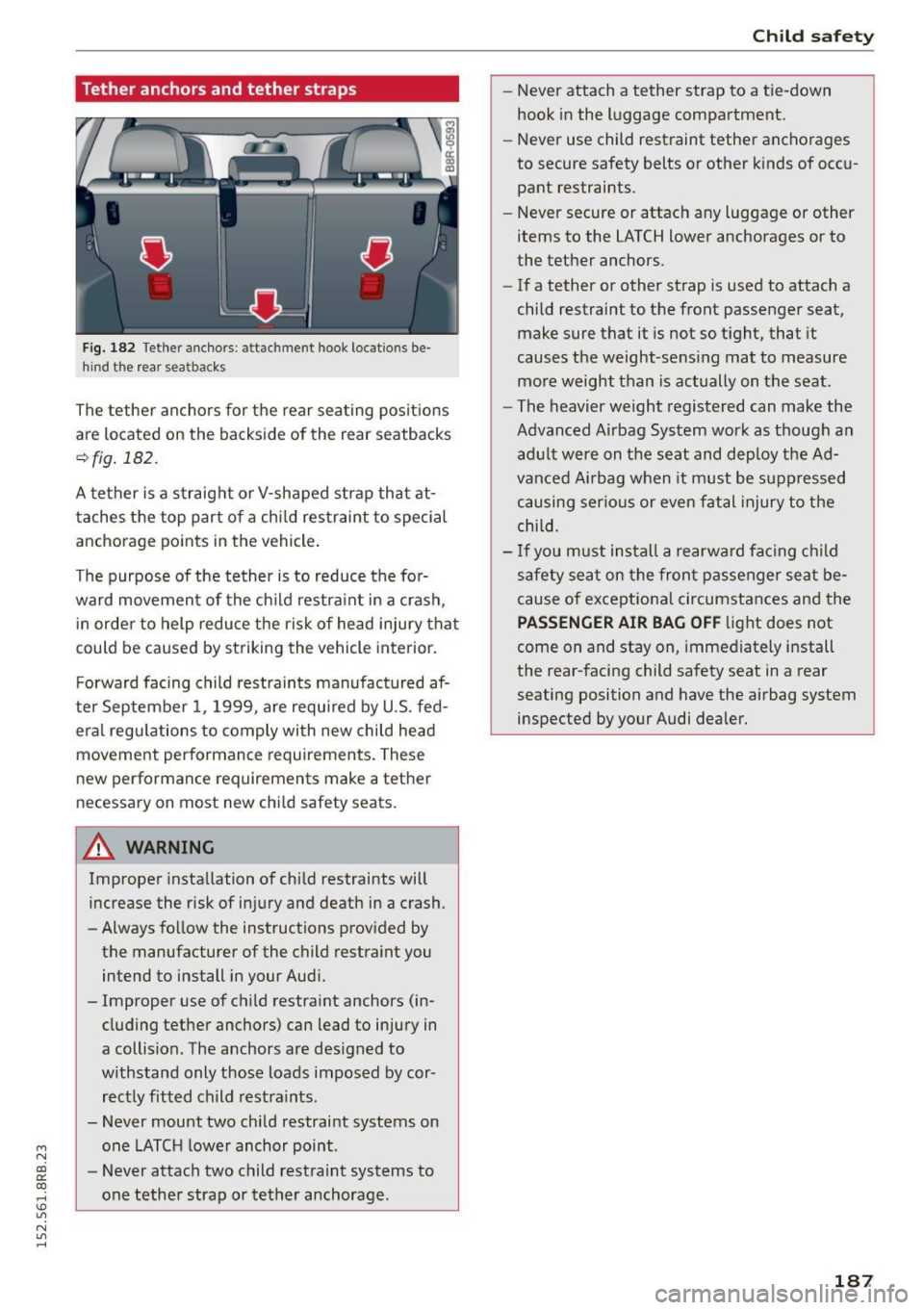
Fig. 182 Tether ancho rs: attach ment hook locatio ns be·
h ind t he rear sea tbacks
The tethe r anchors for the rear seating posit ions
are located on the backside of the rear seatbacks
¢ fig . 182 .
A tether is a s traig ht or V-shaped strap that at
taches the top part o f a ch ild restraint to special
anchorage points in the vehicle .
The purpose of the tether is to reduce the fo r
ward movemen t of the ch ild restra int in a crash ,
i n orde r to help reduce the ris k of head injury that
could be caused by striking the vehicle interior.
F orward facing child restra ints manufact ured af
ter September 1, 1999, are requ ired by U.S. fed
eral reg ulations to comply with new child head
movement performance requirements . These
new performance requirements make a tether
necessary on most new chi ld safety seats.
A WARNING
Improper installation of chi ld restraints will
increase the risk of i nju ry and death in a crash.
- Always fo llow the instructions prov ided by
the manufacturer of the child restra int you
intend to install in your Aud i.
- Improper use of ch ild restraint anchors (in
cluding tether anchors) can lead to injury in
a collision . The anchors are des igned to
withstand only those loads imposed by cor
rectly fitted child restra ints .
- Never mount two chi ld restraint systems on
one LATC H lower anchor point .
- Never attach two child restraint systems to
one tether strap or tether anchorage .
Child sa fe ty
- Never attach a tether strap to a tie-down
hook in the luggage compa rtment.
- Never use child restraint tether ancho rages
to secure safety belts or other k inds of occ u
pant restraints.
- Never secure or attach any luggage or other
items to the LATCH lower anchorages or to
the tether anchors.
- If a tether or other strap is used to attach a
child restraint to the front passenger seat,
make sure that it is not so t ight, that it
causes the weight -sens ing mat to measure
mo re weight than is actually on the seat .
- The heavier weight registered can make the
Advanced A irbag System work as though an
adult were on the seat and dep loy the Ad
vanced Ai rbag when it must be suppressed
causing ser ious or even fatal injury to the
child.
- If you m ust ins tall a rearwa rd fa cing c hild
safety sea t on the fron t passenger se at be
cause of except iona l circumstances and the
PASSENGER AIR BAG OFF light does not
come on and stay on , immediately install
the rear-facing child safety seat in a rear
seating position and have the airbag system
inspected by your Audi dealer.
187
Page 193 of 302
M N
co
a:
co
,...., \!) 1.1"1
N 1.1"1 ,....,
shared, please see your contract with the
wireless telecommunications provider and the
"About Aud i connect" tab in your vehicle's
MMI*:
IMENU I button> Audi connect > About
Audi connect .
Electronic Stabilization
Control (ESC)
Description
The Electronic Stabilization Control (ESC) reinfor
ces driver safety. It reduces the risk of slipping
and improves driving stability. ESC detects criti
cal s ituations such as the vehicle oversteering
and understeering or the wheels sp inning. The
veh icle is stab ilized by applying the brakes or re
ducing engine torque. Once the ESC is act ive, the
indicator light
m blinks in the instrument clus
ter.
The fol low ing systems a re integrated in the ESC:
Anti-lock brake system (ABS)
ABS prevents the wheels from locking up when
brak ing . The vehicle can still be steered even dur
ing hard braking. Apply steady pressure to the
brake pedal. Do not pump the pedal. A pulsing in
the brake pedal indicates that the system is help
ing you to brake the vehicle.
Brake assist system
The brake assist system can decrease braking d is
tance . It increases braking power when the dr iver
presses the brake pedal quick ly in emergency s it
uations. You must press and hold the brake pedal
unti l the situation is over. In vehicles w ith adap
tive cruise control*, the brake assist system is
more sensitive if the distance detected to the ve
hicle ahead is too small.
Anti-slip regulation (ASR)
ASR reduces engine power when the drive whee ls
begin to spin and adapts the force to the road
conditions. This makes it easier to start, acceler
ate and drive up hills.
Smart Technology
Electronic differential lock (EDL)
The EDL brakes whee ls that are spinning and
trans fers the drive power to the other whee ls.
This function is not avai lable at higher speeds .
In extreme cases, EDL automatically sw itches off
to help keep the brake on the braked wheel from
overheating. EDL will switch on again automati
ca lly when conditions have returned to normal.
Steering recommendation
The ESC helps to stabilize the vehicle by changing
the steering torque.
On vehicles with dynam ic steering*, ESC helps
stab ilize the steer ing in crit ical situat ions .
Selective wheel torque control
Selective wheel torque control is used when driv
ing on curves. The front wheel on the inside of
the curve or both wheels on the inside of the
curve are braked select ively as needed. This al
lows more precise driving in curves. The applica
ble system may not activate when driving in wet
o r snowy conditions .
A WARNING
-
-The ESC and its integrated systems cannot
overcome the laws of physics. This is espe
cially important on slippery or wet roads. If
the systems begin acting to stabilize your
vehicle, you should immediately change
your speed to match the road and traffic conditions . Do not let the increased safety
provided by these systems tempt you to
take risks. Doing so will increase the risk of a
loss of vehicle control, collision and serious
personal injuries.
- Always adapt your speed to road, traffic and
weather conditions. The risk of los ing con
trol of the vehicle increases when driving
too fast, especially through curves and on
slippery or wet roads, and when driving too
close to vehicles up ahead . The ESC and its
integrated systems cannot a lways prevent
coll isions - there is st ill a risk of acc idents!
- Always accelerate with special care on even,
smooth surfaces such as those that are wet
or covered with ice and snow. The drive
191
Page 194 of 302
Smart Technology
wheels can spin even with these assistance
systems that cannot always help to reduce
the risk of loss of vehicle control.
@ Tips
-ABS and ASR only work correctly when all
four whee ls are equipped with identical
Switching on/off
tires . Different tire sizes can lead to a reduc
tion in engine power .
- You may hear noises when the systems de
scribed are working.
- When installing a factory-supplied roof rack
system on the roof railing, the ESC will
adapt itself to a different center of gravity.
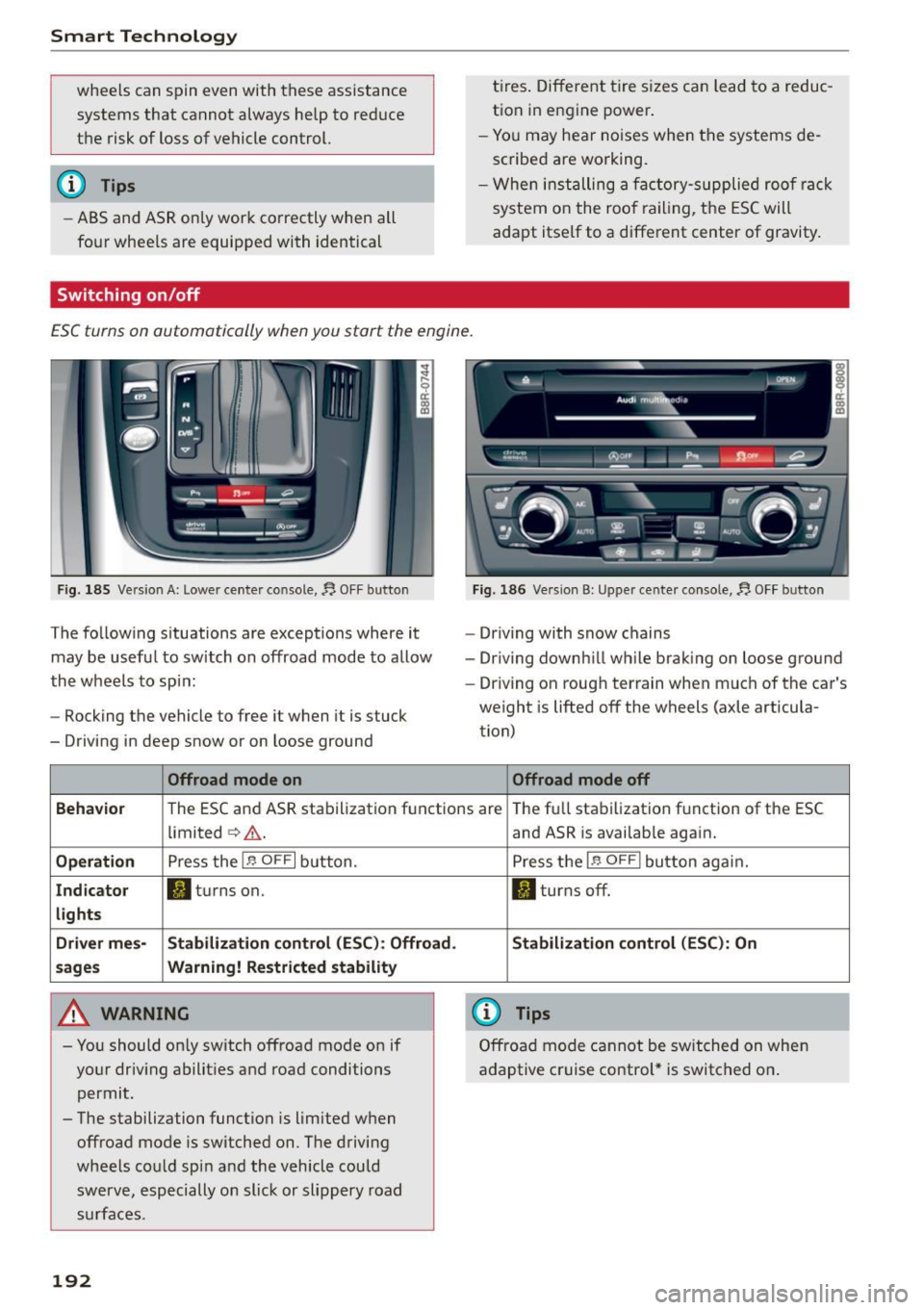
ESC turns on automatically when you start the engine.
Fig. 185 Version A: Lower center console, YJ. OFF butto n
The fo llow ing situations are exceptions where it
may be useful to sw itch on offroad mode to allow
the wheels to spin:
- Rocking the vehicle to free it when it is stuck
- Driving in deep snow or on loose ground
Offroad mode on
Fig. 186 Ve rs ion B: Upper center co nsole, YJ. O FF button
-Driving with snow chains
- Driving downhill while braking on loose ground
- Driving on rough terrain when much of the car's
weight is lifted off the wheels (axle articula
tion)
Offroad mode off
Behavior
The ESC and ASR stabilization functions are The full stabilization function of the ESC
limited
c> & .
Operation Press the l.13 OFF I button.
Indicator Ill turns on.
lights
Driver mes· Stabilization control (ESC): Offroad .
sages Warning! Restricted stability
A WARNING
- You should only switch offroad mode on if
your driving abilit ies and road conditions
permit.
- The stabilization function is limited when offroad mode is switched on. The driving
wheels cou ld spin and the vehicle could
swerve, especially on slick or slippery road
surfaces.
192
and ASR is availab le again.
Press the
1.$ OFF I button again.
II turns off.
Stabilization control (ESC): On
(D Tips
Offroad mode cannot be switched on when
adaptive cruise control" is switched on .
Page 202 of 302
Driving and th e environment
consumption by 10-15 percent. This section will
give you some tips on how you can help the envi ronment and your pocketbook.
(D Tips
The consumption estimates as published by ENVIRONMENTAL PROTECTION AGENCY (EPA)
and Transport Canada may not correspond to
your actual consumption on the road, wh ich
w ill vary depend ing upon vehicle load and
speed, road and weather conditions, trip
length, etc .
Drive smoothly and keep a lookout ahead
Vehicles use the most fuel when they are acceler
ating .
"'Avoid unnecessary accelerating and braking.
Vehicles use the most fuel when they are acceler
ating . If you anticipate what is going to happen
next, you will need to brake less and, thus, accel
erate less. Let the vehicle coast whenever possi
ble -for example when you see that the next traf
fic light is red .
Avoid full throttle
Driving at moderate speeds saves fuel and im
proves your mileage.
"' Try and keep well be low your car's max imum
speed.
Accelerating gently reduces fuel consumption,
engine wear, and does not disturb the environ
ment.
Fue l consumption, exhaust emissions and engine
noise increase disproportionately at high speeds.
If you drive at approximately three quarters of
top speed, fuel consumpt ion w ill be reduced by
one half. Never dr ive faster than the posted
speed lim it and weather conditions permit .
200
· Reducing unnecessary idling
Even when your car is just idling it burns up fuel .
"'Shut the engine off when you are not driving
the vehicle.
"' Do not warm up the vehicle by letting the en-
gine run at idle .
The idling phase is automatically reduced for
vehicles with the Start-Stop-System*. It is effi c ient to sw itch off the eng ine in vehicles w ithout
the Start-Stop-System* when stopped at railroad
crossings and long red lights. Turn ing the engine
off for just 30-40 seconds saves more fuel than is
burned by start ing the eng ine again.
It takes a long t ime for the engine to warm up
fully when it is runn ing at id le . However, wear
and noxious emissions are especia lly high when
the engine is warming up. So you sho uld drive
away as soon as you start the eng ine and avoid
running at high rpms whi le the engine is s till
warming up.
Q) Note
Do not leave engine id ling unattended after
starting. If warning lights should come on to
indicate improper operation, they would go
unheeded. Extended idling also produces
heat, which could result in overheating or oth
er damage to the veh icle or other property.
· Regular maintenance
A badly tuned engine unnecessarily wastes a lot
of fuel.
"' Have your vehicle serviced at regu lar intervals.
By having your veh icle reg ularly serv iced by an
authorized Aud i dea le r helps to ensure that i t
runs proper ly and economica lly. The condition of
your vehicle not on ly affects its safety and ability
to hold its value, it also affects
fuel consump
t ion .
Chec k your oil ea ch t ime y ou fill your tank.
The amount of o il used is re lated to engine load
and speed. .,.
Page 204 of 302
Offroad driving
Off road driving
Driving under difficult
conditions and off-road
General information
The opera tion of the E lectronic Stabilization Con
trol (ESC) is expanded for operation away from paved roads. In situat ions where s lip or a differ
ential locking function is required, the offroad mode can be activated
<=> page 191. Your Aud i al
so has permanent a ll-wheel drive in addition .
However, your Audi is not a pure offroad veh icle.
It was not bu ilt for driving under extreme condi
tions, e.g. for trips that are in the nature of an ex
pedit io n.
Dri ve o nly on roads and offro ad sections which
match the des ign of you r vehicle and your abil i
ties as a dr iver. Neve r take r isks!
B efo re driving offroad
- Check the eng ine oil level, tire p ressure, cool
ant leve l, and the fluid level i n the windshield
washer reservo ir.
- Stow luggage items and other objects in the
lu ggage compartment, and sec ure them
against slid ing aro und.
After dri ving off road
- After trips offroad, remove any twigs and othe r
f oreign objects from the grill, the unde rbody
and the wheels . Pay special attention to foreign
objects (stones) which have become lodged in
the tire tread.
- Clean the body and the vehicle unders ide, and
inspect the vehicle for poss ible damage.
- Clean dirty windows, headlamp lenses, rear
lights, and license p lates.
- Perform a brake check (particularly after t ravel
li ng through water).
A WARNING
- Drive especia lly attentive ly and plan ahead
in diffic ult road cond itions and w hen
off
road. Excessive speed or incorrect mane u
vers can cause in ju ries and damage to the
vehicle.
202
- Always adapt your speed and driving sty le to
road, off road, traffic, and weather cond i
tions. Dr ive espec ially slowly offroad w hen
your view is restricted.
- Please be aware that in offroad mode, par
ticularly on a smooth and slippery road, the
wheels may have an increased tendency to
spin and the vehicle may break away -dan
ge r of skidding!
- Stability is limited in the offroad mode .
® For the sake of the environment
Avoid damage to the environment and respect
nature.
(D Tips
Only drive where it is permitte d and stay on
marked roads and paths .
Explanation of some technical terms
The following data refer to ideal cond itions. De
pend ing on veh icle load a nd gro und cond itions
and the env ironment, the numbe rs may vary.
It is
the d river 's responsibility to decide whethe r ave
h icle can overcome a specific s ituation
<=> .&, .
Gradient angle
The number of meters in alt itude ga ined over a
distance of 109 .4 yards or 100 meters (grade)
are given as a pe rcentage o r degrees . Info rma
tion about the gradient the ve hicle can climb un
der i ts own power (depends in part on the road
s ur fa ce and eng ine power). M axim um permi tted
grade: 31°
Ground clearance
The distanc e between the road s urface and the
l owest poi nt of the veh icle underbody . G round
cl ear ance 7.9 in ( 20 0 mm)
A WARNING
Exceed ing the s tated max imum figur es c an
res ult in seve re injuries or vehicle damage .
- All the info rm ation w as g athered on level,
-
fi rm and non -slip pery road s urfaces, and un-
de r dry weather conditions .
llll>
Page 206 of 302
Trailer mode
Trailer mode
Driving with a trailer
General information
Your Audi was designed primarily for passenger
transportation.
If you plan to tow a trai ler, please remember that
the additional load will affect durability, econo my and performance.
Trailer towing not on ly places more stress on the
vehicle, it also calls for more concentration from the driver .
F or this reason, always follow the operating and
driving instructions provided and use common
sense.
Technical requirements
Tr aile r h itch
Use a weight-carrying hitch conforming to the
gross trailer weight. The hitch must be suitable
for your vehicle and trailer and must be mounted
securely on the veh icle's chassis at a technically
sound
location . Use only a trai ler hitch w ith a re
movable bal l mount . Always check with the tra il
er h itch man ufacturer to make sure that you are
using the co rrect hitch.
D o not u se a bump er hit ch.
The hitch must be installed in such a way that it
does not interfere with the impact -absorbing
bumper system. No mod ificat ions should be
made to the vehicle exhaust and brake systems .
From time to time, check that all hitch mounting
bolts remain securely fastened .
When you are not towing a trailer, remove the
trailer h itch ball mount. This prevents the hitch
from causing damage should your vehicle be struck from behind ¢ .&, .
Trailer bra kes
If your trailer is equipped with a braking system,
check to be sure that it conforms to all regula
tions.
204
The trailer hydraulic brake system must not be di
rect ly connected to the vehicle's hydraulic brake
system ¢.&, .
Safet y ch ain s
Always use safety chains betwee n your veh icle
and the trai ler .
Tr aile r lights
Trailer lights must meet all regulations. Be sure
to check w ith your author ized Audi dealer for cor
rect w iring, sw itches, and relays .
Mirro rs
If you are unable to see the traffic behind you us
ing the regular outside mirrors, then you
must in
stall extended mirrors .
It is important that you
always have clear vision to the rear.
&, WARNING
-If a trailer has electrical brakes p lease note
that these brakes are not activated by the
factory -fitted contro l unit -risk of accident!
- After removing the t railer hitch, do not store
it in your vehicle . In case of sudden braking,
the hitch could fly forward and injure you or
your passengers.
- Never install a "weight distributing" or "load equalizing" trailer hitch on your vehi
cle. The vehicle was not designed for these
kinds of tra iler hitches. The hitch attach
ment can fail, causing the tra iler to tear
loose from the veh icle.
- The Gross Vehicle Weight Rating for your ve
hicle, found on the safety compliance label
on the driver's side B-p illar, must never be
exceeded under any circumstances . Exceed
ing the Gross Vehicle We ight Rating of your
veh icle is likely to damage your vehicle, and
such damage will not be covered by your Limited New Vehicle Warranty. Exceeding
the Gross Vehicle Weight Rating will also
change the performance and handling char
acteristics of your vehicle, wh ich could cause
a crash resulting in serious injury or death .
Page 208 of 302
Trailer mode
Weight distribution
Towing a loaded trai ler with an empty car res ults
in a high ly unstable distribution of weight. If this
cannot be avoided , drive at very low speeds only
to avoid the risk of losing steering contro l.
A "balanced" rig is easier to operate and control.
This means that the tow vehicle should be loaded
to the extent possible and permissible, while
keeping the trailer as light as possible under the
circumstances. Whenever possible, transfer
some cargo to the luggage compartment of the
tow vehicle while observing tongue load require
ments and vehicle loading considerations .
Speed
The higher the speed, the more difficult it be
comes for the driver to control the rig . Do not
drive at the maximum permiss ible speed. Reduce
your speed even more if load, weathe r or wind
conditions are unfavorable - particularly when
going downhill.
Reduce vehicle speed
immediately if the trailer
shows the s lightest sign of swaying .
Do not try
to stop the swaying by accelerating.
Observe speed limits. In some areas, speeds for
veh icles towing trailers are lower than for regular
ve hicles .
A lways app ly brakes ear ly. When driving down
hill, shift into a lower gear to use the engine
brak ing effect to slow the vehicle. Use of the
brakes alone can cause them to overheat and fa il.
Coolant temperature
The coolant temperature gauge c::> page 10 must
be observed carefully.
If the need le moves close
to the upper end of the scale, reduce speed im
mediately and/or turn off the a ir condit ioner.
If the coo lant temperature warning light in the
instr ument cluster starts flashing •• pu ll off
the road, stop and let the engine
idle for about
two minutes to prevent heat build-up.
A WARNING
Anyone not properly restrained in a moving
vehicle is at a much greater r isk in an acc i-
206
-
dent. Never let anyone ride in your car who is
not properly wearing the restraints provided
by Audi.
Trailer mode notes
Important to know
Your vehicle handles differently when towing a
trai ler because of the additiona l weight and dif
ferent we ight distribution . Safety, performance
and economy will greatly depend on how careful
l y you load your trailer and operate your rig.
Before you actua lly tow your trai ler, practice
turning, stopping and backing up in an area away
from traffic . Keep practicing until you have be
come comp lete ly familiar with the way your vehi
cle-trailer comb inat ion behaves and responds.
Backing up is difficult and requires practice. Back
ing up with a trai ler generally requires steering
action opposite to that when backing up your ve
hicle without a tra iler.
Maintain a greater distance between your vehicle
and the one in front of you. Yo u will need more
room to stop. To compensate for the trailer, you
will need a larger than normal turn ing radius.
When passing, remember that you cannot accel
erate as fast as you norma lly wou ld because of
the added load. Make sure you have enough room
to pass. After passing, allow plenty of room for
your tra iler before changing lanes again.
Avoid jerky starts , sharp t urns or rapid lane
changes.
@ Tips
- Do not tow a trailer during the break-in peri
od of your vehicle.
- If you tow a trailer, your Audi may requi re
more frequent maintenance due to the ex
tra load
c::> page 281.
Page 210 of 302

Care and cleaning
Care and cleaning
General information
Regular, proper care he lps to maintain your vehi
cle's value.
It can also be a requirement when
submitting warranty claims for corrosion damage
and paint defects on the body.
The necessary care products can be obtained
from your authorized Audi dealer . Read and fol
low the instructions for use on the packaging.
A WARNING
-Using cleaning and care products incorrectly
can be dangerous to your health.
- Always store cleaning and care products out of reach of children to reduce the risk of poi
soning .
@ For the sake of the environment
-Preferably use environmentally-friendly
products when buying cleaning agents.
- Do not dispose of leftover cleaning and care
products with household trash .
Car washes
The longer that deposits such as insects, bird
droppings, tree sap or road sa lt remain on the ve
hicle, the more the surface can be damaged. High
temperatures such as those caused by sunlight
increase the damaging effect .
Before washing, rinse off heavy deposits with
plenty of water.
Stubborn deposits such as bird droppings or tree
sap are best removed with plenty of water and a
microfiber cloth .
Also, wash the underside of your vehicle once
road salt stops being used for the season.
Pressure washers
When washing your veh icles with a pressure
washer, always follow the operating instructions
p rovided with the pressure washer. This is espe
cially important in regard to the pressure and
spraying distance. Do not aim the spray direct ly
at seals on side windows, doors, the hood, the
208
rear lid or the sunroof* or at tires, rubber hoses,
insulating material, sensors* or camera lenses*.
Keep a distance of at least 16 inches (40 cm).
Do not remove snow and ice with a pressure
washer.
Never use rotary nozzles or high pressure noz
zles.
The water temperature must not be above 140 °F
(60 °().
Automatic car washes
Spray off the vehicle before washing.
Make sure that the windows and roof* are closed
and the windshie ld wipers are off . Follow instruc
tions from the car wash operator, especially if
there are accessories attached to your vehicle.
If possible, use car washes that do not have
brushes.
Washing by hand
Clean the veh icle starting from the top and work
i ng down using a soft sponge or cleaning b rush .
Use solvent-free cleaning products.
Washing vehicles with matte finish paint by
hand
To avoid damaging the paint when washing, first
remove dust and large particles from your vehi
cle. Insects, grease spots and fingerprints are
best removed with a special cleaner for matte
finish paint .
Apply the product using a microfiber cloth . To
avoid damaging the paint surface, do not use too
much pressure.
Rinse the vehicle thoroughly with water. Then
clean using a neutra l shampoo and a soft micro
fiber cloth .
Rinse the vehicl e thoroughly again and let it air
dry. Remove any water residue using a shammy.
A WARNING
-
- Only wash the vehicle when the ignition is
off and fo llow the instruct ions from the car
Page 213 of 302

M N
co
a:
co
,...., \!) 1.1"1
N 1.1"1 ,....,
Care and cleaning
Component Situation Solution
Te xtile s
Deposits adhering to Vacuum cleaner
artificial leather, the surface
Alcantara Water-based depos its Absorbent
cloth and mild soap solutiona)
such as coffee, tea,
b lood, etc.
Oil-based deposits Apply a m ild soap solutiona>, blot away the dissolved oil or
such as oil, make-up, dye, treat afterward with water, if necessary
etc.
Special deposits such Specia l sta in remover, blot with absorbent material, treat
as ink, na il polish, la- afterward with mild soap solution, if necessarya>
tex paint, shoe pol-
ish, etc.
Natural leather Fresh stains Woo
l cloth with a mild soap solutiona>
Water-based deposits fresh stains : absorbent cloth
such as coffee, tea, dried stains: stain remover suitable for leather
blood, etc.
Oil-based deposits Fresh stains: absorbent cloth and stain remover sui tab le
such as oil, make-up, for leathe r
etc. dried stains: Oil cleaning spray
Special deposits such Spot remover suitable for leather
as ink, nai l polish, la-
t ex paint, shoe po l-
ish, etc.
Ca re Regularly apply conditioning cream that protects from
light and penetrates into the mate rial. Use specially-col-
ored conditioning cream, if necessary.
Carbon parts Deposits clean the same way as plastic parts
a) Mild soap sol ution : maximum two tablespoons of neutral soap in 1 quart (1 liter) of water
.8, WARNING
The windshield may not be treated with wa
ter-repelling windshield coating agents . Un
favorab le conditions such as wetness, dark
ness, or low sun can resu lt in increased glare.
Wiper blade chatter is also possible.
@ Note
- Headlights/tail lights
- Never clean headlights or tail lights with a
dry cloth or sponge.
- Do not use any cleaning product that con
tains alcohol, because they could cause
cracks to form.
- Wheels
-
- Never use any paint polish or other abra
sive materials.
- Damage to the protective layer on the
rims such as stone chips or scratches must
be repaired immediately.
- Sensors/camera lenses
-Never use warm or hot water to remove
snow or ice from the camera lens. This
could ca use the lens to crack.
- Never use abrasive cleaning materials or
alcohol to clean the camera lens. This
could cause scratches and cracks.
- Door windows
-Remove snow and ice on windows and ex-
terior mirrors with a plastic scraper. To
211