seats AUDI Q5 2016 User Guide
[x] Cancel search | Manufacturer: AUDI, Model Year: 2016, Model line: Q5, Model: AUDI Q5 2016Pages: 300, PDF Size: 75.02 MB
Page 75 of 300
..... N
co ~ CX)
..... I.Cl U"I
..... I.Cl .....
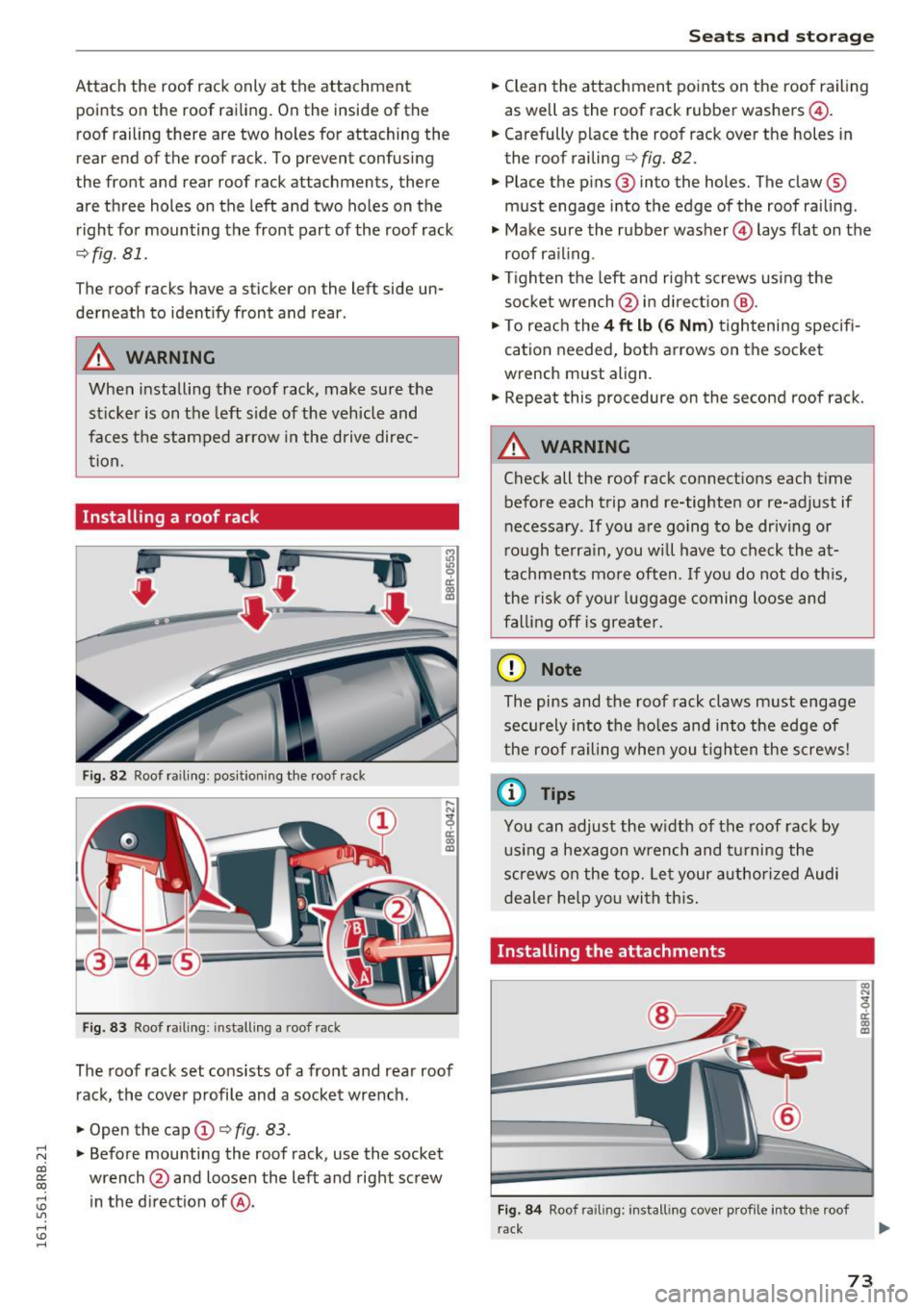
Attach the roof rack only at the attachment poin ts on the roof railing. On the inside of th e
roof railing there are two holes for attaching the
rear end of the roof rack. To p revent confusing
the front and rear roof rack attachment s, there
are three holes on the left and two holes on the
ri ght for mounting the front part of the roof rack
q fig . 81 .
The roof racks have a sti cker on the left side un
derneath to ident ify front and rear .
A WARNING
When installing the roof rack, make sure the
st icker is on the left side of the vehicle and
faces the stamped arrow in the drive dire c
t ion.
Installing a roof rack
Fig. 82 Roof railing: posi tion ing the roo f rac k
Fig . 83 Roof railing: installing a roo f rack
The roof rack set cons ists of a front and rear roof
rack, the cove r profile and a socket wrench.
• Open the cap
(D q fig . 83 .
• Before mounting the roof rack, use the socket
wrench @and loosen the left and right screw
in the d irect ion of@ .
Seats and storag e
• Clean the attachment po ints on the roof railing
as well as the roof rack rubber washers@.
• Carefully place the roof rack over the holes in
the roof railing
q fig. 82.
• Place the p ins @ into the holes. The claw ®
must engage into the edge of the roof rai ling .
"' Make sure the rubber washer © lays flat on the
roof railing .
"' Tighten the left and r ight screws using the
soc ket wrench @ in d irect ion @.
"' To reac h the
4 ft lb (6 Nm ) tightening specif i
cation needed, both arrows on the socket
wrench must align .
"' Repeat this procedure on the second roof rack.
A WARNING
Check all the roof rack connect ions each t ime
before each trip and re-tighten or re-adjust if
necessa ry . If you a re going to be dr iving or
r ough te rra in, you w ill have to check the at
tachments mo re often. If yo u do not do th is,
the r isk of you r luggage coming loose and
fa lling off is greate r.
(D Note
The pins and the roof rack claws must engage
securely into the holes and into the edge of
the roof railing whe n you t ighten the screws!
(0 Tips
You can adjust the w idt h of the roof rack by
u sing a hexagon wrench and t urning the
screws on the top. Let your authori zed Audi
dealer help you wi th this.
Installing the attachments
Fi g. 8 4 Roof ra ilin g: i nstall ing cov er pro file into the roo f
rack
a)
"' 9 a: a) m
73
Page 77 of 300
..... N
co ~ CX)
..... I.Cl U"I
..... I.Cl ......
Opening rear beverage h olders
• To open the rear cupholder, press on the sym
bol~ @~
fig. 86.
Hold ing bev erages at the rear
• To adjust the arm @, swing it in the d irect ion
of the ar row .
• Place the beverage in the holde r and release
the a rm. The a rm swings back by itse lf and au
tomatica lly sec ures the beverage.
Clo sing the r ear cupholders
• To close the rear cupholder, press on the center
section between the two arms and p ush the cu
pholder in the s lot as far as it will go.
The hold ing arm must be adjusted such that it
l ies closely against the cupholde r.
A maximum of two beverages can be placed in
the center armrest.
A WARNING
Spilled hot liquid can cause an accident and
personal injury.
- Never carry any beverage containers with
hot liquids, such as hot coffee or hot tea, in
the vehicle while it is moving. I n case of a n
acc ident, sudden braki ng or o ther veh icle
movement, hot liq uid could spill, causing
sca ld ing burns . Spilled hot liquid can also
cause an accident and perso nal i nju ry.
- Use only soft cups in the cupholder . Hard
cups and g lasses can cause i njury in an acci
dent.
- Never use t he cupholder or adapter as an
ashtray -risk of fire .
(D Note
Onl y drink containe rs with lids should be ca r
r ied in the cupholder . Liquid could sp ill out
and damage your vehicle's electronic equip
ment or stain the upho lstery, etc .
Seats and storag e
Climatized cupholders
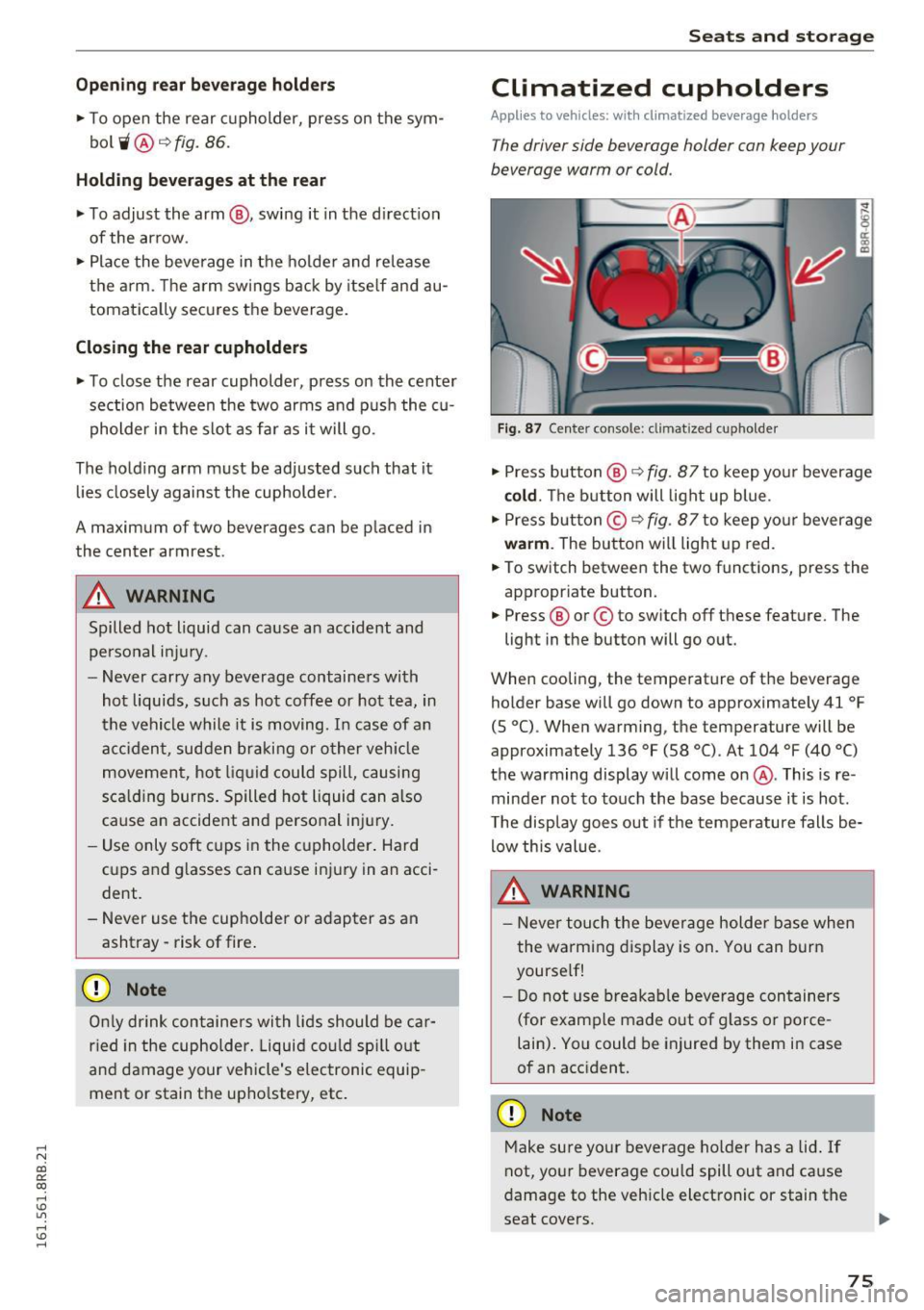
Applies to vehicles: w it h climat ized beve rage holders
The driver side beverage holder can keep your
beverage warm or cold.
Fig. 87 Center console: climatized cupholder
• Press button @¢ fig. 87 to keep you r beverage
cold . The b utton will light up blue.
• Press but ton © ¢
fig. 87 to keep yo ur beverage
wa rm . The button will light up red.
• To switch between the two functions, press the
appropr iate button.
• Press ® or© to sw itch off these feature. The
light in the button will go out.
When cooling, the temperature of t he beverage
holder base will go down to approximately 41
°F
(S °C). When warm ing, the temperature will be
approximately 136
°F (58 °(). At 104 °F (40 °()
the warming display will come on@. This is re
minder not to touch the base because it is hot.
T he disp lay goes out if the temperature falls be
low this value.
A WARNING
- Neve r tou ch the bever age holder base when
the wa rming display is on. You can bur n
yourse lf!
- Do not use bre akab le beverage con tainers
(for e xamp le made out of g lass or porce
lain) . Yo u could be injured by them in case
of an acc ident.
(D Note
M ake sure your beverage ho lder has a lid . If
not, your beverage cou ld spill out and cause
damage to the vehicle electronic or stain the
seat covers .
75
Page 79 of 300
..... N
co ~ CX)
..... I.Cl U"I
..... I.Cl .....
.. Remove the cigarette lighter when it pops out.
The c igarette lighter sho uld only be used as a
power so urce for the compressor from the inflat
ab le spare tire/tire repai r kit* when absolute ly
necessary.
A WARNING
T he ciga rette lighter on ly works when the ig
nition is sw itched on. Incorrect usage can lead
to ser ious injuries or burns. For this reason,
children shou ld never be left unattended i n
the vehicle beca use this increases the risk of
injury.
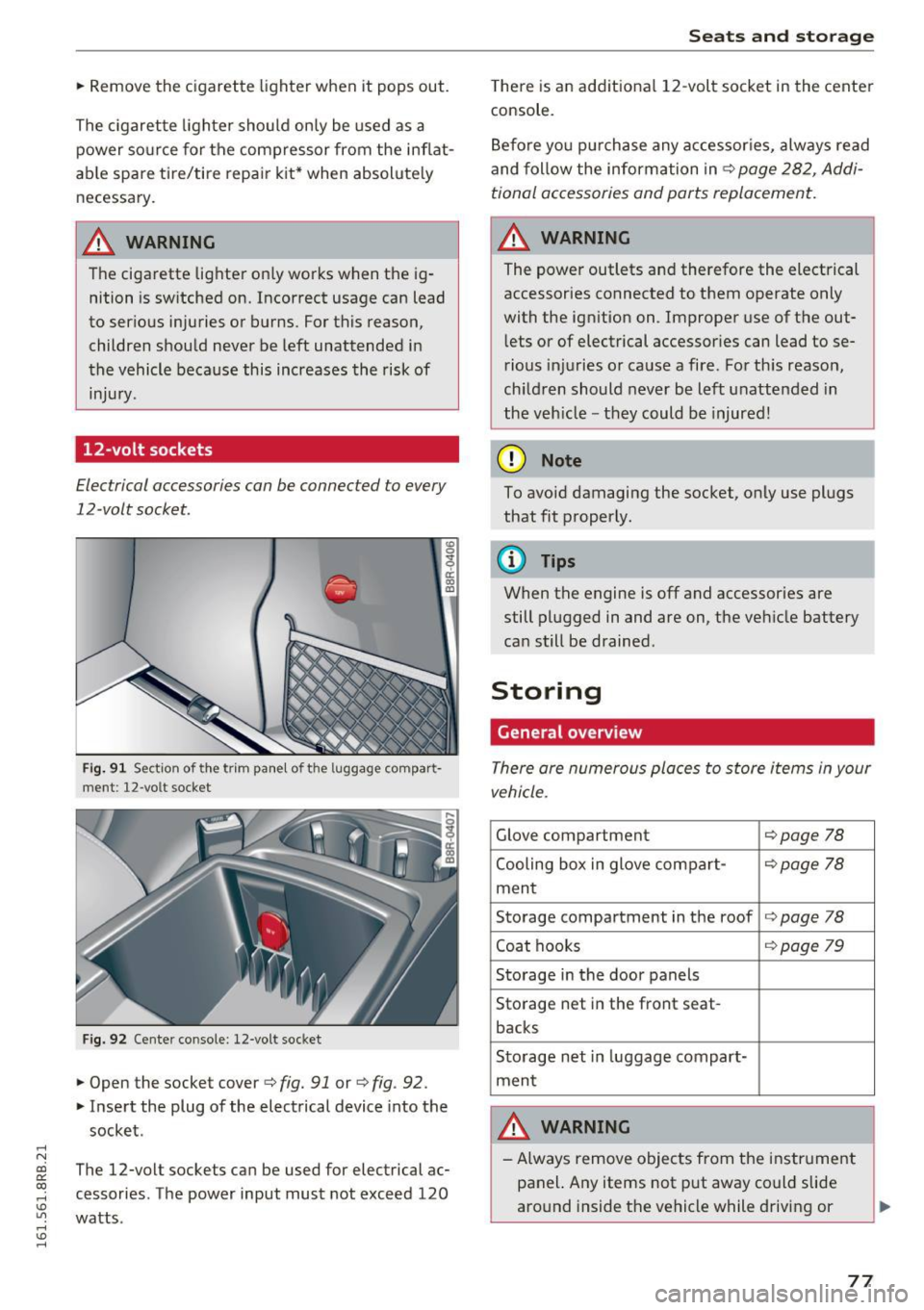
12 -volt sockets
Electrical accessories can be connected to every
12-volt socket.
Fig. 91 Section of the trim pa nel of the luggage compart
ment: 12-volt socket
Fig . 9 2 Cen ter console: 12-volt socket
.. Open the socket cover c:> fig. 91 or ¢ fig. 92.
.. Inse rt the plug of the electrical device into the
socket .
The 12-volt sockets can be used for electrical ac
cessories. The power input must not exceed 120
watts .
Seats and storag e
There is an add itio na l 1 2-volt socket in the center
console.
B efore yo u pur chase any accessor ies, always read
and follow the information inc::>
page 282, Addi
tional accessories and parts replacement.
A WARNING
The power outlets and therefore the electrical
accessories connected to them operate only
with the ign ition on. Improper use of the out
l ets or of electrical accessor ies can lead to se
rio us inj uries or cause a fire. Fo r th is reason,
ch ildren should never be left unattended in
the veh icle -they could be injured!
(D Note
To avoid damaging the socket, o nly use plugs
that fit properly.
(D Tips
When the engine is off and accessories are
still plugged in and are on, the ve hicle battery
ca n still be drained .
Storing
General overview
There are numerous places to store items in your
vehicle .
Glove compartment c::>page 78
Cooling box in glove com pa rt-¢ page 78
men t
Storage compartment in the roof
¢page 78
Coat hooks ¢page 79
Storage in the door panels
Sto rage net in the front seat-
backs
Sto rage net in luggage compart-
ment
A WARNING
- A lways remove objects from the instr ument
panel. Any items not p ut away could slide
aro und inside the vehicle while driving or
~
77
Page 81 of 300
..... N
co ~ CX)
..... I.O U"I
..... I.O .....
.. To close the lid, push it up until it engages .
A WARNING
Always keep the lid closed while driving to re
duce the risk of injury during a sudden brak
ing maneuver or in the event of an accident .
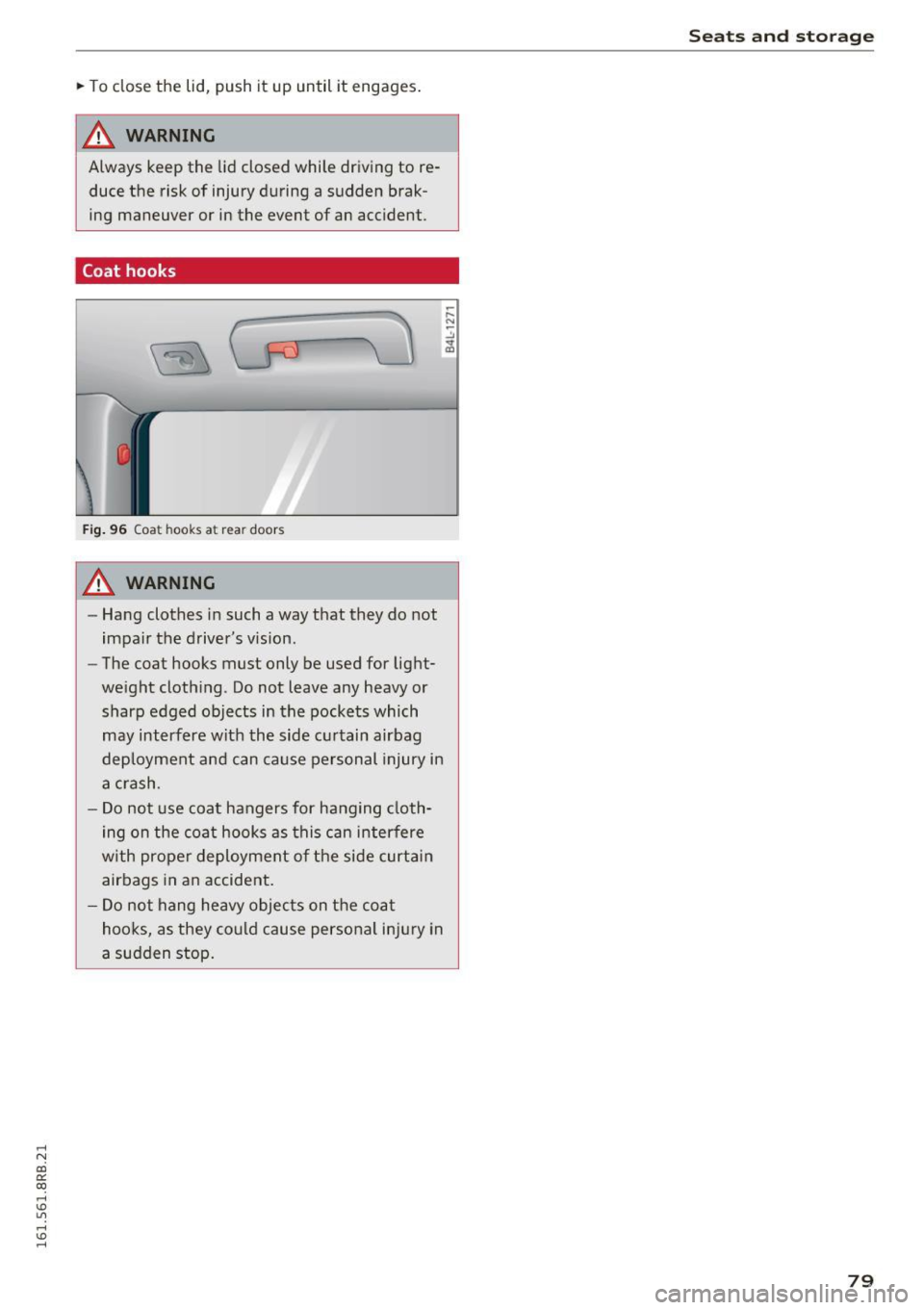
Coat hooks
Fig. 96 Coat hoo ks a t re ar doors
A WARNING
- Hang clothes in such a way that they do not
impair the driver 's vision.
- The coat hooks must only be used for light
weight clothing . Do not leave any heavy or
sharp edged objects in the pockets which
may interfere with the side curtain airbag
deployment and can cause personal injury in
a crash .
- Do not use coat hangers for hanging cloth
ing on the coat hooks as this can interfere
with proper deployment of the side curtain
airbags in an accident.
- Do not hang heavy objects on the coat
hooks, as they could cause personal injury in
a sudden stop .
Seats and storage
79
Page 84 of 300
Warm and cold
[ii Adjusting seat heating*
P ressing the button switches the seat heating on
at the highest setting (level 3). The LEDs indicate
the temperature level. To reduce the tempera
ture, press the button again. To switch the seat heating
off, press the button repeatedly until the
LED turns
off.
After 10 minutes, the seat heating automatically
switches from level 3 to level 2.
lil Adjusting seat ventilation*
Pressing the button switches the seat vent ilation
on at the highest sett ing (level 3). The LEDs indi
cate the venti lation level. To reduce the ventila
tion level, press the button again. To sw itch the
seat ventilation
off, press the button repeatedly
until the LED turns
off.
l qo, FRONT I Switch the defroster on/off
The windshield and side windows are defrosted
or cleared of condensation as quickly as possible.
The maximum amount of air flows main ly from
the vents below the windshield. Recirculation
mode switches off. The temperature should be
set to 72 °F (22 °() or higher. The temperature is
controlled automat ically .
The
IAUTOI button switches the defroster off.
IQiil REARI Switching rear window heater on/
off
The rear window heater on ly operates when the
engine is running. It switches off automatica lly
after a few minutes, depending on the outside
temperature.
To prevent the rear window heater from switch ing
off automatically, press and ho ld the l(jji) REARI
button for more than 2 seconds. This remains
stored until the ign it ion is switched off.
Air vents
You can open and close the center and rear air
vents using the thumbw heels . The levers adjust
the direction of the airflow from the vents.
You can adjust the air temperature in the rear by
turning the thumbwheel toward the red side to
82
make it warmer or toward the blue side to make
it coo ler.
A WARNING
- Do not use the recirculation for extended
periods of time. The windows could fog up
since no fresh air can enter the vehicle. If
the windows fog up, press the air rec ircula
tion button again immed iately to switch
off
the air rec irculat ion function or select de
frost.
- Individuals with reduced sensit iv it y to pain
or temperature could develop burns when
using the seat heating* function . To reduce
the risk of injury, these individuals should
not use seat heating.
(D Note
To avoid damage to the heating elements* in
the seats, do not kneel on the seats or place heavy loads on a small area of the seat.
Setup
-
The basic climate control settings can be adjust
ed in the radio or MM!".
"'Select : !CAR I function button> A/C control but
ton. Or
"' Select:
I CAR I function button > Car systems*
control button >
A/C.
Automatic recirculation
When switched on, automat ic rec irculation con
tro ls the recirculation mode automatically. If the
windows fog up, press the
I® FRO NT ! button.
Synchronization
When synchron izat ion is switched on, the same
settings are applied to both the dr iver and front
passenger , except for the seat heating/ventila
tion* . Synchronization switches
off when you ad
just the settings on the front passenger's side.
You can also switch synchronizat ion on by press -
i ng and holding the knob on the driver's side .
Ill>-
Page 136 of 300
Driving sa fe ty
Driving safety
Basics
Safe driving habits
Please remember -safe ty first!
This chapter contains important information,
tips, instruct ions and warn ings that you need to
read and observe for your own safety, the safety
of your passengers and others. We have summar ized here what you need to know about safety
be lts, a irbags, child restra ints as well as child
safety. Your safety is for us
priority number 1 . Al
ways observe the i nfo rmation and wa rn ings in
this section - for your own safety as well as that
of your passengers.
The information i n this section applies to all
model versions of yo ur vehicle . Some of the fea
tures descr ibed in t his sections may be s tanda rd
equipment on some models, or may be optional
equipment on others . If you are not sure, ask
your authorized Audi dealer.
A WARNING
- Always make sure that you follow the in
structions and heed the WARNINGS in th is
Manual.
It is in your interest and in the in
te rest of your passengers .
- Always keep the comp lete Owner's Litera
ture in your A udi when you lend or sell your
vehicle so that this important information
will always be available to the d river and
passenge rs.
- Always keep the Owner 's literature handy so
that you can find it easily if you have ques
t ions.
Safety equipment
The safety features are part of the occupant re
straint system and work together to help reduce
the risk of injury in a wide variety of occident si t
uations.
Your safety and the safety of your passenge rs
should not be left to chance. Advan ces i n tech
nology have made a var iety of features avai lab le
to help reduce t he risk of injury in an accident .
134
The following is a list of just a few of the sa fety
features in your Audi :
- sophis tica ted safety be lts fo r dr ive r and all pas-
senge r seat ing pos itions,
- belt fo rce limi ters for the front seats,
- be lt pretensione rs fo r the seats,
- belt height adjustment for the front seats,
- head restraints for each seating position,
- front airbags,
- side airbags in the front seats and outer rear
seats *,
- side curtain airbags,
- special LAT CH anchorages for ch ild rest rai nts,
- adj ustab le steer ing column.
T hese ind iv idual safety features , can work to
gether as a system to help protect you and your
passengers in a wide range of acc idents. These
features cannot wo rk as a system if they are not
a lways correc tly ad justed a nd cor rect ly used.
Safety i s everybody' s responsibil ity!
Important things to do before driving
Safety is everybody 's job! Vehicle and occupant
safety always depends on the informed and care
ful driver .
For your safety and the safety of your passen
gers,
before driving always:
.,. Make sure that a ll lights and signals are operat
ing correctly .
.,. Make sure that the tire pressure is correct .
.,. Make sure that all windows are clean and afford
good vis ibility to the outs ide .
.,. Secure all luggage and othe r items ca refully
i=> page 77 .
.,. Ma ke sure that noth ing ca n interfere wi th the
pedals.
.,. Adjust front seat, head rest raint and mirrors
correctly for yo ur height.
.,. Instruct passeng ers to adjust the head re
straints according to their he ight.
.,. Make sure to use the rig ht child restraint cor
rectly to protect children
c> page 171 , Child
safety . ..,.
Page 138 of 300
Driving safety
For detailed information on how to adjust the
driver's seat, see ¢
page 64.
A WARNING
Drivers who are unbelted, out of position or
too close to the airbag can be seriously in
jured by an airbag as it unfolds. To help re
duce the risk of serious personal injury:
- Always adjust the driver's seat and the
steering wheel so that there are at least
10 inches (25 cm) between your breastbone
and the steering wheel.
- Always hold the steering wheel on the out
side of the steering wheel rim with your
hands at the 9 o'clock and 3 o'clock posi
tions to help reduce the risk of personal in
jury if the driver's airbag inflates.
- Never hold the steering wheel at the
12 o'clock position or with your hands at
other positions inside the steering wheel
rim or on the steering wheel hub. Holding
the steering wheel the wrong way can cause serious injuries to the hands, arms and head
if the driver's airbag deploys.
- Pointing the steering wheel toward your
face decreases the ability of the su pplemen
tal driver's airbag to protect you in a colli
sion.
- Always sit in an upright position and never lean against or place any part of your body
too close to the area where the airbags are
located.
- Before driving, always adjust the front seats
and head restraints properly and make sure
that all passengers are properly restrained.
- Never adjust the seats while the vehicle is
moving . Your seat may move unexpectedly
and you could lose control of the vehicle.
- Never drive with the backrest reclined or
tilted far back! The farther the backrests are
tilted back, the greater the risk of injury due
to incorrect positioning of the safety belt
and improper seating position.
- Children must always ride in child safety
seats¢
page 171. Special precautions ap
ply when installing a child safety seat on the
front passenger seat
¢page 151.
136
-
Proper seating position for the front
passenger
The proper front passenger seating position is
important for safe, relaxed driving.
For your own safety and to reduce the risk of in
jury in the event of an accident, we recommend
that you adjust the seat for the front passenger
to the following position :
.,. Adjust the angle of the seatback so that it is in
an upright position and your back comes in full
contact with it whenever the vehicle is moving.
.,. Adjust the head restraint so the upper edge is
as even as possible with the top of your head. If
that is not possible, try to adjust the head re
straint so that it is as close to this position as
possible
¢ page 137.
.,. Keep both feet flat on the floor in front of the
front passenger seat.
.,. Fasten and wear safety belts correctly
¢page 146.
For detailed information on how to adjust the
front passenger's seat, see
¢ page 63.
A WARNING
Front seat passengers who are unbelted, out
of position or too close to the airbag can be
seriously injured or killed by the airbag as it
unfolds. To help reduce the risk of serious
personal injury:
- Passengers must always sit in an upright po
sition and never lean against or place any
part of their body too close to the area
where the airbags are located.
- Passengers who are unbelted, out of posi
tion or too close to the airbag can be seri
ously injured by an airbag as it unfolds with
great force in the blink of an eye.
- Always make sure that there are at least
10 inches (25 cm) between the front pas
senger's breastbone and the instrument
panel.
- Each passenger must always sit on a seat of
their own and properly fasten and wear the
safety belt belonging to that seat.
- Before driving, always adjust the front pas senger seat and head restraint properly.
Page 139 of 300
..... N
co
er::
co
.....
of the seat. Never rest them on the seat, in
strument panel, out of the window, etc. The
airbag system and safety belt will not be able to protect you properly and can even in
crease the risk of injury in a crash.
- Never drive with the backrest reclined or
tilted far back! The farther the backrests are
tilted back, the greater the risk of injury due
to incorrect positioning of the safety belt
and improper seating position .
- Children must always ride in child safety
seats¢
page 171 . Special precaut ions ap
ply when installing a ch ild safety seat on the
front passenger seat ¢
page 151.
Proper seating positions for passengers in
rear seats
Rear seat passengers must sit upright with both
feet on the floor consistent with their physical
size and be properly restrained whenever the ve hicle is in use.
To reduce the risk of injury caused by an incorrect
seating position in the event of a sudden braking
maneuver or an accident, your passengers on the
rear bench seat must always observe the follow
ing:
~ If there is a passenger on the rear center seat
ing position, slide the center head restraint up
ward at least to the next notch ¢
page 67.
~ Make sure that the seatback is securely latched
in the upright position
¢page 69.
~ Keep both feet flat in the footwell in front of
the rear seat .
~ Fasten and wear safety belts properly
¢page 146.
~ Make sure that children are always properly re
strained in a child restraint that is appropriate
for their size and age ¢
page 171.
A WARNING
Passengers who are improperly seated on the
rear seat can be seriously injured in a crash .
- Each passenger must always sit on a seat of
their own and properly fasten and wear the
safety belt belonging to that seat .
Driving safety
- Safety belts only offer maximum protection
when the seatback is securely latched in the
upright position and the safety belts are properly positioned on the body . By not sit
ting upright, a rear seat passenger increases
the risk of personal injury from improperly
positioned safety belts!
- Always adjust the head restraint properly so
that it can give maximum protection.
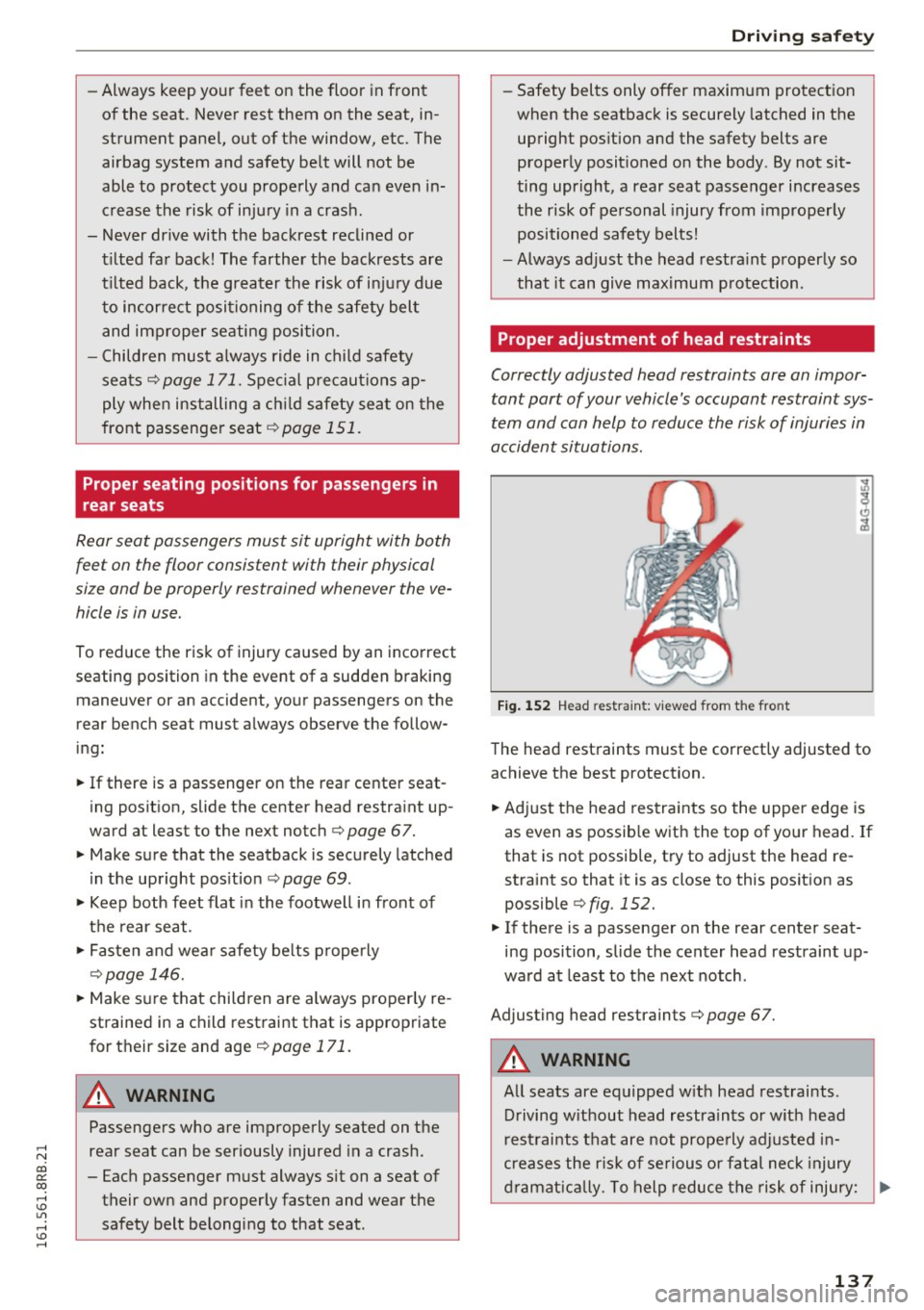
Proper adjustment of head restraints
Correctly adjusted head restraints are an impor
tant part of your vehicle's occupant restraint sys
tem and can help to reduce the risk of injuries in
accident situations.
Fig. 1S2 Head restraint: vi ew ed from t he front
The head restraints must be correctly adjusted to
achieve the best protection.
~ Adjust the head restraints so the upper edge is
as even as possible with the top of your head. If
that is not possible, try to adjust the head re
straint so that it is as close to this position as
possible
¢ fig . 152.
~ If there is a passenger on the rear center seat
ing position, slide the center head restraint up
ward at least to the next notch .
Adjusting head restraints¢
page 67.
A WARNING
-All seats are equipped w ith head restraints.
Driving without head restraints or with head
restraints that are not properly adjusted in
creases the risk of serious or fata l neck injury
dramatically . To help reduce the risk of injury: ..,
137
Page 140 of 300
Driving sa fe ty
-Always drive with the head restraints i n
place and properly adjusted.
- Every person in the vehicle must have a
properly adjusted head restra int.
- Always make sure each person in the vehicle
properly adjusts their head restraint. Adjust
the head restra ints so the upper edge is as
even as possib le w ith the top of your head.
If that is not possib le, try to adjust the head
restra int so that it is as close to th is position
as possib le.
- Never attempt to adjust head restraint wh ile driving.
If you have dr iven off and
must adjust the driver headrest for any rea
son, fi rst stop the vehicle safely before at
tempting to ad just the head restr aint.
- Children must always be p roperly restrained
in a chi ld restrain t th at is appropria te fo r
their age and size~
page 171.
Examples of improper seating positions
The occupant restraint system can only reduce
the risk of injury if vehicle occupants are properly
seated.
I mp roper seating positions can cause se rious in
ju ry or deat h. Safety belts can only wo rk when
they are p roperly posi tioned o n the body . Im
p roper seating posi tions reduce t he effe ct iveness
of sa fety belts and w ill even increase the r isk o f
in jury and death by moving the safety be lt to crit
ical areas of the body . Improper seating posit ions
also increase the risk of ser ious injury and death
when an airbag deploys and strikes an occupant
who is not in the prope r seat ing position. A driver
is respo nsible for the safety of all vehicle occu
pants and especially fo r children. Therefo re:
~ Never allow anyone to assume an incorrect
seat ing pos ition w hen the veh icle is being used
~ .&. -
The follow ing bulletins list only some sample po
sitions that will inc rease the risk of serious inju ry
and death. Ou r hope is that these examples will
make you more aware of seat ing pos it io ns that
a re dangero us.
138
Therefore , whenever the vehicle is moving :
-neve r stand up in the vehicle
- neve r sta nd on the seats
- neve r kneel on the seats
- never ride w ith the seatback recl ined
- neve r lie down on the rear seat
- neve r lean up against the instrument panel
- never s it on the edge of the seat
- neve r sit sideways
- neve r lean out t he window
- neve r put your feet o ut the window
- never put your feet on the instrument panel
- neve r rest your feet on the seat cushion or back
of the seat
- never ride in the footwell
- never ride in the cargo area
'
A WARNING
Imp roper seating positions inc rease the risk
of ser ious personal injury and death whenever
a veh icle is being used.
- Always make sure that all veh icle occupants
stay in a proper seating posit ion and are
properly restrained whenever the vehicle is be ing used .
Pedal area
Pedals
The pedals must alway s be free to move and
must never be interfered with by a floor mat or
any o ther object.
Mak e su re t hat all pedals move free ly w ithout in
te rfe rence and t hat nothing prevents them from
r etur ning to their orig inal positions.
Only use floor mats that leave the pedal a rea free
and can be secured wi th floor ma t faste ne rs.
If a brake circuit fails, i ncreased brake pedal trav
el is requ ired to bring the vehicle to a fu ll stop.
A WARNING
Pedals that ca nnot move freely ca n cause loss
of vehicle contro l and increase the r is k of seri
ous injury.
Page 145 of 300
..... N
co
er::
co
.....
General information
Always wear safety belts!
Wearing safety belts correctly saves lives!
This chapter explains why safety belts are neces
sary, how they work and how to adjust and wear
them correctly. "' Read all the information that follows and heed
all of the instructions and WARNINGS.
A WARNING
Not wearing safety belts or wearing them im
properly increases the risk of serious personal
injury and death.
- Safety belts are the single most effective
means available to reduce the risk of serious
injury and death in automobile accidents.
For your protection and that of your passen
gers, always correctly wear safety belts
when the vehicle is moving.
- Pregnant women, injured, o r physically im
paired persons must also use safety belts.
Like all vehicle occupants, they are more
likely to be seriously injured if they do not
wear safety belts. The best way to protect a
fetus is to protect the mother -throughout
the entire pregnancy.
Number of seats
Your Audi has a total of five seating positions:
two in the front and three in the rear. Each seat ing position has a safety belt.
A WARNING
Not wearing safety belts or wearing them im
properly increases the risk of serious personal
injury and death.
- Never strap more than one person, includ
ing small children, into any belt.
It is espe
cially dangerous to place a safety belt over a
child sitting on your lap.
- Never let mo re people ride in the vehicle
than there are safety belts available .
Safety belts
-Be sure everyone riding in the vehicle is
properly restrained with a separate safety
belt or child restraint.
Safety belt warning light
Your vehicle has a warning system for the driver
and (on USA models only) front seat passenger
to remind you about the importance of buckling
up .
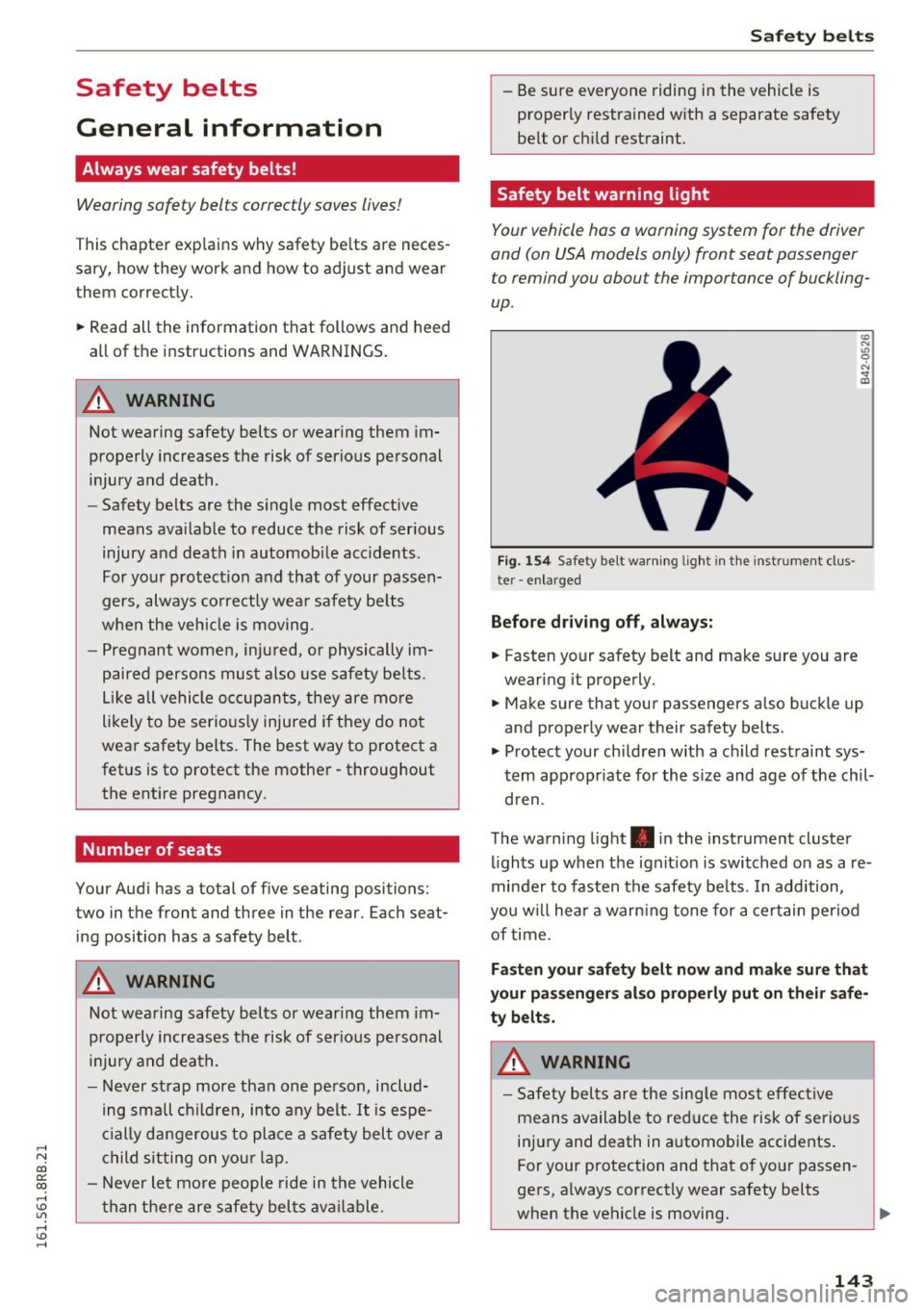
Fig. 154 Safety belt warning light in the instrument clus
te r -enlarged
Before driving off, always:
.. Fasten your safety belt and make sure you are
wearing it properly.
.,, N
"' 0 ..:, ., m
"' Make sure that your passengers also buckle up
and properly wear their safety belts.
"' Protect your children with a ch ild restraint sys
tem appropr iate for the size and age of the chil
dren .
The warning light . in the instrument cluster
lights up when the ignit ion is switched on as a re
minder to fasten the safety be lts. In addition,
you w ill hear a warn ing tone for a certain period
of time.
Fasten your safety belt now and make sure that
your passengers also properly put on their safe
ty belts.
A WARNING
-
-Safety belts are the single most effective
means available to reduce the risk of serious
injury and death in automobile accidents .
For your protection and that of your passen
gers, a lways correctly wear safety belts
when the vehicle is moving.
143