seats AUDI Q5 2016 Owner's Guide
[x] Cancel search | Manufacturer: AUDI, Model Year: 2016, Model line: Q5, Model: AUDI Q5 2016Pages: 300, PDF Size: 75.02 MB
Page 161 of 300
..... N
co ~ CX)
..... I.Cl U"I
..... I.Cl .....
restraints or occupants on the front passen
ger seat and prevent the side airbag in the
seat backrest from deploying properly.
- Never use cushions, pillows, blankets or
similar items on the front passenger seat.
The additional padding will prevent the
weight-sensing mat in the seat from accu
rately registering the child restraint or per
son on the seat and prevent the Advanced
Airbag System from functioning properly .
- If you must use a child restraint on the front passenger seat and the child restraint man
ufacturer's instructions require the use of a
towel, foam cushion or something else to
properly position the child restraint, make
certain that the
PASSENGER AIR BAG OFF
light comes on and stays on whenever the
child restraint is installed on the front pas
senger seat.
- If the
PASSENGER AIR BAG OFF light does
not come on and stay on, immediately in
stall child restraint in a rear seating position
and have the airbag system inspected by
your authorized Audi dealer .
How the Advanced Airbag System
components work together
The front Advanced Airbag System and the side
airbags supplement the protection offered by the
front three-point safety belts with pretensioners
and load limiters and the adjustable head re
straints to help reduce the risk of inju ry in a wide
range of accident and crash situations. Be sure to
read the important information about safety and
heed the WARNINGS in this chapter.
Deployment of the Advanced Airbag System and
the act ivation of the safety be lt pretensioners de
pend on the deceleration measured by the crash
sensors and regis tered by the electronic control
unit . Crash severity depends on speed and decel
eration as well as the mass and stiffness of the
vehicle or object involved in the crash .
On the passenger side, regardless of safety belt
use, the airbag will be turned off if the weight on
the passenger seat is less than the amount pro grammed in the elect ronic control unit. The front
Airbag system
airbag on the passenger side will also be turned
off if one of the child safety seats that has been
certified under Federal Motor Vehicle Safety
Standard 208 has been recognized on the seat.
The
PASSENGER AIR BAG OFF light comes on
and stays on to tell you when the front Advanced
Airbag on the passenger side has been turned off
q page 152, Child restraints on the front seat -
some important things to know .
_&. WARNING
To reduce the risk of injury when an airbag in
flates, always wear safety belts properly.
- If you are unrestrained, leaning forward, sit
ting sideways or out of position in any way,
your risk of injury is much higher.
- You will also receive serious injuries and
could even be killed if you are up against the
airbag or too close to it when it inflates -
even with an Advanced Airbag
qpage 151.
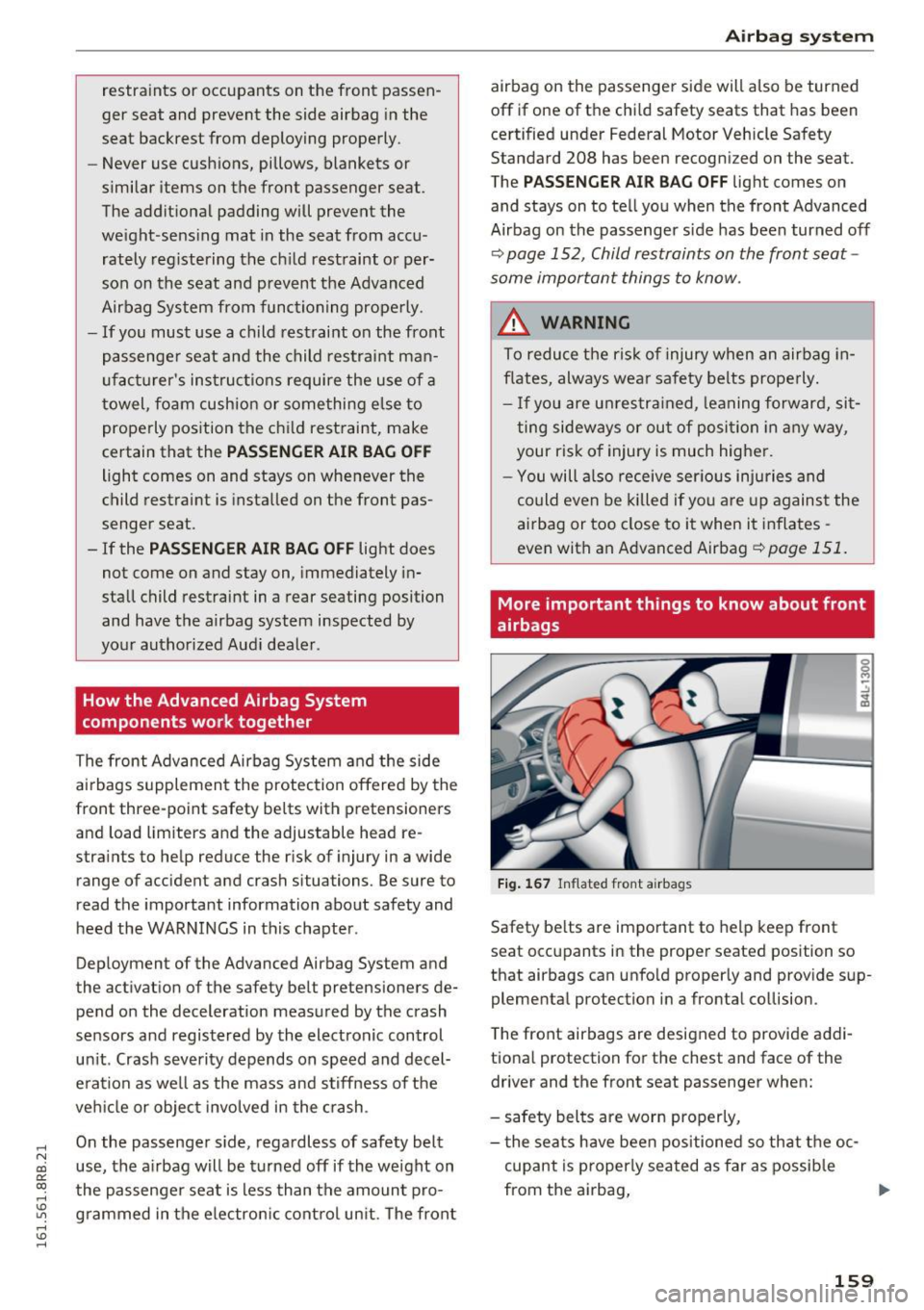
More important things to know about front
airbags
Fig. 167 Inflated front airbags
Safety belts are important to help keep front
seat occupants in the proper seated position so
that airbags can unfold properly and provide sup
plemental protection in a frontal collision .
The front airbags are designed to provide addi
tional protection for the chest and face of the
driver and the front seat passenger when:
- safety belts are worn properly,
- the seats have been positioned so that the oc-
cupant is properly seated as far as possible
from the airbag, ..,.
159
Page 162 of 300
Airbag syste m
-and the head restraints have been properly ad -
justed .
Because airbags i nflate i n the blink of an eye w ith
g reat for ce, th ings you have on your lap or have
p laced on the seat cou ld become dangerous pro
jectiles, and be pushed into you if the airbag in
flates .
When an a irbag deploys, fine dus t is re leased.
This is normal and is not caused by a fire in the
vehicle . This dust is made up mostly of a powder
used to lubricate the airbags as they deploy. It
could irr itate sk in.
It is important to remember that whi le the sup
p lemental airbag system is designed to reduce
the likelihood of serious injur ies, other in juries,
for example swelling, bruising and m inor abra
sions, can also happen when airbags inflate. Air bags do not protect the arms or the lower parts
of the body . Front airbags only supplement the
three po int safety belts in some fronta l co llisions
i n which the veh icle decelerat ion is high enough
to deploy the airbags.
Fr ont airbags w ill not deploy:
- if the ignit ion is switched off when a crash oc -
curs ,
- in s ide collisions,
- in rear-end collisions,
- in rollovers,
- when the crash decelerat ion measured by the
airbag system is less than the minimum thresh
o ld needed for airbag deployment as registered
by the electronic control unit.
The front pass eng er airbag will also not
depl oy :
- when the front passenger seat is not occupied,
- when the weight on the front passenger seat as
sensed by the Advanced A irbag System indi
cates that the front airbag on the passenger
s ide has to be turned off by the electronic con
trol unit (the
PAS SENGER AIR B AG OFF light
comes on and stays on) .
A WARNING
Sitting in the wrong pos ition can increase the
r is k of se rious i njury in c rashes.
160
- To reduce the risk o f injury when the airbags
inflate, the driver and passengers must al
ways sit in an upright position, must not
lean aga inst or place any part of their body
too close to the area where the airbags are
located.
- Occupants who are unbelted, out of posit ion
or too close to the airbag can be serious ly
in ju red by an airbag as it unfolds wit h great
force in the blink of an eye r=;,
page 152.
A WARNING
A child in a rearward-fa cing child safety seat
installed on the front p assenger sea t will be
seriously injured and can be killed if the front
airbag inflates -even with an Advanced Airbag
System.
- The inflating airbag will hit the chi ld safety
seat o r infant ca rrier with great force and
w ill smash the child safety seat and child
aga inst the backrest, center a rmrest, door
or roof.
- Always install rear-fac ing ch ild safety seats
on the rear seat.
- If you must insta ll a rearwa rd facing child
safety seat on the front passenger seat be
cause of exceptional circumstances and the
PAS SENGER AIR BAG OFF light does not
come on and stay on, immediately install
the rea r-facing child safety seat in a rear
seating position and have the ai rbag system
inspected by your au thori zed Au di d ealer.
A WARNING
Objects between you and the airbag will i n
crease the r is k of injury in a crash by interfer
ing with the way the airbag unfolds or by be
ing p ushed into you as the airbag inflates .
- Never hold things in yo ur hands o r on your
lap when the vehicle is in use .
- Never transport items on or in the area of
the front passenger seat . Objects could
move into the area of the front airbags dur
ing braking or other sudden maneuver and
become dangerous projectiles that can
cause serious persona l injury if the airbags
inflate.
Page 165 of 300
,....,
N
co
er::
co
,....,
ly seated on the center of the seat cushion with
his or her back up against the backrest and the
backrest is not reclined
9 page 135 , Correc t
passenger seating positions,
- the adult is not taking weight off the seat by
holding on to the passenger assis t handle
above the front passenger door or suppor ting
their weight on the armrest,
- the safety bel t is being properly worn and that
there is not a lot of slack in the safety belt web
bing,
- accessory seat covers or cushions or other
things that may cause an incorrect reading or
impression on the weight-sensing mat under
the upholstery of the seat have been removed
from the front passenger seat,
- a safety belt extender has not been left in the
safety belt latch for the front passenger seat.
In addition to the
PASSENGER AIR BAG OFF
light in the center of the instrument panel, the
message
PASSENGER AIR BAG OFF or PASSEN
GER AIR BAG ON
will briefly appear in the instru
ment cluster display . This is to inform the driver
of the current front passenger airbag status.
Important safety instructions on
monitoring the Advanced Airbag System
A WARNING
An airbag system that is not functioning prop erly cannot provide supplemental protection
in a frontal crash .
- If the airbag indicator light
9 page 16
comes when the vehicle is being used, have
the system inspected immediately by your
authorized Audi dealer. It is possible that
the airbag will inflate when it is not sup
posed to, or will not inflate when it should.
A WARNING
If the front airbag inflates, a child without a
child restraint, in a rearward-facing child safe
ty seat or in a forward-facing child restraint
that has not been properly installed will be
seriously injured and can be killed.
Airbag system
-Even though your vehicle is equipped with
an Advanced Airbag System, make certain
that all children, especially 12 years and
younger, always ride on the back seat prop erly restrained for their age and size .
- Always install forward or rear-facing child
safety seats on the rear seat -even with an
Advanced Airbag System .
- If you must install a rearward-facing child
safety seat on the front passenger seat be
cause of exceptional circumstances and the
PASSENGER AIR BAG OFF light does not
appear and stay on, immediately install the
rear-facing child safety seat in a rear seating
position and have the airbag system in
spected by your authorized Audi dealer.
-A tight tether or other strap on a rearward
facing child restraint attached to the front passenger seat can put too much pressure
on the weight-sensing mat in the seat and
register more weight than is actually on the
seat . The heavier weight registered can
make the system work as though an adult
were on the seat and deploy the Advanced
Airbag when it must be suppressed causing
serious or even fatal injury to the child.
- If, in exceptional circumstances, you must
install a forward-facing child restraint on
the front passenger seat, always move the
seat into its rearmost position in the seat's
fore and aft adjustment range, as far away
from the airbag as possible. The backrest must be adjusted to an upright position .
Make sure that the
PASSENGER AIR BAG
OFF
light comes on and stays on all the time
whenever the ignition is switched on.
A WARNING
-- If the PASSENGER AIR BAG OFF light does
not go out when an adult is sitting on the
front passenger seat after taking the steps
described above, make sure the adult is
properly seated and restrained at one of the rear seating positions.
- Have the airbag system inspected by your
authorized Audi dealer before transporting
anyone on the front passenger seat.
163
Page 166 of 300
Airbag system
(D Tips
If the weight-sensing mat in the front passen
ger seat detects an empty seat, the front air
bag on the passenger side will be turned off,
and
PASSENGER AIR BAG OFF will stay on.
Repair , care and disposal of the airbags
Parts of the airbag system are installed at many
different places on your Audi. Installing , remov
ing, servicing or repairing a part in an area of the
vehicle can damage a part of an airbag system and prevent that system from working properly in a collision.
There are some important things you have to
know to make sure that the effectiveness of the
system will not be impaired and that discarded
components do not cause injury or pollute the
environment.
A WARNING
Improper care, servicing and repair proce
dures can increase the risk of personal injury
and death by preventing an airbag from de
ploying when needed or deploying an airbag
unexpectedly:
-
- Never cover, obstruct, or change the steer
ing wheel horn pad or airbag cover or the in
strument panel or modify them in any way .
- Never attach any objects such as cupholders
or telephone mountings to the surfaces cov
ering the airbag units.
- For cleaning the horn pad or instrument panel, use only a soft, dry cloth or one mois
tened with plain water. Solvents or cleaners could damage the airbag cover or change
the stiffness or strength of the material so
that the airbag cannot deploy and protect properly.
- Never repair, adjust , or change any parts of
the airbag system.
- All work on the steering wheel, instrument
panel, front seats or electrical system (in
cluding the installation of audio equipment,
cellular telephones and CB radios, etc.)
must be performed by a qualified technician
164
who has the training and special equipment necessary.
- For any work on the airbag system, we
strongly recommend that you see your au
thorized Audi dealer or qualified workshop .
- Never modify the front bumper or parts of
the vehicle body.
- Always make sure that the side airbag can
inflate without interference:
- Never install seat covers or replacement
upholstery over the front seatbacks that
have not been specifically approved by
Audi .
- Never use additional seat cushions that
cover the areas where the side airbags in
flate.
- Damage to the original seat covers or to
the seam in the area of the side airbag
module must always be repaired immedi
ately by an authorized Audi dealer .
- The airbag system can be activated only
once . After an airbag has inflated, it must
be replaced by an authorized Audi dealer or
qualified technician who has the technical
information, training and special equipment
necessary.
- The airbag system can be deployed only
once . After an airbag has been deployed, it
must be replaced with new replacement
parts designed and approved especially for
your Audi model version. Replacement of complete airbag systems or airbag compo
nents must be performed by qualified work
shops only. Make sure that any airbag serv
ice action is entered in your Audi Warranty
& Maintenance booklet under AIRBAG RE
PLACEMENT RECORD.
- In accidents when an airbag is deployed, the
vehicle battery separates the alternator and
the starter from the vehicle electrical sys
tem for safety reasons with a pyrotechnic
circuit interrupter.
- Work on the pyrotechnic circuit interrupt
er must only be performed by a qualified
dealer - risk of an accident!
- If the vehicle or the circuit interrupter is
scrapped, all applicable safety precautions
must be followed.
llll-
Page 173 of 300
,....,
N
co
er::
co
,....,
Important information
Introduction
The rear seat is generally the safest place in a
collision .
The physical principles of what happens when
your vehicle is in a crash apply also to children
c:> page 144, What happens to occupants not
wearing safety belts? .
But unlike adults and
teenagers, their muscles and bones are not fully
developed. In many respects children are at
greater r isk of serious injury in crashes than
adults .
Because children's bodies are not fu lly devel
oped, they requ ire restraint systems especially
des igned for their size, we ight, and body struc
ture. Many countr ies and all states of the United
States and provinces of Canada have laws requir
ing the use of approved child restraint systems
for infants and small children .
In a frontal crash at a speed of 20-3 5 mph
(30-56 km/h) the forces acting on a 13-pound
(6 kg) infant will be more than 20 times the
weight of the child . This means the weight of the
child would suddenly be more than 260 pounds
(120 kg) . Under these conditions, only an appro
priate child restraint properly used can reduce
the risk of serious injury . Child restra ints, like
adult safety belts, must be used properly to be
effect ive. Used improperly, they can increase the
risk of serious injury in an accident .
Consult the child safety seat manufacturer's in
structions in order to be sure the seat is right for
your child's size
c:> page 174, Important safety
instructions for using child safety seats .
Please
be sure to read and heed all of the important in
formation and WARNINGS about child safety,
Advanced Airbags, and the installation of child restraints in this chapter.
There is a lot you need to know about the Ad
vanced Airbags in your vehicle and how they work
when infants and children in chi ld restraints are
on the front passenger seat . Because of the large
amount of important information, we cannot re-
Ch ild safety
peat it all here. We urge you to read the detailed
information in this owner's manual about airbags
and the Advanced Airbag System in your vehicle
and the very important information about trans
porting children on the front passenger seat.
Please be sure to heed the WARNINGS -they are
extremely important for your safety and the safe
ty of your passengers, especially infants and small chi ldren.
_& WARNING
- Accident statistics have shown that children
are generally safer in the rear seat area than in the front seating position . Always restrain
any child age 12 and under in the rear.
- All vehicle occupants and especially children must be restrained properly whenever riding
in a vehicle. An unrestrained or improperly restrained child cou ld be injured by striking
the inter ior or by being ejected from the ve
h icle during a sudden maneuver or impact .
An unrestrained or improperly restrained
child is a lso at greater risk of injury or death
through contact w ith an inflating a irbag.
-A suitable ch ild restraint properly installed
and used at one of the rear seating positions
provides the h ighest degree of protect ion
for infants and small children in most acci
dent situat ions .
_& WARNING
f"-"----
Children on the front seat of any car even with
Advanced Airbags can be seriously injured or
even killed when an airbag inflates . A child in
a rearward-facing chi ld safety seat installed
on the front passenger seat will be seriously i njured and can be killed if the front airbag in
flates .
- The inflating airbag will h it the ch ild safety
seat or infant carr ier with great force and
will smash the child safety seat and child aga inst the backrest, center armrest, or
door.
- Always install rear-fac ing child safety seats
on the rear seat .
- If you must install a rearward facing child
safety seat on the front passenger seat in
171
Page 176 of 300
Child safet y
Model Manufactured on or
after
Cosco Summit Deluxe September 25, 2007
High Back Booster
22-262
Cosco High Back Boos -
September 25, 200 7
ter 22-209
Evenflo Tribute V September 25, 2007
379xxxx
Evenflo Medallion 254 December 1, 1999
E venflo Generations September 25, 200 7
352xxxx
Graco ComfortSport September 25, 2007
Graco Toddler Safety Sep tember 25, 200 7
Seat Step 2
Graco P latinum Cargo September 25, 2007
,& WARNING
T o red uce the risk of serio us i njur y, m ake s ure
t ha t the
PASSENGER AIR BAG OFF lig ht
comes o n and stays on wheneve r a child re
straint is installed on the front passenger seat
and the ignition is sw itche d on.
- Take the ch ild rest raint off the front passen
ger seat and insta ll it p roperly at one of the
rear seat positions if the
PASSENGER AIR
BAG OFF
light does not stay on.
- Have the airbag system inspecte d by your
autho rized Aud i dealer immediately.
(D Tips
The ch ild seats listed in catego ries A to C have
been statica lly tested by Au di only for the Ad
vanced Airbag function.
Important safety instructions for using
child safety seats
Correct use of child safety seats substantially re
duces the risk of injury in on occident!
As the driver, you are respons ible for the safety
of everybody in the vehicle, especially chi ldren:
... Always use the r ight chi ld safety seat for each
c h ild and a lways use it properly ¢
page 176.
174 ...
Always carefully follow the chi ld safety seat
manufact urer 's instructions on how to route
the sa fety be lt properly thro ugh the ch ild safe
ty seat.
... When using the vehicle safety belt to install a
child safety seat, you must first act ivate the
convertib le lock ing retracto r o n the safety belt
to prevent the chi ld safety seat from moving
¢ page 180.
... Push the ch ild sa fety sea t down wi th yo ur fu ll
weigh t to get the safety belt rea lly tight so tha t
the seat cannot move forward or sideways
more than one inch (2 .5 cm).
... If a strap or tether is being used to tie the child
safety seat to the front passenge r seat, make
sure that it is not so tight t hat it causes the
weight -sensing mat to measure more weight
t han is actually o n the seat .
... Secu re unused safety belts on the rear s eat
¢ page 176.
Always remember : Even though your veh icle is
equipped wi th an Advanced Airbag system, all
c hi ld ren, especially those 12 yea rs and you nger,
s h ould always ride in th e back sea t proper ly re
strained for their age and s ize.
,& WARNING
-
Not usin g a child sa fe ty seat, us ing t he wrong
c h ild safety seat or imprope rly installing a
chi ld restraint inc reases t he risk of serious
personal injury and death.
- All vehicle occupants and es pecially children
m ust always be restra ined properly whenev
er riding in a vehicle.
- An unrestra ined o r imprope rly restrained
c h ild ca n be injured or killed by bei ng
t h rown ag ai nst the inside of the vehicle or
b y being ejected from it durin g a sudden
maneuver o r impact.
- An unrestra ine d or i mprope rly restrained
ch ild is at much g reater risk of injury or
death by being struck by an inflating air
bag .
- Commerc ia lly available child safety seats
are required to comply with U.S. Federal
Motor Vehicle Safety Standard (FMVSS) 213
(in Canada C MVSS 213). ...
Page 177 of 300
,....,
N
co
er::
co
,....,
that fits your child and the vehicle.
- Only use child restraint systems that fully
contact the flat portion of the seat cush
ion. The child restraint must not tip or
lean to either side. Audi does not recom
mend using child safety seats that rest on
legs or tube-like frames. They do not pro
vide adequate contact with the seat.
- Always heed all legal requirements per taining to the installation and use of child
safety seats and carefully follow the in
structions provided by the manufacturer
of the seat you are using.
- Never allow children under 57 inches
(1.45 meters) to wear a normal safety belt.
They must always be restrained by a proper
child restraint system. Otherwise, they
could sustain injuries to the abdomen and
neck areas during sudden braking maneu
vers or accidents.
- Never let more than one child occupy a child
safety seat.
- Never let babies or older children ride in a
vehicle while sitting on the lap of another
passenger.
- Holding a child in your arms is never a sub
stitute for a child restraint system.
- The strongest person could not hold the
child with the forces that exist in an acci
dent. The child will strike the interior of
the vehicle and can also be struck by the
passenger.
- The child and the passenger can also in
jure each other in an accident.
- Never install rear-facing child safety seats
or infant carriers on the front passenger
seat. A child will be seriously injured and
can be killed when the passenger airbag in
flates -even with an Advanced Airbag Sys
tem.
- The inflating airbag will hit the child safety
seat or infant carrier with great force and
will smash the ch ild safety seat and child
against the backrest, center armrest, door
or roof.
- Always install rear-facing child safety seats
or infant carriers on the rear seat .
Child safety
-Forward- facing child safety seats installed
on the front passenger's seat can interfere
with the airbag when it inflates and cause
serious injury to the child. Always install for
ward-facing child safety seats on the rear seat.
- If exceptional circumstances require the use of a forward-facing child restraint on the
front passenger's seat, the child's safety
and well-being require that the following
special precautions be taken:
- Make sure the forward-facing seat has
been designed and certified by its manu
facturer for use on a front seat with a pas
senger front and side airbag.
- Always carefully follow the manufacturer's
instructions provided with the child safety
seat or carrier.
- Always move the front passenger seat into
the rearmost position of the passenger
seat's fore and aft adjustment range, and
as far away from the airbag as possible be
fore installing the child restraint.
- Always make sure that nothing prevents
the front passenger's seat from being
moved to the rearmost position in its fore
and aft adjustment range.
- Always make sure that the backrest is in
the upright position.
- Always buckle the child safety seat firmly in
place even if a child is not sitting in it. A
loose child safety seat can fly around during
a sudden stop or in a collision.
- Always read and heed all WARNINGS when
ever using a child restrained in a vehicle is
being used¢
page 143, Safety belts,
¢ page 151, Airbag system and
¢ page 171, Child safety.
A WARNING
-To reduce the risk of serious injury, make sure
that the
PASSENGER AIR BAG OFF light
comes on and stays on whenever a child re
straint is installed on the front passenger seat
and the ignition is switched on.
~
175
Page 178 of 300
Child safety
-Take the child restraint off the front passen
ger seat and install it proper ly at one of the
rear seat positions if the
PASSEN GER AIR
BA G OF F
light does not stay on.
- Have the airbag system inspected by your
authorized Aud i dealer immediately.
Secure unused safety belts on the rear seat
l8
,h- --lJ ;g
--- 0
Fig . 173 Schematic overv iew: keep unused safety be lts
away from chi ld ren i n chil d safety seats.@-oute r rear
safety belt, @ - center rear safety be lt
~
If a chi ld safety seat is used on the rear bench,
especially with LA TCH universal lower anchorag
es, the unused safety be lts
mu st be secured so
that the child in the child restraint cannot reach
them ¢,& .
- Gu ide the safety belt webbings @and @ be
hind the head restraint of the seat where the
child restraint is installed
¢fig. 173. When do
ing so, do not engage the convertib le locking
retractor! You should not hear a "clicking"
sound when w inding up the safety be lt .
- Let the belt retractor wind up the safety belt
webb ing .
_& WARNING
A ch ild in a child safety seat installed with the
LATC H lowe r anchorages or w ith the standard
safety belt or a child in a booste r seat on the
rear seat could p lay wit h unused rear seat
safety belts and become entangled. This
cou ld cause t he chi ld ser ious personal injury
and even death.
- Always sec ure unused rear seat safety belts
o ut of reach of ch ild ren in child seats such
as by proper ly routing them aro und the
176
head restraint of the seat where the child
restraint is installed .
- Never activate t he convertible locking re
tractor when routing the safety belts around
the head restraints.
- Never let anyone s it at the center rear seat
ing position if the center rear safety belt has
been routed around a rear head restraint.
Child seats
Infant seats
Babies and infants up to about one year old and
20 lbs . or
9 kg need special rearward-facing
child restraints that support the back, neck and
head in a crash.
Fig. 1 74 Sc hema tic ove rview : rearward -facing infa nt sea t,
p rope rly installed on th e rear sea t
.. When using the veh icle safe ty belt to install a
c hild safe ty seat, yo u must first a ct ivate the
convertib le locking re tractor on the safe ty belt
to prevent the child safety seat from moving
¢
page 180 or insta ll the seat using the LATCH
attachments .
.. Push the child safety seat down with your full
weight to get the safety belt really tight so that
the seat cannot move forward or sideways
more than one inch (2 .5 cm).
.. Secure unused safety bel ts on the rear seat
¢ page 176.
Infants up to about one year (20 lbs . or 9 kg) are
bes t protected in special infant carr iers and child
safe ty seats designed for the ir age group. Many
expe rts be lieve that inf ants and small ch ildren
sho uld r ide o nly in special res tra ints in wh ic h t he
ch ild faces the back of the vehicle. These infant
II>
Page 179 of 300
..... N
co ~ CX)
..... I.Cl U"I
..... I.Cl .....
seats support the baby 's back, neck and he ad in a
crash
c!;> fig . 174.
The airbag on the passenger side makes the front
seat a potentially dange ro us p lace for a child to
ride. The front seat is not the safest place for a
child in a forward-facing child seat . It is a very
dangerous place for an infant or a larger child in
a rearward-facing seat .
A WARNING
Not using a child safety seat , using the wrong
child safety seat or imp roperly installing a
child restra int increases the risk of se rious
perso nal in jury and death in a crash .
- Never install rear -facing child safety seats
o r infant carriers on the front passenger
seat -even with an Advanced Airbag System.
A ch ild will be ser iously injured and can be
ki lled when the infla ting airbag hi ts the
child safety seat o r infant carr ier with great
force and smashes the child safety seat and child against the backrest, center armrest,
door or roof
c:> page 152, Child restraints on
the front seat -some important things to
know .
-Always install rear-facing child safety seats
or infant carriers on the rear seat.
- Never install a rear -facing child restraint in
the forward-facing direct ion. Such restraints
are designed for the spec ial needs of infants
and very small children and cannot protect
them properly if the seat is forwa rd- facing .
- If you must install a rearward fac ing ch ild
safety seat on the front passenger seat be
c a use of except io na l circumstances and the
PASSENGER AIR BAG OFF light does not
come o n and stay o n, immed iate ly i nstall
the re ar-facing c hild safety seat ih a rear
seating posit ion and have the airbag system
inspected by your Audi dealer .
- Always read and heed all WARN INGS when
ever using a child restrained in a veh icle is
being used
c:, page 143, Safety belts,
<=:> page
151, Airbag system and
c:> page 171, Important information.
Ch ild sa fety
Convertible child safety seats
Properly used convertible child safety seats can
help protect toddlers and children over age one
who weigh between 20 and 40 lbs . (9 and 18 kg)
in a crash.
F ig . 17 5 Schem atic overv ie w: installat ion o f the attac h
me nts applicable to a LA TCH sea t
Fig. 17 6 Sc hemat ic overv iew : in sta llat ion of t he seat using
t he ve hicle 's sa fety be lt syst em
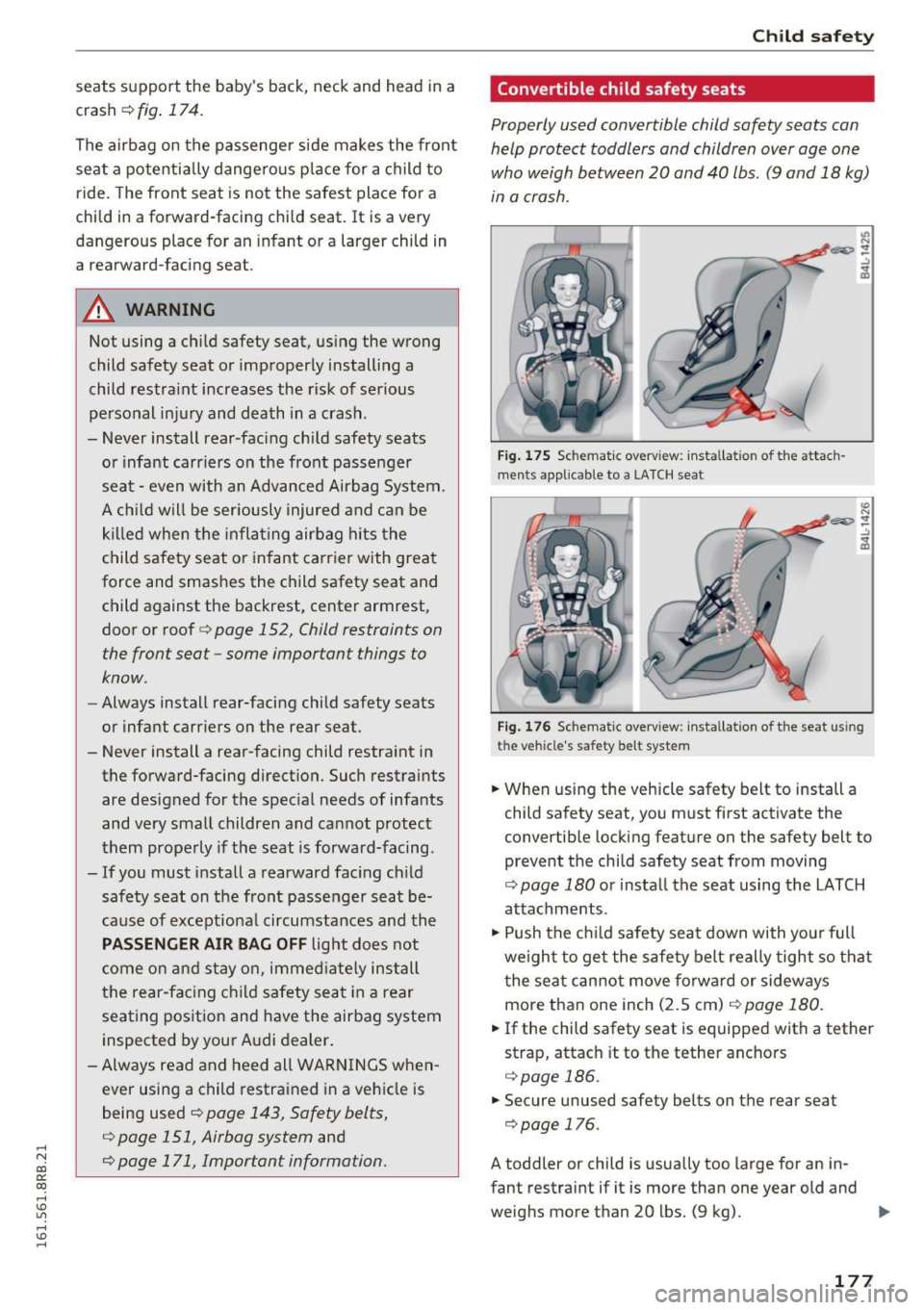
.. W hen using the vehicle safe ty belt to install a
child sa fety seat, you must first activate the
convertib le locking feat ure on the safety belt to
prevent the child safety seat from moving
c:::> page 180 or install the seat using the LATCH
attachments .
.. Push the ch ild safety seat down with yo ur full
we igh t to ge t the safety belt really tight so tha t
t he seat can not move forwa rd or sideways
more than one inch (2 .5 cm)
<=:> page 180.
.. If the child safety seat is equ ipped with a tether
strap, attac h it to the tether anchors
c:::> page 186.
.. Secure unused safety belts on the rear seat
c:::> page 176 .
A toddler or child is usua lly too large fo r an in
fant restraint if it is more th an one year old and
weighs more t han 20 lbs. (9 kg). ..,
177
Page 180 of 300
Child safety
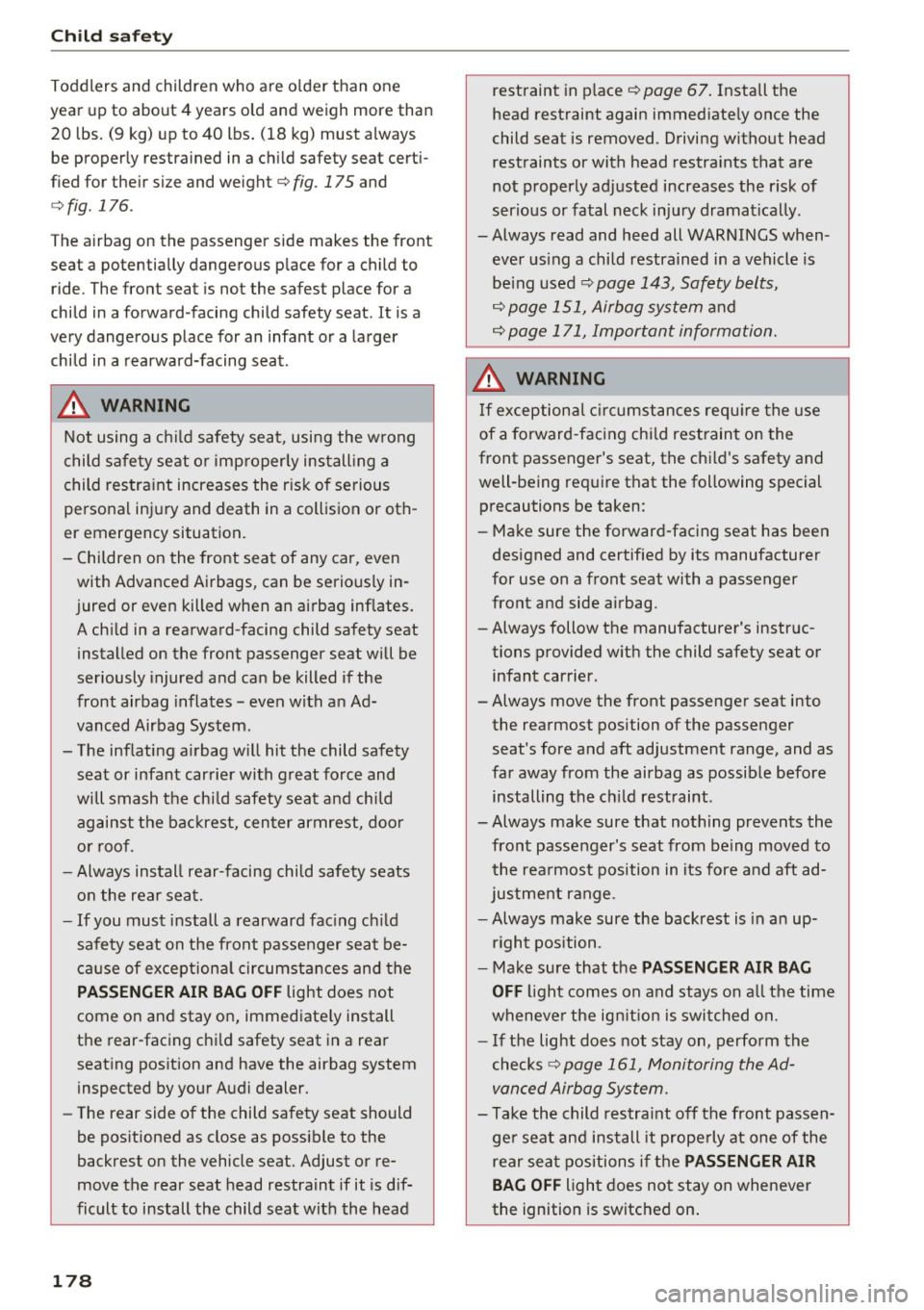
Toddlers and children who are older than one
year up to about 4 years old and weigh more than 20 lbs. (9 kg) up to 40 lbs. (18 kg) must always
be properly restrained in a child safety seat certi
fied for their size and weight¢
fig. 175 and
¢fig. 176 .
The airbag on the passenger side makes the front
seat a potentially dangerous place for a child to
ride. The front seat is not the safest pl ace for a
child in a forward-facing child safety seat . It is a
very dangerous place for an infant or a larger
child in a rearward-facing seat.
.8, WARNING
Not using a child safety seat, using the wrong
child safety seat or improperly installing a
child restraint increases the risk of serious
personal injury and death in a collision or oth
er emergency situation.
- Children on the front seat of any car, even with Advanced Airbags, can be seriously in
jured or even killed when an airbag inflates.
A child in a rearward-facing child safety seat
installed on the front passenger seat will be
seriously injured and can be killed if the
front airbag inflates - even with an Ad
vanced Airbag System .
- The inflating airbag will hit the child safety seat or infant carrier with great force and
will smash the child safety seat and child against the backrest, center armrest, door
or roof.
- Always install rear-facing child safety seats
on the rear seat.
-If you must install a rearward facing child
safety seat on the front passenger seat be
cause of exceptional circumstances and the
PASSENGER AIR BAG OFF light does not
come on and stay on, immediately install
the rear-facing child safety seat in a rear
seating position and have the airbag system
inspected by your Audi dealer.
- The rear side of the child safety seat should
be positioned as close as possible to the
backrest on the vehicle seat. Adjust or re
move the rear seat head restraint if it is dif
ficult to install the child seat with the head
178
restraint in place ¢ page 67. Install the
head restraint again immediately once the
child seat is removed . Driving without head
restraints or with head restraints that are
not properly adjusted increases the risk of
serious or fatal neck injury dramatically .
- Always read and heed all WARNINGS when ever using a child restrained in a vehicle is
being used
¢page 143, Safety belts,
¢ page 151, Airbag system
and
¢ page 171, Important information.
.8, WARNING
If exceptional circumstances require the use
of a forward-facing child restraint on the
front passenger's seat, the child's safety and
well-being require that the following special precautions be taken:
- Make sure the forward-facing seat has been
designed and certified by its manufacturer
for use on a front seat with a passenger
front and side airbag.
- Always follow the manufacturer's instruc
tions provided with the child safety seat or
infant carrier.
- Always move the front passenger seat into the rearmost position of the passenger seat's fore and aft adjustment range, and as
far away from the airbag as possible before
installing the child restraint.
- Always make sure that nothing prevents the front passenger's seat from being moved to
the rearmost position in its fore and aft ad
justment range.
-Always make sure the backrest is in an up
right position .
- Make sure that the
PASSENGER AIR BAG
OFF
light comes on and stays on all the time
whenever the ignition is switched on.
- If the light does not stay on, perform the
checks ¢
page 161, Monitoring the Ad
vanced Airbag System .
-Take the child restraint off the front passen
ger seat and install it properly at one of the
rear seat positions if the
PASSENGER AIR
BAG OFF
light does not stay on whenever
the ignition is switched on.