door lock AUDI Q5 2016 Owner's Manual
[x] Cancel search | Manufacturer: AUDI, Model Year: 2016, Model line: Q5, Model: AUDI Q5 2016Pages: 300, PDF Size: 75.02 MB
Page 88 of 300
Driving
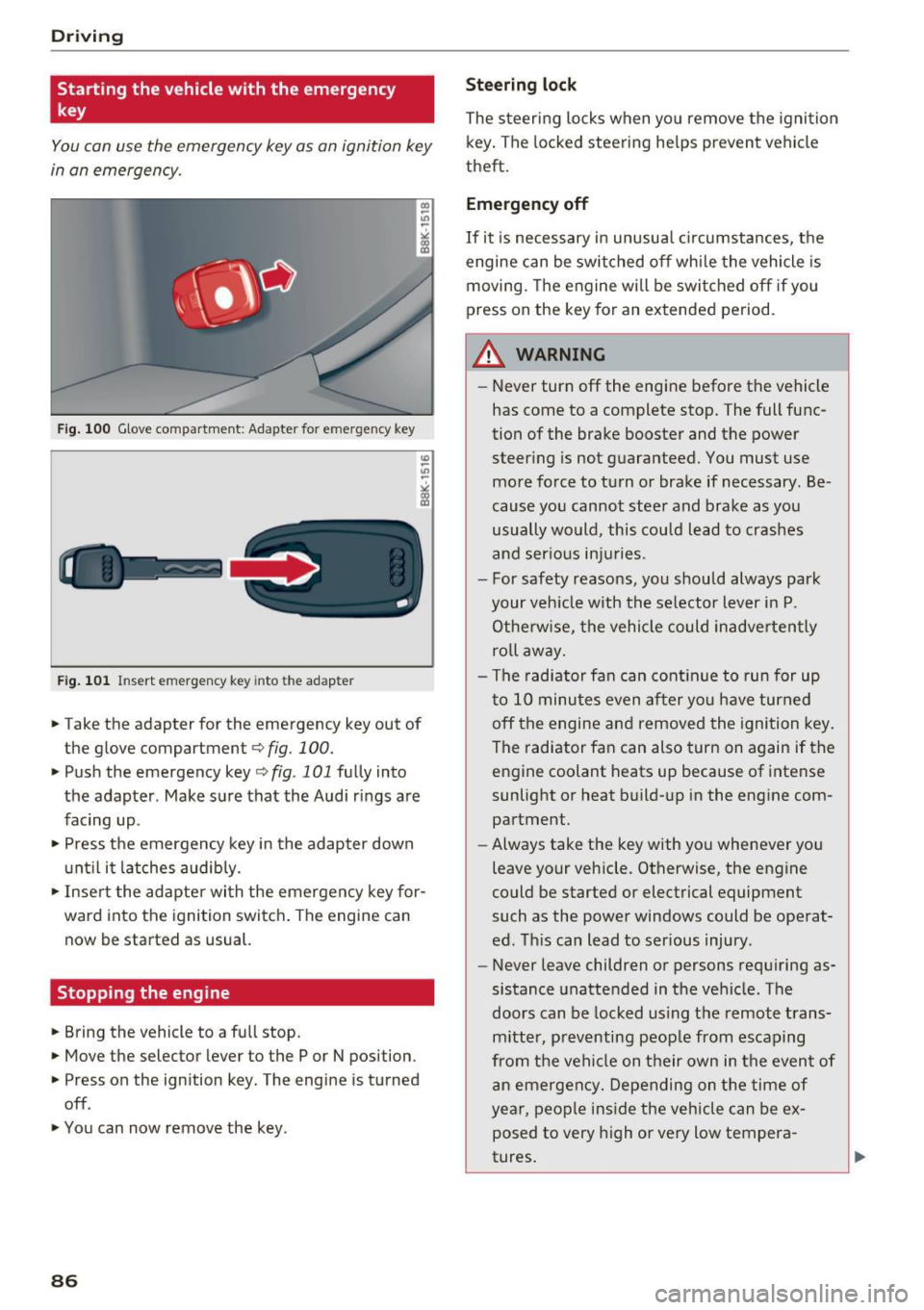
Starting the vehicle with the emergency
key
You can use the emergency key as an ignition key
in an emergency.
Fig. 100 Glove compartment : Ada pte r fo r em erg en cy key
Fig. 101 In sert emergency key into the adap te r
... Take the adapter for the emergency key out of
the glove compartment ¢
fig. 100.
.,. Push the emergency key ¢ fig . 101 fully into
the adapter . Make sure that the Audi rings are
facing up .
.,. Press the emergency key in the adapter down
until it latches audibly.
.,. Insert the adapter with the emergency key for
ward into the ignition switch. The engine can
now be started as usual.
Stopping the engine
... Bring the vehicle to a full stop.
... Move the selector lever to the P or N position .
.. Press on the ignition key . The engine is turned
off .
.,. You can now remove the key .
86
Steering lock
The steering locks when you remove the ignition
key. The locked steering helps prevent vehicle
theft.
Emergency off
If it is necessary in unusual circumstances, the
engine can be switched off while the vehicle is
moving. The engine will be switched off if you
press on the key for an extended period .
A WARNING
-Never turn off the engine before the vehicle
has come to a complete stop. The full func
tion of the brake booster and the power
steering is not guaranteed. You must use
more force to turn or brake if necessary . Be
cause you cannot steer and brake as you
usually would, this could lead to crashes
and serious injuries .
- For safety reasons, you should always park
your vehicle with the selector lever in P .
Otherwise, the vehicle could inadvertently
roll away.
- The radiator fan can continue to run for up
to 10 minutes even after you have turned
off the engine and removed the ignition key .
The radiator fan can also turn on again if the
engine coolant heats up because of intense
sunlight or heat build-up in the engine com
partment .
- Always take the key with you whenever you
leave your vehicle . Otherwise, the engine
could be started or electrical equipment
such as the power windows could be operat
ed. This can lead to serious injury .
- Never leave children or persons requiring as
sistance unattended in the vehicle. The
doors can be locked using the remote trans
mitter, preventing people from escaping
from the vehicle on their own in the event of
an emergency. Depending on the time of
year, people inside the vehicle can be ex
posed to very high or very low tempera
tures.
Page 89 of 300
..... N
co ~ CX)
..... I.Cl U"I
..... I.Cl .....
CD Note
If the engine has been under heavy load for
an extended per iod, heat builds up in the en
gine compartment after the engine is switch
ed off- there is a risk of damaging the eng ine .
Allow the engine to run at idle for about two
m inutes before switching it off .
Convenience key
Starting the engine
Applies to vehicles: with Conve nien ce key
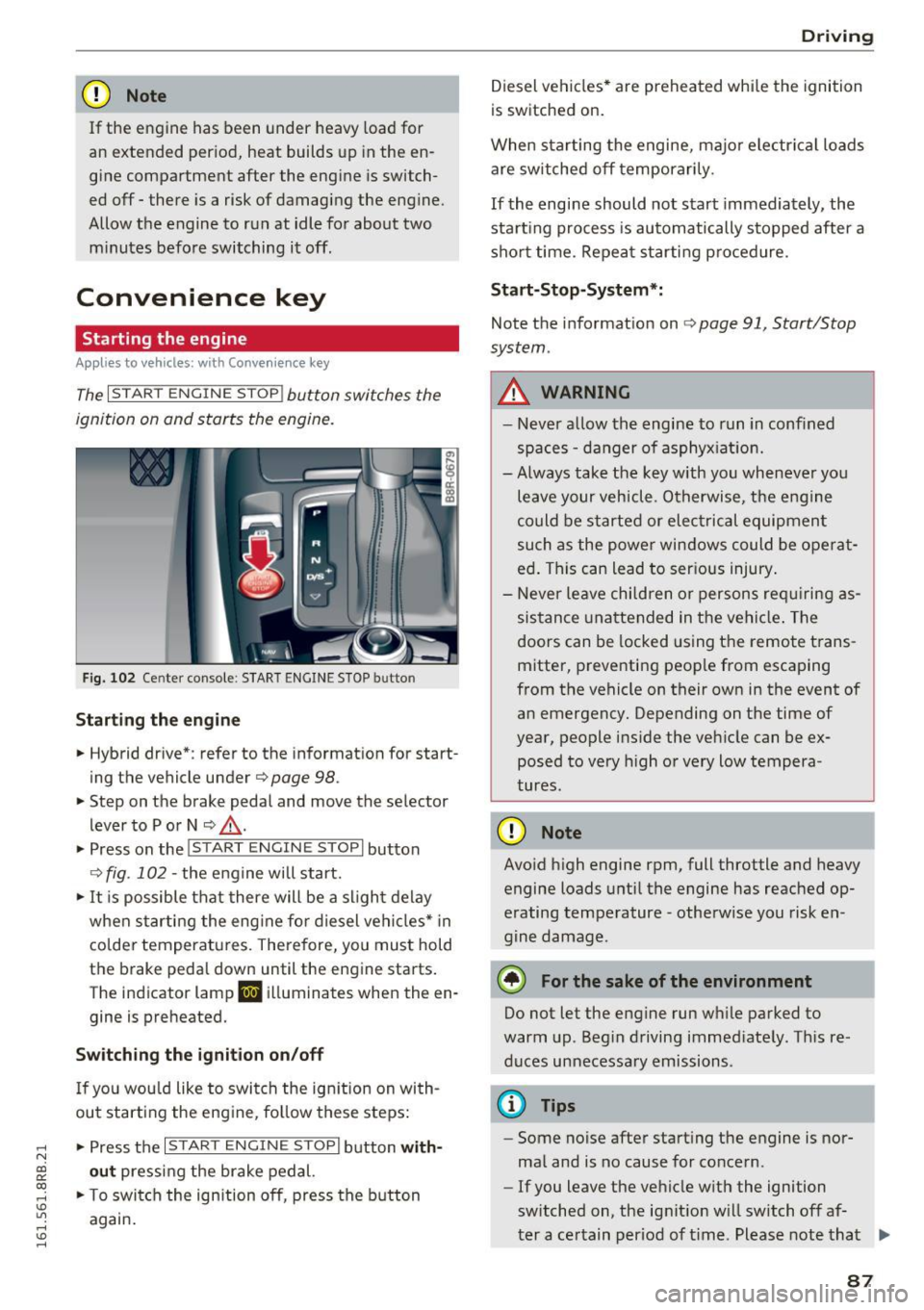
The I S TA RT ENGINE S TOP ! button switches the
ignition on and starts the engine.
Fig. 102 Ce nter console : S TART E NGINE STOP b utto n
Starting the engine
• Hybrid drive *: refer to the informat ion fo r start
ing the vehicle under
Q page 98 .
• Step on the brake pedal and move the selector
lever to P or
N Q LD, .
• Press on the~ , S_T_A_R_ T_E _N _G_ I_N_E_S_T_O_P~I button
Q fig . 102 -the engine will start.
• It is possible that there will be a sligh t delay
when starting the eng ine fo r die sel vehi cles* in
colder temperatu res. Therefore, you mus t hold
the brake peda l down until the engine starts .
The indicator lamp
II illuminates when the en
gine is preheated.
Switching the ignition on/off
I f you wou ld like to switch the ign ition on wi th
ou t starting the eng ine , follow these steps :
• Press t he
I S T AR T ENG IN E STOPI button with
out pressing the brake pedal.
• To swi tch the ignition off, press the b utton
again .
Drivi ng
Diesel vehi cles* are preheated whi le the ignition
is switched on.
When starting the e ngine, majo r electrical loads
are switched off temporarily.
If the engine should not start immediately, the
sta rt ing process is au tomatically s topped after a
sho rt time. Repea t starti ng procedure.
Start-Stop-System*:
Note the information on Q page 91, Start/Stop
system .
A WARNING
--Never allow the engine to r un in conf ined
spaces -danger of asphyx iat ion.
- Always take the key with you whenever yo u
leave your vehicle . Otherwise, the eng ine
co uld be started or elect rical equipmen t
such as the powe r windows could be operat
ed . This can lead to ser ious injury .
- Never le a ve chi ldren o r persons re quiring as
sis tan ce una ttende d in the ve hicl e. The
doors can be locked us ing the remote t rans
mitter, preventing peop le from escaping
from the vehicle on their own in the event of an emergency. Depending on the time of
year, people ins ide the veh icle can be ex
posed to very high o r very low tempera
tures .
CD Note
Avoid h igh engine rpm, full throttle and heavy
engine loads u ntil the engine has reached op
erating temperature -otherwise you risk en
g ine damage.
@ For the sake of the environment
Do n ot let the engine run wh ile parked to
warm up . Beg in d riving immed iate ly. T his re
d uces unnecessa ry emissions .
@ Tips
-Some noise after start ing the engine is nor
ma l and is no cause for co ncern.
- If you leave the vehicle w ith the ignition
switched on , the ignit ion w ill switch of f af-
-
ter a certain per iod of time . Please note that .,,_
87
Page 90 of 300
Driving
electrical equipment such as exterior lights
will switch off as well when that happens.
Switching engine off
Applies to veh icles: w ith Conven ience key
~ Bring your vehicle to a complete stop.
~ Move the selector lever to the P or N position.
~ Press the I START ENGIN E STOPI button
¢page 87, fig. 10 2.
Steering lock
The steering locks when you turn the engine off
using the
!START ENGINE STOP ! button and
open the driver 's door. The locked steering helps
prevent vehicle theft.
Emergency off
If necessary, the engine can be switched off with
the s ele ctor lever in the R or D/S position. The
engine stops if you press and hold the
!START ENGINE STOP! button at speeds below
6 mph (10 km/h) and press the brake pedal.
A WARNING
- Never turn off the engine before the vehicle
has come to a complete stop. The full func
t ion of the brake booster and the power
steering is not guaranteed. You must use
more force to turn or brake if necessary. Be
cause you cannot steer and brake as you
usually would, this could lead to crashes
and serious injuries.
- For safety reasons, you should always park
your vehicle with the selector lever in P.
Otherwise, the vehicle could inadvertently
roll away .
- The radiator fan can continue to run for up
to 10 minutes even after you have turned
off the engine and removed the ignition key.
The radiator fan can also turn on again if the
engine coolant heats up because of intense
sunlight or heat build-up in the engine com
partment.
- Always take the key with you whenever you
leave your vehicle. Otherwise, the engine
could be started or electrical equipment
88
such as the power windows could be operat
ed. This can lead to serious injury.
- Never leave children or persons requiring as
sistance unattended in the vehicle. The
doors can be locked using the remote trans
mitter, preventing people from escaping
from the vehicle on their own in the event of
an emergency. Depending on the time of
year, people inside the vehicle can be ex
posed to very high or very low tempera
tures.
0 Note
If the engine has been under heavy load for
an extended period, heat builds up in the en
gine compartment after the engine is switch
ed off -there is a risk of damaging the engine.
Allow the engine to run at idle for about two
minutes before switching it off.
Driver messages
Ignition is on
This message appears and a warning tone sounds
if you open the driver 's door when the ignition is
switched on.
No key identified
This message appears when the
ISTART E NGIN E STOP !* button is pressed if there
is no master key inside the vehicle or if the sys
tem does not recognize it. For example, the mas
ter key cannot be recognized if it is covered by an
object (e .g . aluminum brief case) which
screens
the radio s ignal. Electronic devices such as cell
phones can also interfere with the radio signal.
Press brake pedal to start engine
This message appears if you do not press the
brake pedal to start the engine .
Shift to N or P to start engine
This message appears when attempting to start
the engine if the selector lever for the automatic
transmission is not in the P or N position. The en
gine can only be started with the selector in
these positions.
ll-
Page 91 of 300

..... N
co ~ CX)
..... I.Cl U"I
..... I.Cl .....
!I Is the ke y in the vehicle ?
This message appears in a veh icle w ith Conven
ience key* if the master key is removed from the
ve hicle w ith the engine r unning.
If the master
key is no longer in the vehicle, you cannot switch
on the ignition after stopping the engine and you
also cannot start the eng ine again. Moreover, you
cannot lock the veh icle from the outside with the
key.
Shift to P othe rwis e vehicle c an roll away . Doors
do not l ock if lever i s not in
P.
This message appears for safe ty reasons a long
with a warning s ignal.
It appears i f the selector
lever for the automatic transmission is not in the
P posit ion when switching
off the ignition. Move
the selector lever to the P posit ion, otherwise the
vehicle is not secured aga inst rolling away . You
also cannot lock the vehicle using the locking button* on the door handle or using the remote
key .
Turn off ignit io n befo re lea ving car
Th is message appears if the driver's door is
opened while the ignition is switched on . Always
switch
off the ignition if you are leaving the vehi
cle . See also
c:;, page 93.
Turn off ignit ion befo re lea ving car. Batte ry is
dis charging
This message appears if the d river's door is
ope ned while the ignition is switched on. Always
switch
off the ignition if you are leaving the vehi
cle . See a lso
c:;, page 93.
Shift to P and turn off ignition, otherwi se vehi
cle can roll awa y
This message appears if the driver 's door is
opened while the igni tion is sw itched on and t he
selec to r lever is not in t he P posit ion. Shift the
se lector lever into the P pos ition and switch of f
the ignition when you exit the vehicle . Otherwise
the vehicle cou ld roll . See also
c:;, page 93.
Con venien ce k ey defe cti ve ! Use igniti on lo ck
This message appears if the engine must be
started or stopped using the ignit ion key and not
the
! S TAR T ENGINE ST OPI* button .
Electromechanical
parking brake
Operation D
rivi ng
The electromechanical parking brake replaces
the hand brake.
F ig. 103 Center co nsole : P ark ing brake
.,. Pull on the switch Wl c:;, fig. 103 to apply the
parking brake. The indicator lights in the switch
and . (USA models)/ . (Canada models) in
the inst rument cluster illuminate .
.,. With the ignition switched on, step o n the
brake pedal or the accelerator pedal and press
t he swit ch(® at the same time to re lease the
parking brake . The indicator lights in the switch
and . (USA mode ls)/ . (Canada models) in
the instrument cluster go out.
You r vehicle is equ ipped wi th an electromechan i
ca l parking brake . The parking brake is designed
to prevent the vehicle from ro lling unintentional
ly and replaces the hand brake.
In add ition to the normal functions of a trad i
t iona l han d brake, the electromechanical parking
brake provides va rious convenience and safety
funct ions .
When starting from rest
-The integra l sta rting assist he lps yo u when
driving by automati cally releas ing the pa rking
brake
c:;, page 90, Starting from res t.
-When start ing on incline s, t he s tart ing assist
prevents the vehicle from uninten tionally ro ll
ing back . The braking force of the parking brake
is not re leased unti l sufficient driving force has
been built up at the wheels. .,.
89
Page 92 of 300
Driving
E m erg ency b ra ke function
An emergency b rake ensures that the veh icle can
be slowed down even if the normal brakes fai l
¢ page 91, Emergency broking.
A WARNING
If a drive range is engaged with the vehicle
stationary and the engine running, you must
in no instance accelerate care lessly. Other
w ise the vehicle will start to move immediate
ly -risk of an accident.
(D Tips
- If the parking brake is app lied with the igni
tion switched off, the indicator lights in the
switch and. (USA models)/ . (Cana-
da models) in the instrument cluster will go
out after a ce rtain per iod of t ime.
- Occasiona l noises whe n the parking b rake is
applied and released are normal and are not
a cause for conce rn.
- When the vehicle is par ked, the park ing
brake goes thro ugh a self-test cycle at regu
l a r i nte rvals. Any associa ted noises a re nor
mal.
Parking
" Press the brake ped al to stop the vehicle.
" Pull the switch
¢ page 89, fig. 103 to set the
parking brake.
" Move the selector lever to P.
" Turn the eng ine off¢ &_.
-
"When on incl ines or declines, turn the steering
wheel so that the vehicle w ill roll into the curb
if it beg ins to move .
A WARNING
-When you leave your vehi cle - even if on ly
br iefly- always remove the ign ition key. This
applies particular ly when c hildren remain in
the vehicle . Otherwise the children could
sta rt the engine, release the pa rking brake
or operate electrical eq uipment (e .g. power
windows). There is the risk of an acc ident.
- When the vehicle is loc ked, no one - particu
larly not children shou ld remain in the vehi-
90
-
cle. Locked doors make it more d ifficult for
emergency wo rkers to get into the vehicle -
putting lives at risk.
Starting from rest
The starting assist function ensures that the
parking broke is released automatically upon
starting.
Stopping and applying park ing brake
" Pull the switch to app ly the parking b rake.
Starting and automat ically releasing the
park ing brake
" When you start to d rive as usua l, the par king
brake is automatically released and yo ur vehicle
beg ins to move.
When stopp ing at a t raffic sig na l or s topping in
c ity traff ic on vehicles with an automat ic t rans
mission, the pa rking brake can be applied . The
vehicle does not have to be held with the foot brake. The parking brake eliminates the tendency
to c reep w ith a dr ive range engaged . As soon as
you drive off as usual, the parking brake is re
leased automat ica lly and the vehicle starts to
move.
Starting on slope s
When starting on incl ines, the starting assist pre
vents the vehicle from un intent iona lly rolling
back. The braking force of the parking brake is
not re leased u nti l sufficient dr iv ing fo rce has
been built up at the wheels.
@ Tips
For safety reasons, the park ing brake is re
l eased automatically on ly when the d river's
safety be lt is engaged in the b uckle.
Starting off with a trailer
To prevent rolling bock unintentionally on on in
cline, do the following:
" Keep the switch pu lled and depress the acceler
ator. The park ing brake stays applied and pre-
vents the ve hicle from roll ing backward.
IJ,,
Page 93 of 300
,....,
N
co
er::
co
,....,
that you are developing enough driving force at
the wheels by depressing the accelerator .
Depending on the weight of the r ig (vehi cle and
tra iler) and the severity of the incline, you may
ro ll backwards as you start . You can prevent roll
ing backwards by holding the parking brake
switch pulled out and accelerating -just as you
wou ld when starting on a hill with a conventiona l
h and brake .
Emergency braking
In the event that the conven tional brake system
fails or locks .
~ In an emergency, pull the sw itch and cont inue
to pull it to slow your veh icle down with the
parking b rake.
~ As soon as you release the switch or accelerate,
the b raking process stops .
If you pull the sw itch and hold it above a speed of
about 5 mph (8 km/h) , the eme rgency braking
function is in it iated . The vehicle is braked at all
four wheels by activating the hydraulic brake sys
te m. T he b rake perfo rman ce is sim ila r t o making
an em ergen cy sto p ~ ,& .
In o rder not to activate the emergency brak ing by
mista ke, an audib le wa rn ing tone (buzze r)
sounds w hen the sw itch is p ulled. As soon as t he
sw itch is rele ased, or the acce le ra to r p edal is de
p ressed, eme rgency bra king stops.
A WARNING
Emergency bra king should only be use d in an
emergency, w hen the normal foot brake has
fai led or the bra ke pedal is obstructed . Using
the par king b rake to perfo rm emergency
brak ing will slow your vehicle down as if you
had made a full bra ke ap plication . The laws of
physics cannot be suspended even wi th ESC
a n d its associated components (A BS, ASR,
E DS). In c orn ers and when road or weath er
c ondi tions are bad, a full brake ap plication
c an ca use the vehicle to sk id or the rear end to
break away· r isking an accident .
Driving
Driver messages in the instrument cluster
Caution: Vehicle parked too steep
T h is message appears when the pa rking bra ke is
applie d on an in cl in e that exceeds about 30%.
In this case the braki ng power o f the pa rking
brake may not be adequate to prevent the ve hi
cle from roll ing uninten tionally.
Press b rake pedal to release park ing brake
This dr iver message appears when the sw itch to
re lease the par king brake was pressed. The park
ing brake can only be released if you step o n the
brake pedal and at the same time press the
switch or you automatica lly re lease the park ing
bra ke w ith the sta rting ass ist ~
page 90 .
r.lJ Parking brake malfunction!
This dr iver message appears together w ith the
yellow
rlJ symbol whe n there is a parki ng brake
malfu nction .
Start/Stop system
Description
Applies to vehicles: wit h Start-Stop-Syste m
The Start -Stop -System can he lp increase f uel
economy and reduce CO2 emissions.
In the Start -S top -mode, the engine sh uts off au
tomat ica lly when the vehicle is stoppe d, such as
at a t raff ic light. The ignition remains switched
on d uring this stop phase. The eng ine will be a u
tomat ically restarted when needed.
T he last Start-Stop -System setting (on/off usin g
the b utton
10~ 1) will be restored when the ign i
t ion is turned on. The LED in the
10'" 1 button turns
on when the Start-Stop-System is switched off
manua lly .
Ba sic requirements for the Start-Stop mode
- The d river 's door is closed.
- The driver 's sea t belt is latc hed.
- The hood is closed.
- The vehicle must have bee n driven fast er than
2.5 mph (4 km/h) s in ce the last s top.
- A t railer is not hitched to the vehicle . .,.
91
Page 95 of 300
..... N
co ~ CX)
..... I.Cl U"I
..... I.Cl .....
engine will no t be switched off in the following
situations:
- The eng ine has not reached the m in imum re
quired temperature for Start-Stop-mode.
- T he interior temperature selected by the A/C
system has not been reached.
- The outs ide temperatu re is ext remely h igh/low.
- The w indshield is being defrosted
¢ page 82.
-The parking system* is switched on.
- The battery charge level is too low.
- The steering whee l is sharply turned or there is
a steering movement.
- After engaging the reverse gear.
- On sharp inclines .
IIJ appears in the instrument cluster display and
§ii;Ff&Ff ~lso appears in the tr ip comp ute r.
Engine automatically re starts
The stop phase is interrupted in the following sit
uations, for example . The eng ine restarts without
any action by the driver .
- The interior temperature varies from the tem
perature se lected in the A/C system .
- The windshield is beeing defrosted
¢ page 82.
- The brake pedal is pressed several times in a
row.
- The battery charge level becomes too low.
- High power cons umption .
IIJ appears in the instrument cluster display and
H§;Ff&Fii ~lso appears in the tr ip comp ute r.
Switching the ignition off autom atically
To prevent the battery from draining, the ignition
will switch off
automati cally when all of the fol
lowing cond itions have been met:
- The veh icle has already been driven.
- The eng ine has been turned off by the Start-
Stop-System .
- The driver's door is opened .
- T he dr iver's seat bel t is removed.
- The brake pedal is not pressed down.
- T he veh icle is stationary .
In this case, the activated low beam will be re
placed by the s ide marker lights . The side marker
D rivi ng
lights will switch of f after approximate ly 30 m i
nutes or when you lock the veh icle.
If t he Start-S top-System has not turned off the
engine or if you have swi tched the S tart -Stop
System off manually, the ignition will
not be au
tomatica lly switched off and the eng ine wi ll con
t in u e to run¢& .
A WARNING <= -
Never allow the engine to run in confined
spaces -danger of asphyx iation.
(D Tips
If you shift into the 0/S or N positions after
shifting into reverse, the vehicle must be dr iv
en faster than 6 mph (10 km/h) in order for
the engine to switch off again .
Switching the Start-Stop -System on /off
manually
App lies to vehicles: wi th Start -S top-Syste m
If you do not wish to use the system, you can
switch it off manually.
= , __ (A)Off _ --"'-- f'~-.::a-----
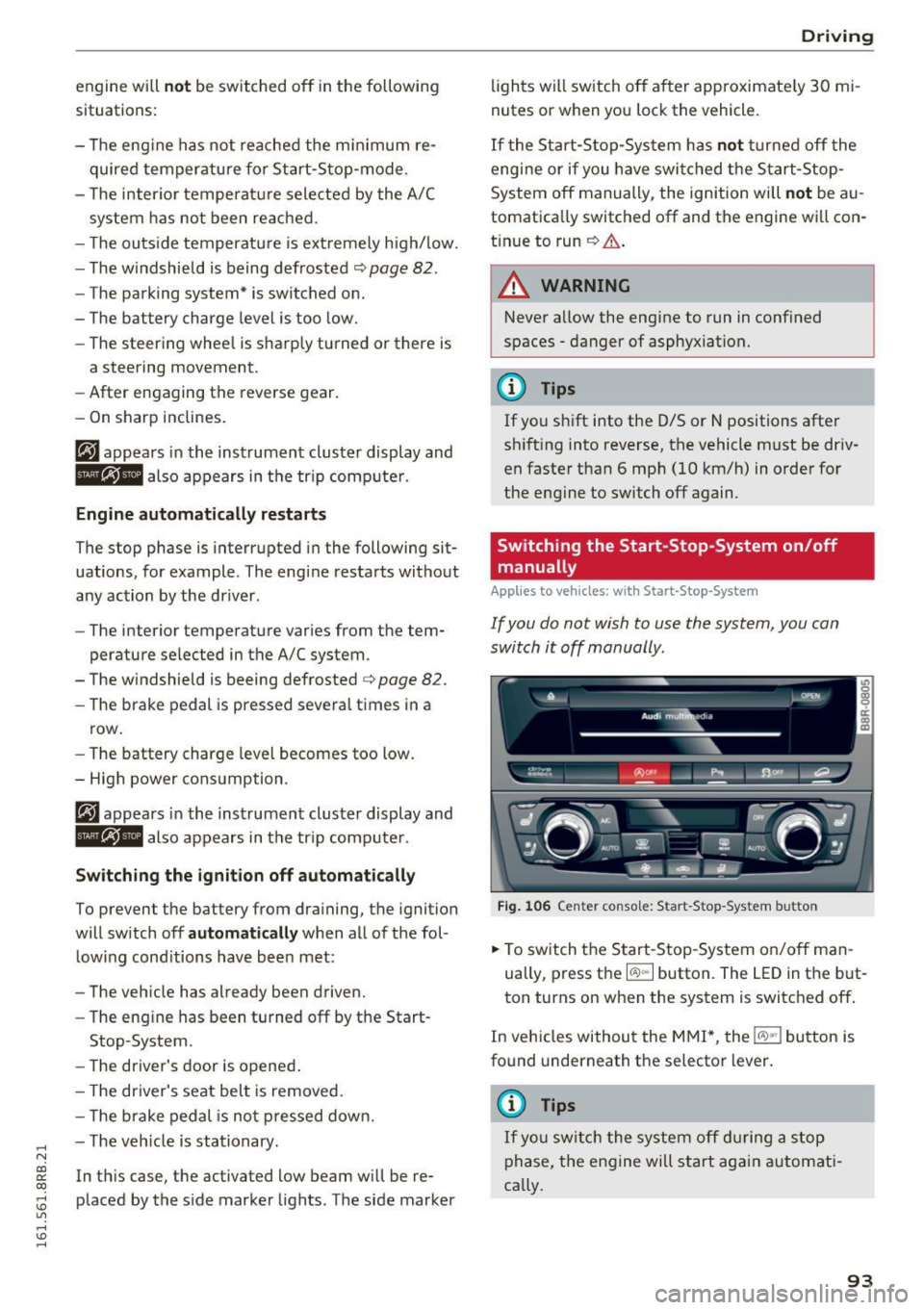
Fig . 10 6 Cen ter co nsole: S ta rt -Stop -System button
.. To switch the Start -Stop-System on/off man
ually, press the
I CAJ ,,.I button. The LED in the b ut
ton turns on when the system is switched off .
In vehicles without the M MI*, the
!CA.> "'! button is
found underneath the se lector lever.
(D Tips
If y ou swit ch the system off d uring a stop
phase, the engine will st art aga in automati
ca lly.
93
Page 126 of 300
Automatic transmissio n
(N eu tra l) for more than approx imately 1 second,
w ithout th e brake peda l being pressed.
Release button
The release button on the se lec to r lever preven ts
the lever from being accidentally sh ifted into cer
tain posit ions . Press ing t his but ton deactivates
the selector lever lock . Depending on the direc
tion of the shift, the selector lever locks at differ
ent positions. The positions are high lighted in
the illustrat ion ¢
fig. 135 .
Ignition key safety int erlock
The key cannot be removed from the igni tion un
less the selector lever is in the P park pos ition .
When the ignition key is removed, the selector lever will be locked in the P pos ition.
Driving the automatic transmission
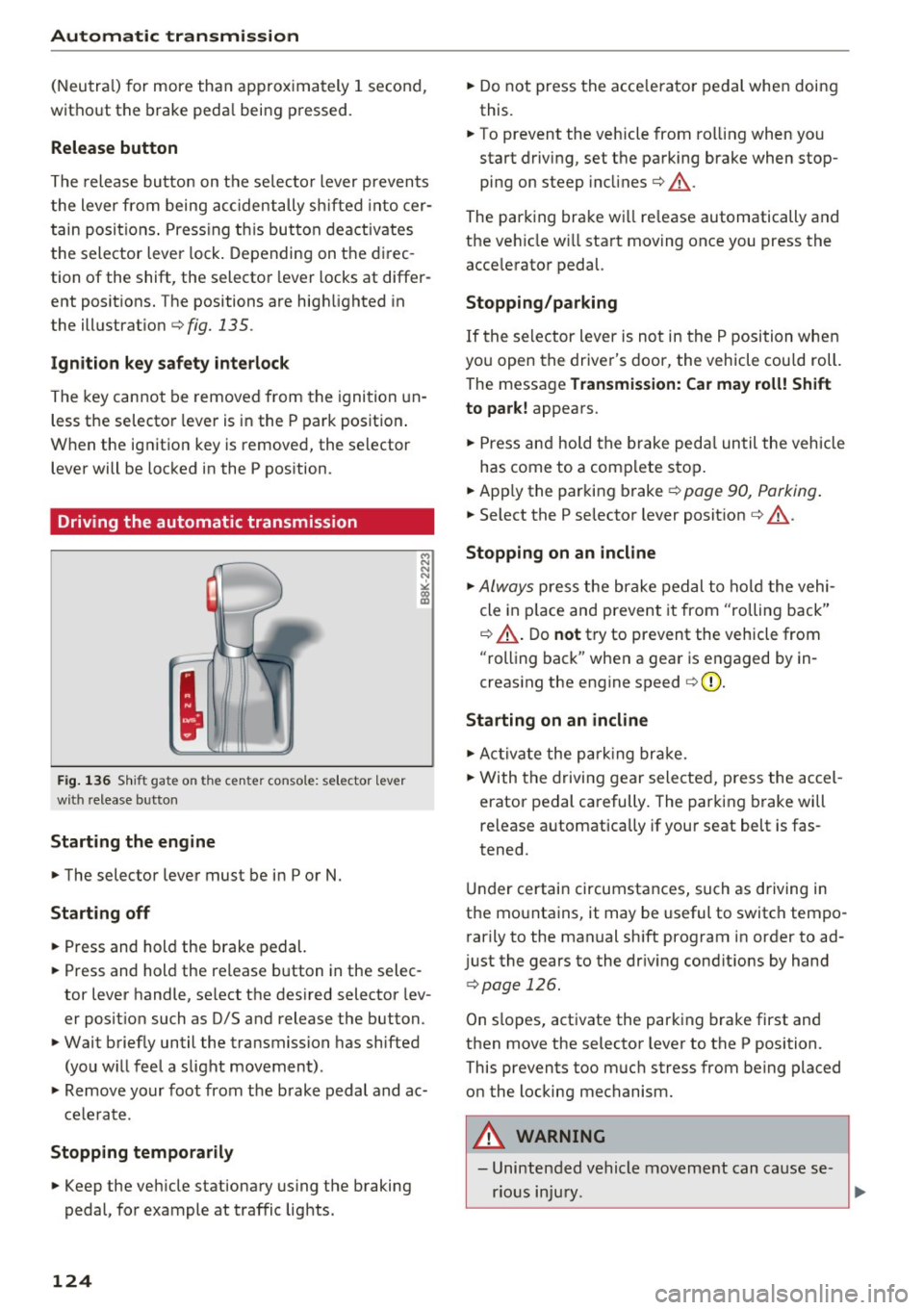
F ig. 1 36 Shi ft gat e on t he c en te r co nsole : se lecto r lev er
w ith release b utto n
Starting the engine
~ The selector lever must be in P or N.
Starting off
~ Press and hold the brake pedal.
~ Press and hold the release button in the selec
tor lever handle, se lect the des ired selector lev
er posit ion such as D/S and release the button.
~ Wait briefly until the transmission has shifted
(you w ill feel a slight movement) .
~ Remove your foot from the brake pedal and ac
cele rate .
Stopp ing temporarily
~ Keep the veh icle stationary us ing the braking
pedal, for example at traffic lights .
124
~ Do not press the acce lerato r pedal when doing
this.
~ To prevent the veh icle from ro lling when you
start driving, set the parking brake when stop
ping on steep incl ines¢ &_.
The parking brake wi ll re lease automatically and
the ve hicle w ill start moving once you press the
acce lerator pedal.
Stopping /par king
If the se lector lever is not in the P position whe n
you open the driver's door, the vehicle cou ld roll.
The message
Tr ansmis sion: Car may roll! Shift
to park!
appears.
~ Press and hold the brake peda l un til the vehicle
has come to a comp lete stop .
~ Apply the parking brake¢ page 90, Parking .
~ Select the P selector lever posit ion ¢ &_ .
Stopping on an incline
~ Always press the brake pedal to ho ld the vehi
cle in p lace and prevent it from "rolling back"
¢ &_ . D o
not try to prevent the vehicle from
"rolling back" when a gear is engaged by in
creas ing the engine speed ¢(D .
Starting on an incline
~ Ac tivate the pa rk ing br ake.
~ With the d riving gear selected, press the accel
erator pedal carefully. The parking brake will
release a utomatica lly if your seat belt is fas
tened.
Under certain circumstances, such as driving in
the mounta ins, it may be useful to switch tempo
rarily to the manual sh ift program in order to ad
j ust the gears to the dr iv ing cond it ions by hand
¢ page 126.
On slopes, activate the parking b rake first and
then move the selector lever to the P position.
This prevents too m uch stress from being placed
on the locking mechanism.
A WARNING
- Unintended vehicle movement can cause se
rious injury .
Page 142 of 300
Driving safety
-Always put objects, for example, luggage or
other heavy items in the luggage compart
ment.
- Always secure objects in the luggage com
partment using the tie-down eyelets and
suitable straps.
A WARNING
Heavy loads will influence the way your vehi
cle handles. To help reduce the risk of a loss
of control leading to serious personal injury:
- Always keep in mind when transporting
heavy objects, that a change in the center of
gravity can also cause changes in vehicle
handling:
- Always distribute the load as evenly as
possible.
- Place heavy objects as far forward in the
luggage compartment as possible.
- Never exceed the Gross Axle Weight Rating or the Gross Vehicle Weight Rating specified
on the safety compliance sticker on the left
door jamb. Exceeding permissible weight
standards can cause the vehicle to slide and handle differently .
- Please observe information on safe driving
¢page 134.
A WARNING
To help prevent poisonous exhaust gas from
being drawn into the vehicle, always keep the
rear lid closed while driving.
- Never transport objects larger than those fitting completely into the luggage area be
cause the rear lid cannot be fully closed .
- If you absolutely must drive with the rear lid open, observe the following notes to reduce
the risk of poisoning:
- Close all windows,
- Close the Panoramic sliding sunroof*,
- Open all air outlets in the instrument pan-
el,
- Switch off the air recirculation,
- Set the fresh air fan to the highest speed .
140
A WARNING
,--
Always make sure that the doors, all win
dows, the Panoramic sliding sunroof* and the
rear lid are securely closed and locked to re
duce the risk of injury when the vehicle is not
being used .
-After closing the rear lid, always make sure
that it is properly closed and locked.
- Never leave your vehicle unattended espe
cially with the rear lid left open. A child
could crawl into the vehicle through the lug
gage compartment and close the rear lid be
coming trapped and unable to get out. Be
ing trapped in a vehicle can lead to serious
personal injury.
- Never let children play in or around the vehi
cle.
- Never let passengers ride in the luggage
compartment. Vehicle occupants must al
ways be properly restrained in one of the ve
hicle's seating positions.
(D Tips
- Air circulation helps to reduce window fog
ging. Stale air escapes to the outside
through vents in the trim panel. Be sure to keep these slots free and open .
- The tire pressure must correspond to the
load. The tire pressure is shown on the tire
pressure label. The tire pressure label is lo
cated on the driver's side B-pillar . The tire
pressure label lists the recommended cold
tire inflation pressures for the vehicle at its
maximum capacity weight and the tires that
were on your vehicle at the time it was man
ufactured. For recommended tire pressures
for normal load conditions, please see chap
ter ¢
page 245.
Tie-downs
The luggage compartment is equipped with four
tie-downs to secure luggage and other items.
Use the tie-downs to secure your cargo properly
¢page 139, Loading the luggage compartment . ..,_
Page 179 of 300
..... N
co ~ CX)
..... I.Cl U"I
..... I.Cl .....
seats support the baby 's back, neck and he ad in a
crash
c!;> fig . 174.
The airbag on the passenger side makes the front
seat a potentially dange ro us p lace for a child to
ride. The front seat is not the safest place for a
child in a forward-facing child seat . It is a very
dangerous place for an infant or a larger child in
a rearward-facing seat .
A WARNING
Not using a child safety seat , using the wrong
child safety seat or imp roperly installing a
child restra int increases the risk of se rious
perso nal in jury and death in a crash .
- Never install rear -facing child safety seats
o r infant carriers on the front passenger
seat -even with an Advanced Airbag System.
A ch ild will be ser iously injured and can be
ki lled when the infla ting airbag hi ts the
child safety seat o r infant carr ier with great
force and smashes the child safety seat and child against the backrest, center armrest,
door or roof
c:> page 152, Child restraints on
the front seat -some important things to
know .
-Always install rear-facing child safety seats
or infant carriers on the rear seat.
- Never install a rear -facing child restraint in
the forward-facing direct ion. Such restraints
are designed for the spec ial needs of infants
and very small children and cannot protect
them properly if the seat is forwa rd- facing .
- If you must install a rearward fac ing ch ild
safety seat on the front passenger seat be
c a use of except io na l circumstances and the
PASSENGER AIR BAG OFF light does not
come o n and stay o n, immed iate ly i nstall
the re ar-facing c hild safety seat ih a rear
seating posit ion and have the airbag system
inspected by your Audi dealer .
- Always read and heed all WARN INGS when
ever using a child restrained in a veh icle is
being used
c:, page 143, Safety belts,
<=:> page
151, Airbag system and
c:> page 171, Important information.
Ch ild sa fety
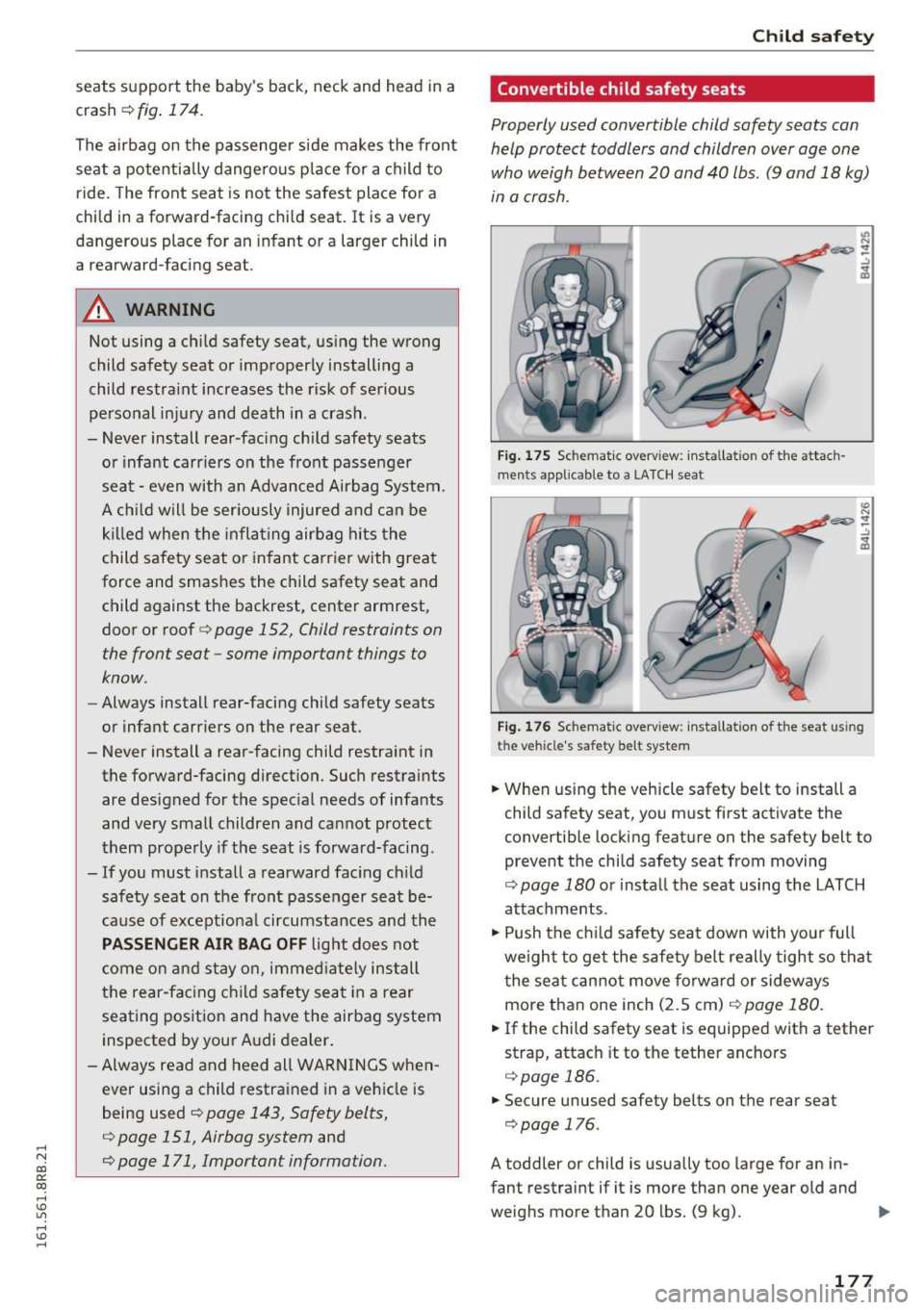
Convertible child safety seats
Properly used convertible child safety seats can
help protect toddlers and children over age one
who weigh between 20 and 40 lbs . (9 and 18 kg)
in a crash.
F ig . 17 5 Schem atic overv ie w: installat ion o f the attac h
me nts applicable to a LA TCH sea t
Fig. 17 6 Sc hemat ic overv iew : in sta llat ion of t he seat using
t he ve hicle 's sa fety be lt syst em
.. W hen using the vehicle safe ty belt to install a
child sa fety seat, you must first activate the
convertib le locking feat ure on the safety belt to
prevent the child safety seat from moving
c:::> page 180 or install the seat using the LATCH
attachments .
.. Push the ch ild safety seat down with yo ur full
we igh t to ge t the safety belt really tight so tha t
t he seat can not move forwa rd or sideways
more than one inch (2 .5 cm)
<=:> page 180.
.. If the child safety seat is equ ipped with a tether
strap, attac h it to the tether anchors
c:::> page 186.
.. Secure unused safety belts on the rear seat
c:::> page 176 .
A toddler or child is usua lly too large fo r an in
fant restraint if it is more th an one year old and
weighs more t han 20 lbs. (9 kg). ..,
177