weight AUDI Q5 2016 Owner's Manual
[x] Cancel search | Manufacturer: AUDI, Model Year: 2016, Model line: Q5, Model: AUDI Q5 2016Pages: 300, PDF Size: 75.02 MB
Page 172 of 300
Airbag system
Important safety instructions on the side
curtain airbag system
Airbags are only supplemental restraints. Always
properly wear safety belts and ride in a proper
seating position.
There is a lot that you and your passengers must
know and do to help the safety belts and airbags
do their job to provide supplemental protection.
A WARNING
Improperly wearing safety belts and improper
seating positions increase the risk of serious
personal injury and death whenever a vehicle
is being used .
- Never let occupants place any parts of their
bodies in the area from which the side cur
tain airbags inflate.
- Always make sure that the side curtain air
bags can inflate without interference. Un
suitable accessories fitted inside the expan
sion range of a head airbag can dangerously interfere with its function . A deploying head
airbag develops enough force to catapult
any piece of add-on component out of its
path of inflation and into the passenger
compartment. An occupant hit by such a
projectile can suffer serious injury or death
Q page 282, Technical Modifications.
- Do not swivel the sun visors to the side if
you have any objects clipped onto them (for example pens).
If the airbag should deploy,
you could be injured by these objects.
- Use the built-in coat hooks only for light
weight clothing. Never leave any heavy or
sharp-edged objects in the pockets that may
interfere with airbag deployment and can
cause personal injury in an accident.
- Never use hangers to hang clothing from the hooks.
- Only use factory-installed sun shades or, in
the case of shades installed after the vehicle
leaves the factory, only Audi roll-up
sunscreens may be used
Q page 282, Addi
tional accessories and parts replacement .
-Always sit in proper seating position and
wear safety belts while traveling so that the
170
side curtain airbags can help provide protec
tion .
- The airbag system can only be triggered
once . If the airbag has been triggered, the
system must be replaced by an authori zed
Audi dealer or qualified workshop.
- Always have work involving the side curtain
airbag system, removal and installation of
the airbag components, or other repairs
performed by an authorized Audi dealer or
qualified workshop . Otherwise the airbag
system may not work correctly.
- Never attempt to modify any components of
the airbag system in any way.
Page 173 of 300
,....,
N
co
er::
co
,....,
Important information
Introduction
The rear seat is generally the safest place in a
collision .
The physical principles of what happens when
your vehicle is in a crash apply also to children
c:> page 144, What happens to occupants not
wearing safety belts? .
But unlike adults and
teenagers, their muscles and bones are not fully
developed. In many respects children are at
greater r isk of serious injury in crashes than
adults .
Because children's bodies are not fu lly devel
oped, they requ ire restraint systems especially
des igned for their size, we ight, and body struc
ture. Many countr ies and all states of the United
States and provinces of Canada have laws requir
ing the use of approved child restraint systems
for infants and small children .
In a frontal crash at a speed of 20-3 5 mph
(30-56 km/h) the forces acting on a 13-pound
(6 kg) infant will be more than 20 times the
weight of the child . This means the weight of the
child would suddenly be more than 260 pounds
(120 kg) . Under these conditions, only an appro
priate child restraint properly used can reduce
the risk of serious injury . Child restra ints, like
adult safety belts, must be used properly to be
effect ive. Used improperly, they can increase the
risk of serious injury in an accident .
Consult the child safety seat manufacturer's in
structions in order to be sure the seat is right for
your child's size
c:> page 174, Important safety
instructions for using child safety seats .
Please
be sure to read and heed all of the important in
formation and WARNINGS about child safety,
Advanced Airbags, and the installation of child restraints in this chapter.
There is a lot you need to know about the Ad
vanced Airbags in your vehicle and how they work
when infants and children in chi ld restraints are
on the front passenger seat . Because of the large
amount of important information, we cannot re-
Ch ild safety
peat it all here. We urge you to read the detailed
information in this owner's manual about airbags
and the Advanced Airbag System in your vehicle
and the very important information about trans
porting children on the front passenger seat.
Please be sure to heed the WARNINGS -they are
extremely important for your safety and the safe
ty of your passengers, especially infants and small chi ldren.
_& WARNING
- Accident statistics have shown that children
are generally safer in the rear seat area than in the front seating position . Always restrain
any child age 12 and under in the rear.
- All vehicle occupants and especially children must be restrained properly whenever riding
in a vehicle. An unrestrained or improperly restrained child cou ld be injured by striking
the inter ior or by being ejected from the ve
h icle during a sudden maneuver or impact .
An unrestrained or improperly restrained
child is a lso at greater risk of injury or death
through contact w ith an inflating a irbag.
-A suitable ch ild restraint properly installed
and used at one of the rear seating positions
provides the h ighest degree of protect ion
for infants and small children in most acci
dent situat ions .
_& WARNING
f"-"----
Children on the front seat of any car even with
Advanced Airbags can be seriously injured or
even killed when an airbag inflates . A child in
a rearward-facing chi ld safety seat installed
on the front passenger seat will be seriously i njured and can be killed if the front airbag in
flates .
- The inflating airbag will h it the ch ild safety
seat or infant carr ier with great force and
will smash the child safety seat and child aga inst the backrest, center armrest, or
door.
- Always install rear-fac ing child safety seats
on the rear seat .
- If you must install a rearward facing child
safety seat on the front passenger seat in
171
Page 174 of 300
Child safety
exceptional circumstances and the
PASSENGER AIR BAG OFF light does not
come on and stay on, immediately install
the rear-facing child safety seat in a rear
seating position and have the airbag system inspected immediately by your Audi dealer .
A WARNING
If, in exceptional circumstances, you must in
stall a forward-facing child restraint on the
front passenger's seat:
- Always make sure the forward-facing seat
has been designed and certified by its man
ufacturer for use on a front seat with a pas
senger front and side airbag.
- Always follow the manufacturer's instruc
tions provided with the child safety seat or
carrier.
- Always move the passenger seat into its
rearmost position in the seat's fore and aft
adjustment range, as far away from the air
bag as possible before installing the child
restraint. The backrest must be adjusted to
an upright position.
- Always make sure that the
PASSENGER AIR
BAG OFF
light comes on and stays on all the
time whenever the ignition is switched on.
(D Tips
Always replace child restraints that were in stalled in a vehicle during a crash. Damage to
a child restraint that is not visible could cause
it to fail in another collision situation.
Advanced front airbag system and children
Your vehicle is equipped with a front "Advanced
Airbag System" in compliance with United States
Federal Motor Vehicle Safety Standard (FMVSS)
208, as well as Canada Motor Vehicle Safety
Standard (CMVSS) 208 as applicable at the time
your vehicle was manufactured.
The Advanced Airbag system in your vehicle has
been certified to meet the "low-risk" require
ments for 3- and 6-year old children on the pas
senger side and small adults on the driver side.
The low risk deployment criteria are intended to
172
reduce the risk of injury through interaction with
the airbag that can occur, for example, by being
too close to the steering wheel and instrument panel when the airbag inflates. In addition, the
system has been certified to comply with the
"suppression" requirements of the Safety Stand
ard, to turn off the front airbag for infants up to
12 months who are restrained on the front pas
senger seat in child restraints that are listed in
the Standard .
Even though your vehicle is equipped with an Ad
vanced Airbag system, all children, especially
those 12 years and younger, should always ride
in the back seat properly restrained for their age
and size. The airbag on the passenger side makes
the front seat a potentially dangerous place for a
child to ride. The front seat is not the safest place
for a child in a forward-facing child safety seat. It
can be a very dangerous place for an infant or a
larger child in a rearward-facing seat.
· Advanced Airbags and the weight-sensing
mat in the front seat
The Advanced Airbag System in your vehicle de
tects the presence of an infant or child in a child
restraint on the front passenger seat using the
weight-sensing mat in the seat cushion and the
sensor below the safety belt latch on the front
passenger seat that measures the tension on the
safety belt.
The weight-sensing mat measures total weight
of the child and the child safety seat and a child
blanket on the front passenger seat . The weight
on the front passenger seat is related to the de
sign of the child restraint and its "footprint", the
size and shape of the bottom of the child re
straint as it sits on the seat . The weight of a child
restraint and its "footprint" vary for different
kinds of child restraints and for the different
models of the same kind of child restraint of
fered by child restraint manufacturers.
The weight ranges for the individual types,
makes and models of child restraints that the
NH TSA has specified in the Safety Standard to
gether with the weight ranges of typical infants
and typical 1 year -old child have been stored in ..,.
Page 175 of 300
,....,
N
co
er::
co
,....,
When a child restraint is being used on the front
passenger seat with a typical 1 year-old child, the
Advanced Airbag System compares the weight measured by the weight sensing mat with the in
formation stored in the electronic control unit .
The electronic control un it also registers the ten
sion on the front passenger safety belt. The ten
sion on the safety belt for the front passenger
seat will be different for an adult who is properly
using the safety belt as compared to the tension
on the belt when it is used to attach a ch ild re
stra int to the seat. The senso r below the latch for
the safety belt for the front seat passenger
measures the tens ion on the belt. The input from
this sensor is then used with the weight to "de
cide", whether there is a child restraint wit h a
typical 1 year-old child on the front passenger
seat and whether or not the airbag must be
turned off.
Child restraints and Advanced Airbags
Regardless of the child restra int that you use,
make sure that it has been cert ified to meet Safe
ty Standards and has been certified by its manu
facturer for use wi th an airbag. Always be sure
that the child restraint is properly installed at
one of the rear seating positions . If in exception
a l circumstances you must use it on the front
passenger seat, carefully read all of the informa
tion on child safety and Advanced Airbags and heed all of the appl icable WARNINGS. Make cer
tain that the child restra int is correctly recog
nized by the weight-sensing mat inside the front
passenger seat, that the front passenger airbag
i s turned off and that the airba g status is always
correct ly signa led by the
PASSENGER AIR BAG
OFF lig ht.
Many types and models of child restraints have
been available over the years, new models are in
troduced regular ly incorporat ing new and im
proved designs and older mode ls are taken out o f
production . Chi ld restraints a re not standardized .
Child restraints of the same type typica lly have
different weights and sizes and different 'foot
prints, ' the s ize and shape of the bottom of the
child restraint that sits on the seat, when they
Child safety
are installed on a vehicle seat . These differences
make it virtua lly impossib le to certify compliance
with the requirements for advanced a irbags w ith
each and every child restraint that has ever been
sold in the past or will be sold over the course of
the useful life of your vehicle.
For t his reason, the United States National High
way Traffic Safety Admin istration has published a
list of spec ific type, makes and models of ch ild
restra ints that must be used to certify compli
ance of the Advanced Airbag System in your vehi
cle with the su ppress ion requirements of Federa l
Motor Vehicle Safety Standard 208. These child
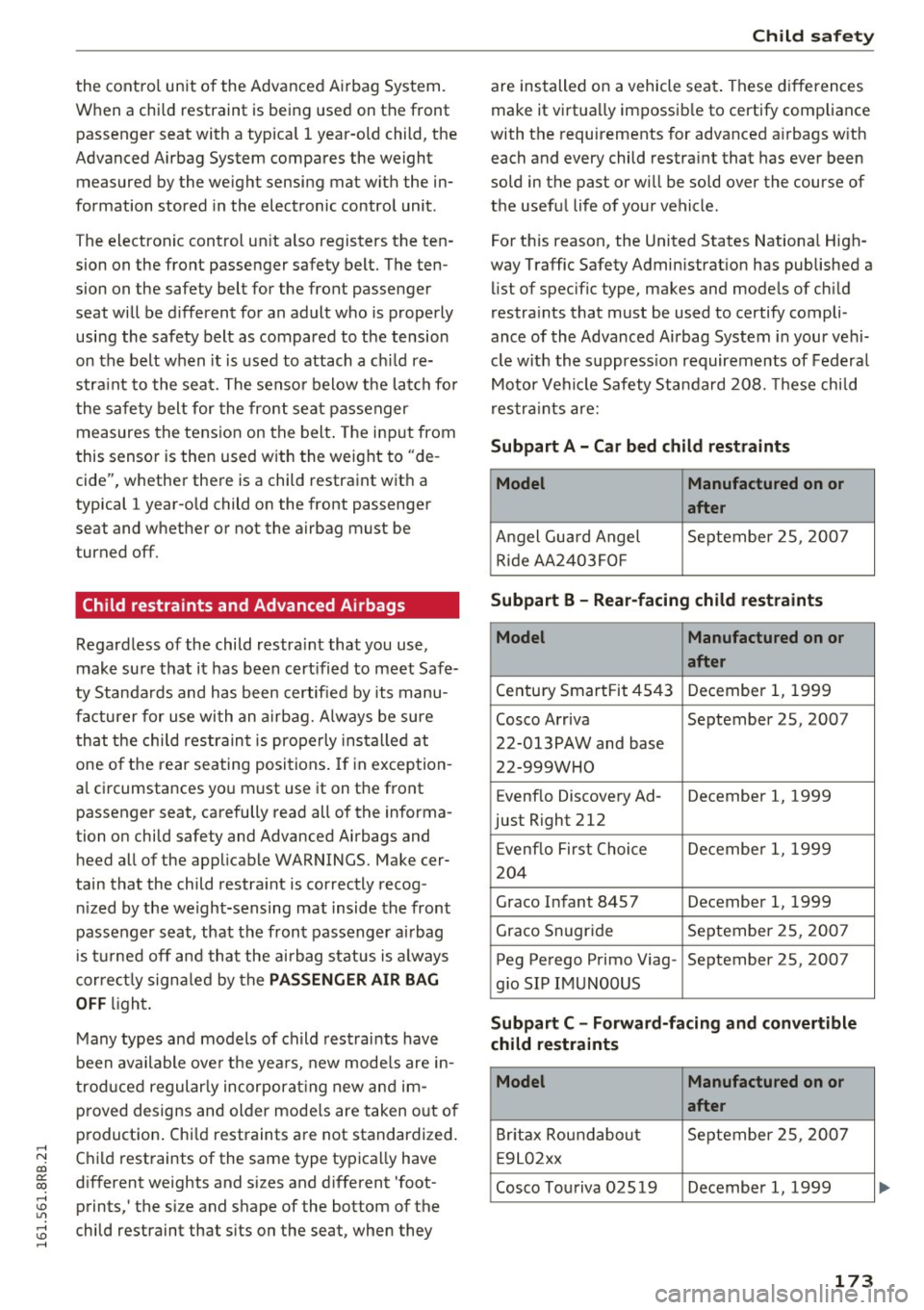
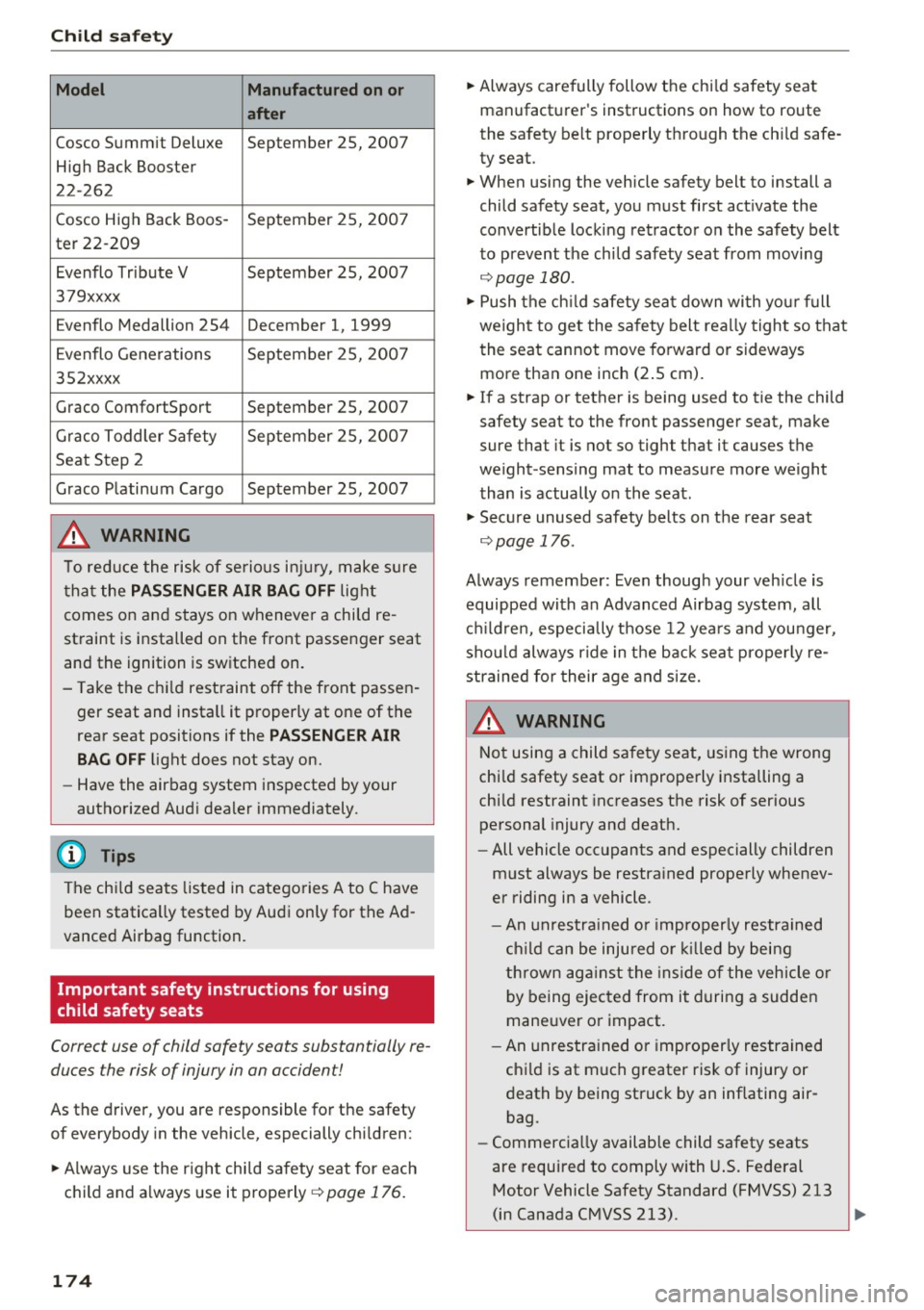
restraints are:
Subpart A -Car bed child restraints
Model Manufactured on or
after
A ngel Guard Angel September 2S, 2007
Ride AA2403FOF
Subpart B - Rear-facing child restraints
Model Manufactured on or
after
Century SmartFit 4543 December 1,
1999
Cosco Arriva September 25, 2007
22-013PAW and base
22-999WHO
Evenflo Discovery Ad- December 1, 1999
just Right 212
E venflo First Choice December 1, 1999
204
Graco Infant 8457 December 1, 1999
Graco Snugride September 25, 2007
Peg Perego Primo Viag -September 25, 2007
g io SIP IMUNOOUS
Subpart C -Forward-facing and convertible
child restraints
Model Manufactured on or
after
Britax Roundabout September 25, 2007
E9L02xx
Cosco Touriva 02519 December 1, 1999
173
Page 176 of 300
Child safet y
Model Manufactured on or
after
Cosco Summit Deluxe September 25, 2007
High Back Booster
22-262
Cosco High Back Boos -
September 25, 200 7
ter 22-209
Evenflo Tribute V September 25, 2007
379xxxx
Evenflo Medallion 254 December 1, 1999
E venflo Generations September 25, 200 7
352xxxx
Graco ComfortSport September 25, 2007
Graco Toddler Safety Sep tember 25, 200 7
Seat Step 2
Graco P latinum Cargo September 25, 2007
,& WARNING
T o red uce the risk of serio us i njur y, m ake s ure
t ha t the
PASSENGER AIR BAG OFF lig ht
comes o n and stays on wheneve r a child re
straint is installed on the front passenger seat
and the ignition is sw itche d on.
- Take the ch ild rest raint off the front passen
ger seat and insta ll it p roperly at one of the
rear seat positions if the
PASSENGER AIR
BAG OFF
light does not stay on.
- Have the airbag system inspecte d by your
autho rized Aud i dealer immediately.
(D Tips
The ch ild seats listed in catego ries A to C have
been statica lly tested by Au di only for the Ad
vanced Airbag function.
Important safety instructions for using
child safety seats
Correct use of child safety seats substantially re
duces the risk of injury in on occident!
As the driver, you are respons ible for the safety
of everybody in the vehicle, especially chi ldren:
... Always use the r ight chi ld safety seat for each
c h ild and a lways use it properly ¢
page 176.
174 ...
Always carefully follow the chi ld safety seat
manufact urer 's instructions on how to route
the sa fety be lt properly thro ugh the ch ild safe
ty seat.
... When using the vehicle safety belt to install a
child safety seat, you must first act ivate the
convertib le lock ing retracto r o n the safety belt
to prevent the chi ld safety seat from moving
¢ page 180.
... Push the ch ild sa fety sea t down wi th yo ur fu ll
weigh t to get the safety belt rea lly tight so tha t
the seat cannot move forward or sideways
more than one inch (2 .5 cm).
... If a strap or tether is being used to tie the child
safety seat to the front passenge r seat, make
sure that it is not so tight t hat it causes the
weight -sensing mat to measure more weight
t han is actually o n the seat .
... Secu re unused safety belts on the rear s eat
¢ page 176.
Always remember : Even though your veh icle is
equipped wi th an Advanced Airbag system, all
c hi ld ren, especially those 12 yea rs and you nger,
s h ould always ride in th e back sea t proper ly re
strained for their age and s ize.
,& WARNING
-
Not usin g a child sa fe ty seat, us ing t he wrong
c h ild safety seat or imprope rly installing a
chi ld restraint inc reases t he risk of serious
personal injury and death.
- All vehicle occupants and es pecially children
m ust always be restra ined properly whenev
er riding in a vehicle.
- An unrestra ined o r imprope rly restrained
c h ild ca n be injured or killed by bei ng
t h rown ag ai nst the inside of the vehicle or
b y being ejected from it durin g a sudden
maneuver o r impact.
- An unrestra ine d or i mprope rly restrained
ch ild is at much g reater risk of injury or
death by being struck by an inflating air
bag .
- Commerc ia lly available child safety seats
are required to comply with U.S. Federal
Motor Vehicle Safety Standard (FMVSS) 213
(in Canada C MVSS 213). ...
Page 178 of 300
Child safety
-Take the child restraint off the front passen
ger seat and install it proper ly at one of the
rear seat positions if the
PASSEN GER AIR
BA G OF F
light does not stay on.
- Have the airbag system inspected by your
authorized Aud i dealer immediately.
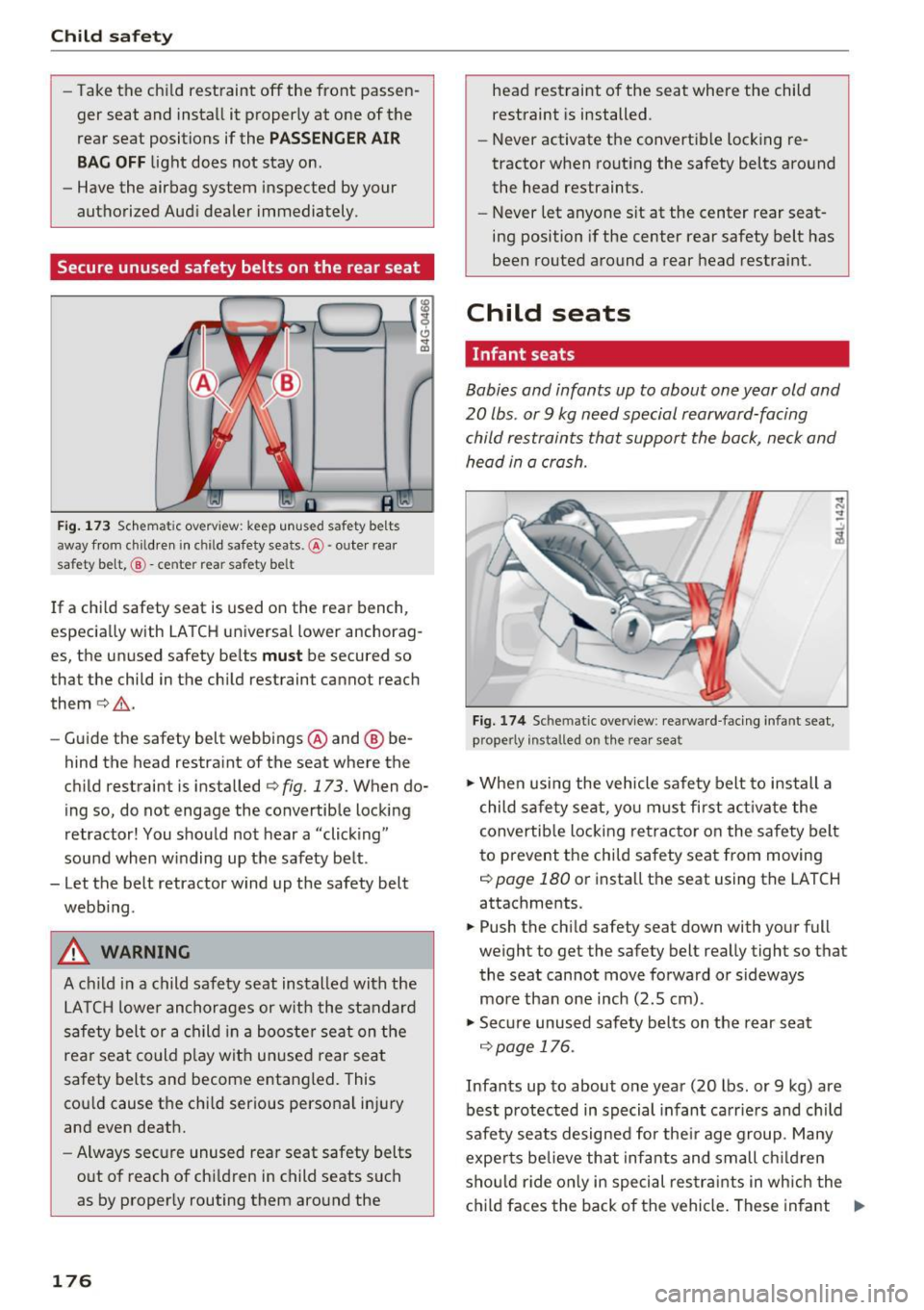
Secure unused safety belts on the rear seat
l8
,h- --lJ ;g
--- 0
Fig . 173 Schematic overv iew: keep unused safety be lts
away from chi ld ren i n chil d safety seats.@-oute r rear
safety belt, @ - center rear safety be lt
~
If a chi ld safety seat is used on the rear bench,
especially with LA TCH universal lower anchorag
es, the unused safety be lts
mu st be secured so
that the child in the child restraint cannot reach
them ¢,& .
- Gu ide the safety belt webbings @and @ be
hind the head restraint of the seat where the
child restraint is installed
¢fig. 173. When do
ing so, do not engage the convertib le locking
retractor! You should not hear a "clicking"
sound when w inding up the safety be lt .
- Let the belt retractor wind up the safety belt
webb ing .
_& WARNING
A ch ild in a child safety seat installed with the
LATC H lowe r anchorages or w ith the standard
safety belt or a child in a booste r seat on the
rear seat could p lay wit h unused rear seat
safety belts and become entangled. This
cou ld cause t he chi ld ser ious personal injury
and even death.
- Always sec ure unused rear seat safety belts
o ut of reach of ch ild ren in child seats such
as by proper ly routing them aro und the
176
head restraint of the seat where the child
restraint is installed .
- Never activate t he convertible locking re
tractor when routing the safety belts around
the head restraints.
- Never let anyone s it at the center rear seat
ing position if the center rear safety belt has
been routed around a rear head restraint.
Child seats
Infant seats
Babies and infants up to about one year old and
20 lbs . or
9 kg need special rearward-facing
child restraints that support the back, neck and
head in a crash.
Fig. 1 74 Sc hema tic ove rview : rearward -facing infa nt sea t,
p rope rly installed on th e rear sea t
.. When using the veh icle safe ty belt to install a
c hild safe ty seat, yo u must first a ct ivate the
convertib le locking re tractor on the safe ty belt
to prevent the child safety seat from moving
¢
page 180 or insta ll the seat using the LATCH
attachments .
.. Push the child safety seat down with your full
weight to get the safety belt really tight so that
the seat cannot move forward or sideways
more than one inch (2 .5 cm).
.. Secure unused safety bel ts on the rear seat
¢ page 176.
Infants up to about one year (20 lbs . or 9 kg) are
bes t protected in special infant carr iers and child
safe ty seats designed for the ir age group. Many
expe rts be lieve that inf ants and small ch ildren
sho uld r ide o nly in special res tra ints in wh ic h t he
ch ild faces the back of the vehicle. These infant
II>
Page 180 of 300
Child safety
Toddlers and children who are older than one
year up to about 4 years old and weigh more than 20 lbs. (9 kg) up to 40 lbs. (18 kg) must always
be properly restrained in a child safety seat certi
fied for their size and weight¢
fig. 175 and
¢fig. 176 .
The airbag on the passenger side makes the front
seat a potentially dangerous place for a child to
ride. The front seat is not the safest pl ace for a
child in a forward-facing child safety seat . It is a
very dangerous place for an infant or a larger
child in a rearward-facing seat.
.8, WARNING
Not using a child safety seat, using the wrong
child safety seat or improperly installing a
child restraint increases the risk of serious
personal injury and death in a collision or oth
er emergency situation.
- Children on the front seat of any car, even with Advanced Airbags, can be seriously in
jured or even killed when an airbag inflates.
A child in a rearward-facing child safety seat
installed on the front passenger seat will be
seriously injured and can be killed if the
front airbag inflates - even with an Ad
vanced Airbag System .
- The inflating airbag will hit the child safety seat or infant carrier with great force and
will smash the child safety seat and child against the backrest, center armrest, door
or roof.
- Always install rear-facing child safety seats
on the rear seat.
-If you must install a rearward facing child
safety seat on the front passenger seat be
cause of exceptional circumstances and the
PASSENGER AIR BAG OFF light does not
come on and stay on, immediately install
the rear-facing child safety seat in a rear
seating position and have the airbag system
inspected by your Audi dealer.
- The rear side of the child safety seat should
be positioned as close as possible to the
backrest on the vehicle seat. Adjust or re
move the rear seat head restraint if it is dif
ficult to install the child seat with the head
178
restraint in place ¢ page 67. Install the
head restraint again immediately once the
child seat is removed . Driving without head
restraints or with head restraints that are
not properly adjusted increases the risk of
serious or fatal neck injury dramatically .
- Always read and heed all WARNINGS when ever using a child restrained in a vehicle is
being used
¢page 143, Safety belts,
¢ page 151, Airbag system
and
¢ page 171, Important information.
.8, WARNING
If exceptional circumstances require the use
of a forward-facing child restraint on the
front passenger's seat, the child's safety and
well-being require that the following special precautions be taken:
- Make sure the forward-facing seat has been
designed and certified by its manufacturer
for use on a front seat with a passenger
front and side airbag.
- Always follow the manufacturer's instruc
tions provided with the child safety seat or
infant carrier.
- Always move the front passenger seat into the rearmost position of the passenger seat's fore and aft adjustment range, and as
far away from the airbag as possible before
installing the child restraint.
- Always make sure that nothing prevents the front passenger's seat from being moved to
the rearmost position in its fore and aft ad
justment range.
-Always make sure the backrest is in an up
right position .
- Make sure that the
PASSENGER AIR BAG
OFF
light comes on and stays on all the time
whenever the ignition is switched on.
- If the light does not stay on, perform the
checks ¢
page 161, Monitoring the Ad
vanced Airbag System .
-Take the child restraint off the front passen
ger seat and install it properly at one of the
rear seat positions if the
PASSENGER AIR
BAG OFF
light does not stay on whenever
the ignition is switched on.
Page 183 of 300
,....,
N
co
er::
co
,....,
Improperly installed child safety seats in
crease the risk of serious personal injury and
death in a collision .
- Always make sure that the safety belt re
tractor is locked when installing a child
safety seat . An unlocked safety belt retrac
tor cannot hold the child safety seat in place during no rma l driving or in a crash.
- Always buckle the child safety seat firmly in
place even if a child is not sitting in it. A
loose child safety seat can fly around d uring
a sudden stop or in a collision .
- Always ma ke sure that the rear seat bac k
rest to wh ich the center rea r safety be lt is
attached is secure ly latched whenever the
rear center safety belt is being used to se
cure a ch ild rest raint.
- If the backrest is not securely latched, the
child and the child restraint will be thrown
forward together with the backrest and will
strike parts of the vehicle interior. The ch ild
can be seriously injured or killed.
- Never install rear-facing child safety seats or infant carriers on the front passenger
seat. A child will be serious ly injured and
can be killed when the passenger airbag in
flates .
- The inflating a irbag w ill hit the child safety
seat or infant carrier with great force and
will smash the ch ild safety seat and ch ild
against the backrest, center armrest, door
o r roof.
- Always install rear-faci ng child safety seats
o r infant carriers on the rear seat.
- Forward-fac ing ch ild safety seats or infant
c a rriers ins talled on the front passenge r's
seat may inte rfe re with t he deployment of
the a irbag and cause serious injury to the
child.
- It is s afe r to ins tall a forward-fac ing ch ild
sa fety seat on the rear seat.
- Always read and heed all WARN INGS when
ever using a child res trained in a veh icle is
being used
r:o page 171. Spec ia l precautions
apply when installing a child safety seat on
the front passenger seat
¢ page 152, Child
Ch ild safety
restraints on the front seat -some impor
tant things to know.
A WARNING
-A lways take special precautions if you must
i nstall a forward or rearward-facing child re
stra int on the front passenger's seat in excep
tional s ituations:
- Whenever a forward or rearward-fac ing
child restraint is installed on the front pas
senger seat, the
PASSENGER AIR BAG OFF
light must come on and stay on whenever
the ignition is switched on.
- I f the
PASSENGER AIR BAG OFF light does
not come on and stay on, perform the
checks desc ribed
r:o page 161, Monitoring
the Advanced Airbag System.
- T ake the child restra int off t he front passen
ge r seat an d install it prope rly at one of the
rear seat positions i f the
PASSENGER AIR
BAG OFF
light does not stay on whenever
the ignition is switched on .
- Improper installat ion of child res traints can
reduce their effectiveness or even prevent
them f rom providing any protect ion .
- An improperly installed child restraint can
interfere with the airbag as it deploys and
serio usly injure or even kill the chi ld.
- Always carefully follow the manufacturer's
instr uctions provided with the child sa fety
seat o r carr ie r.
- Never p lace additiona l items on the seat
that can increase the total weight registered
by the weight-sensing mat and can cause in
jury in a crash.
A WARNING
-Forward-facing child restra ints:
- Always make sure the forward- facing seat
has been des igned and certified by its man
ufacturer for use on a front seat with a pas
senger front and side airbag .
- Never put the forward-facing child restraint
up, against or very near the instrument pan-
-
el. ~
181
Page 184 of 300
Child safety
-Always move the passenger seat into its
rearmost position in the seat's fore and aft
adjustment range, as far away from the air
bag as possible before installing the for
ward-facing child restraint. The backrest must be adjusted to an upright position.
- Make sure that the
PASSENGER AIR BAG
OFF
light comes on and stays on all the time
whenever the ignition is switched on .
A WARNING
Rearward-facing child restraints:
-A child in a rearward-facing child safety seat
installed on the front passenger seat will be
seriously injured and can be killed if the
front airbag inflates - even with an Ad
vanced Airbag System.
- The inflating airbag will hit the child safety
seat or infant carrier with great force and
will smash the child safety seat and child
against the backrest, center armrest, door
or roof.
- Always be especially careful if you must in
stall a rearward facing child safety seat on
the front passenger seat in exceptional cir cumstances.
- A tight tether strap on a rearward-facing
child restraint attached to the front passen
ger seat can put too much pressure on the
weight-mat in the seat and register a heavi er weight in the Advanced Airbag System.
The heavier weight registered can make the
system work as though an adult were on the
seat and deploy the Advanced Airbag when
it must be suppressed causing serious or
even fatal injury to the child.
- Make sure that the
PASSENGER AIR BAG
OFF
light comes on and stays on all the time
whenever the ignition is switched on.
-If the PASSENGER AIR BAG OFF light does
not come on and stay on, immediately in
stall the rear-facing child safety seat in a
rear seating position and have the airbag
system inspected by your Audi dealer .
182
· Activating the convertible locking retractor
Use the convertible locking retractor to secure a
child restraint.
Always heed the child safety seat manufacturer 's
instructions when installing a child restrain t in
your vehicle . To activate the convertible locking
retractor:
.. Place the child restraint on a seat, preferably
on the rear seat .
.. Slowly pull the belt
all the way out .
.. Route it around or through the child restraint
belt path
~ .& .
.. Push the child safety seat down with your full
weight to get the safety belt really tight.
.. Insert the belt tongue into the buckle for that
seating position.
.. Guide the safety belt back into the retractor un
til the belt lies flat and snug on the child safety
seat.
.. You should hear a "clicking" noise as the belt
winds back into the inertia reel. Test the con
vertible locking retractor by pulling on the belt.
You should no longer be able to pull the belt
out of the retractor. The convertible locking re
tractor is now activated.
.. Make sure that the red release button is facing
away from the child restraint so that it can be
unbuckled quickly.
.. Pull on the belt to make sure the safety belt is
properly tight and fastened so that the seat
cannot move forward or sideways more than
one inch (2 .5 cm) .
A WARNING
Using the wrong child restraint or an improp
erly installed child restraint can cause serious
personal injury or death in a crash.
- Always make sure that the safety belt re
tractor is locked when installing a child
safety seat. An unlocked safety belt retrac
tor cannot hold the child safety seat in place
during normal driving or in a crash.
- Always buckle the child safety seat firmly in
place even if a child is not sitting in it. A
loose child safety seat can fly around during
a sudden stop or in a crash.
Page 188 of 300
Child safety
Tether anchors and tether straps
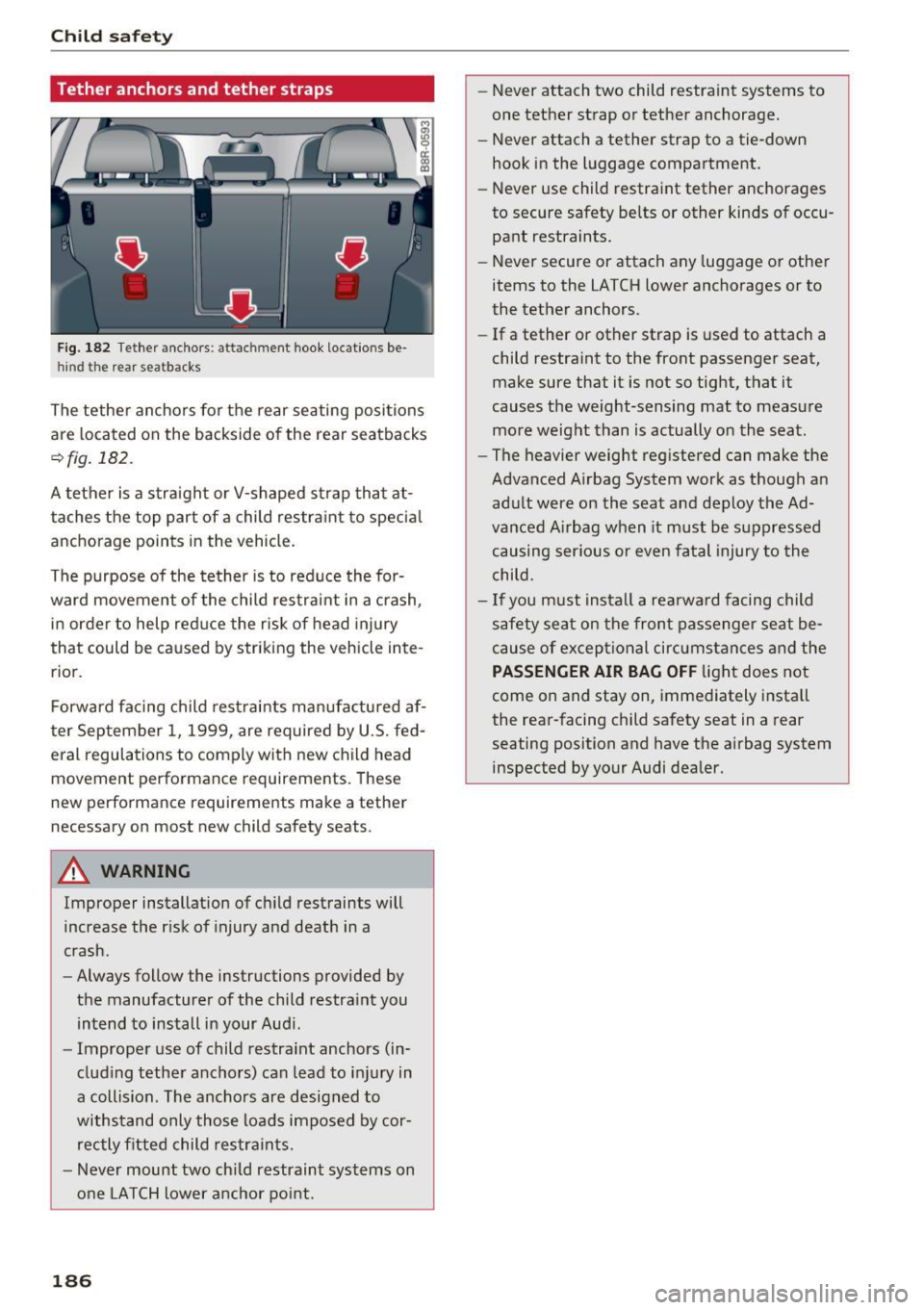
Fig. 182 Tether anchors: attachm ent hook locatio ns be
hind the rear seatbacks
The tether anchors fo r the rear seating positions
are located on the backside of the rear seatbacks
~ fig. 182 .
A tether is a stra ight or V-shaped strap tha t at
taches the top part of a child restra int to speci al
anchorage points in the vehicle.
The purpose of the tether is to red uce the for
ward movement of the child restraint in a crash,
in order to help red uce the risk of head injury
that could be caused by strik ing the vehicle inte
rior.
Forward fac ing child restraints manufactured af
ter September 1, 1999, are required by U.S. fed
eral regulations to comply with new child head
movement performance requirements. These
new perfo rmance requirements make a tethe r
necessary on most new child safety seats.
A WARNING
Improper installation of ch ild restraints will
increase the r isk of injury and death in a
crash.
- Always follow the instructions provided by
the manufacturer of the child restra int you
intend to install i n your Audi .
- Improper use of child restra int anchors (in
clud ing tether anchors) can lead to inj ury in
a collision . The ancho rs are designed to
withs tand only those loads imposed by cor
rectly fitted child restra ints.
- Never mount two chi ld restraint systems on
one LATCH lower a nchor po int.
186
- Never attach two child restraint systems to
one tether strap or tether anchorage.
- Never attach a tether strap to a tie-down
hook in the luggage compartment .
-Never use child restraint tether anchorages
to secure safety be lts or other kinds of occu
pant restraints.
- Never secure or attach any luggage or othe r
items to the LATCH lower anchorages or to
the tether anchors.
- If a tether or other strap is used to attach a
child restraint to the front passenger seat,
make sure that it is not so tight, that it
causes the weight-sensing mat to measu re
more weight than is actually on the seat.
- The heavier weight reg istered can make the
Advanced A irbag System wor k as though a n
adu lt were on the seat and deploy the Ad
vanced Ai rbag when it must be suppressed
causing ser ious o r even fatal injury to the
child .
-If you must install a rea rwa rd facing child
safety seat on the front passenger seat be
cause of excep tio nal circ ums tances a nd the
PASSENGER AIR BAG OF F light does not
come on and stay on, immediately install
the rea r-facing child safety seat in a rear
seating position and have the airbag system
inspected by your Audi dea ler.