oil temperature AUDI Q5 2016 Owners Manual
[x] Cancel search | Manufacturer: AUDI, Model Year: 2016, Model line: Q5, Model: AUDI Q5 2016Pages: 300, PDF Size: 75.02 MB
Page 13 of 300
..... N
co ~ CX)
Warning light in the instrument cluster
display
If the . warning light in the instrument cluster
display flashes, this can mean one of two things:
either the coolant
temperature is too high, or the
coolant
level is too low~ page 29.
If the needle is well in the upper area of the
gauge, the coolant temperature is too high.
Stop
the vehicle, switch the engine off, and allow it
to cool. If the warning light comes on again after
driving a short distance, contact an authorized
Audi dealer or other qualified workshop .
..&, WARNING
- Always observe the warning in ~ page 220,
before opening the hood and checking the
engine coolant level.
- Never open the engine hood if you see or
hear steam, or if you see engine coolant
dr ipping from the engine compartment. You
cou ld burn yourself. Let the engine cool off
first so that you cannot hear or see any
steam or engine coo lant.
CD Note
- Mounting additional lights or accessories in
front of the air inlets reduces the cooling ef
fect of the radiator. At high outside temper
atures or high engine load, the engine could
overheat.
- The front spoiler has been designed to prop
erly distribute the cooling air when the vehi
cle is moving. If the spoiler is damaged, this
could reduce the cooling effect and the en
gine could then overheat. Ask your author
iz ed Audi dealer for assistance.
Tachometer (engine rev counter)
The tachometer indicates the engine RPM (revo
lutions per minutes) .
If engine RPM drops below 1,500, you should
downshift to the next lower gear. The red area at
the end of the scale indicates max imum permis
sible engine RPM after the break-in period . Be-
~ fore reaching this area, move the selector lever U"I
..... \!) .....
Instruments and indicator lights
to posit ion D/S or ease your foot off the accelera
tor pedal.
CD Note
The tachometer needle@~ page 10, fig. 3
should only briefly be in the red zone: you
could damage your engine! The beginning of
the red zone varies depending on the engine.
@ For the sake of the environment
Upshifting early saves fuel and reduces en
gine noise.
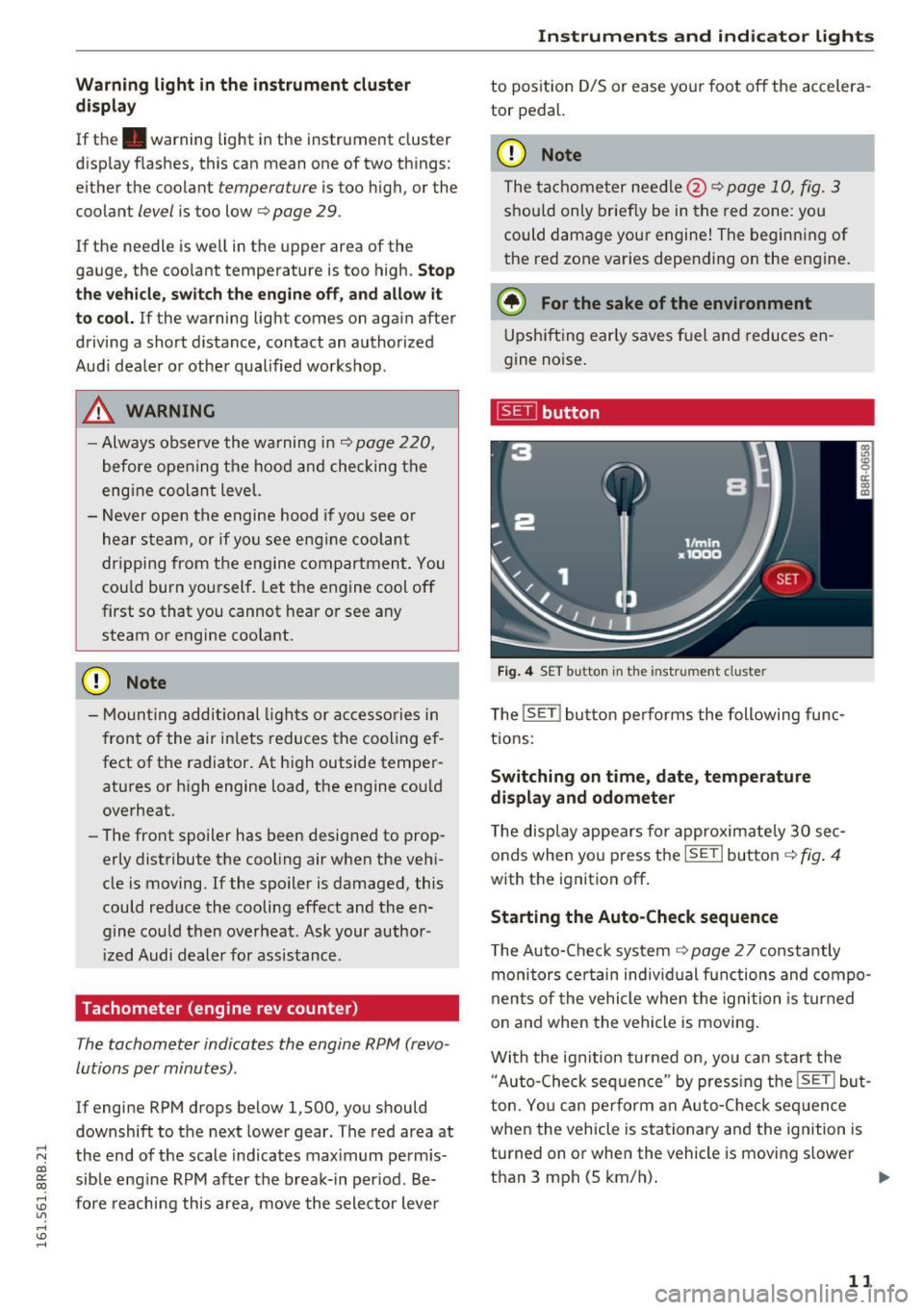
~ button
Fig. 4 SET button in the instrument cluster
The !SET ! button performs the following func
tions:
Switching on time, date, temperature
display and odometer
The display appears for approximately 30 sec
onds when you press the
ISETI button ~fig . 4
with the ignition off .
Starting the Auto-Check sequence
The Auto-Check system ~ page 2 7 constantly
monitors certain individual functions and compo
nents of the vehicle when the ignition is turned
on and when the vehicle is moving.
With the ignit ion turned on, you can start the
"Auto-Check sequence" by press ing the
!SE TI but
ton. You can pe rform an Auto-Check seq uence
when the vehicle is stationary and the ignition is
turned on or when the vehicle is moving slower
than 3 mph (5 km/h).
IIJ,,,
11
Page 33 of 300
,....,
N
co
er::
co
,....,
~ Drive immediate ly to an authorized Audi dealer
to have the malfunction corrected .
If there is a malfunction in the electronic ignition
lock, the ignition cannot be turned off . Drive im
mediately to an authorized service facility to have
the cause of the malfunction corrected.
On vehicles with Convenience key*, the engine
should not be switched off using the Start/Stop button because the engine cannot be started
again after the ignition has been switched off.
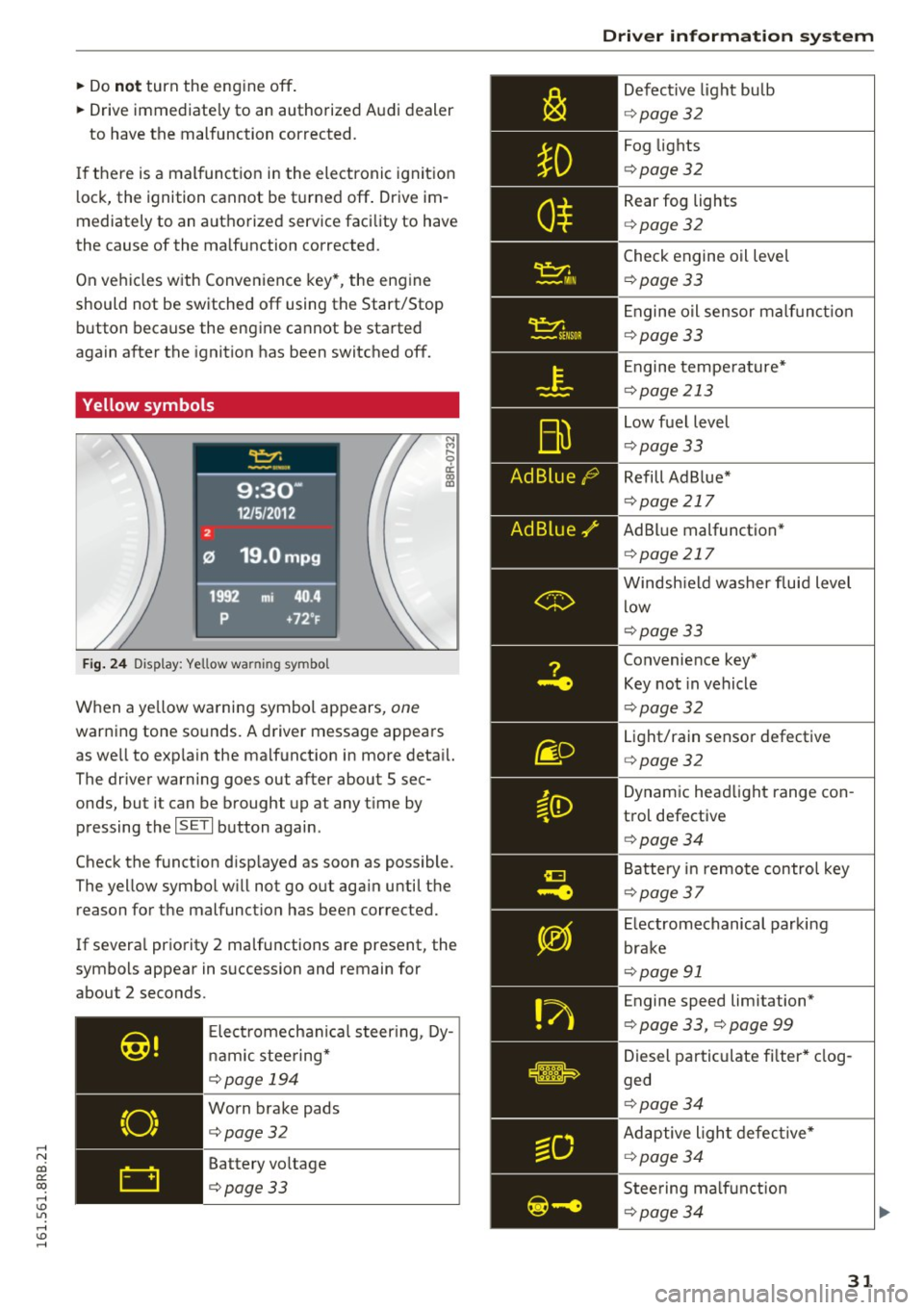
Yellow symbols
Fig. 24 Display: Yellow warning symbo l
N M
9 a: a, a,
When a yellow warning symbol appears, one
warning tone sounds. A driver message appears
as well to exp la in the malfunction in more detail.
The driver warning goes out after about 5 sec
onds, but it can be brought up at any t ime by
pressing the
ISETI button again.
Check the function disp layed as soon as possible.
The yellow symbol w ill not go out aga in until the
reason for the malfunct ion has been corrected.
If severa l priority 2 ma lfunctions are present, the
symbols appear in succession and remain for
about 2 seconds.
Elect romechan ical steering, Dy
nam ic stee ring*
¢page 194
Worn brake pads
¢page32
Battery voltage
¢page33
Driver information system
Defective light bulb
¢page 32
Fog lights
¢pag e 32
Rear fog lights
¢page 32
Check engine oil leve l
¢page 33
Engine oil sensor malf unc tion
¢page 33
Engine temperature*
¢page 213
Low fuel level
¢pag e 33
Refill Ad Blue*
¢page 217
AdBlue malfunction *
¢page 217
Windshield washer fluid level
low
¢page 33
Convenience key*
Key not in vehicle
¢pag e 32
Light/rain sensor defective
¢page 32
Dynamic headlight range con
trol defective
¢ page 34
Battery in remote control key
¢page 37
Electromechanical parking
brake
¢page 91
Engine speed limitation*
¢ page 33, ¢ page 99
Diesel particulate fi lter * clog
ged
¢pag e 34
Adaptive light defective*
¢page 34
Steering malfunction
¢page 34
31
Page 200 of 300
Driving and th e en vironm ent
- Do not apply additional undercoating or
rustproofing on or near the exhaust mani
fold, exhaust pipes, catalytic converter or heat sh ields . During dr iv ing, the substance
used for undercoating could overheat and
cause a fire .
{U) Note
-Be aware that just one tank filling with
leaded fuel will already seriously degrade
the performance of the catalytic co nverter .
- Do not exceed the correct engine oil level
c:>page224 .
-Do not drive until the fuel tank becomes
completely empty . The engine could mis
fire. Unburned fuel could also get into the
exhaust system and this could cause the
catalytic converte r to overheat.
- Do not turn off the ignition while the vehicle
. . 1s moving.
- Do not continue to operate your vehicle un
der these cond itions, as otherwise fuel can
r each the catalytic converte r. This could re
su lt in overheating of the converter, requir
i ng its replacement .
- To assure efficient operation of the Emis
s ion Control System:
- Have your vehicle maintained properly and in accordance with the service recommen
dations in your Warranty
& Maintenance
booklet .
- Lack of proper maintenance as well as im
proper use of the vehicle will impair the
function of the em ission control system
and could lead to damage.
@ For the sake of the environment
Even when the Emission Control System is op
erat ing properly, the exhaust gas can have a
sulfur-like exhaust gas smell under some op
erat ing states . This depends on the su lfur
content of the fuel be ing used. Using a differ
ent brand of fue l may he lp, or filling the tank
with lead-free super grade gasoline.
198
Diesel particulate filter
Applies to vehicles: with diesel engine
The diese l particulate filter filters near ly all of
the soot particles out of th e exhaust. The filter
cleans itself automat ically under normal d riving
conditions. If the filter cannot clean itself (for ex
ample, because you are only driving shor t distan
ces), the filter becomes clogged with soot and
the
II symbol for the diesel part iculate filter il
luminates
c:> page 34 .
&_ WARNING
-Do not park your vehicle over flammable
materials such as grass or leaves because
the high temperature of the diesel particu
late filter could start a fire.
-
- Do not apply an underbody protectant in the
exhaust system area or a fire could start.
Avoid damaging the
vehicle
When you are driving on poor roads, or over
curbs, steep ramps, etc., make certain that low
lying parts such as spoilers and exhaust system
parts do no t bottom out and ge t damaged.
This is espec ially true for vehicles with low-s lung
chassis (sports chassis)* and fully loaded
vehicles.
Economical and environ
mentally-friendly driving
General
Your personal style of driving will determine the
economy of your vehicle, as well as exhaust and
noise levels.
Fuel economy, environmental impact, and wear
on your engine, brakes and tires largely depend
on three factors:
- your personal driving style
- operating conditions
- technical limitations
If you anticipate what you need to do next and
drive economically, you can easily cu t your fuel
Page 202 of 300
Driving and th e en vironm ent
It is normal for the oil consumption o f a new en
gine to reach its lowest value after a certain mile
age has been driven .
You must drive yo ur vehicle about 3,000 miles
(5,000 kilometers) before you can properly as
sess oi l consumption.
This a lso applies to fuel consumption and engine
outpu t.
@ Note
- Have yo ur vehicle maintained properly and
i n accordance with the serv ice recommenda
tions in yo ur Warranty
& Maintenance book
l et. Lack of proper maintenance as well as
improper use of the vehicle will impair the
funct ion of the emission control system and
could lead to damage.
- Do not a lter or remove any component of
the Emission Control System unless ap proved by the manufacturer.
- Do not alter or remove any device, such as
heat shie lds, switches, ignition wires,
valves, which are designed to protect your
vehicle's Emission Cont rol System and other
i mportant vehicle components.
Fewer short trips
Fuel consumption will always be relatively high
on short trips .
.,. Try to avoid driving short distances with a cold
engine.
The engine and catalytic converter have to reach
their optimal
oper ating temp eratur e to reduce
fuel consumption and noxious emissions effec tively .
Just after starting, a co ld engine in a mid-size car
only achieves a fue l economy of 6-8 miles per
gallon (30-40 l/100 km). After about a half a mile, fuel economy cl imbs to 12 mpg (20 l/100
km). After about
2 .5 miles (4 km), the engine is
at its proper operating temperature and fuel
economy has reached a normal level. So you can
see that you sho uld avoid short t rips whenever
possible.
200
The out side t empe rature is also critica l in this re
gard . Your car consumes more fuel in the winter
than in the summer.
Page 215 of 300
,....,
N
co
er::
co
,....,
pecia lly we ll for winter or summer driving. Dur
ing seasona l change-over, we suggest that you
f ill up at busy gas stations where the seasonal
adjustment is more likely to be made in time.
- Fuels containing a high percentage of etha
no l such as ESO and E85 may only be used in
vehicles with flexible fuel* eng ines. Using
high ethanol fuel in veh icles not equ ipped
with flexible fuel* engines can cause severe
engine damage .
- Methanol fuels which do not meet these re quirements may ca use corros io n and dam
age to plast ic and r ubber components in the
fuel system.
- Do not use fuels that fail to meet the spec i
fied c rit er ia i n this c hapter.
- If you a re unable to determine whether or
not a particular fue l blend meets the spec i
fi cat ions, ask your service station o r its fuel
su pplier.
- Do not use fue l fo r w hich the contents can
not be identified.
- Fuel sys tem damage and performance prob
l ems result ing from the use of fue ls diffe r
ent from those specified are not the respon
s ibility o f Audi and are no t covered under
the New Vehicle or the Emissio n Contro l
System Wa rranties .
- If you experience a loss of fue l economy o r
driveability an d performance prob lems d ue
to the use o f one of these fuel b lends, we
r ecommend that you switch to unblended
fuel.
Ethanol fuel (Bio-ethanol)
App lies to vehicles: with flexib le fuel engine
You con recognize vehicles with a flexible fuel
engine by looking a t the label on the inside of
the fuel filler flop.
Veh icles with flexibl e fu el engines may be op er
ated w ith bio -ethanol fuels such as E85 (85%
ethano l and 15% gasoline) or with un leaded gas
oline (9 1 AKI/RO Z 95). The ve hicle may a lso be
ope rated with a mixture of these fuels.
Fuel and R efueling
Your fuel consumpt ion w ill increase when using
bio-ethano l fue ls due to th e lower amount of en
ergy conta ined per un it vol ume in ethanol.
Warming up the flexible fuel engine in low
temperature s
Due to the chemica l composition of b io -ethanol ,
a certa in amount of fue l ends up in the engine o il
when driving short distances in very low temper
atures . This fuel evaporates again when the en
gine is warmed up.
II Please warm up eng ine .
If the drive r message appears in the instr ume nt
cluster disp lay, drive with a warm engine to re
duce the oil leve l.
(D Note
- N ever fill wi th metha nol o r with a higher
percentage of b io -ethanol than 85% (E85).
A highe r percentage of bio-ethanol in the
fuel can cause damage to the engine or to the fuel system.
- If you use on ly E85, it is recommended to
fill the fue l tank complete ly w ith unleaded
premium grade gasoline every 5,000 mi les.
- If you expe rience starting, rough id le or hes
itat ion d riveab ility prob lems, f ill the fuel
tank complete ly w ith unleaded p remium
grade gaso line and drive it norma lly until
the gaso line is used. See your author ized
Audi dea ler if the problem persists.
- Inform your author ized Audi dealer that you
are operating o r have operate d the vehicle
w ith E8S.
- Read and follow the i nformat ion and tips
abou t gasoli ne <=:>
page 212 .
(D Tips
It may take longer to start the engine when
the outs ide temperatu re is very cold . If possi
ble, use w inte rized fue l if tempe ratures are
below free zing .
213
Page 216 of 300
Fuel and R efu eli ng
Gasoline additives
Applies to veh icles: w ith gaso li ne engine
A major concern among many auto manufactur
ers is carbon deposit build- up ca used by the type
of gasoline you use.
Although gasoline grades d iffer from one manu
facturer to another, they have certain things in
common. All gaso line grades contain substances
that can cause deposits to collect on v ita l engine
parts, such as fue l injectors and intake valves . Al
though most gasoline brands include additives to keep engine and fuel systems clean, they are not
equally effective.
Audi recommends using TOP TIER Detergent Gas
oline. For more information on TOP TIER Deter
gent Gasoline, please go to the official website (www.toptiergas.com).
After an extended pe riod of using inadequate
fue ls, built-up carbon depos its can rob your en
gine of peak performance.
(D Note
- Damage or ma lfunction due to poor fue l
quality is not covered by the Audi New Vehi
cle Limited Warranty.
- Do not add aftermarket fuel additive prod
ucts to yo ur fuel tank.
Diesel fuel
Applies to veh icles: w ith d iese l e ngine
Always use ULSD (Ultra Low Su lfur Diesel) No. 2 .
The ULSD No . 2 meets the ASTM D97S.
Diese l fuel with concentrations of biodiesel high
er than S % such as 811,820 or 8100 are strictly prohibited.
Service station f uel pumps are labeled with the
correct fue l information for easy recognition by
the user.
If the diesel fuel pump is not labeled
ask the station operator what fuel is be ing dis
pensed before filling up your vehicle .
ULSD No . 2 may not be availab le outside the USA
and Canada . Be sure to check before traveling to
other countries .
214
ULSD No. 2 can become thicke r in very cold tem
peratures, and this can impair the engine's start
i ng and running. Depend ing on the season, gas
stations provide ULSD No. 2 that flows better in
cold temperatures so that you can continue oper
at ing your vehicle as usual.
(D Note
- Your vehicle's diese l eng ine was designed
so ley for use w ith ULSD No. 2. Therefore,
never use gasoline, heating oil, other fuels
or flow improvers. These contain substances
that will severely damage the fuel system and the engine. Such damage will no t be
c ove red by your New Vehicle Limited War
ranty .
-If you pu t any amo unt of inco rre ct fuel in
the fuel tank, do not start the engine u nder
any circumstances. Immed iate ly contact the
nearest authorized Audi dealer or author
ized Audi Serv ice Facility for ass istance .
These fuels contain substances that can se
verely damage the fuel system and the en gine if the engine is started .
Refueling
Fuel filler neck
The fuel filler neck is located on the right rear
s ide panel behind the fuel filler flap .
If the power lock ing system shou ld fai l, you can
still open the flap manually -fo r detailed instruc
tions see
¢ page 216 .
You can find the fuel tan k capacity of your vehicle
in ¢ page277.
The label on the inside of the fuel filler flap tells
you the correct fuel for your veh icle. For more in
fo rmat ion about fuel specifications, see
¢ page 212.
Your vehicle f uel tank has an on-board refuelling
vapor recovery system . Th is feature helps to pre
ven t fue l vapors from escaping from the tank and
po lluting the environment wh ile you refue l yo ur
vehicle. In order to fill the tank properly wh ile
protecting the environment, p lease follow this
refue ling procedure carefully .
Page 223 of 300
,....,
N
co
er::
co
,....,
ponents will burn skin on contact .
- To reduce the risk of being burned, never
open the hood if you see or hear steam or
coolant escaping from the engine compart
ment. Wait until no steam or coolant can be
seen or heard before carefully opening the
hood.
- Keep children away from the engine com
partment .
- Never spill fluids on hot engine compo
nents. They can cause a fire .
- Never touch the radiator fan. The auxiliary
electric fan is temperature controlled and
can switch on suddenly.
- Never open the coolant reservoir cap when
the engine is still warm. The coolant system
is pressurized and hot coolant could spray
out .
- Protect your face, hands and arm from
steam or hot engine coolant by placing a
thick rag over the cap when you open the
coolant reservoir .
- Do not remove the engine cover under any
circumstances. This increases the risk of
burns.
- If work on the fuel system or the electrical
system is necessary:
- Always disconnect the battery.
- Never smoke or work near heaters or open
flames. Fluids in the engine compartment
could start a fire.
- Keep an approved fire extinguisher imme
diately available.
- To avoid electrical shock and personal injury
while the engine is running or being started, never touch:
- Ignition cables
- Other components of the high voltage
electronic ignition system .
- If you must perform a check or repair with
the engine running:
- First, fully apply the parking brake, move
selector lever of automatic transmission
to P (Park).
Checking and Filling
-Always use extreme caution to prevent
clothing, jewelry, or long hair from get
ting caught in the radiator fan, V-belts or
other moving parts, or from contacting hot parts. Tie back hair before starting,
and do not wear clothing that will hang or
droop into the engine.
- Minimize exposure to emission and chemi
cal hazards
~ .&, .
A WARNING
California Proposition 65 Warning:
- Engine exhaust , some of its constituents,
and certain vehicle components contain or
emit chemicals known to the State of Cali
fornia to cause cancer and birth defects and
reproductive harm. In addition, certain flu
ids contained in vehicles and certain prod
ucts of component wear contain or emit
chemicals known to the State of California
to cause cancer and birth defects or other
reproductive harm.
- Battery posts, terminals and related acces
sories contain lead and lead compounds,
chemicals known to the State of California
to cause cancer and reproductive harms .
Wash hands after handling .
(I) Note
When adding fluids, always make sure that
they are poured into the proper container or
filler opening, otherwise serious damage to
vehicle systems will occur.
@) For the sake of the environment
To detect leaks in time, inspect the vehicle
floor pan from underneath regularly . If you
see spots from oil or other vehicle fluids, have
your vehicle inspected by an authorized Audi dealer.
221
Page 227 of 300
,....,
N
co
er::
co
,....,
to prevent oil from be ing sprayed on the hot
engine and exhaust system when the engine
is running -fire hazard!
- If your skin has come in contact with the en
gine oil, you must subsequently cleanse it
thoroughly .
@ Note
-Check the oil level using the radio or the
MM!*. If the message
Ple ase redu ce oil l ev
el
appears, contact your authorized Aud i
dealer or other qualified workshop to have
excess oil extracted if necessary.
- Audi do es not recommend th e use of o il
addit ive s. The y ma y damage the eng ine
and ad verse ly affect your New Vehicle
Wa rranty.
@ For the sake of the environment
- Under no circumstances can the o il come in
contact with the sewage network or the soil.
- Observe and follow legal regulations whe n
dispos ing of empty oil conta iners.
Changing the engine oil
We recommend that have your oil changed by an
authorized Audi dealer or a qualified service sta
tion.
Before you check anyth ing in the eng ine compart
ment,
alw ays read and h eed all WARNING S c:> .&.
in Working in the engine compartment on
page 220 .
The engine oil must be changed according to the
intervals specified in your Warranty
& Mainte
nance booklet . This is very important because the
l ubricat ing propert ies of o il d iminish gradually
du ring normal vehicle use.
Under some circumstances the engine o il should
be changed more frequently . Change oil more of
ten if you drive mostly short distances, operate
the veh icle in dusty areas or under predominant ly
stop-and -go traffic condit ions, or have yo ur vehi
cle whe re temperatures remain below freezing
for extended periods.
Ch eck ing and Filling
Detergent additives in the oi l will make fresh oil
look dark after the engine has been running for a
short time . This is normal and is not a reason to
change the oi l more often than recommended.
Because of the problem o f proper disposal, along
with the specia l tools and necessary expertise re
quired, we strongly recommend that yo u have
your o il changed by an authori zed
Audi dealer or
a qual ified service stat ion.
If y ou choo se to chan ge your oil your self , please
note the following important information:
A WARNING "--
To reduce the risk of persona l injury if you
must change the eng ine oil in your vehicle
yourself:
- Wear eye protection.
-
-To reduce the r isk of burns from hot engine
oil, let the engine cool down to the touch.
- When remov ing the oil drain plug w ith your
f ingers, stay as far away as possible. Always
keep your forearm parallel to the ground to
he lp prevent hot oil from running down your
arm.
- Drain the oil into a container designed for
this purpose, one large enough to hold at least the tota l amou nt of oil in your engine.
- Engine oil is poisonous. Keep it well out of
the reach of childre n.
- Continuous contact with used engine o il is
harmful to your skin. Always protect your
skin by washing oil off thoroughly with soap
and water .
«I) Note
Never mix oil additives with your engine oil.
These additives can damage your engine and
adverse ly affect yo ur Audi limited New Vehi
cle Warranty .
@ For the sake of the environment
-Before chang ing yo ur oi l, first make sure
you know where you can properly d ispose of
the used oil.
- Always dispose of used engine o il properly .
Do not dump it on ga rden soil, wooded
225
Page 228 of 300
Checking and Filling
areas, into open streams or down sewage
drains.
- Recycle used engine oil by taking it to a used
engine oil collection facility in your area, or
contact a service station .
Cooling system
Coolant
The engine coolant performs two functions: it
keeps the engine from overheating and it pro tects the engine from freezing in the winter.
The cooling system is sealed and generally re
qu ires little attention .
The cooling system has been filled at the factory
with a permanent coolant which does not need to
be changed. The coolant consists of
a mixture of
specially conditioned water and the manufactur
er's g lycol-basedcoo lant additive G 13 antifreeze
w ith anticorrosion addi tives (50% for USA mod
e ls· 60% for Canadian mode ls). This m ix ture
'
both ass ures the ne cess ary fros t protection and
p rotects metal com ponents in the engi ne's coo l
ing system from corrosion and scaling .
It also
raises the boiling point of the coolant.
Do not red uce the concent ra tion of the cool ant in
the s ummer by addi ng p la in water.
The propor
tion of coolant additive must be at lea st 50 %
but not more than 60 %
to maintain antifreeze
protection and cooling efficiency. If the coolant
frost protection is too low, the coo lant could
freeze and damage the vehicle heat ing and en
g ine cooling system .
For year -round driving, antifreeze is added at the
factory for temperatures down to:
- -3 1 °F
c -3s0c) usA
- -4 0° F ( -40°C) Canad a.
I f you must add coolant, use a m ixt ure of wa ter
and coolant add it ive. M ixing the coolant additive
with d istilled water is recommen ded.
_& WARNING
B efore you che ck anyt hing i n the engine com
partmen t, a lways read and heed all WARN -
226
INGS ~ & in Working in the engine compart
ment on page 220.
(D Note
- Be fore w inter sets in, have the coolan t
checked to see if the coo lant additive in your
vehicle is suff ic ient to meet the climate con
ditions. This is especially important if you
live in a region where the winter is extreme
ly cold. If necessary, increase the proportion
of coolant addi tive to 60% .
- Whe n adding coolant additive to your cool
ing system, remember:
- We re commend usin g on ly coo lant addi
tive G12++ o r G13 fo r yo ur vehicle. This
coolant ad dit ive is availab le at authorized
Audi dealers. Other types of antifreeze can
significantly reduce corrosion protection.
The resulting corrosion can cause a loss of
coolant and serio us engine damage.
- Do not add any type of radiato r leak sealant
to your vehicle's engine coolant. Adding ra
diator repair fluid may adversely affect the
function and perfo rmance of yo ur cooling
system and cou ld resu lt in damage not cov
ered by your New Ve hicle Li mited War ranty.
Checking the engine coolant level
The engine coolant level can be checked with a
quick glance.
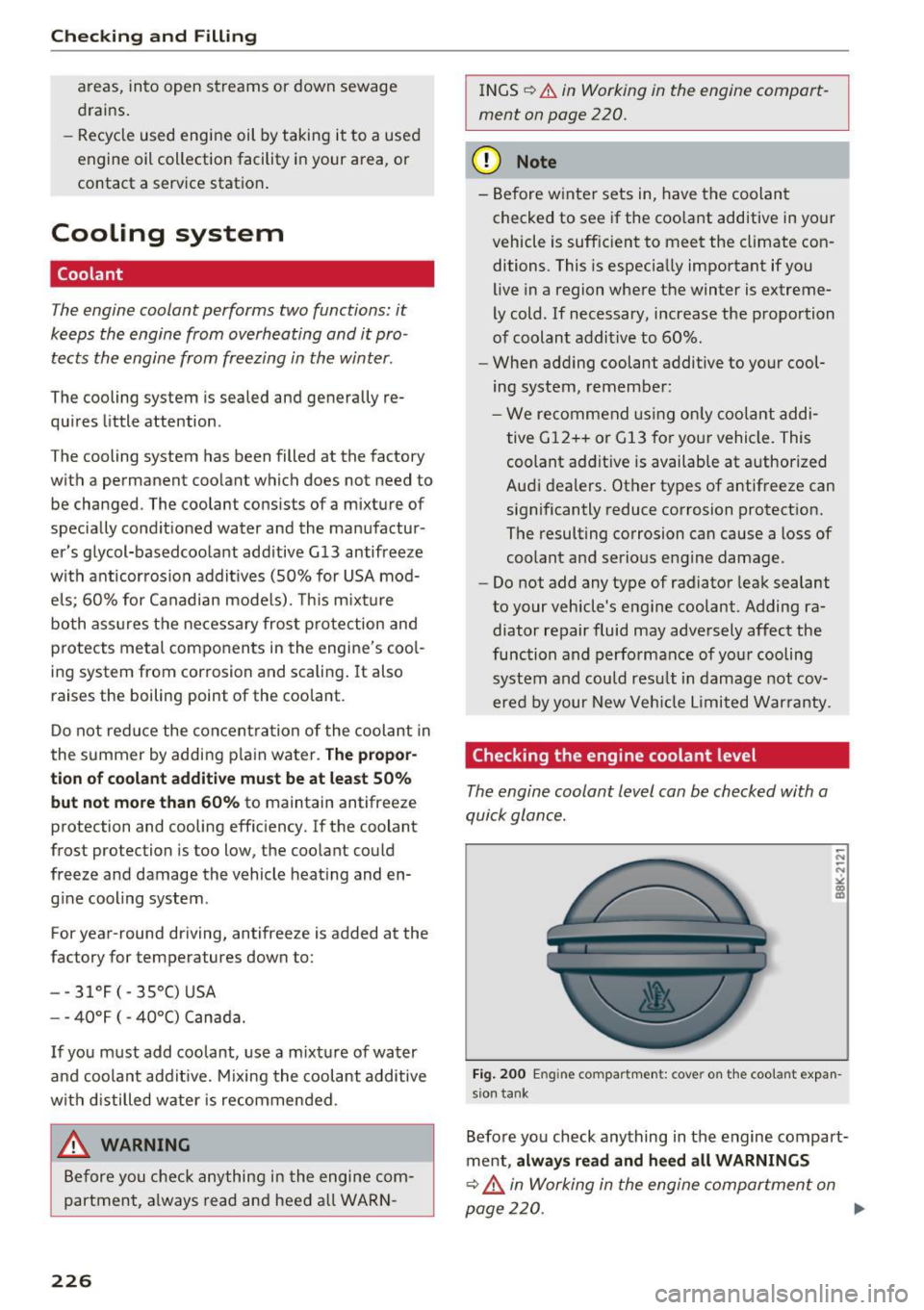
Fi g. 20 0 Eng ine compartment: cover on the coo lant expan
s io n tank
Befo re yo u check anything in the engine compart
ment,
always read and heed all WARNINGS
~ ,& in Working in the engine compart,nen t on
page 220. ..,.
Page 231 of 300
,....,
N
co
er::
co
,....,
partition of the engine compartment on the left
side ¢
page 222.
The fl uid level may drop slightly after some time
due to the automatic adjustment of the brake
pads . This is not cause for alarm.
I f the b rake fl uid level fa lls
considerably be low
the "MIN" mark, the brake wa rning/ind icator
light (U .S. mode ls:
1111 , Canadian models:.)
will come on¢
page 18 and ¢ page 28 . Do not
continue to operate the vehicle. The complete brake system should be thoroughly checked by an
author ized Audi dealer or qualified workshop and
the cause corrected . If the brake fluid level is too
low, the brake warning/ind icator light will illumi
nate. Contact an authorized Audi dealer
immedi
a te ly.
Changing brake fluid
Have the brake fluid changed by an experienced technician.
Brake fluid absorbs mo isture from the air. If the
water conte nt in the brake fluid is too h igh, cor
ros ion in the brake system may resu lt after ape
riod of time. The boiling poi nt of the brake flu id
will also dec rease cons iderably and decrease
braking pe rformance.
Therefore, the b rake fluid must be changed
e ve ry
two year s.
Always use new b rake fluid wh ich con
forms to Fede ral Motor Veh icle St andard "FMVSS
116 DOT 4".
The brake fluid reservoir can be diff icult to reach,
therefore, we re commend that yo u have the
b rake fl uid changed by yo ur autho rized
Audi
deal er.
Your dealer has the cor rect too ls, the
right brake fluid and the know -how to do this for
you.
A WARNING
- Brake fluid is poisonous. It must be stored
only in the closed original container out of
the reach of chi ldren!
- B rake failure can resu lt from old or inappro
pr iate brake flu id. Observe these precau
t io ns:
Ch eck ing and Filling
-Use only brake fluid that meets SAE speci
ficat ion
J 1703 and conforms to Federal
Motor Vehicle Standard 116. Always check
with your authorized Aud i dealer to make
sure you are us ing the correct brake fluid .
The co rrect type of brake flu id is also i ndi
cated on the b rake fluid reservoir.
- The brake flu id must be new. Heavy use of
the b rakes can cause a vapo r lock if the
bra ke fluid is left in the system too long.
T his can se riously affe ct the efficiency of
t h e b rakes as we ll as you r safety . This
could resu lt in an accident.
(D Note
B rake flu id will damage the paint of your ve h i
cle.
@) For the sake of the environment
Because of the p roblem of proper d isposa l of
brake fluid as well as the spec ial too ls re
q uire d and the necessary expertise, we rec
ommend that yo u have the bra ke fluid
c hanged by yo ur authorize d Au di dealer.
Battery
General information
Under normal ope rat ing condit ions, the batte ry
in you r A udi does not need any mainte nance.
Wi th
high o utside temperatures or long daily
drives we recommend that yo u have the elec tro
lyte level checked by an authorized A udi dealer or
qualified workshop . The electro lyte level should
also be checked each time the battery is charged
~ page 231.
Have the batte ry checked when you take your ve
hicle in for service. You are we ll advised to re
place a battery that is older than S years.
Wi th certain types of airbag deployment, the
battery is d isconnected from the veh icle electri
ca l system for safety reasons¢.&.
in Repair, care
and disposal of the airbags on page 164.
Hyb rid dr ive *: yo u can find impo rtant informat ion
about the high voltage battery under ¢
page 97. .,.
229