air condition AUDI Q5 2017 User Guide
[x] Cancel search | Manufacturer: AUDI, Model Year: 2017, Model line: Q5, Model: AUDI Q5 2017Pages: 296, PDF Size: 74.43 MB
Page 154 of 296
Airbag syste m
Front airbags
Description of front airbags
The airbag system can provide supplemental
protection to properly restrained front seat occu
pants.
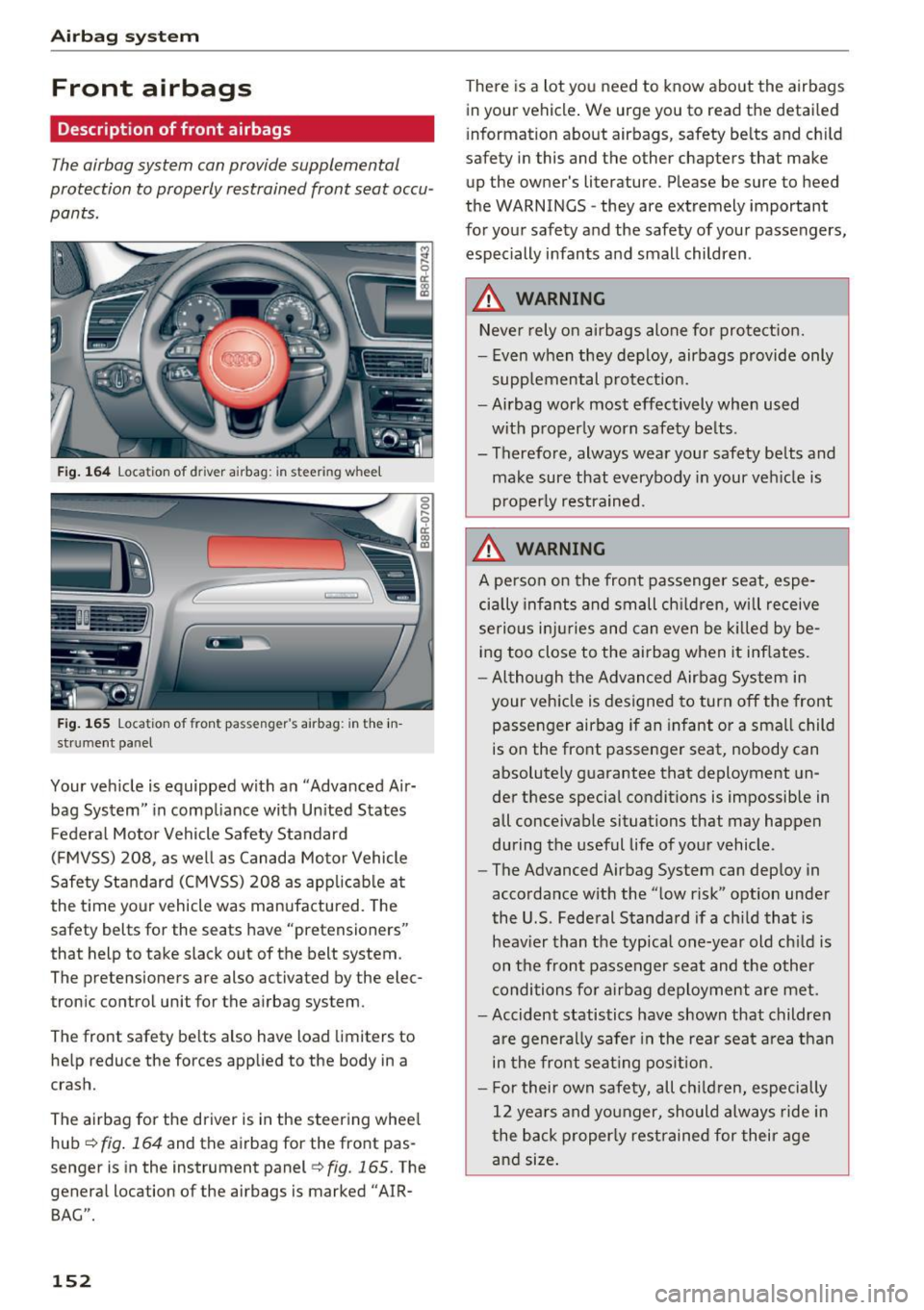
Fig. 164 Location of driver airbag: in steering whee l
Fig. 165 Location of front passenger's airbag: in the in
strument panel
Your veh icle is equipped with an "Advanced Air
bag System" in compliance with Un ited States
Federa l Motor Vehicle Safety Standard
(FMVSS) 208, as well as Canada Motor Vehicle
Safety Sta ndard (CMVSS) 208 as app licable at
the time your vehicle was manufactured. The
safety belts for the seats have "pretensioners"
that help to take slack out of the belt system.
The pretensioners are also activated by the elec
tronic control unit for the airbag system.
The front safety be lts also have load limiters to
help reduce the forces applied to the body in a
crash.
The airbag for the driver is in the steering wheel
hub<=>
fig . 164 and the airbag for the front pas
senger is in the instrument panel
<=>fig. 165. The
general location of the airbags is marked "AIR
BAG".
152
There is a lot you need to know about the airbags
in your vehicle . We urge you to read the detailed
i nformation about airbags, safety belts and child
safety in this and the other chapters that make
up the owner's literature. Please be sure to heed
the WARNINGS -they are extremely important
for your safety and the safety of your passengers,
especially infants and small children .
.&_ WARNING -
Never rely on airbags alone for prote ct ion.
- Even when they deploy, airbags provide only supp lemental protection.
- Airbag work most effectively when used with properly worn safety be lts.
- Therefore, always wear your safety belts and make sure that everybody in your veh icle is
properly restrained .
.&_ WARNING
A person on the front passenger seat, espe
cially infants and small ch ildren, wi ll receive
serious inju ries and can even be killed by be
ing too close to the airbag when it inf lates.
- Although the Advanced Airbag System in
-
your vehicle is designed to turn off the front passenger airbag i f an infant or a small child
is on the front passenger seat, nobody can
absolutely guarantee that deployment un
der these special conditions is impossible in
all conceivable situations that may happen
during the useful life of your vehicle.
- The Advanced Airbag System can deploy in
accordance with the "low risk" option under
the U.S. Federal Standard if a child that is
heav ier than the typical one-year old ch ild is
on the front passenger seat and the other
conditions for airbag deployment are met.
- Accident statistics have shown that children are generally safer in the rear seat area than
in the front seat ing pos ition.
- For their own safety, all chi ld ren, especially
12 years and younger, should always ride in
the back proper ly restrained for their age
and size .
Page 161 of 296
a,
a,
..... N r-N ..... 0 0
0:
co
PASSENGER AIR BAG OFF light
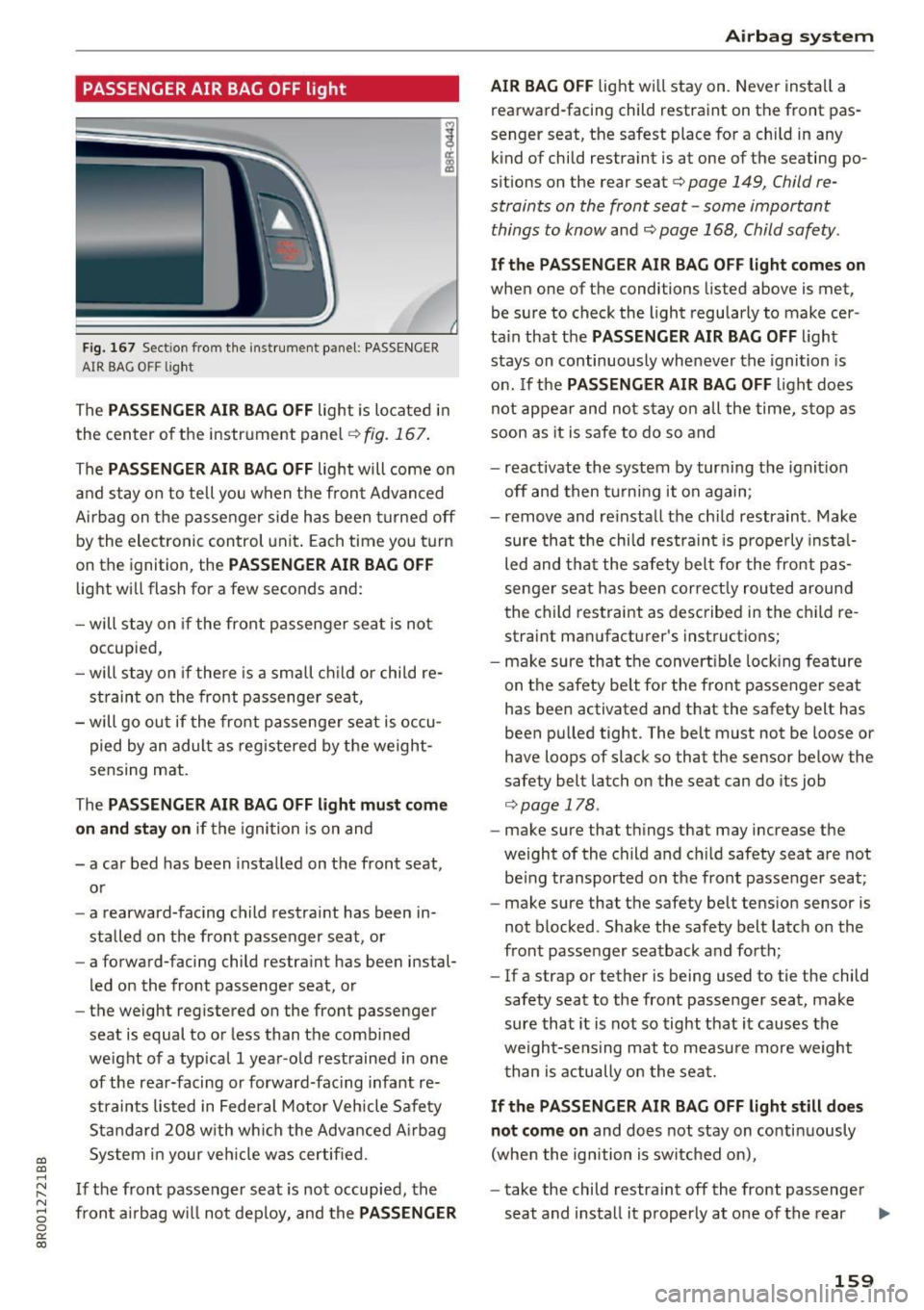
Fig. 167 Sect ion from the instrument panel: PASSENGER
AIR BAG O FF light
The PA SSENGER AIR BAG O FF light is located i n
the center of the instrument pane l¢
fig. 167 .
The PASSENGER AIR BAG OFF light will come on
and stay on to tell you when the front Advanced
Ai rbag on the passenger side has been t urned off
by the electronic control unit . Each time you turn
on the ignition, the
PA SSEN GER AIR BAG OFF
light will flash for a few seconds and:
- will stay on if the front passenger sea t is not
occupied,
- will stay on if the re is a small child or child re
straint on the front passenger seat,
- will go ou t if the front passenge r seat is occu
pied by an adul t as reg istered by the weight
sensing mat.
The
PASSENGER AIR BAG OFF light mu st come
on and stay on
if the ignition is on and
- a car bed has been installed on t he front seat,
or
- a rearward-facing child restraint has been in
stalled on the front passenger seat, or
- a forward-facing child restra int has been instal
led on the front passenger seat, or
- the weight registered on the front passenger
seat is equal to or less than the combined
weight of a typical 1 year-old restrained in one
of the rear-facing or forward-fac ing infant re
straints listed in Federal Motor Vehicle Safety
Sta ndard 208 with w hich the Adva nced A irbag
System in your veh icle was certified.
I f the front passenger seat is not occupied, the
front a irbag w ill not deploy, and the
PASSENGER
Airb ag sys tem
AIR BAG OFF light wi ll stay on. Never install a
rearward-facing child restraint on the front pas
senger seat, the safest place for a ch ild in any
k ind of child restraint is at one of the seating po
sitions on the rear seat¢
page 149, Child re
straints on the front seat -some important
things to know
and r::;, page 168, Child safety.
If the PAS SENGER AIR BAG OFF light comes on
when one of the conditions listed above is met,
be su re to check the light regularly to make cer
ta in that the
PASSENGER AIR BAG OFF li ght
stays on continuously whenever the ignition is
on. If the
PASSENGER AIR BAG OFF li ght does
not appear and not s tay o n all the time, stop as
soon as it is safe to do so and
- reactivate the system by turning the ignit ion
off and then t urning it on again;
- remove and re insta ll the child restraint . Make
sure that the child restraint is properly insta l
led and tha t the safety belt for the fro nt pa s
senger seat has bee n correct ly routed around
the child res traint as desc ribed in the c hild re
stra int man ufactu rer's instructions;
- make sure that the convert ible lo ck ing fea ture
on the safety be lt for the front passenger seat
has been activated and that the safety belt has
been pulled tight. The belt must not be loose or
have loops of slack so that the sensor be low the
safety belt latch on the seat can do its job
c:;, page 178 .
-make sure that things that may increase the
weight of the child and ch ild safety seat are not
be ing transported on the front passe nger seat;
- make sure that the safety belt tens ion sensor is
not blocked . Shake the safety belt latch on the
front passe nger seatback and forth;
- If a strap or tether is being used to tie the child
safety seat to the front passenger seat, make
sure that it is not so tight that it causes the
weight-sens ing mat to measu re more weight
t han is actually on the seat.
If th e PA SS ENGER AIR BA G OFF light still does
not come on
and does not stay on continuously
(whe n the ignition is switc hed on),
- take the child restraint off the front passenger
seat and insta ll it properly at one of the rear
Iii--
159
Page 170 of 296
Child safety
Child safety
Important information
Introduction
The rear seat is generally the safest place in a
collision .
The physical principles of what happens when
your vehicle is in a crash apply also to children
¢ page 141, What happens to occupants not
wearing safety belts? .
But unlike adults and
teenagers, their muscles and bones are not fully
developed. In many respects children are at
g reater r isk of serious injury in crashes than
adults .
Because children's bodies are not fully devel
oped, they require restraint systems especially
des igned for their size, weight, and body struc
ture. Many countries and all states of the United
States and provinces of Canada have laws requir
ing the use of approved child restraint systems
for infants and small children .
I n a frontal crash at a speed of 20-35 mph
(30-56 km/h) the forces acting on a 13 -pound
(6 kg) infant will be more than 20 times the
weight of the child. This means the weight of the child would suddenly be more than 260 pounds
(120 kg) . Under these conditions, only an appro
priate child restraint properly used can reduce
the risk of serious injury . Child restra ints, like
adu lt safety belts, must be used properly to be
effect ive. Used improperly, they can increase the
risk of serious injury in an acc ident.
All ch ildren, especially those 12 years and young
er must always ride in the back seat properly re
stra ined for their age and size. If you must insta ll
a child restraint on the front passenger seat in
exceptional circumstances, be sure to read and
heed the important information and warnings
¢
page 149. Infants and other children who are
properly restrained in an appropriate child re
straint that is for their si ze and age can benefit
from the protection that supplemental side air
bags provide in some kinds of crashes .
For more information please see information
provided by the:
168
- National Highway Traffic Safety Administration
(NHTSA), currently at: http :/ /www.safe
rcar.gov (for the USA)
- Transport Canada Information Centre, current-
ly at: http://www.tc.gc.ca (for Canada)
Consult the child safety seat manufacturer's in
structions in order to be sure the seat is right fo r
your chi ld's size ¢
page 171, Important safety
instructions for using child safety seats .
Please
be sure to read and heed all of the important in
formation and WARNINGS about child safety,
Advanced Airbags, and the installation of child restra ints in this chapter .
There is a lot you need to know about the Ad
vanced Airbags in your vehicle and how they work
when infants and children in child restraints are on the front passenger seat . Because of the large
amount of important informat ion , we cannot re
peat it all here. We urge you to read the detailed
i nformation in this owner's manual about airbags
and the Advanced Airbag System in your vehicle
and the very important information about trans
porting children on the front passenger seat.
Please be sure to heed the WARNINGS -they are
extremely important for your safety and the safe
ty of your passengers, especially infants and
small children .
A WARNING
-Accident statistics have shown that children
are generally safer in the rear seat area than
in the front seat ing pos ition. Always restrain
any child age 12 and under in the rear.
-All vehicle occupants and especially children
must be restra ined prope rly whenever rid ing
in a vehicle. An un restrained or improperly
restrained child could be injured by striking
the interior or by being ejected from the ve
hicle during a sudden maneuver or impact.
An unrestrained or improperly restrained
child is a lso at greater risk of injury or death
through contact w ith an inflating airbag.
-A suitable ch ild restraint properly installed
and used at one of the rear seating positions
provides the highest degree of protect ion
for infants and small children in most acc i
dent situat ions.
Page 191 of 296
CD
CD
.... N ,-... N ..... 0 0 C<'. 00
situations, such as an a irbag dep loyment or hit
ting a road obstacle, data that wi ll assist in un
derstanding how a vehicle 's systems performed.
The EDR is designed to record da ta rela ted to ve
hicle dynamics and safety systems for a short pe
riod of time, typically 30 seconds or less . The
E DR in th is veh icle is des igned to record such da
ta as:
- How various systems in your vehicle were oper
at ing;
- Whether o r not the driver and passenger safety
belts were buckled/fastened;
- How far ( if at all) the dr iver was depressing the
acce lerator and/or brake peda l; and,
- How fast the vehicle was trave ling.
These da ta ca n he lp provide a better understand
ing of the ci rcumstances in which crashes and in
juries occur. NO TE: EDR data are reco rded by your
vehicle only if a non-triv ia l crash situation occurs ;
no data are recorded by the EDR under normal
driving conditions and no personal data (e.g., name, gender, age, and crash location) are re
corded . H owever, other parties, such as law en
forcement, could combine the EDR data w ith the
type of personally identify ing dat a routine ly ac
q uir ed dur ing a crash invest iga tion.
To read data reco rded by an EDR, specia l equip
ment is req uired, a nd access to t he veh icle or the
E DR is needed. I n add it io n t o the veh icle ma nu
facture r, ot he r p arties, s uch as law enfor cement,
that have the specia l equipment, can read the in
formation if they have access to the vehicle or the
EDR.
Some state l aws restrict the retr ieval or down
loading of data stored by EDRs insta lled in a vehi
cle for the express purpose of retrieving data af
ter an accident or crash event without the own
er's consent.
Aud i will not access the EDR and/or s imilar data
or give it to others -
- u nless the veh icle owner (or lessee if t he vehi
cl e h as bee n leased) agrees; or
- u pon the officia l request by the po lice; o r
- upon the order of a court of law or a govern-
ment agency; o r
Intelligent Technology
- for the defense of a lawsuit thro ugh the jud ic ia l
discovery process.
- Aud i may a lso use the data for resea rch about
vehicle operation and safety performance or
provide the data to a third party for research
purposes witho ut identify ing the specif ic veh i
cle or information about the ident ity of its own
er or lessee and only after the recorded veh icle
data has been accessed .
Vehicle control modules
You r vehicle is also eq uipped w ith a number of
electronic control modules for various vehicle
systems, such as engine management, emiss ion
contro l, airbags, and safety be lts .
These elect ronic contro l modu les record data
during norma l vehicle operation that may be
needed by trained techn ic ians for diagnostic and
repa ir purposes . The recording capab ility of these
modules is lim ited to data (no sound is record
ed) . Only a sma ll amount of data is actua lly re
corded over a very lim ited period of time, or stor
ed whe n a system fault is de tected by a contro l
module . Some of the da ta s tored may rela te to
vehicle speed, direction, or braking, as well as re
straint system use and performance in the event
of a crash . Stored data can also only be read and
downloaded wit h specia l equipment that is di
rectly connected to the vehicle.
{!) Tips
Your vehicle may be equipped w ith Aud i con
nect. Your use of certain Aud i connect fea
tures requires wire less serv ices that are pro
v ided by a third party wireless telecommuni
cations provider . Fo r details regarding how in
fo rmation ob tained throug h Au di connec t is
colle cted, p ro cessed, tra nsmitted, used, and
s hare d, ple ase see yo ur contra ct with t he
wireless tele commun ications provider and the
"About A udi connect" tab in your vehicle's
MMI:
I MENU ! button > Audi connect > About
Audi connect .
189
Page 204 of 296
Trailer towing
Sp eed
The higher the speed, the more d ifficult it be
comes for the driver to contro l the rig. Do not
dr ive at the maximum permissible speed. Reduce
your speed even more if load, w eather or wind
conditions are unfavorable -particularly when
going downhill.
Red uce vehicle speed
immediatel y if the trai le r
shows the s lightest sign of swaying .
Do not try
to stop the swayin g by ac cele rating.
Observe speed limits . In some areas, speeds for
vehicles towing trailers are lower than for reg ular
ve hicles.
A lways apply b rakes early . When dr iving down
hi ll, shi ft into a lower gear to use the engine
braking effect to slow the vehicle. Use of the
brakes a lone can cause them to overheat and fail.
Coolant temperature
The coolant temperatu re gauge ¢ page 8 must
be observed ca refully . If the needle moves close
to the upper end of the scale, reduce speed im
mediately and/or turn off the air conditioner .
I f t he coolan t temperature warn ing light i n the
instr ument cluster s tarts flashing ., pull off
the road, stop and let the engine
idle for about
two minutes to prevent heat bu ild-up .
A WARNING
Anyone not properly restrained in a moving
vehicle is at a much greater risk in an acci
dent . Never let anyone ride in your car who is
not properly wearing the restraints provided
by Audi .
Trailer towing
information
Important to know
Your veh icle hand les different ly when tow ing a
tra iler because of the additional weight and dif
fe rent weight d istr ibut ion . Safety, performance
and economy w ill great ly depend on how careful
ly you load you r trailer and operate your rig .
202
Before you actually tow your trailer, practice
turning, stopping and backing up in an area away
from traffic . Keep pract icing unt il yo u h ave be
come comp lete ly familiar w ith the way your vehi
cle-tra iler combination behaves and responds.
Backing up is difficult and requires practice .
Backing up w ith a trailer generally req uires steer
i ng action opposite to that when backing up your
vehicle without a trailer.
Maintain a greater distance between your vehicle
and the one in front of you . You will need more
room to stop. To compensate for the trailer, you
will need a larger than normal turning radius.
When passing, remember that you cannot accel erate as fast as you normally wou ld because of
the added load. Make sure you have enough room
to pass. After passing, allow p lenty of room for
your trailer before changing lanes again.
Avo id jerky starts, sharp turns or rapid lane
changes.
(D Tips
- Do not tow a trailer during the break-in peri
od of your veh icle.
- If you tow a trai ler, your Audi may requi re
more frequent maintenance due to the ex
tra load ¢
page 2 76.
' Parking on a slope
Do not park on a slope with a trailer. If it cannot
be avoided, do so only after doing the following:
When parking:
.,. App ly the foot bra ke .
.,. Have someone place cho cks under bot h the ve
hicle and the trailer wheels .
.,. With choc ks in place, slowly release the brakes
until the wheel chocks absorb the load.
.,. Turn the wheels towards the curb .
.,. App ly the parking brake .
.,. Move the selector lever to P .
When restarting after parking :
.,. App ly the foot brake .
.,. Start the eng ine .
.,. Move the se lector lever to D/S.
Page 209 of 296
CD
CD
.... N ,-... N .... 0 0 c:<: 00
Care and cleaning
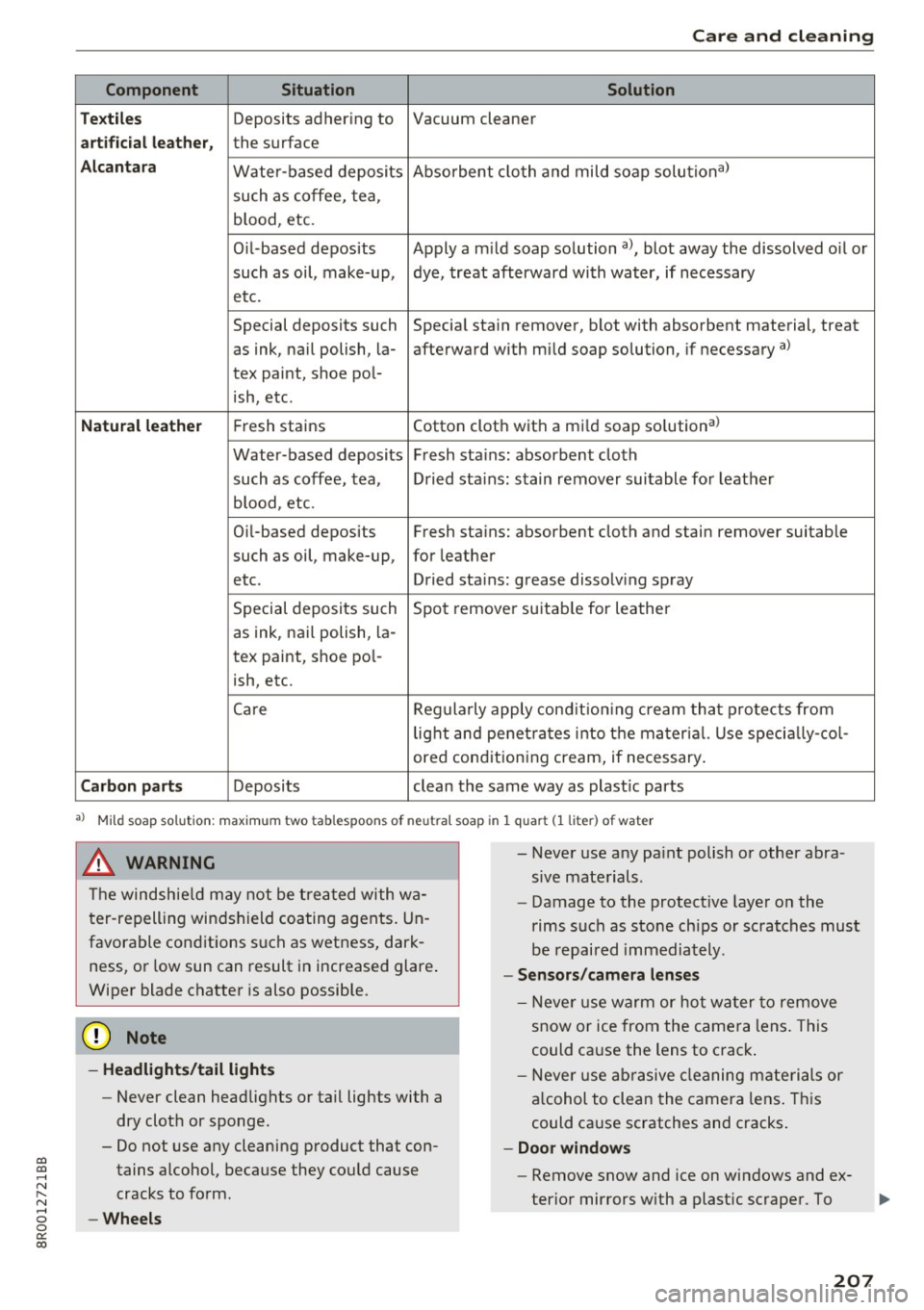
Component Situation Solution
T ex til es
Deposits adhering to Vacuum cleaner
art ifici al leat her, the surface
A lcan tara Water-based deposits Absorbent
cloth and mild soap solutiona>
such as coffee, tea,
b lood, etc.
Oil -based deposits Apply a m ild soap solution
a), blot away the dissolved o il or
such as oil, make-up, dye, treat afterward with water, if necessary
etc.
Special deposits such Special stain
remover, blot with absorbent material, treat
as ink, nail polish, la- afterward with mild soap solution, if necessary
a)
tex paint, shoe pol-
ish, etc.
Natu ral le ath er Fresh stains Cotton cloth with a mild soap solution a>
Water-based deposits Fresh stains: absorbent cloth
such as coffee, tea, Dried stains : stain
remover suitable fo r leather
b lood , etc.
Oi l-based deposits Fresh stains: absorbent cloth and stain
remover suitable
such as oil, make-up, for leather
etc. Dried stains : grease dissolving spray
Special deposits such Spot remove r suitab le for leather
as ink, nai l polish, la-
tex paint, shoe pol-
ish, etc.
Care Regularly apply condit ion ing c ream that protects from
lig ht and penet rates into the material. Use specia lly-co l-
ored conditioning cream, if necessary .
Carbon part s Deposits clean the same way as plast ic parts
a) Mi ld soap solution: maximum two tablespoons of neutral soap in 1 q uart (1 liter) of water
.8, WARNING
The windshield may not be trea ted with wa
ter-repelling windshield coating agents. Un
favorable cond itions such as wetness, dark
ness, or low sun can result in increased glare.
Wiper blade chatter is also possible.
@ Note
- Headlight s/tail li ght s
-Never clean headlights or tail lights with a
dry cloth or sponge.
- Do not use any cleaning product that con
tains alcohol, because they could cause
cracks to form.
- Whe els
-
- Never use a ny pa int polish or other abra
sive materials .
- Damage to the protect ive layer on the
rims such as sto ne ch ips or scratches must
be repaired immediately .
-Sen sor s/camera l enses
- Neve r use warm or hot water to remove
snow or ice from the camera lens . This
could cause the lens to crack .
- Neve r use ab rasive cleaning materials or
a lcohol to clean the camera lens . This
could cause scratches and cracks .
-Door window s
-Remove snow and ice on windows and ex-
terior mirrors w ith a plast ic scraper . To
207
Page 248 of 296
Wheels
damage the ti res, and the chains w ill quickly be
destroyed .
A WARNING
Using incorrect snow chains or insta lling snow
chains incorrectly can result in loss of vehicle
control, which increases the risk of an acc i
dent .
(D Note
Snow chains can damage the rims/wheel cov
ers * if the chains come into d irect contact
w ith them. Remove the wheel covers* first .
Use coated snow chains.
(D Tips
When using snow cha ins, it may be useful to
sw itch the off road mode on ¢
page 187.
Low aspect ratio tires
Your Audi is factory -equipped with low aspect ra
tio tires. These t ires have been tho roughly tested
a nd been se lected specifically fo r yo ur model fo r
thei r supe rb per fo rman ce , road feel and handling
un der a va riety of d riving conditions . As k yo ur au
thor ized Audi dealer for mo re details .
T he low aspect ratio of these t ires is in dicated by
a nume ral of
55 or less in the tire's size desig na
tion . The numera l rep resents the rat io o f th e
tire's sidewall he ight in relat ion to its tread width
expressed in pe rcentage. Conventional tires have
a height/w idt h rat io o f 60 o r more .
The performance of low-aspect -ra tio tires i s par
ticularly sensitive to improper inflation pres
sure . It is therefore important that low aspect
ratio tires are inflated to the specified pressure
and that the inflation pressure is regularly
checked and maintained . Tire pressures should
be checked at least once a month and always
before a long trip ¢
page 240.
What you can do to avoid tire and rim
damage
Low aspect rat io tires can be damaged more easi
ly by impact with potholes, cu rbs, gullies or
246
ridges on the road, particularly if the tire is un
derinflated.
I n orde r to mi nimize the occur rence o f imp act
dam age to the tires o f yo ur vehicle, we recom
mend that you observe the following preca u
tions:
- Always m aintain reco mmende d in fla tion pres
sures. Check yo ur tir e pressure eve ry 2,0 00
m iles (3,00 0 km) and add air if necessary .
- Dr ive c arefully on ro ads w ith potholes, deep
gu llies o r ridges . The impact from dr iving
through or over such obstacles can damage
your tires. Impact with a curb may a lso ca use
damage to your t ires.
- After any impact, immediate ly inspect you r
tires or have them inspected by the nearest au
thorized Aud i dealer. Replace a damaged tire as
soon as possible.
- Inspect your tires every 2,000 m iles (3,000 km)
for damage and wear . Damage is not always
easy to see . Damage can lead to loss of a ir and
unde rinflation, w hich could event ua lly cause
tire fa ilure . If you believe that a tire may have
be en damaged, replace the tire as soon as pos
sible .
- These tires may wear mo re quickly than o thers .
- Please also remember that, while these tires delive r responsive hand ling, they may ride less
comfortab ly and make mo re noise than o ther
choi ces.
Reduced performance in winter/cold season
conditions
A ll tires are des igned for certain purposes. The
l ow aspect ratio, ultra h igh performance tires
o rigin ally ins talle d on your veh icle are inten ded
for m aximum dry and wet road per forma nce and
handling . They a re not suitable for co ld, snowy or
i cy weather conditions . If you drive under those
c ir cumstances, you should equip yo ur vehicle
with all-season o r winter tires, which offer better
tract ion under t hose conditions. We suggest you
u se the recommended s now or all-season tires
spec ified for your vehicle, o r the ir equiva lent .
Refer to¢
page 245 for more detailed informa
tion regard ing winter tires.
Page 278 of 296
Consumer information
Consumer information
Warranty coverages
Your Audi is covered by the following warran
ties:
- New Vehicle Limited Warranty
- Limited Warranty Against Corrosion Perfora-
tion
- Emissions Control System Warranty
- Emissions Performance Warranty
- California Emissions Control Warranty (USA
vehicles only)
- California Emissions Performance Warranty
(USA vehicles only)
Detailed information regarding your warranties
can be found in your
Warranty & Maintenance
booklet .
Operating your vehicle
outside the U.S.A. or
Canada
Government regulati ons in the United States and
Canada require that automobi les meet specific
emission regulations and safety standards.
Therefore, vehicles built for the U.S.A. and Cana
da differ from vehicles sold in other countries.
If you plan to take your vehicle outside the conti
nenta l limits of the United States or Canada,
there is the poss ibility that:
- un leaded fue ls for vehicles with catalytic con
verter may not be available;
- fuel may have a considerably lower octane rat
ing . Improper fuel may cause engine damage;
- service may be inadequate due to lack of proper
service facilities, tools or testing equipment;
- r eplacement parts may not be readily available.
- Nav igation systems for veh icles built for the
U.S .A . and Canada will not necessarily work in
Europe, and may not work in other countries
outside of North America.
276
(D Note
Audi cannot be responsib le for mechanical
damage that could result from inadequate
fuel, service or parts ava ilability.
Audi Service Repair
Manuals and Literature
Audi Official Factory Service Manuals and Litera
ture are published as soon as poss ible after mod
el introduction . Service Manuals and literature
are available to order from the Audi Technical Lit
erature Ordering Center at :
www.audi.techliterature .com
Maintenance
General '
Your vehicle has been designed to help keep
maintenance requirements to a minimum. How
ever, a certain amount of regular maintenance is
still necessary to assure your vehicle's safety,
economy and reliability . For detailed vehicle
maintenance consult your Warranty & Mainte
nance booklet .
Under difficult operating conditions, for exam
ple at extremely low outside temperatures, in
very dusty regions, when towing a trailer very fre
quently, etc., some service work should be per
formed between the intervals specified. This ap
plies particularly to:
- oil changes, and
- cleaning or replac ing the a ir filter .
'
@) For the sake of the environment
By regularly maintain ing your vehicle, you
help make sure that em iss ion standards are
maintained, thus minimizing adverse effects
on the environment .
Important considerations for you and your
vehicle
The increasing use of electronics, sophisticated
fuel injection and emission control systems, and
the generally increas ing technica l complexity of ..,_
Page 279 of 296
CD
CD
.... N ,-... N ..... 0 0 C<'. 00
today's automobiles, have steadily reduced the
scope of maintenance and repairs which can be
carried out by vehicle owners.
Also, safety and
environmental
concerns place very strict limits
on the nature of repairs and adjustments to en
gine and transmission parts which an owner can perform .
Maintenance, adjustments and repairs usually re
quire special tools, testing devices and other
equipment available to specially trained work
shop personnel in order to assure proper per
formance, reliability and safety of the vehicle and
its many systems.
Improper maintenance, adjustments and repairs
can impair the operation and reliability of your
vehicle and even void your vehicle warranty .
Therefore, proof of servicing in accordance with
the maintenance schedule may be a condition for upholding a possible warranty claim made within
the warranty period.
Above all , operational safety can be adversely af
fected, creating unnecessary risks for you and
your passengers.
If in doubt about any servicing, have it done by
your authorized Audi dealer or any other properly equipped and qualified workshop. We strongly urge you to give your authorized Audi dealer the
opportunity to perform all scheduled mainte nance and necessary repairs. Your dealer has the
facilities, original parts and trained specialists to keep your vehicle running properly .
Performing limited maintenance yourself
The following pages describe a limited number of
procedures which can be performed on your vehi
cle with ordinary tools, should the need arise and
trained personnel be unavailable. Before per
forming any of these procedures, always thor
oughly read all of the applicable text and careful ly follow the instructions given . Always rigorously
observe the
WARNINGS provided .
Before you check anything in the engine com
partment, always read and heed all WARNINGS
c::> .&. and c::> .&. in Working in the engine compart
ment on page 217 .
Consumer information
A WARNING
-Serious personal injury may occur as a result
of improperly performed maintenance, ad
justments or repairs .
- Always be extremely careful when working
on the vehicle. Always follow commonly ac
cepted safety practices and general com
mon sense. Never risk personal injury.
- Do not attempt any of the maintenance,
checks or repairs described on the following pages if you are not fully familiar with these
or other procedures with respect to the ve hicle, or are uncertain how to proceed.
- Do not do any work without the proper tools
and equipment. Have the necessary work
done by your authorized Audi dealer or an
other properly equipped and qualified work
shop.
- The engine compartment of any motor vehi cle is a potentially hazardous area. Never
reach into the area around or touch the radi
ator fan.
It is temperature controlled and
can switch on suddenly - even when the en
gine is off and the ignition key has been re
moved . The radiator fan switches on auto
matically when the coolant reaches a certain
temperature and will continue to run until
the coolant temperature drops.
- Always remove the ignition key before any
one gets under the vehicle.
- Always support your vehicle with safety
stands if it is necessary to work underneath
the vehicle . The jack* supplied with the vehi
cle is not adequate for this purpose and
could collapse causing serious personal in
jury.
- If you must work underneath the vehicle
with the wheels on the ground, always make
sure the vehicle is on level ground, that the
wheels are always securely blocked and that the engine cannot be started.
- Always make sure the transmission selector
lever (automatic transmission) is in P (Park
position) and the park brake is applied.
277
Page 281 of 296
CD
CD
.... N ,-... N ..... 0 0 C<'. 00
means that you risk both a substant ia l reduction
in the operationa l safety of your vehicle and an
increased wear of vehicle parts¢
A.
Author ized Audi dealers w ill per form this wor k in
a professional and competent manner or, in spe
cial cases, refer you to a professional company
that spec ializes in such modifications.
A WARNING
Improper repairs and mod ificat ions can
change the way veh icle systems work and
cause damage to the veh icle and ser ious per
sonal injury.
If emergency repa irs must be pe rformed else
where, have the vehicle examined by an au thorized A udi dealer as soon as possib le .
Declaration of
Compliance, Telecom munications and
Electronic Systems
Radio Frequency Devices and Radiocommunica
tion Equipment User Manual Notice.
T he manufacturer is not respons ible for any radio
or TV interference caused by unauthor ized modi
fications to this equ ipment .
Devices
The fo llow ing devices each comp ly w ith FCC Part
15.19, FCC Part 15.21 and RSS-Gen Issue
1:
- Adaptive cruise control*
- Convenience key*
- Audi s ide ass ist*
- Cell phone package*
- E lectron ic immobilizer
- Homelink universal remote contro l"
- Remote contro l key
FCC Part 15.19
This devi ce comp lies with p art 15 of the FCC
Ru les. Ope ra tion is subject to the following two
conditions :
Consumer inf ormation
(1) This dev ice may not ca use ha rmf ul inter fer
ence, and
( 2 ) th is d evice m us t ac cep t any inte rference re
c e ived, in clu ding in terference tha t may c ause un
desired ope ra tion.
FCC Part 15.21
CAU TION:
Changes or mod ificat ions not express ly approved
by the party responsible for compliance cou ld
vo id the user's a uth ori ty to ope rate t he equ ip
me nt.
RSS-Gen Issue 1
Operat ion is subject to the following two cond i
t ions:
(1) this device may not cause inte rfe rence, and
( 2 ) this devi ce m us t a cc ep t any inte rference, in
cl udi ng interference tha t may cause undes ired
operation of the device .
279