automatic transmission AUDI Q5 2017 User Guide
[x] Cancel search | Manufacturer: AUDI, Model Year: 2017, Model line: Q5, Model: AUDI Q5 2017Pages: 296, PDF Size: 74.43 MB
Page 124 of 296
Audi drive select
Audi drive select
Drive settings
Introduction
Applies to: vehicles with Audi drive select
Drive select provides the possibility to experience
d ifferent types of vehicle settings in one veh icle.
F or instance, using the three
Comfort, Auto and
Dynamic modes, the driver can switch from a
sporty to a comfortable driving mode with the
press of a button.
Addit ionally, in vehicles with MM I*, the vehicle
setup for Individual* mode can be customized by
you. This makes it possible to combine settings such as a sporty engine tuning with comfortable
steering .
A WARNING
-
Improper use of the drive select can cause
collisions, other accidents and serious person
al injury .
Description
Applies to: vehicles with Audi drive select
The vehicle setup in each mode depends on the
veh icle's features . However, the engine, auto
mat ic transmission and steering are a lways in
volved.
Engine and automatic transmission
Depending on the mode, the engine and the au
tomatic transmission respond quicker or in a
more balanced manner to accelerator pedal
movements . In the sporty dynamic mode, the au
tomatic transmission shifts at higher RPMs.
Steering
The steering adapts in terms of steering effort
and steering ratios. Indirect steer ing that moves
easi ly, like the steering in comfort mode, is best
suited to long drives on a highway. In contrast,
dynamic mode provides sporty, direct steering.
The follow ing applies to vehicles with dynam ic
steer ing*: the stee ring rat io changes based on
veh icle speed in order to ma inta in optim um
steer ing effort for the driver at all times. This
122
sets the steering to be less sensitive at higher
speeds in order to provide improved vehicle con
tro l. At reduced speeds, however, steering is
more direct in order to keep the steering effort as
minimal as possible when the driver is maneuver
ing the vehicle . At low and average speeds, dy
nam ic steering addit ionally prov ides more re
spons ive steering performance .
Adaptive dampers*
The adaptive dampers* use sensors to record in
formation regarding steering movements, brak ing and acceleration operations by the driver,
road surface, driving speed, and load . This makes
i t possible to adapt damp ing to the driving situa
tion virtually in real time . Drive select also makes
i t possible to sat isfy the desire for sporty suspen
sion (Dynamic) and comfortable suspension
(Comfort) without giving up balanced tuning (Au
to).
Engine sound*
The sound of the eng ine is adapted to the select
ed mode and ranges from subtle to sporty.
Adaptive cruise control*
The behavior whe n accelerating can be adjusted
from comfortable to sporty, depending on the
drive select mode. Adaptive cruise control also
r esponds to the driv ing behavior of the vehicle
ahead in a more conservative or sporty manner .
(D Tips
- In some models, the maximum vehicle
speed can only be reached in the
Auto and
Dynamic modes.
- Selecting the
Dynamic mode results in spo r
ty shifting characteristics. The S gear posi
tion engages automatically.
- In veh icles that have dynamic steering*, op
erating noise is heard when starting or stop
ping the engine. This does not indicate a
prob lem.
Page 125 of 296
a,
a,
..... N r-N ..... 0 0
0:
co
Selecting the driving mode
App lies to: vehicles wit h Audi drive select
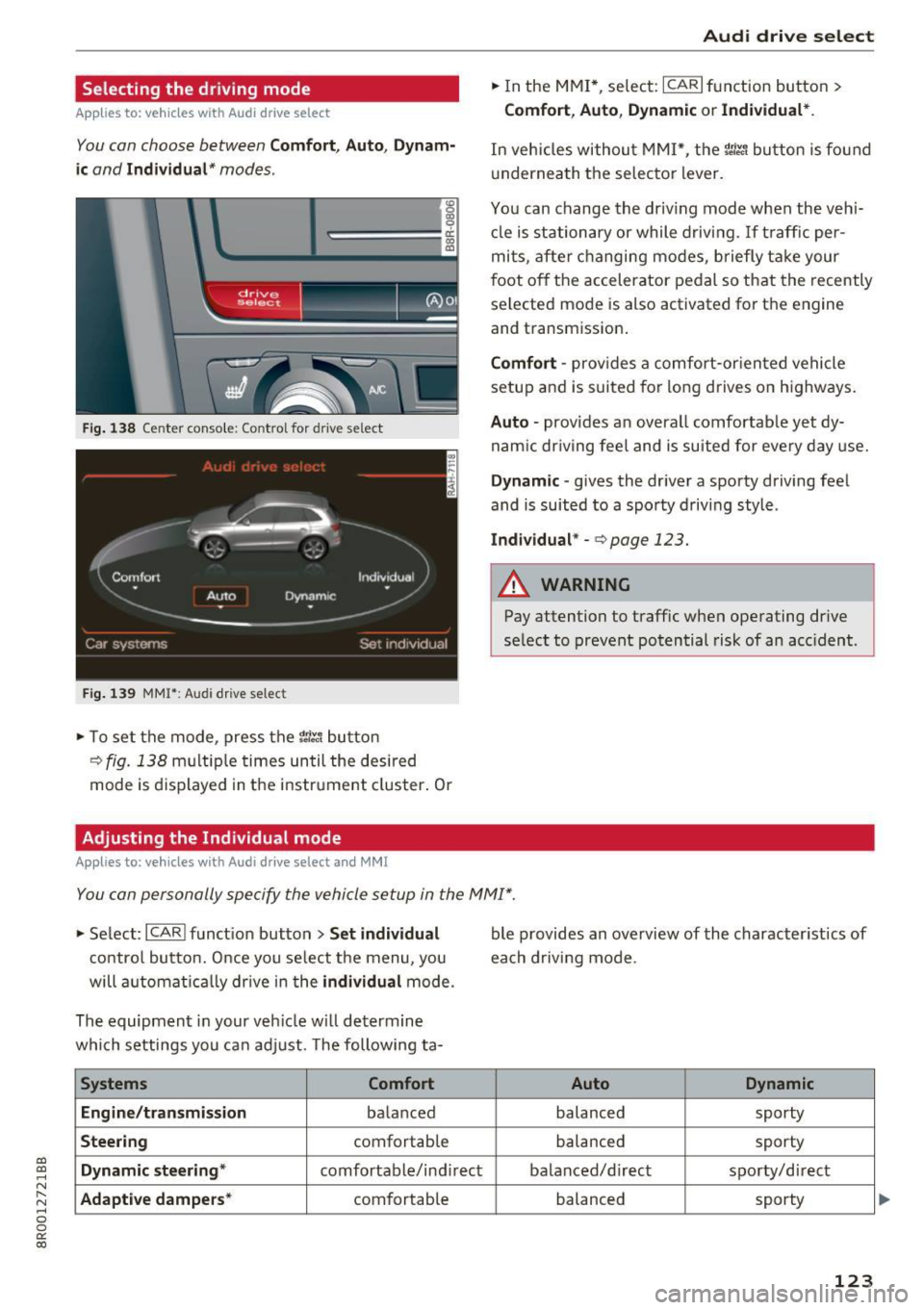
You con choose between Comfort, Auto, Dynam
ic and Individual* modes .
«>
~ 9
c:=====::::;: ~ a,
drive I I r.,. select _ - ~
Fig. 138 Center conso le: Co ntrol for drive se lect
Fig. 139 MMI*: Audi drive select
... To set the mode, press the r:i~ button
c>fig. 138 multip le times until the desired
mode is displayed in the instrument cluster. Or
Adjusting the Individual mode
Applies to: vehicles with Audi drive select and MMI
Audi drive select
... In the MMI*, select: ICARlfunction button>
Comfort , Auto , Dynamic or Individual*.
In vehicles without MMI*, the rn~, button is found
underneath the selector lever.
You can change the driving mode when the veh i
cle is stationary or while driving.
If traff ic per
mits, after changing modes, briefly take your
foot off the accelerator pedal so that the recently
selected mode is also activated for the engine
and transmission .
Comfort -provides a comfort-or iented vehicle
setup and is suited for long drives on highways.
Auto -provides a n overal l comfortab le yet dy
namic driving feel and is suited for every day use.
Dynamic -gives the driver a sporty driving feel
and is suited to a spo rty driving style .
Individual* -c> poge 123.
A WARNING
-Pay attention to traffic when operating drive
se lect to prevent potential risk of an acc ident.
You can personally specify the vehicle setup in the MMI" .
... Se lect: I CARI function button > Set individual
control button. Once you se lect the menu, you
will automatically drive in the
individual mode .
The equipment in your vehicle will determine
which settings you can adjust. The following ta-
Systems Comfort
Engine/transmission
ba lanced
Steering comfortab le
Dynamic steering* comfortable/ind irect
Adaptive dampers * comfortable ble
provides an overview of the character istics of
each driving mode.
Auto Dynamic
balanced sporty
balanced sporty
balanced/d irect sporty/direct
balanced sporty
123
Page 220 of 296
Checking and Filling
-Always let the engine cool down. Hot com
ponents will burn skin on contact .
- To reduce the risk of being burned, never
open the hood if you see or hear steam or
coolant escaping from the engine compart
ment. Wait until no steam or coolant can be
seen or heard before carefully opening the
hood.
- Keep children away from the engine com
partment.
- Never spill fluids on hot engine compo
nents . They can cause a fire.
- Never touch the radiator fan. The auxiliary
electric fan is temperature controlled and
can switch on suddenly.
- Never open the coolant reservoir cap when
the engine is still warm. The coolant system
is pressurized and hot coolant could spray
out .
- Protect your face, hands and arm from steam or hot engine coolant by placing a
thick rag over the cap when you open the coolant reservoir.
- Do not remove the engine cover under any
circumstances . This increases the risk of
burns.
- If work on the fuel system or the electrical
system is necessary:
- Always disconnect the battery.
- Never smoke or work near heaters or open flames. Fluids in the engine compartment
could start a fire.
- Keep an approved fire extinguisher imme
diately available.
- To avoid electrical shock and personal injury
while the engine is running or being started, never touch:
- Ignition cables
- Other components of the high voltage
electronic ignition system .
- If you must perform a check or repair with
the engine running:
- First, fully apply the parking brake, move
selector lever of automatic transmission
to P (Park).
218
- Always use extreme caution to prevent
clothing, jewelry, or long hair from get
ting caught in the radiator fan, V-belts or
other moving parts, or from contacting hot parts . Tie back hair before starting,
and do not wear clothing that will hang or
droop into the engine.
- Minimize exposure to emission and chemi
cal hazards
~ &.
&, WARNING
California Proposition 65 Warning:
- Engine exhaust, some of its constituents,
and certain vehicle components contain or
emit chemicals known to the State of Cali
fornia to cause cancer and birth defects and
reproductive harm. In addition, certain flu
ids contained in vehicles and certain prod
ucts of component wear contain or em it
chemicals known to the State of California
to cause cancer and birth defects or other
reproductive harm .
- Battery posts, terminals and related acces sories contain lead and lead compounds,
chemicals known to the State of California
to cause cancer and reproductive harms .
Wash hands after handling.
('.!) Note
When adding fluids, always make sure that
they are poured into the proper container or
filler opening, otherwise serious damage to
vehicle systems will occur.
@ For the sake of the environment
To detect leaks in time, inspect the vehicle
floor pan from underneath regularly . If you
see spots from oil or other vehicle fluids, have
your vehicle inspected by an authorized Audi dealer.
Page 257 of 296
CD
CD
.... N ,-... N ..... 0 0 C<'. 00
(D Note
Special care is required if you are repairing
the tire on a steep incline.
@ Tips
- Do not operate the compressor for more
than 12 minutes continuously, otherwise it
can overheat. Once the compressor has
cooled, you can continue to use it.
- If sealant has spi lled out, let it dry and then
you can remove it by peeling it away like a
foil.
- Remember to obtain a new bott le of sealant
from your authorized Audi dealer after re
pair ing a tire. After this, the functionality of
the tire repair set is restored .
- Obey all laws.
Replacing wheels
Before changing a wheel
Observe the following precautions for your own
and your passenger's safety when changing a
wheel.
"" After you experience a tire failure, pull the car
well away from moving traff ic and try to reach
level ground before you stop¢_& .
.. All passengers sho uld
leave the car and move
to a safe location (fo r instance, behind the
guardrai l) ¢ .&_ .
.. Engage the
par king b rake to prevent yo ur vehi
cle from roll ing unintentionally ¢&_ .
.. Move
selecto r le ver to po sitio n P ¢ &_ .
"" If you are towing a trailer: unh itch the trailer
from your veh icle.
"" Block the diagonally opposite wheel with the
folding chocks o r other objects .
""T ake the
jac k* and the inflatable spa re tir e*
out of the luggage compartment¢ page 250 .
A WARNING
You or your passengers cou ld be inj ured while
changing a wheel if you do not follow these
safety precautions:
- If you have a flat tire, move a safe distance
off the road. Turn off the engine, turn the
Em ergenc y ass is tanc e
emergency flashers on and use other wa rn
ing dev ices to alert other motorists.
- Make sure that passengers wait in a safe
place away from the vehicle and well away
from the road and traff ic.
- To help prevent the veh icle from moving
suddenly and possib ly slipping off the jack*,
always fully set the parking brake and block
the wheel diagonally opposite the wheel be i n g changed with the fold ing c hocks or oth
er objects . When one front whee l is lifted
off the ground, placing the Automatic
Transmission in P (Park) w ill
not prevent the
veh icle from moving.
- Before you change a wheel, be sure the
gro und is leve l and firm.
If necessary, use a
sturdy board under the jack*.
- Always s tore the vehicle too l kit, the jack*
and the replaced tire in the lugg age com
partment
¢ page 136.
Changing a wheel
When you change a wheel, follow the sequence
described below s tep-by -step and in exactly that
order.
1. Remove the de corative wheel cover* . For
more detai ls see also
¢page 256, Decaro-
tive wheel covers
o r r::!> poge 256, Wheels
with wheel bolt cops .
2. Loosen the w
heel bolts¢ page 256 .
3. Locate the proper mounting point for the
jack* and align the jack* below that point
¢ page 257.
4. Li ft the car with the jack*¢ page 257.
s. Remove the wheel with th e flat tire and then
insta ll the
inflatable spar e tire*
¢ page 258.
6. Tighte n all whee l bolts lightly.
7 .
Lo wer the vehicle wi th the jack *.
8 . Use the whee
l bolt wrench and
firml y tighten
all wheel bo lts
r::!> poge 256 .
9. Replace the decorat ive wheel co ver* .
255
...
Page 268 of 296
Emergency situations
Emergency situations
General
This chapter is intended for trained emergency crews and working personnel who have the nec
essary tools and equipment to perform these
operations.
Starting by pushing or
towing
(D Note
Vehicles with an automatic transmission
cannot be started by pushing or towing.
Starting with jumper
cables
If necessary, the engine con be started by con
necting it to the battery of another vehicle.
If the engine should fail to start because of a dis
charged or weak battery, the battery can be con
nected to the battery of
another vehicle, using a
pair of jumper cables to start the engine.
Jumper cables
Use only jumper cables of sufficiently large cross
section
to carry the starter current safely. Refer
to the manufacturer's specifications.
Use only jumper cables with
insulated terminal
clamps which are distinctly marked :
plus(+) cable in most cases colored red
minus(-) cable
in most cases colored black.
A WARNING
Batteries contain electricity, acid, and gas.
Any of these can cause very serious or fatal in
jury. Follow the instructions below for
safe
handling of your vehicle's battery.
-Always shield your eyes and avoid leaning
over the battery whenever possible.
-A dead battery can freeze at temperatures
around 32 °F (0 °C) . If the vehicle battery is
frozen, you must thaw it before connecting
the jump start cables.
If you do not, this in-
266
creases the risk of an explosion and chemi
cal burns. After jump starting the vehicle,
drive to an authorized Audi dealer or author
ized Audi Service Facility immediately to
have the vehicle battery checked.
- Do not allow battery acid to contact eyes or
skin . Flush any contacted area with water
immediately.
- Improper use of a booster battery to start a
vehicle may cause an explosion .
- Vehicle batteries generate explosive gases.
Keep sparks, flame and lighted cigarettes
away from batteries.
- Do not try to jump start any vehicle with a
low acid level in the battery.
- The voltage of the booster battery must also
have a 12-Volt rating. The capacity (Ah) of
the booster battery should not be lower
than that of the discharged battery. Use of
batteries of different voltage or substantial
ly different "Ah" rating may cause an explo
sion and personal injury.
- Never charge a frozen battery. Gas trapped
in the ice may cause an explosion.
- Never charge or use a battery that has been
frozen. The battery case may have be weak
ened.
- Use of batteries of different voltage or sub
stantially different capacity (Ah) rating may
cause an explosion and injury. The capacity (Ah) of the booster battery should not be
lower than that of the discharged battery.
- Before you check anything in the engine
compartment, always read and heed all
WARNINGS
r=:> poge 217.
([) Note
-Applying a higher voltage booster battery
will cause expensive damage to sensitive electronic components, such as control
units, relays, radio, etc.
- There must be no electrical contact between
the vehicles as otherwise current could al
ready start to flow as soon as the positive
(+) terminals are connected.
Page 269 of 296
a,
a,
..... N r-N ..... 0 0
0:
co
@ Tips
The discharged battery must be properly con
nected to the vehicle's electrical system .
When jump starting or charg ing the battery,
never connect the negative ground cable to
the battery negative post because the battery
manager system must be able to detect the
battery's state of charge. Always connect the
negative ground cable to the negative ground
post of the battery manager control unit.
Use of jumper cables
Make sure to connect the jumper cable clamps in
exactly the order described below!
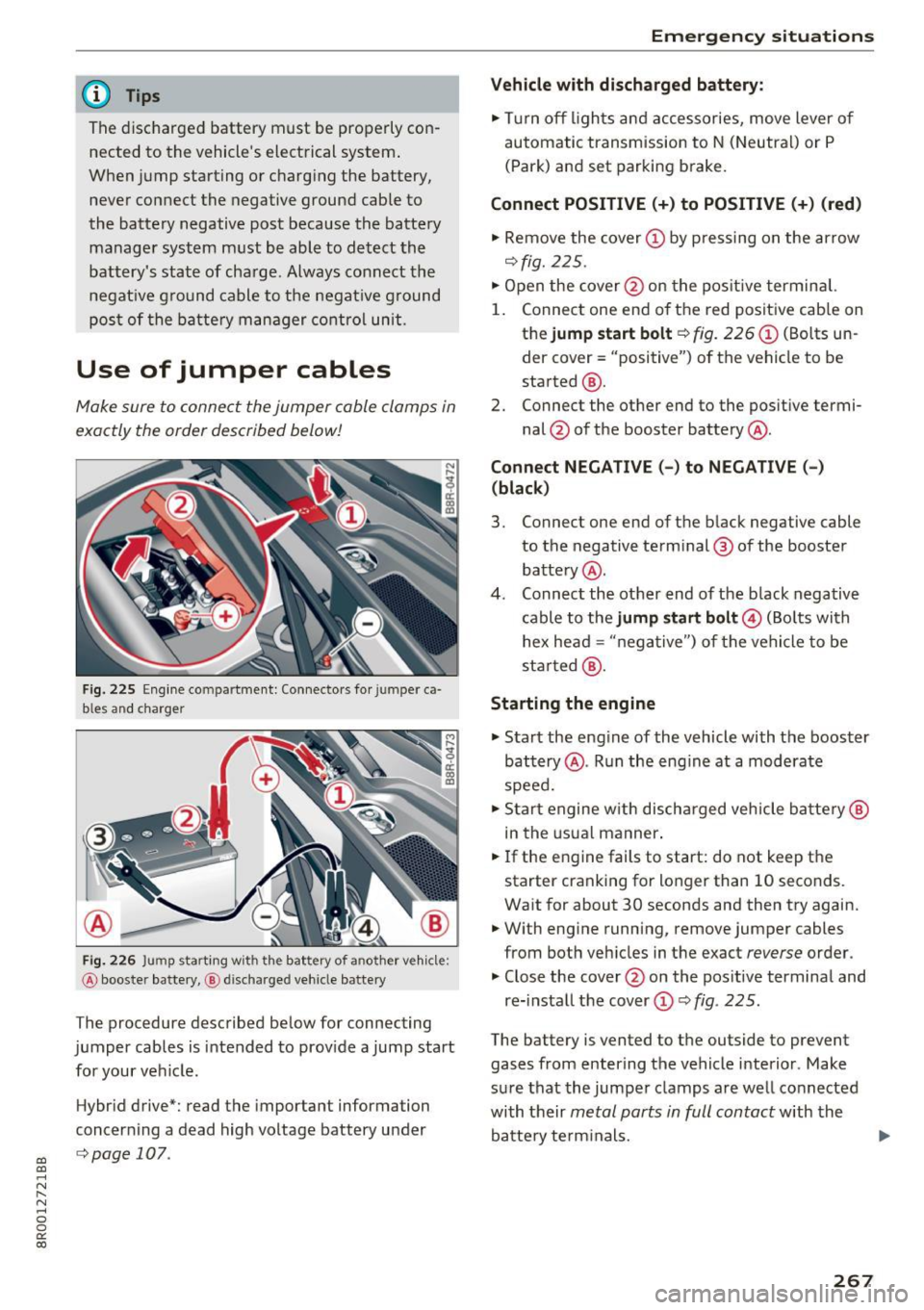
Fig. 225 Engine compartment: Connectors fo r jumper ca
bles and charger
Fig. 226 Jump starting with the battery of another vehicle:
@ booster battery, @ discharged vehicle battery
The procedure described below for connecting
jumper cables is intended to provide a jump start
for your vehicle.
Hybrid drive*: read the important information
concerning a dead high voltage battery under
¢page 107.
Emergency situations
Vehicle with discharged battery:
.,. Turn off lights and accessories, move lever of
automatic transmission to N (Neutral) or P
(Park) and set parking brake.
Connect POSITIVE(+) to POSITIVE(+) (red)
"' Remove the cover
CD by pressing on the arrow
¢fig. 225.
.,. Open the cover @on the positive terminal.
1. Connect one end of the red positive cab le on
the
jump start bolt¢ fig. 226 CD (Bolts un
der cover = "positive") of the vehicle to be
started @.
2. Connect the other end to the positive termi-
nal@of the booster battery @.
Connect NEGATIVE (-) to NEGATIVE(-)
(black)
3. Connect one end of the black negative cable
to the negative term i nal @of the booster
battery @.
4. Connect the other end of the b lack negative
cable to the
jump start bolt@ (Bolts with
hex head= "negative") of the vehicle to be
started @.
Starting the engine
.,. Start the engine of the vehicle with the booster
battery @. Run the engine at a moderate
speed .
.,. Start engine w ith discharged vehicle battery@
in the usual manner .
.,. If the engine fails to start: do not keep the
starter cranking for longer than 10 seconds.
Wait for about 30 seconds and then try again .
.,. With engine running, remove jumper cables
from both vehicles in the exact
reverse order.
"' Close the cover @on the positive terminal and
re- install the cover
CD <=> fig . 225.
The battery is vented to the outside to prevent
gases from entering the vehicle interior. Make
sure that the jumper clamps are well connected
with their
metal parts in full contact with the
batte ry term inals. .,.
267
Page 279 of 296
CD
CD
.... N ,-... N ..... 0 0 C<'. 00
today's automobiles, have steadily reduced the
scope of maintenance and repairs which can be
carried out by vehicle owners.
Also, safety and
environmental
concerns place very strict limits
on the nature of repairs and adjustments to en
gine and transmission parts which an owner can perform .
Maintenance, adjustments and repairs usually re
quire special tools, testing devices and other
equipment available to specially trained work
shop personnel in order to assure proper per
formance, reliability and safety of the vehicle and
its many systems.
Improper maintenance, adjustments and repairs
can impair the operation and reliability of your
vehicle and even void your vehicle warranty .
Therefore, proof of servicing in accordance with
the maintenance schedule may be a condition for upholding a possible warranty claim made within
the warranty period.
Above all , operational safety can be adversely af
fected, creating unnecessary risks for you and
your passengers.
If in doubt about any servicing, have it done by
your authorized Audi dealer or any other properly equipped and qualified workshop. We strongly urge you to give your authorized Audi dealer the
opportunity to perform all scheduled mainte nance and necessary repairs. Your dealer has the
facilities, original parts and trained specialists to keep your vehicle running properly .
Performing limited maintenance yourself
The following pages describe a limited number of
procedures which can be performed on your vehi
cle with ordinary tools, should the need arise and
trained personnel be unavailable. Before per
forming any of these procedures, always thor
oughly read all of the applicable text and careful ly follow the instructions given . Always rigorously
observe the
WARNINGS provided .
Before you check anything in the engine com
partment, always read and heed all WARNINGS
c::> .&. and c::> .&. in Working in the engine compart
ment on page 217 .
Consumer information
A WARNING
-Serious personal injury may occur as a result
of improperly performed maintenance, ad
justments or repairs .
- Always be extremely careful when working
on the vehicle. Always follow commonly ac
cepted safety practices and general com
mon sense. Never risk personal injury.
- Do not attempt any of the maintenance,
checks or repairs described on the following pages if you are not fully familiar with these
or other procedures with respect to the ve hicle, or are uncertain how to proceed.
- Do not do any work without the proper tools
and equipment. Have the necessary work
done by your authorized Audi dealer or an
other properly equipped and qualified work
shop.
- The engine compartment of any motor vehi cle is a potentially hazardous area. Never
reach into the area around or touch the radi
ator fan.
It is temperature controlled and
can switch on suddenly - even when the en
gine is off and the ignition key has been re
moved . The radiator fan switches on auto
matically when the coolant reaches a certain
temperature and will continue to run until
the coolant temperature drops.
- Always remove the ignition key before any
one gets under the vehicle.
- Always support your vehicle with safety
stands if it is necessary to work underneath
the vehicle . The jack* supplied with the vehi
cle is not adequate for this purpose and
could collapse causing serious personal in
jury.
- If you must work underneath the vehicle
with the wheels on the ground, always make
sure the vehicle is on level ground, that the
wheels are always securely blocked and that the engine cannot be started.
- Always make sure the transmission selector
lever (automatic transmission) is in P (Park
position) and the park brake is applied.
277
Page 283 of 296
Automatic transmission . . . . . . . . . . . . . . . . . 94
Automatic Shift Lock (ASL) . . . . . . . . . . . . . 95
Driving . . . . . . . . . . . . . . . . . . . . . . . . . . . . . 96
Emergency mode . . . . . . . . . . . . . . . . . . . . . 98
Emergency release . . . . . . . . . . . . . . . . . . . . 99
H ill descent control . . . . . . . . . . . . . . . . . . . 97
Kick-down . . . . . . . . . . . . . . . . . . . . . . . . . . . 98
Manual shift program . . . . . . . . . . . . . . . . . 98
Removal lock (ignit ion key) . . . . . . . . . . . . . 81
Selector lever . . . . . . . . . . . . . . . . . . . . . . . . 94
Shift paddles . . . . . . . . . . . . . . . . . . . . . . . . 98
Automatic wipe/wash system . . . . . . . . . . . . 54
Auto Safety Hotline . . . . . . . . . . . . . . . . . . . 138
AUTO (climate control) . . . . . . . . . . . . . . . . . . 78
Average speed . . . . . . . . . . . . . . . . . . . . . . . . 19
Avoid damaging the vehicle . . . . . . . . . . . . . 195
B
Bass box . . . . . . . . . . . . . . . . . . . . . . . . . . . . 251
Battery . . . . . . . . . . . . . . . . . . . . . . . . . . . . . 225
Battery location inside the luggage compart
ment .. .. .. .. ...... ......... .. .. .. . 225
Charge level . . . . . . . . . . . . . . . . . . . . . . . . 192
Charging . .. .. ............... .. . 107,227
Energy management . . . . . . . . . . . . . . . . . 192
Impor tant warnings when working on the
battery . . . . . . . . . . . . . . . . . . . . . . . . . . . . 225
Jump starting . . . . . . . . . . . . . . . . . . . . . . . 266
Replacing the battery . . . . . . . . . . . . . . . . 228
Voltage . . . . . . . . . . . . . . . . . . . . . . . . . . . . . 30
Winter operation . . . . . . . . . . . . . . . . . . . . 225
Working on the battery . . . . . . . . . . . . . . . 225
Before driving . . . . . . . . . . . . . . . . . . . . . . . . 131
Belt tensioners . . . . . . . . . . . . . . . . . . . . . . . 146
Bio-ethanol (Fuel)....... ..... ... ... .. . 210
Blended gasoline . . . . . . . . . . . . . . . . . . . . . 209
Blower (climate control) . . . . . . . . . . . . . . . . 78
Booster seats . . . . . . . . . . . . . . . . . . . . . . . . 176
B ra ke fluid
Changing the brake fluid . . . . . . . . . . . . . . 224
Checking the brake fluid l evel . . . . . . . . . . 224
Brake system
Anti-lock brake system . . . . . . . . . . . . . . . . 14
~ Brak e booster . . . . . . . . . . . . . . . . . . . . . . . 190 ....
~ Brake fluid . . . . . . . . . . . . . . . . . . . . . . . . . 224
8 Brake fluid specifications for refill and re-
~ placement . . . . . . . . . . . . . . . . . . . . . . . . . 224 00
Index
Brake light defective . . . . . . . . . . . . . . . . . . 29
Brakes . . . . . . . . . . . . . . . . . . . . . . . . . . . . . 190
Electromechanical parking brake . . . . . . . . 86
Fluid reservo ir . . . . . . . . . . . . . . . . . . . . . . 224
Malfunction . . . . . . . . . . . . . . . . . . . . . . . . . 25
Warning/indicator lights . . . . . . . . . . . . . . . 15
Worn brake pads symbol . . . . . . . . . . . . . . . 29
Braking Brake assist . . . . . . . . . . . . . . . . . . . . . . . . 186
Braking guard . .. . ... ............. 109, 115
Messages . . . . . . . . . . . . . . . . . . . . . . . . . . 116
Settings . . . . . . . . . . . . . . . . . . . . . . . . . . . 116
Switching on and off . . . . . . . . . . . . . . . . . 116
Break -in per iod
Brake pads . . . . . . . . . . . . . . . . . . . . . . . . . 190
Ti res . . . . . . . . . . . . . . . . . . . . . . . . . . . . . . 194
Breaking in . . . . . . . . . . . . . . . . . . . . . . . . . . 194
New tires . . . . . . . . . . . . . . . . . . . . . . . . . . 237
Breakover angle . . . . . . . . . . . . . . . . . . . . . . 198
Bulbs . . . . . . . . . . . . . . . . . . . . . . . . . . . . . . . 264
C
Californ ia Proposition 65 Warning 218
Battery specific . . . . . . . . . . . . . . . . . . . . . 227
Capacities . . . . . . . . . . . . . . . . . . . . . . . . . . . 273
AdBlue . . . . . . . . . . . . . . . . . . . . . . . . . . . . 214
Engine oil ....... .. ................. 219
Care . . . . . . . . . . . . . . . . . . . . . . . . . . . . . . . . 204
Cargo area
refer to Loading the luggage compart-
ment...... ... . ... ................. 136
Cargo floor . . . . . . . . . . . . . . . . . . . . . . . . . . . 68
Catalytic converter . . . . . . . . . . . . . . . . . . . . 194
Cente r armrest
Adjusting . . . . . . . . . . . . . . . . . . . . . . . . . . . 65
Storage compartment . . . . . . . . . . . . . . . . . 65
Centra l locking . . . . . . . . . . . . . . . . . . . . . . . . 35
Certification . . . . . . . . . . . . . . . . . . . . . . . . . 279
Changing Engine oil . . . . . . . . . . . . . . . . . . . . . . . . . . 222
Child restraints
Danger of using child restra ints in the front
seat...... .... .. .. ............... .. 149
System anchors . . . . . . . . . . . . . . . . . . . . . 181
Where can I get additional information
about child restraints and their use? . . . . 185
281
Page 289 of 296
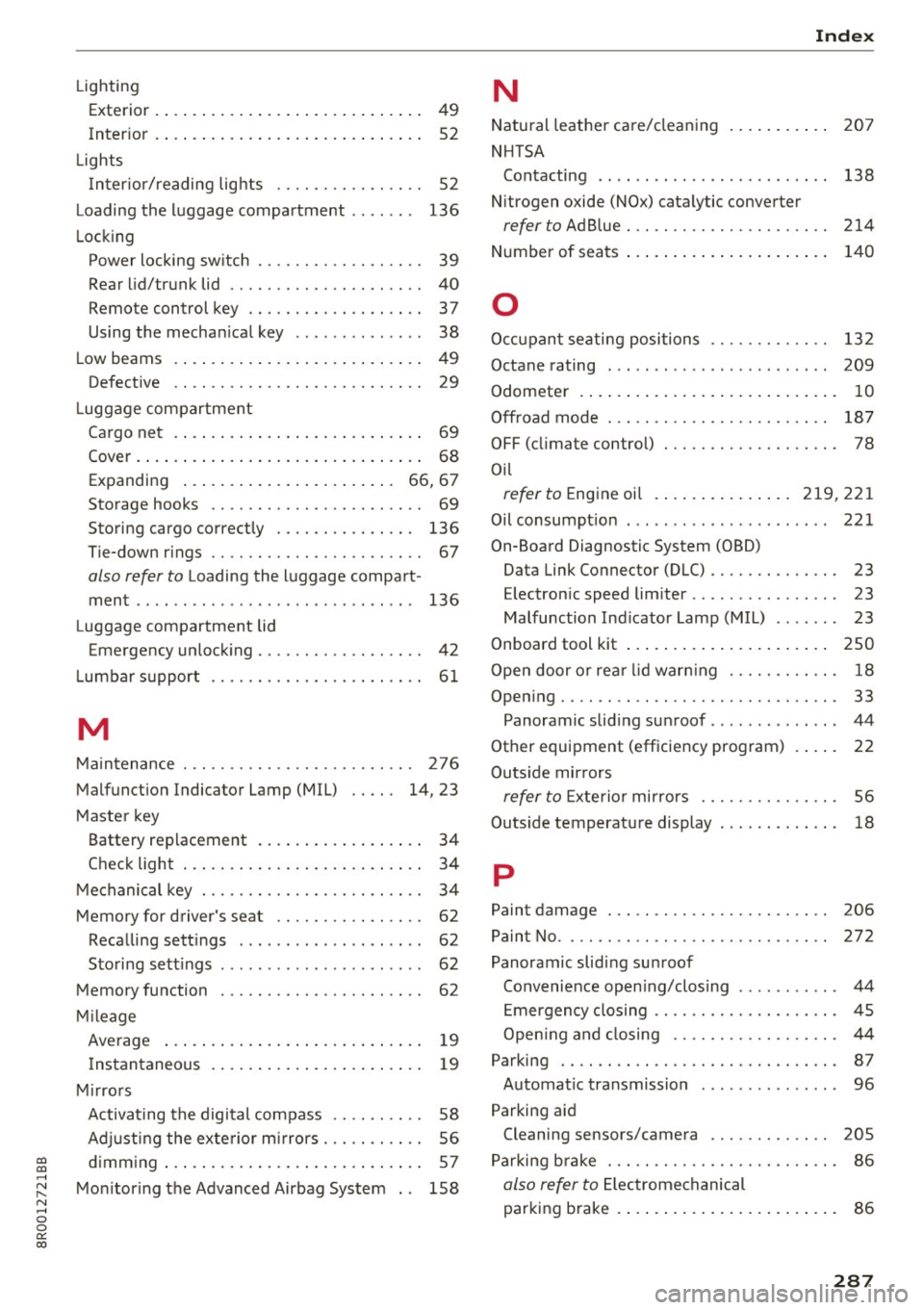
CD
CD
.... N ,-... N ..... 0 0 C<'. 00
Lighting Exterior . . . . . . . . . . . . . . . . . . . . . . . . . . . . .
49
Inter ior . . . . . . . . . . . . . . . . . . . . . . . . . . . . . 52
Lights Interior/reading lights . . . . . . . . . . . . . . . . 52
Loading the luggage compartment . . . . . . .
136
Locking
Power locking switch . . . . . . . . . . . . . . . . . .
39
Rear lid/trunk lid . . . . . . . . . . . . . . . . . . . . . 40
Remote control key . . . . . . . . . . . . . . . . . . . 3 7
Using the mechan ical key . . . . . . . . . . . . . .
38
Low beams
Defective . . .. ................ ..... .. 49
29
L uggage compartment
Cargo net . . . . . . . . . . . . . . . . . . . . . . . . . . .
69
Cover. ... .. .. ................ ..... .. 68
Expanding . . . . . . . . . . . . . . . . . . . . . . . 66, 67
Storage hooks . . . . . . . . . . . . . . . . . . . . . . . 69
Storing cargo correctly . . . . . . . . . . . . . . . 136
Tie-down rings . . . . . . . . . . . . . . . . . . . . . . . 67
also refer to Loading the luggage compart -
ment .. .. .. .. ........ ..... ... ... .. .
136
Luggage compartment lid
Em
l k' ergency un oc ing . . . . . . . . . . . . . . . . . . 42
Lumbar s upport . . . . . . . . . . . . . . . . . . . . . . . 61
M
M . t ain enance . . . . . . . . . . . . . . . . . . . . . . . . . 276
Malfunction Indicator Lamp (MIL) . . . . . 14, 23
Master key
Battery replacement . . . . . . . . . . . . . . . . . .
34
Check light . . . . . . . . . . . . . . . . . . . . . . . . . . 34
Mechanical key . ............... .. ...... 34
Memory for driver's seat ........ .. ..... . 62
Recalling settings . . . . . . . . . . . . . . . . . . . . 62
Storing settings . . . . . . . . . . . . . . . . . . . . . . 62
Memory function
Mileage 62
Average . . . . . . . . . . . . . . . . . . . . . . . . . . . .
19
Instantaneous . . . . . . . . . . . . . . . . . . . . . . . 19
Mirrors
Activating the digital compass . . . . . . . . . .
58
Adjusting the exte rior mirrors. . . . . . . . . . . 56
d' ' 1mm 1ng . . . . . . . . . . . . . . . . . . . . . . . . . . . . 57
Monitoring the Advanced Airbag System . .
158
Index
N
Natural leather care/cleaning
NHTSA 207
Contacting . . . . . . . . . . . . . . . . . . . . . . . . . 138
Nitrogen oxide (NOx) cata lytic converter
refer to Ad Blue. ................... .. 214
Number of seats ... .. ............... ..
0
Occupant seating positions
Octane rating ... .. .. ...... ....... .. . .
140
132
209
Odometer . . . . . . . . . . . . . . . . . . . . . . . . . . . . 10
Offroad mode . . . . . . . . . . . . . . . . . . . . . . . . 187
OFF (climate control) . . . . . . . . . . . . . . . . . . . 78
Oil
refer to Engine oil ............... 219, 221
Oil consumpt ion . . . . . . . . . . . . . . . . . . . . . . 221
On-Board Diagnostic System (OBD)
Data Link Connector (DLC) . . . . . . . . . . . . . .
23
Electronic speed limiter . . . . . . . . . . . . . . . . 23
Malfunction Ind icator Lamp (MIL) . . . . . . . 23
Onboard tool kit . . . . . . . . . . . . . . . . . . . . . . 250
Open door or rear lid warn ing . . . . . . . . . . . .
18
Opening.... .... .. ................. .. . 33
Panoramic sliding sunroof . . . . . . . . . . . . . .
44
Other equipment (efficiency program) . . . . . 22
Outs ide mirrors
refer to E xterior mirrors . . . . . . . . . . . . . . . 56
Outside temperature display . . . . . . . . . . . . .
18
p
Paint damage
Paint No .
Panoramic sliding sunroof 206
272
Convenience opening/closing
. . . . . . . . . . . 44
Emergency closing . . . . . . . . . . . . . . . . . . . . 45
Opening and closing . . . . . . . . . . . . . . . . . .
44
Parking . . . . . . . . . . . . . . . . . . . . . . . . . . . . . . 87
Automatic transmission . . . . . . . . . . . . . . . 96
Parking aid
Cleaning sensors/camera . . . . . . . . . . . . . 205
Parking brake . . . . . . . . . . . . . . . . . . . . . . . . .
86
also refer to Electromechanical
parking brake . . . . . . . . . . . . . . . . . . . . . . . .
86
287
Page 292 of 296
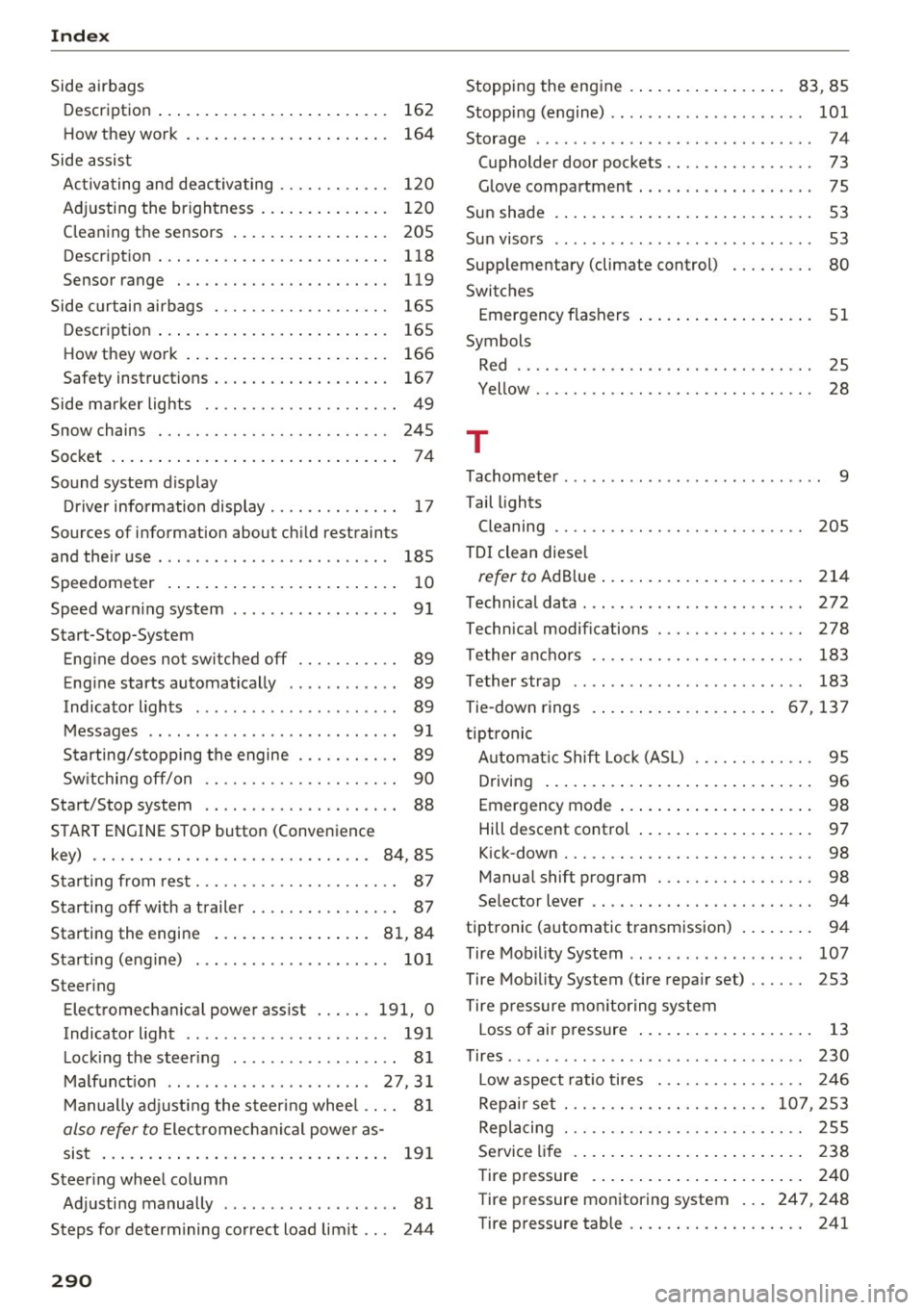
Index
Side airbags Description . . . . . . . . . . . . . . . . . . . . . . . . . 162
How they work . . . . . . . . . . . . . . . . . . . . . . 164
Side assist Activating and deactivating . . . . . . . . . . . . 120
Adjusting the brightness . . . . . . . . . . . . . . 120
Cleaning the sensors . . . . . . . . . . . . . . . . . 205
Description . . . . . . . . . . . . . . . . . . . . . . . . . 118
Sensor range . . . . . . . . . . . . . . . . . . . . . . . 119
Side curtain airbags . . . . . . . . . . . . . . . . . . . 165
Description . . . . . . . . . . . . . . . . . . . . . . . . . 165
How they work . . . . . . . . . . . . . . . . . . . . . . 166
Safety instructions . . . . . . . . . . . . . . . . . . . 167
Side marker lights . . . . . . . . . . . . . . . . . . . . . 49
Snow chains . . . . . . . . . . . . . . . . . . . . . . . . . 245
Socket . . . . . . . . . . . . . . . . . . . . . . . . . . . . . . . 74
Sound system display Driver information display . . . . . . . . . . . . . . 17
Sources of information about child restraints
and their use . . . . . . . . . . . . . . . . . . . . . . . . . 185
Speedometer . . . . . . . . . . . . . . . . . . . . . . . . . 10
Speed warning system . . . . . . . . . . . . . . . . . . 91
Start-Stop-System Engine does not switched off . . . . . . . . . . .
89
Engine starts automatically . . . . . . . . . . . . 89
Indicator lights . . . . . . . . . . . . . . . . . . . . . . 89
Messages . . . . . . . . . . . . . . . . . . . . . . . . . . . 91
Starting/stopping the engine . . . . . . . . . . . 89
Sw itching off/on . . . . . . . . . . . . . . . . . . . . . 90
Start/Stop system . . . . . . . . . . . . . . . . . . . . . 88
START ENGINE STOP button (Convenience key) . . . . . . . . . . . . . . . . . . . . . . . . . . . . . . 84, 85
Starting from rest . . . . . . . . . . . . . . . . . . . . . . 87
Starting off with a trailer . . . . . . . . . . . . . . . . 87
Starting the engine . . . . . . . . . . . . . . . . . 81, 84
Starting (engine) . . . . . . . . . . . . . . . . . . . . . 101
Steering Electromechanical power assist ..... . 191, 0
Indicator light . . . . . . . . . . . . . . . . . . . . . . 191
Locking the steering . . . . . . . . . . . . . . . . . . 8 1
Malfunction .. .. ................ .. 27, 3 1
Manually adjusting the steering wheel . . . . 81
also refer to Electromechanical power as-
sist . . . . . . . . . . . . . . . . . . . . . . . . . . . . . . . 191
Steering wheel column Adjusting manually . . . . . . . . . . . . . . . . . . . 81
Steps for determining correct load limit . . . 244
290
Stopping the engine . . . . . . . . . . . . . . . . . 83, 8S
Stopping (engine) . . . . . . . . . . . . . . . . . . . . . 101
Storage . . . . . . . . . . . . . . . . . . . . . . . . . . . . . . 74
(upholder door pockets . . . . . . . . . . . . . . . . 73
Glove compartment . . . . . . . . . . . . . . . . . . . 75
Sun shade . . . . . . . . . . . . . . . . . . . . . . . . . . . . 53
Sun visors . . . . . . . . . . . . . . . . . . . . . . . . . . . . 53
Supplementary (climate control) 80
Switches Emergency flashers . . . . . . . . . . . . . . . . . . . 51
Symbols Red . . . . . . . . . . . . . . . . . . . . . . . . . . . . . . . . 25
Yellow.... .. .. .. .. .. .. ........... .. . 28
T
Tachometer . . . . . . . . . . . . . . . . . . . . . . . . . . . . 9
Tail lights
Cleaning . . . . . . . . . . . . . . . . . . . . . . . . . . . 205
TOI clean diesel
refer to Ad Blue ... .. .. ............... 214
Technica l data . . . . . . . . . . . . . . . . . . . . . . . . 272
Technical modifications . . . . . . . . . . . . . . . . 278
Tether anchors . . . . . . . . . . . . . . . . . . . . . . . 183
Tether strap . . . . . . . . . . . . . . . . . . . . . . . . . 183
Tie-down rings . ... .. .. ............ 67, 137
tiptronic Automat ic Shift Lock (ASL) . . . . . . . . . . . . . 95
Driving . . . . . . . . . . . . . . . . . . . . . . . . . . . . . 96
Emergency mode . . . . . . . . . . . . . . . . . . . . . 98
Hill descent control . . . . . . . . . . . . . . . . . . . 97
Kick-down . . . . . . . . . . . . . . . . . . . . . . . . . . . 98
Manual shift program . . . . . . . . . . . . . . . . . 98
Selector lever . . . . . . . . . . . . . . . . . . . . . . . . 94
tiptronic (automatic transmission) . . . . . . . . 94
Tire Mobility System . . . . . . . . . . . . . . . . . . . 107
Tire Mobility System (tire repair set) . . . . . . 253
Tire pressure mon itoring system
Loss of air pressure . . . . . . . . . . . . . . . . . . . 13
Tires .... ... .. .. .. .. .. ........ ..... .. 230
Low aspect ratio tires . . . . . . . . . . . . . . . . 246
Repair set . . . . . . . . . . . . . . . . . . . . . . 107, 253
Replacing . . . . . . . . . . . . . . . . . . . . . . . . . . 255
Service life . . . . . . . . . . . . . . . . . . . . . . . . . 238
Tire pressure . . . . . . . . . . . . . . . . . . . . . . . 240
Tire pressure monitoring system ... 247, 248
Tire pressure table . . . . . . . . . . . . . . . . . . . 241