fuel AUDI Q5 2017 User Guide
[x] Cancel search | Manufacturer: AUDI, Model Year: 2017, Model line: Q5, Model: AUDI Q5 2017Pages: 296, PDF Size: 74.43 MB
Page 30 of 296
Driver information s ystem
"' Do not turn the engine off .
"'Drive immediate ly to an authorized Audi dealer
to have the malfunction corrected.
If there is a malfunct ion in the electronic ignition
lock, the ignition cannot be turned
off . Drive im
mediately to an authorized service facility to have
the cause of the malfunction corrected.
O n ve hicles with Convenience key* , the eng ine
should not be switched
off using the Start/Stop
button because the engine cannot be started
again after the ignition has been switched
off.
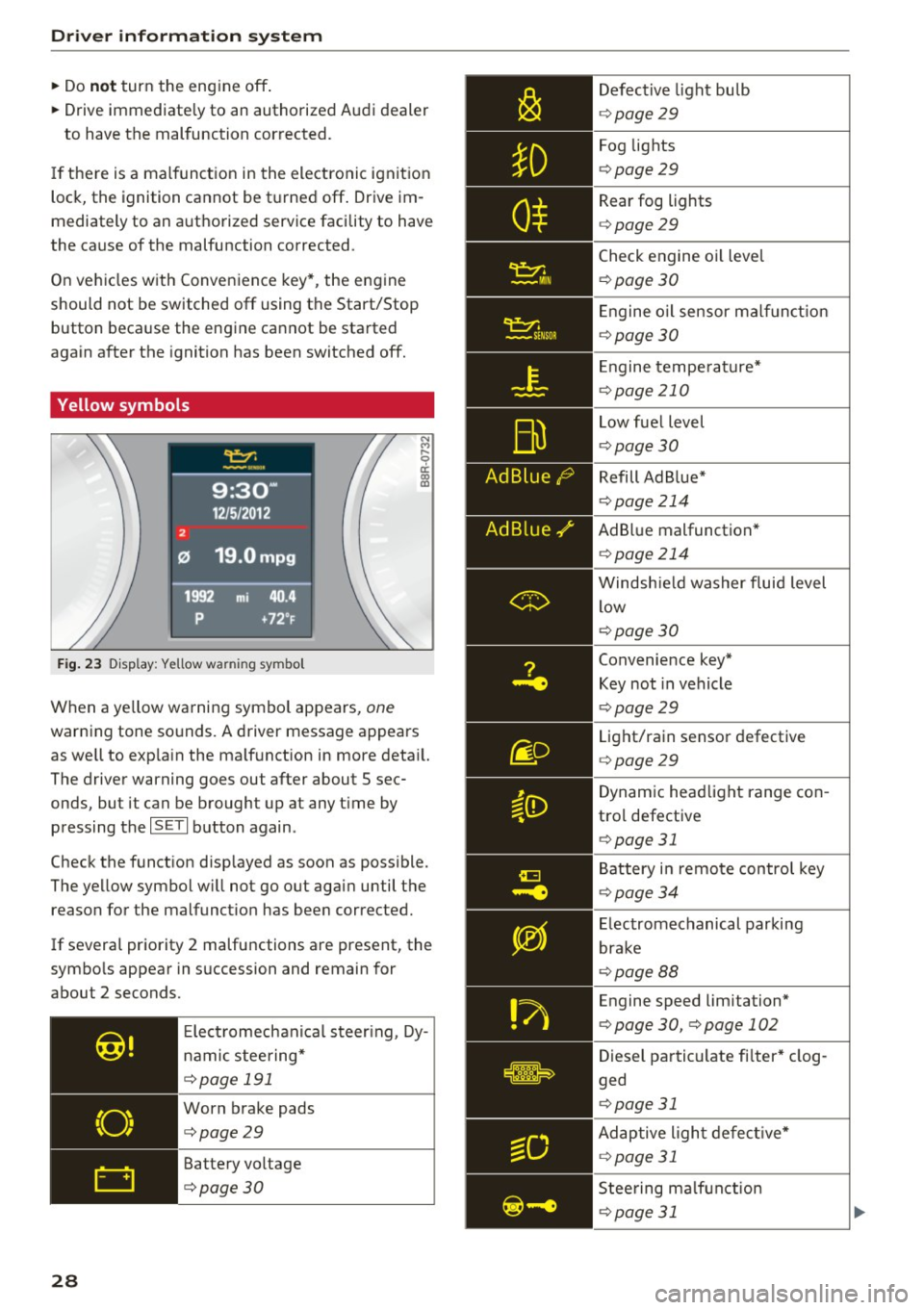
Yellow symbols
F ig . 2 3 Display : Yellow wa rning symbo l
N M
9 a: a, ID
When a ye llow warning symbol appears, one
warning tone sounds. A driver message appears
as well to exp la in the ma lfunction in more deta il.
The driver wa rning goes out after about 5 sec
onds, but it can be brough t up at any t ime by
pressing the
I S ET I button again .
Check the funct ion disp layed as soon as possible.
The yellow symbol w ill not go o ut again until the
reason for the malfunct io n has been corrected.
If several priority 2 malfunctions are present, the
symbo ls appear in succession and remain for
about 2 seconds.
28
E lect romechanica l steer ing , Dy
namic steering*
c::> poge 191
Worn brake pads
c::> poge29
Battery vo ltage
c::>poge30 Defective
light bu lb
c::> poge 29
Fog lights
c::> poge29
Rear fog lights
c::> poge29
Check engine oil leve l
¢ page 30
E ngine o il sensor ma lf u nct ion
c::> page 30
E ngine tempe ra tu re*
c::> page 210
Low fuel level
c::> page 30
Refill Ad B lue*
c::> page 214
AdBl ue malfunction *
c::> page 214
Windsh ie ld washer fluid level
low
c::> page 30
Convenience key*
Key not in vehicle
c::> page29
Light/rain sensor defective
c::> page 29
Dynam ic headlight range con
tro l defective
c::> page 31
Battery in remote control key
c::> page34
E lectromechanical parking
brake
c::> page 88
Engine speed limitation*
c::> page 30, c::>poge 102
Dies el particulate fi lter * clog
ged
c::> page 31
Adaptive ligh t defec tive *
c::> page 31
Steering ma lf u nction
c::> poge 31
Page 32 of 296
Driver information s ystem
IJ-If a rear fog lamp has failed, the indicator
light turns on to ind icate the location on the vehi
cle.
Vehicle ligh ts : S ys tem f ault!
If t he message appears , there is a ma lfunction in
the head lights or light switc h.
Drive to your authorized Aud i dea ler immediately
to have the malfunct ion corrected .
A WARNING
-Light bu lbs are p ressurized and could ex
plode while they a re being changed ca us ing
serious person al injury.
-
-Work with due ca re when handling the high
vo ltage section of g as dis charge (xenon)
l igh ts *. Failure to do so could result in de ath
or serious injury .
(D Tips
Have the bu lb replaced or the connect io n re
pai red by yo ur autho rize d Aud i Serv ice depart
ment.
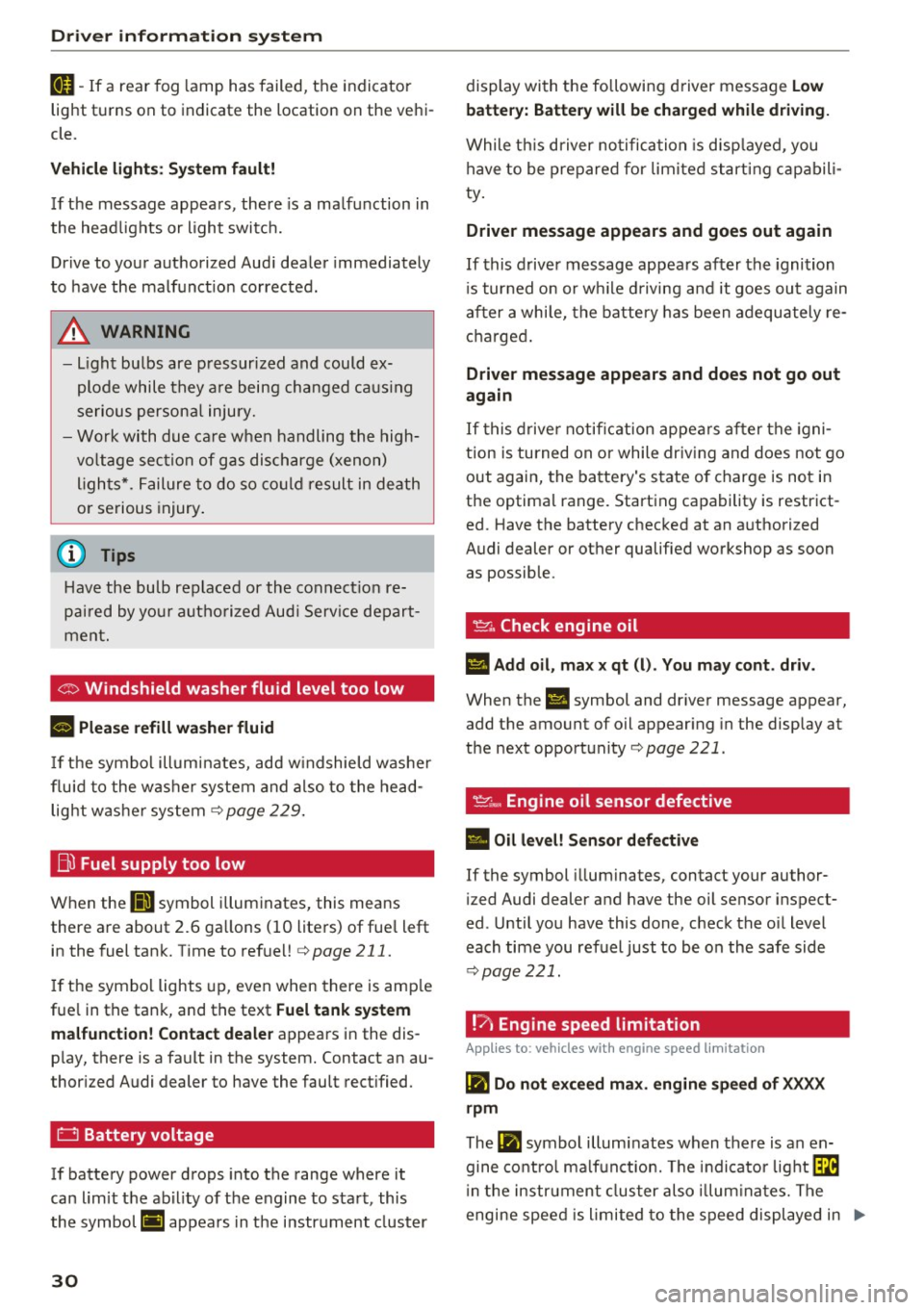
C> Windshield washer fluid level too low
B Plea se refill wa sher fluid
If t he symbol illumi nates, add w indshield washe r
fluid to the was her system and also to the head
light washe r system ¢
page 229.
Bl Fuel supply too low
When the (jg symbol illum inates, this means
ther e are about 2 .6 ga llons (10 liters) of fue l le ft
in the fuel tank. Time to refuel!¢
page 211.
If the symbol lights up, even when there is amp le
fue l in the tank, and the text
Fuel tank system
malfun ction! Contact dealer
appears in the dis
p lay, there is a fault in the system. Contact an au
thor ized Audi dealer to have the fault rect ified.
D Battery voltage
If ba ttery power drops into the range where it
can limit t he ab il ity of t he engine to sta rt , this
the symbol
(•j appea rs in t he i nstr ument cluster
30
display with the following driver message Low
batte ry: Batte ry will be charged while d riv ing.
While th is d river no tific ation is disp layed, you
have to be prepare d for lim ited start ing capabili
ty .
Driver message appears and goes out again
If this driver message appears after the ignition
i s tur ned on or w hile d riving and it goes ou t again
a ft er a whi le, the battery has been adequately re
c h arged .
Driver message appears and does not go out
again
I f this drive r notific ation appea rs after the igni
tion is turned on or while driv ing and does not go
out again, the battery's state of charge is not in
the optimal range. Starting capability is restrict
ed. Have the battery checked at an a uthori zed
Audi dealer or other qualified workshop as soon
as possib le.
~. Check engine oil
II Add oil , ma x x qt (l) . You may cont. driv .
When the Ill symbol and driver message appear,
add the amount of oil appear ing in the display at
the next opportunity ¢
page 221.
' ~-· Engine oil sensor defective
• Oil level! Sensor defective
If the symbol illuminates, contact your author
i z ed Audi dealer and have the oil sensor inspect
ed . Until you have this done, check the oi l level
each time you refuel just to be on the safe side
¢ page 221.
!? Engine speed limitation
Applies to: vehicles with engine speed limitation
(II Do not exceed max. engine speed of XXXX
rpm
The (II symbol illuminates when the re is an en
gine co ntro l ma lf u nct ion. The indi cator light ~
i n the instrument cluster also illum ina tes. The
engine spee d is limited to the speed displ ayed in
liJJ>
Page 38 of 296
Opening and closin g
Tu rn sign als
When you unlock the vehicle , the turn signa ls
flash twice. When you lock the vehicle, the turn
signals flash once. If they do not flash, one of the
doors, the rear lid or the hood is not locked .
Unintentionally locking your self out
In the following cases there safegua rds to pre
vent you lock ing your remote master key in the
vehicle:
- T he vehicle does not lock with the power lock
ing switch
r:!> page 39 if a doo r is open.
- On vehicles with Convenience key*, if the most
recently used master key is in the luggage com
partment, the rear l id is automa tically unlocked
again after it is closed.
Do not lock yo ur vehicle with the
re mot e ma st e r
ke y or Convenien ce key*
unti l all doors and the
rear lid are closed. In th is way you avoid locking
yourse lf out accidenta lly.
A WARNING
- When you leave the vehicle, always remove
the ignition key and take it with you . This
will prevent passengers (children, for exam ple) from accidentally being locked in the
vehicle should they acc identally press the
power locking switch in the front doors .
- Do not leave children inside the vehicle un
superv ised . In an emergency it would be im
poss ible to open the doors from the outs ide
without the key .
@ Tips
-In the event of a crash with airbag deploy
ment all locked doors will be automat ically
unlocked to give access to the veh icle occu
pants from the outside .
- If the power lock ing system should mal
funct ion, you can lock the driver's door us
i ng the mechanical key
r:::.>page 39.
-If the power lock ing system should fail, you
can still open the fuel tank flap in an emer
gency
r::!> page 213.
-You are well adv ised not to keep val uables
i nside an unattended vehicle, v is ible or not.
3 6
Even a proper ly locked veh icle cannot pro
vide the security of a safe.
- If the LED in the upper edge of the driver's
door panel comes on for about 30 seconds
after the vehicle is locked, there is a mal
function in the power locking or the anti
theft warning system. Have the malfunction corrected by an authorized Aud i dealership
or qualified repair fac ility .
Setting power locking
The driver can determine the functions for power
locking in the radio or in the MM!*.
.. Select: !CAR ! function button> Centr al lo cking .
Or
.. Select:
I CAR ! function button > Car s yste ms *
control button > Vehicl e sett ing s> (C entral
lo cking )*.
Un locking single door /Unloc k doo rs -
you can
spec ify which doors unlock when you open the ve
hicle .
- Select ing Off /All and pressing the~ button on
the remote control key unlocks the ent ire vehi
cle .
- Select ing
On /Dr iver and pressing the [§] button
on the remo te control key once unlocks only
the driver's door. In veh icles w ith a convenience
key*, only the door whose handle you pull will
unlock. If you press the
l@J button tw ice, the en
tire veh icle will unlock.
If you press the l@J but
ton, the entire ve hicle wi ll always lock .
Trunk lid/tailg ate /L o ck e xter ior trun k handl e -if
you select
O n, the rea r lid handle locks
r:::.> page 40, fig. 34 . In this case, the rear lid can
be opened with the
l = I bu tton on the master key
r:::.> page 3 7, fig. 2 8 o r with the~ button in the
driver's door
r:::.> page 40, fig . 33.
F o ld mirr ors* -if you se lect On , the outside mir
r ors will fold in automatically when you press the
lil button on the remote contro l key r:::.> page 56.
Confirmation ton e/Tone wh en lockin g -if you
select
On , a tone w ill sound when yo u lock the ve
hicle.
Page 73 of 296
a,
a,
..... r-1 ,-... r-1 ..... 0 0
0:
co
Installing the attachments
• Remove the ca p @ q fig . 83 .
• Slide the attachment into the T-groove 0-
• Tighten the attachment according to the roof
rack installation inst ructions .
• Close the cap.
Install ing the cov er profile
• Seal the openings in the T-groove 0 with the
cover profile @ after hav ing installing the at
tachments.
• If you not want to use th e attachment, seal the
whole T-groove
0 with the cover profile @.
• Cut t he cover profile to the length needed, if
necessary .
Roof load
The cargo on the roof mus t be securely attached.
Handling charac teristics change when cargo is
transported .
The permissible roof load for your veh icle is
165 lbs (75 kg ). The roof load is the total of the
weight of the roof rack, the attachme nts and the
cargo you are carrying .
_&, WARNING
- The cargo m ust be sec urely attached on the
roof rack, otherwise yo u risk a n accide nt.
- Dist ribute the load as evenly as possible and
do not make the roof rack wider than the
m ax imum permitted.
- Yo u must unde r no circumstances exceed
t he perm iss ible roof load, the permiss ible
ax le loads and the pe rm issib le overa ll
we ight of yo ur vehicle -risk of an accident.
- M ount the a ttachments to the roof rack only
after you have placed the roof rack on the
vehicle .
- C onsider that whe n transpo rting heavy ob
je cts or one wi th a large s urf ac e, the han
dling characterist ics c hange due to shift in
the cente r of gravity or the greater s urface
exposed to the w ind. So adapt your driving
and your speed to prevailing conditions. We
recommend that you do not dr ive faster
than 80 mp h (130 km/h) .
Seats and storag e
-Mounting a roof rack changes the height of
your veh icle. Keep t his in m ind when parking
your veh icle in your garage, or when dr iving
through a tunnel o r under a n overpass.
(D Note
- Ma ke sure the rea r lid does not hit the cargo
on the roof rack when you open it. On
vehicles with automatic rear lid/trunk lid
operation* you may have to adjust the open
position of the rear lid
~ page 41.
- Remove the roof rack and attachment be
fore taking your vehicle th rough an auto
matic car wash to avoid damage .
@ For the sake of the environment
As a result of the increased wind res istance
created by a roof rack, your vehicle is using
fuel u nnecessarily . So remove the roof rack
aft er using it.
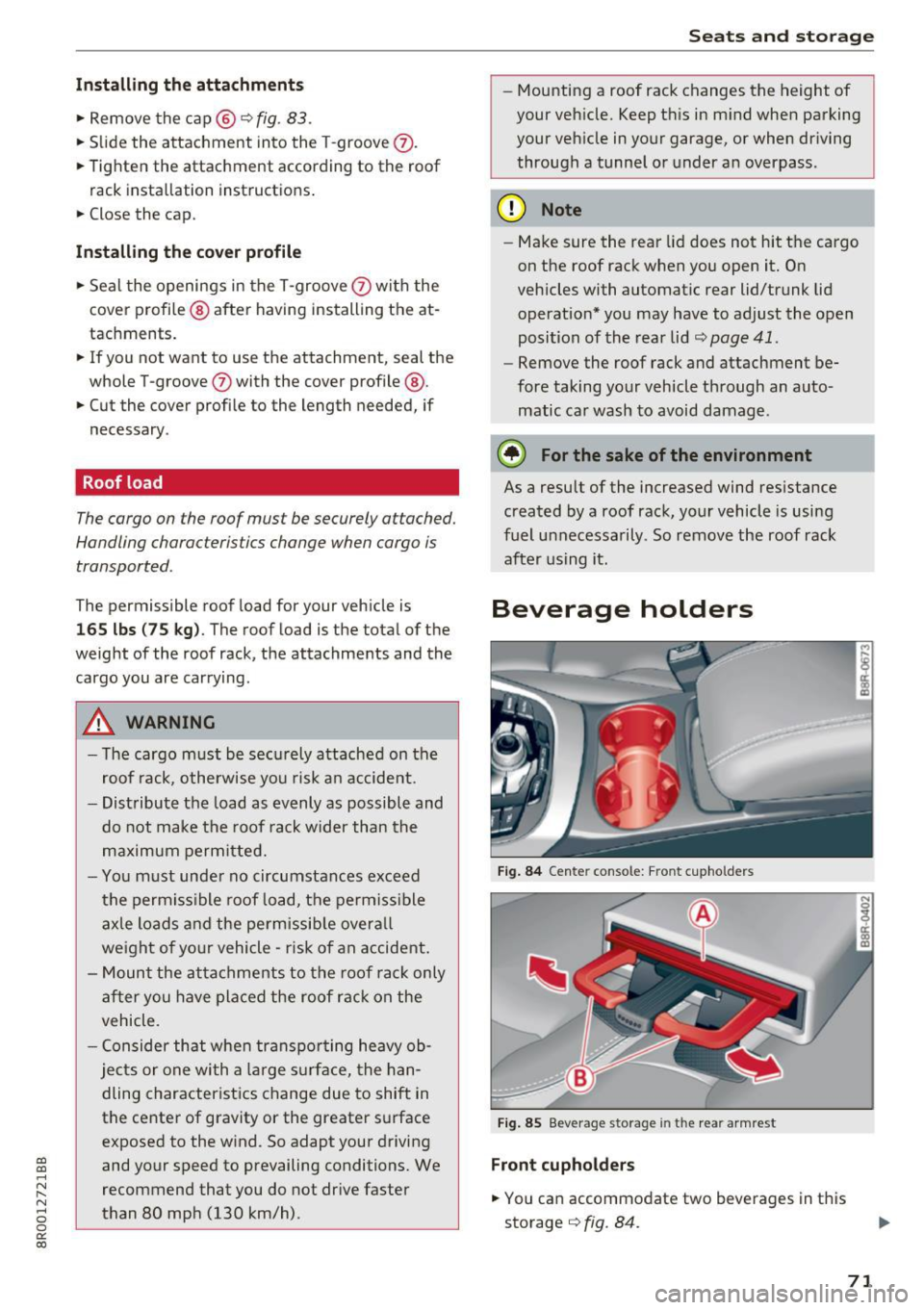
Beverage holders
Fig . 84 Cente r conso le: Fro nt c upho lders
Fig. 85 Beverage storage in th e rea r arm rest
Front cupholders
• You ca n accommo date two beverages in this
storage
q fig . 84 .
71
Page 79 of 296
CD
CD
.... N ,-... N .... 0 0 C<'. 00
Warm and cold Climate control system
Description
The climate control system warms , cools and
adds humidity to the a ir in the veh icle inter ior. It
i s the most effective when the windows and pan
oramic sliding sunroof* ar e closed. If th ere is a
bui ld-up of heat inside th e vehicle, ventilation
can help to sp eed up th e cooling process.
I n all heating mode functions except
defrost, the
b lower only switches to a higher speed once the
engine coolant has reached a certain tempera
ture .
Condensat ion from the cooling system can drip
and fo rm a puddle of water unde r the vehicle.
This is normal and does not mean there is a leak.
Pollut ant filter
The pollutant filter removes pollutants such as
dust and pollen from the air.
The air pollutants filter must be changed at the intervals specified in your Warranty
& Mainte
nance booklet, so that the a ir condit ione r can
p roperly work.
If you drive your vehicle in an area with high air
pollution , the filter may need to be changed
mo re frequently than specified in your Aud i Wa r
ranty
& Ma intenance booklet. If in doubt, ask
your author ized Audi Service Advisor for advice .
Key co ded setting s
The climate control settings are automatically
stored and assigned to the remote control key
that is i n use .
_&. WARNING
Reduced visib ility is dangerous and can ca use
accidents.
- For safe dr iv ing it is very impo rtant that all
windows be free of ice, snow and condens a
tion .
Warm and c old
- Completely familiarize yourself with the
proper use and function of the heating and
ventilation system and especially how to de
fog and defrost the windows .
- Never use the windshield wiper/washer sys
tem in freezing weather until you have
warmed the windshie ld first, using the heat
ing and vent ilation system . The washe r solu
tion may freeze on the w indshield and re
duce visibility.
(D Note
- If you suspect that the air conditioner has bee n damaged, sw itch the system off to
avoid further damage and have it inspected
by a qualified dea lership.
- Repa irs to the Aud i a ir cond itioner requ ire
special techn ical know ledge and spec ial
t ools. Contact an a uthorized Audi dea ler fo r
assistance.
@ For the sake of the environment
By reduc ing the amo unt of fuel you use, yo u
also reduce the amount of pollutants emitted
into the air.
(D Tips
- Keep the a ir intake slots (in fro nt of t he
w indshield) free from ice , snow and debr is
in orde r to maintain the proper function of
the climate control system .
- T he energy management system may switch
the seat heating* or rear window defroster
off temporarily . These systems are availab le
again as soon as the energy ba lance has
been restored .
- The a ir flowing out of the vents and
throughout the vehicle's ent ire inter ior is
discharged at the rear of the vehicle . Make
sure that the out let slots are not covered by
cloth ing , etc.
77
Page 82 of 296

Warm and cold
Supplementary heater*
The supplementary heater warms the interior of
veh icles with flexible fuel engines*, diesel en
gines* or hybrid drive* more quickly. The supple
mentary heater is controlled automatically in the
Auto setting.
80
Page 96 of 296

Driving
Automatic transmission
Introduction
The automat ic t ransmission is cont rolled e lec
tron ica lly . The transmission ups hifts or down
shifts au toma tically depending on wh ich drive
p rogram is selected. The power is transferred by
a torque converter .
When a
moderate driving styl e is used , the
t ra nsmission se lects t he most eco nomical d riving
mode.
It will then change up early an d de lay the
downshifts to give better fuel economy .
The transm iss ion switches to a spo rty mode afte r
a kic k-down or when the drive r uses a
sporty
dri ving st yle
character ized by quic k accelerator
pedal movements, heavy acce leration, freq uent
changes in speed and traveling at the maximum
speed.
If desired, the dr iver can also select the gears
manually (tiptronic mode) ¢ page 98.
Selector lever positions
0 ;:!: 0 ci: a, a,
F ig. 109 D is p lay in t he inst rum ent cl uster: se lecto r lever in
p os it ion P
The se lector lever position engaged appears next
to the selector lever as well as in the instrument
cluster display .
P -Park
In th is selector lever pos ition the transm ission is
mechanically locked. Engage P only when the ve
h icle is
completely stopped¢.&. in Driving the
automatic transmission on page
96 .
To shift in or out of position P, you must
first
press and ho ld the brake pedal and then p ress
the re lease button in the selector lever handle
94
whi le moving the selector leve r to o r from P. Yo u
can shift out of this position o nly with the igni
t ion on.
R -Reve rs e
Se lect R only when the veh icle is at a full stop
and t he e ngine is runn ing at idle speed¢ A in
Driving the automatic transmission on
page
96 .
Befo re yo u move the sele ctor leve r to R, p ress
both the but to n in t he hand le of t he selec tor lev
er
and t he brake peda l at the same time .
When the igni tion is on, t he backup lights illumi
na te when the se lector lever is moved into R.
N -Neutral
The tra nsmission is in neutra l in this position .
S hi ft to this pos it io n for s tand ing wi th the b rakes
applied
¢ .&. in Driving the automatic transmis
sion on page
96. The vehicle ca n also ro ll when
t h e e ngine is s topped.
When the vehicle is stationa ry or at speeds be low
1 mph (2 km/h), you must a lways apply th e foot
bra ke befo re and wh ile movi ng the lever out of N.
D /S -Normal position for driving forward
In the D/S position, the transmission can be op
erated either in the normal mode Dor in the
spo rt mode S . T o se lect the sport mode S, pull
t h e se lecto r lever back b rie fly. Pull ing t he leve r
ba ck aga in will selec t the normal mode D. The in
str ument cluster d isp lay shows the selected d riv
ing mode.
I n the
normal mode D , th e transmission auto
mati cally selec ts the s uitable gear ratio .
It de
pends on engine load, veh icle spee d an d dr ivi ng
sty le.
Se lect t he
sport mode S fo r spo rty d rivi ng. The
vehicle makes f ull use of the eng ine 's power.
S hif ting may become no ticeable when acceler at
ing . Hyb rid drive *: electric d riving is not poss ible.
When the vehicle is statio na ry o r at speeds below
1 m ph (2 km/h), you mus t always apply the foot
br ake befo re and wh ile movi ng the lever to D/S
out of N. .,..
Page 103 of 296
Starting the vehicle
Applies to: vehicles with hybrid drive
The vehicle is started and turned off either wi th
the ign ition key <;>
page 81 or with the
IS TAR T ENG INE S TOPI button* 9 page 84 in t he
same way as a conventional vehicle .
W hen start ing the veh icle, the needles in the in
s trument clus ter move upward briefly . When the
ve hicle enters d rive ready mode, the s tatus mes
sage
hybrid ready appears briefly in t he instru
ment cluster display and the needle in the power
meter points to
READY 9 page 101.
Depending on the ope ration mode of the hybrid
sys tem, there are two possible drive ready modes
after the vehicle has been started:
Drive ready mode with combustion engine
If the ope rat ing req uiremen ts
r;!) page 103 for
e lectric dr ive mode are not met, the combust ion
Power meter overview
Applies to: vehicles with hybrid drive
Hybrid
engine starts the veh icle as usual. You can start
driving as usual.
Drive ready mode with the electric motor
If the operating requireme nts
9 page 103 for
the e lectr ic dr ive mode a re met, the comb ustion
engi ne rema ins off after starting the vehicle .
(j) Tips
To p revent the 12 vo lt batte ry from discha rg
i ng, never le ave the vehicle pa rked in the drive
ready mo de. Remove the key from the igni
tion or press the
I START E N GINE STOP ! but
ton* . When leaving the vehicle always take
the key with yo u.
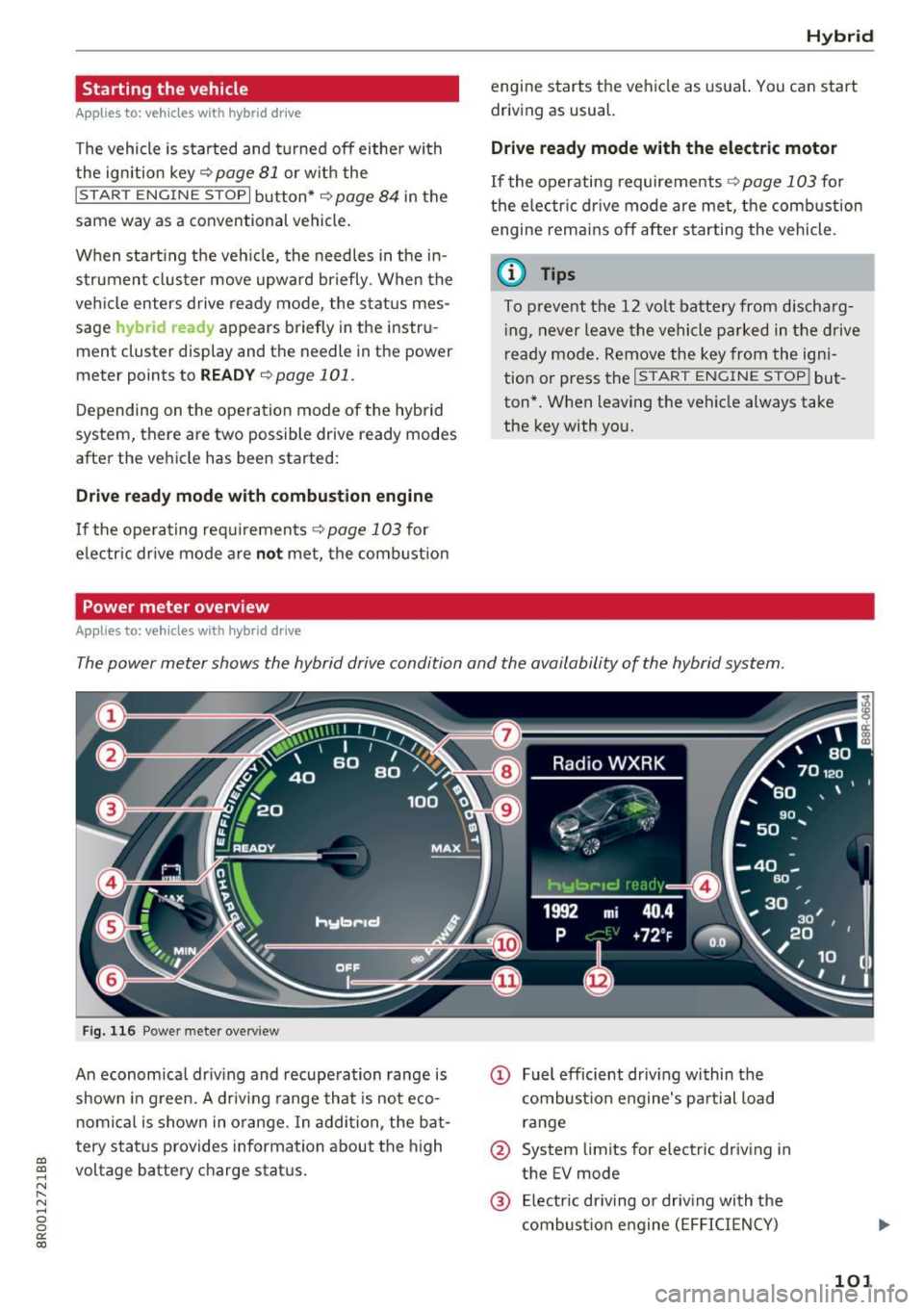
The power meter shows the hybrid drive condition and the availability of the hybrid system.
Fig . 116 Power mete r overv iew
An econom ica l dr iv ing and recupe ra tion range is
shown in g reen. A driv ing range that is no t
eco
nomi cal is shown in o range. In addition , the bat
tery s tat us provides informatio n about the high
a,
~ voltage batte ry c harge stat us.
N r-N ...... 0 0
0:
co
@ Fuel efficient driv ing wi thin the
c ombus tion engine's pa rtial load
r a nge
@ System limits for electric driving in
the EV mode
@ El ectr ic dr iving o r driv ing with the
c ombust ion engine ( EFFICI ENCY)
101
Page 106 of 296
Hybrid
Start-Stop function
The combustion engine is operated on ly as need
ed . Generally, the combustion engine turns off
when the vehicle is stationary and the high volt
age battery powers the electrical vehicle sys
tems.
The purpose o f automatica lly shutting the com
bustion engine off in hybrid drive mode is to save
fuel. All of the important vehicle systems, such
as steering, brakes and the A/C system, continue
to remain active. In some cases , systems may re
qu ire the combustion eng ine to continue running
when the vehicle is stationary . When dr iv ing in
congested traff ic for long per iods of t ime, the
combustion eng ine will cycle on when the veh icle
is stationary to keep the high voltage battery
charged.
Gliding
If the gas pedal is not pressed and the D posit ion
is selected, the combustion engine remains
turned off up to speeds of approximately 99 mph
(160 km/h) . Driving conservative ly like th is can
reduce fuel con5umption .
Energy recovery (recuperation)
When braking, the electric motor will act as a
generator creating e lectr ic energy that is then
sto red in the high voltage battery. This also oc
curs when the vehicle is coasting or driving down
hi ll. The combustion engine is automat ica lly
turned off in this case .
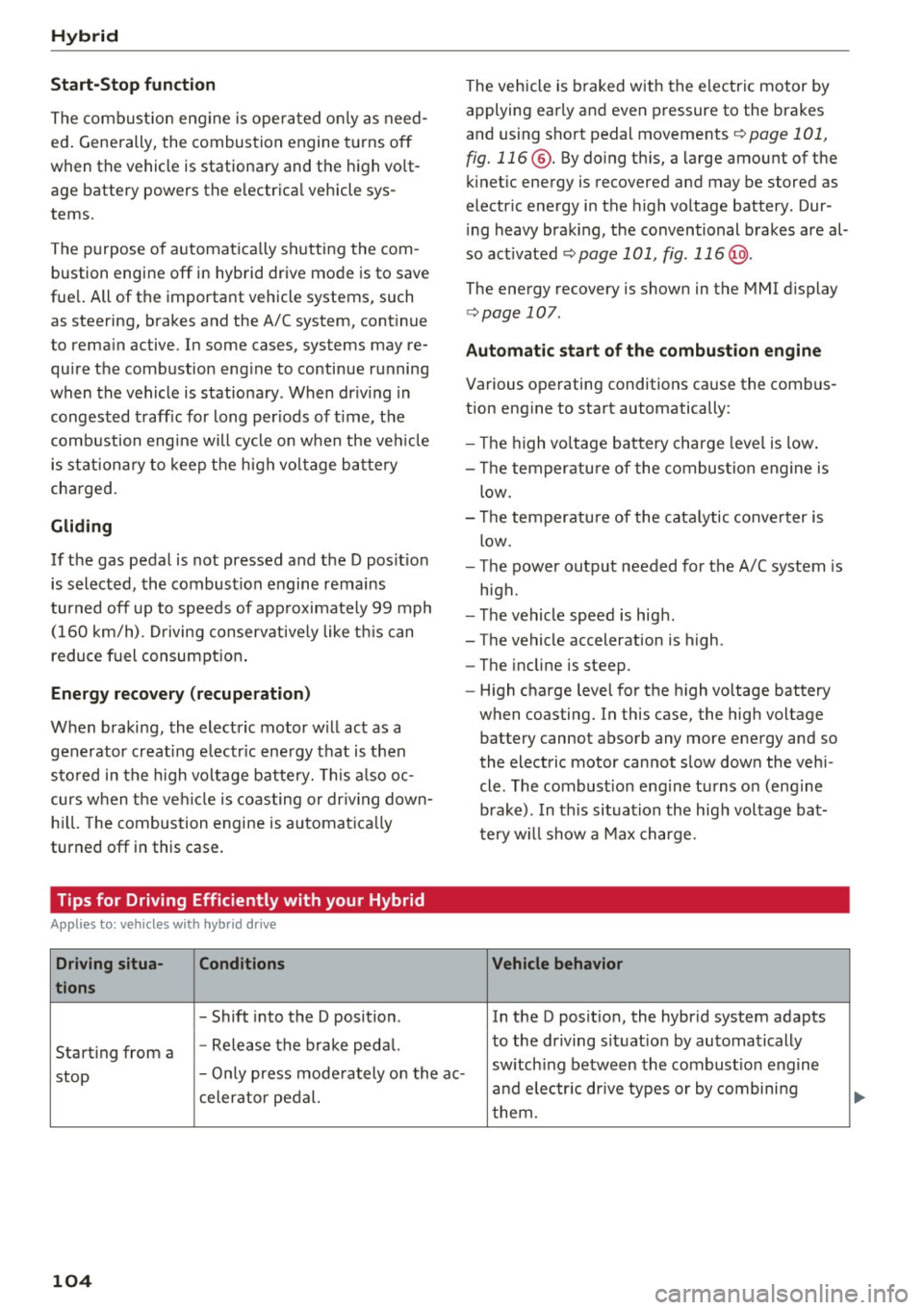
Tips for Driving Efficiently with your Hybrid
Appl ies to: ve hicles w ith hyb rid drive
Driving situa- Conditions
tions
- Shift into the D position .
Starting from a -
Release the brake pedal. The vehicle is braked with
the electric motor by
applying early and even pressure to the brakes
and using short pedal movements
¢ page 101,
fig. 116 @. By doing this, a large amount of the
kinet ic energy is recovered and may be stored as
electric energy in the high voltage battery. Dur
i ng heavy brak ing , the conventional brakes are al
so act ivated
¢ page 101, fig . 116 @.
The energy recovery is shown in the MMI display
¢page 107 .
Automatic start of the combustion engine
Various operating conditions cause the combus
tion eng ine to start automatically:
- Th e high voltage battery charge level is low.
- Th e temperature of the combustion engine is
low .
- Th e temperature of the catalytic converter is
low .
- T he power output needed for the A/C system is
high.
- The vehicle speed is high .
- The vehicle acceleration is high .
- The incline is steep .
- High charge level for the high voltage battery
when coasting. In this case, the high voltage battery cannot absorb any more energy and so
the electric motor cannot slow down the veh i
cle. The combust ion engine turns o n (engine
brake) . In this situation the high voltage bat
t ery w ill show a Max charge.
Vehicle behavior
In the D posit ion, the hybrid system adapts
to the driving situat ion by automatically
stop -
Only press moderately on the ac- sw
itch ing between the combustion engine
and e lectr ic drive types or by combining
celerator pedal.
them.
104
...
Page 107 of 296
CD
CD
.... N ,-... N .... 0 0 C<'. 00
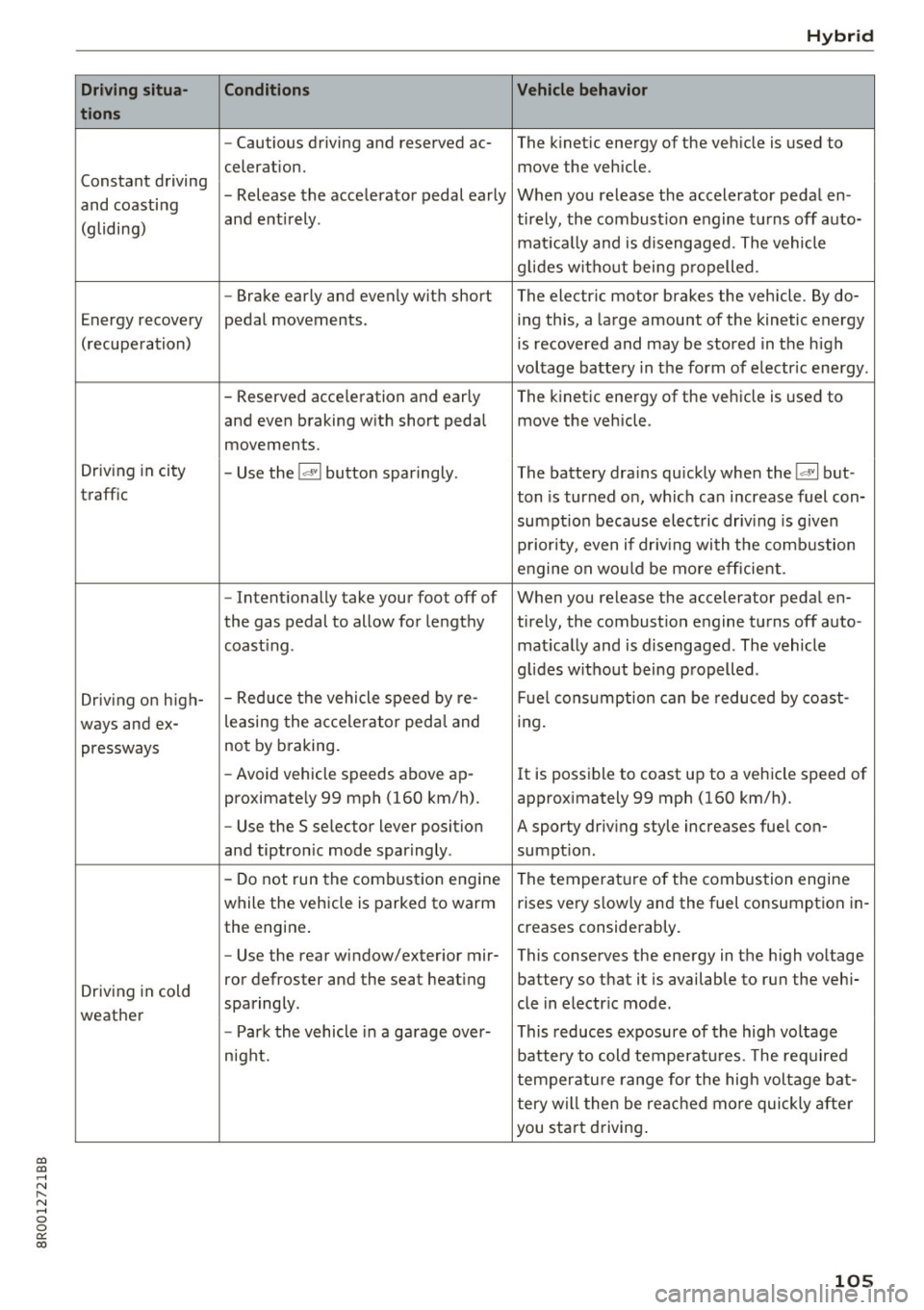
Driving situa -
tion s
Constant driving
and coasting
(gliding)
Energy recovery
(recupe ration)
Driving in city
traffic
Driving on high-
ways and ex- pressways
Driving in cold
weather
Cond itions
- Cautious driving and reserved ac-
celeration.
- Release the accelerator pedal early
and entirely .
- Brake early and evenly with short
pedal movements .
- Reserved acce leration and early
and even braking with short pedal
movements.
- Use the
!<=!VI button sparingly .
- Intentionally take your foot off of
the gas pedal to allow for lengthy
coast ing .
- Reduce the vehicle speed by re-
leasing the acce le rato r peda l and
not by b raking.
- Avoid vehicle speeds above ap-
proximately 99 mph (160 km/h).
- Use the 5 selector lever position
and tiptronic mode sparingly .
- Do not run the combustion erngine
while the vehicle is parked to warm
the engine.
- Use the rear window/exter ior mir-
ror defroster and the seat heating
sparingly .
- Park the vehicle in a garage over-
night.
H yb ri d
Vehicle behav ior
The kinetic energy of the vehicle is used to
move the vehicle .
When you release the accelerator pedal en-
tirely, the combustion engine turns off auto-
mat ica lly and is disengaged. The vehicle
g lides without being propelled .
The electric motor brakes the vehicle . By do-
ing this, a large amount of the kinetic energy
is recovered and may be stored in the h igh
voltage battery in the form of electric energy .
The kinetic energy of the vehicle is used to
move the vehicle .
The battery dra ins quickly when the
!<=!VI but -
ton is turned on, which can increase fuel con-
sumpt ion because electric driv ing is given
priority, even if driv ing with the combustion
engine on wo uld be more efficient.
When you release the accelerator pedal en-
tirely, the combustion engine turns off auto- mat ically and is disengaged . The vehicle
g lides without being propelled .
F ue l consumption can be reduced by coast-
i ng.
It is possible to coast up to a vehicle speed of
approximately 99 mph (160 km/h).
A sporty driving style increases fue l con-
sumption .
The temperature of the combustion engine
rises very s lowly and the fuel consumption in-
creases considerably.
This conserves the energy in the high voltage
battery so that it is available to run the vehi-
cle in electr ic mode .
This reduces exposure of the high voltage
battery to cold temperat ures . The required
temperature range for the high voltage bat-
tery will then be reached more quickly after
you sta rt driving .
105