brake light AUDI Q5 2017 Owner's Manual
[x] Cancel search | Manufacturer: AUDI, Model Year: 2017, Model line: Q5, Model: AUDI Q5 2017Pages: 296, PDF Size: 74.43 MB
Page 94 of 296
Driving
Speed warning 1: setting a speed limit
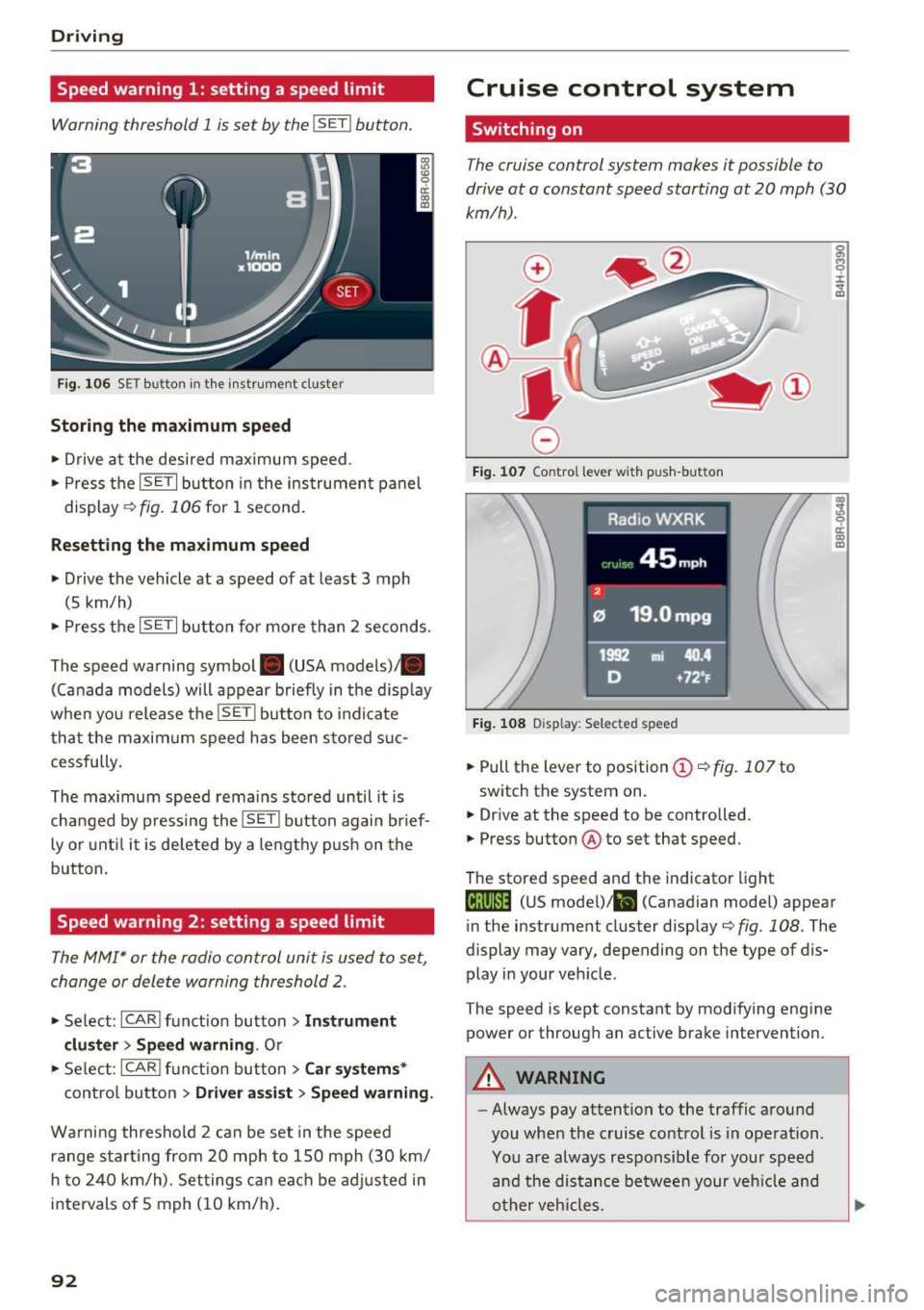
Warning threshold 1 is set by the I SET I button .
Fig. 1 06 SET button in t he ins trume nt cluster
Storing the maximum spe ed
• Drive at the desired maximum speed.
• Press the
!SE TI but ton in the ins trumen t panel
display ~fig.106for 1 second.
Resetting the maximum speed
• Drive the vehicle at a speed of at least 3 mph
(5 km/h)
• Press the
~IS-E T~I button for more than 2 seconds .
The speed warning symbol. (USA models)/ .
(Canada models) will appear briefly in the disp lay
when you release the
!SE TI butto n to indicate
that the maxim um speed has been sto red suc
cessfully.
The max imum speed remains stored until it is
changed by pressing the
I SETI button again brief
ly or unt il it is deleted by a lengthy p ush on the
button.
Speed warning 2: setting a speed limit
The MMI* or the radio control unit is used to set,
change or delete warning threshold 2 .
• Se lect : !CARI funct ion button> Ins trum ent
clu st e r > S peed warning .
Or
• Select : !CARI function button> C ar sys te m s*
contro l button > Dri ver ass ist > S peed w arnin g.
Wa rning threshold 2 can be set in the speed
range star ting from 20 mph to 150 mph (30 km/
h to 240 km/h) . Set tings can each be ad justed in
intervals of 5 mph (10 km/h).
92
Cruise control system
Switching on
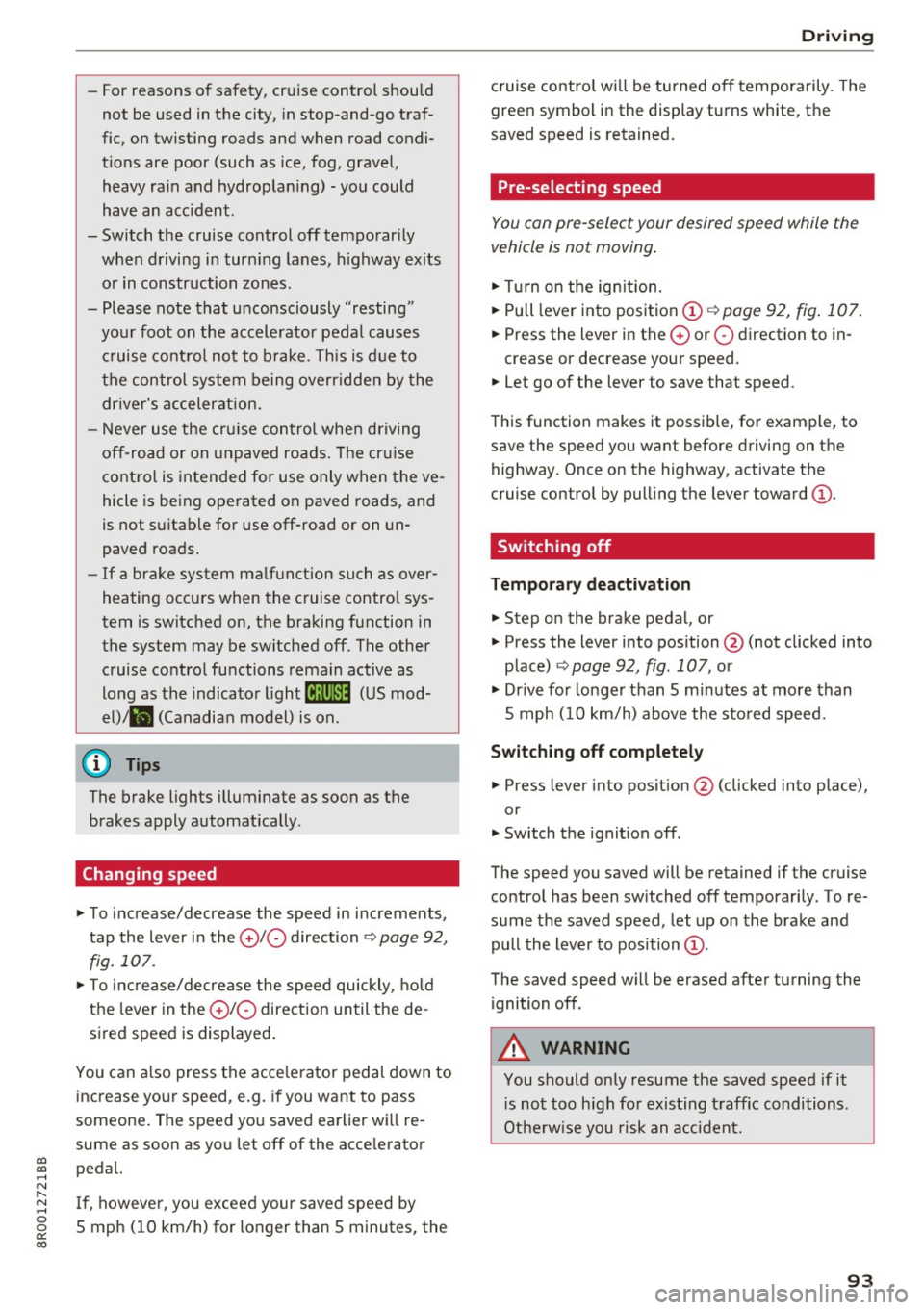
The cruise control system makes it possible to
drive at a constant speed starting at
20 mph (30
km/h) .
0
f
®l
0
Fig. 10 7 Control leve r wit h pu sh-but ton
Fig . 108 Disp lay: Selected speed
• Pull the lever to position (D <=> fig . 10 7 to
switch the system on.
• Drive at the speed to be controlled.
• Press button @to set that speed .
The stored speed and the indicator light
g M 0 ±
~
Q)
~ ci: Q) m
Iij;\1)~14 (US model) !lll (Canadian mode l) appear
in the instrument cluster display
c::> fig. 108 . The
display may vary, depending on the type of dis
play in your vehicle .
The speed is kept constant by modifying engine power or through an active brake intervention.
A WARNING
- Always pay attention to the traffic around
you when the cruise control is in operation .
You are always respons ible for your speed
and the distance between your veh icle and
other veh icles .
-
Page 95 of 296
CD
CD
.... N ,-... N .... 0 0 C<'. 00
-For reasons of safety, cruise control should
not be used in the city, in stop-and-go traf
fic, on twisting roads and when road condi
tions are poor (such as ice, fog, gravel,
heavy rain and hydroplaning) -you could
have an accident.
- Switch the cruise control off temporarily
when driving in turning lanes, highway exits
or in construction zones.
- Please note that unconsciously "resting"
your foot on the accelerator pedal causes
cruise control not to brake. This is due to
the control system being overridden by the
driver's acceleration.
- Never use the cruise control when driving
off-road or on unpaved roads. The cruise
control is intended for use only when the ve
hicle is being operated on paved roads, and
is not suitable for use off-road or on un
paved roads.
- If a brake system malfunction such as over
heating occurs when the cruise control sys
tem is switched on, the braking function in
the system may be switched off. The other
cruise control functions remain active as
long as the indicator light
0;(1)~14 (US mod
el)/li,I (Canadian model) is on .
(Di Tips
The brake lights illuminate as soon as the
brakes apply automatically.
Changing speed
.,. To increase/decrease the speed in increments,
tap the lever in the
010 direction ¢ page 92,
fig. 107.
.,. To increase/decrease the speed quickly , hold
the lever in the
010 direction until the de
sired speed is displayed.
You can also press the accelerator pedal down to
increase your speed, e.g. if you want to pass
someone. The speed you saved earlier will re
sume as soon as you let off of the accelerator
pedal.
If, however, you exceed your saved speed by
S mph
(10 km/h) for longer than S minutes, the
Driving
cruise control will be turned off temporarily. The
green symbol in the display turns white, the
saved speed is retained.
Pre-selecting speed
You con pre-select your desired speed while the
vehicle is not moving.
.,. Turn on the ignition.
.,. Pull lever into position
(D ¢ page 92, fig. 107.
.,. Press the lever in the 0 or 0 direction to in-
crease or decrease your speed.
.,. Let go of the lever to save that speed .
This function makes it possible, for example, to
save the speed you want before driving on the
highway . Once on the highway, activate the
cruise control by pulling the lever toward
(D .
Switching off
Temporary deactivation
.,. Step on the brake pedal, or
.,. Press the lever into position @ (not clicked into
place) ¢
page 92, fig . 10 7, or
.,. Drive for longer than S minutes at more than
S mph (10 km/h) above the stored speed.
Switching off completely
.,. Press lever into position @ (clicked into place),
or
.,. Switch the ignition off.
The speed you saved will be retained if the cruise control has been switched off temporarily. To re
sume the saved speed, let up on the brake and
pull the lever to position
(D.
The saved speed will be erased after turning the
ignition off .
A WARNING
=
You should only resume the saved speed if it
is not too high for existing traffic conditions .
Otherwise you risk an accident.
93
Page 96 of 296

Driving
Automatic transmission
Introduction
The automat ic t ransmission is cont rolled e lec
tron ica lly . The transmission ups hifts or down
shifts au toma tically depending on wh ich drive
p rogram is selected. The power is transferred by
a torque converter .
When a
moderate driving styl e is used , the
t ra nsmission se lects t he most eco nomical d riving
mode.
It will then change up early an d de lay the
downshifts to give better fuel economy .
The transm iss ion switches to a spo rty mode afte r
a kic k-down or when the drive r uses a
sporty
dri ving st yle
character ized by quic k accelerator
pedal movements, heavy acce leration, freq uent
changes in speed and traveling at the maximum
speed.
If desired, the dr iver can also select the gears
manually (tiptronic mode) ¢ page 98.
Selector lever positions
0 ;:!: 0 ci: a, a,
F ig. 109 D is p lay in t he inst rum ent cl uster: se lecto r lever in
p os it ion P
The se lector lever position engaged appears next
to the selector lever as well as in the instrument
cluster display .
P -Park
In th is selector lever pos ition the transm ission is
mechanically locked. Engage P only when the ve
h icle is
completely stopped¢.&. in Driving the
automatic transmission on page
96 .
To shift in or out of position P, you must
first
press and ho ld the brake pedal and then p ress
the re lease button in the selector lever handle
94
whi le moving the selector leve r to o r from P. Yo u
can shift out of this position o nly with the igni
t ion on.
R -Reve rs e
Se lect R only when the veh icle is at a full stop
and t he e ngine is runn ing at idle speed¢ A in
Driving the automatic transmission on
page
96 .
Befo re yo u move the sele ctor leve r to R, p ress
both the but to n in t he hand le of t he selec tor lev
er
and t he brake peda l at the same time .
When the igni tion is on, t he backup lights illumi
na te when the se lector lever is moved into R.
N -Neutral
The tra nsmission is in neutra l in this position .
S hi ft to this pos it io n for s tand ing wi th the b rakes
applied
¢ .&. in Driving the automatic transmis
sion on page
96. The vehicle ca n also ro ll when
t h e e ngine is s topped.
When the vehicle is stationa ry or at speeds be low
1 mph (2 km/h), you must a lways apply th e foot
bra ke befo re and wh ile movi ng the lever out of N.
D /S -Normal position for driving forward
In the D/S position, the transmission can be op
erated either in the normal mode Dor in the
spo rt mode S . T o se lect the sport mode S, pull
t h e se lecto r lever back b rie fly. Pull ing t he leve r
ba ck aga in will selec t the normal mode D. The in
str ument cluster d isp lay shows the selected d riv
ing mode.
I n the
normal mode D , th e transmission auto
mati cally selec ts the s uitable gear ratio .
It de
pends on engine load, veh icle spee d an d dr ivi ng
sty le.
Se lect t he
sport mode S fo r spo rty d rivi ng. The
vehicle makes f ull use of the eng ine 's power.
S hif ting may become no ticeable when acceler at
ing . Hyb rid drive *: electric d riving is not poss ible.
When the vehicle is statio na ry o r at speeds below
1 m ph (2 km/h), you mus t always apply the foot
br ake befo re and wh ile movi ng the lever to D/S
out of N. .,..
Page 97 of 296
a,
a,
..... N r-N ..... 0 0
0:
co
,&_ WARNING
Read and follow all WARNINGS ¢ A in Driv
ing the automatic transmission on
page 96.
(D Note
Coas ting downhil l w it h t he t ransm iss ion in N
and the engine not runn ing will result in dam
age to the automatic transmission and possi
bly the catalyt ic converter.
(D Tips
- On vehicles with Audi drive select*, you can
adjust the sporty shift characteristics in the
Dynami c driv ing mode .Sw ill appear in the
i nstrument cl uster display instead of 0 .
- If you accidenta lly select N while driv ing ,
take your foot off the accelerator pedal im
mediately and wa it for the engine to slow
down to idle before selecting 0/S.
- Hybrid drive*: if the l<=1 •l button ¢
page 103
is pressed wh ile in sport mode S, the trans
mission switches automatically to the nor
mal mode 0 .
- If there is a power fa ilure, the selector lever
will not move o ut of the P posit ion . The
eme rgency release can be used if this hap
pens
¢ page 99 .
Automatic Shift Lock (ASL)
-
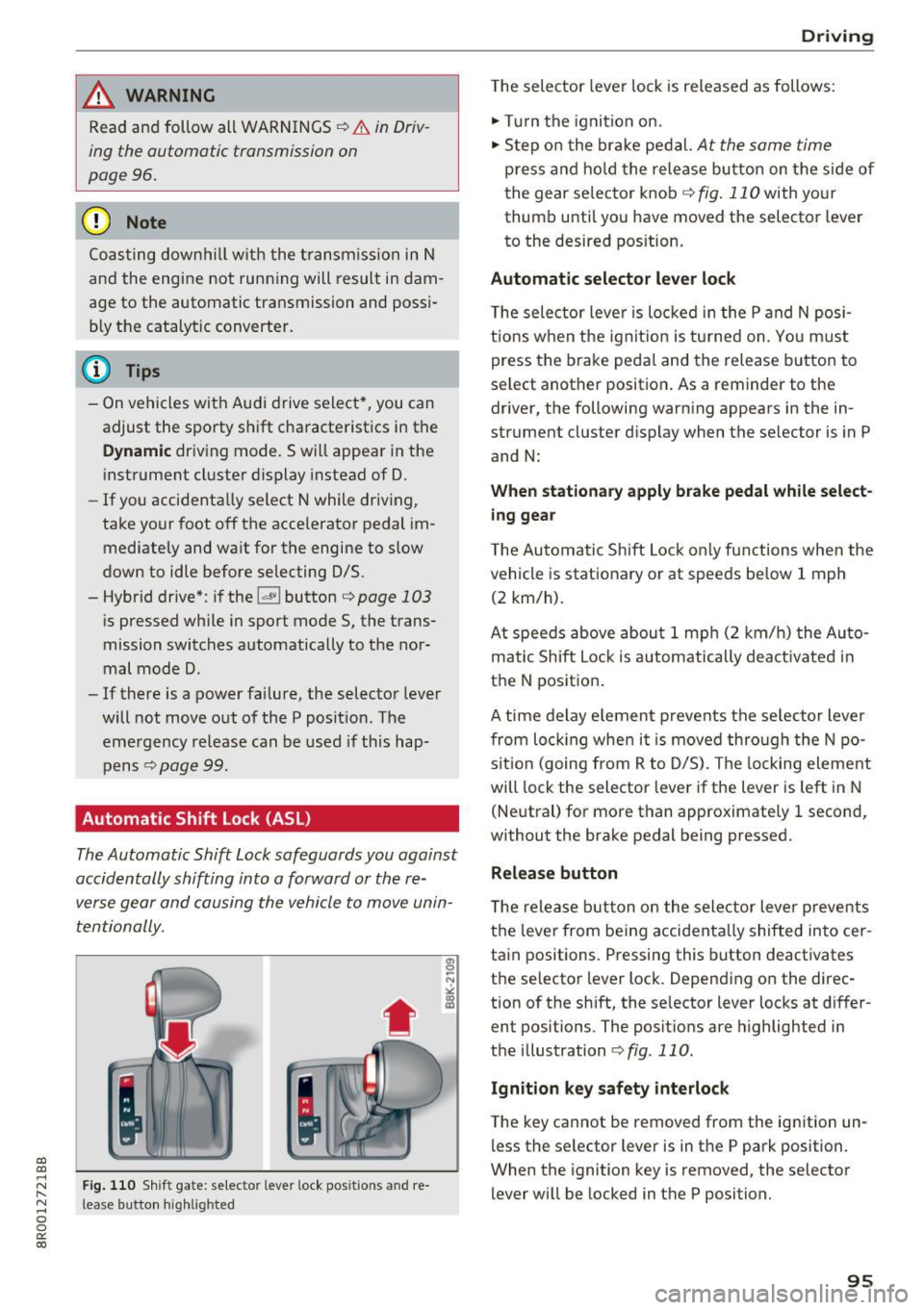
The Automatic Shift Lock safeguards you against
accidentally shifting into a forward or the re
verse gear and causing the vehicle to move unin
ten tionally.
•
F ig. 11 0 Shift gate: se le cto r lever lock pos it io ns and re
lea se butto n highlig h ted
D rivi ng
The selector lever lock is released as follows :
" Tur n the ignition on.
" Step on t he br ake pedal.
At the same time
press a nd ho ld the release bu tton on the side of
the gear se lector knob
¢ fig . 110 with yo ur
thumb until yo u have moved the selecto r lever
to the desired pos ition.
Automatic selector lever lock
T he selec tor leve r is lo cked in t he P and N posi
t io ns w hen the ig nition is tu rned on. You m ust
press the brake peda l and the release button to
select another position . As a reminder to the
driver, the following warn ing appears in the in
strument cluster d isplay when the se lector is in P
and N:
When stationary appl y brake pedal while select
ing gear
T he Au tomatic Sh ift Lock only fu nctio ns when the
veh icle is stationary o r at spee ds be low 1 mph
(2 km/h).
At spee ds above abou t 1 mp h (2 km/h) the Au to
ma tic Sh ift Lock is autom atically deact ivated in
the N positio n.
A time de lay e lemen t prevents the se lector lever
from lo cking whe n it i s moved thro ugh the N po
s ition (going from R to D/S) . The locking element
will lock the selector leve r if the lever is left in N
(Ne utral) for more than approximately 1 second,
without the brake pedal being pressed.
Release button
T he release but ton on the selector leve r preve nts
the lever from be ing accidenta lly shifted into cer
ta in positions. Pressing this button deactivates
the se lector lever lock . Depending on the d irec
t ion of the sh ift, the se lector lever locks at d iffer
ent positions . The posit ions are highlighted in
the i llustration
¢ fig . 110.
Ignition key safety interlock
T he key cannot be removed from the ignition un
l ess the selector lever is in the P park position.
When the ignition key is removed , the selector
lever will be locked in the P position.
95
Page 98 of 296
Driving
Driving the automatic transmission
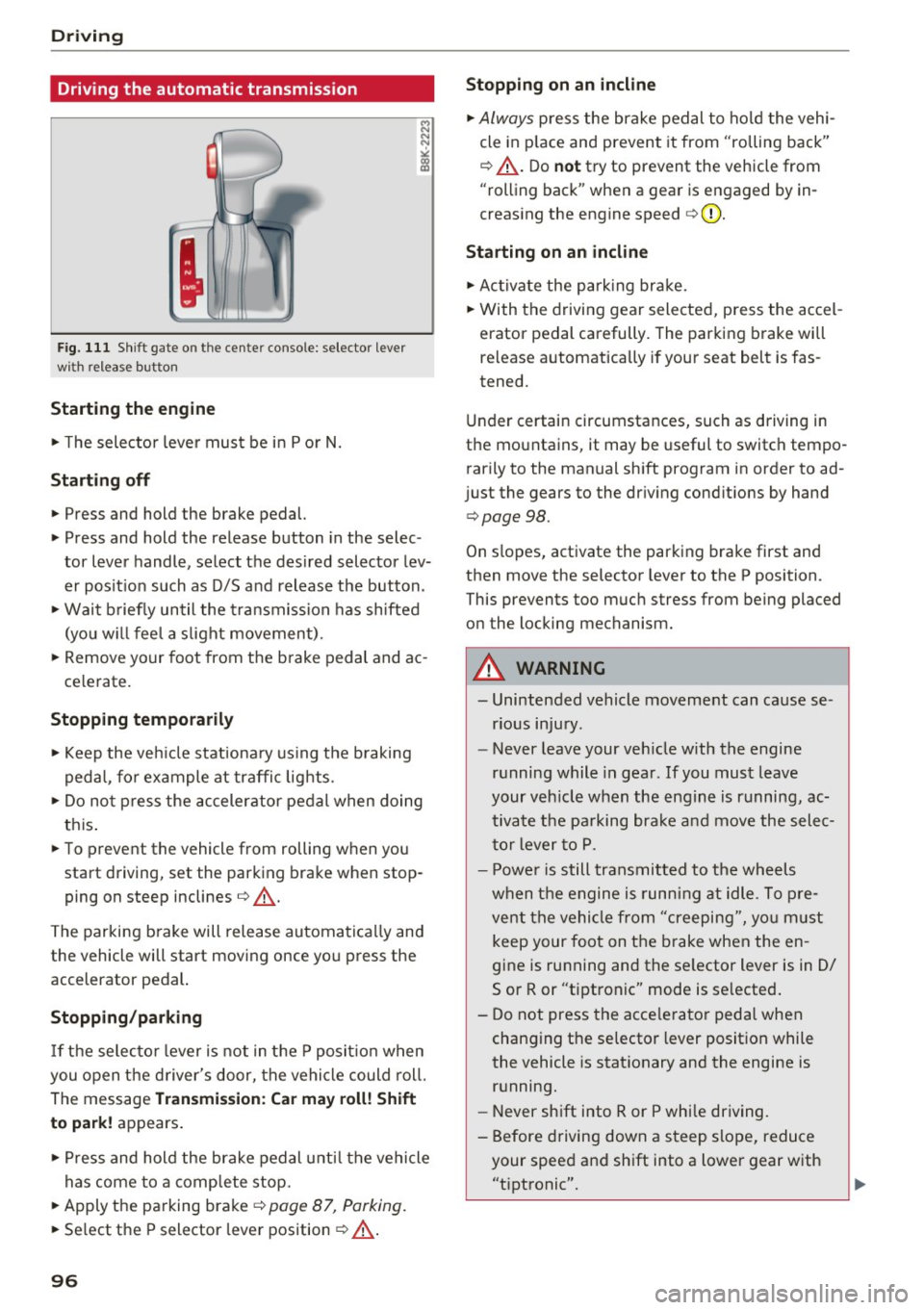
F ig. 111 Shift gate o n the cen te r co nso le: selecto r lever
wi th re lease button
Starting the engine
.. The selector leve r must be in P o r N.
Starting off
.. Press and hold the brake pedal.
.. Press and hold the release button in the selec
tor lever handle, select the des ired selector lev
er posit ion such as D/S and release t he button.
.. Wai t briefly until the transmission has shifted
(you w ill feel a s light movement) .
.. Remove your foot from t he b rake pedal and ac
ce lerate.
Stopping temporarily
.. Keep the veh icle stat iona ry using the b raking
pedal, fo r example at traffi c lights .
.. Do not p ress the accelerator pe dal when doing
th is .
.. To preve nt the vehicle from rolling when you
start driving, set the parking brake w hen stop
ping on steep inclines¢_&. .
The parking b rake will release automatica lly and
the vehicle will start moving once you press the
accelerator pedal.
Stopp ing /parking
If t he se lec to r l ever i s not in t he P posit io n w hen
you open t he d river's door, the vehicle could roll.
The message
Transmission: Ca r ma y roll! Shift
to pa rk!
appears .
.. Press and hold the brake pedal unti l the vehicle
has come to a comp lete stop.
.. Apply t he parking brake¢
page 87, Parking .
.. Se lect the P selector lever position ¢ _&. .
96
Stopping on an incline
.. Always press the brake pedal to ho ld the vehi
cle in p lace and prevent it from "rolling back"
¢ _&. . D o
not try to prevent the vehicle from
"rolling back" when a gear is engaged by in
creas ing the engine speed ¢(D .
Starting on an incline
.. Ac tivate the pa rk ing br ake .
.. With the driving gear selected, press the accel
erator pedal carefully. The parking brake will
re lease a utomatically if your seat belt is fas
tened.
Under certain circumstances, such as driving in
the mountains, it may be useful to switch tempo rarily to the manual sh ift program in order to ad
j ust the gears to the dr iv ing cond it ions by hand
¢ page 98 .
On slopes, activate the parking brake first and
then move the selector lever to the P position.
This prevents too m uch stress from being placed
on the locking mechanism.
A WARNING
- Unintended vehicle moveme nt can cause se
rious injury .
- Never leave your veh icle with the engine
r u nning while in gear . If you mus t leave
your veh icle when the engine is running, ac
tiva te t he pa rking bra ke and move the selec
t o r lever to P .
- P owe r is still transmitted to the wheels
w hen t he engine is running at idle . To pre
vent the vehi cle from "creeping", yo u m ust
keep your foot on the brake when the en
gine is running and the se lector lever is in 0/
Sor R or "tiptronic" mode is se lected .
- Do not press the acce le ra tor pedal when
changing t he se lector lever posit ion while
the vehicle is stat ionary and the engine is
running.
- Never shift into R or P whi le driving.
- Before driving down a s teep slope, reduce
your spee d and sh ift into a lower gear with
"t i pt ronic" .
Page 104 of 296
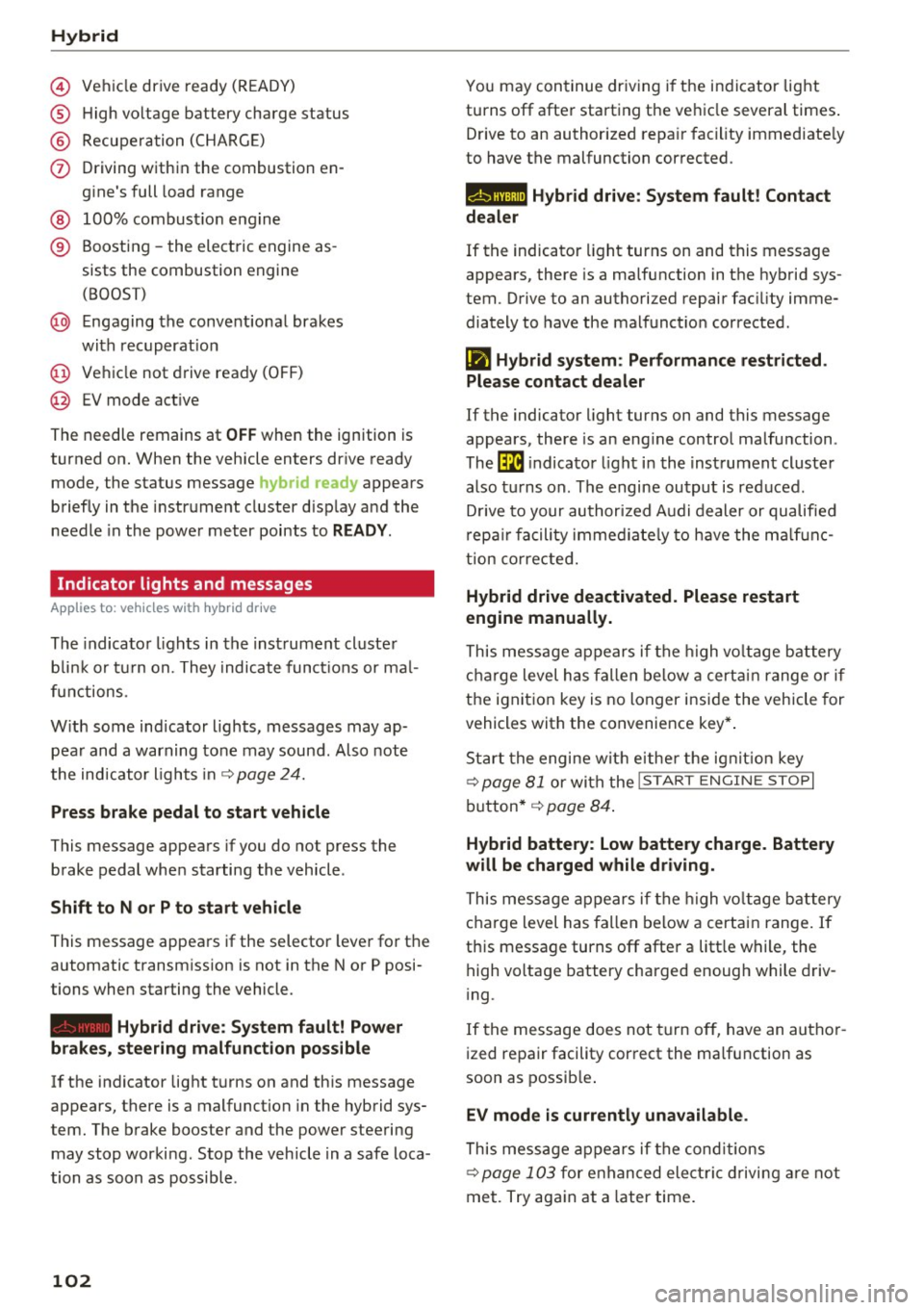
Hybrid
© Vehicl e drive ready (READY)
® High voltage battery charge status
® Recuperation (CHARGE)
(j) Driving within the combustion en-
gine's full load range
® 100% combust ion engine
® Boosting -the electric engine as-
sists the combustion engine
(BOOST)
@ Engaging the conventional brakes
with recuperat ion
@ Vehicle not drive ready (OFF)
@ EV mode act ive
The needle remains at
OFF when the ignition is
turned on. When the vehicle enters drive ready
mode, the status message
hybrid ready appears
briefly in the instrument cluster display and the
needle in the power meter points to
READY.
Indicator lights and messages
App lies to: ve hicles w ith hyb rid drive
The indicator lights in the instrument cluster
b lin k or tu rn on. They indicate functions or mal
f unct ions.
With some indicator lights, messages may ap
pear and a warning tone may sound . Also note
the indicator l ights in
¢page 24.
Press brake pedal to start vehicle
This message appears if you do not press the
brake pedal when starting the vehicle .
Shift to N or P to start vehicle
This message appears if the selector lever for the
automatic transmission is not in the Nor P posi
tions when starting the vehicle.
- Hybrid drive: System fault! Power
brakes, steering malfunction possible
lfthe indicator light turns on and this message
appears, there is a malfunction in the hybrid sys
tem . The brake booster and the power steering
may stop working. Stop the vehicle in a safe loca
tion as soon as possible.
102
You may continue driving i f the i ndicator light
turns off after starting the vehicle several times .
Drive to an authorized repair facility immediate ly
to have the malfunction corrected .
Q/ij:@,j rlybrid drive: System fault! Contact
dealer
If the indicator light turns on and this message
appears, there is a malfunction in the hybrid sys
tem. Drive to an authorized repair fac ility imme
diately to have the malfunct ion corrected.
(II Hybrid system: Performance restricted.
Please contact dealer
If the indicator light turns on and this message
appears, there is an eng ine control malfunction .
The
ffa i ndicator light in the instrument cluster
also turns on. The engine output is reduced.
D rive to your authorized Audi dealer or qualified
r epa ir facility immediate ly to have the malfunc
tion corrected.
Hybrid drive deactivated. Please restart
engine manually.
This message appears if the high vo ltage battery
charge level has fallen below a certain range or if
the ignition key is no longer inside the vehicle for
vehicles with the convenience key* .
Start the engine wit h eithe r the ignition key
¢
page 81 or with the !START ENGINE STOPI
button* ¢ page 84.
Hybrid battery: Low battery charge. Battery
will be charged while driving.
This message appears if the high vo ltage battery
charge level has fallen below a certain range. If
this message turns off after a litt le while, the
high voltage battery charged enough while driv
i ng.
If the message does not turn off, have an author
ized repair facility correct the ma lfunction as
soon as possib le .
EV mode is currently unavailable .
This message appears if the conditions
¢ page 103 for enha nced elect ric driving are not
met. Try again at a la ter time .
Page 114 of 296
Audi adaptive cruise control and braking guard
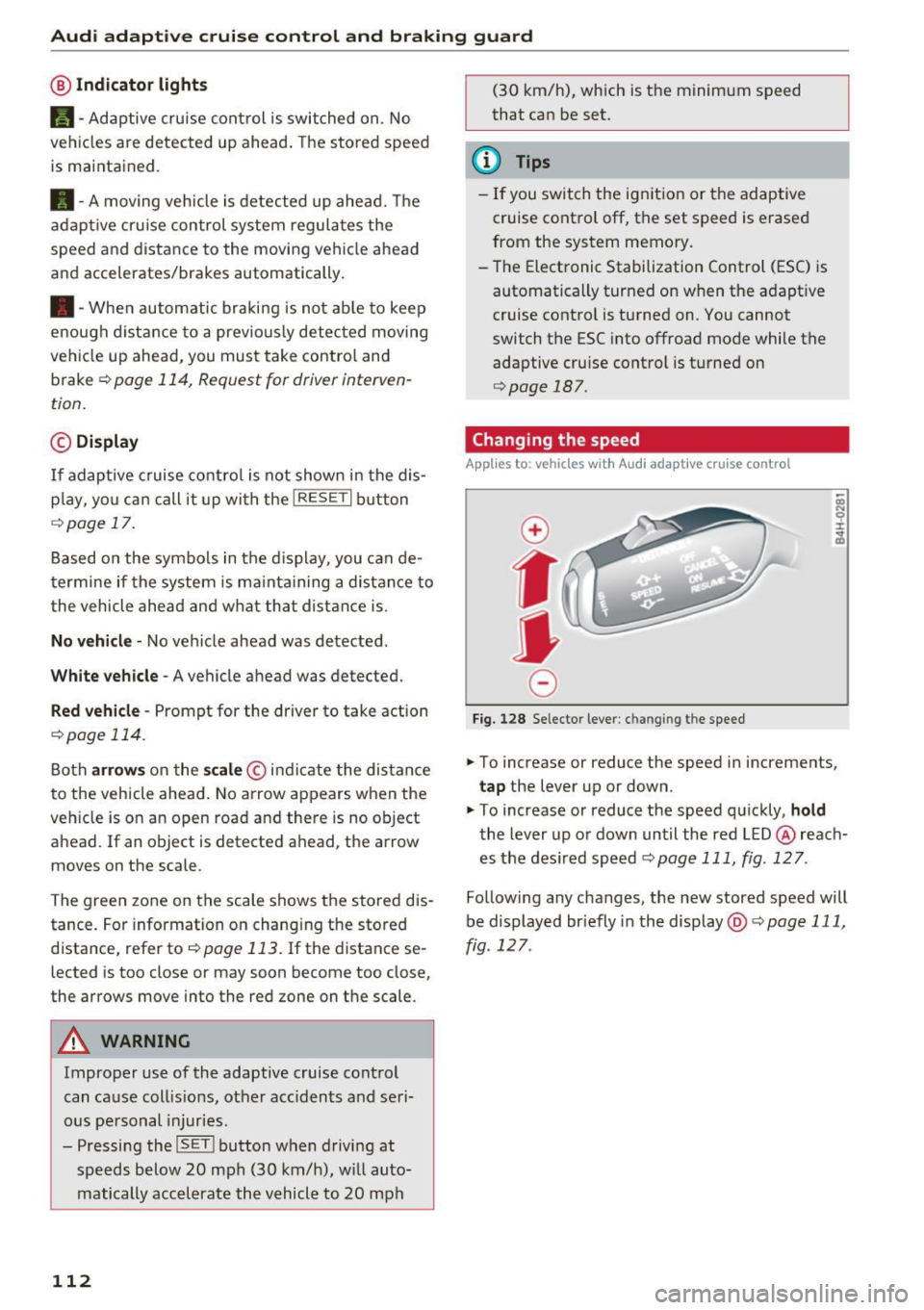
@ Indicator lights
Ill -Adaptive cruise control is switched on. No
vehicles are detected up ahead. The stored speed
is maintained .
• -A moving veh icle is detected up ahead. The
adaptive cruise control system regulates the
speed and distance to the moving vehicle ahead
and accelerates/brakes automatically.
• -When automatic braking is not able to keep
enough distance to a previously detected moving
vehicle up ahead, you must take contro l and
brake
¢ page 114, Request for driver interven
tion.
© Display
If
adaptive cruise control is not shown in the dis
play, you can call it up with the
IRESETI button
¢page 17.
Based on the symbo ls in the display, you can de
termine if the system is ma inta ining a distance to
the vehicle ahead and what that distance is .
No vehicle -No vehicle ahead was detected .
White vehicle -A vehicle ahead was detected.
Red vehicle -Prompt for the driver to take action
¢page 114.
Both arrows on the scale© indicate the distance
to the vehicle ahead . No arrow appears when the
veh icle is on an open road and there is no object
ahead. If an object is detected ahead, the arrow
moves on the scale .
The green zone on the scale shows the stored dis
tance . For information on changing the stored
distance, refer to
¢page 113. If the distance se
lected is too close or may soon become too close,
the arrows move into the red zone on the scale .
A WARNING
Improper use of the adaptive cruise control
can cause collis ions, other accidents and seri
ous personal injuries.
- Pressing the
! SET ! button when driving at
speeds below 20 mph (30 km/h), will auto
matically accelerate the vehicle to 20 mph
112
(30 km/h), which is the minimum speed
that can be set.
@ Tips
- If you switch the ign it ion or the adaptive
cruise control off, the set speed is erased
from the system memory.
- The Electronic Stabilization Control (ESC) is
automatically turned on when the adapt ive
cruise control is turned on. You cannot
switch the ESC into offroad mode while the
adaptive cruise control is turned on
¢page 187.
Changing the speed
App lies to: vehicles with Audi adaptive cru ise control
0
f
•
0
Fig. 128 Selector lever: ch an gin g the speed
.,. To increase or reduce the speed in increments,
tap the lever up or down.
.,. To increase or reduce the speed quickly,
hold
the lever up or down until the red LED @ reach
es the desired speed
¢page 111, fig . 127 .
Follow ing any changes, the new stored speed will
be displayed br iefly in the display @¢
page 111,
fig . 127 .
Page 117 of 296
a,
a,
..... N r-N ..... 0 0
0:
co
Audi adaptive cruise control and braking guard
Audi braking guard
Description
Applies to: ve hicles with Audi adaptive cruise co ntro l
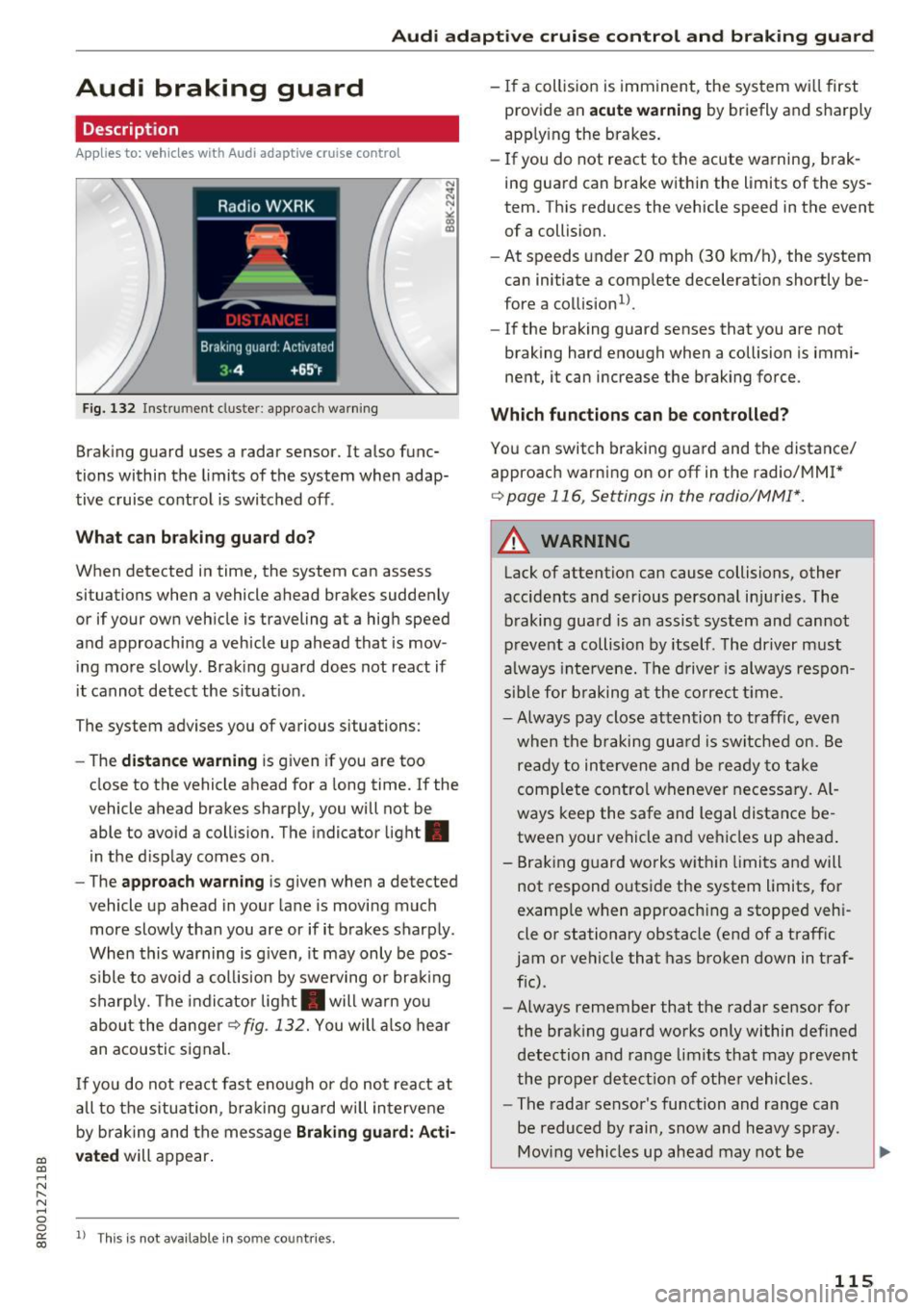
Fig. 132 Instrument cluste r: approach warning
Braking guard uses a radar sensor. It also func
tions within the limits of the system when adap
tive cruise control is switched off .
What can braking guard do?
When detected in time, the system can assess
situations when a vehicle ahead brakes suddenly
or if your own vehicle is traveling at a high speed
and approaching a vehicle up ahead that is mov
ing more slowly . Braking guard does not react if
it cannot detect the situat ion.
The system advises you of various situations:
- The
distance warning is g iven if you are too
close to the vehicle ahead for a long time.
If the
vehicle ahead brakes sharply, you will not be
able to avoid a collision. The indicator light .
in the display comes on.
- The
approach warning is given when a detected
vehicle up ahead in your lane is moving much
more slowly than you are or if it brakes sharply .
When this warning is g iven, it may only be pos
s ible to avo id a col lision by swerving or brak ing
sharp ly. Th e indicator light . will warn you
about the danger
¢fig. 132. You will also hear
an acoustic signal.
If you do not react fast enough or do not react at
all to the situation, braking guard will intervene
by braking and the message
Braking guard: Acti
vated
will appear.
1> Th is is not ava ilab le in some coun tries.
-If a collision is imminent, the system wi ll first
provide an
acute warning by briefly and sharply
apply ing the brakes.
- If you do not react to the acute warning, brak
ing guard can brake within the limits of the sys
tem. This reduces the vehicle speed in the event
of a collision.
- At speeds under 20 mph (30 km/h), the system
can initiate a comp lete decelerat ion shortly be
fore a collision
ll.
- If the braking guard senses that you are not
braking hard enough when a collision is immi
nent, it can increase the braking force .
Which functions can be controlled?
You can switch braking guard and the distance/
approach warn ing on or
off in the radio/MM!*
¢ page 116, Settings in the radio/MM!*.
A WARNING
-
Lack of attention can cause collisions, other
accidents and ser ious personal in juries. The
braking guard is an assist system and cannot
prevent a collision by itself. The driver must
always intervene. The driver is always respon
sible for braking at the correct tim e.
- Always pay close attention to traffic, even
when the braking guard is switched on. Be
ready to intervene and be ready to take
comp lete control whenever necessary. Al
ways keep the safe and legal distance be
tween your vehicle and vehicles up ahead .
- Braking guard works wit hin limits and will
not respond outside the system limits, for
examp le when approaching a stopped veh i
cle or stationary obstacle (end of a traffic
jam or vehicle that has broken down in traf
fic).
- Always remember that the radar sensor for
the braking guard works only within defined
detection and range limits that may prevent
the proper detect ion of other vehicles.
- The radar sensor's function and range can
be reduced by rain, snow and heavy spray.
Moving vehicles up ahead may not be
,.
115
Page 188 of 296
Intelligent Technology
Intelligent Technology
Electronic Stabilization
Control (ESC)
Description
The Electronic Stabilization Control (ESC) reinfor
ces driver safety . It reduces the risk of slipping
and improves driving stability. ESC detects crit i
cal s ituations such as the vehicle oversteering
and understeering or the wheels sp inning. The
veh icle is stab ilized by applying the brakes or re
ducing engine torque . Once t he ESC is active, the
indicator light
Ji) blinks in t he instrument clus
ter.
The fo llow ing systems are integrated in the ESC :
Ant i-loc k brake system (ABS)
ABS preve nts the wheels from locking up when
braking. The veh icle can still be steered even dur
ing hard brak ing. Apply steady pressure to the
brake pedal. Do not pump t he pedal. A pulsing in
the brake pedal indicates that the system is help
i n g you to brake the vehicle .
Br ake assist system
The brake assist system can decrease brak ing dis
tance . It increases braking power when the driver
presses the brake pedal quick ly in emergency sit
uations . You must press and hold the b rake pedal
until the situa tion is over. In vehicles w it h adap
tive c ruise contro l* , the brake assist system is
mo re sensit ive if the di stance de te cte d to the ve
h icle ahead is too small.
Anti -slip regulation (ASR)
ASR reduces eng ine power when the drive wheels
begin to spin and adapts t he force to the road
conditions . This makes it easie r to sta rt, acceler
ate and dr ive up h ills.
Electronic differential lock (EDL )
The EDL brakes w heels that a re spinning and
transfers the drive power to the other whee ls .
This f unction is not avai lab le at higher speeds.
In extreme cases, EDL automatically switches off
to help keep the brake on the braked wheel from
186
overheating . EDL will sw itch on again automati
ca lly when conditions have returned to normal.
Steering recommendation
The ESC he lps to s tabilize the vehicle by chang ing
t h e s teer ing torque.
On vehicles with dynam ic steeri ng*, ESC helps
stab ilize the steer ing in crit ica l sit uat io ns.
Selective wheel torque control
Se lective wheel torque cont rol is used when driv
i ng on curves. The front whee l on the inside of
the curve or both wheels on the inside of the cu rve are braked se lectively as needed. This al
l ows mo re precise dr iving in c urves . The applica
ble system may not ac tiv ate when d riving in wet
o r snowy cond it ions.
_&. WARNING
- The ESC and i ts in teg ra ted systems can not
overcome the laws of physics . This is espe
cially important on slippery or wet roads. If
the systems begin act ing to stab ilize your
veh icle, you should immediately change
your speed to match the road and traffic conditions. Do not let the increased safety
provided by t hese systems tempt yo u to
take risks. Doing so will i ncrease the r isk of
a loss of vehicle con trol, collisi on and se ri
ous person al injur ies.
- Always a dapt your speed to road, traffic and
weather condi tions. The risk of los ing c on
t rol of the vehicle in creases w hen driving
too fast, es pecially through curves and on
slippe ry or wet roads, and when driving too
close to ve hicles up ahead. The ESC and its
integ rated systems cannot always prevent
col lisions - there is still a risk of accidents!
- Always accelerate w ith special care on even,
smooth su rfaces s uch as those that are wet
or covered wit h ice and snow. The drive
wheels can spin even w it h these assistance
sys tems t hat cannot a lways help to reduce
t he risk of loss of vehicle co ntro l.
Page 193 of 296
CD
CD
.... N ,-... N ..... 0 0 C<'. 00
-Before descending a steep grade , reduce
speed and shift transm iss ion into a lower
gear or lower driving range. Do not ride the
brakes or hold the pedal down too long or
too often . This could cause the brakes to get
hot and d iminish brak ing efficiency .
- Do not "r ide the brakes" by resting your foot
on the pedal when you do not intend to
bra ke. This may cause the bra kes to over
heat , premat ure wea r and increased stop
ping distance.
- Under certa in climat ic and operating condi
tions su ch as p assing thro ugh w ater, dr iving
in heavy ra in or after washing the vehicle,
the ef fectiveness of the brakes can be re
duced. In winter, ice can acc umulate on the
brake pads, linings, discs and drums . Care
fully apply b rakes for a test. Brakes wi ll dry
and ice coatings wi ll be cleaned off after a
few careful brake applications .
- Driv ing for an extended period of time on
salt-covered roads without using your
bra kes can also affect bra king efficiency .
Clean off accumulated sa lt coating from
bra ke discs and pads with a few caref ul
bra ke appl ic a tion s.
- If you damage the front spoiler, or if yo u in
sta ll a differen t spoi le r, be sure the air flow
to the front br akes is not o bstru cte d. O the r
wise the br ake system could over heat reduc
ing the e ffec tiveness of the entire brake sys
tem.
- Failure of one brake circuit will imp air the
brak ing capability resulting in an increased
stopping distance . Avoid driving the vehicle
and have it towed to the nearest a uthorized
Audi dealer or qualif ied workshop.
- Never let the vehicle roll to a stop with the
engine shut off .
- If the brake booster is not wor king, the
brake pedal m ust be pressed considerably
harder to make up for the lack of booster
assistance .
Intelligent Technology
Electromechanical power
assist, Dynamic steering
The electromechanical power assist helps the
driver when steering .
Power steering adap ts elec tronically based on
the vehicle speed .
Indicator lights and message s
• Steering defecti ve! Do not drive vehicle!
If this indi ca to r li ght tur ns on and st ays on and
t hi s message appea rs, the powe r steering may
have failed.
Stop t he vehi cle in a safe location as soon as pos
s ible. Do
not cont inue drivi ng. See yo ur author
ized Audi dea ler or o ther qualif ied repa ir facility
for assistance .
l;rij Dynamic steering : Sy stem fault! You can
continue driving
If the indicator light turns on and the message
appea rs , the steer ing may be more diffic ult to
move o r more sensitive than usu a l. Th e steering
m ay also be at an angle when dr iving st raig ht.
D rive slowly to your a uthorized Aud i dea le r or
qualified wo rksh op to have t he malfunct io n cor
rec ted .
'Iij Dynamic steering: Initializing
Aud i drive select* : if the indicato r light blinks and
the driver message appears, the dynamic steer
ing* is re init ia liz ed . After sta rting the engine , the
steering wheel will move slig htly . Re -initializa
t io n m ight be necessary if the steer ing whee l was
moved hard to t he left and r ight wh ile the veh icle
was not mov ing. The display turns off if the initi
aliza tion was successful.
(D Tips
- If the . or l~ij indicato r light only stays on
for a shor t time, you m ay cont inue drivi ng.
- The dynam ic stee ring* sta bility systems
r=;, page 186 are no t ava ilable in the event of
a system mal func tio n.
- For add itiona l information on dy namic
steering*
r=;, page 122 .
191