tire pressure AUDI Q5 2017 Owner's Manual
[x] Cancel search | Manufacturer: AUDI, Model Year: 2017, Model line: Q5, Model: AUDI Q5 2017Pages: 296, PDF Size: 74.43 MB
Page 249 of 296
CD
CD
.... N ,-... N ..... 0 0 C<'. 00
Uniform tire quality grading
- T read wear
- Tractio n AA A B C
- Temperature ABC
Q ua lity grades ca n be found where ap plicable on
the tire side wall between tread shoulder and
maximum sect ion w idth
c:> page 230, fig. 202.
For example: Tread wear 200 , Traction AA, Tem
perature
A .
All passenge r ca r tires m ust conform to Federal
Safety Requirements in add ition to these grades .
Tread wear
The tread wear grade is a comparat ive rating
based on the wear rate of the t ire when tested
under cont ro lled conditions o n a specified gov
e rnment test course.
For example, a t ire graded
1 50 would wear one
and one ha lf
( 1 1/2) times as well on the gove rn
men t course as a tire g raded
100.
The relative performance of t ires depends upo n
the actual conditions of their use, howeve r, and
may depart significant ly from the norm due to
va ria tions in driving ha bits, serv ice practices and
d ifferences in road cha racteristics and climate .
Traction
The traction grades, from highest to lowest, are
AA, A, B and
C. T hose grades represent the t ire's
ab il ity to stop on wet pavement as meas ured un
de r contro lled condi tions on specified gove rn
ment tes t sur faces of asphalt and conc re te. A tire
mar ked C may have poor traction performance
c:> &. .
Temperature
The temperature grades are A (t he hi ghest), B ,
a nd C, represent ing the tire's resis tan ce to t he
generation o f heat and its ability to diss ipate
h eat when tested unde r contro lled conditions on
a specified indoor laboratory test whee l.
Sus ta ined hig h temper ature c an cause t he mate
r ial of the ti re to degenerate and red uce tire life,
and excessive temperatu re can lea d to sud den
tire fai lure
c:> &..
Wh eel s
The grade C cor responds to a level of perform
ance which all passenger car tires must meet un
der the Federal Motor Vehicle Safety Standa rd
No.
109 . Grades Band A represent higher levels
of pe rformance on the laboratory test wheel than
the minimum req uired by law .
A WARNING ,-
The tractio n grade assigned to this tire is
based on s traight-a head braking traction
t e st s, and does no t include acceler ation, co r
n eri ng, hy dropla ning or pe ak tra ction charac
terist ics.
A WARNING ,.,___
The tempera ture grade for t his tire is estab
lished for a tire that is properly inflated and
not overloaded . Excessive speed, underinfla
tion, or excessive loading, either separate ly or
i n comb inat ion, can cause heat bu ildup and
possib le tire fai lure.
A WARNING
-
Temperature g rades apply to tires that are
p roperly inflated a nd not over o r under inflat
ed.
Tire pressure monitoring system
ill General notes
App lies to : vehicles wi th tire pressure mo nito rin g syste m
-
Each tire, including the spare (if provided),
should be checked monthly whe n cold and inflat
ed to the inflat io n pressure recommended by the
vehicle manufacturer on the veh icle placard or
t ir e infla tion p ressure la be l. (If your ve hicle has
t ir es of a different size than t he si ze ind ic a ted on
the vehi cle placar d or tire in flat ion press ure la
bel, you sho uld dete rmine the proper tire infla
t ion pr ess ure for those tires) .
As an ad ded s afety feat ure, yo ur vehicle has been
equipped with a tire press ure mon itor ing system
( T PMS) t hat illuminates a low tire pressure tell
ta le wh en one or mo re of your tires is signif icant -
ly under-inf lated. According ly, when the low t ire
pressure telltale i llum inates, you shou ld stop and.,.
247
Page 250 of 296
Wheels
check your tires as soon as possible, and inflate
them to the proper pressure. Driving on a signifi
cantly under-inflated tire causes the tire to overheat and can lead to tire failure. Under-inflation
also reduces fuel efficiency and tire tread life,
and may affect the vehicle's handling and stop
ping ability.
Please note that the TPMS is not a substitute for
proper tire maintenance, and it is the driver's re
sponsibility to maintain correct tire pressure,
even if under-inflation has not reached the level
to trigger illumination of the TPMS low tire pres
sure telltale.
Your vehicle has also been equipped with a TPMS malfunction indicator to indicate when the sys
tem is not operating properly. The TPMS mal
function indicator is combined with the low tire pressure telltale. When the system detects a
malfunction, the telltale will flash for approxi
mately one minute and then remain continuously
illuminated. This sequence will continue upon
subsequent vehicle start-ups as long as the mal
function exists .
When the malfunction indicator is illuminated,
the system may not be able to detect or signal low tire pressure as intended . TPMS malfunctions
may occur for a variety of reasons, including the
installation of replacement or alternate tires or
wheels on the vehicle that prevent the TPMS from functioning properly . Always check the
TPMS malfunction telltale after replacing one or
more tires or wheels on your vehicle to ensure
that the replacement or alternate tires and
wheels allow the TPMS to continue to function
properly.
248
· If the Tire Pressure Monitoring System
indicator appears
Applies to: vehicles with Tire Pressure Monitoring System
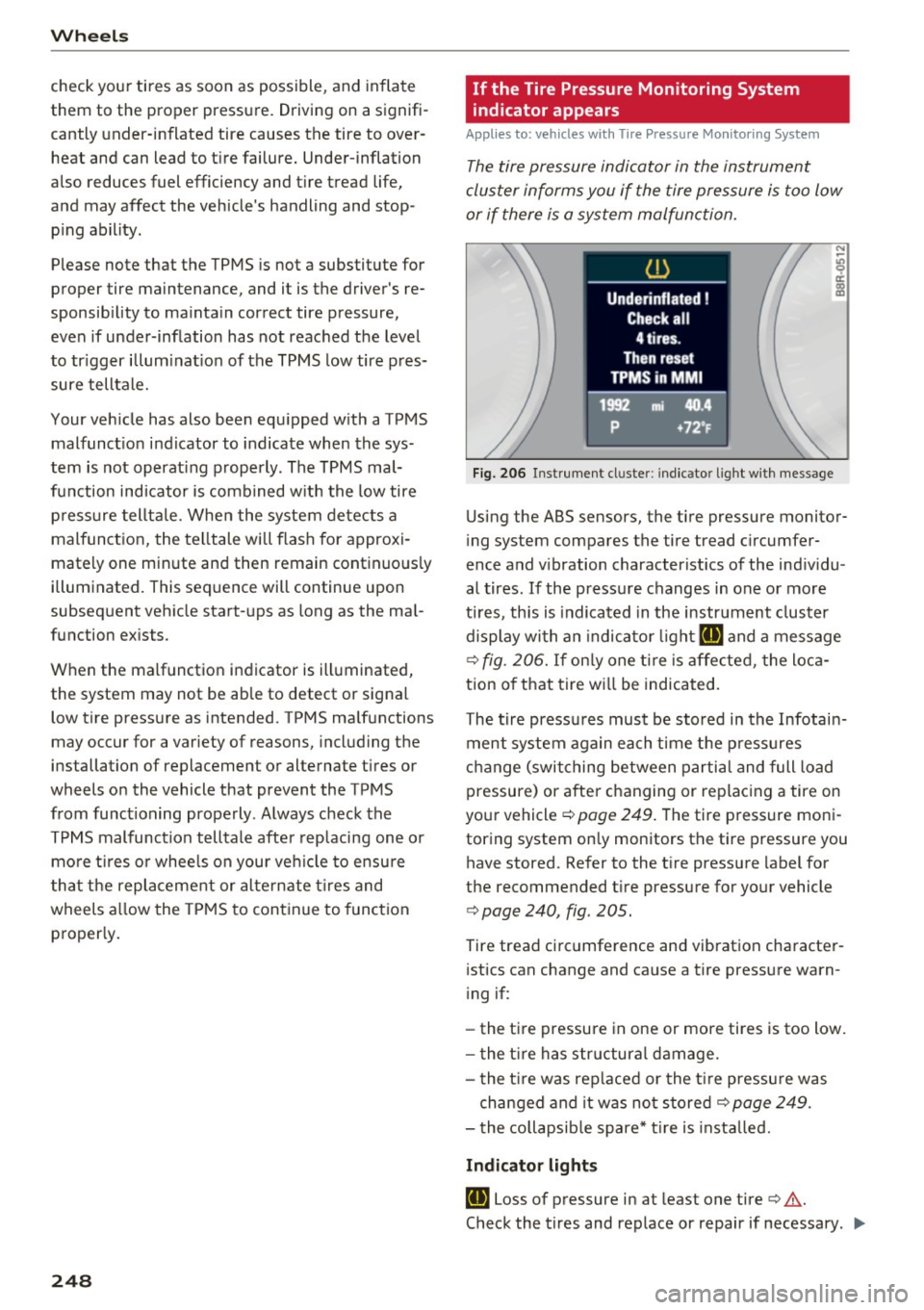
The tire pressure indicator in the instrument
cluster informs you if the tire pressure is too low
or if there is a system malfunction.
Fig. 206 Instrument cl uster: i ndic ator ligh t with message
Using the ABS sensors, the tire pressure monitor
ing system compares the tire tread circumfer
ence and vibration characteristics of the individu
al tires . If the pressure changes in one or more
tires , this is indicated in the instrument cluster
display with an indicator light
IE and a message
c>fig. 206. If only one tire is affected, the loca
tion of that tire will be indicated.
The tire pressures must be stored in the Infotain
ment system again each time the pressures
change (switching between partial and full load
pressure) or after changing or replacing a tire on
your vehicle
c> page 249. The tire pressure moni
toring system only monitors the tire pressure you have stored. Refer to the tire pressure label for
the recommended tire pressure for your vehicle
c> page 240, fig . 205.
Tire tread circumference and vibration character
istics can change and cause a tire pressure warn
ing if:
- the tire pressure in one or more tires is too low.
- the tire has structural damage.
- the tire was replaced or the tire pressure was
changed and it was not stored
c> page 249 .
-the collapsible spare* tire is installed.
Indicator lights
IE Loss of pressure in at least one tire c> &.
Check the tires and replace or repair if necessary . .,.
Page 251 of 296
CD
CD
.... N ,-... N .... 0 0 C<'. 00
Check/correct the pressures of all four tires and
store the pressure again in the Infotainment sys
tem ¢
page 249.
ffim (T ire Pressure Monitoring System) T ire
pressu re : S ys tem malfunction !. If ffim
appears
after switching the ignition on or whi le driving
and the
[I] indicator light in the instrument clus
ter blinks for approximate ly one minute and then
stays on, there is system malfunction. Try to
store the correct tire pressures¢
page 249. If
the ind icator light does turn off or turns on again
after a short period of time, dr ive to an author
i zed A udi dealer o r authorized Audi Service Fac ili
ty immediately to have the malfunc tion correct
ed .
& WARNING ,___ -
- If the tire pressure indicator appea rs in the
display, reduce your speed immed iate ly and
avoid any hard steer ing or braking maneu
vers. Stop as soon as possib le and check the
t ires and their pressure.
- The driver is responsib le for maintaining the
correct tire pressure. You must check the
t ire pressure regu larly.
- Under certa in conditions (such as a sporty
driv ing style, winter cond itions or unpaved
roads), the tire p ressure monitoring system
indicator may be delayed.
{D) Tips
- The t ire pressure monitoring system can al
so stop work ing when there is an ESC mal
funct ion.
- Using snow chains may result in a system
malfunction.
- The t ire pressure monitoring system in your
Audi was calibrated with "Audi Orig inal
Tires"
¢ page 23 7. We recommend that you
use these t ires.
Wh eel s
Storing tire pressures
App lies to : veh icles w ith Tir e Pressure Mo nito rin g Syste m
If the tire pressure changes or a tire is replaced,
it must be confirmed in the Infotainment sys
tem .
.,.. Make sure before storing t hat the t ire pressures
of all four tires meet the specified values and
are adapted to the load
¢ page 240 .
.,.. Switch the ignit ion on.
.,.. Select: the
I CAR ! funct io n key> Tire pre ssure
monitoring
> Ye s, store now . Or
.,.. Sele ct: the
I CAR I funct ion but ton > Car Sys
tem s*
control b utton > Service & check s > Tire
pressu re monitoring
> Store tire pre ssure >
Yes, store now.
@ Tips
Do not store the tire pressures if snow chains
are installed.
249
Page 254 of 296
Emerg ency assis ta nce
_& WARNING
- Never use the spare tire if it is damaged or if
it is worn down to the tread wear indicators .
- If the inflatable spare tire is more than 6
years old, use it only in an emergency and
with extreme caut ion and careful driving.
- The inflatable spare tire is intended only for
temporary and short-term use . It should be
replaced as soon as poss ible with the nor
mal wheel and tire.
- The tire pressure value for the inflatable
spare tire is located on the driver's s ide B
pillar
~ page 240, fig. 205.
- Max imum permissible speed is SO mph
(80 km/h).
- Avoid full-throttle accelerat ion, heavy brak
ing, and fast cornering.
- When the air is let out of the inflatable
spare wheel, it does not ass ume its folded
shape for several hours . Until then, it can
not be placed back in the spare wheel well
and stowed sec urely .
- Never dr ive with more than one inflatable
spare tire.
- For technical reasons, the use of tire chains
on the inflatab le spare tire is not perm itted.
If it is necessa ry to drive w ith tire chains,
the in flatable spare wheel m ust be mounted
on the front ax le in the event of a flat in a
rear tire. The newly avai lab le front wheel
must then be installed in place of the rear
wheel w ith the flat tire. Installing the tire
chain before mounting the wheel and tire is
recommended .
- Loose items in the passenger compartment
can cause ser ious personal injury during
hard braking or in an accident . Never store
the inflatable spare t ire or jac k* and tools in
the passenger compartment.
0 Note
- The inflatable spare tire has been developed
spec ifically for this vehicle model. It must
not be exchanged or used for other vehicle
models. Similarly, inflatable tires from oth
er vehicle models mus t no t be used.
252
- Norma l summer or winte r tires must not be
installed on the inflatable tire rim .
Inflating inflatable spare tire
Applies to: vehicles with inflatable spa re ti re
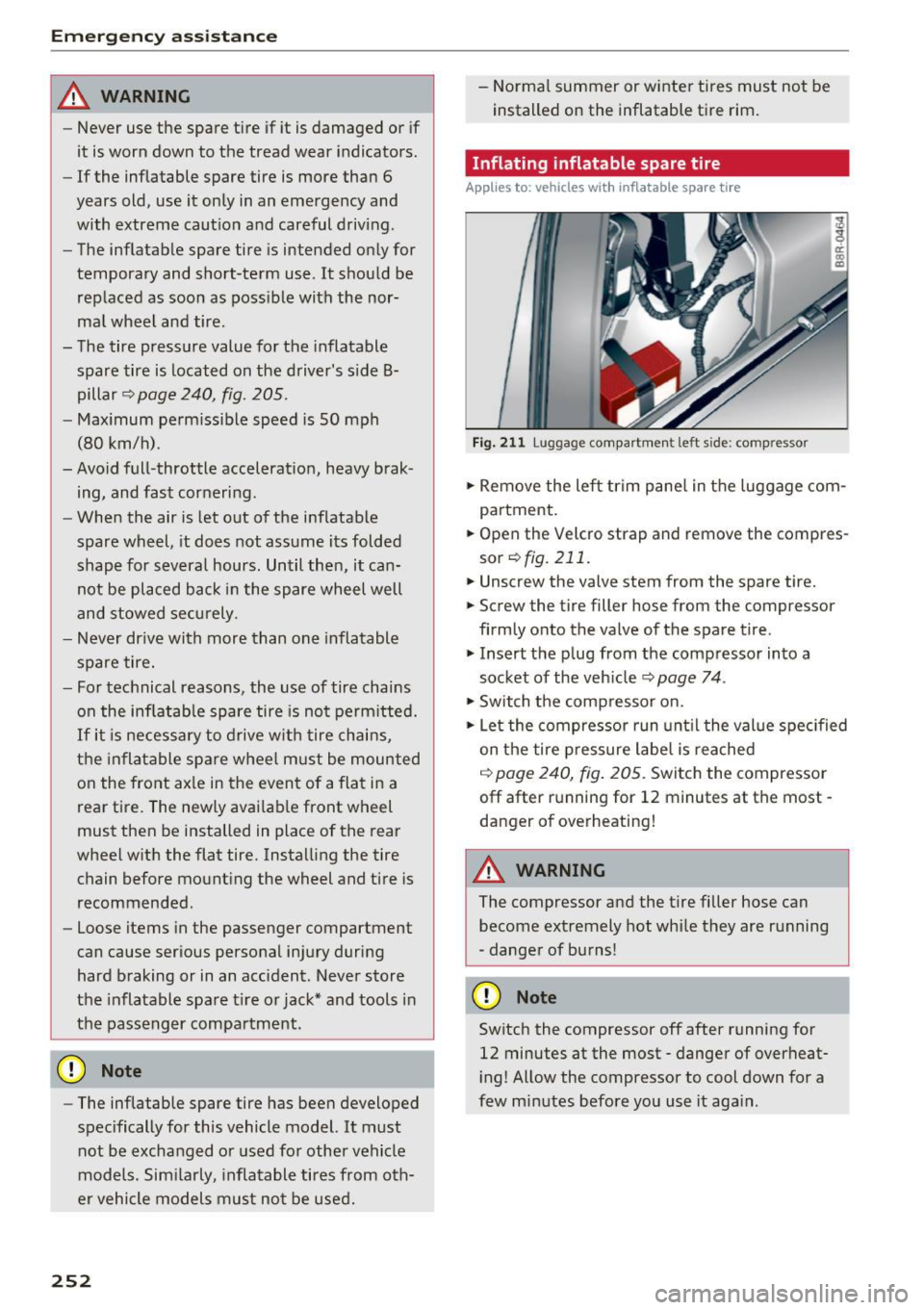
F ig . 211 Luggage compart men t left s ide : comp ressor
.,. Remove the left tr im pane l in the luggage com
partment.
.. Open the Velcro strap and remove the compres
sor
~ fig. 211.
.. Unscrew the valve stem from the spare tire.
.,. Screw the tire filler hose from the compressor
firmly onto the valve of the spare t ire.
.,. Insert the plug from the comp ressor into a
socket of the veh icle
~ page 74 .
.,. Switch the comp ressor on.
.,. Let the compressor run unt il the value spec ified
on the tire p ressure label is reached
~ page 240, fig. 205. Switch the compressor
off after r unning for 12 minutes at the most -
danger of overheating!
A WARNING
The compressor and the tire filler hose can become extremely hot whi le they are running
- danger of burns!
(D Note
Switch the compressor off after running for
12 minutes at the most - danger of overheat
i ng! Allow the compressor to cool down for a
few minutes before you use it aga in .
-
Page 255 of 296
a,
a,
..... N r-N ..... 0 0
0:
co
Tire mobility kit
General information and safety precautions
Appl ies to: ve hicles with tire repair kit
The tire repair is only meant for temporary use.
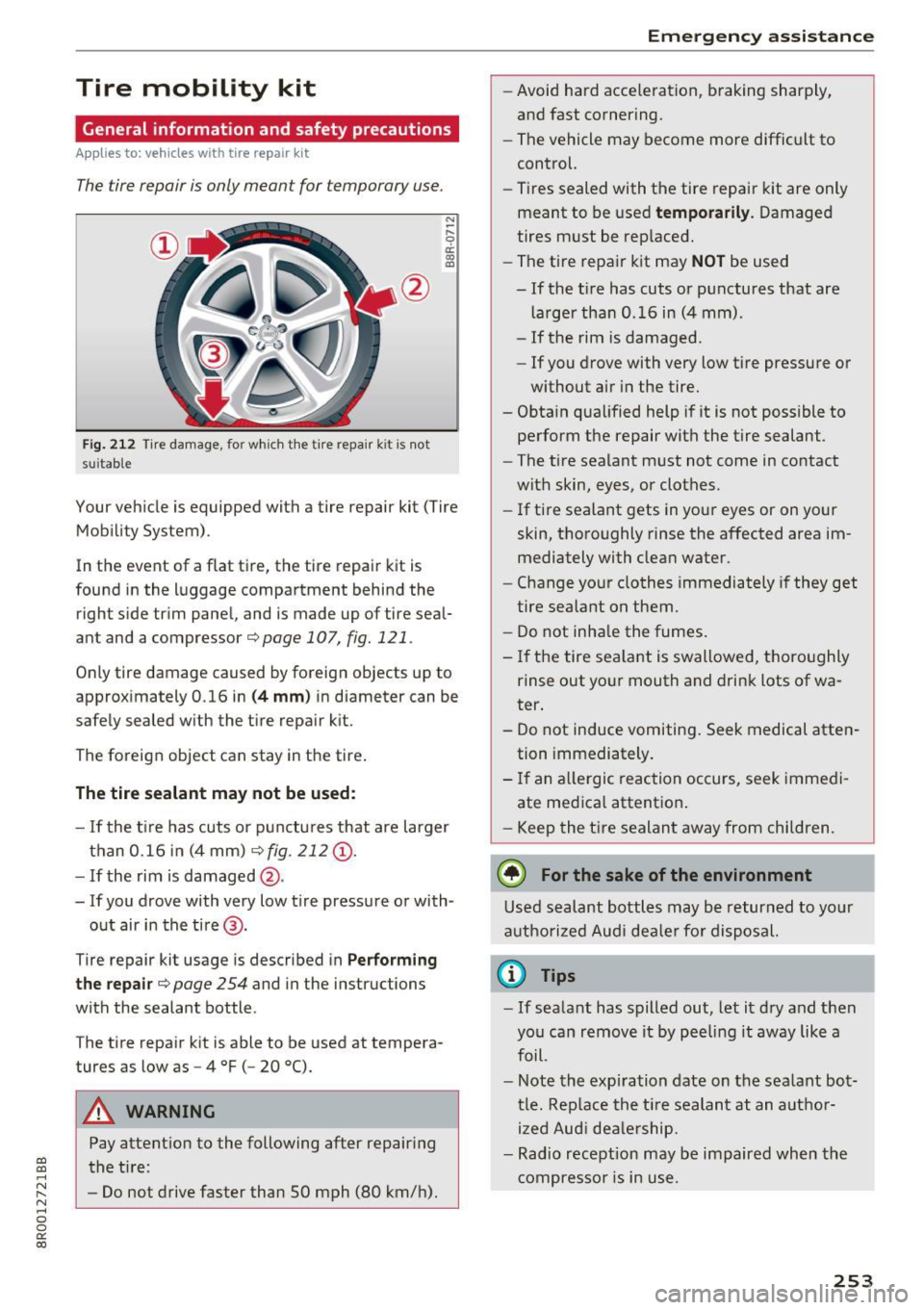
Fig. 212 T ire damage, for which the ti re repair kit is not
su itable
N
-r--0 ci: co ID
Your veh icle is equipped with a tire repair kit (Tire
Mobility System) .
In the event of a flat tire, the tire repair kit is
found in the luggage compartment behind the right side trim panel, and is made up of tire seal
ant and a compressor¢
page 107 , fig. 121 .
Only tire damage caused by foreign objects up to
approx imately 0.16 in
( 4 mm ) in diameter can be
safely sealed with the tire repair kit.
The foreign object can stay in the tire .
The tire sealant may not be used :
-If the t i re has cuts or punctures that are larger
than 0.16 in (4 mm)
,=;,fig. 212@.
-If the rim is damaged @.
- If you drove with very low t ire pressure or with-
out air in the tire@.
Tire repair kit usage is described in
Performing
t he repai r
c;, page 254 and in the instructions
with the sealant bottle .
The tire repair kit is able to be used at tempera
tures as low as -4
°F ( -20 °().
A WARNING
Pay attent ion to the following after repairing
the tire:
- Do not drive faster than SO mph (80 km/h).
Em ergen cy a ssis tanc e
-Avoid hard acce leration, braking sharply,
and fast cornering .
- The vehicle may become more difficult to
control.
- Tires sealed with the tire repair kit are only
meant to be used
t e mpo ra ril y . Damaged
tires must be replaced.
- The tire repa ir k it may
NO T be used
- If the t ire has cuts or punctures that are
larger than 0.16 in (4 mm) .
- If the rim is damaged.
- If you drove with very low tire pressure or
without air in the tire.
- Obta in qualified help if it is not possible to
perform the repair with the tire sealant.
- The tire sealant must not come in contact
with skin, eyes, or clothes.
- If tire sealant gets in your eyes or on your
skin, thoroughly rinse the affected area im
mediately with clean water .
- Change your clothes immediately if they get
tire sealant on them.
- Do not inha le the fumes .
- If the tire sea la nt is swallowed, thoro ughly
rinse out your mouth and drink lots of wa
ter .
- Do not induce vomiting . Seek medical atten
tion immediately.
- If an a llergic reaction occurs, seek immedi
ate med ica l attent ion .
- Keep the t ire sealant away from child ren.
@ For the sake of the environment
Used sealant bottles may be returned to yo ur
authorized Audi dea le r fo r disposal.
@ Tips
- If sealant has spilled out, let it dry and then
you ca n remove it by pee ling it away like a
foil.
- Note the expiration date on the sealant bot
tle. Rep lace the ti re sealant at an a utho r
ized Aud i dea le rship.
- Radio reception may be impaired when the
compressor is in use .
253
Page 256 of 296
Emergency assistance
Performing the repair
Applies to: vehicles w ith tire repair k it
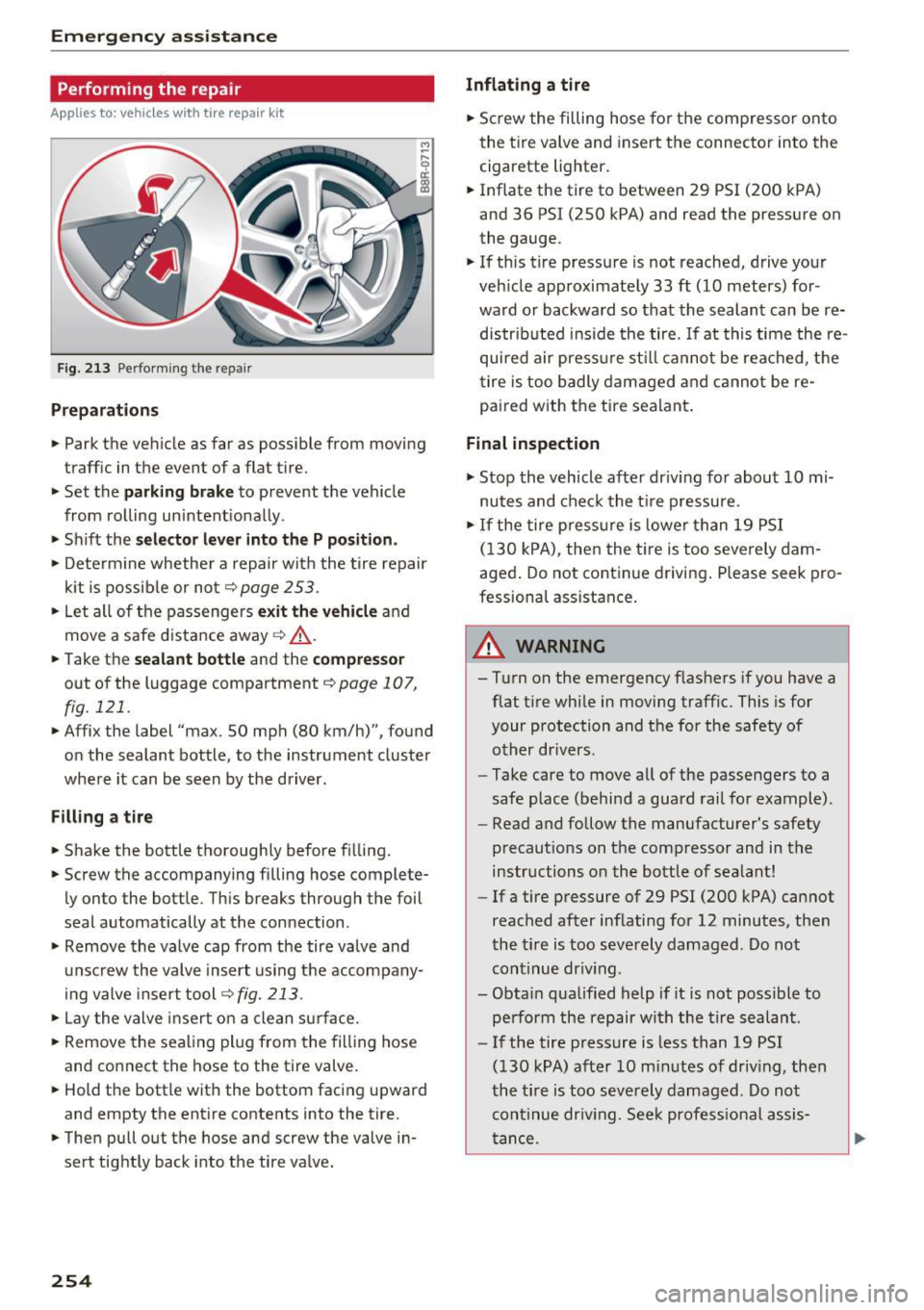
Fig. 213 Performing the repair
Preparations
.,. Park the vehicle as far as possible from moving
traffic in the event of a flat tire.
.,. Set the
parking brake to prevent the vehicle
from ro lling un intent ionally.
.,. Sh ift the
selector lever into the P po sition .
.,. Determ ine whether a repair with the tire repair
kit is possible or not¢
page 253.
.,. Let all of the passengers
exit the vehicle and
move a safe distance away¢_&. .
.,. Take the
sealant bottle and the compressor
out of the luggage compartment ¢ page 107,
fig. 121.
.,. Affix the label "max. 50 mph (80 km/h)", found
on the sealant bottle, to the instrument cluster
where it can be seen by the driver.
Filling a tire
.,. Shake the bottle thoroughly before fi lling.
.,. Screw the accompanying filling hose complete
ly onto the bottle. This breaks through the foil
seal automatically at the connection .
.,. Remove the valve cap from the tire valve and
unscrew the valve insert using the accompany
ing valve insert tool
~fig. 213 .
.,. Lay the valve insert on a clean surface .
.,. Remove the sealing plug from the filling hose
and connect the hose to the tire valve .
.,. Hold the bottle with the bottom facing upward
and empty the entire contents into the tire .
.,. Then pull out the hose and screw the valve in
sert tightly back into the tire valve.
254
Inflating a tire
.,. Screw the filling hose for the compressor onto
the tire valve and insert the connector into the
cigarette lighter.
.. Inflate the tire to between 29 PSI (200 kPA)
and 36 PSI (250 kPA) and read the pressure on
the gauge .
.,. If this tire pressure is not reached, drive your
veh icle approximately 33
ft (10 meters) for
ward or backward so that the sealant can be re
distr ibuted inside the tire. If at this time the re
qui red air press ure st ill cannot be reached, the
tire is too badly damaged and cannot be re
pa ired with the tire sealant .
Final inspection
.,. Stop the vehicle after dr iv ing for about 10 mi
nutes and check the tire pressure.
.,. If the tire pressure is lower than 19 PSI
(130 kPA), then the t ire is too severely dam
aged . Do not continue driving . Please seek pro
fessional ass istance .
&_ WARNING
- Turn on the emergency flashers if you have a
flat tire while in moving traffic. This is for
your protection and the for the safety of
other drivers.
- Take care to move all of the passengers to a
safe place (behind a guard rail for example) .
- Read and follow the manufacturer's safety
precaut ions on the compressor and in the
instructions on the bottle of sealant!
- If a tire pressure of 29 PSI (200 kPA) cannot
reached after inflating for 12 minutes, then
the tir e is too severely damaged. Do not
continue driving.
- Obta in qualified help if it is not possible to
pe rform the repair with the tire sealant .
- If the tire pressure is less than 19 PSI
(130 kPA) after 10 minu tes of driv ing, then
the tire is too severely damaged . Do not
con tinue driv ing. Seek profess ional assis
ta nce.
Page 261 of 296
CD
CD
.... N ,-... N .... 0 0 C<'. 00
~ Use the hexagonal socket in the screwdriver
handle to screw in and tighten all whee l bolts
slightly .
~ Remove the alignment pin and insert and tight
en the remaining wheel bolt slightly like the
rest .
~ Turn the jack handle* counter-clockwise to low
er the vehicle until the jack* is fully released .
~ Use the wheel bolt wrench to tighten all wheel
bolts firmly
Q page 256. Tighten them cross
wise,
from one bolt to the (approximately) op
posite one, to keep the wheel centered .
Q) Note
When removing or installing the whee l, the
rim could hit the brake rotor and damage the
rotor. Work carefu lly and have a second per
son help you.
(D Tips
Never use the hexagonal socket in the handle
of the screwdriver to loosen or tighten the
wheel bolts.
- Pull the reversible blade from the screwdriv
er before you use the hexagonal socket in
the handle to turn the wheel bolts.
- When mounting tires w ith
unidirectional
tread design
make sure the tread pattern is
pointed the right way
Q page 259.
- The wheel bolts should be clean and easy to
turn. Check for d irt and corrosion on the
mating surfaces of both the wheel and the
hub. Remove all dirt from these surfaces be
fore remount ing the wheel.
Tires with unidirectional tread design
Tires with unidirectional tread design must be
mounted with their tread pattern pointed in the
right direction .
Using a spare tire with a tread pattern
intended for use in a specific direction
When using a spare t ire with a tread pattern in
tended for use in a specific direction, please note
the following:
- The direct ion of rotat ion is marked by an arrow
on the side of the tire.
Emergency assistance
- If the spare tire has to be installed in the incor
rect direction, use the spare tire on ly tempora
r il y since the tire will not be able to ac hieve its
optimum performance characterist ics with re
gard to aquap lan ing, no ise and wear.
- We recommend that you pay part icu lar atten
tion to th is fact during wet weather and that
you adjust your speed to match road cond i
tions.
- Rep lace the flat tire w ith a new one and have it
installed on your veh icle as soon as possible to
restore the handling advantages of a un id irec
tional tire .
Notes on wheel changing
Please read the information Qpage 237, New
tires or wheels
if you are going to use a spare tire
which is different from the tir es on your veh icle.
After you change a tire:
- Check the tire pressure on the spare immedi
ately after installation.
- Have the wheel bolt tightening torque
checked with a torque wrench as soon as pos
sible by your authorized Audi dealer or a
qualified workshop.
- With steel and alloy wheel rims, the wheel
bolts are correctly tightened at a torque of
105
ft lb (140 Nm).
- If you notice that the wheel bolts are corroded
and difficult to turn while changing a tire,
they should be replaced before you check the
tightening torque.
- Replace the flat tire with a new one and have
it installed on your vehicle as soon as possi
ble. Remount the wheel cover.
Until then, drive with extra care and at reduced
speeds.
.&_ WARNING
- If you are going to equip your vehicle with
tires or rims which differ from those which
were fac tory installed, then be sure to read
the information
Q page 237, New tires or
wheels .
-
259
Page 288 of 296
Index
How safety belt pretensioners work ..... .
Hybrid drive .. .. .. ................ ... .
12 volt batteries .. ........... .... .. . 146
100
107
Consumption display . . . . . . . . . . . . . . . . . 107
Efficient drive mode . . . . . . . . . . . . . . . . . . 104
Energy flow display . . . . . . . . . . . . . . . . . . 106
EV mode . . . . . . . . . . . . . . . . . . . . . . . . . . . 103
High voltage battery . . . . . . . . . . . . . 100, 107
High voltage system . . . . . . . . . . . . . . . . . 100
Operating modes . . . . . . . . . . . . . . . . . . . . 103
Power meter . . . . . . . . . . . . . . . . . . . . . . . . 101
Starting the vehicle . . . . . . . . . . . . . . . . . . 101
Transport 108
I
Ignition
Switching on/off . . . . . . . . . . . . . . . . . . . . . 81
Ignition key Emergency unlocking . . . . . . . . . . . . . . . . . . 35
I gnition lock . . . . . . . . . . . . . . . . . . . . . . . . . . 81
Malfunction .... ................ .. 27, 31
Imbalance (wheels) . . . . . . . . . . . . . . . . . . . 238
Important things to do before driving . . . . 131
I mproperly worn safety belts . . . . . . . . . . . 146
Indicator lights . . . . . . . . . . . . . . . . . . . . 11, 102
Airbag system . . . . . . . . . . . . . . . . . . . . . . 159
PASSENGER AIR BAG OFF . . . . . . . . . . . . . 159
Infant seats . . . . . . . . . . . . . . . . . . . . . . . . . 17 4
I nflatable spare tire . . . . . . . . . . . . . . . . . . . 251
I nflating . . . . . . . . . . . . . . . . . . . . . . . . . . . 252
Inflation pressure (tires) . . . . . . . . . . . . . . . 240
Installing the upper tether strap on the an
chorage . . . . . . . . . . . . . . . . . . . . . . . . . . . . . 184
I nstrument cluster . . . . . . . . . . . . . . . . . . . . 101
Indicator lights . . . . . . . . . . . . . . . . . . . . . . 11
Messages . . . . . . . . . . . . . . . . . . . . . . . . . . . 11
I nstrument illum inat ion . . . . . . . . . . . . . . . . 53
Instruments . . . . . . . . . . . . . . . . . . . . . . . . . . . 8
I nstruments and controls
General illustration . . . . . . . . . . . . . . . . . . . . 6
I nterior lights
Front . . . . . . . . . . . . . . . . . . . . . . . . . . . . . . . 52
Rear . . . . . . . . . . . . . . . . . . . . . . . . . . . . . . . 52
Interval wiping . . . . . . . . . . . . . . . . . . . . . . . . 54
Rain sensor . . . . . . . . . . . . . . . . . . . . . . . . . . 54
286
J
Jump-starting 266
Jumper cables . . . . . . . . . . . . . . . . . . . . . . . . 267
Jump starting 107
K
Key...........
... .. .. ................ 33
Battery replacement . . . . . . . . . . . . . . . . . . 34
Check light . . . . . . . . . . . . . . . . . . . . . . . . . . 34
Emergency key . . . . . . . . . . . . . . . . . . . . . . . 83
lg n ition/ engine on/ off . . . . . . . . . . . . . . . . 81
Key replacement . . . . . . . . . . . . . . . . . . . . . 33
Master key with remote control . . . . . . . . . 33
Mechanica l key . . . . . . . . . . . . . . . . . . . . . . . 34
Removing . . . . . . . . . . . . . . . . . . . . . . . . . . . 83
Kick-down tiptronic . . . . . . . . . . . . . . . . . . . . . . . . . . . . 98
L
Lane Change Assistant
refer to Side assist . . . . . . . . . . . . . . . . . . . 118
LATCH . . . . . . . . . . . . . . . . . . . . . . . . . . . . . . 181
Description . . . . . . . . . . . . . . . . . . . . . . . . . 182
Installing a child restraint . . . . . . . . . . . . . 182
Location . . . . . . . . . . . . . . . . . . . . . . . . . . . 181
Mounting and releasing the anchorage
hook . . . . . . . . . . . . . . . . . . . . . . . . . . . . . . 182
Lateral angle . . . . . . . . . . . . . . . . . . . . . . . . . 198
Leather care/cleaning . . . . . . . . . . . . . . . . . 207
Lefthand drive .. .. .. .. ............. ... 51
Lifting jack . . . . . . . . . . . . . . . . . . . . . . . . . . 257
Light Coming home . . . . . . . . . . . . . . . . . . . . . . . . 50
Dayt ime runn ing lights . . . . . . . . . . . . . . . . 50
Driving light control. . . . . . . . . . . . . . . . . . . 49
Emergency flashers . . . . . . . . . . . . . . . . . . . 51
Exterior lighting . . . . . . . . . . . . . . . . . . . . . . 50
High beam . . . . . . . . . . . . . . . . . . . . . . . . . . 52
High beam warning/indicator light. . . . . . . 14
Leaving home . . . . . . . . . . . . . . . . . . . . . . . . 50
Sensor .. .. .. .. .. .. .. ...... .... ... .. . 49
Sensor defective . . . . . . . . . . . . . . . . . . . . . . 29
Switching on and off . . . . . . . . . . . . . . . . . . 49
Travel mode . . . . . . . . . . . . . . . . . . . . . . . . . 51
Turn signals . . . . . . . . . . . . . . . . . . . . . . . . . 52
Page 290 of 296
Index
Parking system
refer to Audi parking system plus with rear
view camera . . . . . . . . . . . . . . . . . . . . . . . . 125
Particle filter
refer to Diesel particulate filter . . . . . . . . . 31
Parts replacement . . . . . . . . . . . . . . . . . . . . 278
PASSENGER AIR BAG OFF light . . . . . . . . . . 159
Pedals . . . . . . . . . . . . . . . . . . . . . . . . . . . . . . 135
Physical principles of a frontal collision . . . 141
Polishing . . . . . . . . . . . . . . . . . . . . . . . . . . . . 206
Pollen filter
refer to Pollutant filter (climate control) . . 77
Pollutant filter (climate control) . . . . . . . . . . 77
Power Windows . . . . . . . . . . . . . . . . . . . . . . . . . . . 43
Power locking system
E mergency locking . . . . . . . . . . . . . . . . . . . . 39
L ocking and unlocking the vehicle from in-
side . . . . . . . . . . . . . . . . . . . . . . . . . . . . . . . . 39
Rear lid/trunk lid . . . . . . . . . . . . . . . . . . . . . 40
Selective unlock feature . . . . . . . . . . . . . . . 36
Settings . . . . . . . . . . . . . . . . . . . . . . . . . . . . 36
Switch . . . . . . . . . . . . . . . . . . . . . . . . . . . . . . 39
Unlocking and locking vehicle . . . . . . . . . . . 37
Power locks Windows open and closed . . . . . . . . . . . . . . 44
Power meter (hybrid drive) . . . . . . . . . . . . . 101
Power seat adjustment . . . . . . . . . . . . . . . . . 61
Power steering
refer to Electromechanical power assist .. 191
Power window regulators
Convenience opening/closing . . . . . . . . . . . 44
Malfunct ions . . . . . . . . . . . . . . . . . . . . . . . . 44
Pregnant women Special considerations when wearing a safe-
ty belt . . . . . . . . . . . . . . . . . . . . . . . . . . . . . 145
Pressure (tires) . . . . . . . . . . . . . . . . . . . . . . . 248
Proper safety belt position . . . . . . . . . . . . . . 144
Proper seating position Front passenger . . . . . . . . . . . . . . . . . . . . . 133
Occupants . . . . . . . . . . . . . . . . . . . . . . . . . . 132
Rear passengers . . . . . . . . . . . . . . . . . . . . . 134
Protecting . . . . . . . . . . . . . . . . . . . . . . . . . . . 206
Protective tray . . . . . . . . . . . . . . . . . . . . . . . . 68
288
Q
quattro
refer to All-wheel drive
Question What happens to unbelted occupants?
R
192
141
Rain sensor . . . . . . . . . . . . . . . . . . . . . . . . . . . S4
Defect ive . . . . . . . . . . . . . . . . . . . . . . . . . . . 29
Raising the vehicle . . . . . . . . . . . . . . . . . . . . 270
Reading lights . . . . . . . . . . . . . . . . . . . . . . . . . 52
Rear fog lights . . . . . . . . . . . . . . . . . . . . . . . . SO
Rear lid Automatic operation
Opening and closing
Rear light .
. ............. ... 41
40
Defective . . . . . . . . . . . . . . . . . . . . . . . . . . . 29
Rear seats Adjusting seat . . . . . . . . . . . . . . . . . . . . . . . 63
Rearview camera Parking mode 1 . . . . . . . . . . . . . . . . . . . . . 128
Parking mode 2 . . . . . . . . . . . . . . . . . . . . . 129
Rear view mirror . . . . . . . . . . . . . . . . . . . . . . . 57
Rear w indow heating . . . . . . . . . . . . . . . . . . . 79
Recirculation mode (climate control) . . . . . . 78
Red symbols . . . . . . . . . . . . . . . . . . . . . . . . . . 25
Refill engine oil . . . . . . . . . . . . . . . . . . . . . . . . 2 7
Refilling AdBlue With bottle . . . . . . . . . . . . . . . . . . . . . . . . . 215
With canister . ... .. .. ........ ..... .. 216
Refuelling . . . . . . . . . . . . . . . . . . . . . . . . . . . 212
Gasoline inhibitor flap . . . . . . . . . . . . . . . . 212
Release lever for hood . . . . . . . . . . . . . . . . . 217
Remote control key Unlocking and locking . . . . . . . . . . . . . . . . . 37
Remote control operation Garage door opener (Homelink) . . . . . . . . . 45
Remote rear lid release . . . . . . . . . . . . . . . . . 40
Repair manuals . . . . . . . . . . . . . . . . . . . . . . . 276
Repairs Airbag system 161
Replacing Light bu lbs . . . . . . . . . . . . . . . . . . . . . . . . . 264
Replacing wiper blades . . . . . . . . . . . . . . . . . 55
Reporting Safety Defects . . . . . . . . . . . 138, 139
Page 292 of 296
Index
Side airbags Description . . . . . . . . . . . . . . . . . . . . . . . . . 162
How they work . . . . . . . . . . . . . . . . . . . . . . 164
Side assist Activating and deactivating . . . . . . . . . . . . 120
Adjusting the brightness . . . . . . . . . . . . . . 120
Cleaning the sensors . . . . . . . . . . . . . . . . . 205
Description . . . . . . . . . . . . . . . . . . . . . . . . . 118
Sensor range . . . . . . . . . . . . . . . . . . . . . . . 119
Side curtain airbags . . . . . . . . . . . . . . . . . . . 165
Description . . . . . . . . . . . . . . . . . . . . . . . . . 165
How they work . . . . . . . . . . . . . . . . . . . . . . 166
Safety instructions . . . . . . . . . . . . . . . . . . . 167
Side marker lights . . . . . . . . . . . . . . . . . . . . . 49
Snow chains . . . . . . . . . . . . . . . . . . . . . . . . . 245
Socket . . . . . . . . . . . . . . . . . . . . . . . . . . . . . . . 74
Sound system display Driver information display . . . . . . . . . . . . . . 17
Sources of information about child restraints
and their use . . . . . . . . . . . . . . . . . . . . . . . . . 185
Speedometer . . . . . . . . . . . . . . . . . . . . . . . . . 10
Speed warning system . . . . . . . . . . . . . . . . . . 91
Start-Stop-System Engine does not switched off . . . . . . . . . . .
89
Engine starts automatically . . . . . . . . . . . . 89
Indicator lights . . . . . . . . . . . . . . . . . . . . . . 89
Messages . . . . . . . . . . . . . . . . . . . . . . . . . . . 91
Starting/stopping the engine . . . . . . . . . . . 89
Sw itching off/on . . . . . . . . . . . . . . . . . . . . . 90
Start/Stop system . . . . . . . . . . . . . . . . . . . . . 88
START ENGINE STOP button (Convenience key) . . . . . . . . . . . . . . . . . . . . . . . . . . . . . . 84, 85
Starting from rest . . . . . . . . . . . . . . . . . . . . . . 87
Starting off with a trailer . . . . . . . . . . . . . . . . 87
Starting the engine . . . . . . . . . . . . . . . . . 81, 84
Starting (engine) . . . . . . . . . . . . . . . . . . . . . 101
Steering Electromechanical power assist ..... . 191, 0
Indicator light . . . . . . . . . . . . . . . . . . . . . . 191
Locking the steering . . . . . . . . . . . . . . . . . . 8 1
Malfunction .. .. ................ .. 27, 3 1
Manually adjusting the steering wheel . . . . 81
also refer to Electromechanical power as-
sist . . . . . . . . . . . . . . . . . . . . . . . . . . . . . . . 191
Steering wheel column Adjusting manually . . . . . . . . . . . . . . . . . . . 81
Steps for determining correct load limit . . . 244
290
Stopping the engine . . . . . . . . . . . . . . . . . 83, 8S
Stopping (engine) . . . . . . . . . . . . . . . . . . . . . 101
Storage . . . . . . . . . . . . . . . . . . . . . . . . . . . . . . 74
(upholder door pockets . . . . . . . . . . . . . . . . 73
Glove compartment . . . . . . . . . . . . . . . . . . . 75
Sun shade . . . . . . . . . . . . . . . . . . . . . . . . . . . . 53
Sun visors . . . . . . . . . . . . . . . . . . . . . . . . . . . . 53
Supplementary (climate control) 80
Switches Emergency flashers . . . . . . . . . . . . . . . . . . . 51
Symbols Red . . . . . . . . . . . . . . . . . . . . . . . . . . . . . . . . 25
Yellow.... .. .. .. .. .. .. ........... .. . 28
T
Tachometer . . . . . . . . . . . . . . . . . . . . . . . . . . . . 9
Tail lights
Cleaning . . . . . . . . . . . . . . . . . . . . . . . . . . . 205
TOI clean diesel
refer to Ad Blue ... .. .. ............... 214
Technica l data . . . . . . . . . . . . . . . . . . . . . . . . 272
Technical modifications . . . . . . . . . . . . . . . . 278
Tether anchors . . . . . . . . . . . . . . . . . . . . . . . 183
Tether strap . . . . . . . . . . . . . . . . . . . . . . . . . 183
Tie-down rings . ... .. .. ............ 67, 137
tiptronic Automat ic Shift Lock (ASL) . . . . . . . . . . . . . 95
Driving . . . . . . . . . . . . . . . . . . . . . . . . . . . . . 96
Emergency mode . . . . . . . . . . . . . . . . . . . . . 98
Hill descent control . . . . . . . . . . . . . . . . . . . 97
Kick-down . . . . . . . . . . . . . . . . . . . . . . . . . . . 98
Manual shift program . . . . . . . . . . . . . . . . . 98
Selector lever . . . . . . . . . . . . . . . . . . . . . . . . 94
tiptronic (automatic transmission) . . . . . . . . 94
Tire Mobility System . . . . . . . . . . . . . . . . . . . 107
Tire Mobility System (tire repair set) . . . . . . 253
Tire pressure mon itoring system
Loss of air pressure . . . . . . . . . . . . . . . . . . . 13
Tires .... ... .. .. .. .. .. ........ ..... .. 230
Low aspect ratio tires . . . . . . . . . . . . . . . . 246
Repair set . . . . . . . . . . . . . . . . . . . . . . 107, 253
Replacing . . . . . . . . . . . . . . . . . . . . . . . . . . 255
Service life . . . . . . . . . . . . . . . . . . . . . . . . . 238
Tire pressure . . . . . . . . . . . . . . . . . . . . . . . 240
Tire pressure monitoring system ... 247, 248
Tire pressure table . . . . . . . . . . . . . . . . . . . 241