tire pressure AUDI Q5 2017 User Guide
[x] Cancel search | Manufacturer: AUDI, Model Year: 2017, Model line: Q5, Model: AUDI Q5 2017Pages: 296, PDF Size: 74.43 MB
Page 206 of 296
Care and cleaning
Care and cleaning
General information
Regular, proper care helps to maintain your vehi
cle's value.
It can also be a requirement when
submitting warranty claims for corrosion damage
and paint defects on the body.
The necessary care products can be obtained
from an authorized Audi dealer or authorized
Audi Service Facility. Read and follow the instruc
tions for use on the packaging.
A WARNING
-Using cleaning and care products incorrectly
can be dangerous to your health .
- Always store cleaning and care products out
of reach of children to reduce the risk of poi
soning .
@ For the sake of the environment
- Preferably purchase environmentally-friend
ly cleaning products.
- Do not dispose of leftover cleaning and care
products with household trash.
Car washes
The longer that deposits such as insects, bird
droppings, tree sap or road salt remain on the ve hicle, the more the surface can be damaged. High
temperatures such as those caused by sunlight
increase the damaging effect .
Before washing, rinse off heavy deposits with
plenty of water.
Stubborn deposits such as bird droppings or tree
sap are best removed with plenty of water and a microfiber cloth.
Also, wash the underside of your vehicle once road salt stops being used for the season .
Pressure washers
When washing your veh icle w ith a pressure wash
er, always follow the operating instructions pro
vided with the pressure washer. This is especially
important in regard to the pressure and spraying
distance. Do not aim the spray directly at the
204
seals on the side windows, doors, lids or the sun
roof* or at tires, rubber hoses, insulating materi
al, sensors* or camera lenses* . Keep a distance of
at least 16 inches (40 cm).
Do not remove snow and ice with a pressure
washer.
Never use cone nozzles or high pressure nozzles.
The water temperature must not be above 140 °F
(60 °().
Automatic car washes
Spray off the vehicle before washing.
Make sure that the windows and roof* are closed
and the windshield wipers are off . Follow instruc
tions from the car wash operator, especially if
there are accessories attached to your vehicle.
If possible, use car washes that do not have
brushes.
Washing by hand
Clean the vehicle starting from the top and work
ing down using a soft sponge or cleaning brush.
Use solvent-free cleaning products.
Washing vehicles with matte finish paint by
hand
To avoid damaging the paint when washing, first
remove dust and large particles from your vehi
cle. Insects, grease spots and fingerprints are
best removed with a special cleaner for matte
finish paint .
Apply the product using a microfiber cloth. To
avoid damaging the paint surface, do not use too
much pressure.
Rinse the vehicle thoroughly with water. Then
clean using a neutral shampoo and a soft micro
fiber cloth .
Rinse the veh icle thoroughly again and let it air
dry. Remove any water residue using a chamois .
A WARNING
-
- Only wash the vehicle when the ignition is
off and follow the instructions from the car
Page 234 of 296
Wheel s
® Mud and snow capability
"M/5" or "M+S" indicates the tire
is sui table for driving on mud and
snow.
& indicates a winter tire.
@ Composition of the tire cord
and materials
The number of plies indicates the
number of rubberized fabric lay
ers in the t ire. In general: the
more layers, the more weight a
tire can carry . Tire manufacturers
must also specify the materials
used in the tire. These include
steel, nylon, po lyester and other
materials.
@ Maximum permitted load
This number indicates the maxi
mum load in kilograms and
pounds that the tire can carry .
@Uniform tire quality grade
standards for treadwear,
traction and temperature resist ance
Treadwear, traction and tempera
ture ranges ¢
page 247.
@ Running direction
The arrows indicate the running
direction of unidirectional t ires .
You must always follow the speci
fied running direction
¢page 259.
232
@ Ma ximum permitted
inflation pressure
This number indicates the maxi
mum pressure to which a tire can
be inflated under normal operat
ing condit ions.
Glossary of tire and loading
terminology
Acces sory we ight
means the combined weight (in
excess of those standard items
which may be replaced) of auto matic transmission, power steer
ing, power brakes, power win
dows, power seats, radio, and
heater, to the extent that these
items are available as factory-in
stalled equipment (whether in
stalled or not) .
Aspect ratio
means the ratio of the height to
the width of the tire in percent .
Numbers of 55 or lower indicate a
low sidewall for improved steer
ing response and better overall
handling on dry pavement.
Bead
means the part of the tire that is
made of steel wires, wrapped or
reinforced by ply cords and that is
shaped to fit the r im . ...
Page 235 of 296
Bead separa tion
means a breakdown of the bond
between components in the bead.
Cord
means the strands forming the
plies in the tire .
Cold tire inflation pressure
means the tire pressure recom
mended by the vehicle manufac
turer for a tire of a designated size that has not been driven for
more than a couple of miles (kilo
meters) at low speeds in the
three hour period before the tire
pressure is measured or adjusted .
Curb weight
means the weight of a motor ve
hicle with standard equipment in
cluding the maximum capac ity of
fuel, oi l, and coolant, a ir condi
tioning and add itional weight of
optional equipment.
E xtra load tire
means a tire designed to operate
at higher loads and at h igher in
flation pressures than the corre sponding standard tire. Extra load
tires may be identified as "XL",
g; "xl", "E XTRA LOAD" , or "RF" on
-~ the sidewal l.
-0 0 0: a:,
Wheels
Gross Axle Weight Rating
(" GAWR")
means the load-carrying capacity
of a single axle system, measured
at the tire -ground interfaces.
Gross Vehicle Weight Rating
(" GVWR ")
means the max imum total loaded
weight of the vehicle.
Groove
means the space between two ad
jacent tread ribs .
Load rating (code)
means the maxim um load that a
tire is rated to carry for a given in
flat ion pressure . You may not f ind
this informat ion on all tires be
cause it is not required by law.
Maximum load rating
means the load rating for a tire at
the maximum permissible infla
tion pressure for that tire .
Maximum loaded vehicle
weight
means the sum of:
(a) Curb weight
(b) Accessory weight
(c) Vehicle capacity we ight , and
(d) Production options we ight
233
Page 236 of 296
Wheel s
Maximum (permissible)
inflation pressure
means the max imum cold infla
tion pressure to which a t ire may
be inflated . Also called "maxi
mum inflation pressure."
Normal occupant weight
means 150 lbs. (68 k ilograms)
times the number of occupants seated in the vehicle up to the to
tal seating capacity of your vehi
cle .
Occupant distribution
means distribution of occupants
in a vehicle.
Outer d iameter
means the overall diamete r of an
inflated new tire.
Overall width
means the linear distance be
tween the exteriors of the side
walls of an inflated tire , including
elevations due to labeling, deco rations, or protective bands or
ribs .
Ply
means a layer of rubber-coated
para llel cords.
234
Production options we ight
means the combined weight of
those installed regular product ion
options weighing over 5 lbs . (2 .3
kg) in excess of those standard
items which they replace, not pre
viously considered in curb weight or accessory weight , including
heavy duty brakes, ride levelers,
roof rack, heavy duty battery, and
special trim.
Radial ply ti re
means a pneumatic tire in which
the ply cords that extend to the beads are la id at substantially 90
degrees to the centerline of the
tread.
Recommended inflation
pressure
see ¢ page 233 , Cold tire infla
tion pressure.
Reinforced tire
means a tire designed to operate
at higher loads and at higher in
flation pressures than the corre
sponding standard tire . Rein
forced tires may be identified as "XL", "xl", "EXTRA LOAD", or "RF"
on the sidewall. ...
Page 237 of 296
a,
a,
-N r-N
-0 0 0: a:,
Rim
means a metal support for a tire
or a tire and tube assembly upon
which the tire beads are seated.
Rim di amet er
means nominal diameter of the
bead seat. If you change your
wheel size, you will have to pur
chase new tires to match the new
rim diameter.
Rim size designation
means rim diameter and width.
Rim width
means nominal distance between
rim flanges.
Sidewall
means that portion of a tire be
tween the tread and bead.
Speed rating (letter code )
means the speed at wh ich a tire is
designed to be driven for extend
ed periods of time . The ratings
range from 93 mph (150 km/h)
to 186 mph (298 km/h)
¢ table
on page 231.
You may not find
this information on all tires be
cause it is not required by law.
The speed rating letter code,
where applicable, is molded on
the tire sidewall and indicates the
Wheels
maximum permissible road
speeds
¢ A in Winter tires on
page 245.
T ire pressure mon itoring
system *
means a system that detects
when one or more of a vehicle's
tires are underinflated and illumi
nates a low tire pressure warning
telltale.
T read
means that portion of a tire that
comes into contact with the road .
Tread separation
means pulling away of the tread
from the tire carcass.
Treadwear indicators (TWI )
means the projections within the
principal grooves designed to give
a visual indication of the degrees
of wear of the tread. See
¢ page 239, Treadwear indicator
for more information on measur
ing tire wear .
Uniform Tire Quality Grading
is a tire information system devel
oped by the United States Nation
a l Highway Traffic Safety Admin
istration (NHTSA) that is designed
to help buyers make relative
235
..
Page 240 of 296
Wheels
&,. WARNING -
-Only use tire/rim combina
tions and suitable wheel bolts
that have been approved by
Audi. Otherwise, damage to
the vehicle and an accident could result.
-For technical reasons, it is not
possible to use tires from oth
er vehicles -in some cases,
you cannot even use tires from
the same vehicle model.
-Make sure that the tires you
select have enough clearance
to the vehicle. Replacement
tires should not be chosen
simply based on the nominal
size, because tires with a dif
ferent construction can differ
greatly even if they are the
same size. If there is not enough clearance, the tires or
the vehicle can be damaged and this can reduce driving
safety and increase the risk of
an accident.
-Only use tires that are more
than six years old when abso
lutely necessary and drive
carefully when doing so.
-Do not use run-flat tires on
your vehicle. Using them when
238
not permitted can lead to ve
hicle damage or accidents.
-If you install wheel covers on the vehicle, make sure they allow enough air circulation to
cool the brake system. If they do not, this could increase the
risk of an accident.
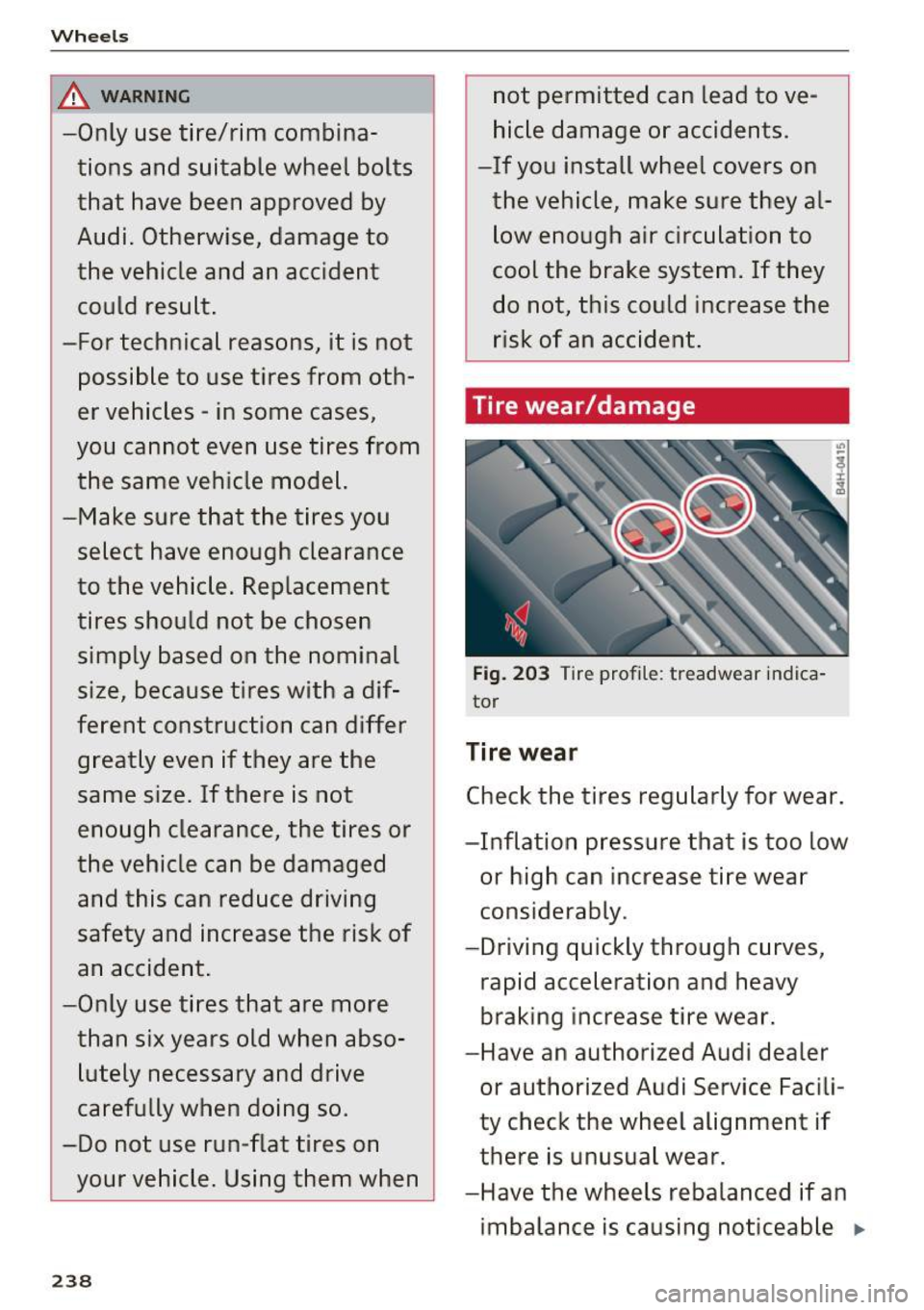
Tire wear/damage
Fig. 203 Tire profile: treadwear indica
tor
Tire wear
Check the tires regularly for wear.
-Inflation pressure that is too low
or high can increase tire wear
considerably.
-Dr iving quickly through curves,
rapid acceleration and heavy
braking increase tire wear.
-Have an authorized Audi dealer
or authorized Audi Service Facili
ty chec k the wheel alignment if
there is unusual wear.
-Have the wheels rebalanced if an imbalance is causing noticeable
i.
Page 242 of 296
Wheels
through curves and when braking, which increases the risk of
an accident.
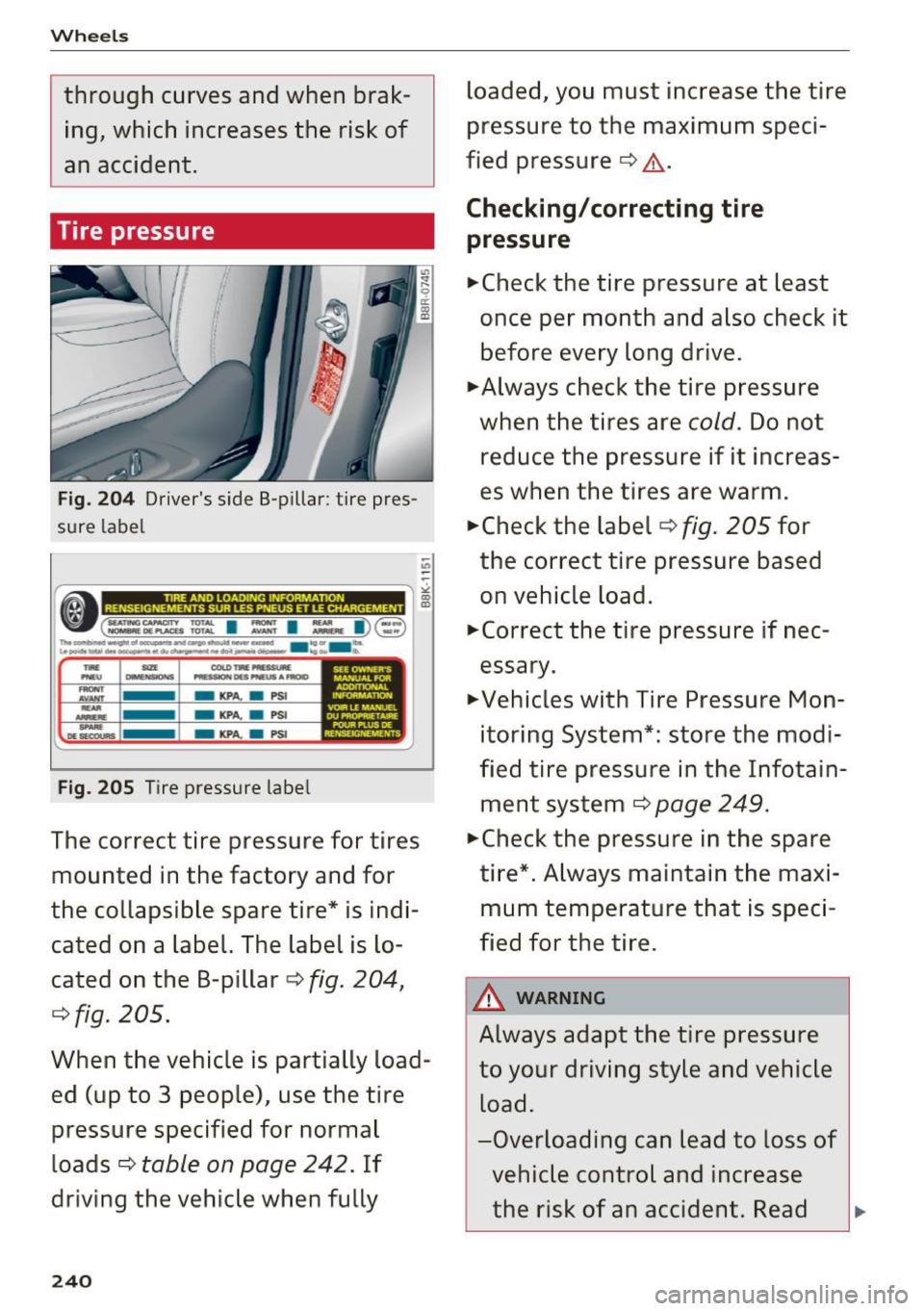
Tire pressure
Fig . 204 Driver's side B-pillar: tire pres
sure label
,_,
AVANT -KPA. -PSI
.::.. -KPA. -
PSI j
l~ "'= =-== ===- = KPA.= ·= PSI== ~~~
Fig. 205 Tire pressure label
The correct tire pressure for tires
mounted in the factory and for
the collapsible spare tire* is indi
cated on a label. The label is lo
cated on the 8-pillar
¢ fig. 204,
¢ fig. 205.
When the vehicle is partially load
ed (up to 3 people), use the tire pressure specified for normal
loads ¢
table on page 242. If
driving the veh icle when fully
240
loaded, you must increase the tire
pressure to the maximum speci
fied pressure ¢
.&,.
Checking/correcting tire
pressure
.,.Check the tire pressure at least
once per month and also check it before every long drive .
.,.Always check the tire pressure
when the tires are
cold. Do not
reduce the pressure if it increas
es when the tires are warm.
... check the labe l¢
fig. 205 for
the correct tire pressure based
on vehicle load .
.,.Correct the tire pressure if nec
essary .
... vehicles with Tire Pressure Mon
itoring System*: store the modi
fied tire pressure in the Infotain ment system
¢ page 249 .
... Check the pressure in the spare
tire*. Always maintain the maxi mum temperature that is speci
fied for the tire.
A WARNING ~
Always adapt the t ire pressure
to your driving style and vehicle load.
-Overloading can lead to loss of vehicle control and increase
the risk of an accident. Read
Page 243 of 296
a,
a,
-N r-N
-0 0 0: a:,
and follow the important safe
ty precautions inc:::>
page 242,
Tires and vehicle load limits .
-The tire must flex more if the
tire pressure is too low or if
the vehicle speed or load are
too high . This heats the tire up
too much. This increases the risk of an accident because it
can cause the tire to burst and result in loss of vehicle con
trol.
- Incorrect tire pressure in
creases tire wear and has a negative effect on driving and
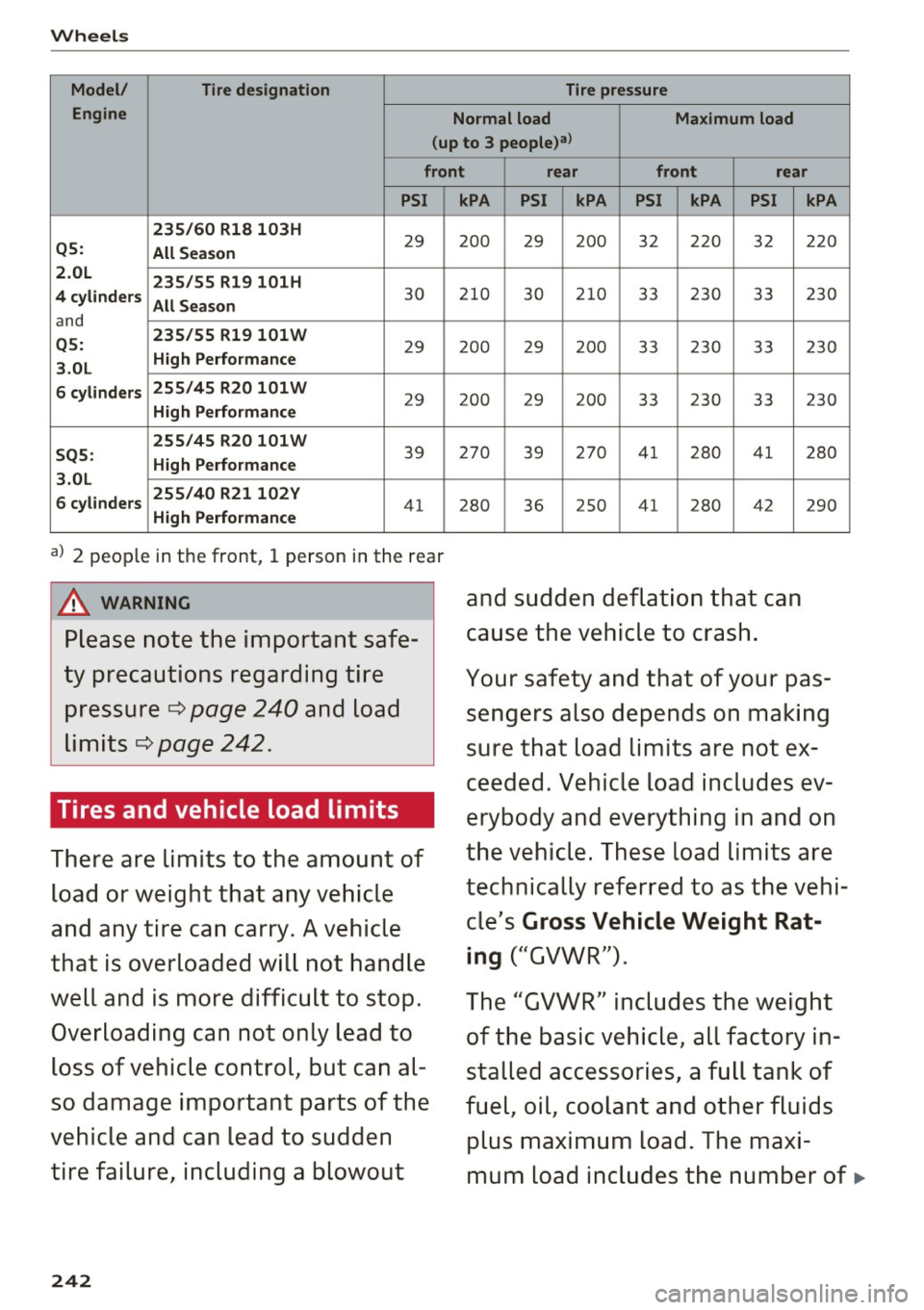
Tire pressure table
Please note that the information
contained in the following table
was correct at the time of print ing, and the information is sub
ject to change . If there are differ
ences between this information
and the tire pressures specified
on the label on the driver's side B
pillar, always follow the specifica
tion on the B-pillar label
c:::> page 240, fig. 204.
Wheels
braking behavior, which in
creases the risk of an accident.
Replace lost valve caps to re
duce the risk of damage to the
tire valves.
Tire pressure that is too low in creases fuel consumption.
Audi recommends using the
tire pressure specified for a
normal load
c:::> table on
page 242
or for a full load
when the vehicle is partially
loaded .
Make sure that the tire designa
tion on your tire matches the des
ignation on the tire pressure label
and the tire pressure table .
The following table lists recom
mended tire pressures in cold
tires according to the load and
the size of the tires installed .
241
Page 244 of 296
Wheels
Model/ Tire designation Tire pressure
Engine Normal load
Maximum load
(up to
3 people)a)
front rear front rear
PSI
235/60 Rl8 103H
29 Q5:
All Season
2.0L 235/55 Rl9 101H
4 cylinders
All Season
30
and
Q5: 235/55 Rl9
101 W 29 High Performance
3.0L
6 cylinders 255/45 R20 101W
29 High Performance
255/45R20101W
39 SQ5:
High Performance
3.0L
6 cylinders 255/40
R21102Y
41 High Performance
a) 2 people in the front, 1 perso n in the r ear
A WARNING
Please note the important safe
ty precautions regarding tire pressure ¢
page 240 and load
limits ¢
page 242.
Tires and vehicle load limits
There are limits to the amount of
load or weight that any vehicle
and any tire can carry . A vehicle
that is overloaded will not handle
well and is more difficult to stop.
Overloading can not only lead to
loss of vehicle control, but can al
so damage important parts of the
vehicle and can lead to sudden
tire failure, including a blowout
242
kPA PSI kPA PSI kPA PSI
200 29 2 00 32 220 32
210 30 210 33 230 33
200 29 200 33 230 33
2 00 29 2 00 3 3 230 33
270 39 270 41 280 41
2 80
36 2
50 41
28 0 42
and sudden deflation
that can
cause the vehicle to crash.
kPA
220
230
230
230
280
2 9 0
Your safety and that of your pas
sengers also depends on making
sure that load limits are not ex
ceeded. Vehicle load includes ev
erybody and everything in and on
the vehicle. These load limits are
technically referred to as the vehi
cle's
Gross Vehicle Weight Rat
ing
("GVWR") .
The "GVWR" includes the weight
of the basic vehicle, all factory in
stalled accessories , a full tank of
fuel, oil, coolant and other fluids
plus maximum load. The maxi
mum load includes the number of
11-
Page 248 of 296
Wheels
damage the ti res, and the chains w ill quickly be
destroyed .
A WARNING
Using incorrect snow chains or insta lling snow
chains incorrectly can result in loss of vehicle
control, which increases the risk of an acc i
dent .
(D Note
Snow chains can damage the rims/wheel cov
ers * if the chains come into d irect contact
w ith them. Remove the wheel covers* first .
Use coated snow chains.
(D Tips
When using snow cha ins, it may be useful to
sw itch the off road mode on ¢
page 187.
Low aspect ratio tires
Your Audi is factory -equipped with low aspect ra
tio tires. These t ires have been tho roughly tested
a nd been se lected specifically fo r yo ur model fo r
thei r supe rb per fo rman ce , road feel and handling
un der a va riety of d riving conditions . As k yo ur au
thor ized Audi dealer for mo re details .
T he low aspect ratio of these t ires is in dicated by
a nume ral of
55 or less in the tire's size desig na
tion . The numera l rep resents the rat io o f th e
tire's sidewall he ight in relat ion to its tread width
expressed in pe rcentage. Conventional tires have
a height/w idt h rat io o f 60 o r more .
The performance of low-aspect -ra tio tires i s par
ticularly sensitive to improper inflation pres
sure . It is therefore important that low aspect
ratio tires are inflated to the specified pressure
and that the inflation pressure is regularly
checked and maintained . Tire pressures should
be checked at least once a month and always
before a long trip ¢
page 240.
What you can do to avoid tire and rim
damage
Low aspect rat io tires can be damaged more easi
ly by impact with potholes, cu rbs, gullies or
246
ridges on the road, particularly if the tire is un
derinflated.
I n orde r to mi nimize the occur rence o f imp act
dam age to the tires o f yo ur vehicle, we recom
mend that you observe the following preca u
tions:
- Always m aintain reco mmende d in fla tion pres
sures. Check yo ur tir e pressure eve ry 2,0 00
m iles (3,00 0 km) and add air if necessary .
- Dr ive c arefully on ro ads w ith potholes, deep
gu llies o r ridges . The impact from dr iving
through or over such obstacles can damage
your tires. Impact with a curb may a lso ca use
damage to your t ires.
- After any impact, immediate ly inspect you r
tires or have them inspected by the nearest au
thorized Aud i dealer. Replace a damaged tire as
soon as possible.
- Inspect your tires every 2,000 m iles (3,000 km)
for damage and wear . Damage is not always
easy to see . Damage can lead to loss of a ir and
unde rinflation, w hich could event ua lly cause
tire fa ilure . If you believe that a tire may have
be en damaged, replace the tire as soon as pos
sible .
- These tires may wear mo re quickly than o thers .
- Please also remember that, while these tires delive r responsive hand ling, they may ride less
comfortab ly and make mo re noise than o ther
choi ces.
Reduced performance in winter/cold season
conditions
A ll tires are des igned for certain purposes. The
l ow aspect ratio, ultra h igh performance tires
o rigin ally ins talle d on your veh icle are inten ded
for m aximum dry and wet road per forma nce and
handling . They a re not suitable for co ld, snowy or
i cy weather conditions . If you drive under those
c ir cumstances, you should equip yo ur vehicle
with all-season o r winter tires, which offer better
tract ion under t hose conditions. We suggest you
u se the recommended s now or all-season tires
spec ified for your vehicle, o r the ir equiva lent .
Refer to¢
page 245 for more detailed informa
tion regard ing winter tires.