lock AUDI Q5 2017 Repair Manual
[x] Cancel search | Manufacturer: AUDI, Model Year: 2017, Model line: Q5, Model: AUDI Q5 2017Pages: 296, PDF Size: 74.43 MB
Page 180 of 296
Child safety
-Never let a child stand or kneel on any seat,
for example the front seat.
- Never let a child ride in the cargo area of
your vehicle.
- Always remember that a child leaning for
ward, sitting sideways or out of position in
any way during an accident can be struck by
a deploying airbag. This will result in serious
personal injury or death.
- If you must install a booster seat on the
front passenger seat because of exceptional
circumstances the
PASSENGER AIR BAG
OFF
light must come on and stay on, when
ever the ignition is switched on.
- If the
PASSENGER AIR BAG OFF light does
not come on and stay on, perform the
checks described
Q page 158, Monitoring
the Advanced Airbag System.
- Take the child restraint off the front passen
ger seat and install it properly at one of the
rear seat positions if the
PASSENGER AIR
BAG OFF
light does not stay on whenever
the ignition is switched on.
-Always read and heed all WARNINGS when
ever using a child restrained in a vehicle is
being used
Q page 140, Safety belts,
Q page 148, Airbag system and
Q page 168, Important information.
Securing child seats
Securing a child safety seat using a safety
belt
Safety belts for the rear seats and the front pas
senger can be locked with the convertible locking
retractor to properly secure child safety seats .
The safety belts emergency locking retractors for
the rear seats safety belts and for the front pas
senger's seat safety belt have a convertible lock
ing retractor for child restraints. The safety belt
must be locked so that belt webbing cannot un
reel. The retractor can be activated to lock the
safety belt and prevent the safety belt webbing
from loosening up during normal driving. A child
safety seat can only be properly installed when
the safety belt is locked so that the child and
child safety seat will stay in place .
178
Always remember: Even though your vehicle is
equipped with an Advanced Airbag system, all
children, especially those 12 years and younger,
should always ride in the back seat properly re
strained for their age and size.
A WARNING
Improperly installed child safety seats in
crease the risk of serious personal injury and
death in a collision.
-
- Always make sure that the safety belt re
tractor is locked when installing a child
safety seat. An unlocked safety belt retrac
tor cannot hold the child safety seat in place
during normal driving or in a crash.
- Always buckle the child safety seat firmly in
place even if a child is not sitting in it. A
loose child safety seat can fly around during
a sudden stop or in a collision.
- Always make sure that the rear seat back
rest to which the center rear safety belt is
attached is securely latched whenever the
rear center safety belt is being used to se
cure a child restraint.
- If the backrest is not securely latched, the
child and the child restraint will be thrown
forward together with the backrest and will strike parts of the vehicle interior. The child
can be seriously injured or killed .
- Never install rear-facing child safety seats
or infant carriers on the front passenger
seat . A child will be seriously injured and
can be killed when the passenger airbag in
flates.
- The inflating airbag will hit the child safety
seat or infant carrier with great force and
will smash the child safety seat and child
against the backrest, center armrest, door
or roof.
- Always install rear-facing child safety seats
or infant carriers on the rear seat.
- Forward-facing child safety seats or infant
carriers installed on the front passenger's
seat may interfere with the deployment of
the airbag and cause serious injury to the
child.
- It is safer to install a forward-facing child
safety seat on the rear seat.
Page 182 of 296
Child safet y
-Make sure that the PAS SENGER AIR BAG
OFF
light comes on and stays on all the time
whenever the ignition is switched on.
- If the
PASS ENGER AIR BAG O FF light does
not come on and stay on, immediately in
stall the rear-fac ing ch ild safety seat in a
rear seat ing position and have the airbag
system inspected by your Aud i dea le r.
Activating the convertible locking retractor
Use the convertible locking retractor to secure a
child restraint.
Always heed the child safety seat manufacturer's
instructions when installing a child restraint in
your veh icle. To activate the convertible locking
retractor:
.. Place the child restraint on a seat, preferab ly
on the rear seat.
.,. Slow ly pull the belt
all the wa y out .
.,. Route it around o r th rough the ch ild restraint
belt path
¢ _& .
.. Push the child safety seat down with your full
weight to get the safety be lt really tight.
.,. Inse rt the bel t tongue into the buckle fo r that
seating position.
.. Guide the safety belt back into the retractor un
ti l the belt lies flat and snug on the child safety
seat.
.,. You should hear a "clicking" no ise as the belt
winds back into the inertia reel. Test the con
vertible locking retractor by pulli ng on the belt .
You should no longer be able to pull the belt
out of the retractor. The conve rtible locking re
tractor is now act ivated .
.,. Make s ure that the red release b utton is fac ing
away from the child restraint so that it can be
u nbuck led quick ly.
.. Pu ll on the be lt to make sure the safety belt is
properly tight and fastened so that the seat
cannot move forward or sideways more than
one inch (2 .5 cm).
A WARNING
Us ing the wrong child restra int or an improp
erly installed ch ild rest raint can cause ser ious
personal in ju ry o r dea th in a cr ash.
180
- Always make sure that the safety be lt re
tractor is locked when installing a ch ild
safety seat. An unlocked safety be lt retrac
tor cannot hold the chi ld safety sea t in place
during normal driving or in a c rash.
- Always buckle the child safety seat firmly in
place even if a ch ild is not sitt ing in it. A
loose child safety seat can fly a round dur ing
a sudden stop or in a c rash.
- Always make sure the seat back rest to which
the child res traint is installed is in an up
right position and securely latched into
place and canno t fold forw ard . Othe rw ise,
the sea tba ck wit h the child safe ty seat at
tached to it could fly forwa rd in the event o f
an accident o r othe r emergency situation.
- Always read and heed all WARNINGS when
eve r us ing a child restrained in a vehicle is
being used
¢page 168. Special precautions
apply when installing a child safety seat on
the front passenger seat
¢ page 149, Child
restraints on the front seat -some impor
tant things to know .
· Deactivating the convertible locking
retractor
The convertible locking retractor for child re
straints will be deactivated automatically when
the bel t is wound all the way back into the re
tra ctor .
.,. Press the red button on the safety belt buckle.
The belt tongue will pop out of the buc kle.
.,. Guide the safety be lt all the way back into i ts
s towed pos it io n .
A lways let the safe ty be lt retract completely into
i ts stowed pos it io n. T he safety be lt ca n now be
u sed as an ord inary safety bel t w ithout t he con
ver tib le locking ret ractor fo r chil d rest raints .
If the conve rtible locking retractor should be ac
tivated inadverte ntly, the safety belt must be un
fastened and guided comp lete ly back i nto its
stowe d position to deac tiva te th is fe ature. If the
convertible locking retractor is no t deactivated,
the safety be lt will gradually become tighter and
u ncomfortab le to wear.
Page 183 of 296
/! WARNING
-
Improperly ins talled chi ld safety seats in
crease the risk of serious personal injury and
death in a collision.
- Never unfasten the safety belt to deactivate
the convertible locking retractor for child re
straints while the vehicle is moving. You
would not be restrained and could be seri ously injured in an accident.
-Always read and heed all WARNINGS when
ever using a child restrained in a vehicle is
being used ¢
page 168. Special precaut ions
apply when installing a child safety seat on
the front passenger seat¢
page 149, Child
restraints on the front seat -some impor
tant things to know .
LATCH system (lower
anchorages and tethers
for children)
Child Restraint System anchors and how
are they related to child safety
T o provide a simpler and more practicable way to
a ttach the child rest raint on the vehicle seat ,
Federal regulat ions require special lower ancho
rages in vehicles and devices on new child re
stra ints to attach to the veh icle anchorages .
In the United States, the combination of the
tether anchorages and the lower anchorages is now generally called the LATC H system for
" L ower Anchorages and Tethers for C hildren ". In
Canada, the terms "top tether " w ith "lower uni
ve rsal anc horages" (or "lower un iversal anchor
age ba rs") are used to describe the system.
In other countr ies the term "ISO FIX " is used to
describe the lowe r anchorages.
Forward-facing child restr aints man ufactured af
ter September 1, 1999 , are required by U.S . fed
eral regulations to comply with new child head movement performance requi rements. These
new perfo rmance requirements make a tethe r
~ necess ary o n most new child seats . ..... N
~ Instal ling a child restraint that requi res a top .....
g tether wi thout one can serio usly impair the pero: co
Ch ild sa fety
formance of the child restraint and its abi lity to
protect the child in a co llision. Installing a child
restra int that requires a top tether without the
top tether may be a violat ion of state law .
Child restraint manufacturers offer LATCH lowe r
anchorag es on th eir child seats with hook-on or
push-on connectors attached to adjustab le
s t raps.
In addition to the LATCH lower anchorages, these
c h ild restraint systems usua lly require th e use of
tether straps to help keep the child restra int
firmly in p lace .
A WARNING
Improper insta llation of child restra ints w ill
in crease the risk of injury and death in a
crash .
- Always follow the instructions prov ided by
the manufactu rer of the ch ild restraint you
inten d to insta ll in your vehicle .
- Never install a chi ld restraint without a
proper ly attached top tether strap if the
chi ld restrain t manufacture r's instructions
require the top te ther s tra p to be used.
- Improper use of chi ld restraint LATCH lower
anchorage poin ts can lead to injury in a coll i
sion . T he LA TC H l ower anchorage poi nts are
des igned to w ithstan d only those loads im
posed by correctly fitted child restrain ts .
- Never mo unt two child res traint sy stems o n
one LA TC H lowe r anchorage po int.
- Never secure or at tach any luggage o r other
item to the LA TC H l owe r an chor ages.
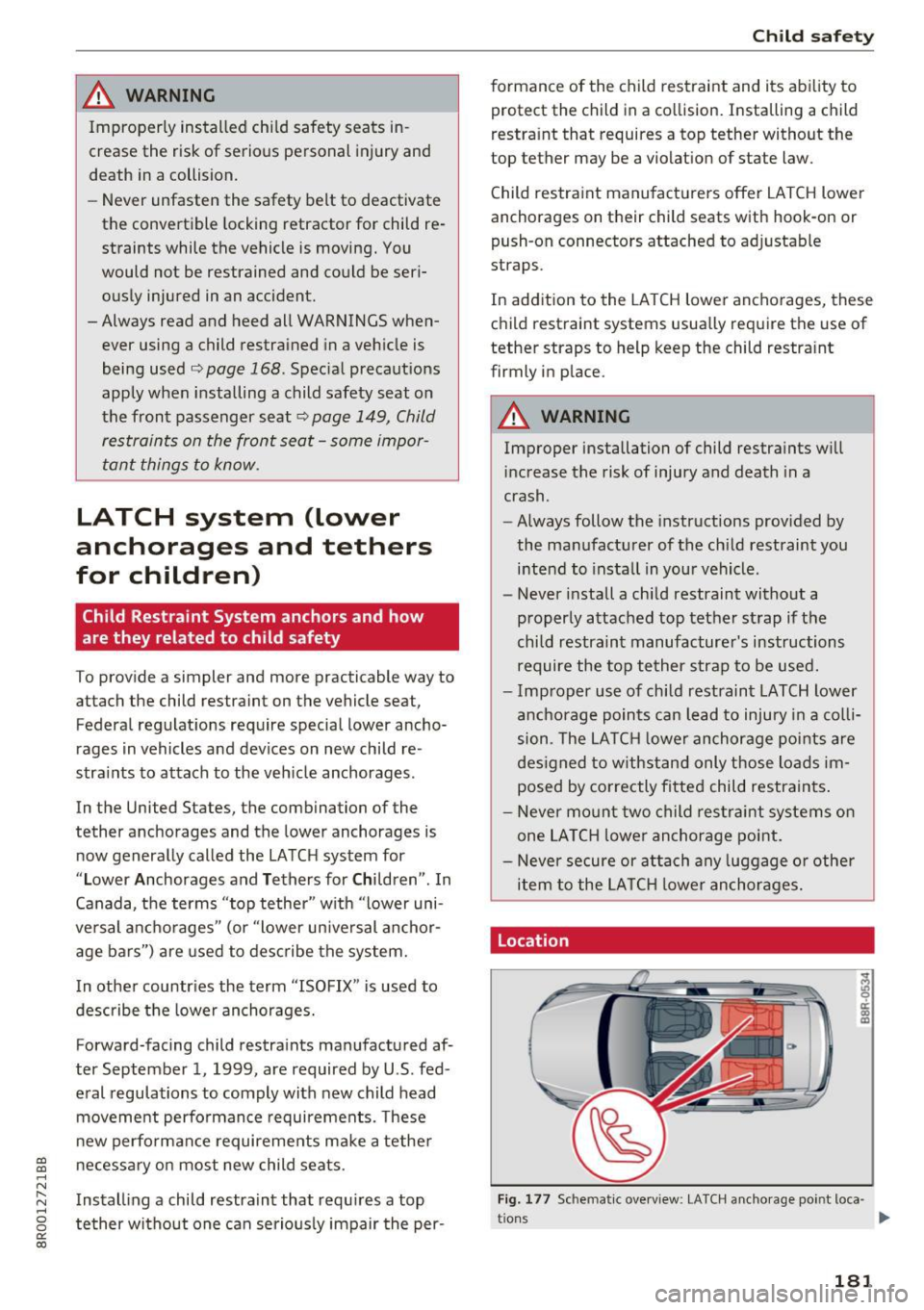
Location
F ig. 177 Sc hemati c overv iew: LATCH ancho rage po in t loca ·
ti on s
~
181
Page 185 of 296
a,
a,
..... N
" ('I ..... 0 0
0:
co
LATCH lower anchorage so that the connectors
lock into place
¢ fig. 180 .
.. Pull on the connector attachments to make
sure they are p roperly attached to the LATCH
lower anchorage .
.. Pull straps tight following the child restraint
manufacturer's instructions .
Relea sing
.. Loosen the tension on the straps following the
c hild restra int manufac turer 's ins tructions .
.. Depress the spring catches to release the an
chorage hooks from the lower anchorages .
Remember: Use tether straps to he lp keep the
child rest raint firmly in place .
A WARNING
Improper use of the LATCH system can in
crease the risk of serious pe rsonal injury and
death in an acc ident.
- These anchors were developed only for child safety seats using the "LA TCH" system .
- Never attach other child safety seats, belts
or othe r objects to these anchors .
- Always make sure that you hear a click when
latch ing the seat in place. If you do not hear
a click the seat is not secure and could fly
forward and h it the interior of t he vehicle,
o r be ejected from the vehicle.
A WARNING
Improper installatio n of child rest rai nts will
increase the r is k of injury in an a cc ident.
- Always follow the child restra int system
man ufacturer's inst ru ct ions for proper in
sta llation of the child res tra int system and
pro per use of tether straps as well as the
lower anchorages or safety be lts in your
ve
hicle.
- Always read and heed the important infor
mation and WARNINGS about child safety
and the insta llation of chi ld restraint sys
tems
¢ page 168, Child safety. Ch
ild
sa fety
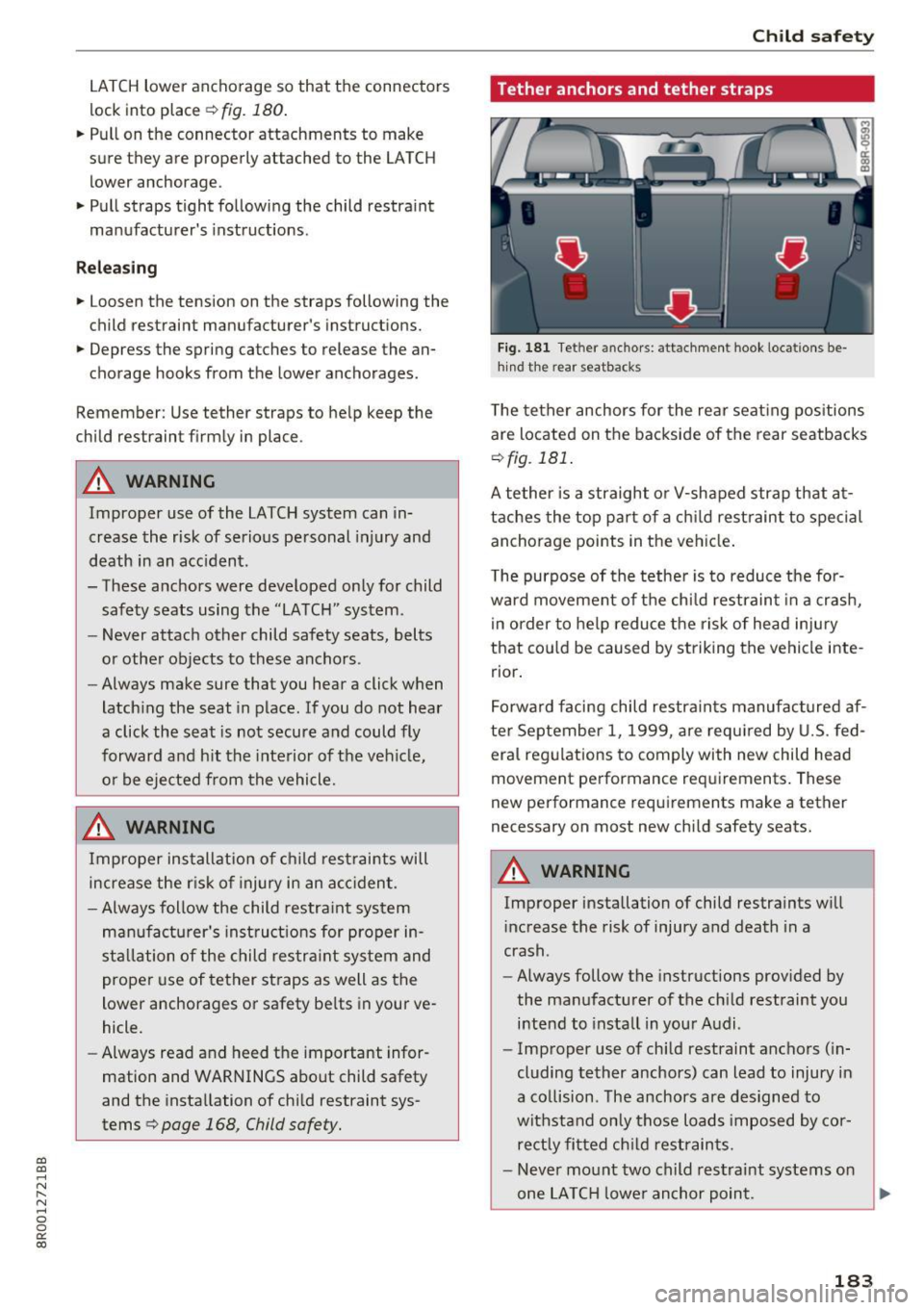
Tether anchors and tether straps
F ig. 181 Tet her anch ors : attachmen t hook loca tion s be
hin d the rear seatbacks
T he tether anchors for the rea r seating pos itions
are located on the backside of the rear seatbacks
¢ fig . 181 .
A tether is a straight o r V-shaped strap that a t
t a ches the top p art of a ch ild rest raint to spe cial
anchorage points in the ve hicle .
T he purpose of the tether is to reduce the for
ward movement of t he ch ild restrain t in a crash,
in order to help reduce the risk of head inju ry
that co uld be caused by striking the vehicle inte
rior.
Forward facing child restra in ts manufac tured af
ter September 1, 1999, are requ ired by U.S . fed
er al reg ulations to comply with new child head
movement performance req uirements. These
new performance requ irements mak e a t ether
necessary on most new chi ld safety seats.
A WARNING
-
Improper installation of child restra ints w ill
i ncrease the risk of injury and death in a
crash .
- Always follow the instructions prov ided by
the ma nufact urer of the ch ild restraint you
i n tend to install in your Audi .
- Improper use of chi ld restraint anchors ( in
cluding tether anchors) can lead to injury in
a co llision . The anchors are designed to
withstand only those loads imposed by cor
rectly fi tted ch ild rest rain ts.
- Neve r mo unt two child restraint systems o n
one LA TC H lowe r anchor point.
~
183
Page 188 of 296
Intelligent Technology
Intelligent Technology
Electronic Stabilization
Control (ESC)
Description
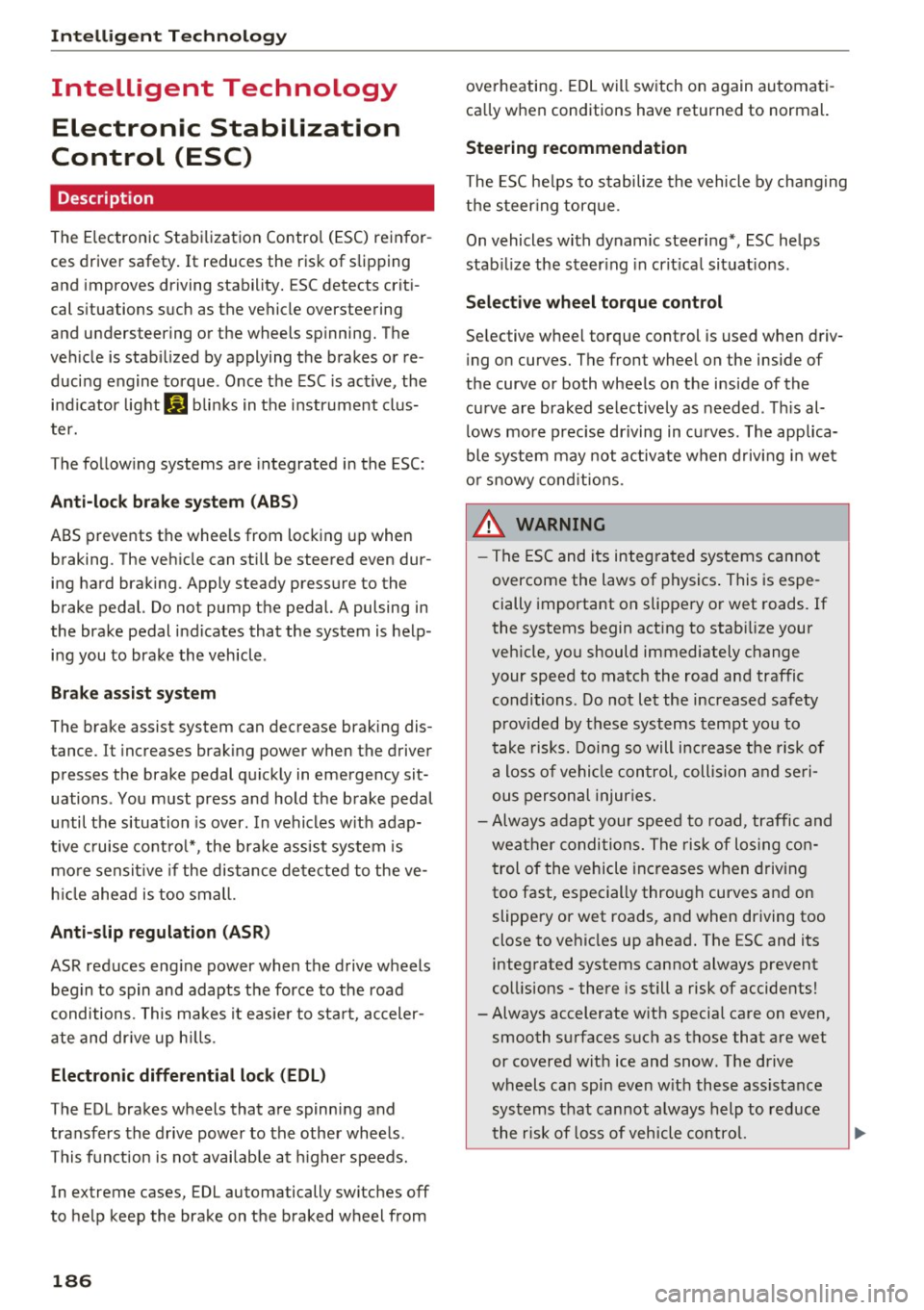
The Electronic Stabilization Control (ESC) reinfor
ces driver safety . It reduces the risk of slipping
and improves driving stability. ESC detects crit i
cal s ituations such as the vehicle oversteering
and understeering or the wheels sp inning. The
veh icle is stab ilized by applying the brakes or re
ducing engine torque . Once t he ESC is active, the
indicator light
Ji) blinks in t he instrument clus
ter.
The fo llow ing systems are integrated in the ESC :
Ant i-loc k brake system (ABS)
ABS preve nts the wheels from locking up when
braking. The veh icle can still be steered even dur
ing hard brak ing. Apply steady pressure to the
brake pedal. Do not pump t he pedal. A pulsing in
the brake pedal indicates that the system is help
i n g you to brake the vehicle .
Br ake assist system
The brake assist system can decrease brak ing dis
tance . It increases braking power when the driver
presses the brake pedal quick ly in emergency sit
uations . You must press and hold the b rake pedal
until the situa tion is over. In vehicles w it h adap
tive c ruise contro l* , the brake assist system is
mo re sensit ive if the di stance de te cte d to the ve
h icle ahead is too small.
Anti -slip regulation (ASR)
ASR reduces eng ine power when the drive wheels
begin to spin and adapts t he force to the road
conditions . This makes it easie r to sta rt, acceler
ate and dr ive up h ills.
Electronic differential lock (EDL )
The EDL brakes w heels that a re spinning and
transfers the drive power to the other whee ls .
This f unction is not avai lab le at higher speeds.
In extreme cases, EDL automatically switches off
to help keep the brake on the braked wheel from
186
overheating . EDL will sw itch on again automati
ca lly when conditions have returned to normal.
Steering recommendation
The ESC he lps to s tabilize the vehicle by chang ing
t h e s teer ing torque.
On vehicles with dynam ic steeri ng*, ESC helps
stab ilize the steer ing in crit ica l sit uat io ns.
Selective wheel torque control
Se lective wheel torque cont rol is used when driv
i ng on curves. The front whee l on the inside of
the curve or both wheels on the inside of the cu rve are braked se lectively as needed. This al
l ows mo re precise dr iving in c urves . The applica
ble system may not ac tiv ate when d riving in wet
o r snowy cond it ions.
_&. WARNING
- The ESC and i ts in teg ra ted systems can not
overcome the laws of physics . This is espe
cially important on slippery or wet roads. If
the systems begin act ing to stab ilize your
veh icle, you should immediately change
your speed to match the road and traffic conditions. Do not let the increased safety
provided by t hese systems tempt yo u to
take risks. Doing so will i ncrease the r isk of
a loss of vehicle con trol, collisi on and se ri
ous person al injur ies.
- Always a dapt your speed to road, traffic and
weather condi tions. The risk of los ing c on
t rol of the vehicle in creases w hen driving
too fast, es pecially through curves and on
slippe ry or wet roads, and when driving too
close to ve hicles up ahead. The ESC and its
integ rated systems cannot always prevent
col lisions - there is still a risk of accidents!
- Always accelerate w ith special care on even,
smooth su rfaces s uch as those that are wet
or covered wit h ice and snow. The drive
wheels can spin even w it h these assistance
sys tems t hat cannot a lways help to reduce
t he risk of loss of vehicle co ntro l.
Page 200 of 296
Offroad dri ving
Offroad driving
Driving under difficult
conditions and off-road
General information
The operation of the Electronic Stabilization Con
trol (ESC) is expanded for operation away from
paved roads. In situations where slip or a differ
ential locking function is required, the offroad mode can be activated
<=> page 186. Your Audi al
so has permanent all-wheel drive in addition .
However, your Audi is not a pure offroad vehicle.
It was not built for driving under extreme condi
tions, e.g. for trips that are in the nature of an
expedition .
Drive only on roads and offroad sections which
match the design of your vehicle and your abili
ties as a driver. Never take risks!
Befo re driving offroad
-Check the eng ine oil level, tire pressure, coo l
ant level, and the fluid leve l in the windshield
washer reservoir.
- Stow luggage items and other objects in the
lu ggage compartment, and secure them
against sliding around.
After driving offroad
-After trips offroad, remove any twigs and other
foreign objects from the grill, the underbody
and the wheels. Pay specia l attention to foreign
objects (stones) which have become lodged in
the tire tread.
- Clean the body and the vehicle underside, and
inspect the vehicle for possible damage.
- Clean dirty windows, headlamp lenses, rear
lights, and license plates.
- Perform a brake check (particularly after travel
ling through water) .
A WARNING
- Drive especially attentive ly and plan ahead
in difficult road conditions and when off
road. Excessive speed or incorrect maneu
vers can cause in juries and damage to the
vehicle.
198
- Always adapt your speed and driving style to
road, offroad, traffic, and weather condi
tions. Drive especially slowly offroad when
your view is restricted.
- Please be aware that in offroad mode, par
ticularly on a smooth and slippery road, the
wheels may have an increased tendency to
spin and the vehicle may break away - dan
ger of skidding!
- Stability is limited in the offroad mode.
® For the sake of the environment
Avoid damage to the environment and re
spect nature.
(D Tips
Only drive where it is permitted and stay on
marked roads and paths.
Explanation of some technical terms
The following data refer to ideal conditions. De pending on vehicle load and ground conditions
and the env ironment, the numbers may vary. It is
the driver's responsibility to decide whether ave
hicle can overcome a specific s ituation
<=> .&. .
Gradient angle
The number of meters in alt itude gained over a
distance of 109.4 yards or 100 meters (grade)
are given as a percentage or degrees . Informa
tion about the gradient the vehicle can cl imb un
der its own power (depends in part on the road
surface and eng ine power). Maximum permitted
grade: 31
°
Ground clearance
The distance between the road surface and the lowest point of the vehicle underbody. Ground
clearance 7.9 in (200 mm)
.&, WARNING
Exceeding the stated maximum figures can
result in severe injuries or vehicle damage.
- All the information was gathered on level,
firm and non-slippery road surfaces, and un-
-
der dry weather conditions. ..,
Page 205 of 296
CD
CD
.... N ,-... N ..... 0 0 C<'. 00
~ Release the parking brake and slowly pull out
and away from the whee l chocks.
~ Stop and have someone retrieve t he whee l
chocks .
(D Tips
If you move the selector lever of the a utomat
ic transm ission to P before applying the park
ing brake and before block ing the wheels, you
may have to use more force later to move the
lever out of the P position .
Trailer towing
203
Page 208 of 296
Care and cleaning
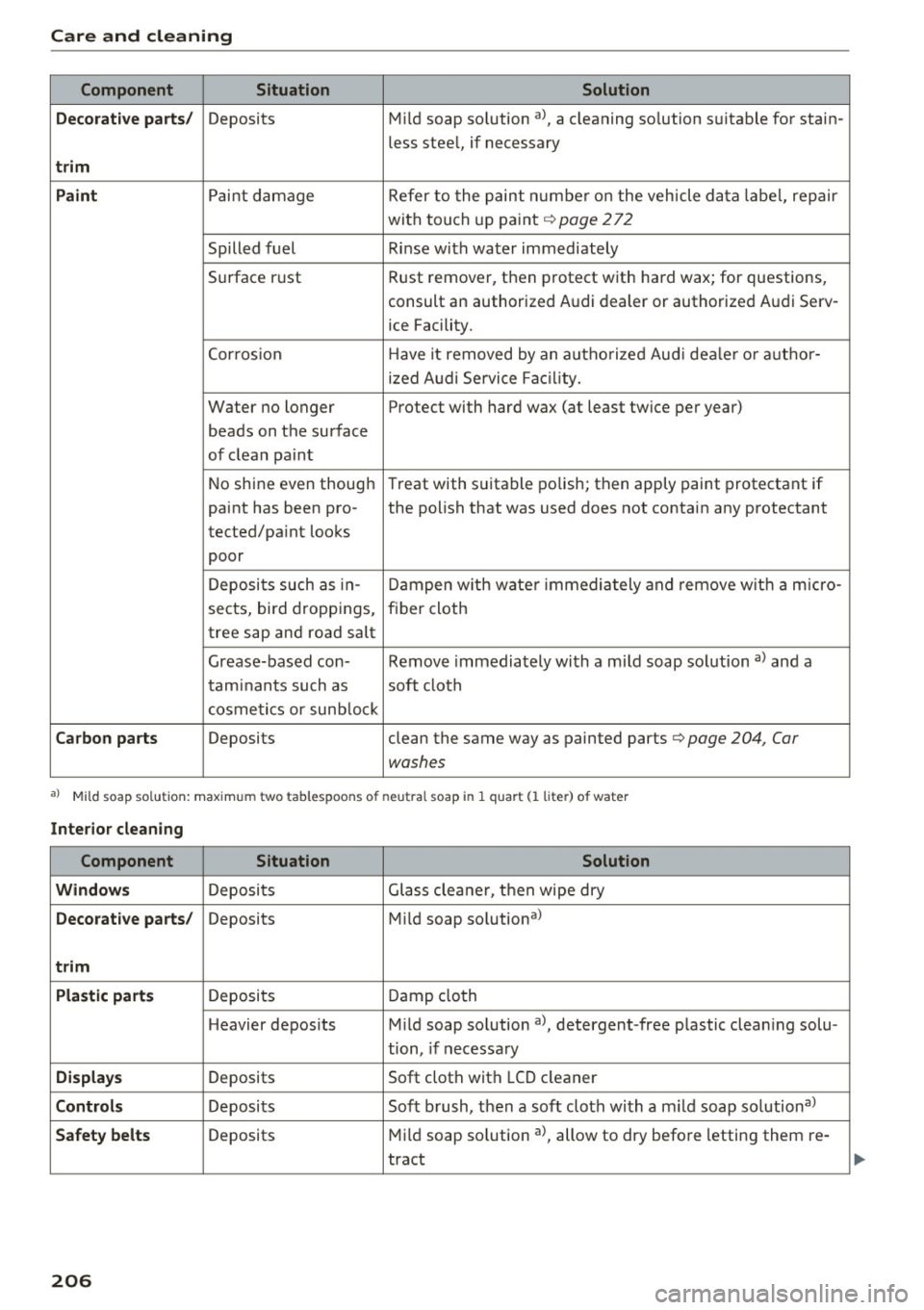
Component Situation Solution
D eco ra tiv e p art s/
Deposits Mild soap so lution a>, a cleaning solution suitable for stain-
less steel, if necessary
trim
Paint
Paint damage Refer to the paint n umber on the vehicle data label, repair
with touch up pa int ¢
page 272
Spilled fuel Rinse with water immediately
Surface rust Rust remover, then protect with hard wax;
for questions,
consult an authorized Audi dealer or authorized Audi Serv-
ice Facility.
Corros ion Have it removed by an authorized Aud i dea le r or author-
ized A udi Service Fac il ity.
Water no longer Protect with hard wax (at least twice per year)
beads on the surface
of clean paint
No shine even though Treat with suitable polish; then apply paint protectant if
paint has been pro- the polish that was used does not contain any protectant
tected/pa int looks
poor
Deposits such as in- Dampen w ith water immediately and remove w ith a micro -
sects, bird droppings, fiber cloth
tree sap and road salt
Grease-based con- Remove immediately with a mild soap solution a) and a
tam inants such as soft cloth
cosmetics or sunb lock
C arbon p arts Deposits clean the same way as painted parts ¢ page 204, Car
washes
•> Mi ld soap solution: maxim um two tablespoons of neutral soap in 1 quart (l liter) of water
Interior cle ani ng
Component Situation Solution
Window s
Deposits Glass cleaner, then wipe dry
D ec orativ e p arts/ Deposits Mild soap so lutional
trim
Pla stic pa rts
Deposits Damp cloth
Heavier deposits M ild soap solution a>, detergent -free plastic cleaning solu-
tion, if necessary
Di sp la ys Deposits Soft cloth with LCD cleaner
Co ntr ols Deposits Soft brush, then a soft cloth with a m ild soap solutiona>
S afe ty belt s Deposits Mild soap solution a>, allow to dry before letting them re-
tract
206
...
Page 213 of 296
CD
CD
.... N ,-... N .... 0 0 C<'. 00
Gasoline additives
Applies to: vehicles with gasoline engine
A major concern among many auto manufactur
ers is carbon deposit build-up caused by the type
of gasoline you use.
Although gasoline grades differ from one manu
facturer to another, they have certain things in
common. All gasoline grades contain substances
that can cause deposits to collect on vital engine parts, such as fuel injectors and intake valves . Al
though most gasolin e brands include additives to
keep engine and fuel systems clean, they are not
equally effe ctive.
Audi recommends using TOP TIER Detergent Gas
oline. For more information on TOP TIER Deter
gent Gasoline , please go to the official website
(www.toptiergas.com).
After an extended period of using inadequate
fuels, built-up carbon depos its can rob your en
gine of peak performance.
CD Note
- Damage or malfunction due to poor fuel
quality is not covered by the Audi New Vehi
cle Limited Warranty .
- Do not add aftermarket fuel additive prod
ucts to your fuel tank.
Diesel fuel
Applies to: veh icles with diesel eng ine
Always use ULSD (Ultra Low Sulfur Diesel) No. 2.
The ULSD No . 2 meets the ASTM 0975.
Diesel fuel with concentrations of biodiesel high
er than S % such as 811,820 or 8100 are strictly prohibited.
Service station fuel pumps are labeled with the
correct fuel information for easy recognition by
the user. If the diesel fuel pump is not labeled
ask the station operator what fuel is being dis
pensed before filling up your vehicle .
ULSD No . 2 may not be available outside the USA
and Canada. Be sure to check before traveling to
other countries.
Fuel and Refueling
ULSD No. 2 can become thicker in very cold tem
peratures, and this can impair the engine 's start
ing and running. Depending on the season, gas
stations provide ULSD No.
2 that flows better in
cold temperatures so tha t you can continue oper
ating your vehicle as usual.
CD Note
- Your vehicle's diesel engine was designed
soley for use with ULSD No.
2. Therefore,
never use gasoline, heating oil, other fuels
or flow improvers . These contain substances
that will severely damage the fuel system
and the engine. Such damage will not be
covered by your New Vehicle Limited War
ranty.
- If you put any amount of incorrect fuel in
the fuel tank, do not start the engine under
any circumstances. Immediately contact the
nearest authorized Audi dealer or author
ized Audi Service Facility for assistance.
These fuels contain substances that can se
verely damage the fuel system and the en gine if the engine is started .
Refueling
Fuel filler neck
The fuel filler neck is located on the right rear
side panel behind the fuel filler flap.
If the power locking system should fail, you can
still open the flap manually -for detailed instruc
tions see
¢ page 213.
You can find the fuel tank capacity of your vehicle
in
¢ page 273.
The label on the inside of the fuel filler flap tells
you the correct fuel for your vehicle. For more in
format ion about fuel specificat ions, see
¢ page 209.
Your vehicle fuel tank has an on-board refuelling
vapor recovery system. This feature helps to pre
vent fuel vapors from escaping from the tank and polluting the environment while you refuel your
vehicle. In order to fill the tank properly while
protecting the environment, please follow this
refueling procedure carefully.
211
Page 214 of 296
Fuel and R efue li ng
_& WARNING
Under normal operating conditions, never car
ry additional fuel containers in you r car. Gas
canisters and other containers used to trans
port fuel can be dangerous . Such containers,
full or empty, may leak and could cause a fire
in a collision. If you must transport fuel to
use for your lawn mower, snow blower, etc.,
be very careful and a lways observe local and
state laws regarding the use, transportation
and sto rage of such fue l conta iners. Make cer
tain the container meets industry standards (ANSI/ASTM F852 -86) .
(D Note
Never drive you r vehicle unt il the fuel tank is
comp letely empty. The irregular supply of
fue l can cause m isfiring. Gasoline cou ld enter
the exhaust system and damage the catalytic
converter.
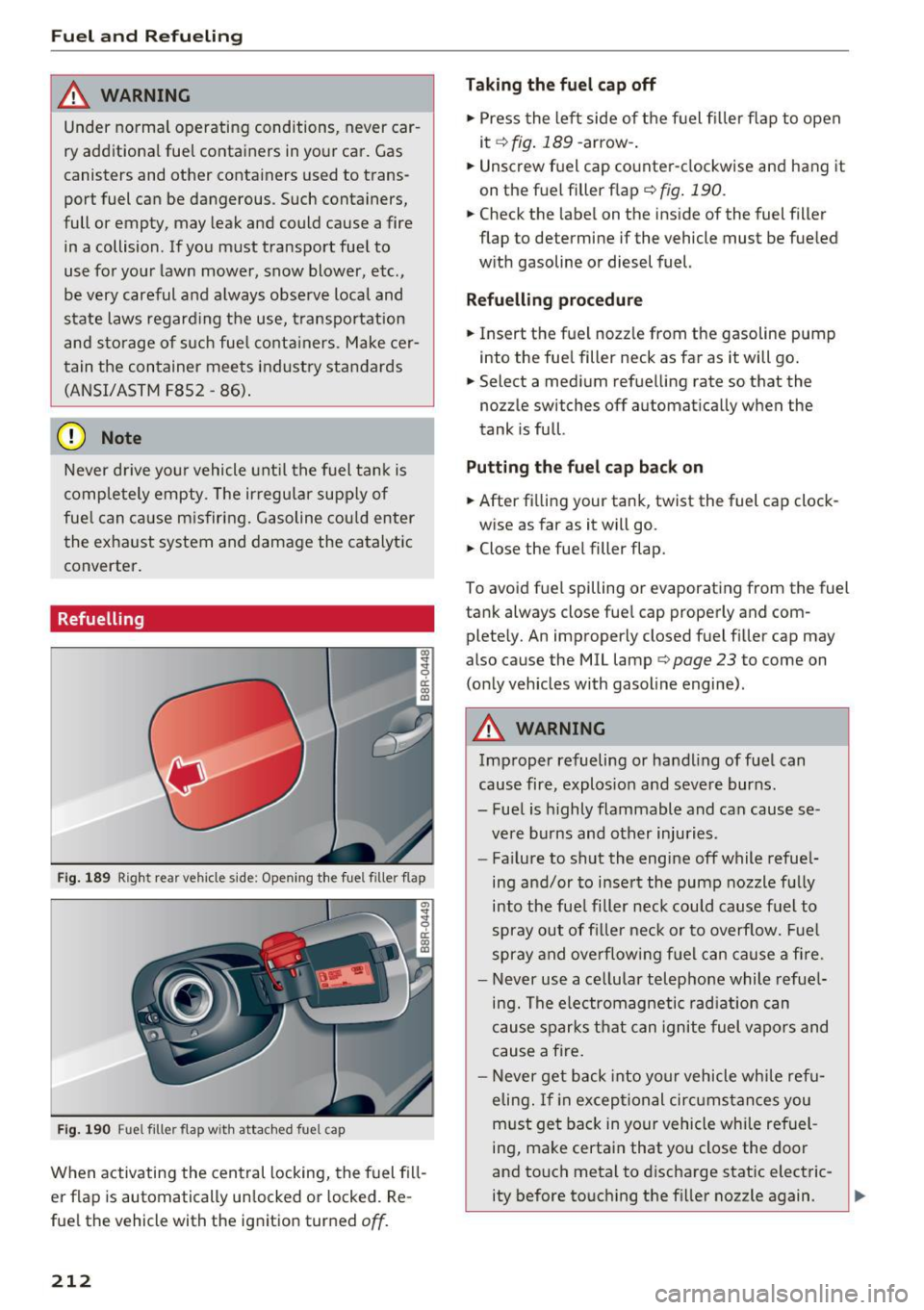
Refuelling
Fig. 189 Right rear veh icle side: Opening the fuel filler flap
Fig. 190 Fuel filler flap wit h attac hed fuel cap
When activating the central locking, the fuel f ill
er flap is automatically unlocked o r locked. Re
fuel the vehicle with the ignition turned
off.
212
Taking th e fue l cap off
.. Press the left side of the fuel fi ller flap to open
it
¢ fig. 189 -ar row-.
.. Unscrew fuel cap counter-clockwise and hang it
on the fuel filler flap¢
fig. 190 .
.. Check the label on the inside of the fuel filler
flap to determine if the vehicle must be fueled
w ith gasoline or diesel fuel.
Refuelling procedur e
.. Insert the fuel nozzle from the gasoline pump
into the fuel filler neck as far as it will go.
.. Select a medium refuelling rate so that the
nozzle switches off automatically when the
tank is full.
Putting th e fu el c ap b ack o n
.. After filling your tank, twist the fuel cap clock-
wise as far as it will go.
.. Close the fuel filler flap.
To avoid fuel spilling or evaporating from the fuel
tank always close fuel cap properly and com
plete ly. An improperly closed fuel filler cap may
also cause the MIL lamp¢
page 23 to come on
(only vehicles with gasoline engine).
_& WARNING
Improper refueling or handling of fuel can
cause fire, explos ion and severe burns.
- Fuel is highly flammable and can cause se
vere burns and other injuries.
-
- Fa ilure to shut the engine off while refuel
ing and/or to insert the pump nozzle fully into the fue l filler neck could cause fuel to
spray out of fi ller neck or to overflow. Fue l
spray and ove rflowing f uel can ca use a fire .
- Never use a ce llular telephone while refuel
ing. The electromagnetic radiation can
cause sparks t hat can ignite fuel vapors and
cause a fire.
- Never get back into your vehicle whi le refu
eling. If in exceptional circumstances you
must get back in your vehicle wh ile refuel
ing, make certain that you close the door
and touch metal to discharge static electric-
ity before touching t he f iller nozzle again. .,_