warning light AUDI Q5 2018 Owners Manual
[x] Cancel search | Manufacturer: AUDI, Model Year: 2018, Model line: Q5, Model: AUDI Q5 2018Pages: 392, PDF Size: 60.56 MB
Page 316 of 392
Check ing and F illing
On -Board Diagnostic S yst em
Eng ine data can be read out at the On-Board D i
agnostic System connection po rt using a special
testing device
¢ fig. 257 .
Indicator light
Ift hP ¢..ifi indicato r light b lin ks o r tu rns o n, there
is a malfunction that is caus ing poor emiss ions
qua lity and that could damage the catalytic con
verter.
Dr ive s low ly to an author ized Audi dealer or au
thor ized Audi Se rvice Fac il ity to have the ma l
f u nction co rrected.
The indicator l ight can also turn on if the fuel fi ll
er cap is not closed correct ly
9 page 311.
_& WARNING
Incorrect use of the connection po rt fo r th e
On-Board Diagnostic Sys tem can ca use mal
functions, which can then result in accidents
and serious injuries.
- Only allow an authorized Audi dealer or au
thorized Audi Service Facility to read out the
engine data .
Engine compartment
Working in the engine compartment
Special care is required if you are working in the
engine compartment
-
Fo r w ork in th e engi ne comp artm ent su ch as
c heck ing and filli ng flu id s, the re is a risk of in
jur y, scalding , ac cident s, and b urns . Fo r this
r easo n, follow all th e warning s and g enera l
sa fe ty preca ution s pro vided in the foll owin g in
f o rm ation . Th e e ng ine comp artmen t is a d an
ger ous ar ea .
9 &, .
_& WARNING
- T urn the eng ine off.
- Switch the ig nition off.
- Set the parking brake .
- Select the "P" selector lever pos it io n.
- let the engine coo l down.
314
- Never open the hood when there is steam or
coo lant escaping from the engine compart
ment, because there is a risk that you could
be burned . Wait unt il no steam or coolant is
escaping.
- Keep children away from the eng ine com
partment .
- Never sp ill fluids on a hot engine . These flu
ids (such as the anti-freezing agent con
tained in the coolant) can ignite .
- Avoid short c ircuits in the electrical system.
- When working in the engine compartment, remember that the radiator fan can switch
on even if the ignition is switched off, wh ich
increases the r isk of injury .
- Never open the cap on the coolant expan
sion tank when the engine is warm . The
cool ing system is under pressure .
- To protect your face, hands, and arms from
hot steam or coolant, cover the cap w ith a
large cloth when open ing.
- Do not remove the engine cover under any
circumstances . This increases the risk of
burns .
- If tests need to be performed with the en
gine runni ng, there is add itiona l danger due
to mov ing components (such as the r ibbed
be lt, alte rnato r and rad iato r fan) and from
the hig h-voltage ignition system.
- Do not unde r any ci rcumstances activate the
throttle inadvertent ly (for example, by hand
from the engine compartment) if the veh i
cle is stationary but the engine is running
and a gear is engaged. Otherwise, the vehi
cle will start to move immediate ly and this
could result in an acc ident.
- Pay attention to the following warnings
when work on the fue l system is required:
- Do not smoke.
- Never work near open flames .
- Always have a working fire extinguisher
nearby.
- All work on the battery or electrical system in your vehicle can result in injuries, chemi
cal burns, acc idents or burns . Because of
this, all work must be performed
only by an
author ized Audi dealer or author ized Audi
Serv ice Faci lity.
Page 317 of 392
u co ..... N r-N .....
~ 0 co
-To reduce the risk of electric shock and in
jury, never touch the following components
when the engine is running or is being start
ed :
- Ignition cable
- Other components in the electronic high-
voltage ignition system
- If you must check or perform work on the
engine while it is running:
- Set the parking brake first and then select
the
"P" selector lever position .
- Always proceed with extreme caution so
that clothing, jewelry or long hair do not
become caught in the radiator fan, fan
belt or other moving components or do
not come into contact with hot compo nents. Tie back long hair before beginning
work and do not wear cloth ing that can
hang down into the engine.
- Limit your exposure to exhaust and chemi
cals to as short a time as possible
c::> & .
..&, WARNING
California Proposition 65 Warning:
- Engine exhaust, some of its constituents,
and certain vehicle components contain or
emit chemicals known to the State of Cali
fornia to cause cancer and birth defects and
reproductive harm. In addition, certain flu
ids contained in vehicles and certain prod
ucts of component wear contain or emit
chemicals known to the State of California
to cause cancer and birth defects or other
reproductive harm.
- Battery posts, terminals and related acces
sories contain lead and lead compounds, chemicals known to the State of California
to cause cancer and reproductive harms.
Wash hands after handling.
(D Note
When filling fluids, be sure not to mix the flu
ids up . Otherwise severe malfunctions and en
gine damage will occur.
Checking and Filling
@) For the sake of the environment
You should regularly check the ground under
your vehicle in order to detect leaks quickly.
If
there are visible spots from oil or other fluids,
bring your vehicle to an authorized Audi deal
er or authorized Audi Service Facility to be
checked .
Opening/closing the hood
The hood is released from inside the vehicle .
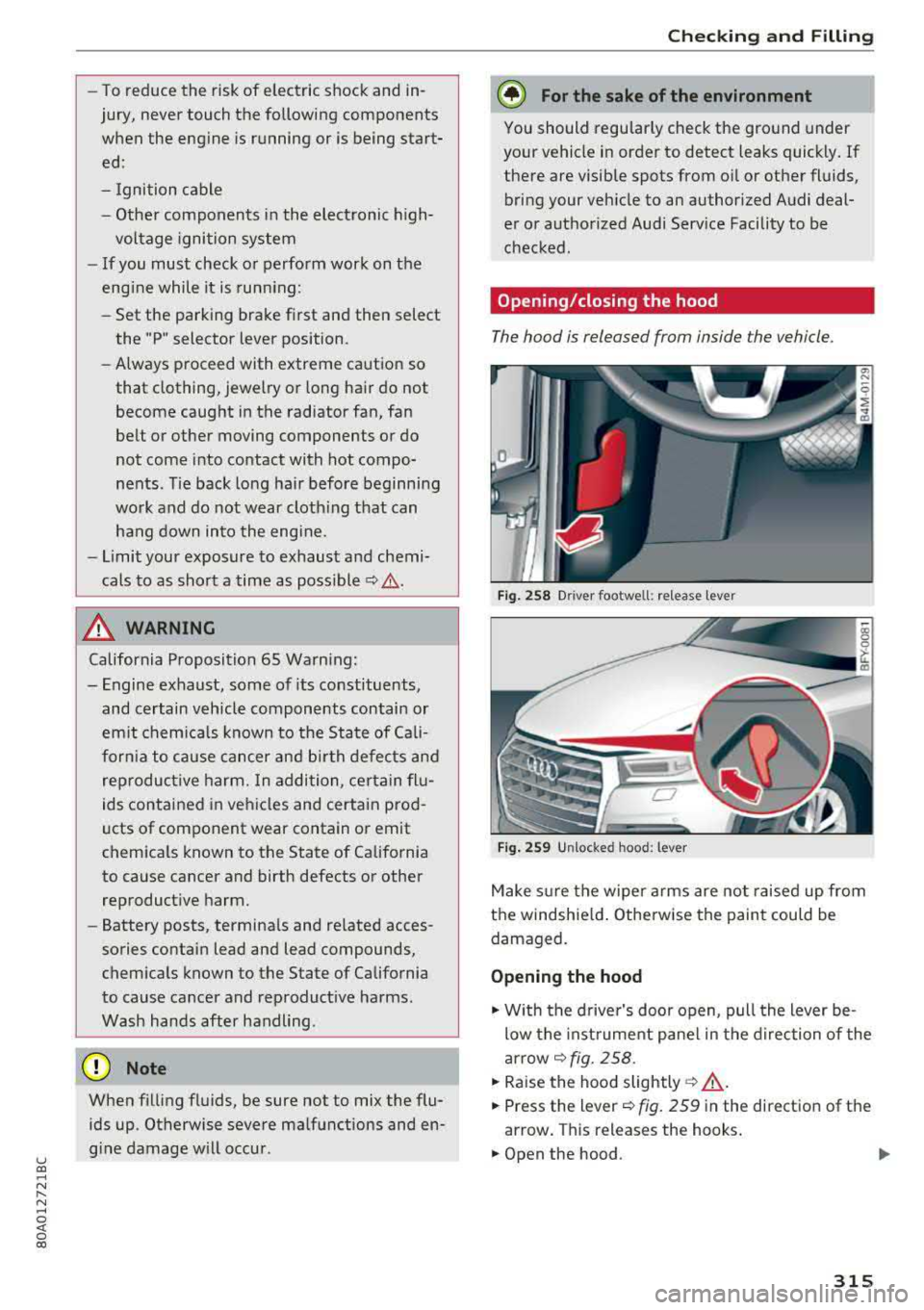
Fig. 258 Driver footwell : relea se lever
Fig. 259 Unlocked hood: lever
Make sure the wiper arms are not raised up from
the windshield . Otherwise the paint could be
damaged.
Opening the hood
.,. With the driver 's door open, pull the lever be
low the instrument panel in the direction of the
arrow
c::, fig. 258.
.,. Raise the hood slightly c::> &.-
.. Press the lever c::, fig. 259 in the direction of the
arrow. This releases the hooks .
.,. Open the hood. ..,.
315
Page 318 of 392
Checking and Filling
Cl osing the ho od
~ Push the hood down until you overr ide the
force of t he struts .
~ Let the hood fall light ly into the latch. Do not
press it in.
c::> &_ .
A WARNING
-Never open the hood when there is steam or
coolant escaping from the engine compart
ment, because there is a risk that you could
be burned. Wait until no steam or coolant is
escaping.
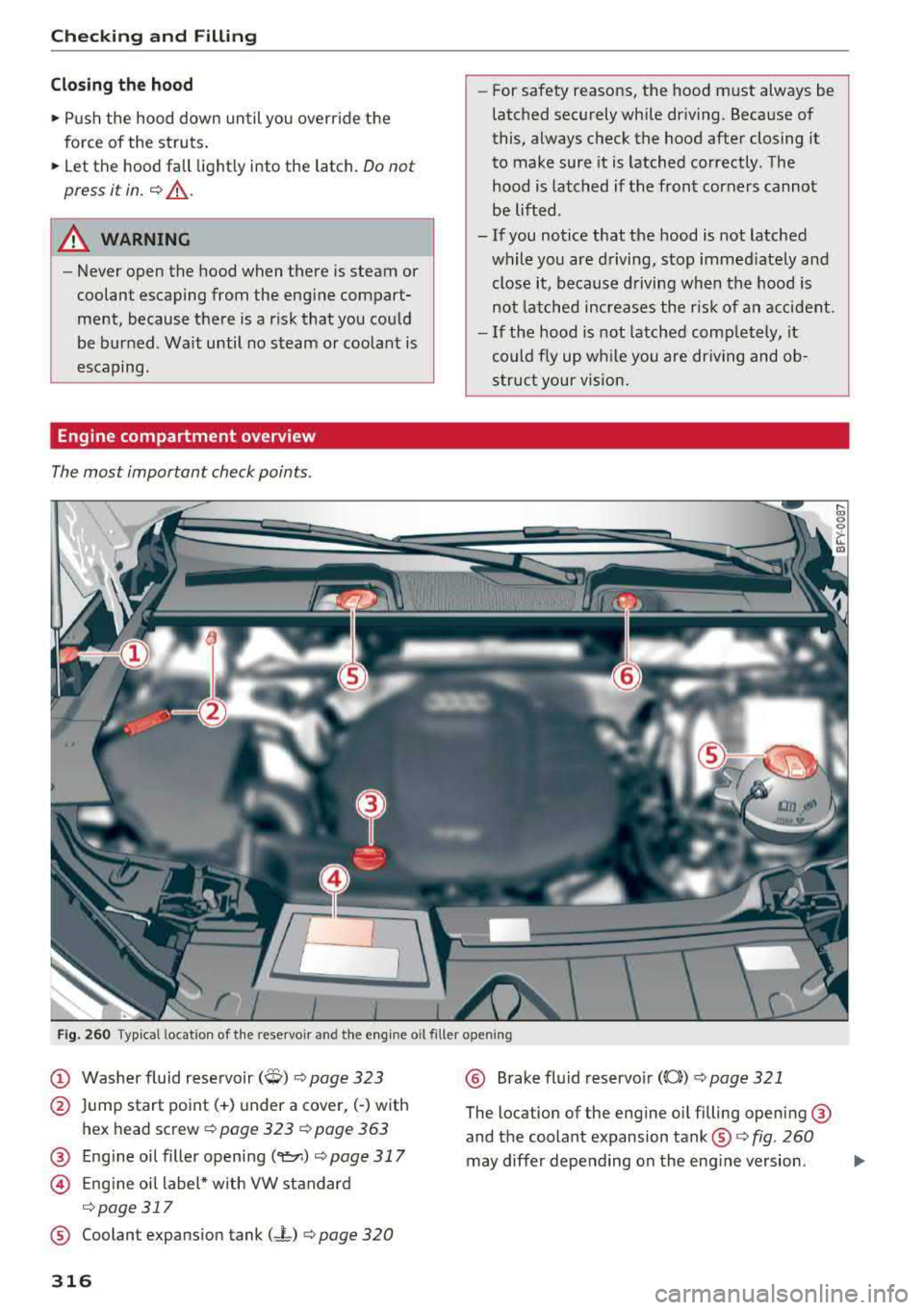
Engine compartment overview
The most important check points .
-For safety reasons, the hood must always be
latched securely while dr iving. Because of
this, always check the hood after closing it
to make sure it is latched correctly . The
hood is latched if the front corners cannot
be lifted .
-If you notice that the hood is not latched
while you are driving, stop immed iate ly and
close it, because d riving when the hood is
not latched increases the r is k of an accident.
-If the hood is not latched comp letely, it
could f ly up wh ile you are driving and ob
s t ruc t your vis ion.
F ig . 260 Typical location of the rese rvoir and the engine o il fil le r open ing
@ Washer fluid rese rvoir (W) c::> page 323
@ J ump start po int(+) under a cover,(-) w ith
hex head screw
c::> page 323 c::> page 363
® Eng ine oi l filler openi ng (9:=r.) c::> page 317
@ Eng ine oi l label * w ith VW st andard
c;, page 317
® Coolant expans ion tank (-L) c::> page 320
316
@ B rake fl uid reservo ir (Oi) c::>pag e 321
The location of the eng ine o il filling open ing ®
and the coolant expansion tank ®
c::> fig. 260
may differ depending on the eng ine version .
Iii>
Page 321 of 392
u co ..... N r--N ..... 0 <( 0 00
-Pay attention to legal requirements when
disposing of empty oi l containers .
Changing the engine oil
We recommend that have your oil changed by an
authorized Audi dealer or a qualified service sta
tion .
Before you check anyt hing in the eng ine compart
ment,
alwa ys read and heed all WARNING S¢.&.
in Working in the engine comportment on
page 314.
The engine oil must be changed accord ing to the
intervals specified in your Warranty
& Mainte
nance booklet . This is very important because the
lubricat ing propert ies of oil diminish gradually
during normal vehicle use.
Under some circumstances the engine oi l should
be changed more frequently. Change oil more of
ten if you drive most ly short distances, operate
the vehicle in dusty areas or under predominant ly
stop-and-go traffic condit ions, or have your vehi
cle where temperatures remain below freezing
for extended periods.
Detergent additives in the oil will make fresh oil
look dark after the engine has been running for a
short time. Th is is normal and is not a reason to
change the oil more often than recommended.
Because of the problem of proper disposal, along
with the special tools and necessary expertise re
qu ired, we strongly recommend that you have
your oil c hanged by an authorized
A udi de aler or
a qualified service station .
If you choos e to change your o il y our self , please
note the following important information:
A WARNING
T o red uce the r isk of pe rsonal injury if yo u
must change the engine oil in your ve hicle
yourse lf:
-Wear eye p rotection.
-To reduce the risk of burns from hot engine
o il, let the eng ine cool down to the touch.
-
-Whe n removing the o il drain plug with your
fingers, stay as far away as poss ible. A lways
Ch eck ing and F illing
keep your forearm pa rallel to the ground to
he lp prevent hot oil from running down your
arm.
-Drain the oil into a container designed for
this purpose, one la rge enough to hold at
least the tota l amount of oil in your engine.
-Engine oil is poisonous. Keep it well out of
the reach of children.
-Continuous contact with used engine o il is
harmful to your skin. Always protect your
skin by washing oil off thoroughly with soap
a nd water.
@ Note
Never mix oil additives with yo ur engine oil.
These additives can damage your engine and
adverse ly affect your Audi limited New Vehi
cle Warranty.
@) For the sake of the environment
-Before chang ing your oi l, first ma ke sure
you know where you can properly d ispose of
the used oil.
-Always dispose of used engine o il properly.
Do not dump it on garden so il, wooded
areas, into open streams o r down sewage
dra ins.
-Recycle used eng ine o il by tak ing it to a used
eng ine oi l collec tion fac ility in yo ur area, or
contact a se rvice station.
Cooling system
Coolant
The eng ine cooling system is fi lled w ith a mixture
of purified water and coolant additive at the fac
tory. This coolant must not be not changed.
T he coo lant level is monitored through
the . in
dicator light
¢page 23. However, we do recom
mend occasionally checking the coolant leve l
manual ly.
If you must add coo lant, use a mixture of water
and coolant additive. Mixing the coolant add itive
with dist illed water is recommended.
IIJ>-
319
Page 324 of 392
Checking and Filling
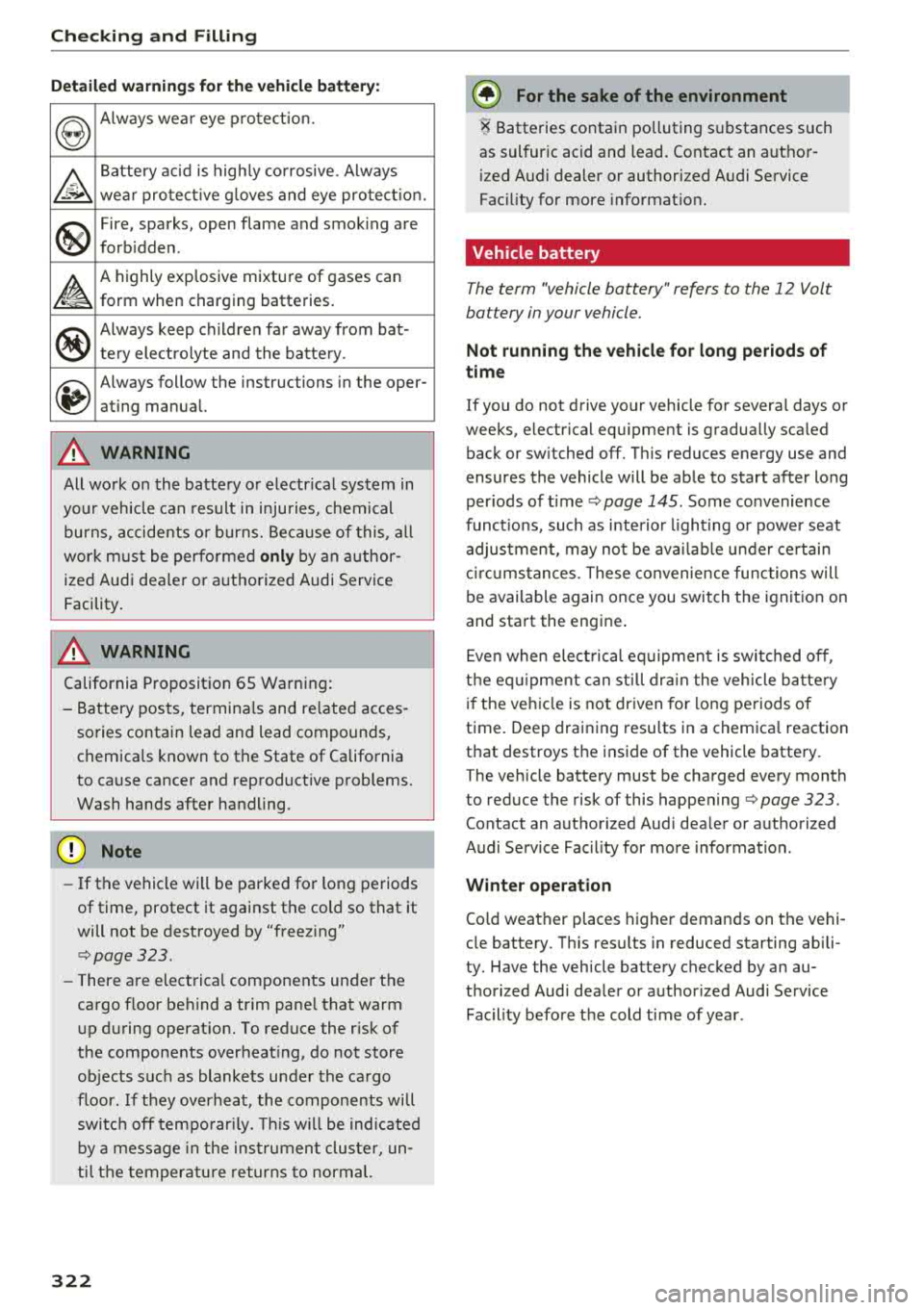
Detailed warnings for the vehicle battery:
~
Always wea r eye protection.
~
Battery acid is highly corrosive. Always
wea r protect ive g loves and eye pro tect io n .
.
®
Fire, sparks, open flame and smok ing are
forb idden .
~
A highly explosive mixture of gases can
form when charging batteries.
®
Always keep childre n far away from bat-
tery electrolyte and the batte ry .
~
Always follow the instructions in the oper-
ating manual.
A WARNING
All wo rk on the batte ry o r electrical system in
yo ur vehicle can result in inju ries, chemical
burns, accidents or burns. Because of this, all
wor k must be performed
only by an author
ized Audi dealer or authorized Audi Service
Facility.
A WARNING
California Proposition 65 Warning:
- Battery posts, terminals and re lated acces
sories contain lead and lead compounds,
chemica ls known to the State of California
to cause cancer and reproductive problems.
Wash hands after handling .
@ Note
-If the vehicle will be parked for long periods
of time, protect it against the cold so that it
will not be destroyed by "freezing"
<=>page 323.
-There are electrical components under the
cargo floor behind a trim pane l that warm
up during operation. To reduce the risk of
the components overheat ing, do not store
objects such as blankets under the cargo
floor . If they overheat, the components wi ll
switc h off temporarily. This will be ind icat ed
by a message in the instrument cluster, un
til the temperature returns to normal.
322
@ For the sake of the environment
i Batteries contain polluting substances such
as sulfur ic acid and lead. Contact an author
i zed Audi dealer or authorized Audi Service
Fac ility for more informat ion.
Vehicle battery
The term "vehicle battery" refers to the 12 Volt
battery in your vehicle.
Not running the vehicle for long periods of
time
If you do not drive your vehicle for severa l days or
weeks, electrical equ ipment is gradually sca led
back or switched off. This reduces energy use and
ensures the vehicle will be able to start after long
periods of
time<=> page 145 . Some convenience
funct ions, such as interior lighting or power seat
adjustment, may not be available under certain
circumstances . These convenience functions will
be available again once you switch t he ignition on
and start the engine .
Even when electrical equipment is switched off,
the equipm ent can still drain the vehicle battery
if the vehicl e is not driven for long periods of
time. Deep draining results in a chemical reaction
that destroys the inside of the vehicle battery.
The vehicle battery must be charged every month
to reduce the risk of this happening
<=> page 323.
Contact an authorized Aud i dealer or authorized
Audi Service Fac il ity for more information.
Winter operation
Cold weather places higher demands on the vehi
cle battery. This results in reduced starting abili
ty. Have the vehicle battery checked by an au
thorized Audi dealer or authorized Audi Service
Fac il ity before the cold time of year .
Page 325 of 392
u co ..... N r-N .....
~ 0 co
Charging the vehicle battery
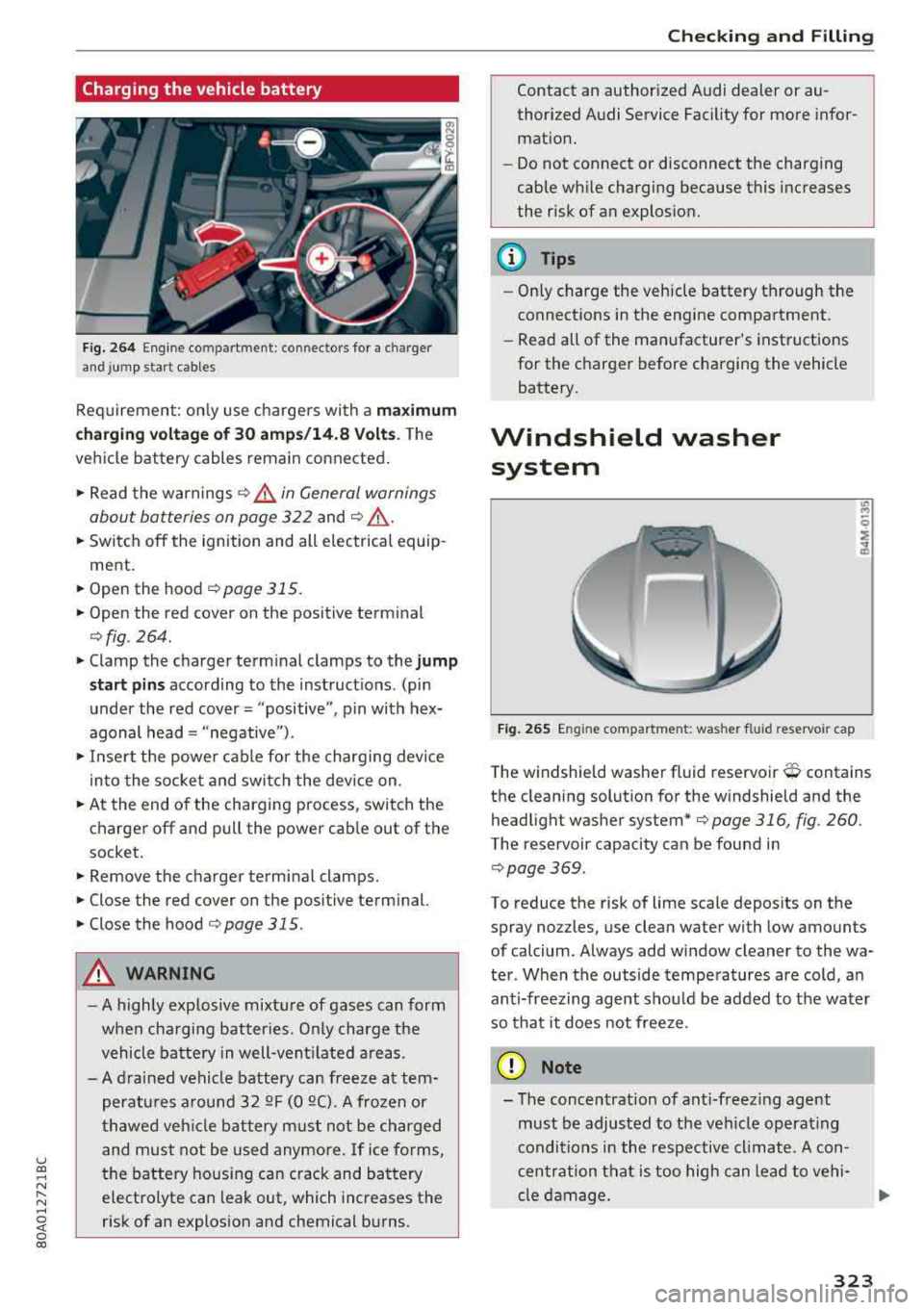
Fig. 264 Engine co mpartment : connec tor s fo r a charg er
and jump s ta rt cab les
Req uirement: on ly use charge rs with a maximum
c harging voltage of 30 amp s/14 .8 Volt s.
T he
vehicle battery cables remain connected .
.,. Read the warnings ¢ & in General warnings
about batteries on page 322
and ¢ ,& .
.,. Switch off the ignition and all e lectrical equip
ment .
.,. Open the hood ¢ page 315 .
.,. Open the red cover on the positive term inal
¢ fig . 264 .
.,. Clamp the charger term inal clamps to the jump
s tart pins
according to the instruct ions . (pin
under the red cover = "positive", p in with hex
agonal head= "negative ") .
.,. In se rt the powe r cable for the charging device
in to the socket and swi tch the device on .
.,. At the end of the charging process, switch the
charger off and pull the power cab le out of the
socket.
.,. Remove the charger terminal clamps .
.,. Close the red cover on the positive term inal.
.,. Close the hood ¢ page 315 .
A WARNING
-A highly explosive mixtu re of gases can form
whe n cha rging batter ies. O nly charge the
vehicle ba tte ry in well-ven tilated are as.
- A dra ined vehicle battery can freeze at tem
peratu res a round 3 2
QF (0 QC). A frozen or
t hawed veh icle bat tery m ust not be charged
and must not be used anymore. If ice forms,
the battery housing can crack and battery electrolyte can leak out, which increases the
risk of an explosion and chemical b urns .
Chec king and Filling
Contact an author ized Audi dealer or au
thorized Audi Service Facility for more infor
mat ion.
- Do not connect or disconnect the charging
cable wh ile charging because this increases
the risk of an explos ion.
(D Tips
- Only charge the veh icle battery through the
connect ions in the engine compartment .
- Read all of the manufacturer's instructions
for the charger before charging the vehicle battery.
Windshield washer system
F ig. 265 Engine compar tmen t: was her fluid reservo ir ca p
T he windshield washer fluid reservoir O contains
the clean ing solut ion for the w indshield and the
headlight washer system*
¢page 316, fig. 260 .
The reservoir capacity can be found in
¢page 369 .
To reduce the risk of lime scale deposits on the
spray no zzles, use clean water with low amounts
of calcium . Always add w indow cleaner to the wa
ter . When the outside tempe ratures are cold, an
anti-freez ing agent sho uld be added to t he water
so that it does not free ze.
@ Note
- The concentration of ant i-freez ing agent
must be adjusted to the ve hicle operat ing
conditio ns in the respective cl imate . A con
c en tration that is too high can lead to vehi
cle d am age .
323
Page 327 of 392
u a, .... N r-N ....
~ a,
Wheels
Wheels and Ti re s
General information
.,,.Check your tires regularly for
damage (punctures, cuts , cracks
and bulges). Remove foreign ob
jects from the tire tread .
.,,. If driving over curbs or similar
obstacles, drive slowly and ap
proach the curb at an angle.
.,,. Have faulty tires or rims re
placed immediately .
.,,.Protect your tires from oil ,
grease and fuel.
.,,. Mark tires before removing
them so that the same running
direction can be maintained if
they are reinstalled .
.,,.Lay tires flat when storing and
store them in a cool, dry locat ion
with as litt le exposure to light as
possible .
&_ WARNING -
-Never drive faster than the
maximum permitted speed
for your tires. This could cause the tires to heat up too much .
This increases the risk of an
acc ident because it can cause
the tire to burst.
-Always adapt your driving to the road and traffic condi-
Wheels
tions. Drive carefully and re
duce your speed on icy or slip
pery roads . Even winter tires
can lose traction on black ice .
@ N ot e
-Please note that summer and
winter tires are designed for
the condit ions that are typical
in those seasons. Audi recom
mends using winter ti res dur
ing the winter months. Low
temperatures significantly de crease the e lasticity of summ
er tires , which affects traction
and braking ab ility . If summer
tires are used in very cold
temperatures, cracks can form on the tread bars, resulting in
permanent tire damage that
can cause loud driving noise
and unbalanced tires.
-Burnished, polished or chromed rims must not be
used in winter driving condi
tions . The surface of the rims
does not have sufficient corro
sion protect ion for this and
could be permanently dam
aged by road salt or similar
substances.
325
Page 345 of 392
individual tires. If the pressure changes in one or
more tires, this is indicated in the instrument
cluster display with an indicator light
[IJ and a
message . If only one tire is affected, the location
of that tire will be indicated.
The tire pressures must be stored in the Infotain ment system again each time the pressures
change (switching between partial and full load
pressure) or after changing or replacing a tire on
your vehicle
¢ page 343 . The tire pressure moni
toring system only monitors the tire pressure you
have stored. Refer to the tire pressure label for
the recommended tire pressure for your vehicle
¢ page 335, fig. 269.
Tire tread circumference and vibration character
istics can change and cause a tire pressure warn
ing if:
- the tire pressure in one or more tires is too low
- the tires have structural damage
- the tire was replaced or the tire pressure was
changed and it was not stored
¢ page 343
- tires that are only partially used are replaced
with new tires
Indicator lights
[IJ-loss of pressure in at least one tire¢,&. .
Check the tires and replace or repair if necessary.
Check/correct the pressures of all four tires and
store the pressure again in the Infotainment sys
tem
¢ page 343 .
mm (Tire Pressure Monitoring System) Tire
pressure: malfunction! See owner's manual.
If
mm appears after switching the ignition on or
while driving and the
[IJ indicator light in the in
strument cluster blinks for approximately one minute and then stays on, there is system mal
function . Try to store the correct tire pressures
~ page 343 . In some cases , you must drive for
several minutes after storing the pressures until
the indicator light turns
off. If the indicator light
does turn off or turns on again after a short peri
od of time, drive to an authorized Audi dealer or
authorized Audi Service Facility immediately to
~ have the malfunction corrected. .... N ,..._
N ..... 0 <( 0 00
Wheels
A WARNING
--- If the tire pressure indicator appears in the
display, reduce your speed immediately and
avoid any hard steering or braking maneu
vers. Stop as soon as possible and check the
tires and their pressure.
- The driver is responsible for maintaining the
correct tire pressure. You must check the
tire pressure regularly .
- Under certain conditions (such as a sporty
driving style, winter conditions or unpaved
roads), the tire pressure monitoring system
indicator may be delayed.
@ Tips
- The tire pressure monitoring system can al
so stop working when there is an ESC mal
function.
- Using snow chains may result in a system
malfunction.
- The tire pressure monitoring system in your
Audi was calibrated with
"Audi Original
Tires"~ page 332. Using these tires is rec
ommended.
Storing tire pressures
App lies to: vehicles wi th Tir e Pr essure Mo nito ring Syste m in
dica tor
If the tire pressure changes or a tire is replaced ,
it must be confirmed in the Infotainment sys tem .
.. Before storing the tire pressures, make sure the
tire pressures of all four tires meet the speci
fied values and are adapted to the load
¢page 335 .
.. Switch the ignition on .
.. Select in the Infotainment system: I MENU ! but
ton
> Vehicle > Service & checks > Tire pres
sure monitoring
> Store tire pressure > Yes,
store now.
(D Tips
Do not store the tire pressures if snow chains
are installed .
343
Page 346 of 392
Care and cleaning
Care and cleaning
General information
Regular, proper care helps to maintain your vehi
cle's value. It can also be a requirement when
submitting warranty claims for corrosion damage
and paint defects on the body.
The required cleaning and care products can be
obtained from an authorized Audi dealer or au
thorized Service Facility . Read and follow the in
structions for use on the packaging .
A WARNING
-Using cleaning and care products incorrectly
can be dangerous to your health.
- Always store clean ing and care products out
of reach of children to reduce the r isk of poi
son ing.
@ For the sake of the environment
- Preferab ly purchase environmenta lly-friend
l y cleaning products.
- Do not dispose of leftover cleaning and care
products with household trash.
Car washes
The longer that deposits such as insects, bird
droppings, tree sap or road salt remain on the ve
h icle, the more the surface can be damaged. High
temperatures such as those caused by sunlight
increase the damaging effect.
Before washing, r inse
off heavy deposits with
p lenty of water.
Stubborn deposits such as bird droppings or tree
sap are best removed with plenty of water and a microfiber cloth.
A lso, wash the underside of yo ur vehicle once
road sa lt stops being used for the season .
Pressure washers
When washing your veh icle w ith a pressure wash
er , al ways fo llow the operating instructions pro
vided with the press ure washer. This is especially
important in regard to the pressure and spraying
distance. Do not aim the spray directly at the
344
seals on the side windows, doors, lids or the sun
roof* or at tires, rubber hoses, insulating materi
a l, sensors* or camera lenses* . Keep a distance of
at least 16 in (40 cm).
Do not remove snow and ice with a pressure
washer.
Never use cone nozz les or high pressure nozzles.
The water temperature must not be above 140 °F
(60 °() .
Automatic car washes
Spray off the vehicle before washing.
Make sure that the windows and roof* are closed
and the windshie ld wipers are
off . Follow instruc
tions from the car wash operator, especially if
there are accessories attached to your vehicle.
If possible, use car washes that do not have
brushes.
Washing by hand
Clean the vehicl e starting from the top and work
in g down using a soft sponge or cl eaning br ush.
Use solvent-free cleaning products.
Washing vehicles with matte finish paint by
hand
To avoid damaging the paint when washing, first
remove dust and large part icles from you r vehi
cle. Insects, grease spots and fingerprints are
best removed with a special cleaner for matte
finish paint .
Apply t he product using a microfiber cloth. To
avoid damaging th e paint surface, do not use too
much pressure.
R inse the vehicl e thoroughly with wate r. Then
clean using a neutra l shampoo and a soft micro
f iber cloth .
Rinse the vehicl e thoroughly again and let it air
dry. Remove any water residue using a chamois.
A WARNING
-Only wash the vehicle when the ignition is
off and follow the instructions from the car
-
Page 349 of 392
u co .... N ,..._
N .... 0 <( 0 00
Care and cleaning
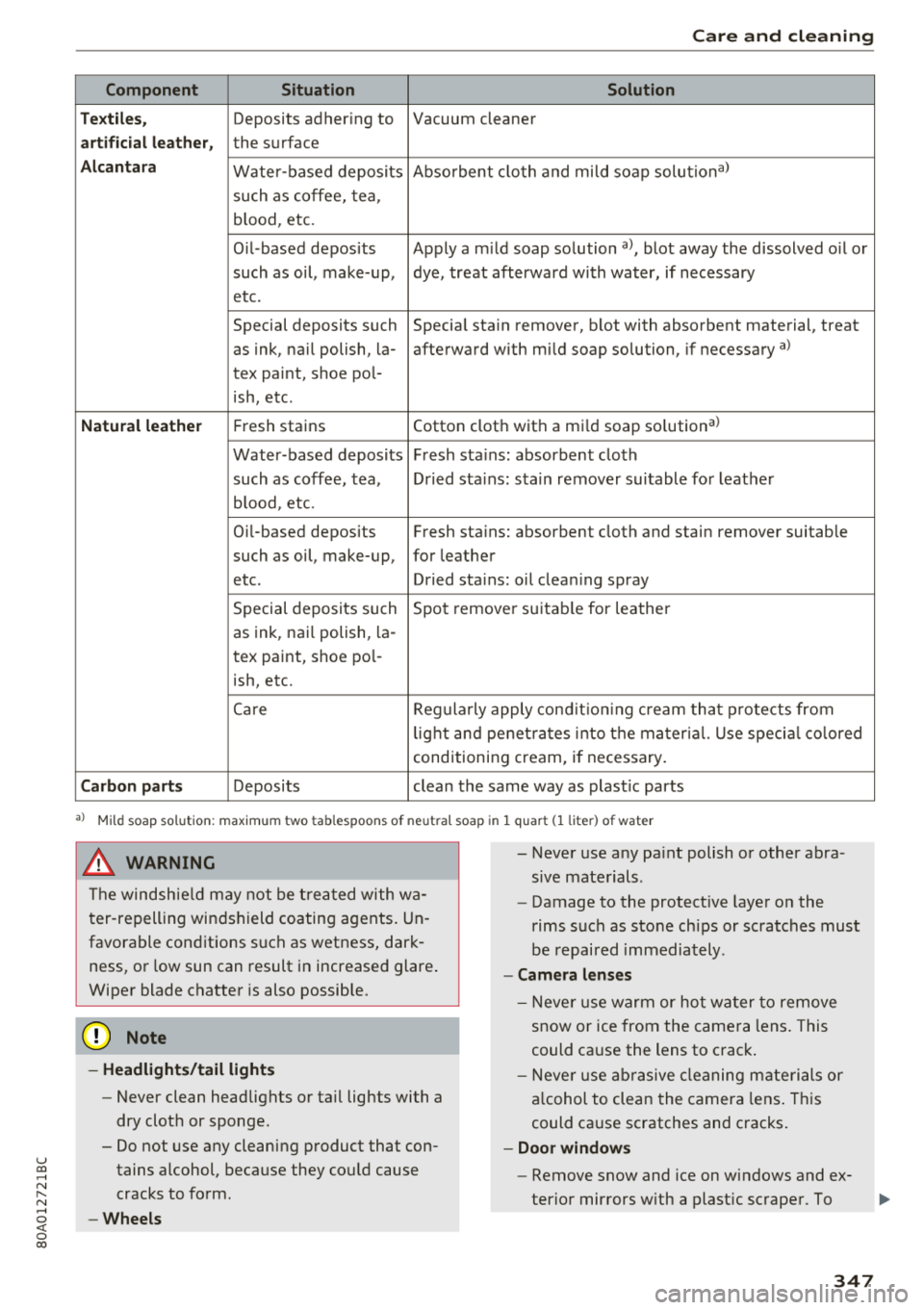
Component Situation Solution
T ex tile s,
Deposits adhering to Vacuum cleaner
art ifi ci al l eat her, the surface
A lcan tara Water-based deposits Absorbent cloth and mild soap solutiona>
such
as coffee, tea,
b lood, etc.
O il-based deposits Apply a m ild soap solution
al, blot away the dissolved o il or
such as oil, make-up, dye, treat afterward with water, if necessary
etc.
Special deposits such
Special stain remover, blot with absorbent material, treat
as ink, nail polish, la-afterward with mild soap solution, if necessary
a)
tex paint, shoe pol-
ish, etc.
Natu ral leathe r Fresh stains Cotton cloth with a mi
ld soap so lution a>
Water-based deposits Fresh stains : absorbent cloth
such as coffee, tea, Dried stains: stain remover suitable for leather
b lood , etc.
Oi l-based deposits Fresh stains: absorbent cloth and stain remover suitable
such as oil, make-up, for leather
etc . Dried stains: oil clean ing spray
Special deposits such Spot
remove r suitable for leather
as ink, nai l polish, la-
tex paint, shoe pol-
ish, etc.
Care Regula rly apply cond it ion ing cream that p rotects from
lig ht and penet rates into the mater ia l. Use specia l co lored
conditioning cream, if necessary.
Carbon p art s Deposits clean the same way as plast ic parts
a) Mi ld soap solution: maximum two tablespoons of neutral soap in 1 quar t (1 liter) of water
.8, WARNING
The windsh ie ld may not be trea ted with wa
ter-repelling windshield coating agents. Un
favorable conditions such as wetness, dark
ness, or low sun can result in increased glare .
Wiper blade chatter is also possible.
@ Note
- Headlights /tail light s
-Never clean headlights or tail lights with a
dry clot h or sponge.
- Do not use any cleaning product that con
tains alcohol, because they could cause
cracks to form .
-Wheels
-
- Never use any pa int polish or other abra
sive materials .
- Damage to the protect ive layer o n the
rims such as stone ch ips or scratches must
be repaired immediately .
-Cam era lenses
- Neve r use warm or hot wa ter to remove
snow or ice from the camera lens . This
could ca use the lens to crack .
- Neve r use ab rasive cleaning m ate rials or
a lcohol to clean the camera lens . This
could ca use scratches and cracks .
-Door window s
-Remove snow and ice on windows and ex-
terior mirrors w ith a plast ic scraper . To
347