year 5 AUDI Q5 2018 User Guide
[x] Cancel search | Manufacturer: AUDI, Model Year: 2018, Model line: Q5, Model: AUDI Q5 2018Pages: 392, PDF Size: 60.56 MB
Page 293 of 392
u co ..... N r--N ..... 0 <( 0 00
Child safety
Important information
Introduction
The rear seat is generally the safest place in a
collision .
The physical principles of what happens when
your vehicle is in a crash apply also to children
c> page 262, What happens to occupants not
wearing safety belts? .
But unlike adults and
teenagers, their muscles and bones are not fully
developed. In many respects children a re at
greater r isk of se rious injury in c rashes than
ad ults .
Because ch ildren's bodies are not fully devel
oped, they requ ire restra int systems especially
des igned for their size, we ight, and body struc
ture. Many coun tries and a ll states of the United
States and p rovinces of Canada have laws requi r
ing the use of approved child restraint systems
for infants and small children .
In a frontal crash at a speed of 20 - 35 mph (30 -
56 km/h) the forces acting on a 13-pound (6 kg)
infant will be more than 20 times the weight of
the child . This means the weight of the chi ld
wou ld suddenly be more than 260 pounds
(120 kg) . Under these condit ions, only an appro
priate ch ild restraint properly used can reduce
the r isk of serious injury . Child restra ints, like
adu lt safety belts, must be used properly to be
effect ive. Used imp roperly, they can increase the
risk of ser ious injury in an acc ident .
All ch ildren, especially those 12 years and you ng
er must a lways r ide in the back seat properly re
stra ined fo r their age and size. If you must insta ll
a child restra int on t he front passenger seat in
exceptional circumstances, be sure to read and h eed the important information and warnings
c> page 270. Infants and other chi ldren who are
properly restrained in an appropriate child re
stra int that is for their si ze and age can benefit
from the protection that supplemental s ide air
bags provide in some kinds of crashes .
For more information please see information
provided by the:
Ch ild saf ety
- National Highway Traffic Safety Administration
(NHTSA), currently at: http ://www .safe
rcar.gov (for the USA)
- Transport Canada Information Centre, current-
ly at: http://www .tc .gc .ca (for Canada)
Cons ult the ch ild safety seat manuf acture r's in
structions in order to be sure t he seat is right for
yo ur chi ld's size
c> page 295 , Important safety
instructions for using child safety seats .
Please
be sure to read and heed all of the important in
format ion and WARNINGS about ch ild safety,
Advanced Airbags, and the installation of child
restra ints in this chapter .
There is a lot you need to know about the Ad
vanced Airbags in your veh icle and how they work
whe n infants and children in child restraints are
on the fro nt passenger seat . Because of the large
amount of important informat ion, we cannot re
peat it all he re . We u rge you to read the detailed
i nformat ion in this owner 's ma nual about airbags
and the Advanced Airbag Sys tem in yo ur veh icle
and the very important information about trans
porting children on the front passenger seat.
Please be sure to heed the WARNINGS -they are
extremely important for your safety and the safe
ty of your passengers, especially infants and
small ch ildren .
A WARNING
-
-Accide nt statistics have shown that children
are generally safer in the rear seat area than
i n the front seat ing pos it ion. Always restrain
a ny child age 12 and unde r in t he rear.
- All vehicle occupants and especially children
m ust be restra ined prope rly whe never r id ing
i n a vehicle. An u nres tra ined o r improperly
rest rained chi ld cou ld be inju red by st riking
the interio r or by being ejected from the ve
hicle during a sudden maneuver or impact.
An unrestrained or improperly restrained
child is a lso at greater r isk of injury or death
through contact w it h an inflating a irbag.
- A suitable ch ild restraint properly installed
and used at one of the rear seating positions
prov ides the h ighest degree of protect io n
for infants and small children in most acc i
dent situat ions .
291
Page 295 of 392
on all the time whenever the ignition is
sw itched on.
- If the
PASSENGER AIR BAG OFF ~. light
does not come on and stay on, immediate
ly insta ll the forward-facing child seat in a
rear seating position and have the airbag
system inspected by your authorized Aud i
deale r.
- Always buckle the chi ld seat firmly in
place even if a ch ild is not sitt ing in it. A
loose ch ild seat ca n fly around during a
sudden stop o r in a coll is ion.
- Always read and heed all WARNINGS
wheneve r us ing a ch ild restraint in a veh i
cle
~ page 261, Safety belts, ~ page 269,
Airbag system and ~page 291, Impor
tant information .
(j) Tips
Always replace ch ild restraints that were in
stalled in a veh icle dur ing a crash. Damage to
a child restra int tha t is not visib le co uld cause
it to fail in another collision situation .
Advanced front airbag system and children
Your vehicle is equipped with an "Advanced Air
bag System" in comp liance with United States
Federa l Motor Vehicle Safety Standard (FMVSS)
208, as well as Canada Motor Veh icle Safety
Standard (CMVSS) 208 as applicable at the t ime
your ve hicle was manufactured .
The Advanced Airbag system in your vehicle has
been certified to meet the "low-risk" requ ire
ments for 3- and 6-year old children on the pas
senger side and small adults on the driver side.
The low risk deployment crite ria are intended to
reduce t he r isk of injury thro ugh inte ract ion with
the airbag t hat can occur, for examp le, by being
too close to the steering whee l and instrument
panel when the airbag inflates . In addition, the
system has been certified to comply with the
"suppression" req uirements of the Safety Stand
ard, to turn off the front airbag for infants up to
~ 12 months who are restra ined on the front pas-...,
~ senger seat in child restraints that are listed i n
~ the Standard. 0 <( 0 00
Child s af ety
E ven thoug h your veh icle is equipped with an Ad
vanced Airbag system, all chi ldren, especially
those 12 years and younger, should a lways ride
in the back seat properly restrained for their age
and size . The airbag on the passenger side makes
the front seat a potentia lly dangerous p lace for a
ch ild to ride . Th e front seat is not the safest place
fo r a ch ild in a forward-fac ing ch ild safety seat.
It
can be a very dangerous place fo r an infant o r a
la rge r ch ild i n a rea rwa rd -facing seat.
T he veh icle 's Advanced A irbag System has a ca
pacit ive passenger detection system in the front
passenge r seat cushion that can detect the p res
ence of a baby or a c hild in a child res tra int sys
tem on this seat .
T he capacitive passenger detection system reg is
te rs the changes that result i n an elect rical field
whe n a child, a ch ild restraint, and a baby b la nket
are on t he fron t passenger seat. The change in
the measured capacitance due to the presence of a chi ld, a child restraint, and a baby blanket on
the front passenger seat is related to the child
restra int system resting on the seat. The meas
ured capacitance of a child restra int system var
ies depend ing on the type of system and specific
make and model.
The electrical capac itance of the various types,
makes, and models of child restraints specif ied
by the U .S . National Highway Traffic Safety Ad
min istrat ion (NHTSA) in the relevant safety
standard are stored in the Advanced Airbag Sys
tem contro l unit together with the capacitances
typ ica l of infants and a 1 -year old child. When a
c h ild restraint is used on the front passenger
seat with a typical 1 year -old infant, t he Ad
vanced Airbag System compares the capacitance
measured by the capacitive passenger detection
system with the data stored in the electronic con
trol un it .
Child restraints and Advanced Airbags
Regardless of the ch ild restraint that you use,
make sure that it has been certified to meet Safe
ty Standards and has been cert ified by its manu
fact urer for use w ith an airbag . Always be s ure
t h at the c hild restraint is properly installed at
IJJ,,
293
Page 297 of 392
u co ..... N ,..._
N ..... 0 <( 0 00
-Take the chi ld restraint off the front passen
ger seat and install it properly at one of the
rear seat positions if the
P AS SEN GER AIR
BA G
OFF ~; light does not stay on.
- Have the airbag system inspected by your
authorized Audi dealer immediately.
(D Tips
The chi ld seats listed in categories A to C have
been statically tested by Audi only for the Ad
vanced Airbag function.
Important safety instructions for using
child safety seats
Correct use of child safety seats substantially re
duces the risk of injury in an accident!
As the driver, you are responsible for the safety
of everybody in the veh icle, especially chi ldren:
~ Always use the right chi ld safety seat for each
child and a lways use it properly
~ page 297.
~ Always carefully follow the child safety seat
manufacturer's instructions on how to route
the safety belt properly through the child safe
ty seat .
~ When using the vehicle safety be lt to install a
ch ild safety seat, you must first activate the
convertible locking retractor on the safety be lt
to prevent the child safety seat from moving
~page 302 .
~ Push the child safety seat down with your fu ll
weight to get the safety be lt really tight so that
the seat cannot move forward or sideways
more than one inch (2.5 cm).
~ Secure unused safety belts on the rear seat
~ page 297.
Always remember: Even though your vehicle is
equ ipped w ith an Advanced A irbag system, all
children, especially those 12 years and younger,
should always ride i n the back seat properly re
stra ined fo r their age and size.
_& WARNING
Not using a ch ild safety seat, using the w rong
child safety seat or improper ly installing a
Ch ild saf ety
chi ld restraint increases the risk of serious
personal injury and death.
- All vehicle occupants and especially children
must be restra ined properly whenever r iding
in a vehicle. An unrestra ined or improperly
restrained child cou ld be injured by striking
the inter ior or by be ing ejected from the ve
hicle dur ing a sudden maneuve r or i mpact.
An unrest rained or imprope rly restrained
child is a lso at greater r is k of injury or death
through contact w ith an inflating airbag.
- Commerc ially availab le child safety seats
are requi red to comply with U.S. Federal
Motor Vehicle S afety S tandard (FMVSS) 213
(in Canada CMVSS 213).
- When buying a child restra int, select one
that fits your ch ild and the vehicle .
- Only use child restraint systems that fully
contact the flat portion of the seat cush
ion. The ch ild restraint must not t ip or
lean to either side. Audi does not recom
mend using child safety seats that rest on
legs or tube-like frames. They do not pro
vide adequ ate cont act with the se at.
- Always heed all lega l requirements per
t ai ning to the insta llation and use of child
safety seats and carefu lly follow the in
structions provided by the manufact urer
of the seat you are using .
- Never a llow children under S7 inches
(1.45 meters) to wear a normal safety be lt.
They must a lways be restrained by a proper
child restraint system. Otherwise, they
could sustain injuries to the abdomen and
neck areas during sudden braking maneu
vers or accidents .
- Never let more than one child occupy a chi ld
safety seat.
- Never let babies or o lder children ride in a
veh icle while sitting on the lap of another
passenger.
- Holding a child in your arms is never a sub
stitute fo r a chi ld restraint system .
- The st rongest person cou ld no t ho ld the
ch ild with the forces tha t exist in an acci
dent. The child will strike the interior of
the vehicle and can also be struck by the passenger.
295
Page 299 of 392
u co ..... N r-N .....
~ 0 co
comes on and stays on whenever a child re
straint is installed on the front passenger seat
and the ignition is switched on.
- Take the child restraint off the front passen
ger seat and install it properly at one of the
rear seat positions if the
PASSENGER AIR
BAG OF F
~; light does not stay on .
- Have the airbag system inspected by your
authorized Audi dealer immediately .
Secure unused safety belts on the rear seat
Fig . 241 Schematic overview: keep unused safety belts
away from children in child safety seats. @· oute r rear
safety belt, ® · center rear safety belt
If a chi ld safety seat is used on the rear bench,
especia lly with LATCH universal lower anchorag
es, the unused safety be lts
mu st be secured so
that the child in the child restraint cannot reach
them <=>.&. .
-Guide the safety belt webbings @ and @ be
hind the head restra int of the seat where the
child restraint is installed
<=> fig. 241. When do
ing so, do not engage the convertible locking
retractor! You shou ld not hear a "clicking"
sound when w inding up the safety be lt .
- Let the belt retractor wind up the safety belt webbing .
A WARNING
A child in a child safety seat installed with the
LA TC H l ower anchorages or w ith the standard
safety belt or a child in a booster seat on the
rear seat could play with unused rear seat
safety belts and become entangled. This
co uld cause the chi ld serious personal i njury
and even death.
Ch ild s afe ty
-Always secure unused rear seat safety belts
out of reach of children in child seats such
as by properly routing them around the
head restraint of the seat where the child
restraint is installed .
- Never activate the convert ible lock ing re
tractor when rout ing the safety belts around
the head restraints.
- Never let anyone sit at the center rear seat
ing position if the center rear safety belt has
been routed around a rear head restraint.
Child safety seats
Infant seats
Babies and infants up to about one year old and
20 lbs. or
9 kg need special rearward-facing
child restraints that support the back, neck and
head in a crash .
Fig. 242 Sc hematic overview: rearward-facing in fant seat,
properly i nstalled on th e rear seat
.,. When using the vehicle safety belt to install a
child safety seat, you must first activate the
convertib le locking retractor on the safety belt
to prevent the child safety seat from moving
<=> page 302 or install the seat using the LATCH
attachme nts .
.,. Push the ch ild safety seat down with you r full
weight to get the safety belt really tight so that
the seat cannot move forward or sideways more than one inch (2.5 cm).
.,. Secure unused safety belts on the rear seat
<=>page 297 .
Infants up to about one yea r (20 lbs. or 9 kg) are
best protected in special infant ca rr ie rs and child
sa fety seats designed for the ir age group. Many
experts believe that infants and small ch ildren
Iii>-
297
Page 301 of 392
Convertible child safety seats
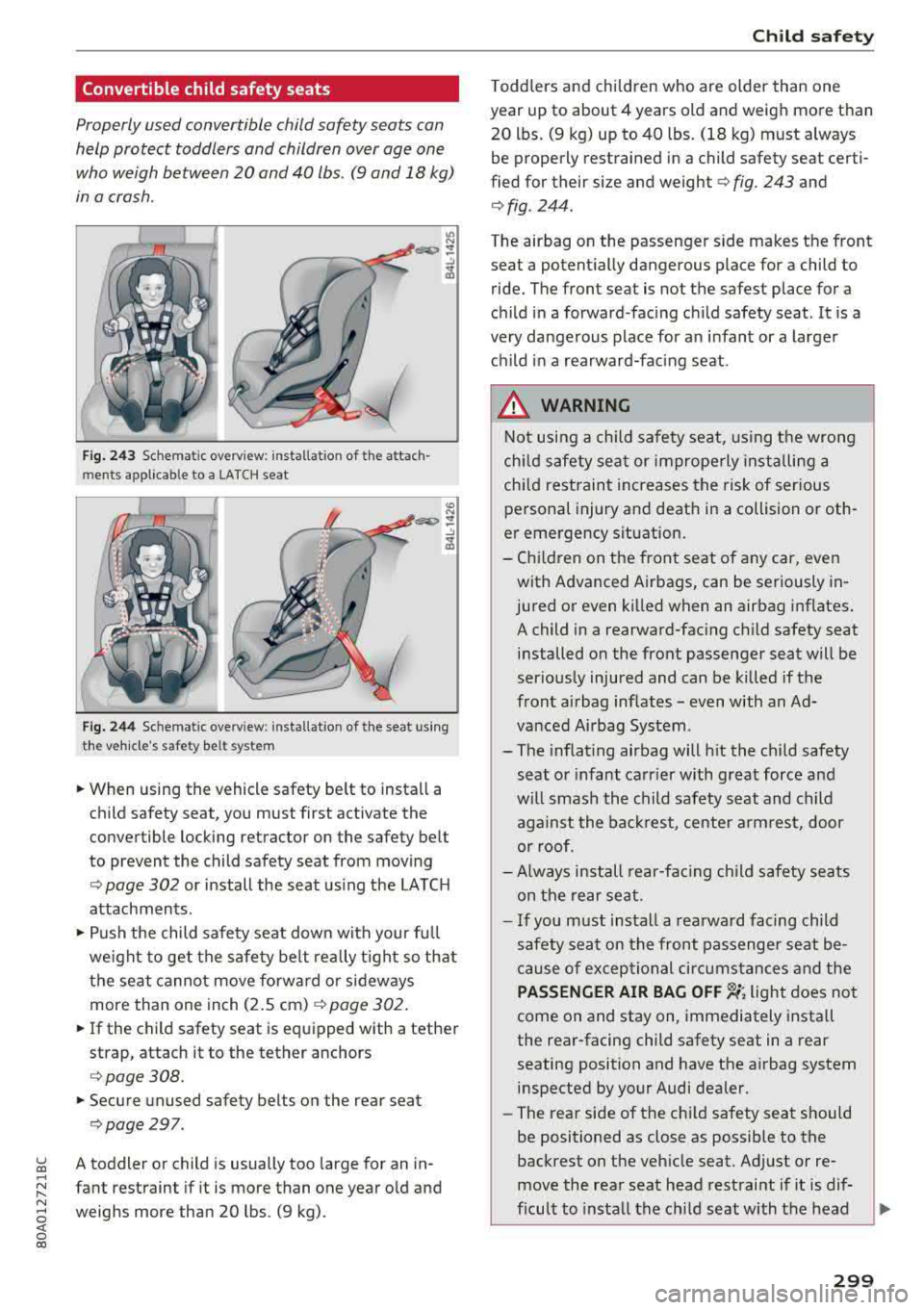
Properly used convertible child safety seats can
help protect toddlers and children over age one
who weigh between
20 and 40 lbs. (9 and 18 kg)
in a crash.
f ig . 243 Sche matic overview: installatio n of the attach
ments applica ble to
a LA TCH seat
Fig. 2 44 Schematic overview: installat ion of the seat using
the vehicle's safety belt system
~ When using the vehicle safety belt to install a
child safety seat, you must first activate the
convertible locking retractor on the safety belt
to prevent the child safety seat from moving
¢page 302 or install the seat us ing the LA TC H
attachments .
~ Push the child safety seat down with your fu ll
weight to get the safety be lt rea lly t ight so that
the seat cannot move forward o r sideways
more than one inch (2.5
cm)¢ page 302 .
~ If the child safety seat is equipped with a tether
strap, attach it to the tether anchors
¢page 308.
~ Secure unused safety belts on the rear seat
¢page 297.
~ A toddler or child is usually too large for an in-
~ fant restraint if it is more than one year old and r--
~ weighs more than 20 lbs. (9 kg).
~ 0 co
Child s afe ty
Todd lers and children who are older than one
year up to about 4 years old and weigh more than
20 lbs. (9 kg) up to 40 lbs . (18 kg) must always
be properly restrained in a child safety seat certi
fied for their size and
weight¢ fig. 243 and
¢ fig. 244.
The airbag on the passenger side makes the front
seat a potent ially dangerous place for a child to
ride. The front seat is not the safest place for a
child in a forward -fac ing child safety seat . It is a
very dangerous place for a n in fant or a larger
child in a rearward-facing seat .
_&. WARNING
Not using a child safety seat, using t he wrong
chi ld safety seat or imprope rly insta lling a
chi ld restraint increases the risk of ser ious
personal injury and death in a collision or oth
er emergency situation.
-Ch ildren on the front seat of any car, eve n
wit h Advanced Airbags, can be seriously in
jured or even killed when an airbag inflates .
A child in a rearward-fac ing ch ild safety seat
installed on the front passenger seat will be
serious ly injured and can be killed if the
front airbag inflates -even with an Ad
va nced Ai rbag System .
-The inflat ing airbag will h it the ch ild safety
seat or infant carr ier with great force and
will smash the child safety seat and child aga inst the backrest, ce nter a rmrest, door
or roof.
- Always ins tall rear-fa cing c hild safety seats
on the rear seat .
-If you m ust instal l a rea rwa rd facing child
safety seat on the front passenger seat be
cause of exceptional circ ums tan ces and the
PASSENGER AIR BAG OFF "1; light does not
come on and stay on, immediately insta ll
the rea r-facing child safety seat in a rear
seating position and have the a irbag system
inspected by your Audi dealer.
-The rear side of the ch ild safety seat shou ld
be positioned as close as possible to the
backrest on the veh icle seat. Adjust or re
move the rear seat head restraint if it is dif-
f icult to instal l the ch ild seat with the head ._.
299
Page 303 of 392
Booster seats and safety belts
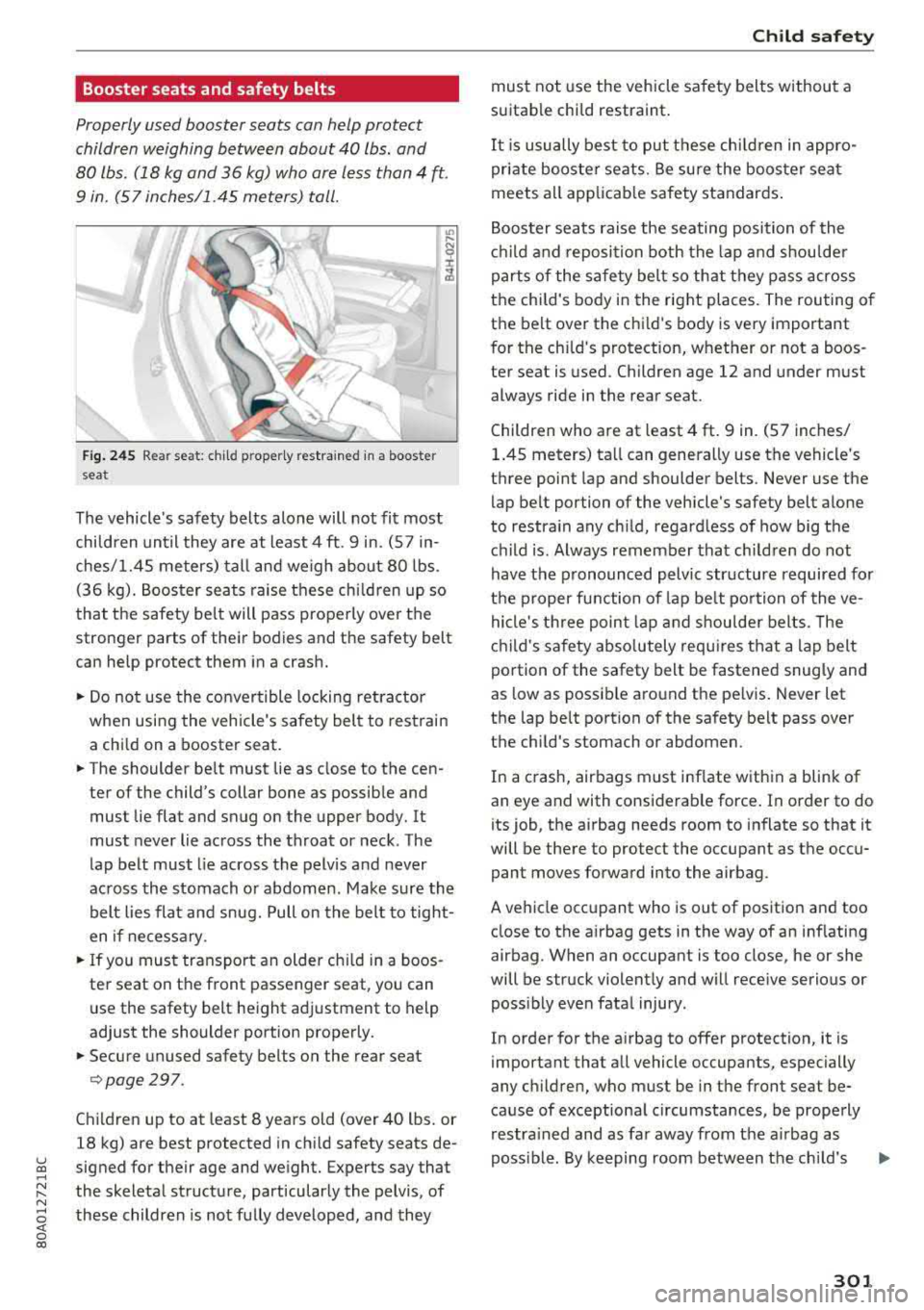
Properly used booster seats can help protect
children weighing between about 40 lbs. and
80 lbs . (18 kg and 36 kg) who are less than 4
ft.
9 in. (57 inches/1.45 meters) tall.
Fig . 245 Rea r seat: chi ld p roper ly restrained in a booster
sea t
The vehicle's safety belts alone will not fit most
children until they are at least 4
ft. 9 in. (57 in
ches/1.45 meters) tall and weigh about 80 lbs.
(36 kg). Booster seats raise these children up so
that the safety belt will pass properly over the
stronger parts of their bodies and the safety belt
can help protect them in a crash.
.,. Do not use the convertible locking retractor
when using the vehicle's safety belt to restrain
a chi ld on a booster seat .
.. The shoulder belt must lie as close to the cen
ter of the child's collar bone as possib le and
must lie fla t and snug on the upper body. It
must never lie across the throat or neck. The
lap belt must lie across the pelvis and never
across the stomach or abdomen . Make sure the
belt lies flat and snug. Pull on the belt to tight
en if necessary .
.,. If you must transport an older child in a boos
ter seat on the front passenger seat, you can
use the safety belt height adjustment to help
adjust the shoulder portion properly .
.. Secure unused safety belts on the rear seat
¢page 297.
Children up to at least 8 years old (over 40 lbs. or
18 kg) are best protected in chi ld safety seats de-
~ signed for their age and we ight. Experts say that .....
~ the skeletal structure, particularly the pelvis , of N
~ these children is not fully developed, and they
0 co
Child safety
must not use the vehicle safety belts without a
suitable child restraint .
It is usually best to put these children in appro
priate booster seats. Be sure the booster seat
meets all applicab le safety standards .
Booster seats raise the seating position of the
child and reposition both the lap and shoulder
parts of the safety belt so that they pass across
the chi ld's body in the right places. The routing of
the be lt over the chi ld's body is very important
for the ch ild's protection, whether or not a boos
ter seat is used. Children age 12 and under must
always ride in the rear seat.
Children who are at least 4
ft. 9 in. (57 inches/
1.45 meters) tall can generally use the vehicle 's
three point lap and shoulder belts. Never use the
lap belt portion of the vehicle 's safety belt alone
to restrain any ch ild, regard less of how big the
ch ild is. Always remember that child ren do not
have the pronounced pelvic structure required for
the proper function of lap belt portion of the ve
hicle's three point lap and shoulde r belts. The
child's safety absolutely requires that a lap belt
portion of the safety belt be fastened snugly and
as low as possible around the pe lvis . Never let
the lap belt portion of the safety belt pass over
the child 's stomach or abdomen .
In a crash, airbags must inflate within a blink of
an eye and with considerab le force. In order to do
its job, the airbag needs room to inflate so that it
will be there to protect the occupant as the occu pan t moves forward into the airbag .
A vehicle occ upant who is out of position and too
close to the a irbag gets in the way of an inf lating
airbag. When an occupant is too close , he or she
will be struck violent ly and w ill rece ive serious or
poss ibly even fata l injury .
In order for the airbag to offer protection, it is
important that all vehicle occupants, especially
any ch ildren, who must be in the front seat be
cause of exceptiona l circumstances, be properly
restrained and as far away from the airbag as
poss ible. By keeping room between the child's
..,_
301
Page 324 of 392
Checking and Filling
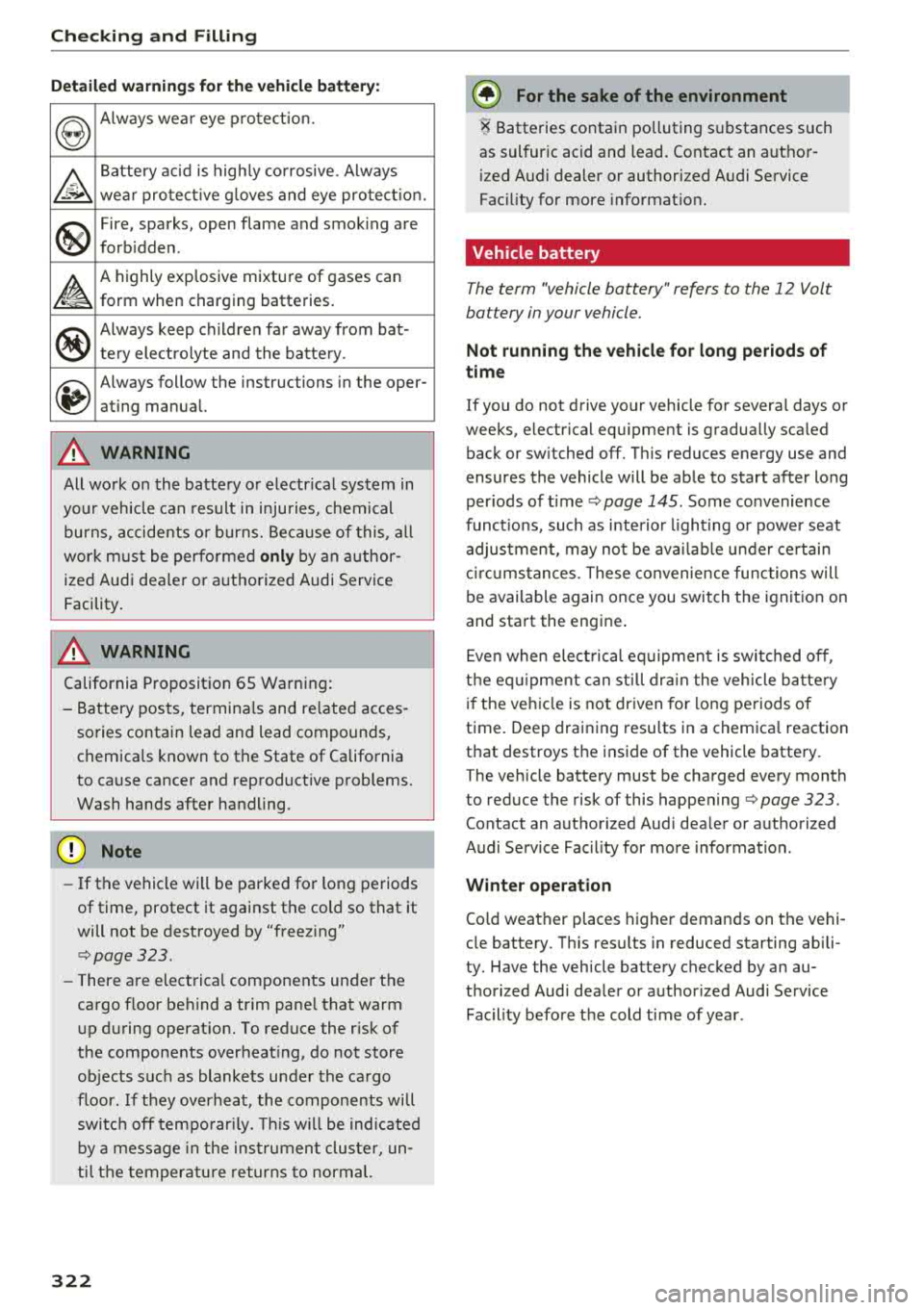
Detailed warnings for the vehicle battery:
~
Always wea r eye protection.
~
Battery acid is highly corrosive. Always
wea r protect ive g loves and eye pro tect io n .
.
®
Fire, sparks, open flame and smok ing are
forb idden .
~
A highly explosive mixture of gases can
form when charging batteries.
®
Always keep childre n far away from bat-
tery electrolyte and the batte ry .
~
Always follow the instructions in the oper-
ating manual.
A WARNING
All wo rk on the batte ry o r electrical system in
yo ur vehicle can result in inju ries, chemical
burns, accidents or burns. Because of this, all
wor k must be performed
only by an author
ized Audi dealer or authorized Audi Service
Facility.
A WARNING
California Proposition 65 Warning:
- Battery posts, terminals and re lated acces
sories contain lead and lead compounds,
chemica ls known to the State of California
to cause cancer and reproductive problems.
Wash hands after handling .
@ Note
-If the vehicle will be parked for long periods
of time, protect it against the cold so that it
will not be destroyed by "freezing"
<=>page 323.
-There are electrical components under the
cargo floor behind a trim pane l that warm
up during operation. To reduce the risk of
the components overheat ing, do not store
objects such as blankets under the cargo
floor . If they overheat, the components wi ll
switc h off temporarily. This will be ind icat ed
by a message in the instrument cluster, un
til the temperature returns to normal.
322
@ For the sake of the environment
i Batteries contain polluting substances such
as sulfur ic acid and lead. Contact an author
i zed Audi dealer or authorized Audi Service
Fac ility for more informat ion.
Vehicle battery
The term "vehicle battery" refers to the 12 Volt
battery in your vehicle.
Not running the vehicle for long periods of
time
If you do not drive your vehicle for severa l days or
weeks, electrical equ ipment is gradually sca led
back or switched off. This reduces energy use and
ensures the vehicle will be able to start after long
periods of
time<=> page 145 . Some convenience
funct ions, such as interior lighting or power seat
adjustment, may not be available under certain
circumstances . These convenience functions will
be available again once you switch t he ignition on
and start the engine .
Even when electrical equipment is switched off,
the equipm ent can still drain the vehicle battery
if the vehicl e is not driven for long periods of
time. Deep draining results in a chemical reaction
that destroys the inside of the vehicle battery.
The vehicle battery must be charged every month
to reduce the risk of this happening
<=> page 323.
Contact an authorized Aud i dealer or authorized
Audi Service Fac il ity for more information.
Winter operation
Cold weather places higher demands on the vehi
cle battery. This results in reduced starting abili
ty. Have the vehicle battery checked by an au
thorized Audi dealer or authorized Audi Service
Fac il ity before the cold time of year .
Page 329 of 392
u a, .... N r-N ....
~ a,
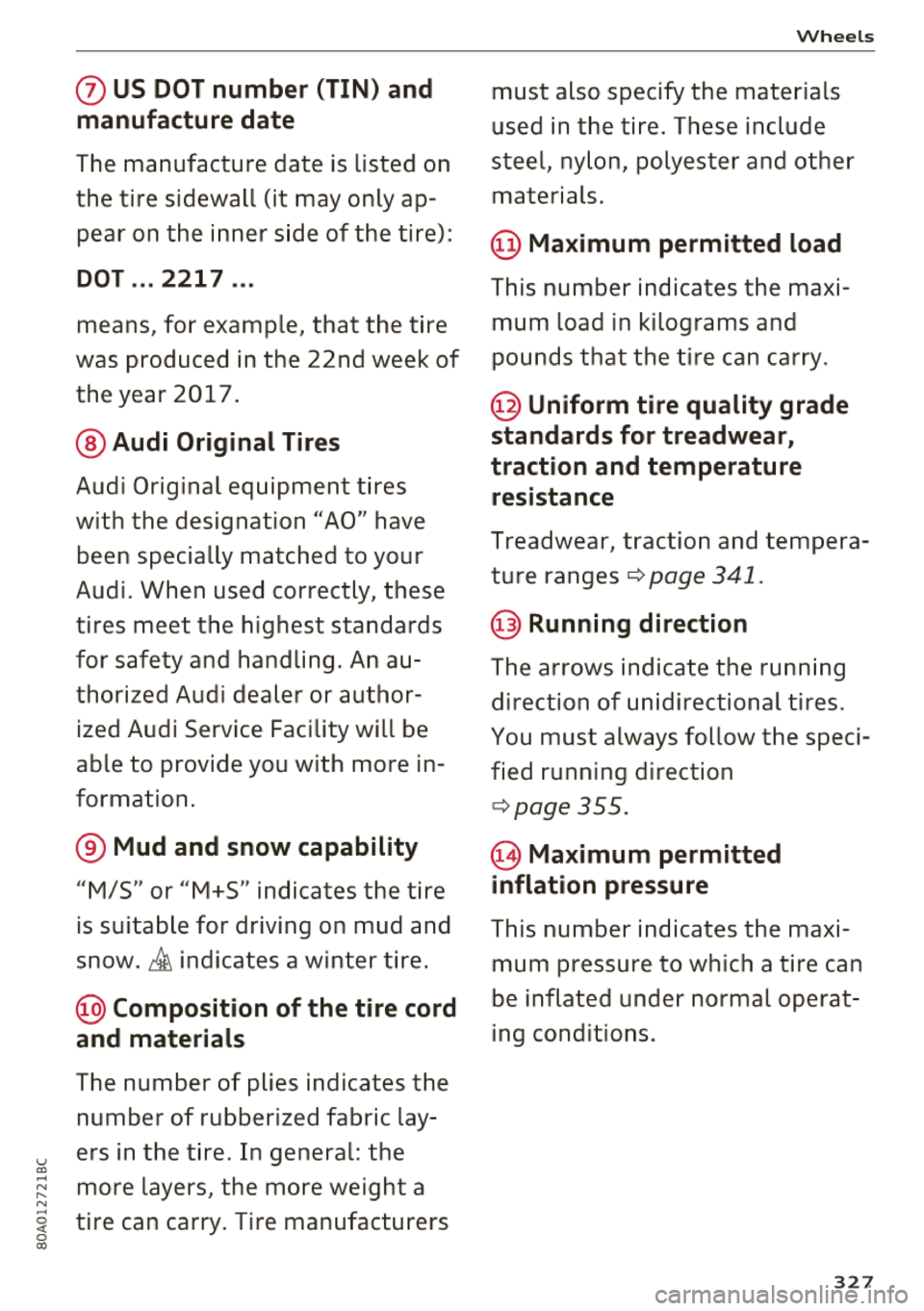
(J) US DOT number (TIN) and
manufacture date
T he manufacture date is listed on
the tire sidewall (it may only ap
pear on the inner s ide of the tire):
DOT .. . 2217 .. .
means , for example, that the tire
was produced in the 22nd week of
the year 2017 .
@ Audi Original Tires
Audi Original equipment tires
with the designation
"AO" have
been specially matched to your
Audi . When used correct ly , these
tires meet the highest standards
for safety and handling . An au
thorized Audi dealer or author
ized Audi Service Facility will be
able to provide you with more in
formation .
® Mud and snow capability
"M/5 " or "M+S" indicates the tire
is suitable for driving on mud and
snow .
& indicates a winter tire .
@ Composition of the tire cord
and materials
The number of plies indicates the
number of rubberized fabric lay
ers in the tire. In general : the
more layers, the more weight a
tire can carry . Tire manufacturers
Wh eel s
must also specify the materials
used in the tire . These include
steel, nylon, polyester and other
materials.
@ Ma ximum permitted load
This number indicates the maxi
mum load in kilograms and
pounds that the tire can carry .
@ Uniform tire qual ity grade
standards for treadwear,
traction and temperature resistance
Treadwear , tract ion and tempera
ture ranges
r=:>page 341 .
@ Running direction
The arrows indicate the runn ing
direction of unidirectional tires .
You must always follow the speci
fied running direction
Q page 355.
@ Ma ximum permitted
inflation pressure
This number indicates the maxi
mum pressure to which a tire can
be inflated under normal operat
ing cond itions .
327
Page 333 of 392
u a, .... N r-N ....
~ a,
maximum permissible road
speeds. See
also ¢.& in General
information on page 325.
Tire pre ssure mon itoring
system
means a system that detects
when one or more of a vehicle's
tires are underinflated and illumi
nates a low tire pressure warning
telltale.
Tread
means that portion of a tire that
comes into contact with the road .
Tread separation
means pulling away of the tread
from the tire carcass.
Treadwea r indicators (TWI )
means the projections within the
principal grooves designed to give
a visual indication of the degrees
of wear of the tread. See
¢ page 334, Treadwear indicator
for more information on measur
ing tire wear .
Uniform Tire Quality Grading
is a tire information system devel
oped by the United States Nation
al Highway Traffic Safety Admin
istration (NHTSA) that is designed
to help buyers make relat ive com-
Wheels
parisons among tires . The U TQG
is not a safety rating and not a
guarantee that a tire will last for
a prescribed number of miles
(kilometers) or perform in acer
tain way . It simply gives tire buy
ers additional information to
combine with other considera
tions, such as price, brand loyalty and dealer recommendatio ns. Un
der UTQG, tires are graded by the
tire manufacturers in three areas :
treadwear, tract ion, and tempera
ture resistance. The UTQG infor
mation on the tires, molded into
the sidewalls.
U.S. DOT Tire Identification
Number (TIN)
T his is the tire's "se ria l number" .
It begins with the letters "DO T"
and indicates that the tire meets all federal standards. The next
two numbers or letters indicate
the plant whe re it was manufac
tured, and the last four numbers
represent the week and year of
manufactu re . For example,
DOT .. . 2217 ...
means that the tire was produced
in the 22nd week of 2017 . The
other numbers are marketing co des that may or may not be used
.,.
33 1
Page 335 of 392
u a, .... N r-N ....
~ a,
differently even if they are the
same
size ¢,&. .
.,,. If you would like to equip your
vehic le with a tire/rim combina
tion that is different from what
was installed at the factory, con
sult with an authorized Audi
dealer or authorized Audi Service Facility before making a pur
chase¢ ,&..
Because the spare tire* is differ
ent from the regular tires instal
led on the vehicle (such as winter
tires or wide tires), only use the spare tire* temporari ly in case of
emergency and drive carefully
while it is in use. It should be re
placed with a regular tire as soon
as possible.
All four wheels must be equipped
with tires that are the same brand
and have the same construction
and tread pattern so that the
drive system is not damaged by
different tire speeds. For this rea
son, in case of emergency, only
use a spare tire* that is the same
circumference as the regular
tires.
A WARNING
-
-Do not use steel rims that are 17 inches or larger. Other-
Wheels
wise, damage to the vehicle
and an accident could result .
-Only use tire/rim combina tions and suitable wheel bolts
that have been approved by
Audi. Otherwise, damage to
the vehicle and an accident
could result.
-For technical reasons, it is not
possible to use tires from oth
er vehicles
-in some cases,
you cannot even use tires from
the same vehicle model.
-Make sure that the tires you select have enough clearance
to the vehicle. Replacement
tires should not be chosen
simply based on the nominal
size, because tires with a dif
ferent construction can differ
greatly even if they are the
same size. If there is not
enough clearance, the tires or
the vehicle can be damaged
and this can reduce driving
safety and increase the risk of
an accident.
-Only use tires that are more than six years old when absolutely necessary and drive
carefully when doing so.
-Do not use run-flat tires on
your vehicle. Using them when
,..
333