automatic transmission AUDI Q7 2009 Owner´s Manual
[x] Cancel search | Manufacturer: AUDI, Model Year: 2009, Model line: Q7, Model: AUDI Q7 2009Pages: 426, PDF Size: 97.13 MB
Page 191 of 426

_________________________________________________ A_ u_t_ o_ m_ a_t _i _ c _ t _ra_ n_s_ m __ is_s_ io_ n _ __.11111
Ap plies to vehi cles : wi th tip troni c-st eerin g wh eel
Steering wheel with tiptronic ®
The shift buttons on the steering wheel allow the driver to
shift gears manually.
Fig . 202 Steering
wheel: Shift buttons
- To downshift, touch the button on the left Q.
- To upshift , touch the button on the right G) .
The shift buttons are activated when the selector lever is in D, Sor
in the manual shift program (tip tronic) .
Of course, you can continue to use the manual shift program with
the selector lever on the center console .•
Automatic transmission malfunction ~
In the event of a system malfunction, the automatic transmission
switches to emergency operation mode.
Gearbox malfunction: You can continue driving
You can continue to drive the vehicle. See an authorized Audi dealer or other qualified workshop at the next opportunity.
Gearbox malfunction: You can continue driving but functions
are restricted
Con tro ls and eq uip
ment
There is a serious system malfunction:
• The program shifts only into certain gears.
• The engine may stall.
• It is not possible to restart the engine if it has been switched off .
• Continuing to drive could result in subsequent damage .
0 Note
If the transmission switches to fail -safe mode , you should take the
vehicle to an authorized Audi dealership as soon as possible to have
the condition corrected .•
Emergency release for selector lever
If the vehicle's power supply fails, the selector lever can
be released in an emergency.
Fig . 203 Remove the
ashtray insert
~
Vehicle care I I Technical data
Page 194 of 426
• .___A_ d_v_ a_ n_c_ e_ d_ P _a_r_k _i_ n -=g,_ S-=y"- s_ t_ e_ m __________________________________________ _
-Press the sw itch PJJJ! in the cente r console ~ page 191,
fig. 206 t o activate the A udi pa rking system m anually .
Activation of the acoustic parking system is confirmed by
a brief acknowledgement sound . The indicator light in
the switch lights up.
D ea ctivation
If you drive forwards faster tha n approx. 6 mph (10 km/h),
or
- if you switch the ign ition off, the entire acoustic parking
assist is automatically deactivated, or
- you can press the sw itch
P111! i n the center console
=> page 191, fig. 206 to deact ivate the Audi parking
system. The indicator light in the switch goes out.
You have to turn on the acoustic parking assist m anuall y if you wish
to park the vehicle forwards or if you w ish to approach an obstacle
forwards and want a distance warning .
The range at which the sensors start to measu re is
about:
Front
Rear
W arning ton es side
cen
te r
side
cen ter 3 ft (0
.90 ml
4ft (1.20 ml
2 ft (0.60 ml
5 .2 ft (1.60 ml
Distance warning is given by chimes which are generated by a
signal generator . The volume and the pitch of the chimes can be
adjusted in the MMI => page 201.
Mute In the case of vehic les with automa tic transmission, an acoustic
distance warning is discontinued when the transmission selector lever is moved to the P position. However, the system remains
active
. As soon as the selector lever is moved from the
P posi tion
and the vehicle approaches an obstacle, the acoustic distance
warning resumes .
Dri ving fo rward/ba ckvv ard
Distance warning when driving forward/backward is based o n
detection of an obstacle in the range of the parking assist . As the
distance dec reases, the time interval between the audible tones
becomes shorter.
When the distance is less than approx . 1 ft (0.30 m), the tone
becomes continuous. At this point you shou ld s top backing up or
driving forward .
If the distance to an obstac le remains the same, the vo lume of the
distance warning is gradually reduced after about
4 seconds (does
not app ly to the zone for the cont inuous tone). If you sta rt to
approach the detected obstacle again, the distance warning will
sound at the normal volume again .
P a rk ing
When you selec t ano ther gear when parki ng (e .g . reverse/forward),
the warning tones are temporarily suppressed, but the visual display remains on the MMI display . If you start approaching a
detected obstacle again, the distance warning wi ll sound at the
normal vo lume again .
Vi sual disp lay
T he segments on the MMI display indicate a change in the distance
between the vehicle and an obstacle . The number of segments
displayed depends on the obstacles in front of or behind the
vehic le. The c loser the vehic le comes to the obstacle, the closer the
segments approach the vehic le => page 191, fig. 207. When the
segment before last is disp layed, the veh icle has reached the colli
sion zone. At this point you should stop backing up or driving
forward =>
&,. ..,.
Page 310 of 426
ll'I __ T_ r _a_ il_e _r_ t_ o_ vv_ in__... g,_ __________________________________________________ _
& WARNING
Anyone not properly restrained in a moving vehicle is at a much
greater risk
in an accident. Never let anyone ride in your car who
is not properly wearing the restraints provided by Audi .
c:
Trailer towing tips
Important to know
Your vehicle handles differently when towing a trailer because of
the additional weight and different weight distribution. Safety,
performance and economy will greatly depend on how carefully you
load your trailer and operate your rig.
Before you actually tow your trailer, practice turning, stopping and
backing up in an area away from traffic. Keep practicing until you
have become completely familiar with the way your vehicle -trailer
combination behaves and responds.
Backing up is difficult and requires practice. Backing up with a
trailer generally requires steering action opposite to that when
backing up your vehicle without a trailer.
Maintain a greater distance between your vehicle and the one in
front of you. You will need more room to stop. To compensate for
the trailer, you will need a larger than normal turning radius.
When passing, remember that you cannot accelerate as fast as you normally would because of the added load. Make sure you have
enough room to pass. After passing, allow plenty of room for your
trailer before changing lanes again.
Avoid jerky starts, sharp turns or rapid lane changes.
[ i] Tips
• Do not tow a trailer during the break-in period of your vehicle. • If you tow
a trailer, your Audi may require more frequent mainte
nance due to the extra load~
page 401. •
Parking on a s1ope
Do not park on a slope with a trailer. If it cannot be
avoided , do so only after doing the following:
When parking:
-Apply the foot brake.
- Have someone place chocks under both the vehicle and
the trailer wheels.
- With chocks in place, slowly release the brakes until the
wheel chocks absorb the load.
- Turn the wheels towards the curb.
- Apply the parking brake.
- Move the selector lever to
P.
When restarting after parking:
- Apply the foot brake.
- Start the engine.
- Move the selector lever to
D.
-Release the parking brake and slowly pull out and away
from the wheel chocks.
- Stop and have someone retrieve the wheel chocks.
[ i] Tips
I f you move the selector lever of the automatic transmission to P
before applying the parking brake and before blocking the wheels, II-
Page 350 of 426
-~_T_ ir_e_ s_ a_ n_d _ w_ h_ e_e _l_s _________________________________________________ _
& WARNING (continued)
crashes and serious personal injuries . Have worn or damaged tires
replaced immediately.
• Tires age even if they are not being used and can fail suddenly,
especially at high speeds. Tires that are more than 6 years old can
only be used in an emergency and then with special care and at
low speed.
Glossary of tire and loading terminology
Accessory weight
means the combined weight (in excess of those standard items
which may be replaced) of automatic transmission, power steering,
power brakes, power windows, power seats, radio, and heater, to
the extent that these items are available as factory-installed equip
ment (whether installed or not).
Aspect ratio means the ratio of the height to the width of the tire in percent.
Numb ers of 55 or lower indicate a low sidewall for improved
steering response and better overall handling on dry pavement.
Bead
means the part of the tire that is made of steel wires, wrapped or reinforced by ply cords and that is shaped to fit the rim.
Bead separation means a breakdown of the bond between components in the bead.
Cord
means the strands forming the plies in the tire.
& WARNING (continued)
• Never mount used tires on your vehicle if you are not sure of
their "previous history." Old used tires may have been damaged
even though the damage cannot be seen that can lead to sudden
tire failure and loss of vehicle control.
• If you notice unusual vibration or if the vehicle pulls to one side
when driving, always stop as soon as it is safe to do so and check
the wheels and tires for damage . •
Cold tire inflation pressure
means the tire pressure recommended by the vehicle manufacturer
for a tire of a designated size that has not been driven for more than
a couple of miles (kilometers) at low speeds in the three hour period
before the tire pressure is measured or adjusted.
Curb weight means the weight of a motor vehicle with standard equipment
including the maximum capacity of fuel, oil, and coolant, air condi
tioning and additional weight of optional equipment.
Extra load tire
means a tire design to operate at higher loads and at higher infla
tion pressures than the corresponding standard tire. Extra load tires
may be identified as "XL",
"xi", "EXTRA LOAD", or "RF" on the side
wall.
Gross Axle Weight Rating ("GAWR")
means the load-carrying capacity of a single axle system, measured
at the tire -ground interfaces.
Gross Vehicle Weight Rating ("GVWR"l
means the maximum total loaded weight of the vehicle.
Page 375 of 426
What do I do now? -
---------------~.;______
•
& WARNING (continued)
• Loose items in the passenger compartment can cause serious
personal injury during hard braking or in an accident .
- Never store the inflatable spare tire or jack and tools in the
passenger compartment.
- Always store all jacking equipment, tools, and the inflatable
spare tire in the luggage compartment.
- Tighten the knurled retaining screw for the inflatable spare
tire securely.
0 Note
• Th e inflatable spare tire has been developed specifically for this
vehicle model. It must not be exchanged or used for other vehicle
models. Similarly, inflatable tires from other vehicle models must
not be used.
• Normal summer or winter tires must not be installed on the
inflatable tire rim.•
Changing a wheel
Before changing a wheel
Observe the following precautions for your own and your
passenger's safety when changing a wheel.
-After you experience a tire failure, pull the car well away
from moving traffic and try to reach
level ground before
you stop => & .
- All passengers should
leave the car and move to a safe
location (for instance, behind the guardrail)=> &.
- Engage the
parking brake to prevent your vehicle from
rolling unintentionally=> &. -
Move
selector lever to position P =:> & .
- If you are towing a trailer: unhitch the trailer from your
vehicle.
- Block the diagonally opposite wheel with the folding
chocks or other objects.
- Take the
jack and the inflatable spare tire out of the
luggage compartment=>
page 370.
& WARNING
You or your passengers could be injured while changing a wheel if
you do not follow these safety precautions:
• If you have a flat tire, move a safe distance off the road. Turn off
the engine, turn the emergency flashers on and use other warning
devices to alert other motorists.
• Make sure that passengers wait in a safe place away from the
vehicle and well away from the road and traffic.
• To help prevent the vehicle from moving suddenly and possibly
slipping off the jack , always fully set the parking brake and block
the wheel diagonally opposite the wheel being changed with the
folding chocks or other objects. When one front wheel is lifted off
the ground, placing the Automatic Transmission in "P" (Park) will
not prevent the vehicle from moving.
• Before you change a wheel, be sure the ground is level and firm .
If necessary, use a sturdy board under the jack.
• After installing the inflatable spare tire, make sure that you
replace the flat tire/wheel in its storage area properly and tighten
the knurled retaining screw securely. •
Do-it -yourself service
Page 385 of 426
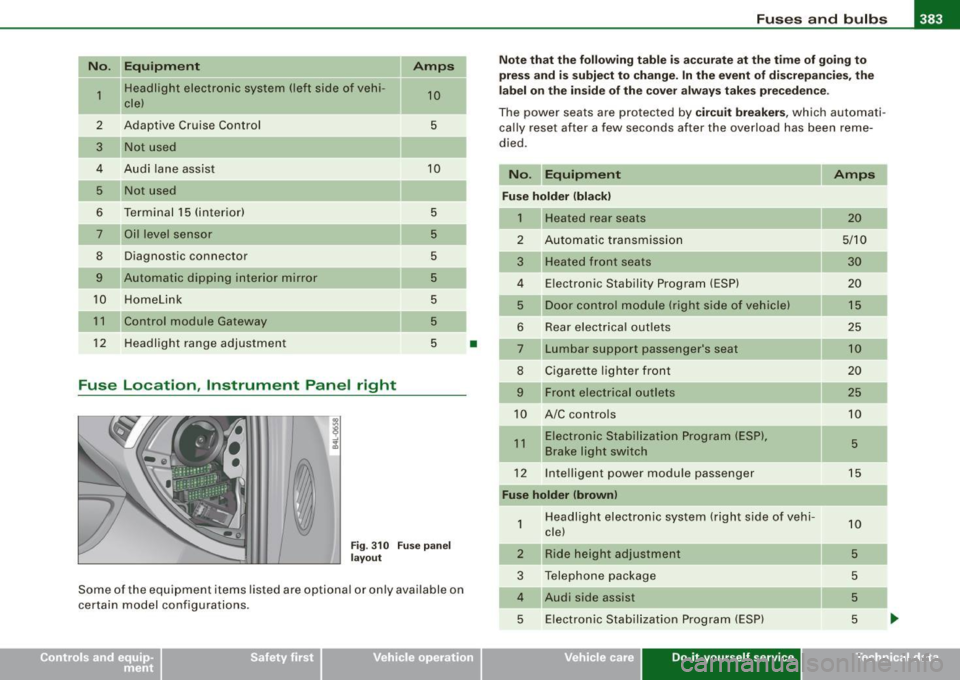
Fuses and bul bs 11111 ________________________________ ..:....:,:_=-.::..:....:.;.:_.:..:..,_,;__,;____,J
....
No.
1
-
2
3
4
5
6
Eq uipm ent
Headlight electronic system (left side of vehi -
cle)
Adaptive Cruise Control
Not used
Audi lane assis t
Not used
Terminal 15 (interior)
Oil level sensor
8 Diagnostic connector
9 Automatic dipping interior mirror
10 Homelink
1 1 Control module Gateway
12 Headlight range adjustment
Amps
10
5
10
5
5
5
5
5
5
5
Fuse Location , Instrument Panel right
Fi g. 310 F use pane l
l ayo ut
Some of the equipment items listed are optional or only avai lable on
certain model configurations .
•
Note that th e fo llo wi ng ta ble is acc urate a t the time of goi ng to
pre ss and is subject to change. In th e event of di screpan cies, t he
l a b el on the ins ide o f th e cover a lw ays ta ke s prec eden ce.
The power seats are protected by circ uit breakers , which automati
ca lly reset af ter a few seconds after the overload has been reme
died .
No. Equipm ent
Fu se holder (bla ck )
1 Heated rear seats
2 Automatic transmission
3 Heated front seats
4 E lectronic Stability Program (ESP)
5 Door control module (right side of vehicle)
6 Rear electrical out
lets
7 Lumbar support passenger's seat
8 Cigarette lighter front
9 Front electrical outlets
10 A/C controls
1 1 Electronic Stabilization Prog ram (ESP),
Brake light switch
12 Inte lligent power modu le passenger
Fuse holder (brown )
1
2
3
Headlight electronic system (right side of vehi
cle)
Ride height adjustment
Telephone package
4 Audi side assist 5 E lectronic Stab ilizat ion Program (ESP)
Vehicle care Do-it-yourself service
Amps
20
5/10
30 20
15
25
10
20
25
10
5
15
1 0
5
5
5
5
-
irechnical data
Page 386 of 426
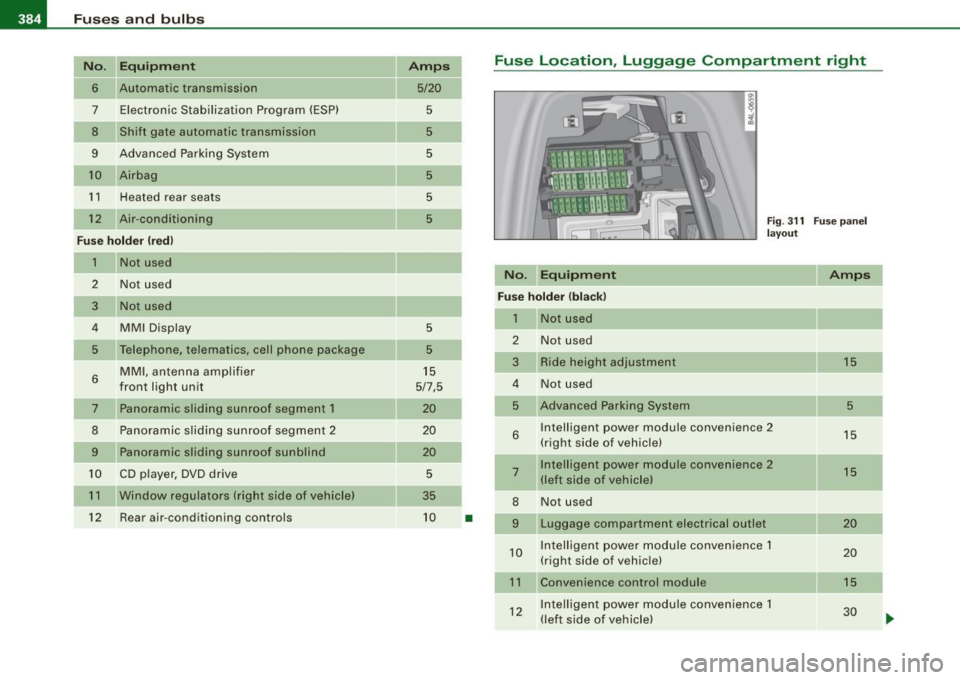
11111 Fuses and bulbs ..._ ____ .;__...;_;,;_ _______________________________ _
No. Equipment Amps
6 Automatic transmission
5/20
7 Electronic Stabilization Program (ESP) 5
8 Shift gate automatic transmission
5
9 Advanced Parking System 5
10 Airbag 5
1 1 Heated rear seats 5
12 Air-conditioning
5
Fuse holder (red)
1 Not used
2 Not used
3 Not used
4 MMI Display 5
5 Telephone, telematics, cell phone package
5
6 MMI, antenna amplifier
15
front light unit 5/7,5
7 Panoramic sliding sunroof segment 1 20
8 Panoramic sliding sunroof segment 2 20
9 Panoramic sliding sunroof sunblind 20
10 CD player, DVD drive
5
11 Window regulators (right side of vehicle) 35
12 Rear air-conditioning controls 10
•
Fuse Location, Luggage Compartment right
No. Equipment
Fig. 311 Fuse panel
layout
Amps
Fuse holder (black)
1 Not used
2 Not used
3 Ride height adjustment
15
4 Not used
5 Advanced Parking System 5
6 Intelligent power module convenience 2
15
(right side of vehicle)
7 Intelligent power module convenience 2
15
(left side of vehicle)
8 Not used
9 Luggage compartment electrical outlet 20
10 Intelligent
power module convenience 1
20
(right side of vehicle)
11 Convenience control module 15
12 Intelligent power module convenience 1
30
(left side of vehicle)
Page 411 of 426

______________________________________________ A_ l_,_ p _h_ a_ b_e _t_ic _ a _ l _in _ d_e _ x __ lll
Important things to know . ... .. .... 241
Indi cator light ...... .. .... ... ..... 252
Monitoring ... .... .... ..... .. .... 252
PASSENGER AIR BAG OFF light ... .. 253
Repairs .. .... .... .... ... .... .... 255
Safety instructions ... .... ..... .. . 254
Side airbags ... .. .... .... ...... .. 257
Side curtain airbags ... .. .... .... . 260
Weight -sensing mat .... ........ .. 264
When must the system be inspected? ..
252
All Wheel Drive .. .... ....... ...... .. 294
Alloy wheels ... .. .... .... ..... .. .... 318
All-whee l drive
Winter tires .... .. .... ...... ... .. . 363
Alternator Malfunction . .... .... ........ ..... 32
Anti-freeze
See Engine coo lant system .. ...... . 337
Anti-glare inside day-night mirror .... 86, 87
Anti -lock brake system
How the ABS system works . .... ... 292
Warning/indicator lights .. .... .... .. 22
Anti-Slip Regulation System (ASR)
How the system works ........ .... 290
Anti-theft systems
Anti-theft alarm system ... ......... 63
Elec tronic immobilizer .. ... .... .... 51
Approach/departure angle ............ 302
Ashtray Front .. .... ... .. .... .... ...... .. 116
R ear .... ... .. .... .... ........... 116
Controls and equip
ment Safety first
ASR
How the Anti-Slip Regulation System
works ...... ............. ...... 290
Asterisk What does it mean when something is
marked with an asterisk? .. ....... .. 6
Audi braking guard ....... .... ... .... 168
Error messages ....... .... ... .... 170
Settings ........... ... .... .... ... 169
Status messages .......... .... ... 170
Switching on and off .. .... .... .... 169
Audi Service Repair Manuals and Literature
401
AUTO mode AC climate contro ls ..... ...... .... 126
Auto Safety Hotline ..... ... ... .. .... . 229
Auto -Check Control ...... ..... ... .... . 30
Automatic belt retractor ... .. .... .... . 235
Automatic car wash
See Washing ............... .... .. 313
Au tomatic mode
Four -zone automatic comfort air
conditioning .... ...... ...... ... 132
Automatic Shif t Lock (ASU ...... ... ... 186
Automatic transmission
6 -speed automatic transmission .... 184
Automatic Shift Lock (ASU ...... .. . 186
Driving ...... ....... ...... .... ... 1 84
Dynamic shift program .... ........ 187
Emergency release for selector lever 189
F ail-safe mode ...... ... .. .... ... . 189
Ignition key safety lock ..... .. .... . 143 Manua
l sh ift program .. .. ....... .. 188
Selector lever .................... 185
Shift buttons ...... .... .... ...... . 189
Steering wheel with tiptronic® ..... 189
Average speed ....................... 40
Avo id damaging the vehicle ... .... .... 299
B
Background lighting
Lighting profiles . ......... ......... 79
Bass box ........... ... .. .... ...... . 371
Battery ...... .... ... .... .... .... ... 342
Battery location .......... .... .... 343
Charging ........................ 344
Important warnings when working on the
battery ...... ....... .... ...... . 343
Jump starting ................ .... 387
Low ...... ........... ....... .. .. 295
Replacing the battery ............ . 346
State of charge ................... 295
Voltage ........... ...... .... .... . 36
Winter operation ............ ... .. 342
Working on the battery ... ....... .. 343
Before driving ... .... .... ...... .... . 221
Blended gasoline .................... 325
Body cavity sealing .. .... .... .... ... . 318
Booster seats ...... ... .. .... .... .... 271
How do I properly insta ll a booster seat in
my vehic le? . .... .... .... ... .... 271
Safety instructions .... .......... .. 271
Brake assistant .......... .... .... ... 293
K ick -down .... .... ...... ...... ... 187 Brake booster ....................... 292
Vehicle operation Vehicle care Do-it-yourself service Technical data
Page 419 of 426

______________________________________________ A_ l_,_ p _h_ a_ b_e _t_ic _ a _ l _in _ d_e _ x __ ffllll
s liding open ..... ........ ...... ... 68
Sunshade ... .... .... ....... .... .. 69
tilting .... .... .... .... ... .... .... . 68
Parking ............................ 147
Automatic transmission ... ... .... . 184
Caution when parking near a parking bar -
rier or curb ...... .... ........... 147
Low bumper cover, spoi lers and
suspension .... .... .... ...... .. 147
Parking brake ..... ...... .... ..... .. . 147
Parking ...... .... .... ... .... .... 147
Warning/indicator lights .. .... .... .. 23
Parking on a decline (downhill) .. ...... 147
Parking on an incline (uphill) .. ... .... . 147
Parts replacement ... .... .... ...... .. 403
PASSENGER AIR BAG OFF light ... .. ... 253
Passenger's seat ..... .... ... .... .. 93, 96
Passive safety system .. .............. 220
Pedals ... ......... ... ........ .... .. 226
Perimeter lighting ... .... .... .... .... . 76
Physical principles of a frontal collision 232
Polishing ...... .... .... .... ... .... . 315
Po llen filter
Climate controls ...... ....... .... . 123
Power locking switch ... .... .... .... .. 55
Power locking system ... .... .... .... .. 52
Convenience close/open feature .... . 66
Locking and unlocking the vehicle from inside . ... .. .... .... ............ 55
Opening and c losing the windows ... 66
Rear lid/trunk lid .... .... .......... 57
Remote control key ................ 49
Se lective unlock feature ............ 55
Controls and equip
ment Safety first
Settings ...
... .... ........ .. . .. .. . 55
Unlocking and locking vehicle ... ... . 53
Power outlets ........... ............ 118
Power seat
Contro ls ... .. .... ........ ....... . 93
Seat adjustment ..... ....... .. .... . 94
Power steering ......... .... .... ... .. 293
Power window switches .... ....... .... 64
In the driver's door .. ......... .... . 65
In the front passenger 's door ... .... . 66
Reactivating the system .. .... .... .. 67
Pregnant women Special considerations when wearing a safety belt ....... .... ....... ... 237
Programming the Homelink® universal re-
mote control .... .... .... .... ... 214
Proper occupant seatiing positions .. ... 222
Proper safety belt position ...... .. .... 236
Proper seating position
Front passenger ... .... .... .... ... 223
Occupants .... .... .... ... .... .... 222
Rear passengers .. ... .... .... .... 224
Protective tray 109
a
Quartz clock .... .... ... .... .... .... .. 14
quattro®
See All Wheel Drive ............... 294
Question What happens to unbelted occupants? .
233
Why safety belts? . .... .... .... .... 23 1
R
Radiator fan .... .... .... .... .... .... 340
Rain sensor ...... .... ..... .. .... ... . 81
Rain sensor defective . .... ... .... .... . 36
Reading lights
Front ... ... ........ ... .... .... ... 78
Rear . .... ..... .. .... .... .... ... .. 79
Rear ashtray ... .. .... .... ... ... ... .. 116
Rear fog lights .. .... ........ .... .... . 75
Rear lid
Automatic operation .... ..... ...... 58
Emergency unlocking . .... ... .... .. 60
Opening and closing ... ... .... ..... 57
Valet key function .... .... .... ... .. 51
Rear light
Defective . ........ .... .... ...... ..
27
Rear operation
Four -zone automatic comfort air
conditioning ... .. ....... .... .... 135
Rear seats Adjusting seat .................... 99
Entry assist ... .... .... ... .... ..... 99
Fo lding seat back up and down . .... 100
Rear view
See Rear-view camera ............. 191
Rear view mirror Inside rear view mirror ..... .... . 86, 87
Rear window defogger ... .... ... .... . 129
Rear -view camera .. ... .. .... .... 191, 194
Parking mode 1 .... .... ........ .. 196
Parking mode 2 .... ...... .... .... 198
Red symbols ...... ....... .... ... ..... 31
Vehicle operation Vehicle care Do-it-yourself service Technical data
Page 420 of 426
llffl Alphabetical index
-----=-------------------------------------
Refuelling . .... ... .... .. ...... . .. .. 327
Release lever for hood . . . . . . . . . . . . . . . 330
Remote control garage door opener
(Homelink®) . . . . . . . . . . . . . . . . . . .
214
Remote control key . . . . . . . . . . . . . . . . . . 49
Un locking and locking .... .... .... . 53
Remote rear lid release ............. .. 57
Repair manuals . . . . . . . . . . . . . . . . . . . . . 401
Repairs
Airbag system . . . . . . . . . . . . . . . . . . .
255
Replacing
Wheel rims ......................
361
Replacing a fuse . . . . . . . . . . . . . . . . . . . . 381
Replacing light bulbs ................ 385
Replacing tires and wheels .... ....... 359
Reporting Safety Defects . . . . . . . . . 229, 230
Reset button . . . . . . . . . . . . . . . . . . . . . . . . 1 5
Residual heat . . . . . . . . . . . . . . . . . . . . . .
125
Retractor . . . . . . . . . . . . . . . . . . . . . . . . . . 235
Rims
Cast alloy .. ... .... ....... .......
318
Replacing ....................... 361
Roof rack . . . . . . . . . . . . . . . . . . . . . . . . . . 112
Loading . . . . . . . . . . . . . . . . . . . . . . . . 113
Mounting locations .............. .
Roof weight ............. ... .... ... .
Rule of behavior offroad
s
113
113
302
SAFE ............................... 15
Safe driving habits . ...... .... ....... 220
Safety belt height adjustment ... .. .... 238
Safety be lt position . . . . . . . . . . . . . . . . . 236
Safety belt height adjustment ...... 238
Safety belts worn by pregnant women ..
237
Safety belt pretensioner . . . . . . . . . . . . . 239
Service and disposal .... .... .... .. 240
Safety belt warning light .... .... .. 21,231
Safety belts . . . . . . . . . . . . . . . . . . . . . . . . 235
cleaning .. .... ........ ... ....... 323
Danger to passengers who do not wear a
safety belt . . . . . . . . . . . . . . . . . . . . .
233
Fastening ........ .......... .. ... 235
Improperly worn ................. 239
Not worn . . . . . . . . . . . . . . . . . . . . . . . 233
Safety belt position . . . . . . . . . . . . . . . 236
Safety instructions .... ...... ..... 234
Securing child safety seats ........ 273
Special considerations for pregnant
women ........................
237
Unfastening . . . . . . . . . . . . . . . . . . . . . 238
Warning/indicator light ........... 231
Why YOU MUST wear them ........ 231
Worn properly ..... .... .......... 234
Safety comp liance sticker ..... .... ... 396
Safety equipment .. ........ ....... .. 220
Safety features for occupant restraint and
protection . . . . . . . . . . . . . . . . . . . . .
220
Safety guide lines
Seat adjustment .. .... .... ... .... .
92
Safety instructions
Engine compartment .............
331
for booster seats ............... .. 271 f
'd
. . b or s1 e curtain air ags .... .... .. .
for using child safety seats . .... .. .
for using convertible child seats ... . 262
266
269
for using infant seats ...... .... ... 268
for using safety belts ...... .... ... 234
Monitoring the Advanced Airbag System
254
Safety lock
Ignition key, automatic transmission
143
Seat adjustment
Adjusting the seat height manually ..
96
Adjusting the seatback .. ........... 94
Adjusting the seatback manually .. .. 96
Driver's seat . . . . . . . . . . . . . . . . . . . . . . 92
Driver's seat memory . ...... .... ... 97
Front passenger's seat ......... .... 93
Front seats . . . . . . . . . . . . . . . . . . . . . . . 92
Head restraints . .... ......... 101, 225
Lumbar support ........... .... ... . 95
Manual controls ... .... ..... ... ... . 96
Moving the seat forward or backward
manually .... .... .... ... .... ....
96
Seat belts
See Safety belts .................. 231
Seat memory . . . . . . . . . . . . . . . . . . . . . . . . 97
Seating capacity ... .. .... .... .... ... 231
Seating position
Driver .... .... .... .... ...... ... .
222
Front passenger ................. 223
How to adjust the front seats ... ... 223
Incorrect seat position ... .... ... .. 225
Occupants .. ...... .... ... .... ... 222
Rear passengers ....... ... .... ... 224