brake sensor AUDI Q7 2009 Owner´s Manual
[x] Cancel search | Manufacturer: AUDI, Model Year: 2009, Model line: Q7, Model: AUDI Q7 2009Pages: 426, PDF Size: 97.13 MB
Page 171 of 426
_____________________________________________ A_ d_a ...: pc.. t _i_ v _e_ C_ ru_ is_ e_ C_ o_n_ t_ r_ o _ l __ lfflll
& WARNING
Inattention can cause collisions, other accidents and serious
personal injuries.
• Always pay close attention to the traffic , even when the Audi
braking guard is switched on. The Audi braking guard provides a
warning but does not brake the car for you. You must apply the
brakes yourself!
• Always keep the safe and legal distance between your vehicle
and vehicles up ahead.
• Audi braking guard works within limits and will not respond
outside the system limits, for example when approaching a
stopped vehicle or stationary obstacle (end of a traffic jam or
vehicle that has broken down in traffic ).
• Always remember that the radar sensor for the Audi brak ing
guard works within defined detection and range limits that may
prevent the proper detection of other vehicles .
• The radar sensor's function and range can be reduced by rain,
snow and heavy spray . Moving vehicles up ahead may not be
promptly detected or may not be detected at all.
• Always pay careful attention to the traffic situation and be
ready to intervene and be ready to take complete control when
ever necessary .
• Reflective surfaces including crash barriers or tunnel entrances
may impair the function of the radar sensor . •
Controls and equip
ment
App lies to veh ic les: with Adap tive Cru ise Contro l
Settings in the MMI
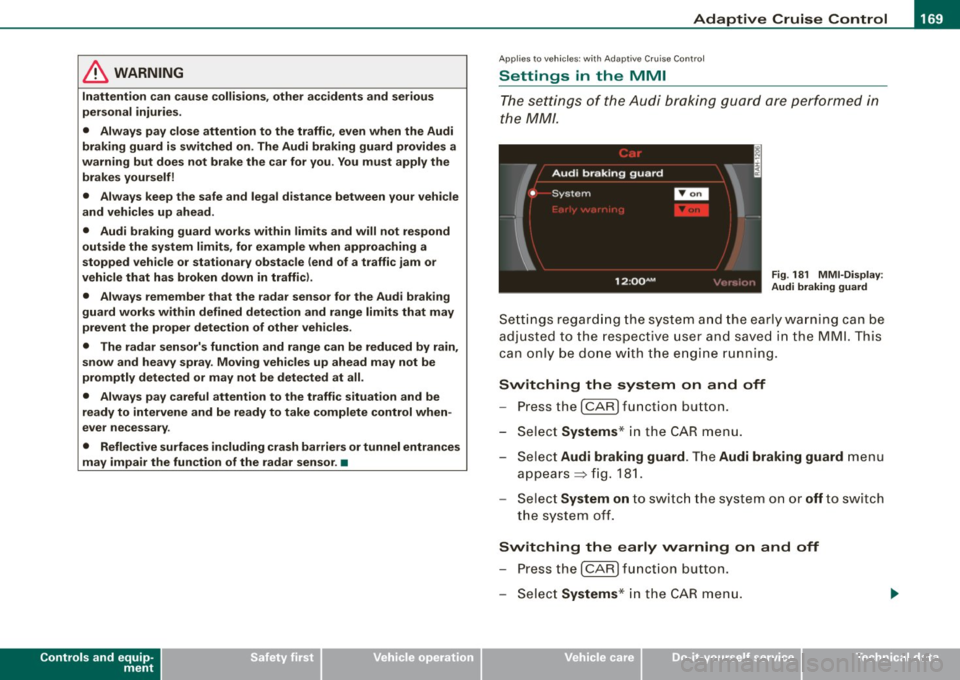
The sett ing s of the Aud i braking guard are performe d in
the MM/ .
Fig. 181 MMI -Display :
Audi braking guard
Settings regarding the system and the ear ly warn ing can be
adju sted to the respect ive u ser and saved in the MML This
can on ly be done with the engine run ning.
Switching the system on and off
- Press the I CAR ] func tion b utton .
- Se lect Systems * in the
CAR menu .
Se lect Audi braking guard . The Audi braking guard menu
appears => fig. 181.
Se lect System on to switch the system on or off t o swi tch
the system off.
Switching the early warning on and off
P res s the I CAR I functio n button .
Select Systems * in the
CAR menu .
I • •
Page 290 of 426
llffl __ ln_ t _e_ ll-'"ig ...,_ e_ n_t _t_ e_ c_ h _ n_o _ l_o _,.g= y,_ __________________________________________ _
Intelligent technology
Notice about data recorded by
vehicle control modu les
Your vehicle is not equipped with an Event Data Recorder (EDR),
installed by some manufacturers for the express purpose of
capturing data for retrieval after an accident or crash event . EDR's
are sometimes called "crash recorders" .
Some state laws restrict the retrieva l or downloading of data stored
by EDR's that were insta lled in a vehicle for the express purpose of
retrieving data after an accident or crash event without the owner's
consent.
Although your vehicle is not equipped with an EDR, it is equipped
with a number of electronic control modules for various vehicle systems such as, for example, engine function, emission control, as
well as for the airbags and safety belts.
These electronic control modules also record vehicle-related data during norma l vehicle operation for diagnost ic and repair purposes .
The recording capacity of the electronic control modules is limited
to data (no sound is recorded) and only a small amount of data is
actually recorded over a very limited period of time and stored when
a system fault or other condition is sensed by a control unit. Some
of the data then stored may relate to vehicle speed, direction, braking as well as restraint system use and performance in the
event of a crash or other condition . Stored data can only be read and
down loaded with special equipment .•
Electron ic Stabilizat ion Program (ESP)
General =nformation
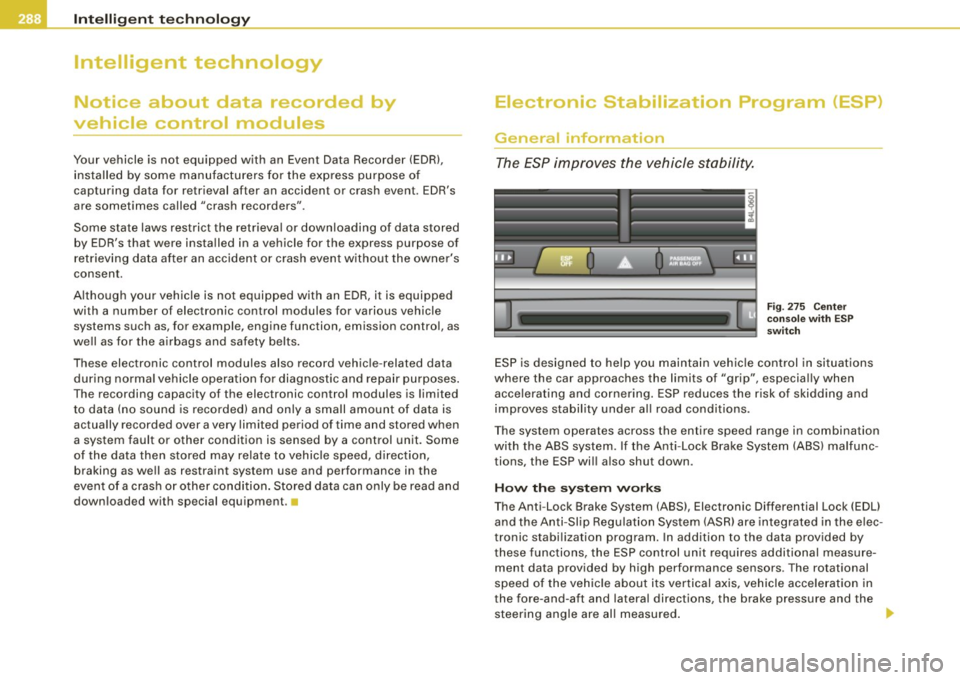
The ESP improves the vehicle stability.
Fi g. 2 75 C ente r
co nso le w it h ES P
swi tch
ESP is designed to he lp you maintain vehic le control in situations
where the car approaches the limits of "grip", especia lly when
accelerating and cornering. ESP reduces the risk of skidding and
improves stabil ity under all road conditions .
T he system operates across the entire speed range in combination
with the ABS system. If the Anti-Lock Brake System (ABS) malfunc
tions, the ESP wil l also shut down .
How th e sys te m w ork s
The Anti -Lock Brake System (ABS) , Electronic Differential Lock (EDU
and the Anti-Slip Regulation System (ASR) are integrated in the e lec
tronic stabi lization program . In addition to the data provided by
these functions, the ESP control unit requires additional measure ment data provided by high performance sensors . The rotational
speed of the vehic le about its vertical axis, vehicle acce leration in
the fore-and-aft and lateral directions, the brake pressure and the steering angle are al l measured .
Page 292 of 426
--~ln~ t ~e~ ll~ig ;t e~ n~t ...:t~ e::_: c::,: h '..!.'..: n~o ~ l.!::o
3g
:t; yL __________________________________________ _
& WARNING (continued)
tendency to spin and the vehicle may break away -danger of skid
ding!
• Stability is limited in the ESP offroad mode. •
Electronic differential lock (EDL)
The electronic differential lock monitors the rotational
speed of the drive wheels.
General notes
The electronic differential lock (EDU helps the car to start moving,
accelerate and climb a gradient on surfaces providing poor or
almost no grip . Without EDL, this would be difficult, if not impos
sible.
How the system works
The EDL operates automatically. It monitors the rotational speed of
wheels with the help of the ABS sensors=> page 292. If a noticeable
slip is detected at the wheels (e.g. on slippery ground on one side),
the spinning wheels are braked and power is transferred to the
other wheels. This is done up to a speed of about 60 mph (100 km/h).
Noises from the brake system signal that wheel spin is being
controlled.
Driving off
When driving off, always be sure to keep road conditions in mind as
you accelerate. If one drive wheel spins because it is on a surface
with less grip, apply plenty of throttle until the car starts to move.
Overheating of brakes
To prevent the disc brake of the braked wheel from overheating if
subjected to excessive loads on this wheel, the EDL cuts out tempo
rarily. The vehicle remains operational and behaves in the same way
as a vehicle without EDL. As soon as the brake has cooled down, EDL switches on again auto
matically.
& WARNING
• When accelerating on slippery surfaces, such as on ice or snow,
always be careful when depressing the accelerator pedal . Even
with the EDL working, the drive wheels can spin and reduce your ability to control your car. Risk of crash!
• The increased safety afforded by EDL does not mean that you
can take safety risks. Always adapt your driving style to the road
conditions and traffic situation.
[ i] Tips
If a fault occurs in the ABS, the EDL is also not functioning. This is
indicated by the ABS warning light=> page 22. •
Anti-Slip Regulat ion System (ASR)
The Anti-Slip Regulation System prevents the driven
wheels from spinning when the car is accelerating.
General notes
The Anti -Slip Regulation System (ASR) is integrated in the electronic
stabilization program (ESP) . When the vehicle starts up and acceler
ates, the wheels are prevented from spinning by adjusting the
engine power to match the amount of grip available from the road
surface.
How the system works
ASR performs automatically, i.e. without the driver's intervention.
With the aid of the ABS sensors=> page 292, ASR monitors the
speed of the driven wheels. If the wheels start to spin, engine torque
is reduced automatically until the tires find enough grip to lock onto
the road surface. The system is active across the entire speed range . ..,
Page 364 of 426
_L_T~ i~ r ~e ~s '..... a ~ n~d ~ w~ h~e~ e::. l !.:s ~ ---------------------------------------------
& WARN ING (continued )
• Never mount used tire s on your vehicle if you are not sure of
their "pre vious history. " Old used tire s may have been damaged
even though the damage cannot be seen that c an lead to sudden
tire f ailure and los s of vehicle control .
• All four wheels must be fitted with radial tires of the same type,
s ize (rolling circumference ) and the same tread pattern. Driv ing
with different tires reduces veh icle handling and can lead to a loss
of cont rol.
• If the spare tire is not the same as the tires that are mounted
on the vehicle • for e xample with winter tires · only use the spare
tire for a short period of time and drive with extra care . Refit the
normal road wheel a s soon as safely possible.
• Never drive faster than the maximum speed for whi ch the tires
on your vehicle are rated because tires that are driven faster than
their rated speed can fail suddenly .
• Overloading tires cause heat build -up , sudden tire failure,
including a blowout and sudden deflation and lo ss of control.
• Temperature grades apply to tires that are properly inflated and
not over or underinflated.
• Fo r te chni cal reasons it is not always possible to use wheels
from other vehicles -in some cases not even wheels from the
same vehi cle model .
• If you install wheel trim di scs on the vehicle wheels , make sure
that the air flow to the brakes is not blo cked . Redu ced airflow to
the brakes can them to overheat , increasing stopping distances
and causing a collision .
• Run flat tires may only be used on vehicle s that were equipped
with them at the factory . The vehicle must have a chassis designed
for run flat tires and a factory -installed tire pressure monitoring
system that indi cates a loss of t ire pres sure . In corre ct u se of run
flat tires can lead to vehicle damage or accident s. Check with an
authorized Aud i dealer or tire specialist to see if your vehicle can
& WAR NING (continued )
be equipped with run flat tires . If run flat tires are used , they must
be installed on all four wheels . Mixing tire types is not permitted .
0 Note
• For tec hnical reas ons, it is not gen erally poss ible to use t he
whee l rims from other vehicles . T his can ho ld true for whee ls of the
sa me v ehicle type.
• I f the spare tire is different from the tires that you have mounted
o n yo ur vehicle ( for example wi nter tires or wide pro file tires), then
use the spare tire for a short period of time on ly and drive with extra
ca re. Replac e th e fl at t ire wi th the tire m atchi ng t he othe rs on you r
vehic le as soon as possib le .
• I f you should put different w heels and tires o n yo ur ve hic le (e. g.
winter wheels and t ires), you must be certain that the wheels and
t ires a re c omp atible with the tire pressure moni tor in g sys tem.
O therwise the system will register a malfunction and a fau lt
m es sage w ill be displayed . For more info rmation, c ontac t yo ur
authorized Audi dea ler.
0 Note
• When insta lling new tires, b e care fu l not to damage the va lv e s or
t ire p ressu re mon itoring syste m sensors .
• N ever drive without the valve stem cap . The va lves could get
damaged.
• I f the sensors must be replaced, then the valve must also be
r e pl ace d at t he same time .
'£> For the sake of the environment
Dispose o f old tires i n acco rdance wit h the local re qu ire ment s.•
Page 385 of 426
Fuses and bul bs 11111 ________________________________ ..:....:,:_=-.::..:....:.;.:_.:..:..,_,;__,;____,J
....
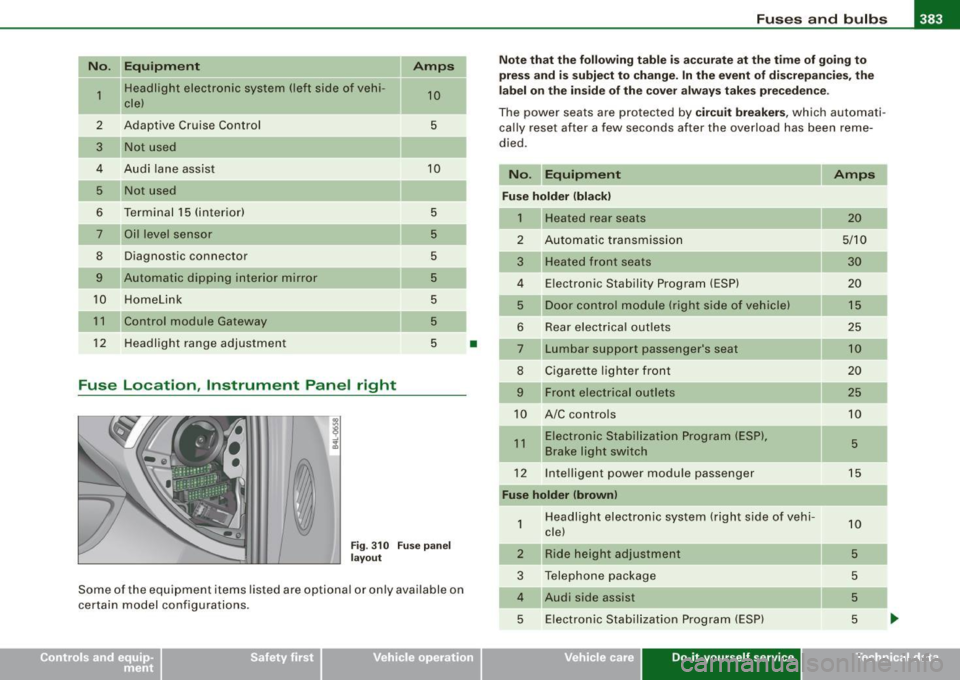
No.
1
-
2
3
4
5
6
Eq uipm ent
Headlight electronic system (left side of vehi -
cle)
Adaptive Cruise Control
Not used
Audi lane assis t
Not used
Terminal 15 (interior)
Oil level sensor
8 Diagnostic connector
9 Automatic dipping interior mirror
10 Homelink
1 1 Control module Gateway
12 Headlight range adjustment
Amps
10
5
10
5
5
5
5
5
5
5
Fuse Location , Instrument Panel right
Fi g. 310 F use pane l
l ayo ut
Some of the equipment items listed are optional or only avai lable on
certain model configurations .
•
Note that th e fo llo wi ng ta ble is acc urate a t the time of goi ng to
pre ss and is subject to change. In th e event of di screpan cies, t he
l a b el on the ins ide o f th e cover a lw ays ta ke s prec eden ce.
The power seats are protected by circ uit breakers , which automati
ca lly reset af ter a few seconds after the overload has been reme
died .
No. Equipm ent
Fu se holder (bla ck )
1 Heated rear seats
2 Automatic transmission
3 Heated front seats
4 E lectronic Stability Program (ESP)
5 Door control module (right side of vehicle)
6 Rear electrical out
lets
7 Lumbar support passenger's seat
8 Cigarette lighter front
9 Front electrical outlets
10 A/C controls
1 1 Electronic Stabilization Prog ram (ESP),
Brake light switch
12 Inte lligent power modu le passenger
Fuse holder (brown )
1
2
3
Headlight electronic system (right side of vehi
cle)
Ride height adjustment
Telephone package
4 Audi side assist 5 E lectronic Stab ilizat ion Program (ESP)
Vehicle care Do-it-yourself service
Amps
20
5/10
30 20
15
25
10
20
25
10
5
15
1 0
5
5
5
5
-
irechnical data
Page 415 of 426

______________________________________________ A_ l_,_ p _h_ a_ b_e _t_ic _ a _ l _in _ d_e _ x __ lllll
Starting with jumper cables ... .... . 387
Stopp ing . . . . . . . . . . . . . . . . . . . . . . . . 144
Engine compartment Safety instructions . ...... ..... .. . 331
Working the engine compartment .. 331
Engine coolant system ...... .... .... . 337
Adding coolant ....... .... .... ... 339
Checking coolant level .. .... .. .... 338
Checking the engine coolant level . .. 338
Malfunction ..... .... .... ......... 33
Radiator fan ........ ............ . 340
Engine coolant temperature Temperature gauge ...... .... ...... 13
Engine data ............... ......... 399
Engine hood
Closing ..................... .... 331
How to rel ease the hood .... .... ... 330
Engine oil . ... .. ..... ........... .... 333
Adding .............. .... .... ... 336
Additives ... .. .... .... .... .... ... 336
Changing .... .... .... ........... 336
Checking the engine oil level ... .... 335
Indications and condit ions r equiring ext ra
checking .... .... .... ... .... .... 335
Oil consumption . .... ... .... ..... 334
Oil grades .. ...... .... ........... 333
Recommended oil check intervals .. . 335
Specification and viscosity .. ....... 333
Engine oil level .. .... .... .... .... .... 37
Engine oi l pressur e
Mal func tion ....... ..... .... ... ... 33
Engine oil sensor defective . .......... . 37
Engine speed limitation ............ ... 37
Controls and equip
ment Safety first
Entry assist
Rear seats .... ...... ........ ... .. . 99
Environment Break -in period ...... ...... .... ... 297
Catalytic conv erter .... .... .... .... 298
Disposing o f your v ehicle battery ... 346
Driving a t high speeds ............ 299
Driving to minimi ze pollution and noise .
299
Fuel . .... ........ .... .... ... .... 327
Fuel economy .... ..... .. .... .... . 299
L e aks under your v ehicle .. ........ 331
L etting th e ve hicle stand and warm up ..
300
Proper disposal of drained brake fluid
341
P roper disposal of drained engine
coolant .. ...... .. .. .... .... .... 339
Proper disposal of drained engine o il 336
Recycl ing us ed engine o il .... ...... 336
Unl eaded fuel ... .. ...... ..... ... . 325
What should I do with an old battery? 346
EPC
See Electronic power control .. .. .... 19
ESP
S ee Electronic stabilization program
(ESP) .. .... ... .................. 19
Event Data Recorder (EDR) ... ....... .. 288
Expansion tank ........... ...... .... 338
Explanation of some technical terms .. . 302
Ext erior lighting in the mirror hous ing . .. 76
Eyeglasses compartment ............. 121
F
Fall line ... .. .... .... ...... .... ... .. 302
Fan Four -zone automatic comfort a ir
conditioning ... .. .... ........... 133
Radiator ..... .. ... ....... ... ..... 340
Flat tire Changing . .... .... .... .... ...... . 373
Floor mats . ... ...... .... ........ ... 226
Fog lights ........... ... .... .... ..... 75
Fo lding chocks .. ... ... .. .... .... .... 370
Fo ldin g master key with remote control .. 48
Foot pedals . ...... .. .... .... .... .... 226
For the sake of the environment Gasoline fumes and th e environment 327
L et ting your eng ine warm up ... ....
143
Reducing engine noise by early
upshifting . ...... ....... .... .. . .. 13
Refueling ..... .... .... .. .. ... .. .. 327
Saving fuel by early upshifting .... . .. 13
Using the rear window defogg er ... . 129
Fording depth ........... .. . ........ 302
Four -zone automa tic comfort a ir
conditioning ... .. .... ........... 131
Automatic mode in rear . ........ .. 132
Heated rear seats ...... .... ....... 137
Rear air distribution ... .... .... .... 133
Rear con trols .... .... .... .... ... . 131
Rear fan . .... ... .... ... .. .... .... 133
Rear operation .... ...... .... .... . 135
Rear temperatu re ............ ... .. 133
Vehicle operation Vehicle care Do-it-yourself service Technical data
Page 419 of 426

______________________________________________ A_ l_,_ p _h_ a_ b_e _t_ic _ a _ l _in _ d_e _ x __ ffllll
s liding open ..... ........ ...... ... 68
Sunshade ... .... .... ....... .... .. 69
tilting .... .... .... .... ... .... .... . 68
Parking ............................ 147
Automatic transmission ... ... .... . 184
Caution when parking near a parking bar -
rier or curb ...... .... ........... 147
Low bumper cover, spoi lers and
suspension .... .... .... ...... .. 147
Parking brake ..... ...... .... ..... .. . 147
Parking ...... .... .... ... .... .... 147
Warning/indicator lights .. .... .... .. 23
Parking on a decline (downhill) .. ...... 147
Parking on an incline (uphill) .. ... .... . 147
Parts replacement ... .... .... ...... .. 403
PASSENGER AIR BAG OFF light ... .. ... 253
Passenger's seat ..... .... ... .... .. 93, 96
Passive safety system .. .............. 220
Pedals ... ......... ... ........ .... .. 226
Perimeter lighting ... .... .... .... .... . 76
Physical principles of a frontal collision 232
Polishing ...... .... .... .... ... .... . 315
Po llen filter
Climate controls ...... ....... .... . 123
Power locking switch ... .... .... .... .. 55
Power locking system ... .... .... .... .. 52
Convenience close/open feature .... . 66
Locking and unlocking the vehicle from inside . ... .. .... .... ............ 55
Opening and c losing the windows ... 66
Rear lid/trunk lid .... .... .......... 57
Remote control key ................ 49
Se lective unlock feature ............ 55
Controls and equip
ment Safety first
Settings ...
... .... ........ .. . .. .. . 55
Unlocking and locking vehicle ... ... . 53
Power outlets ........... ............ 118
Power seat
Contro ls ... .. .... ........ ....... . 93
Seat adjustment ..... ....... .. .... . 94
Power steering ......... .... .... ... .. 293
Power window switches .... ....... .... 64
In the driver's door .. ......... .... . 65
In the front passenger 's door ... .... . 66
Reactivating the system .. .... .... .. 67
Pregnant women Special considerations when wearing a safety belt ....... .... ....... ... 237
Programming the Homelink® universal re-
mote control .... .... .... .... ... 214
Proper occupant seatiing positions .. ... 222
Proper safety belt position ...... .. .... 236
Proper seating position
Front passenger ... .... .... .... ... 223
Occupants .... .... .... ... .... .... 222
Rear passengers .. ... .... .... .... 224
Protective tray 109
a
Quartz clock .... .... ... .... .... .... .. 14
quattro®
See All Wheel Drive ............... 294
Question What happens to unbelted occupants? .
233
Why safety belts? . .... .... .... .... 23 1
R
Radiator fan .... .... .... .... .... .... 340
Rain sensor ...... .... ..... .. .... ... . 81
Rain sensor defective . .... ... .... .... . 36
Reading lights
Front ... ... ........ ... .... .... ... 78
Rear . .... ..... .. .... .... .... ... .. 79
Rear ashtray ... .. .... .... ... ... ... .. 116
Rear fog lights .. .... ........ .... .... . 75
Rear lid
Automatic operation .... ..... ...... 58
Emergency unlocking . .... ... .... .. 60
Opening and closing ... ... .... ..... 57
Valet key function .... .... .... ... .. 51
Rear light
Defective . ........ .... .... ...... ..
27
Rear operation
Four -zone automatic comfort air
conditioning ... .. ....... .... .... 135
Rear seats Adjusting seat .................... 99
Entry assist ... .... .... ... .... ..... 99
Fo lding seat back up and down . .... 100
Rear view
See Rear-view camera ............. 191
Rear view mirror Inside rear view mirror ..... .... . 86, 87
Rear window defogger ... .... ... .... . 129
Rear -view camera .. ... .. .... .... 191, 194
Parking mode 1 .... .... ........ .. 196
Parking mode 2 .... ...... .... .... 198
Red symbols ...... ....... .... ... ..... 31
Vehicle operation Vehicle care Do-it-yourself service Technical data
Page 423 of 426
_____________________________________________ ..:..A ..:: l:.!: p :.:h..:.: a::..:: b:.::e :.: t:.:.ic ::..:: a~l ..::in :...:.::: d:.::e ::: x:__ _IJIII
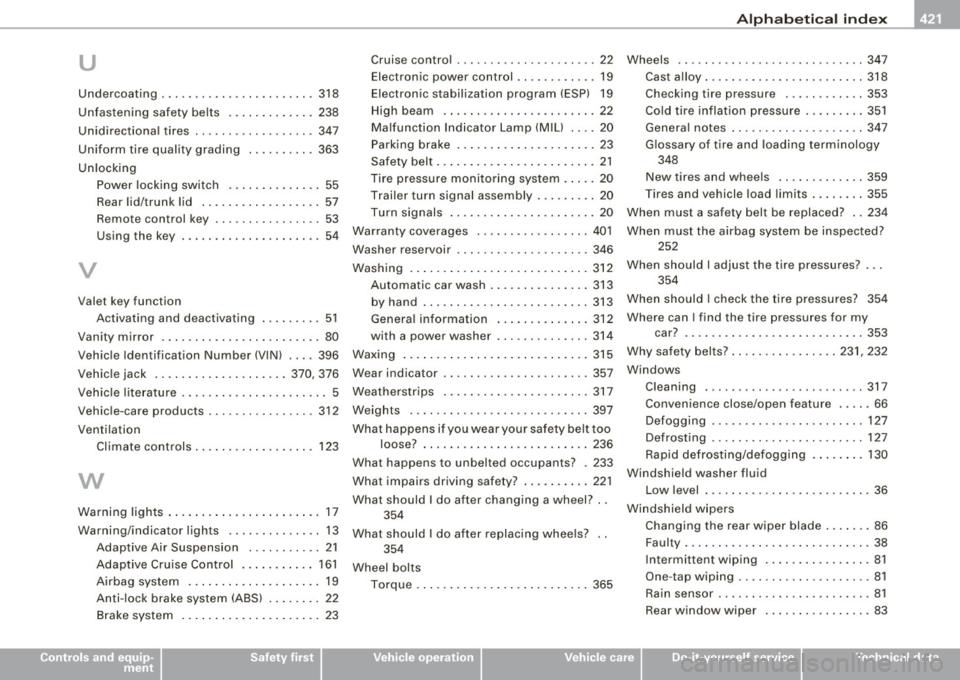
u
Undercoating .... ... ........ .... ... . 318
Unfastening safety belts ... .... ...... 238
Unidirectiona l tires ...... .... ........ 347
Uniform tire quality grading .. ... .... . 363
Unlocking Power locking switch .... .... .... .. 55
Rear lid/trunk lid ........ ......... . 57
Remote control key .......... .... .. 53
Using the key .... .... .... ..... .. .. 54
V
Valet key function
Activating and deactivating .... .... . 51
Vanity mirror .. ... ... ... .... ...... ... 80
Vehicle Identification Number (VIN) .... 396
Vehic le jack .................... 370, 376
Veh ic le literature .... .... .... ... .... ... 5
Vehicle-care products ..... .... .... ... 312
Venti lation
Climate controls ...... ....... .... . 123
w
Warning lights ...... .... .... .... ..... 17
Warning/indicator lights .... .... .... .. 13
Adaptive Air Suspension ......... .. 21
Adaptive Cruise Control .. ...... ... 161
Airbag system . ....... ......... ... 19
Anti -lo ck brake system (ABS) . ...... . 22
Brake system .. ...... .... .... .... . 23
Controls and equip
ment Safety first
Cruise contro
l .... .. . .. .. .... ... .. . 22
Electronic power con trol .. .... .... .. 19
Electronic stabilization program (ESP) 19
High beam ... ... .... .... .... .... . 22
Malfunction Indica tor Lamp (MIU .... 20
Parking brake .. ....... .. .... .... .. 23
Safety belt .......... .............. 21
Tire pressure monitoring system .... . 20
Trailer turn signal assembly .. ..... .. 20
Turn signals ....... ....... ... .... . 20
Warranty coverages ...... ... .... .... 401
Washer reservoir .... .... ... .... .... . 346
Washing .. ......................... 312
Automatic car wash ....... ........ 313
by hand ......................... 313
General information .............. 312
with a power washer ... .... ... .... 314
Waxing ................ ............ 315
Wear indicator ...... ........ .... ... . 357
Weatherstrips ...... .... ......... ... 317
Weights .... .... .... .... .... .... ... 397
What happens if you wear your safety belt too
loose? ...... .... .... ........... 236
What happens to unbelted occupants? . 233
What impairs driving safety? ...... .... 221
What should I do after changing a wheel? ..
354
What should I do after replacing wheels?
354
Wheel bolts
Torque .. .... ... .. .... .... .... ... 365 Wheels
...... .... .. .. ... .. .. ..... .. 347
Cast alloy ... .. .... .... .... .... ... 318
Checking tire pressure . .... .... ... 353
Co ld tire inflat ion pressure ... ..... . 351
General notes ...... ... .... ..... .. 347
Glossary of tire and loading terminology
348
New tires and whee ls .. .... ... ... . 359
Tires and vehicle load limits . ...... . 355
When must a safety belt be replaced? .. 234
When must the airbag system be inspected?
252
When should I adjust the tire pressures? ...
354
When should I check the tire pressures? 354
Where can I find the tire pressures for my
car? . ............... .... ... .. .. 353
Why safety belts? ......... ..... .. 231,232
Windows Cleaning ......... ... .... ........ 317
Convenience close/open feature ..... 66
Defogging .... .... .... ... .... .... 127
Defrosting ..... .... ... .... .... ... 127
Rapid defrosting/defogg ing ........ 130
Windshield washer fluid Low level . ....... ... .. ...... .... .. 36
Windshield wipers Chang ing the rear wiper blade ..... .. 86
Faulty ... .. ........... ........ .... 38
Intermittent wiping .... .... ...... .. 81
One -tap wiping .... .... ... .... ... .. 81
Rain sensor .. .. ... .... ... .... .... . 81
Rear window wiper .... ............ 83
Vehicle operation Vehicle care Do-it-yourself service Technical data