engine coolant AUDI Q7 2009 Owner´s Manual
[x] Cancel search | Manufacturer: AUDI, Model Year: 2009, Model line: Q7, Model: AUDI Q7 2009Pages: 426, PDF Size: 97.13 MB
Page 332 of 426
___ C_h_ e_ c_k _in --== g'-- a_n _d_ f_il _li _n ..:::g:::..- ___________________________________________ _
Checking and filling
Engine hood
Releasing the engine hood
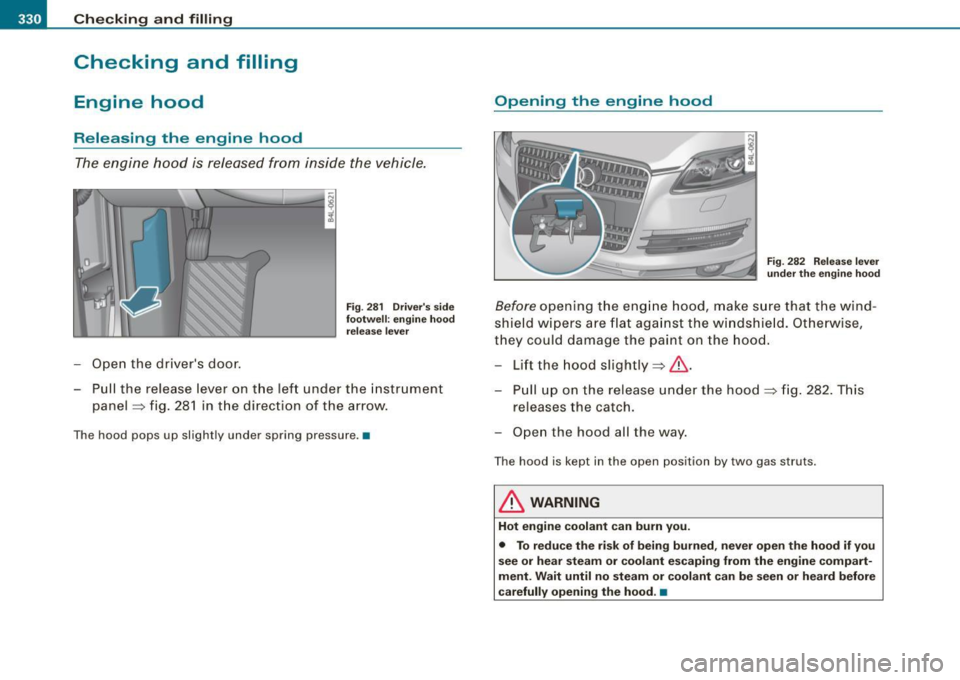
The engine hood is released from inside the vehicle.
-Open the driver's door.
Fig . 281 Driver's side
footwell: engine hood
release lever
-Pull the release lever on the left under the instrument
panel
=> fig. 281 in the direction of the arrow.
The hood pops up slightly under spring pressure. •
Opening the engine hood
Fig. 282 Release lever
under the engine hood
Before opening the engine hood, make sure that the wind
shield wipers are flat against the windshield. Otherwise,
they could damage the paint on the hood.
Lift the hood slightly =>&, .
- Pull up on the release under the hood => fig. 282. This
releases the catch.
- Open the hood all the way.
The hood is kept in the open position by two gas struts.
& WARNING
Hot engine coolant can burn you.
• To reduce the risk of being burned, never open the hood if you
see or hear steam or coolant escaping from the engine compart
ment. Wait until no steam or coolant can be seen or heard before
carefully opening the hood. •
Page 333 of 426
_____________________________________________ C_ h_ e .=....= c..:..k :..:.in :....:..:= g:.....= a..:..n .:....:d::......:. f.:..:il .:..:li ..:..n ::.:g:!....- __
•
Closing the engine hood
- Pull the hood down until the pressure from the struts is
reduced .
- Let the hood
drop down and latch in place. Do not try to
push it shut;
it may fail to engage => &.
& WARNING
A hood that is not completely latched could fly up and block your
view while driving.
• When you close the engine hood, check it to make sure the
safety catch has properly engaged. The hood should be flush with
the surrounding vehicle body parts.
• If you notice while driving that the hood is not secured prop
erly, stop at once and close it. •
Working in the engine compartment
Be especially careful whenever you work in the engine
compartment.
Whenever you must perform any work in the engine compartment,
for example checking and filling different fluids, there is a risk of injury, burns and accidents. To prevent personal injury always
observe the following WARNINGS. The engine compartment of any
vehicle is a hazardous area
~ & .
& WARNING
To help avoid injury, before you check anything under the hood :
• Turn off the engine.
• Remove the ignition key.
• Apply the parking brake .
& WARNING (continued)
• Move selector lever to "P" (Park).
• Always let the engine cool down. Hot components will burn
skin on contact.
• To reduce the risk of being burned, never open the hood if you
see or hear steam or coolant escaping from the engine compart
ment. Wait until no steam or coolant can be seen or heard before
carefully opening the hood.
• Keep children away from the engine compartment .
• Never spill fluids on hot engine components. They can cause a
fire.
• Never touch the radiator fan. The auxiliary electric fan is
temperature controlled and can switch on suddenly.
• Never open the coolant reservoir cap when the engine is still
warm . The coolant system is pressurized and hot coolant could
spray out.
• Protect your face, hands and arm from steam or hot engine
coolant by placing a thick rag over the cap when you open the
coolant reservoir.
• If work on the fuel system or the electrical system is necessary :
- Always disconnect the battery.
- Never smoke or work near heaters or open flames . Fluids in
the engine compartment could start a fire.
- Keep an approved fire extinguisher immediately available.
• To avoid electrical shock and personal injury while the engine
is running or being started, never touch:
- Ignition cables
- Other components of the high voltage electronic ignition system.
• If you must perform a check or repair with the engine running: -First, fully apply the parking brake, move selector lever to "P"
(Park). .,
Vehicle care
I t •
Page 334 of 426
-Checking and filling PW---=---------------
& WARNING (continued )
-Always u se extreme caution to prevent cloth ing , jewelry, or
long hair from getting caught in the radiator fan , V-belt s or
other moving parts , or from contacting hot parts . Tie back hair
before starting , and do not wear clothing that will hang or
droop into the engine .
• Minimize exposure to emis sion and chemical hazards
::::> & .
& WARNING
California Proposition 65 W arn ing :
• Engine exhaust , some of its constituents , and certain vehicle
c omponents cont ain or emit chemicals known to the State of Cali
fornia to cause cancer and birth defects and reproductive harm. In addition , certain fluids contained in vehi cles and certa in products
of component wear contain or emit chemicals known to the State
of California to cause cancer and birth defect s or other reprodu c
tive harm.
• Battery posts , terminals and related ac cessories conta in lead
and lead compounds , chemicals known to the State of California
to cause cancer and reproductive harms. Wash hands after
handling.
0 Note
When adding f luids, always make sure that they are poured into the
proper container or filler ope ning, otherwise serious damage to
vehic le systems wi ll occur.
ci> For the sake of the environment
To detect leaks in time, inspect the vehicle floor pan from under
n eath regu larly. If you see spots fro m oil o r o th e r v eh icle flu ids, hav e
your vehicle inspected by an author ized Audi dea ler. •
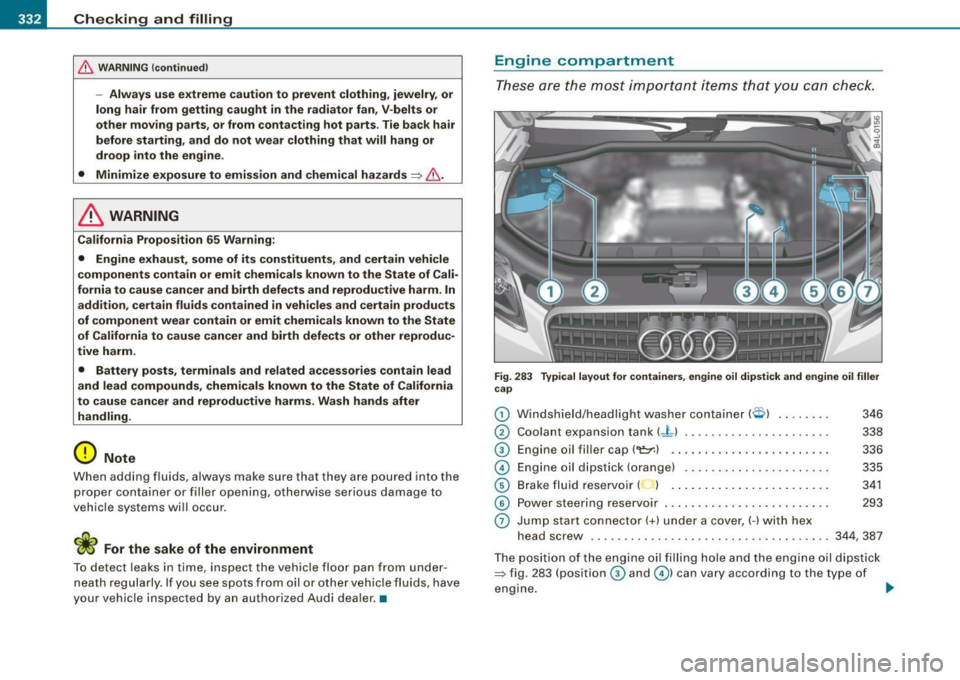
Engine compartment
These are th e m ost im porta nt items th at you can ch ec k.
Fig. 283 Typical layout for containe rs, engine oi l d ipstick and engine oil filler
cap
0 W indsh ield/headligh t was her conta iner ( 9 ) . . . . . . . . 346
0 Coolant e xpansion tank (- L l . . . . . . . . . . . . . . . . . . . . . . 338
G) Engin e oil fi ller cap ("l::r.) . . . . • . . . . . . • • • • . . . • . . • . . 336
© Engine oil d ips tick (orange) . . . . . . . . . . . . . . . . . . . . . . 335
© Brake fluid reservo ir ( ) . . . . . . . . . . . . . . . . . . . . . . . . 341
© Pow er steer ing r eser voir . . . . . . . . . . . . . . . . . . . . . . . . . 2 93
0 Jump sta rt connector( +) u nder a cover,( -) w ith hex
head screw .... ... ..... .... ... .... ... ..... .... . 344 , 387
The positi on of t he e ngin e oil fi lling hole and t he engine oil dipstick
=> fig . 283 (position G) and ©l can vary according to the type of
eng ine. .,_
Page 339 of 426
___________________________________________ C_ h_e _c_ k_ i_n _g _ a_n _d_ f_il _li _n _g __ lll
•
T he engine oil must be changed according to the intervals specified
in your Warranty
& Maintenance book le t. This is very important
because the lubricating properties of oi l diminish gradually during
normal vehicle use .
Under some circumstances the engine oil should be changed more
frequently. Change oil more often if you drive most ly short
distances, opera te the vehic le in dusty areas or under predomi
nant ly stop-and-go traffic conditions, or have your vehicle where
t emperatures remain below free zing for extended periods.
Detergent additives in the oil wil l make fresh oi l look dark after the
engine has been running for a sh ort time . This is normal and is not
a reason to chan ge the oi l more often than recommended.
Because of the problem of proper disposal, along with the specia l
t ools and necessary expertise requ ired, we strongly recommend
that you have your oi l changed by an authorized
Audi de aler or a
qualified se rvice statio n.
If you choo se to change your oil yourself , please note the following
important information:
& WARNING
To reduce the risk of per sonal injury if you mu st ch ange the engine
o il in you r veh icle your self :
• Wear eye protection.
• To reduce the ri sk of burns from hot engine oil , let the eng ine
c ool down to the touch.
• Wh en remo ving the oil dra in plug with your fingers , stay a s far
aw ay as po ssible. Alway s keep your forearm parallel to the ground
to help prevent hot oil from ru nning do wn your arm .
• Drain t he o il into a container designed for thi s purpo se , one
large enough to hold at lea st the total amount of oil in your eng ine.
• Engine oil i s poi sonous . K eep it well out of the rea ch of children .
& WAR N IN G ( continued )
• Continuous contact with used engine oil i s harmful to your
sk in. Al way s prote ct your skin b y was hing oil off thorough ly w ith
soap and water .
0 Note
Never mix oil additives with your engine oil. These additives can
damage your engine and adversely affect your Aud i Limited New
Vehicle Warranty.
can properly dispose of the used oil.
• Always dispose of used engine oil properly. Do not dump it on
garden soil, wooded areas, into ope n strea ms or down sewage
drains .
• Recycle used engine oil by taking it to a used engine oil collec
tion facility in your area, or contact a service station. •
Engine cooling system
Coolant
The engine coolan t per for ms two functions: i t kee ps the
engine from ove rhe ating and it prot ects the e ngine from
freezing in the winter.
The cooling system is sea led and general ly requires litt le attention.
The coo ling system has been fi lled at the fac tory with a per manent
coolant which does not need to be changed. The coo lant consists of
a m ixture of water and the manufacturer's glycol -b asedco olant
additive G 12++ antifreeze with anti corrosion additives (50% for USA .-,
Vehicle care I t •
Page 340 of 426
___ C_h_ e_ c_k _in --== g'-- a_n _d_ f_il _li _n ..:::g:::..- ___________________________________________ _
models; 60% for Canadian models). This mixture both assures the
necessary frost protection and protects metal components in the
engine's cooling system from corrosion and scaling. It also raises
the boiling point of the coolant.
Do not reduce the concentration of the coolant in the summer by
adding plain water.
Th e pro port io n of coo la nt additi ve mu st be at
lea st 50 % but n ot mor e th an 60 %
to maintai n ant ifreeze protection
and cooling efficiency. If the coolant frost protection is too low , the
coolant could free ze and damage the veh icle heating and engine
cooling system .
For year-round driving , antifreeze is added at the factory for temper
atures down to:
• -31 °F ( -35 °c1 usA
• - 40 °F ( - 40 °C) Canada.
You can mix the
Gl 2+ + coolant additive with other additives (G12+
or G12). Always check w ith your authorized Audi dealer.
& WARNING
B efo re you che ck anyt hing in th e eng ine compartmen t, alway s
re ad a nd he ed all WARN ING S~
& in " Working in the engine
c ompar tm ent " on
page 33 1.
0 Not e
• Before winter sets in, have the coolant checked to see if the
coo lant additive in your vehicle is sufficient to meet the climate
conditions. This is especia lly important if you live in a region where
the winter is extremely cold . If necessary, increase the proportion of
coolant additive to 60%.
• When adding coolan t additive to your coo ling system,
remember:
-We recommend using only coolant additive
G12+ + (check the
label) for your vehicle. This coolant additive is avai lable at autho
riz ed Audi dealers. Other types of antifreeze can significantly reduce corrosion protection. The resulting corrosion can cause a
loss of coolant and serious engine damage.
• Do not add any type of radiator leak sealant to your vehicle's
engine coolan t. Adding radiator repair fluid may adversely affect the
function and performance of your cooling system and could result
in damage not covered by your New Vehicle Limited Warranty. •
Checking the engine coolant level
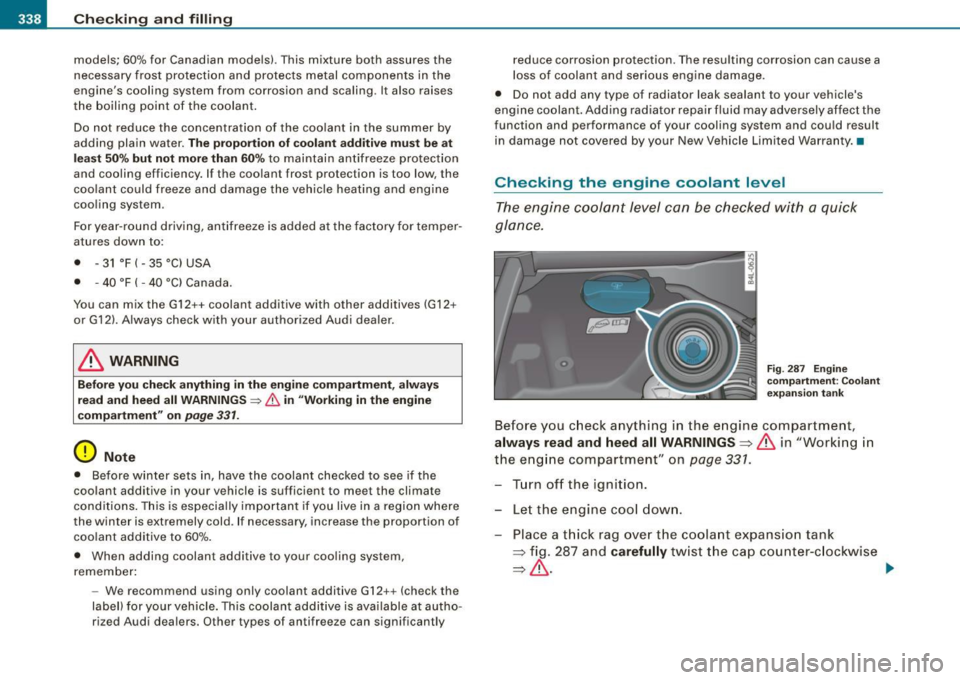
The engine coolant level can be checked with a quick
glance.
F ig . 287 E ngine
com partm ent : Cool ant
ex pans io n tank
Before you check anything in the engine compartment,
alw ays read and h eed all WARNINGS ~
& in "Working in
the eng ine compartment" on page 331.
- Turn off the ignition.
- Let the engine coo l dow n.
Place a thick rag over the coola nt expansio n tank
~ fig . 287 and carefully twist the cap counter-c lockwise
~ & - .,
Page 341 of 426
___________________________________________ C_ h_e _c_ k_ i_n _g _ a_n _d_ f_il _li _n _g __ lR
•
- Read the engine coolant level in the open coolant expan
sion tank :::::>
page 338, fig. 287. With a cold engine, the
coolant level should be between the "min" and "max"
markings. When the engine is warm, the level may be
slightly above the "max" marking.
The location of the coolant expansion tank can be seen in the
engine compartment illustration~
page 332.
To obtain an accurate reading, the engine must be switched off.
The expansion tank in your vehicle is equipped with an electric
coolant level sensor.
When the coolant level is too low, the warning light in the Auto
Check System~
page 33will blink until you add coolant and the
level has been restored to normal. Even though there is an electric
coolant level sensor, we still recommend you check the coolant level
from time to time .
Coolant loss
Coolant loss may indicate a leak in the cooling system . In the event
of coolant loss, the cooling system should be inspected immedi
ately by your authorized Audi dealer . It is not enough merely to add
coolant.
In a
sealed system, losses can occur only if the boiling point of the
coolant is exceeded as a result of overheating.
& WARNING
The cooling system is under pressure and can get very hot. Reduce
the risk of scalding from hot coolant by following these steps.
• Turn off the engine and allow it to cool down.
• Protect your face, hands and arms from escaping fluid and
steam by covering the cap with a large, thick rag.
& WARNING (continued)
• Turn the cap slowly and very carefully in a counter-clockwise
direction while applying light, downward pressure on the top of
the cap .
• To avoid being burned, do not spill antifreeze or coolant on the
exhaust system or hot engine parts. Under certain conditions, the
ethylene glycol in engine coolant can catch fire.
0 Note
Do not add any type of radiator leak sealant to your vehicle's engine
coolant. Adding radiator repair fluid may adversely affect the func
tion and performance of your cooling system and could result in
damage not covered by your New Vehicle Limited Warranty. •
Adding coolant
Be very careful when adding engine coolant.
Before you check anything in the engine compartment,
always read and heed all WARNINGS:::::> & in "Working in
the engine compartment" on
page 331.
- Turn off the engine.
Let the engine cool down.
Place a thick rag over the coolant expansion tank
=:> page 338, fig. 287 and carefully twist the cap counter
clockwise :::::>& .
Add coolant.
- Twist the cap on again
tightly.
Replacement engine coolant must conform to exact specifications
~ page 337, "Coolant". Even in an emergency, if coolant additive .,,
Vehicle care I t •
Page 342 of 426
-~_C_ h_e _c _ k_ i_n ...:::g::;...._ a_n_ d_ f_ i_ll _in -'g:::;.._ ___________________________________________ _
G12+ +, G12 + or G12 is not available, do not use a different addit ive .
Use p lain water ins tead until you ca n get the c orrec t additive and
can restore the correct ratio . This should be done as soon as
poss ible.
If you have los t a considerable amount o f coo lant, then you s hould
add co ld antifreeze and cold water only when the engine is cold .
A lways us e
new en gi ne c oolant when refi llin g .
Do not fi ll coo lant above the "MAX" mark. Excess coolant wil l be
forced out through the pressure relief valve in the cap when the
engine beco mes hot.
& WARNING
• The cooling sy stem is under pressure and can get very hot .
Reduce the risk of s calding from hot coolant by following these
steps .
- Turn off the engine and allow it to cool down.
- Protect your face, hands and arms from escaping fluid and
steam by covering the cap with a large, thick rag .
- Turn the cap slowly and very carefully in a counter -clockwise
dire ction while applying light , downward pressure on the top
of the cap .
- To avoid being burned , do not spill antifreeze or coolant on
the exhaust system or hot engine parts . Under certain condi
tions , the ethylene glycol in engine coolant can catch fire.
• Antifreeze is po isonous . Always store antifreeze in its original
container and well out of the reach of children.
• If you drain the coolant , it must be caught and safely stored in
a proper container clearly marked "poison ".
0 Note
• Coo lant po llutes t he e nviro nment and cou ld cause a n en gin e
fire. Excess coolant wi ll be forced out through the pressure re lief
va lve in the cap when the eng ine becomes hot.
• I f, in an emergency, on ly wate r can be added, the correct ratio
between wate r and ant ifree ze::::>
page 337 must be restored as soon
as possib le .
W For the sake of the environment
Drained coolant should not be reused. Always dispose of used
coo la nt whi le observ ing all env iro nmen tal reg ulat io n s. •
Radiator fan
The radiato r fan switches on au toma tic ally by i tself.
The radiator fa n is dr iven by the eng ine via th e V -belt. The visco us
clutch regulates the speed of the fan according to the temperature
o f t he coo la nt.
An auxiliary electric radiator fan * sw itches on and off depending on
coo la nt t empe rat ure a nd othe r vehic le operating c ondi tio ns.
A ft er you sw itch the e ngine o ff, the au xiliary fa n ca n conti nue
running for up to 10 m inutes- even with the ignition off. It can even
switch o n again lat er by itsel f::::> & , if
• the temperature of the eng ine coo lant rises due to the heat
bu ild -up from the eng ine in the eng ine compartment, or
• the engine compartment heats up because the vehic le is parked
in i ntense sun ligh t.
& WARNING
• To reduce the ri sk of personal injury never touch the radiator
fan .
~
Page 343 of 426
_____________________________________________ C_h_ e_ c _ k_in -= g_a _ n_d _ f_il _li _n ..;::g =-- ____.•
& WA RNING ! continued )
• The auxiliary ele ctric fan is temperature controlled and can
s w itch on suddenly even wh en t he engine is not runn ing .
• The auxiliary radiator fan swit ches on automatic ally when the
engin e coolant rea che s a cer tain temperature and will con tinue to
run until the coolant temperature drop s. •
Brake f luid
Checking brake fluid level
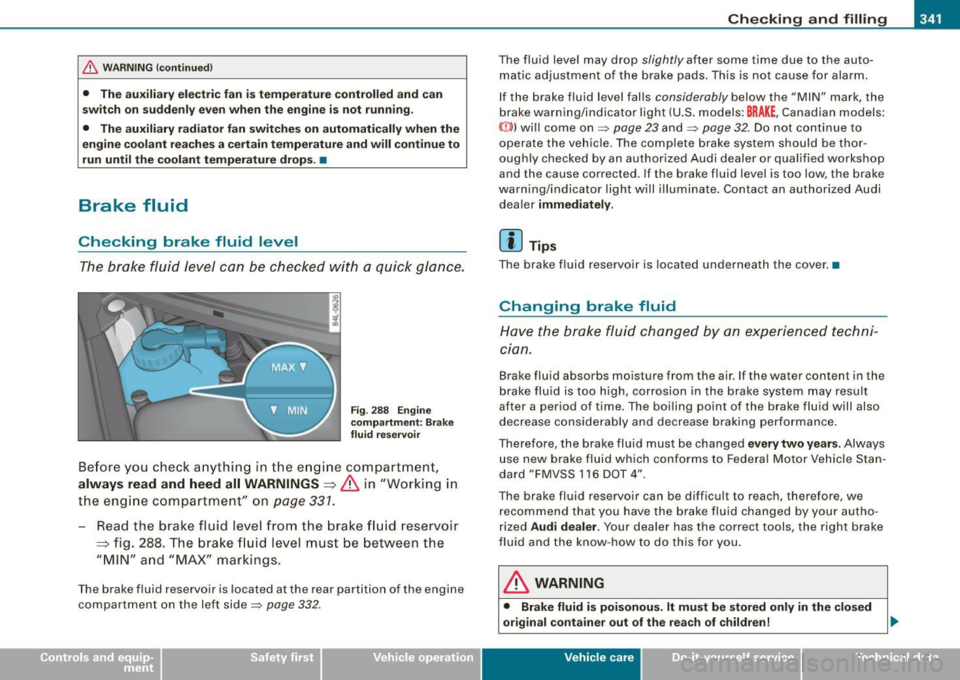
The brake fluid level c an be checke d with a quick gl ance .
Fig. 288 E ngine
comp artm ent: B ra ke
flui d rese rvoir
Be fore you check a nything in th e en g in e co mpart ment,
always read and heed all WARNINGS=> & in "Working in
t h e eng ine compartment" on
page 331.
- Read the brake fluid l eve l from the brake fluid reservoir
=> fig. 288. The brake flu id level mus t be between the
"MIN" and "MAX" markings.
The brake fluid reservoir is locate d at the rear partition of the engine
compartment on the left side=>
page 332.
The fluid level may drop slightly after some time due to the auto
ma tic adjustment of the brake pads. This is not cause for alarm .
If the brake fluid leve l falls
considerably below the "MIN" mark , the
brake warning/indicator light (U.S. models:
BRAKE , Canadian models:
«D> l will come on=>
page 23 and=> page 32 . Do not continue to
operate the vehicle. The complete brake system should be thor
oughly checked
by an author ized Audi dealer or qua lif ied workshop
and the cause corrected . If th e brake fluid level is too low, the brake
warning/indicator light w ill illumi nate. Contact an authorized Audi
dea ler
immedi ately .
[ i ] Tips
The brake fluid reservoir is located underneath the cover .•
Changing brake fluid
Have the brake fluid changed by an experience d techni
cian.
Brak e fluid absorbs mois ture from the air. If the wate r conten t in the
brake fluid is too high, corrosion in the brake sys tem may res ult
after a period of time . The boiling point of the brake fluid will also
decrease conside rably and decrease braking performance .
Therefore , the brake fluid mus t be changed
every two year s. Always
use new brake fluid which conforms to Federal Motor Vehicle S tan
da rd "FMVSS 116 DOT 4".
The brake fluid reservoir can be difficul t to reach, therefore , we
recommend that y ou have the brake fluid changed by your autho
rized
Audi deal er. Your dealer has the correct tools, the right brake
fluid and the know -how to do this for you .
& WARNING
• Brak e fluid is poi sonou s. It mu st be stored only in the clo sed
o riginal conta iner out of the rea ch of children! ..,.
Vehicle care I I irechnical data
Page 405 of 426
__________________________________________________ C_o_ n _ s_u_ m_ e ___ r_l_ n _f_ o_ r _m...:....:.. a:.;..:. ti .... o:.. n ........ _llll
& WA RNIN G (continu ed )
• The engine compartment of any motor vehi cle i s a potentially
h az ardou s area. N ev er re ach into the are a arou nd or to uch the
r a di ator fan . It is temperature co ntrolled and can swi tc h o n
s uddenly -even wh en the engine i s off and the ignition key h as
been removed . The r adiator f an switches on autom atic all y w hen
the coolant reache s a certain temperature and will continue to run
until the coo lant t emper ature drop s.
• Alway s remov e th e ignition key befo re anyone get s under the
v ehi cle .
• Alway s s upport your vehi cle with safety sta nd s if it i s ne ces
sa ry to wor k unde rne ath the veh icle . The ja ck suppl ied with the
v ehic le i s not adequ ate for thi s purpo se and could coll ap se
c au sin g s eriou s per son al in jury .
• If you m ust w ork under neath the vehi cle with the wheel s on
the ground , alwa ys m ake sure the veh icle i s on l eve l ground , that
the wheels ar e always securely blocked and that the engine
ca nn ot be sta rted .
• Alway s mak e sure the tran sm iss ion selecto r leve r (automatic
tr ansmi ssion ) is in "P " (P a rk po sition ) and the park brake is firml y
applied .
c£> For the sake of the environment
• Changing the engine settings w ill adverse ly affect emission
levels . This is detrimenta l to the environment and increases fuel
consumption.
• Always observe environmenta l regu lations when disposing of
old engine oil, used brake fluid, dirty engine coolant, spent batteries
or worn out tires.
• Undeployed airbag modules and pretens ioners might be classi
fied as Perchlorate Material -specia l handling may apply, see
www .dtsc .ca .gov/hazardouswaste/perchlorate. When the vehicle or
parts of the restraint system including airbag modules safety belts
with pretens ioners are scrapped, all applicable laws and regu la-
Controls and equip
ment Safety first Vehicle operation
tions must be observed. Your authorized Audi dealer is familiar with
these requirements and we rec
ommend that you have your dea ler
perform this service for you .•
Additional accessories ,
modifications and parts replacement
Addition al a ccessori es and parts
replacement
Always c onsul t an authorized Audi dealer before
purchasing accessories.
Your vehicle incorporates the latest safety design features ensuring a high standard of act ive and passive safe ty .
This safety could be compromised by non -approved changes to the
vehic le . F or this reason, if par ts have to be replaced, please observe
the following points when insta lling additiona l accessories:
Approved Audi accessories and genuine Audi parts are avai lable
from authorized Audi dealers.
These dealers also have the necessary facilities, tools and trained specialis ts to install the parts and accessories prope rly.
& WARNING
Using the wrong spare part s or u sing non-approved acce ssorie s
can c ause seri ous persona l injur y.
• Use onl y acc essorie s ex pres sly approved by Audi and g enuine
Audi spare p art s
• The se p art s and acce ssorie s have been spe cia lly de signed to
be used on you r vehi cle .
• Nev er in stall acc ess orie s s uch a s telep hone cra d le s or
be ver age holder s on airb ag cover s or within th e airbag deploy-
Vehicle care Do-it-yourself service Tec hn ica l da ta
Page 410 of 426
lffll __ A_ l..:,. p _ h_ a_ b_e _t_ic_ a_l _in_ d_e_ x ____________________________________________ _
A
Accessories . . . . . . . . . . . . . . . . . . . . . . . . 403
Adaptive Air Suspension .... ... .. .... 206
Cargo mode in the MMI ....... .... 212
Controls . . . . . . . . . . . . . . . . . . . . . . . . 207
Description ... ...... ............ 206
High level . . . . . . . . . . . . . . . . . . . . . . . 207
Highway level . . . . . . . . . . . . . . . . . . . 207
Instrument cluster display .. .... ... 209
Jacking mode when changing a flat tire . 210
Low level ... ... ... .... ..... .. ... 207
Normal level . . . . . . . . . . . . . . . . . . . . 207
Segment display . . . . . . . . . . . . . . . . . 208
Setting the driving modes ......... 208
Trailer towing mode ... .... .... ... 211
Using sw itch for cargo mode .. .... 212
Warning/indicator lights . .......... 21
Adaptive Cruise Control .. .... ..... ... 152
Changing speed ................. 156
Driver information ............... 160
Driver intervention prompt ........ 164
Driving in traffic 154
Driving program .. .... .... .... ... 165
Error messages . . . . . . . . . . . . . . . . . . 163
Open road . . . . . . . . . . . . . . . . . . . . . . 154
Override . . . . . . . . . . . . . . . . . . . . . . . . 154
Request for driver to assume control 154
Save speed . . . . . . . . . . . . . . . . . . . . . . 156
Setting distance . . . . . . . . . . . . . . . . . 158
Setting time interval .............. 158
Settings ........................ 165
Specia l driving situations ......... 165 Status
messages . ....... ... .. ... . 163
Switching on and off .. ........... 155
System limits .. .................. 165
Temporarily turning off ......... .. 157
warn ing/indicator lights ........... 161
Adaptive Light .... ...... ...... ... ... . 76
defective ......................... 37
Adding Engine coolant ... ....... .... .... . 339
Engine oil ... .. .. . ... ....... .... . 336
Windshield washer fluid ...... .... . 346
Additiona l accessories .......... .... . 403
Additives Engine oil ....................... 336
Adjusting Instrument cluster i llumination . .... . 17
Steering column electrically ....... 141
Steering column manually ......... 140
Adjusting front seats .... .... .... . ... . 92
Advanced Parking System with rear view
camera
Adjusting the chimes -option 1 . ... 201
Adjusting the chimes -option 2 .... 202
front and back with visual display and
rear -view camera . . . . . . . . . . . . . . . 191
General information ......... ..... 191
Notes on distance information ... .. 200
Parking next to obstac les . . . . . . . . . . 199
Rear-view camera -parking mode 1 196
Rear -view camera -parking mode 2 . 198
Rear -view camera (Rear View) ... ... 194
Rear -view camera coverage area . . . . 195
Rear -view camera tips ............ 204 Special parking
situations ... .. .. .. 199
Switching the rear-view camera on and
off .... . ... .... .... ... .. .... ... 203
switching the visua l display on and off ..
203
System error message ............ 204
Towing hitch ...... .... ...... .... 201
Air conditioning
See Climate controls 123
Air distribution Climate controls ... ....... .... ... 127
Four -zone automatic comfort air
conditioning ................... 133
Air pol lutants fi lter
Climate controls ................. 123
Airbag Warning/indicator lights . ...... .... . 19
Airbag system .... .... .... ... ... 241, 258
Advanced Airbag System ...... .... 245
Advanced Airbag System components . ..
248
Care ........................ .... 255
Child restraints .................. 265
Children ... .... .... ... ...... ... . 264
Components (front airbags) . ....... 248
Danger of fitting a chi ld safety seat on the
front passenger seat . . . . . . . . . . . . 243
Disposal ............. ....... .... 255
Front airbags .. ........ ...... 245, 246
How do the front airbags work? . ... 250
How many airbags does my vehicle have? 248
How the Advanced Airbag System compo -
nents work together . ........ .... 249