radio AUDI Q7 2009 Owner´s Manual
[x] Cancel search | Manufacturer: AUDI, Model Year: 2009, Model line: Q7, Model: AUDI Q7 2009Pages: 426, PDF Size: 97.13 MB
Page 347 of 426
___________________________________________ C_ h_e _c_ k_ i_n _g _ a_n _d_ f_il _li _n _g __ _
•
-Make sure the area is well ventilated when you charge
the battery.
- Open the hood
::::> page 330.
-Open the red cover on the positive pole ::::> fig. 289.
- Connect the charger connectors according to the instruc-
tions to the
jump start bolts. (Bolts under the red cover=
"positive", Bolts with hex head = "negative").
- Only now plug the mains lead for the charging equip
ment into the wall outlet and turn it on
::::> &.
- Make sure the charging rate is not over 30 amps/14.8
Volt.
- When the battery is fully charged: Turn the charging
equipment off and remove the mains lead from the wall
outlet.
- Now remove the clamps for the charging equipment.
- Close the red cover on the positive pole.
- Close the hood=>
page 331.
A discharged battery can freeze at temperatures of only O °C. Allow
a frozen battery to thaw completely before attempting to charge it
~ & .However, we recommend not using a thawed battery again
because the battery casing can be cracked due to ice formation and
can leak battery acid.
Battery charging (Maximum charging rate of 30
amps/14.8 Volt)
When charging at /ow voltages (e.g. with a trickle charger), the
battery cables do not have to be disconnected first. The battery caps
should
not be opened when charging a battery.
It is not necessary to remove the battery from the luggage compart
ment.
Fast charging the battery (charging rate above 14 .8
Volts)
For technical reasons do not use a battery charger that uses voltage
greater than 14.8 Volts to charge your vehicle's battery.
& WARNING
Charging a battery can be dangerous.
• Always follow the operating instructions provided by the
battery charger manufacturer when charging your battery.
• Never charge a frozen battery. It may explode because of gas
trapped in the ice. Allow a frozen battery to thaw out first.
• Do not reuse batteries which were frozen. The battery housing
may have cracked and weakened when the battery froze.
• Charge the battery in a well ventilated area. Keep away from
open flame or electrical spark . Do not smoke. Hydrogen gas gener
ated by the battery is explosive.
• To reduce the danger of explosion, never connect or disconnect
charger cables while the charger is operating.
• Fast charging a battery is dangerous and should only be
attempted by a competent technician with the proper equipment.
• Battery acid that may spill during charging should be washed
off with a solution of warm water and baking soda to neutralize
the acid .
0 Note
Never use a fast charger as a booster to start the engine. This will
seriously damage sensitive electronic components, such as control
units, relays, radio, etc ., as well as the battery charger. •
Vehicle care I t •
Page 350 of 426
-~_T_ ir_e_ s_ a_ n_d _ w_ h_ e_e _l_s _________________________________________________ _
& WARNING (continued)
crashes and serious personal injuries . Have worn or damaged tires
replaced immediately.
• Tires age even if they are not being used and can fail suddenly,
especially at high speeds. Tires that are more than 6 years old can
only be used in an emergency and then with special care and at
low speed.
Glossary of tire and loading terminology
Accessory weight
means the combined weight (in excess of those standard items
which may be replaced) of automatic transmission, power steering,
power brakes, power windows, power seats, radio, and heater, to
the extent that these items are available as factory-installed equip
ment (whether installed or not).
Aspect ratio means the ratio of the height to the width of the tire in percent.
Numb ers of 55 or lower indicate a low sidewall for improved
steering response and better overall handling on dry pavement.
Bead
means the part of the tire that is made of steel wires, wrapped or reinforced by ply cords and that is shaped to fit the rim.
Bead separation means a breakdown of the bond between components in the bead.
Cord
means the strands forming the plies in the tire.
& WARNING (continued)
• Never mount used tires on your vehicle if you are not sure of
their "previous history." Old used tires may have been damaged
even though the damage cannot be seen that can lead to sudden
tire failure and loss of vehicle control.
• If you notice unusual vibration or if the vehicle pulls to one side
when driving, always stop as soon as it is safe to do so and check
the wheels and tires for damage . •
Cold tire inflation pressure
means the tire pressure recommended by the vehicle manufacturer
for a tire of a designated size that has not been driven for more than
a couple of miles (kilometers) at low speeds in the three hour period
before the tire pressure is measured or adjusted.
Curb weight means the weight of a motor vehicle with standard equipment
including the maximum capacity of fuel, oil, and coolant, air condi
tioning and additional weight of optional equipment.
Extra load tire
means a tire design to operate at higher loads and at higher infla
tion pressures than the corresponding standard tire. Extra load tires
may be identified as "XL",
"xi", "EXTRA LOAD", or "RF" on the side
wall.
Gross Axle Weight Rating ("GAWR")
means the load-carrying capacity of a single axle system, measured
at the tire -ground interfaces.
Gross Vehicle Weight Rating ("GVWR"l
means the maximum total loaded weight of the vehicle.
Page 390 of 426
IIIII.___E_ m_ e_r -=g "-e_ n _ c-=y _ s_ i_t _u _a _t_ i_o _n_ s _______________________________________________ _
& WARN ING (c ontinu ed )
• Bef ore you chec k anything in the engin e compartment , always
re ad and h eed all W ARNINGS =>
page 324, "Engine compa rtment".
0 Note
• Applying a higher voltage booster battery wil l cause expensive
damage to sensitive electronic components, such as contro l units,
relays, radio, e tc.
• There must be no electrical contact between the vehicles as
otherwise current could already start to flow as soon as the positive
( + ) terminals are connected .
[ i ] Tip s
• The discharged battery must be properly connected to the
vehic le's e lectrical system. When jump starting or charging the
battery, never connect the negative ground cable to the battery
negative pos t because the battery manager system must be ab le to
detect the battery's state of charge . Always connect the negative
ground cable to the negat ive ground post of the battery manager
control unit. •
Use of jumper cables
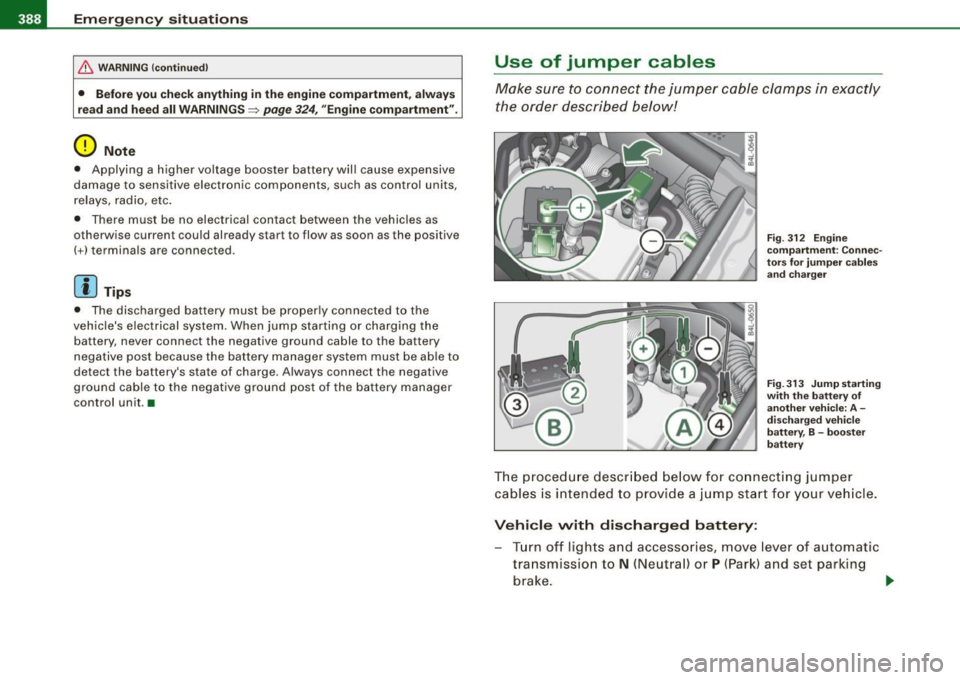
Make sure to connect the jumper c able clamps in exac tly
the order described below!
F ig . 3 12 E ngin e
co mpartm ent : Co nnec
to rs for ju mp er ca ble s
and cha rger
F ig . 3 13 Ju mp st artin g
w it h th e batte ry o f
ano ther v eh icle : A -
d isc harg ed ve h icle
b att ery, B -boo ster
b att ery
The procedure descr ibed below for co nnect ing jumper
cables is intended to provide a j ump star t for your vehi cle .
Vehi cle with discharged battery :
-Turn off lights and accessories, move lever of automatic
tra nsmissio n to
N (Neutral) or P (Par k) and set parking
brake .
~
Page 406 of 426
___ C_ o_n_ s_ u_m _ e_ r_ ln_ f_ o _r _m _ a_ t_ i_o _n ______________________________________________ _
& WARNING (con tinued)
men t zo nes. Doin g s o w ill in cre ase the r isk of injury if airb ags are
t rigg ered in an accid en t!
• Before you che ck anything i n the e ngine co m partment , always
re ad and heed all WARN IN GS
~ page 32 4.
0 Note
• If items other than genuine Audi spare par ts, add-on equipment
and accessory items are used or if repair work is not performed
according to specified methods, this can resu lt in severe damage to
your vehicle 's engine and body (such as corrosion) and adverse ly
affect your vehicle's warranty .
• If emergency repairs must be performed elsewhere, have the
vehic le examined by an authorized Audi dealer as soon as possible.
• The manufacturer cannot be held liable for damage which occurs
due to fai lure to comply w ith these stipu lations. •
Technical Modifications
Our guidelines must be c omplied with when technical
modifi cations are made.
Always consult an authorized Audi dealer before starting work on
any modifications.
This will he lp ensure that vehicle function, performance and safety
are not impaired ~
&-
Attempting to work on e lectronic components and the software
used with them can cause malfunctions. Because of the way e lec
tronic components are interconnected with each other, such
malfunctions can also have an adverse affect on other systems that
are not directly involved . This means that you risk both a substantial
reduction in the operational safety of your vehicle and an increased
wear of vehicle parts~
&-
Authori zed Audi dealers will perform this work in a professiona l and
competent manner o r, in special cases, refer you to a professiona l
company that specializes in such modifications .
& WARNING
Improper r epair s and m odifica tion s can ch ange th e way veh ic le
syst ems w ork and cau se seri ous per sonal inju ry .
0 Note
If emergency repairs must be performed elsewhere, have the
vehicle examined by an authorized Audi dea ler as soon as
possible. •
Declaration of Compliance,
Telecommunications and Electronic
Systems
Radio Frequency Devices and Radiocommunication
Equipment User Manual Notice.
The manufacturer is not responsible for any radio or TV interference
caused by unauthorized modifications to this equipment.
D ev ices
The fol lowing devices each comply with FCC Part 15.19, FCC Part
15.21 and RSS -Gen Issue 1:
• Adaptive Cruise Contro l
• Convenience key
• Audi side assist
• Cell phone package
• Electronic immobilizer
• Homelink® universal remote control