roof AUDI Q7 2009 Owner´s Manual
[x] Cancel search | Manufacturer: AUDI, Model Year: 2009, Model line: Q7, Model: AUDI Q7 2009Pages: 426, PDF Size: 97.13 MB
Page 74 of 426

Opening and closing
Fig. 59 Section of front
headliner: Crank for
emergency operation
- Take the screwdriver from the vehicle tool kit
=>
page 371.
- Remove the two screws=> page 71, fig. 58 -Arrows- from
the light unit.
- Carefully remove the light unit.
- Remove the crank from the bracket on the fuse cover on
the left front of the instrument panel=>
page 381, fig. 308
®·
- Push the crank into the hexagonal hole as far as it can go
=> fig.
59.
- Hold the crank down and turn it to close the roof.
- Re-install the l ight unit. For installation, reverse the
removal sequence.
- Return the crank to its location in the fuse box cover
=>
page 381, fig. 308 and install the cover.
Have the problem corrected.
[ i ] Tips
To turn the crank for emergency closing more easily, you should use
the screwdr iver handle as an aid=> fig. 59 . First,
remove the screw
driver from the handle, then push the handle onto the crank .•
A pplies to vehicle s: with Panoram ic sli ding su nroof
Mechanical emergency closing for rear roof
segment
- Carefully remove the cover for the rear roof segment
drive in the rear area of the headliner.
- Remove the crank from the bracket on the fuse cover on
the left front of the instrument panel=>
page 381 , fig. 308
®·
- Press the crank into the hexagonal hole in the drive as far
as it will go (basically, as shown in=> fig.
59).
- Hold the crank down and turn it to close the roof.
- Re-install the cover.
- Return the crank to its location in the fuse box cover
=>
page 381, fig. 308 and install the cover.
- Have the problem corrected.
[ i ] Tips
To turn the crank for emergency closing more easily, you should use
the screwdriver handle from the tool kit=>
page 371 as an aid. First,
remove the screwdriver from the handle, then push the handle onto
the crank. •
Page 114 of 426
_L-_S::..:: e..:a :..:t:.:s :....:: a:.:.n .:.. d::....: s:.. t.:.. o::..:.. ra= g:..:e :...._ _____________________________________________ _
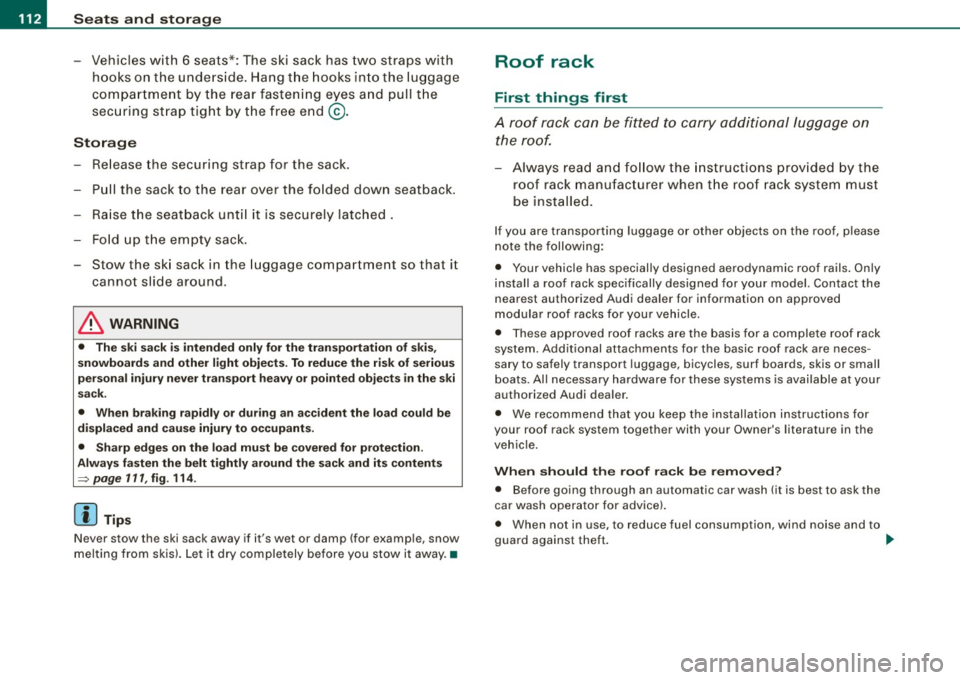
- Vehicles with 6 seats*: The ski sack has two straps with
hooks on the underside. Hang the hooks into the luggage
compartment by the rear fastening eyes and pull the
securing strap tight by the free end@.
Storage
- Release the securing strap for the sack.
- Pull the sack to the rear over the folded down seatback .
- Raise the seatback until it is securely latched.
- Fold up the empty sack.
- Stow the ski sack in the luggage compartment so that it
cannot slide around .
& WARNING
• The ski sack is intended only for the transportation of skis,
snowboards and other light objects. To reduce the risk of serious
personal injury never transport heavy or pointed objects in the ski
sack.
• When braking rapidly or during an accident the load could be
displaced and cause injury to occupants.
• Sharp edges on the load must be covered for protection.
Always fasten the belt tightly around the sack and its contents
=> page 111, fig . 114.
[ i] Tips
Never stow the ski sack away if it 's wet or damp (for example, snow
melting from skis). Let it dry completely before you stow it away. •
Roof rack
First things first
A roof rack can be fitted to carry additional luggage on
the roof.
Always read and follow the instructions provided by the
roof rack manufacturer when the roof rack system must
be installed.
If you are transporting luggage or other objects on the roof, please
note the following :
• Your vehicle has specially designed aerodynamic roof rails. Only
install a roof rack specifically designed for your model. Contact the
nearest authorized Audi dealer for information on approved
modular roof racks for your vehicle.
• These approved roof racks are the basis for a complete roof rack
system. Additional attachments for the basic roof rack are neces
sary to safely transport luggage, bicycles, surf boards, skis or small
boats . All necessary hardware for these systems is available at your
authori zed Audi dealer .
• We recommend that you keep the installation instructions for
your roof rack system together with your Owner's literature in the
vehicle.
When should the roof rack be removed?
• Before going through an automatic car wash (it is best to ask the
car wash operator for advice).
• When not in use , to reduce fuel consump tion, wind noise and to
guard against theft. _.,,
Page 115 of 426
Seats and storage -
-----------------=-----'
& WARNING
• Use of an un appr oved roof ra ck or in correct mounting of an
approved roof ra ck can c aus e the roof ra ck or the item s attached
to it to fall off the r oof ont o the ro ad .
• Object s falling fr om the roof of a vehi cle can c ause a crash and
p ers onal inju ry.
• Only mount the sy ste m between the marking s shown
in
=> fig. 115 .
• The roof rack sy ste m mu st b e in sta lled e xactly a ccording to the
instructions prov ided .
0 Note
• Your vehicle warranty does not cover any damages to the vehicle
caused by using roof racks or moun ting structures no t approved by
Audi for your vehicle . T he same app lies to damage resulting from
incorrect roof rack installation .
• Always check the roof rack mountings and hardware before each
t rip and during a trip to make sure everything is securely tightened.
If necessary, retighten the mountings and check the entire system
from time to time.
• After mounting a roof rack system, or when you transport
objects on the roof of your vehicle, the height of the vehicle is natu
ra lly increased . Be carefu l when driving under low bridges or in
parking garages for exa mple . This cou ld cause damage to the load
and even the vehicle itself .•
Con tro ls and eq uip
ment
Roof rack mounting locations
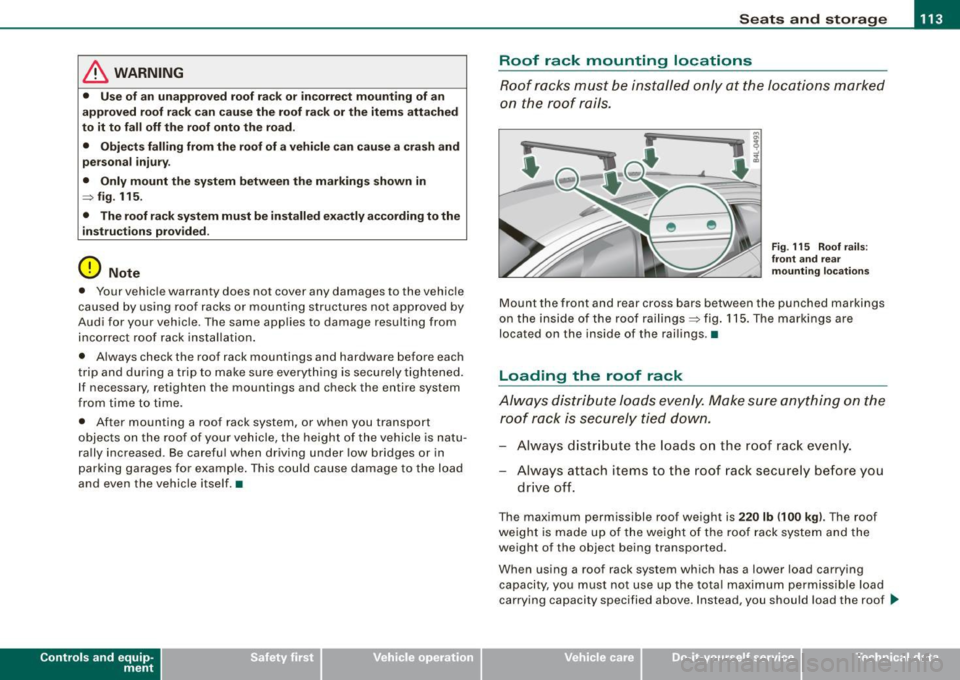
Roof racks must be installed only at the locati ons marked
on t he roof rails .
Fig . 115 Ro of r ails:
fr ont a nd r ear
mountin g locations
Mount the front and rear cross bars between the punched markings
on the inside of the roof railings => fig . 115. The markings are
located on the inside of the rail ings .•
Loading the roof rack
Always di stribute loads evenly. Make sure anything on the
ro of ra ck is securel y tied down.
Always d istr ibute the loads o n the roof rack even ly .
Always attach items to the roof rack secure ly before you
drive off .
The maximum permissible roof weight is 220 lb 1100 kg ). The roof
we ight is made up of the weight of the roof rack system and the
weight of the object being transported .
When using a roof rack system which has a lower load carrying capacity, you must not use up the tota l maximum permissible load
carrying capacity specified above. Instead, you should load the roof
~
Vehicle care I I irechnical data
Page 116 of 426
• ..__S_ e_a _ t_ s_ a_ n_ d_ s_t _o _r_ a-' g==- e ________________________________________________ _
rack syst em only to the maximum capaci ty spec ified by the manu
f actu rer of the roo f ra ck sy stem.
& WARNING
Weak , damaged or improper straps used to secure items to the
roof rack can fail during hard brak ing or in a collision and cause
serious personal injury.
• Make sure the roof rack is installed exactly as spe cified above
~ page 113 .
• Always use suitable mounting straps for securing items to the
roof rack to help prevent items from shifting or flying forward .
• Items on the roof rack must always be securely mounted .
• The use of a roof rack can negatively affect the way a vehicle
handles. Cargo that is large, heavy , bulky, long or flat will have a
greater negative influence on the vehicle's aerodynamics , center
of gravity and overall handling . Always drive slowly, avoid sudden
braking and maneuvers when t ransporting cargo on the roof of
your vehicle.
• Never exceed the maximum permissible load carrying capacity
of the roof of your vehicle , the permissible axle weights and the
perm issible total weight of your vehicle~
page 397, "Weights ".
• Always drive slowly , avoid sudden braking and maneuvers
when transporting cargo on the roof of your vehicle.
0 Note
M ake sure that the opened rear lid does not come in contact with
the ca rgo on the roof.
~ For the sake of the environment
Sometimes it may be easier to leave a roof rack installed eve n
th ough you a re not usi ng it. Due to th e increased a ir resis tanc e your
veh ic le wi ll unnecessarily u se more fue l. Remove the roof rack if you
are no t go in g to us e it.•
Cupholder
Front cupholders
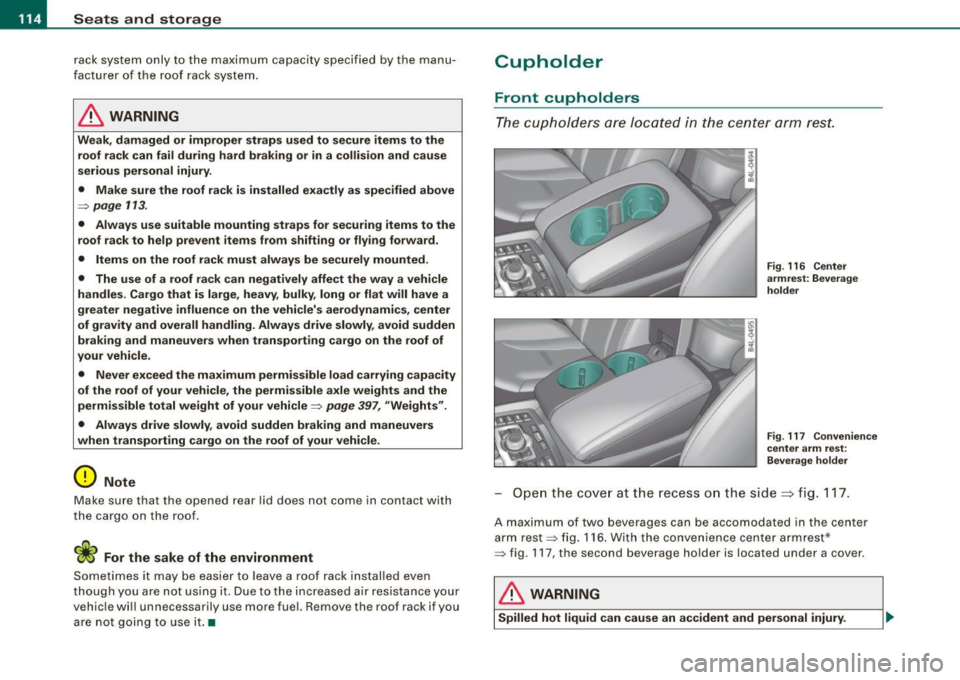
The cupho/d ers ar e l oca ted in the c en te r a rm res t.
Fig . 116 Center
armrest : Beverage
holde r
F ig . 117 Convenience
center arm rest:
Bever age h older
O pen th e cove r at t he recess o n the side ~ fig . 11 7.
A maximum of two beverages can be accomodated in the center
ar m re st ~ fig. 116 . W ith t he c on ve nie nce cent er a rm res t*
~ fig. 117 , the second beverage ho lder is located under a cover.
& WARNING
Spilled hot liquid can cause an accident and personal injury .
Page 121 of 426
________________________________________________ S_ e_ a _ t_ s _a_ n_d _ s_t _o _ r_ a...: g==-- e __ llll
Storage
General overview
There are numerous places to store items in your vehicle.
Glove compartment
Cooling box in glove compartment
Storage compartment in roof
Storage in the door panels
Storage net in footwell
Storage net in the front seat backs
Storage net in luggage compartment
Storage compartment beneath cargo
floor
& WARNING
=> page 119
=> page 120
=> page 121
=> page 121
=> page 122
=> page 122
=> page 109
• Always remove objects from the instrument panel. Any items
not stored could slide around inside the vehicle while driving or
when accelerating or when applying the brakes or when driving
around a corner.
• When you are driving make sure that anything you may have
placed in the center console or other storage locations cannot fall
out into the footwells. In case of sudden braking you would not be
able to brake or accelerate.
• Any articles of clothing that you have hung up must not inter
fere with the driver's view. The coat hooks are designed only for
lightweight clothing. Never hang any clothing with hard, pointed
or heavy objects in the pockets on the coat hooks. During sudden
braking or in an accident -especially if the airbag is deployed -
these objects could injure any passengers inside the vehicle. •
Controls and equip
ment
Glove compartment
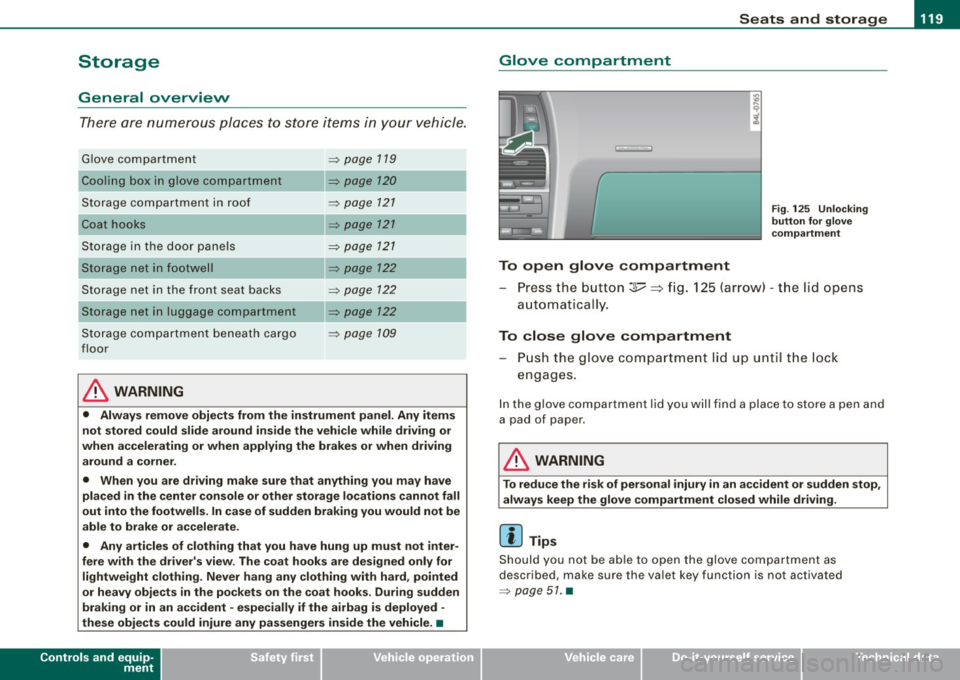
To open glove compartment
Fig . 125 Unlocking
button for glove
compartment
Press the button :];,, ~ fig. 125 (arrow) -the lid opens
automatica I ly.
To close glove compartment
- Push the glove compartment lid up until the lock
engages.
In the glove compartment lid you will find a place to store a pen and
a pad of paper .
& WARNING
To reduce the risk of personal injury in an accident or sudden stop,
always keep the glove compartment closed while driving.
[ i] Tips
Should you not be able to open the glove compartment as
described, make sure the valet key function is not activated
=> page 51. •
I • •
Page 123 of 426
Seats and storage -
-----------------=-----'
Storage compartment in roof
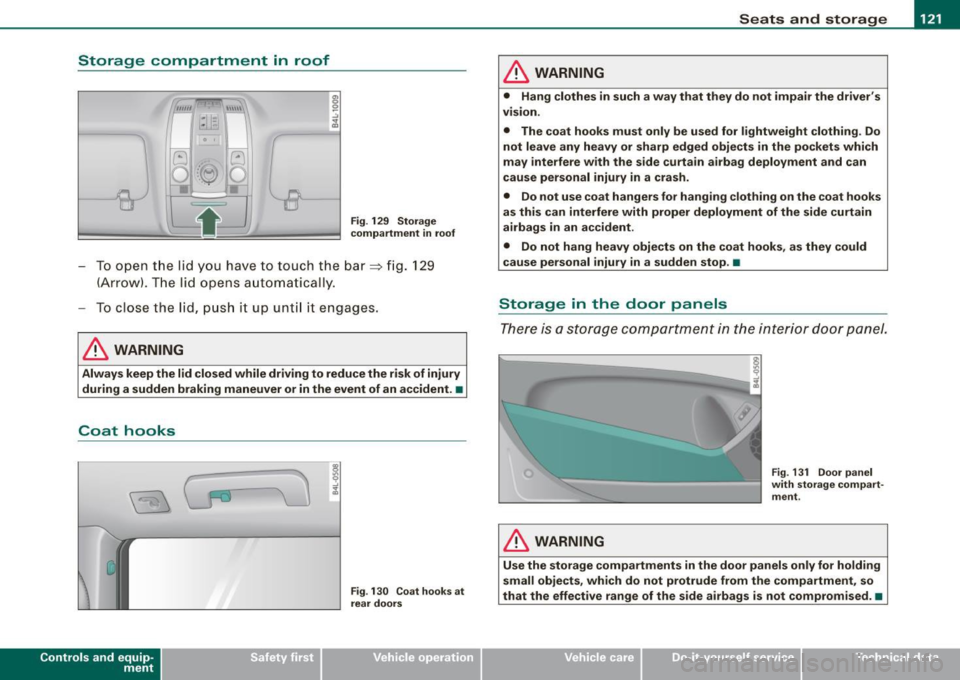
Fig. 129 Storage
compartment in roof
To open the lid yo u have to touch the bar~ fig. 129
(Arrow) . The lid opens automat ically.
To close the lid, push it up until it engages.
& WARNING
Always keep the lid closed while driving to reduce the risk of injury
during a sudden braking maneuver or in the event of an accident. •
Coat hooks
Contro ls and eq uip
ment
Fig . 130 Coat hooks at
rear doors
& WARNING
• Hang clothes in such a way that they do not impair the driver's
VISIOn .
• The coat hooks must only be used for lightweight clothing . Do
not leave any heavy or sharp edged objects in the pockets which
may interfere with the side curtain airbag deployment and can
cause personal injury in a crash.
• Do not use coat hangers for hanging clothing on the coat hooks
as this can interfere with proper deployment of the side curtain
airbags in an accident.
• Do not hang heavy objects on the coat hooks, as they could
cause personal injury in a sudden stop. •
Storage in the door panels
There is a storage compartment in the interior door panel.
& WARNING
Fig. 131 Door panel
with storage compart
ment .
Use the storage compartments in the door panels only for holding
small objects , which do not protrude from the compartment, so
that the effective range of the side airbags is not compromised. •
Vehicle care
I I irechnical data
Page 126 of 426
• .___w_ a_ rm __ a_ n_ d_ c_o _l_d ________________________________________________ _
Energ y man ag em ent
To prevent the battery from being discharged and to restore the
balance of energy, components which require large amounts of
energy are temporarily cut back or switched off=>
page 295.
Heating systems in particular require a great deal of energy. If you
notice, for example, that the seat * or rear window heating is not
heating, they have been temporarily cut back or switched off by
ene rg y m anage ment. These systems are available again as soon as
the energy balance has been res tored .
& WARNING
Reduced visi bilit y is da ng ero us a nd can cau se a ccidents.
• For sa fe driving it i s very imp orta nt that all window s be fr ee of
ic e, s now a nd conde nsation .
• Completely familiarize your self with the proper use and fun c
tion of the heat ing and ventilat ion system and e spe cia lly how to
defog and defrost the windows .
• Neve r use the wind shield wipe r/w asher syste m in free zing
weather until y ou have warmed the wind shield first , usi ng the
heat ing and ventil ation system . The wash er solution m ay freeze
on the wind shield and r educe vi sibilit y.
0 Note
• If you suspect that the air conditioner has been damaged, turn
on ECON and contact an authorized Audi dealer to have the system
inspected.
• Repairs to the Audi air conditioner require special technical
know ledge and special to ols. Contact an authorized Audi dea ler for
assistance.
[ i ] T ip s
• Keep the air intake slots (in front of the windsh ie ld) free from ice,
snow and debris in order to maintain the proper function of the
climate contro l system.
• Air inside the vehicle escapes through air vents located in the
s ide tr im panels beneath the rear side windows. Make sure that the
out let slots are not covered by clothing, etc.
• Climate control works most effectively if the windows and the
Panoramic s liding sunroof* are c losed. However, if the interior of a
parked vehic le is extreme ly hot from the sun's rays, briefly opening
the windows can speed up the cooling process. •
Page 133 of 426

Warm and cold -
-------------------'
- To adjust the direction o f the airflow from the o utlet,
move the tab in the cen ter of the o utlet in the desired
direction . The direction of the air delivered from the
vents can be adjusted hor izontally and vertically .
The air outlets are actuated either automatically or manually
depending on the operating mode selected . Heated or unheated
fresh air, or cooled air flows from the vents .
The air outlets to heat the rear footwell are located under the front seats.
[ i ) Tip s
If the climate control system is operating in cooling mode, air flows
primarily from the outlets in the center console and in the door
pillars . To achieve adequate cooling, you should never close the
out lets completely .•
Using climate control economically
Using the climate controls prudently can help save fuel.
When you use the a ir conditioner, engine power is reduced
and fuel consumption increases. To save fuel, you should
use the air conditioner only when necessary . A lso please
note the follow ing po ints:
- If you want to save fuel, activate ECON.
- If yo u are g oing to dr ive wit h the w indows or Panorami c
sliding sunroof* open, use ECON .
- If the ve hicle is e xtremely ho t due to the heat of t he s un,
br iefly open doors and windows .
Contro ls and eq uip
ment
ffi For the sake of th e environm ent
By reducing the amount of fue l you use, you also reduce the amount
of pollutants emitted into the air. •
Rear Air Conditioning
Applies to vehicles: w ith four- zone aut oma tic com fort air co ndit ionin g
Rear air conditioning -controls
This overview is to assist you in familiarizing yourself with
the rear air conditioning controls.
Fi g. 14 0 Rear air
c ond ition in g co ntro ls
The left disp lay indicates the temperature selected for the rear left
passenger, the right display indicates the temperature se lected for
the rear right passenger. If the sett ings for seat heating*, air distri
bution or the air conditioning fan are changed, the relevant indi
cator will appear briefly on the MMI Display.
Each function is turned on or off by briefly p ressing the corre
sponding button. T he indicator light in the button illuminates when
t he function is active. .,
Vehicle care I I Technical data
Page 230 of 426
lllffl..,___D_ r_iv _i_ n""' g::;._ S_ a_f _e _ly =---------------------------------------------------
& WARNING
Improperly stored luggage or other items can fly through the
vehicle causing serious personal injury in the event of hard braking or an accident. To help reduce the risk of serious personal injury:
• Always put objects, for example, luggage or other heavy items
in the luggage compartment.
• Always secure objects in the luggage compartment using the
tie-down eyelets and suitable straps.
& WARNING
Heavy loads will influence the way your vehicle handles. To help
reduce the risk of a loss of control leading to serious personal
injury :
• Always keep in mind when transporting heavy objects, that a
change in the center of gravity can also cause changes in vehicle
handling:
-Always distribute the load as evenly as possible.
- Place heavy objects as far forward in the luggage compart-
ment as possible.
• Never exceed the Gross Axle Weight Rating or the Gross
Vehicle Weight Rating specified on the safety compliance sticker on the left door jamb. Exceeding permissible weight standards
can cause the vehicle to slide and handle differently.
• Please observe information on safe driving
~ page 220.
& WARNING
To help prevent poisonous exhaust gas from being drawn into the
vehicle, always keep the rear lid closed while driving.
• Never transport objects larger than those fitting completely
into the luggage area because the rear lid cannot be fully closed.
& WARNING (continued)
• If you absolutely must drive with the rear lid open, observe the
following notes to reduce the risk of poisoning :
- Close all windows,
- Close the Panoramic sliding sunroof*,
- Open all air outlets in the instrument panel,
- Switch off the air recirculation,
- Set the fresh air fan to the highest speed.
& WARNING
Always make sure that the doors, all windows, the Panoramic
sliding sunroof* and the rear lid are securely closed and locked to
reduce the risk of injury when the vehicle is not being used.
• After closing the rear lid, always make sure that it is properly
closed and locked .
• Never leave your vehicle unattended especially with the rear lid
left open. A child could crawl into the vehicle through the luggage
compartment and close the rear lid becoming trapped and unable
to get out . Being trapped in a vehicle can lead to serious personal
injury.
• Never let children play in or around the vehicle.
• Never let passengers ride in the luggage compartment . Vehicle
occupants must always be properly restrained in one of the
vehicle's seating positions.
[ i] Tips
• Air circulation helps to reduce window fogging. Stale air escapes
to the outside through vents in the trim panel. Be sure to keep these
slots free and open.
• The tire pressure must correspond to the load. The tire pressure
is shown on the tire pressure label. On USA vehicles, the tire pres- .,_
Page 246 of 426
___ A_ ir_ b_ a-g _ s_y _s_ t_ e_ m _________________________________________________ _
as defin ed i n th e el ectron ic contro l u n it=> page 253, "PASSE NGER
AI R BAG OFF lig ht".
A lwa ys rem em ber, a c hild safet y se at or infant carr ier installe d on
the front seat may be str uck and k nocked o ut of po sition by t he
rap id ly in fla ting passe nger's air bag in a fron tal colli sion . The airb ag
cou ld great ly re duce the effectivene ss of the ch ild restrain t and
e ve n seri ous ly injure the chi ld dur ing in flatio n.
For th is reason, and beca use the bac k seat is the safest plac e for
chi ldren -wh en prop erly rest rained acc ording to th eir age and size
- we strong ly recommend that ch ildren a lways sit in the bac k se at
=> p age 263, "Ch ild Safe ty ".
& WARNING
A child in a rearward -facing child safety seat installed on the front
passenger seat will be ser iously injured and can be killed if the
front airbag inflates - even with an Advanced Airbag System .
• The inflating airbag will hit the child safety seat or infant
carrier with great force and will smash the child safety seat and
child against the backrest , center arm rest , door or roof .
• Always install rear -facing child safety seats on the rear seat .
• If you must install a rearward facing child safety seat on the
front passenger seat because of exceptional circumstances and
the PASSENGER AIR BAG OFF light does not come on and stay on ,
immediately install the rear-facing child safety seat in a rear
seating position and have the airbag system inspected by your
authorized Audi dealer.
• Forward-facing child safety seats installed on the front
passenger's seat may interfere with the deployment of the airbag
and cause serious personal injury to the child .
& WARNING
If, in exceptional circumstances, you must install a forward-facing
child restraint on the front passenger's seat:
& WARNING (continued)
• Always make sure the forward-facing seat has been designed
and certified by its manufacturer for use on a front seat with a
passenger front and side airbag .
• Never put the forward-facing child restraint up against or very
near the instrument panel.
• Always move the passenger seat into its rearmost position in
the seat's fore and aft adjustment range, as far away from the
airbag as possible before installing the forward-facing child
restraint. The backrest must be adjusted to an upright position .
• Make sure that the PASSENGER AIR BAG OFF light comes on
and stays on all the time whenever the ignition is switched on.
& WARNING
To reduce the risk of serious injury , make sure that the PASSENGER
AIR BAG OFF light will be displayed whenever a child restraint is
installed on the front passenger seat and the ignition is switched
on.
• If the PASSENGER AIR BAG OFF light does not stay on , perform
the checks described
=> page 252 , "Monitoring the Advanced
Airbag System" .
• Take the child restraint off the front passenger seat and install
it properly at one of the rear seat positions if the PASSENGER AIR
BAG OFF light does not stay on.
• Have the airbag system inspected by your authorized Audi
dealer immediately.
• Always carefully follow instructions from child restraint manu
facturers when installing child restraints .
& WARNING
If, in exceptional circumstances, you must install a forward or
rearward-facing child restraint on the front passenger's seat :