seats AUDI Q7 2009 Owner´s Manual
[x] Cancel search | Manufacturer: AUDI, Model Year: 2009, Model line: Q7, Model: AUDI Q7 2009Pages: 426, PDF Size: 97.13 MB
Page 102 of 426
• ..__S_ e_a_ t_ s_ a_ n_ d_ s_t _o _ r_ a--' g=- e ________________________________________________ _
- Push the seat forward.
Pushing second row of seats back
- Push the seat back.
- Fold the seat back up unt il it latches.
To make entry to and exit from the rear of the vehicle easier, the seat
backs for the second row seating can be folded forward . At the
same time, the seats can be pushed forward and to the rear .•
A pplies to ve hicles: with th ird ro w seati ng
Folding seat back up and down (third row
seating )
The third row seating is suitable for persons up to 1.6
meters (5
ft 3 in) in height.
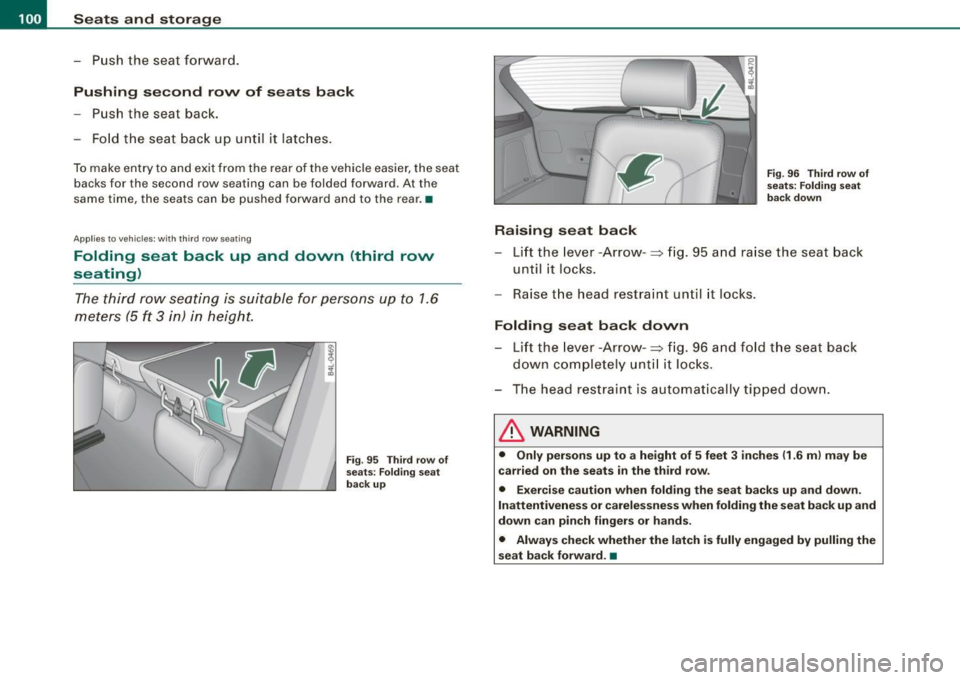
Fig. 95 Third row of
seats: Folding seat
back up
•
Raising seat back
Fig . 96 Third row of
seats: Folding seat
back down
- Lift the lever -Arrow -~ fig. 95 and raise the seat back
until it locks.
- Raise the head restraint until it locks .
Folding seat back down
- Lift the lever -Arrow-~ fig. 96 and fold the seat back
down completely until it locks.
- The head restraint is automatically tipped down.
& WARNING
• Only persons up to a height of 5 feet 3 inches (1.6 ml may be
carried on the seats in the third row.
• Exercise caution when folding the seat backs up and down.
Inattentiveness or carelessness when folding the seat back
up and
down can pinch fingers or hands.
• Always check whether the latch is fully engaged by pulling the
seat back forward. •
Page 103 of 426
________________________________________________ S_e_ a_ ts_ a_ n_d _ s_t _o _r_ a ....; g::;. e _ __._
Head restraints
Adjusting head restraints , front seats
The head restraints must be adjusted properly to provide
protection.
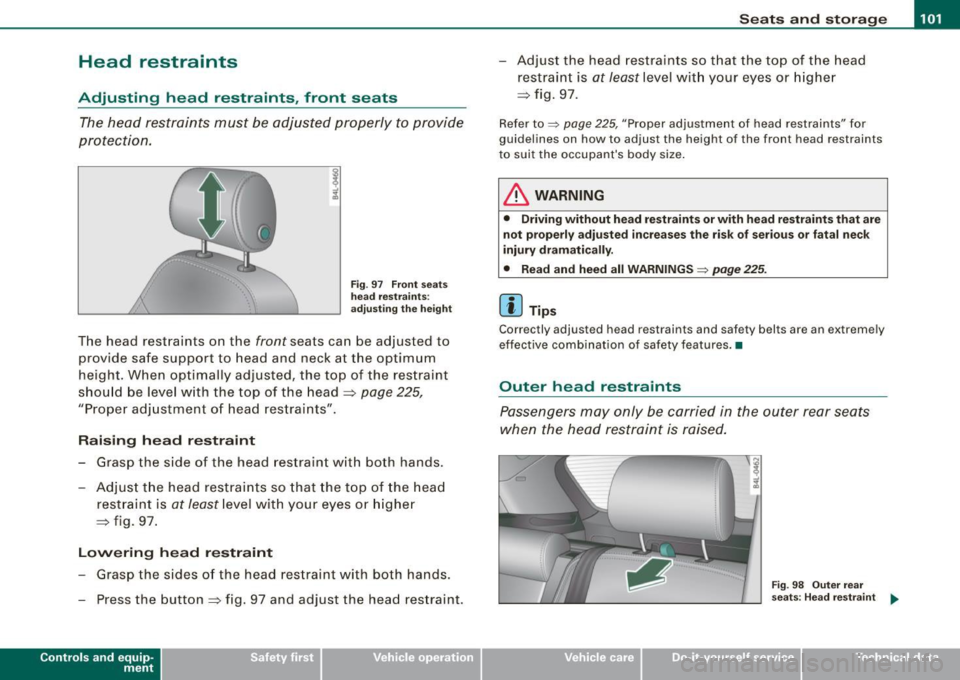
Fig . 97 Front seats
head restraints:
adjusting the height
The head restraints on the front seats can be adjusted to
provide safe support to head and neck at the optimum
height. When optimally adjusted, the top of the restraint
should be level with the top of the head
=> page 225,
"Proper adjustment of head restraints".
Raising head restraint
Grasp the side of the head restraint with both hands.
- Adjust the head restraints so that the top of the head
restraint is
at least level with your eyes or higher
=> fig. 97.
Lowering head restraint
-Grasp the sides of the head restraint with both hands.
- Press the button
=> fig. 97 and adjust the head restraint.
Contro ls and eq uip
ment
- Adjust the head restraints so that the top of the head
restraint is
at least level with your eyes or higher
=> fig. 97.
Refer to=> page 225, "Proper adjustment of head restraints" for
guidelines on how to adjust the height of the front head restraints
to suit the occupant's body size.
& WARNING
• Driving without head restraints or with head restraints that are
not properly adjusted increases the risk of serious or fatal neck
injury dramatically.
• Read and heed all WARNINGS
=> page 225.
[ i] Tips
Correctly adjusted head restraints and safety belts are an extremely
effective combination of safety features. •
Outer head restraints
Passengers may only be carried in the outer rear seats
when the head restraint is raised.
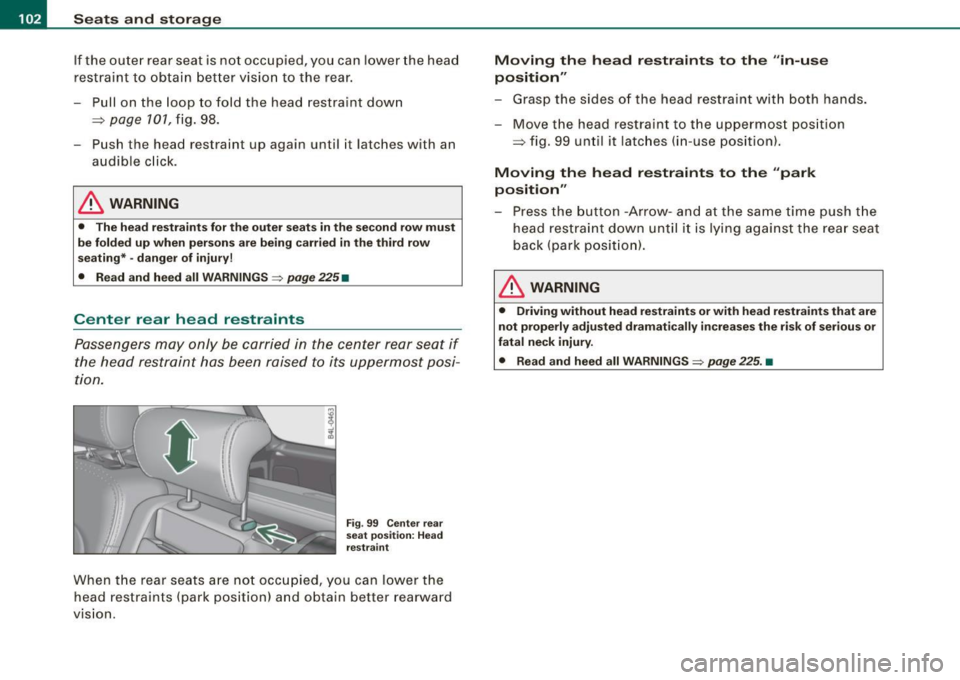
Fig. 98 Outer rear
seats: Head restraint
~
Vehicle care I I irechnical data
Page 104 of 426
• ..__S_ e_ a_t _s _ a_n _d_ s_ t_ o _ r_ a_ g=- e ______________________________________________ _
If the outer rear seat is not occupied, you can lower the head
restraint to obtain better vision to the rear.
Pull on the loop to fold the head restraint down
~ page 101, fig. 98.
- Push the head restraint up aga in until it latches with an
audible click .
& WARNING
• The head restraints for the outer seats in the second row must
be folded up when persons are being carried in the third row
seating* -danger of injury!
• Read and heed all WARNINGS
=> page 225 •
Center rear head restraints
Passengers may only be carried in the center rear seat if
the head restraint has been raised to its uppermost posi
tion.
Fig . 99 Center rear
seat position: Head
restraint
When the rear seats are not occupied , you can lower the
head restraints (park position) and obtain better rearward
vision .
Moving the head restraints to the "in-use
position"
- Grasp the sides of the head restraint with both hands.
- Move the head restraint to the uppermost position
~ fig. 99 until it latches (in-use position).
Moving the head restraints to the "park
position"
-Press the button -Arrow- and at the same time push the
head restraint down until it is lying against the rear seat
back (park position).
& WARNING
• Driving without head restraints or with head restraints that are
not properly adjusted dramatically increases the risk of serious or
fatal neck injury.
• Read and heed all WARNINGS
=> page 225. •
Page 112 of 426
• ..__S_ e_a _ t_ s_ a_ n_ d_ s_t _o _r_ a-' g==- e ________________________________________________ _
- To install the cargo floor, set the front of it into the guides
and push it in the direction of the seatback until it
engages.
You can also store small items under the cargo floor.
The storage room in the protective tray can be enlarged by folding
the cargo floor forward or removing it.
The protective tray can be removed upward by the grip .
On vehicles with
6 or 7 seats * the cargo floor cannot be folded up ,
only raised. If the cargo floor is removed, the hooks must be pushed
into the guides unde r the third row sea ting when the cargo floor is
re -installed.
& WARNING
When the cargo floor is folded upright, the items being trans
ported must not exceed the maximum cargo height, 2/3 of the
cargo floor space with the floor folded forward, or a weight of
about 33 lb. (15 kg).
[ i I Tips
We recommend that you use a tie-down s trap to secure objects to
the tie -down eyelets on the right and left sides of the vehicle .•
A pp lies to veh ic les: w ith securin g attachments
Securing attachments
The fixture set is secured on the track system.
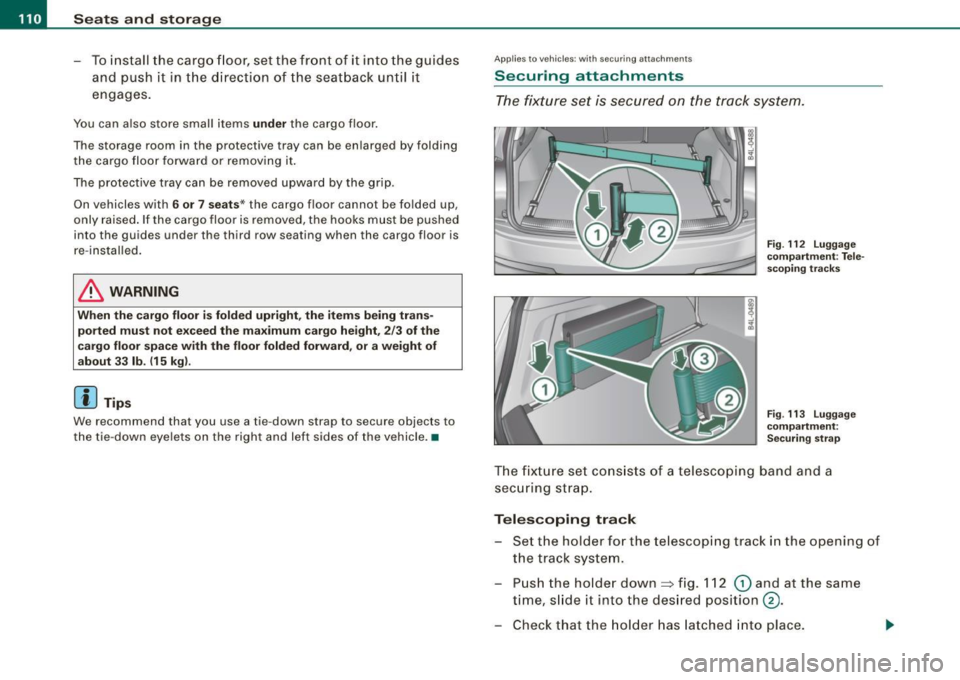
Fig. 112 Luggage
compartment : Tele
scoping tracks
Fig. 113 Luggage
compartment:
Securing strap
The fixture set consists of a telescoping band and a
securing strap.
Telescoping track
- Set the holder for the telescoping track in the opening of
the track system.
- Push the holder down
=> fig. 112 G) and at the same
time, slide it into the desired position @.
- Check that the holder has latched into place.
Page 113 of 426
Seats and storage 1111
-----------------=-----'
- If it has not already been done, fold both seatbacks up
and hang the partition net=>&.
Securing strap
-Set the holder for the securing strap in the opening of the
track system.
Push the holder down=> page
110, fig. 113 G) and at the
same time, slide it into the desired position
0-
- Check that the holder has latched into place.
- Lay the object to be secured behind the securing strap.
- Push the knob on the front side of the holder® to
tighten the strap .
- If it has not already been done, fold both seatbacks up and hang the partition net=>& .
The securing strap can also be secured on the left and right of the
track system,
if needed.
& WARNING
• The backrest must be securely latched in position so that no
items contained in the luggage compartment can slide forward
upon sudden braking.
• Loose items inside the passenger compartment, can fly
forward in a crash or sudden maneuver and injure occupants. •
Con tro ls and eq uip
ment
A pp lies to vehi cles: with ski sa ck
Ski sack
The ski sack allows a maximum of 4 pairs of skis or 2
snowboards to be carried inside the vehicle.
Loading
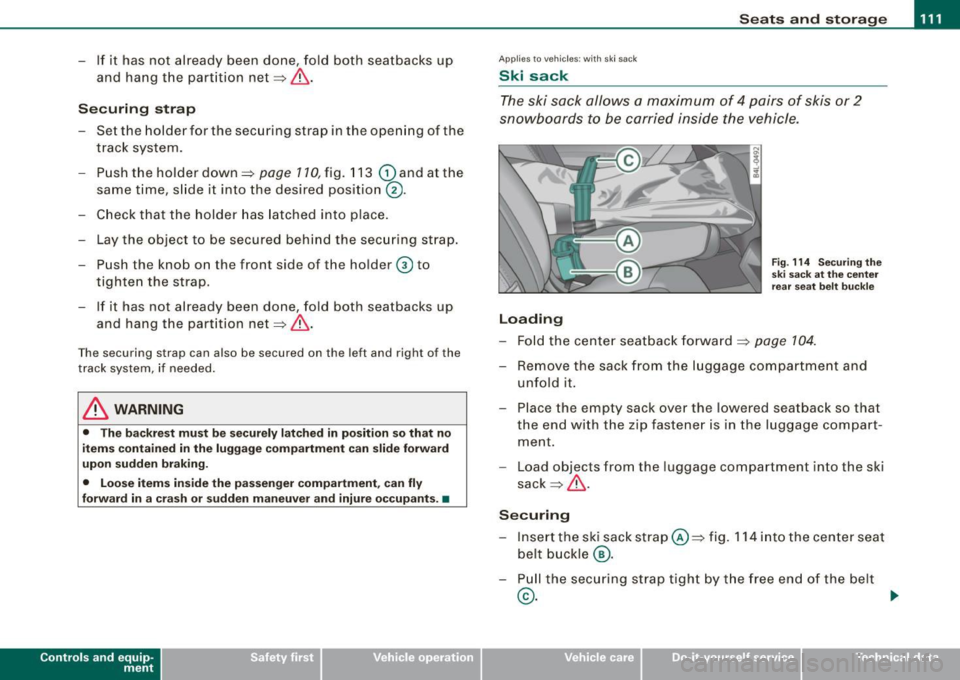
Fig. 114 Securing the
ski sack at the center
rear seat belt buckle
-Fold the center seatback forward=> page 104.
- Remove the sack from the luggage compartment and
unfold it.
- Place the empty sack over the lowered seatback so that
the end with the zip fastener is in the luggage compart
ment.
- Load objects from the luggage compartment into the ski
sack=> &.
Securing
-Insert the ski sack strap©=> fig. 114 into the center seat
belt buckle
@.
- Pull the securing strap tight by the free end of the belt
© ~
Vehicle care I I irechnical data
Page 114 of 426
_L-_S::..:: e..:a :..:t:.:s :....:: a:.:.n .:.. d::....: s:.. t.:.. o::..:.. ra= g:..:e :...._ _____________________________________________ _
- Vehicles with 6 seats*: The ski sack has two straps with
hooks on the underside. Hang the hooks into the luggage
compartment by the rear fastening eyes and pull the
securing strap tight by the free end@.
Storage
- Release the securing strap for the sack.
- Pull the sack to the rear over the folded down seatback .
- Raise the seatback until it is securely latched.
- Fold up the empty sack.
- Stow the ski sack in the luggage compartment so that it
cannot slide around .
& WARNING
• The ski sack is intended only for the transportation of skis,
snowboards and other light objects. To reduce the risk of serious
personal injury never transport heavy or pointed objects in the ski
sack.
• When braking rapidly or during an accident the load could be
displaced and cause injury to occupants.
• Sharp edges on the load must be covered for protection.
Always fasten the belt tightly around the sack and its contents
=> page 111, fig . 114.
[ i] Tips
Never stow the ski sack away if it 's wet or damp (for example, snow
melting from skis). Let it dry completely before you stow it away. •
Roof rack
First things first
A roof rack can be fitted to carry additional luggage on
the roof.
Always read and follow the instructions provided by the
roof rack manufacturer when the roof rack system must
be installed.
If you are transporting luggage or other objects on the roof, please
note the following :
• Your vehicle has specially designed aerodynamic roof rails. Only
install a roof rack specifically designed for your model. Contact the
nearest authorized Audi dealer for information on approved
modular roof racks for your vehicle.
• These approved roof racks are the basis for a complete roof rack
system. Additional attachments for the basic roof rack are neces
sary to safely transport luggage, bicycles, surf boards, skis or small
boats . All necessary hardware for these systems is available at your
authori zed Audi dealer .
• We recommend that you keep the installation instructions for
your roof rack system together with your Owner's literature in the
vehicle.
When should the roof rack be removed?
• Before going through an automatic car wash (it is best to ask the
car wash operator for advice).
• When not in use , to reduce fuel consump tion, wind noise and to
guard against theft. _.,,
Page 115 of 426
Seats and storage -
-----------------=-----'
& WARNING
• Use of an un appr oved roof ra ck or in correct mounting of an
approved roof ra ck can c aus e the roof ra ck or the item s attached
to it to fall off the r oof ont o the ro ad .
• Object s falling fr om the roof of a vehi cle can c ause a crash and
p ers onal inju ry.
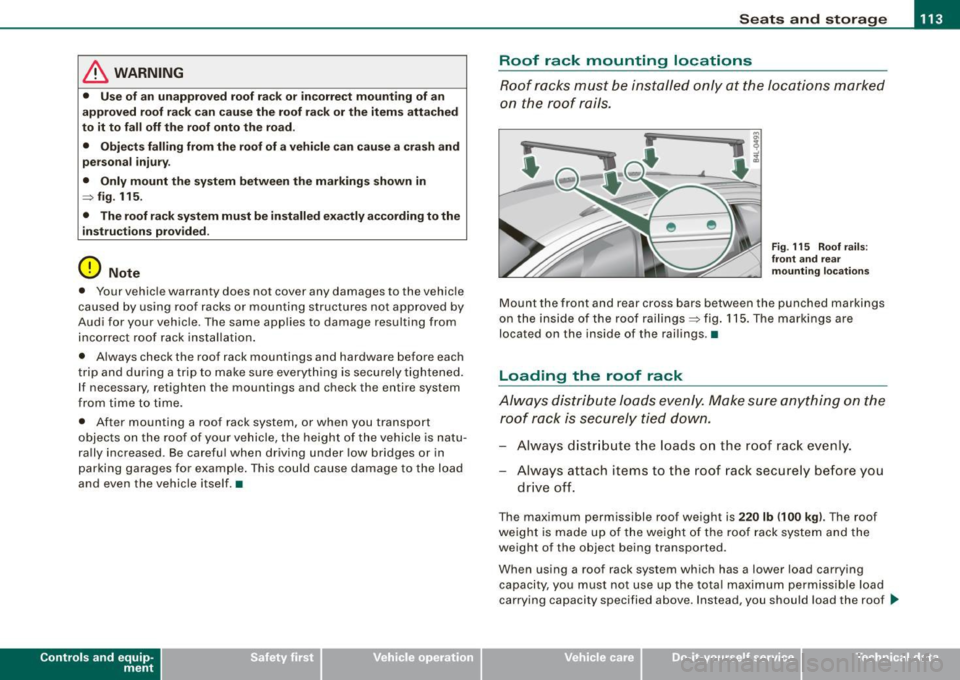
• Only mount the sy ste m between the marking s shown
in
=> fig. 115 .
• The roof rack sy ste m mu st b e in sta lled e xactly a ccording to the
instructions prov ided .
0 Note
• Your vehicle warranty does not cover any damages to the vehicle
caused by using roof racks or moun ting structures no t approved by
Audi for your vehicle . T he same app lies to damage resulting from
incorrect roof rack installation .
• Always check the roof rack mountings and hardware before each
t rip and during a trip to make sure everything is securely tightened.
If necessary, retighten the mountings and check the entire system
from time to time.
• After mounting a roof rack system, or when you transport
objects on the roof of your vehicle, the height of the vehicle is natu
ra lly increased . Be carefu l when driving under low bridges or in
parking garages for exa mple . This cou ld cause damage to the load
and even the vehicle itself .•
Con tro ls and eq uip
ment
Roof rack mounting locations
Roof racks must be installed only at the locati ons marked
on t he roof rails .
Fig . 115 Ro of r ails:
fr ont a nd r ear
mountin g locations
Mount the front and rear cross bars between the punched markings
on the inside of the roof railings => fig . 115. The markings are
located on the inside of the rail ings .•
Loading the roof rack
Always di stribute loads evenly. Make sure anything on the
ro of ra ck is securel y tied down.
Always d istr ibute the loads o n the roof rack even ly .
Always attach items to the roof rack secure ly before you
drive off .
The maximum permissible roof weight is 220 lb 1100 kg ). The roof
we ight is made up of the weight of the roof rack system and the
weight of the object being transported .
When using a roof rack system which has a lower load carrying capacity, you must not use up the tota l maximum permissible load
carrying capacity specified above. Instead, you should load the roof
~
Vehicle care I I irechnical data
Page 117 of 426
Seats and storage 1111
-----------------=-----'
& WARNING !continued)
• Never carry any beverage containers with hot liquids, such as
hot coffee or hot tea, in the vehicle while it is moving. In case of an
accident, sudden braking or other vehicle movement, hot liquid
could spill, causing scalding burns. Spilled hot liquid can also
cause an accident and personal injury.
• Use only soft cups in the cupholder. Hard cups and glasses can
cause injury in an accident.
0 Note
Only drink containers with lids should be carried in the cupholder.
Liquid could spill out and damage your vehicle's electronic equip
ment or stain the upholstery, etc. •
Cupholder in the rear center armrest
The cupholder is located in the center console.
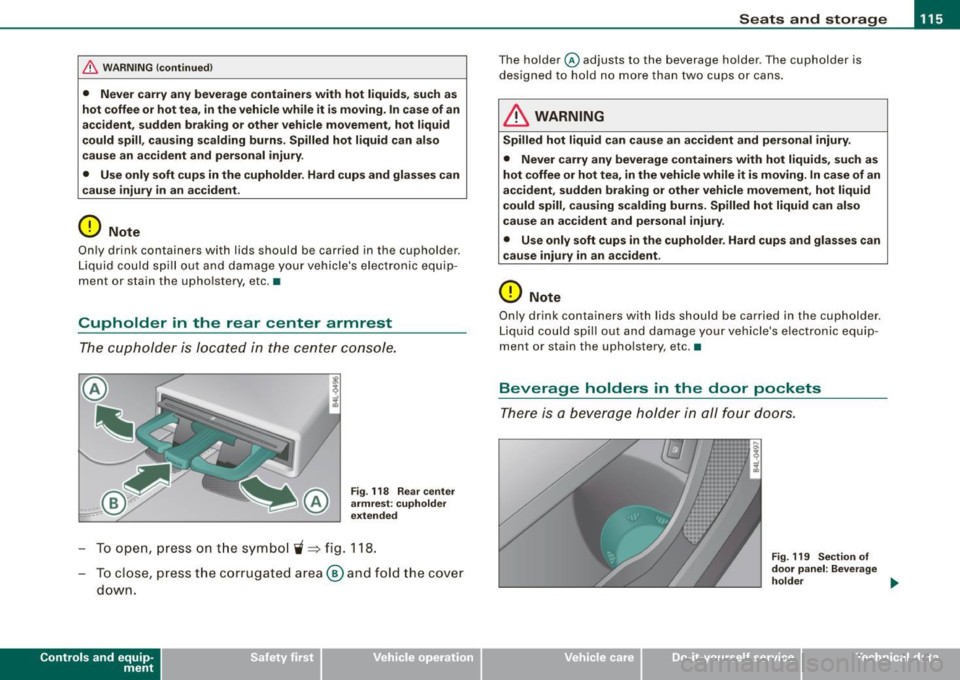
Fig . 118 Rear center
armrest: cupholder
extended
- To open, press on the symbol 'i ~ fig. 118.
- To close, press the corrugated area ® and fold the cover
down.
Con tro ls and eq uip
ment The holder
@adjusts to the beverage holder . The cupholder is
designed to hold no more than two cups or cans.
& WARNING
Spilled hot liquid can cause an accident and personal injury.
• Never carry any beverage containers with hot liquids, such as
hot coffee or hot tea, in the vehicle while it is moving. In case of an
accident, sudden braking or other vehicle movement, hot liquid
could spill, causing scalding burns. Spilled hot liquid can also
cause an accident and personal injury.
• Use only soft cups in the cupholder. Hard cups and glasses can
cause injury in an accident.
0 Note
Only drink containers with lids should be carried in the cupholder.
Liquid could spill out and damage your vehicle's electronic equip
ment or stain the upholstery, etc. •
Beverage holders in the door pockets
There is a beverage holder in all four doors.
Vehicle care I I
Fig. 119 Section of
door panel: Beverage
holder
~
irechnical data
Page 123 of 426
Seats and storage -
-----------------=-----'
Storage compartment in roof
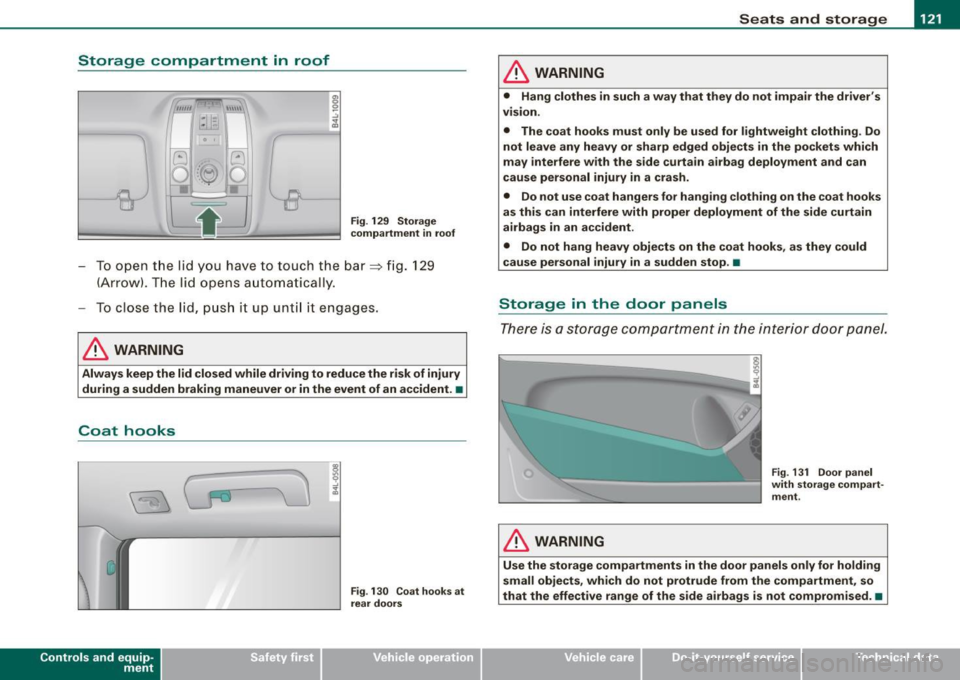
Fig. 129 Storage
compartment in roof
To open the lid yo u have to touch the bar~ fig. 129
(Arrow) . The lid opens automat ically.
To close the lid, push it up until it engages.
& WARNING
Always keep the lid closed while driving to reduce the risk of injury
during a sudden braking maneuver or in the event of an accident. •
Coat hooks
Contro ls and eq uip
ment
Fig . 130 Coat hooks at
rear doors
& WARNING
• Hang clothes in such a way that they do not impair the driver's
VISIOn .
• The coat hooks must only be used for lightweight clothing . Do
not leave any heavy or sharp edged objects in the pockets which
may interfere with the side curtain airbag deployment and can
cause personal injury in a crash.
• Do not use coat hangers for hanging clothing on the coat hooks
as this can interfere with proper deployment of the side curtain
airbags in an accident.
• Do not hang heavy objects on the coat hooks, as they could
cause personal injury in a sudden stop. •
Storage in the door panels
There is a storage compartment in the interior door panel.
& WARNING
Fig. 131 Door panel
with storage compart
ment .
Use the storage compartments in the door panels only for holding
small objects , which do not protrude from the compartment, so
that the effective range of the side airbags is not compromised. •
Vehicle care
I I irechnical data
Page 128 of 426
• .___w_ a_ rm __ a_ n_ d_ c_o _l_d ________________________________________________ _
passenger's side and to the outer rear seats. The new temperature
is shown in the display .
By simultaneously pressing and holding the contro l knobs on the
driver's side and front passenger's side, the temperature setting on
the driver's side can be switched to the front passenger's side. The new temperature is shown in the disp lay.
[ i J Tip s
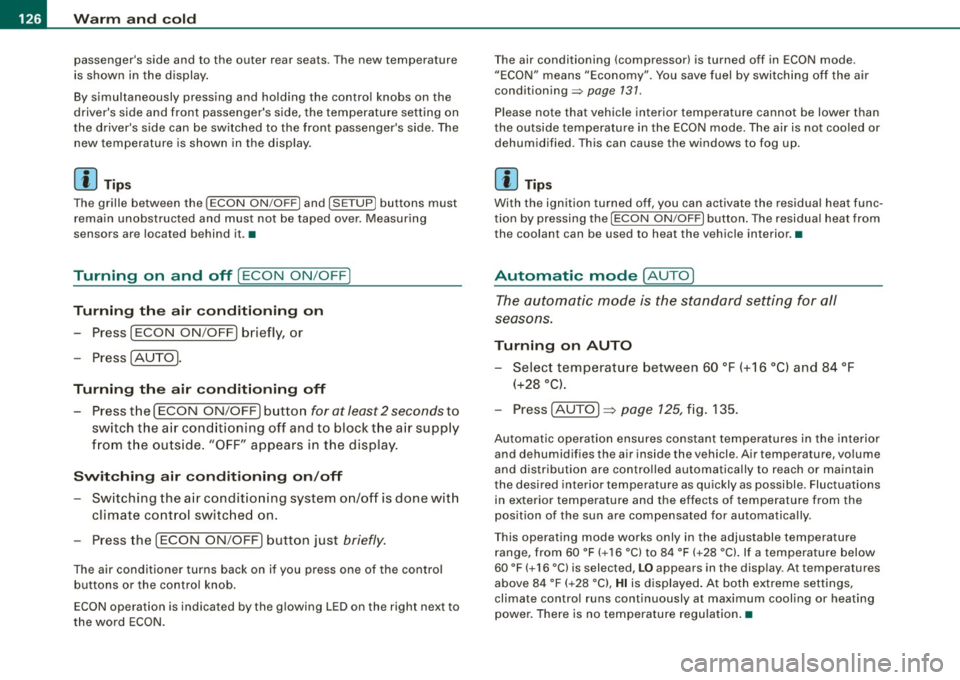
The gri lle between the (ECON ON/OFF] and (SETUP] buttons must
remain unobstructed and must not be taped over. Measur ing
sensors are located behind it. •
Turning on and off [ECON ON/OFF]
Turning the air conditioning on
- Press [ECON ON/O FF] briefly, or
- Press [AUTO].
Turning the air conditioning off
Press the I ECON ON/OFF I button for at least 2 seconds to
switch the a ir cond itioning off and to block the air supply
f rom t he ou tside .
"OFF" appears in the display .
Switching air conditioning on /off
- Switching the a ir conditioning system on/off is done wit h
c limate control switched on .
- Press the [ECON ON/OFF] button just
briefly.
The air conditioner tu rns back on if you press one of the control
buttons or the control knob.
ECON operation is indicated by the glowing LED on the right next to
the word ECON. T
he air conditioning (compressor) is turned off in ECON mode.
"ECON" means "Economy". You save fuel by switching off the air
conditioning=>
page 131.
Please note that vehic le interior temperature cannot be lower than
t he outside temperature in the ECON mode. The air is not cooled or
dehumidified. This can cause the windows to fog up.
[ i J Tip s
With the ignition turned off, you can activate the residual heat func
tion by pressing the
[ECON ON/OFF] button . The residual heat from
the coolant can be used to heat the vehicle interior. •
Automatic mode [AUTO)
The automatic mode is the standard setting for all
seasons.
Turning on AUTO
Select temperature between 60 °F (+16 °C) and 84 °F
(+28 °C).
P ress [ AUTO I => page 125, fig . 135.
Automatic operation ensures constant temperatures in the interior
and dehumidifies the air inside the vehicle. Air temperature, vo lume
and distribution are contro lled automatica lly to reach or maintain
the desired inter ior temperature as quickly as possible. Fluctuations
in exterior temperature and the effects of temperature from the
pos ition o f the sun are compensated for automatica lly.
T his operating mode works only in the adjustable temperature
r ange, from 60 °F (+ 16 °C) to 84 °F (+28 °C). If a temperature below
60 °F
( + 16 °C) is selected, LO appears in the disp lay. At temperatures
above 84 °F ( +28 °C),
HI is d isplayed . At both extreme settings,
climate contro l runs continuously at maximum cooling or heating
power. There is no temperature regu lation .•