belt AUDI Q7 2009 Owner´s Manual
[x] Cancel search | Manufacturer: AUDI, Model Year: 2009, Model line: Q7, Model: AUDI Q7 2009Pages: 426, PDF Size: 97.13 MB
Page 234 of 426
-Safety belts ----=-----------------
Before driving off
, always:
Fasten your safety belt and make sure you are wearing it
properly.
Make sure that your passengers also buckle up and prop
erly wear their safety belts.
- Protect children with a child restraint sys tem appropriate
for the size and age.
The warning light .ft in the instrument cluster lights up when the
ignition is switched on as a reminder to fasten the safety belts. In
addition, you will hear a warning tone.
After the ignition is switched on, the warning light in the instrument
cluster will a lways come on for about 6 seconds and if the driver has
not fastened the safety belt, a warning tone will also sound for
about 6 seconds. As soon as the driver has fastened the safety belt,
the warning tone will stop and the warning light will go out.
If the driver or front seat passenger have not buckled-up within
about 10 seconds after the warning tone has stopped and the
vehicle is moving faster than about 15 mph, the warning tone will
sound again for about 6 seconds and then stop for 24 seconds and
then repeat this reminder sequence for a maximum of 2 minutes. At
speeds be low 5 mph, the warning tone will not sound .
Fasten your safety belt and make sure that your passengers also
properly put on their safety belts.
& WARNING
• Safety belts are the single most effective means available to
reduce the risk of serious injury and death in automobile acci
dents . For your protection and that of your passengers , always
correctly wear safety belts when the vehicle is moving.
• Failure to pay attention to the warning light that come on,
could lead to personal injury.
a
Why safety belts?
Frontal co11isions and the law of physics
Frontal crashes create very strong forces for people riding
in vehicles.
Fig. 240 Unbelted
occupants in a vehicle
heading for a wall
Fig. 241 The vehicle
crashes into the wall
The physical principles are simple. Both the vehicle and the passen
gers possess energy which varies with vehicle speed and body
we ight . Engineers call this energy "kinetic energy."
T he higher the speed of the vehicle and the greater the vehic le's
we ight, the more energy that has to be "absorbed" in the crash .
Vehicle speed is the most significan t factor . If the speed doubles
from 15 to 30 mph (25 to 50 km /h), the energy increases 4 times! .,
Page 235 of 426

Because the passengers of this vehicle are not using safety belts
=:>
page 232, fig. 240, they will keep moving at the same speed the
vehicle was moving just before the crash, until something stops
them -here, the wall =:>
page 232, fig. 241.
The same principles apply to people sitting in a vehicle that is involved in a frontal collision. Even at city speeds of 20 to 30 mph
(30 to 50 km/h), the forces acting on the body can reach one ton
(2,000 lbs. or 1,000 kg) or more . At greater speeds, these forces are
even higher.
People who do not use safety belts are also not attached to their
vehicle. In a frontal collision they will also keep moving forward at
the speed their vehicle was travelling just before the crash. Of course, the laws of physics don't just apply to frontal collisions, they
determine what happens in all kinds of accidents and collisions. •
What happens to occupants not wearing
safety belts?
In crashes unbelted occupants cannot stop themselves
from flying forward and being injured or killed. Always
wear your safety belts!
Safety first
Fig . 242 A driver not
wearing a safety belt is
violently thrown
forward
Safety belts
Fig . 243 A rear
passenger not wearing
a safety belt will fly
forward and strike the
driver
Unbelted occupants are not able to resist the tremendous forces of
impact by holding tight or bracing themselves. Without the benefit
of safety restraint systems, the unrestrained occupant will slam
violently into the steering wheel, instrument panel, windshield, or
whatever else is in the way=:> fig. 242. This impact with the vehicle
interior has all the energy they had just before the crash.
Never rely on airbags alone for protection. Even when they deploy,
airbags provide only additional protection. Airbags are not
supposed to deploy in all kinds of accidents. Although your Audi is
equipped with airbags, all vehicle occupants, including the driver,
must wear safety belts correctly in order to minimize the risk of
severe injury or death in a crash.
Remember too, that airbags will deploy only once and that your
safety belts are always there to offer protection in those accidents
in which airbags are not supposed to deploy or when they have
already deployed. Unbelted occupants can also be thrown out of the
vehicle where even more severe or fatal injuries can occur .
It is also important for the rear passengers to wear safety belts
correctly . Unbelted passengers in the rear seats endanger not only
themselves but also the driver and other passengers=:> fig. 243. In a
frontal collision they will be thrown forward violently, where they can hit and injure the driver and/or front seat passenger. •
Vehicle care I I Technical data
Page 236 of 426
llftl_....::S~a ~f ~e ~ty ~ b~ e~ l~ t ~s ____________________________________________ _
Safety belts protect
People think it's possible to use the hands to brace the
body in a minor collision. It's simply not true!
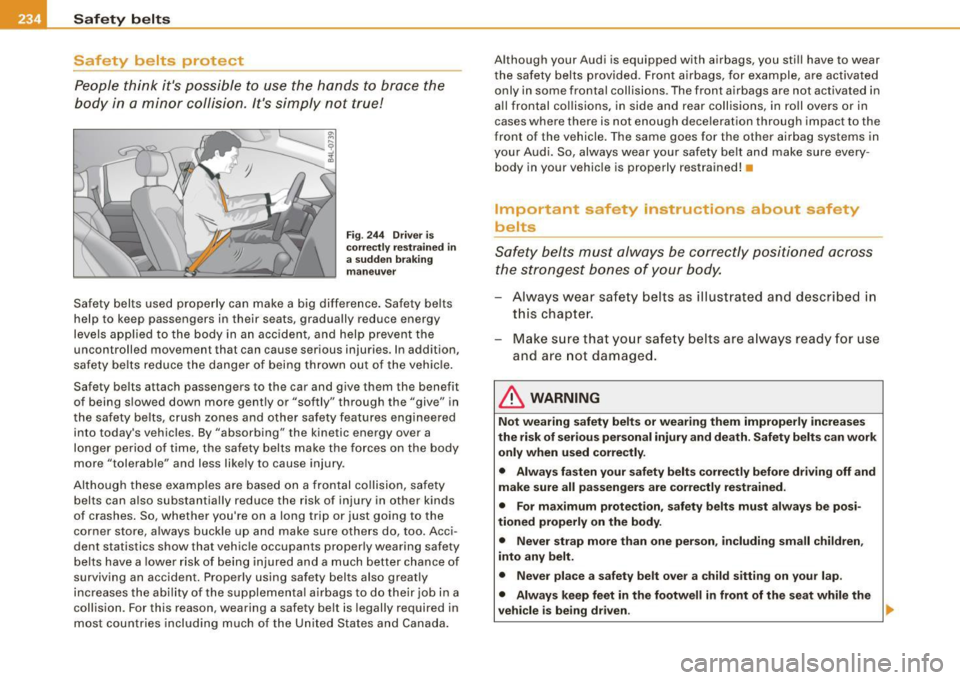
Fig . 244 Driv er is
cor rec tly r estrai ned in
a su dden b raking
m an euver
Safety belts used properly can make a big difference. Sa fety belts
help to keep passengers in their seats, gradually reduce energy
levels app lied to the body in an accident, and help prevent the
uncontrolled movement that can cause serious injuries. In addition,
safety be lts reduce the danger of being thrown out of the vehic le .
Safety belts attach passengers to the car and give them the benefit
of being s lowed down more gently or "softly" through the "give" in
the safety belts, crush zones and other safety features engineered
into today's vehicles. By "absorbing" the kinetic energy over a longer period of time, the safety belts make the forces on the body
more "tolerable" and less likely to cause injury .
Altho ugh these examples are based on a frontal co llision, safety
belts can a lso substantially reduce the risk of injury in other kinds
of crashes . So, whether you're on a long trip or just going to the
corner store, a lways buckle up and make sure others do, too. Acci
dent statistics show that vehicle occupants properly wearing safety
belts have a lower ris k of being injured and a much better chance of
surviving an accident. Properly using safety belts also greatly
increases the abi lity o f the supplementa l airbags to do their job in a
collision . For th is reason , wearing a safety belt is legally required in
most countries including much of the United States and Canada. Although your Audi is equipped with airbags, you sti
ll have to wear
the safety belts provided . Fron t airbags, for example, are activated
only in some frontal collisions . T he front airbags are not activated in
a ll frontal col lisions, in side and rear collisions, in roll ove rs or in
cases where there is not enough dece leration through impact to the
front of the vehicle . The same goes for the other airbag systems in
your Audi . So, always wear your safety belt and make sure every
body in your vehic le is properly restrained! •
Important safety instructions about safety
belts
Safety belts must always be co rrectly positioned across
t he strongest bones of your body.
Always wear safety belts as illustrated and described in
th is chapter.
Make s ure tha t your safe ty belts ar e always ready for use
and are not damaged .
& WARNING
Not wearing safety belts or w earing them improperl y increase s
the risk of seriou s per sonal injury and death . S afe ty belt s can work
onl y when used corre ctl y.
• Alway s fa sten your s afety belt s correctl y before dri ving off and
make sure all p assenger s ar e correctly restrain ed.
• For m aximum protect ion , safet y belts must always be po si
ti oned properly on the body .
• Never strap more th an one person , includi ng sm all children ,
into any belt.
• Never pla ce a s afety belt ove r a child sitting on your lap .
• Alway s keep feet in t he foot well
in front of the seat while the
vehicle is being driven .
~
Page 237 of 426
& WARNING !continued)
• Never let any person ride with their feet on the instrument
panel or sticking out the window or on the seat.
• Never remove a safety belt while the vehicle is moving. Doing
so will increase your risk of being injured or killed.
• Never wear belts twisted.
• Never wear belts over rigid or breakable objects in or on your
clothing, such as eye glasses, pens, keys, etc. , as these may cause
injury .
• Never allow safety belts to become damaged by being caught
in door or seat hardware.
• Do not wear the shoulder part of the belt under your arm or
otherwise out of position.
• Several layers of heavy clothing may interfere with correct posi
tioning of belts and reduce the overall effectiveness of the system.
• Always keep belt buckles free of anything that may prevent the
buckle from latching securely.
• Never use comfort clips or devices that create slack in the
shoulder belt. However, special clips may be required for the
proper use of some child restraint systems.
• Torn or frayed safety belts can tear , and damaged belt hard
ware can break in an accident . Inspect belts regularly . If webbing,
bindings, buckles, or retractors are damaged, have belts replaced
by an authorized Audi dealer or qualified workshop .
• Safety belts that have been worn and loaded in an accident
must be replaced with the correct replacement safety belt by an
authorized Audi dealer. Replacement may be necessary even if
damage cannot be clearly seen. Anchorages that were loaded
must also be inspected.
• Never remove, modify, disassemble, or try to repair the safety
belts yourself.
Safety first
Safety belts
& WARNING !continued)
• Always keep the belts clean. Dirty belts may not work properly
and can impair the function of the inertia reel
~ page 323, "Safety
belts" .•
Safety belts
Fastening safety belts
Seat first -everybody buckle up!
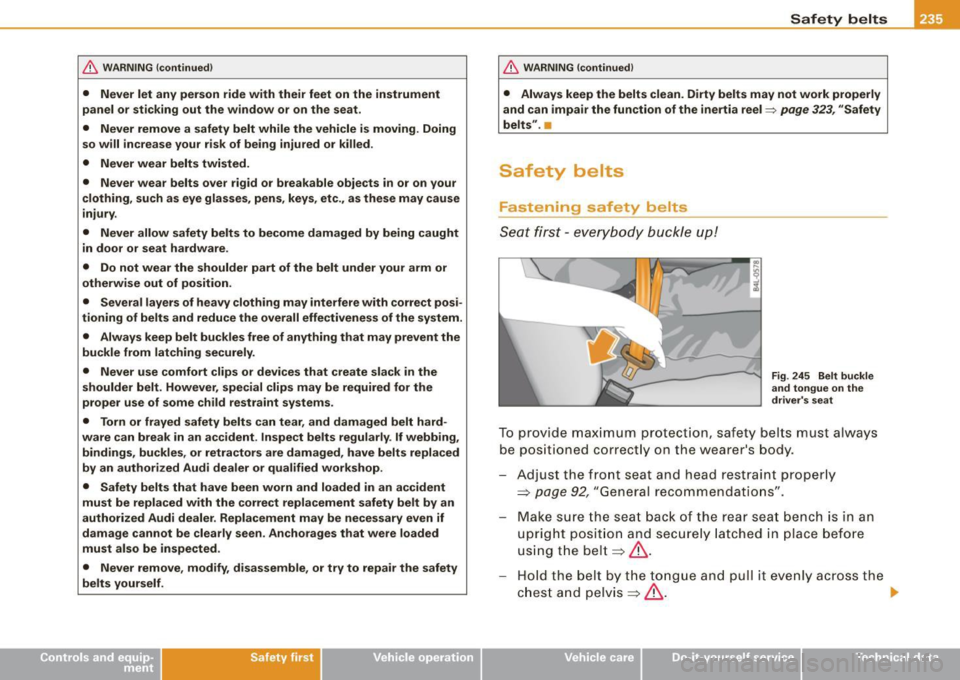
Fig. 245 Belt buckle
and tongue on the
driver's seat
To provide maximum protection, safety belts must always
be positioned correctly on the wearer's body.
Adjust the front seat and head restraint properly
=> page 92, "General recommendations" .
Make sure the seat back of the rear seat bench is in an
upright position and securely latched in place before
using the belt
=> & .
Hold the belt by the tongue and pull it evenly across the
chest and pelvis
=> &. _,.
Vehicle care I I irechnical data
Page 238 of 426
___ S_a_ f_ e_ t-= y_ b_e_ l_ t _s _______________________________________________ _
-Insert the tongue into the correct buckle of your seat
until you hear it latch securely~ fig. 245.
Pull on the belt to make sure that it is securely latched in
the buckle.
Automatic safety belt retractors
Every safety belt is equipped with an automatic belt retractor on the
shoulder belt. This feature locks the belt when the belt is pulled out
fast, during hard braking and in an accident. The belt may also lock
when you drive up or down a steep hill or through a sharp curve. During normal driving the belt lets you move freely.
Safety belt pretensioners
The safety belts are equipped with a belt pretensioner that helps to
tighten the safety belt and remove slack when the pretensioner is
activated. The function of the pretensioner is monitored by a
warning light=>
page 19.
Switchable locking feature
Every safety belt except the one on the driver seat is equipped with
a switchable locking feature that
must be used when the safety belt
is used to attach a child safety seat. Be sure to read the important
information about this feature=>
page 273.
& WARNING
Improperly positioned safety belts can cause serious injury in an
accident =>
page 236, "Safety belt position".
• Safety belts offer optimum protection only when the seat back
is upright and belts are properly positioned on the body.
• Always make sure that the rear seat backrest to which the
center rear safety belt is attached is securely latched whenever
the rear center safety belt is being used. If the backrest is not
securely latched, the passenger will move forward with the back
rest during sudden braking, in a sudden maneuver and especially
in a crash.
& WARNING (continued)
• Never attach the safety belt to the buckle for another seat.
Attaching the belt to the wrong buckle will reduce safety belt
effectiveness and can cause serious personal injury.
• A passenger who is not properly restrained can be seriously
injured by the safety belt itself when it moves from the stronger
parts of the body into critical areas like the abdomen.
• Always lock the convertible locking retractor when you are
securing a child safety seat in the vehicle
=> page 275. •
Safety belt position
Correct belt position is the key to getting maximum
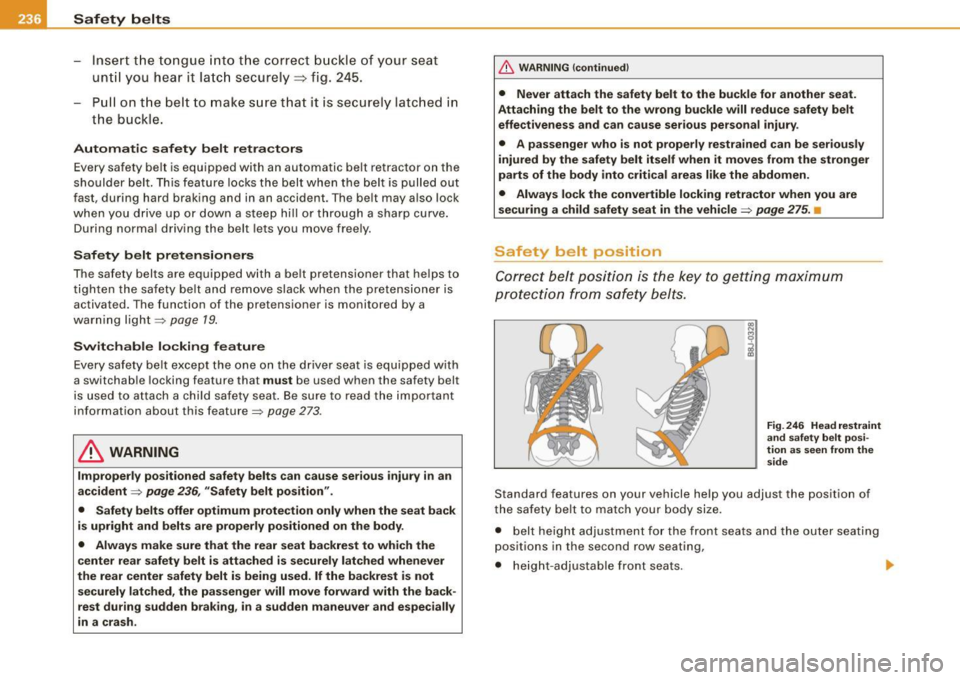
protection from safety belts.
Fig. 246 Head restraint
and safety belt posi
tion as seen from the
side
Standard features on your vehicle help you adjust the position of
the safety belt to match your body size .
• belt height adjustment for the front seats and the outer seating
positions in the second row seating,
• height-adjustable front seats. .,
Page 239 of 426
& WARNING
Improperly positioned safety belts can cause serious personal
injury in an accident.
• The shoulder belt portion of the safety belt must be positioned
over the middle of the occupant's shoulder and never across the
neck or throat .
• The safety belt must lie flat and snug on the occupant's upper
body
=> page 236, fig. 246 . Pull on the belt to tighten if necessary .
• The lap belt portion of the safety belt must be positioned as
low as possible across pelvis and never over the abdomen. Make
sure the belt lies flat and snug=>
page 236, fig. 246. Pull on the belt
to tighten if necessary.
• A loose -fitting safety belt can cause serious injuries by shifting
its position on your body from the strong bones to more vulner
able, soft tissue and cause serious injury.
• Always read and heed all WARNINGS and other important infor
mation
=> page 234. •
Safety first
Safety belts
Pregnant women must also be correctly
restrained
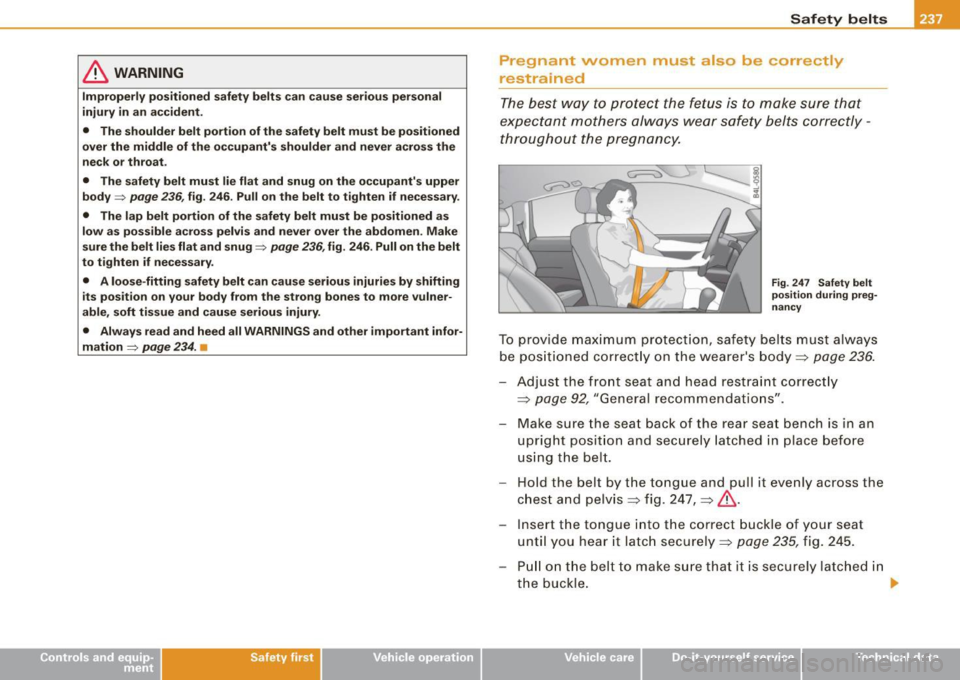
The best way to protect the fetus is to make sure that
expectant mothers always wear safety belts correctly -
throughout the pregnancy.
Fig. 247 Safety belt
position during preg
nancy
To provide maximum protection, safety belts must always
be positioned correctly on the wearer's body=>
page 236.
-Adjust the front seat and head restraint correctly
=>
page 92, "General recommendations" .
- Make sure the seat back of the rear seat bench is in an
upright position and securely latched in place before
using the belt.
Hold the belt by the tongue a nd pull it evenly across the
chest and pelvis=> fig . 247, =>
&.
- Insert the tongue into the correct buckle of your seat
until you hear it latch securely =;,
page 235, fig. 245.
- Pull on the belt to make sure that it is securely latched in
the buckle.
IJ),
Vehicle care I I irechnical data
Page 240 of 426
__ .....::S-=a ::..;f _:e :..:t :.!..y _ b::.....:: e..:..lt :.:s::..._ _____________________________________________ _
& WARNING
Improperly positioned safety belts can cause serious personal
injury in an accident.
• Expectant mothers must always wear the lap portion of the
safety belt as low as possible across the pelvis and below the
rounding of the abdomen .
• Always read and heed all WARNINGS and other important infor
mation
~ & in "Fastening safety belts" on page 235. •
Unfastening safety belts
Unbuckle the safety belt with the red release button only
after the vehicle has stopped.
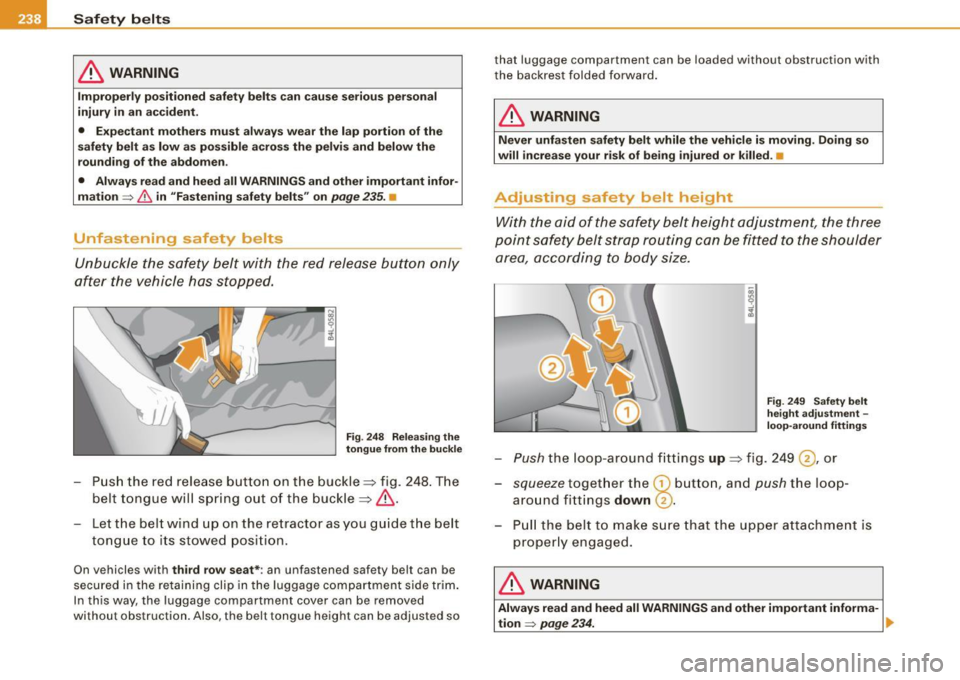
Fig . 248 Releasing the
tongue from the buckle
- Push the red release button on the buckle=> fig. 248. The
belt tongue will spring out of the buckle =>& .
- Let the belt wind up on the retractor as you guide the belt
tongue to its stowed position.
On vehicles with third row seat* : an unfastened safety belt can be
secured in the retaining clip in the luggage compartment side trim.
In this way, the luggage compartment cover can be removed
without obstruction. Also, the belt tongue height can be adjusted so that luggage compa
rtment can be loaded without obstruction with
the backrest folded forward.
& WARNING
Never unfasten safety belt while the vehicle is moving. Doing so
will increase your risk of being injured or killed . •
Adjusting safety belt height
With the aid of the safety belt height adjustment, the three
point safety belt strap routing can be fitted to the shoulder
area, according to body size.
Fig. 249 Safety belt
height adjustment -
loop-around fittings
- Push the loop-around fittings up=> fig. 249 @, or
- squeeze together the G) button, and push the loop -
around fittings
down @ .
- Pull the belt to make sure that the upper attachment is
properly engaged .
& WARNING
Always read and heed all WARNINGS and other important informa-
tion
~ page 234. .,
Page 241 of 426
![AUDI Q7 2009 Owner´s Manual _______________________________________________ S_a _f _e _t -=-y _ b_ e_lt _s __ lJftlll
[ i] Tips
• The shoulder belt part should route approximately over the
middle of your shoulde](/img/6/40274/w960_40274-240.png "AUDI Q7 2009 Owner´s Manual _______________________________________________ S_a _f _e _t -=-y _ b_ e_lt _s __ lJftlll
[ i] Tips
• The shoulder belt part should route approximately over the
middle of your shoulde")
_______________________________________________ S_a _f _e _t -=-y _ b_ e_lt _s __ lJftlll
[ i] Tips
• The shoulder belt part should route approximately over the
middle of your shoulder -under no circumstances should it route
over your neck and throat area~
& in "Safety belt position" on
page 236.
• With the front seats, the height adjustment of the seat can also
be used to adjust the position of the safety belts. •
Improperly worn safety belts
Incorrectly positioned safety belts can cause severe inju
ries.
Wearing safety belts improperly can cause serious injury or
death. Safety belts can only work when they are correctly
positioned on the body . Improper seating positions reduce
the effectiveness of safety belts and will even increase the
risk of injury and death by moving the safety belt to critical
areas of the body. Improper seating positions also increase
the risk of serious injury and death when an airbag deploys
and strikes an occupant who is not in the correct seating
position. A driver is responsible for the safety of all vehicle
occupants and especially for children. Therefore:
- Never permit anyone to assume an incorrect sitting posi
tion in the vehicle while traveling~&.
& WARNING
Improperly worn safety belts increase the risk of serious personal
injury and death whenever a vehicle is being used.
• Always make sure that all vehicle occupants are correctly
restrained and stay in a correct seating position whenever the
vehicle is being used.
Controls and equip ment Safety first Vehicle operation
& WARNING
(continued)
• Always read and heed all WARNINGS and other important infor
mation
~ page 234. •
Safety be lt pretensioners
How safety belt pretensioners work
In front, side and rear-end collisions above a particular
severity and in a rollover, safety belts are tensioned auto
matically.
The safety belts are equipped with safety belt pretensioners . The
system is activated by sensors in front, side and rear -end collisions
of great severity and in a rollover. This tightens the belt and takes up
belt slack ~
& in "Service and disposal of safety belt pretensioner"
on
page 240. Taking up the slack helps to reduce forward occupant
movement during a collision.
0 Note
Never let the belt remain over a rear seat back that has been folded
forward.
[ i] Tips
The safety belt pretensioner can only be activated once.
• In minor frontal and side collisions, in rear -end collisions and in
accidents involving very little impact force, the safety belt preten
sioner are not activated .
• When the safety belt pretensioners are activated, a fine dust is
released . This is normal and is not caused by a fire in the vehicle .
• The relevant safety requirements must be observed when the
vehicle or components of the system are scrapped. An authorized ._
Vehicle care Do-it-yourself service Technical data
Page 242 of 426
l'ffl....__S_a _ fe_ t _y=-- b_ e_ lt_s ________________________________________________ _
Audi dealer or qualified workshop is familiar with these regulations
and wil l be p leased to pass on the information to you .
• Be sure to observe all safety, environmental and other regu la
tions if the vehicle or ind ividual parts o f the system, particu lar ly the
safety belt or airbag, are to be disposed . We recommend you have
your authorized Audi dealer pe rform this se rvice for you. •
Service and disposal of safety belt
pretensioner
The safety belt pretensioners are parts of the safety belts on your
Audi. Installing, removing, servicing or repair ing of belt preten
s ioners can damage the safety belt system and prevent it from
working correctly in a collision.
There a re some important th ings you have to know to ma ke sure
that the effectiveness of the system will not be impaired and that discarded components do not cause inju ry or po llute t he environ
ment.
& WARNING
Improper care , ser vici ng and repair pro cedu re s c an incre ase the
ri sk of per sonal injury and death by preventing a safety belt
p rete nsioner from a ctivating when needed or a cti vating it une x
pectedly:
• The belt preten sioner sy stem can be a ctivated only on ce . If belt
preten sioner s have been act ivated , the system must be repla ced.
• Ne ver r epair , adju st, or cha nge any parts of the safety belt
s ystem .
• S afety belt systems in cluding safet y belt preten sioners c annot
be repaired . Special pro cedures are required for removal , in stalla
tion and di spo sal of th is sy stem .
• Fo r any work on the safety belt system , we strongly recom
me nd th at you see your author iz ed Audi de aler or qu alified te chni-
& W ARN ING (continued )
cian who has an Audi approved repair m anual , train ing and spe cial
equipment nece ssary .
as Perchlorate Material -specia l handling may apply , see
www .dtsc.ca .gov/ha zardouswaste/perchlora te . When the vehicle or
parts of the restraint system including airbag modu les safety belts
with p re tens ioners a re sc rapped, all applicab le laws and regu la
tions must be observed. Your author ized Audi dealer is familiar with
t hese requi rements and we recommend tha t you have your dealer
perform th is service for you. •
Page 243 of 426

__________________________________________________ A_ i_ r _b _a...; g::- s_ y=--- s_t _e _m __ __
Airbag system
Important things to know
Importance of wearing safety belts and
sitting properly
Airbags are only supplemental restraints. For airbags to
do their job, occupants must always properly wear their
safety belts and be in a proper seating position.
For your safety and the safety of your passengers, before
driving off, always:
- Adjust the driver's seat and steering wheel properly
=>
page 222,
-Adjust the front passenger's seat properly=> page 93,
-Wear safety belts properly=> page 234,
- Always properly use the proper child restraint to protect
children =>
page 263.
In a collision, airbags must inflate within the blink of an eye and with
considerable force . The supplemental airbags can cause injuries if
the driver or the front seat passenger is not seated properly. There
fore in order to help the airbag to do its job, it is important, both as
a driver and as a passenger to sit properly at all times.
By keeping room between your body and the steering wheel and the
front of the passenger compartment, the airbag can inflate fully and
completely and provide supplemental protection in certain frontal
collisions =>
page 222, "Proper occupant seating positions". For
details on the operation of the seat adjustment controls=>
page 93.
It's especially important that children are properly restrained
=>
page 263.
Controls and equip ment Safety first Vehicle operation
There is a lot that the driver and the passengers can and must do to
help the individual safety features installed in your Audi work
together as a system .
Proper seating position is important so that the front airbag on the
driver side can do its job. If you have a physical impairment or
condition that prevents you from sitting properly on the driver seat
with the safety belt properly fastened and reaching the pedals, or if
you have concerns with regard to the function or operation of the
Advanced Airbag System, please contact your authorized Audi dealer or qualified workshop, or call Audi Customer CARE at 1-800-
822 -2834 for possible modifications to your vehicle.
When the airbag system deploys, a gas generator will fill the
airbags, break open the padded covers, and inflate between the
steering wheel and the driver and between the instrument panel
and the front passenger. The airbags will deflate immediately after
deployment so that the front occupants can see through the wind
shield again without interruption .
All of this takes place in the blink of an eye, so fast that many people don't even realize that the airbags have deployed. The airbags also
inflate with a great deal of force and nothing should be in their way
when they deploy. Front airbags in combination with properly worn
safety belts slow down and limit the occupant's forward movement .
Together they help to prevent the driver and front seat passenger
from hitting parts of the inside of the vehicle while reducing the
forces acting on the occupant during the crash. In this way they help
to reduce the risk of injury to the head and upper body in the crash.
Airbags do not protect the arms or the lower parts of the body.
Both front airbags will not inflate in all frontal collisions. The trig
gering of the airbag system depends on the vehicle deceleration
rate caused by the collision and registered by the electronic control
unit. If this rate is below the reference value programmed into the
control unit, the airbags will not be triggered, even though the car
may be badly damaged as a result of the collision. Vehicle damage,
9J),
Vehicle care Do-it-yourself service Technical data