belt AUDI Q7 2009 Owner´s Manual
[x] Cancel search | Manufacturer: AUDI, Model Year: 2009, Model line: Q7, Model: AUDI Q7 2009Pages: 426, PDF Size: 97.13 MB
Page 279 of 426

Child Safety -
--------------------''---
(The term "ISOFIX" regarding lower anchorages had been used by
Audi and other manufacturers in the past, but LATCH is now the
standard name for the new child restraint anchorage system.)
Some child restraint system manufacturers have been providing
tether straps on certain models of their child restraint systems, either as standard equipment or as a retrofit, for several years .
Check with the manufacturer of the child restraint system for tether
strap availability .
To provide a simpler and more practicable way to attach the child
restraint system on the vehicle seat, U.S. Federal regulations require
the phase -in of lower anchorages in vehicles and devices on new
child restraint systems to attach to the vehicle anchorages.
Child restraint system manufacturers will probably offer two kinds
of lower anchorages on their child safety seats
They could come with:
• hooks or other latches attached to adjustable straps or
• rigid latches on bars that extend out the back of the child
restraint and are released with release buttons at the bottom of the
child restraint.
In addition to the LATCH lower anchorages, both of these child
restraint systems use tether straps to help keep the child restraint
system firmly in place .•
Where can I get additional information about
child restraint application and usage?
There are a number of sources of additional information about child
restraint selection, installation and usage :
NHTSA advises that the best child safety seat is the one that fits
your child and fits in your vehicle, and that you will use correctly and
consistently.
Try before you buy!
Controls and equip ment Safety first Vehicle operation National Highway Traffic Safety Administration
Tel.: (888) DASH -2 -DOT
www.nhtsa .dot .gov
National SAFE KIDS Campaign
Tel.: (202) 662 -0600
www.safekids.org
Safety BeltSafe U.S.A
Tel.: (800) 745-SAFE (English)
Tel.: (800) 747 -SANO (Spanish)
www.carseat .org
Transport Canada
Tel.: (800) 333-0371
www.tc.gc.ca
Audi Client Relations
Tel.: (800) 822-2834 •
Vehicle care Do-it-yourself service Technical data
Page 282 of 426
-L~C~ h~ il~ d ~S~ a~f e ~ ty!._ _____________________________________________ _
In stalling th e guidan ce fixtures
- Push down on the seat cushion so that the lower ancho r
ages are vis ible.
- Hold the guidance fixture with t he part number facing
downward and push it in the direction of the arrow onto
the anchorage =>
page 279, fig. 266.
- Make sure that each of the two guidance fixtures per seat snaps into place.
Removing the guidan ce fixtures
- Re move the child restrain t according the child res tra int
ma nufactur er's instr uct ions.
- Push down on the seat cushion so that the lower anchor
ages are visib le.
- Pu ll off the guidance fixtures from the lower a nch orages.
- Always remove the gu idance fixtures and keep them in a
safe p lace when not in use .
You may find it easier to insta ll child restraints equipped with hooks
attached to straps without the guidance fixtures in place . If this is
the case, remove the guidance fixtures by pu lling them off the
anchorages. However, the guidance fixtures can he lp you to locate
the LATCH anchorages.
& WARNING
Improp er use of tether anchorage s or lower anchorages can cau se
s erio us persona l inj ury i n a cra sh .
• Alway s carefully foll ow the child restraint manuf acturer's
in stru ction s fo r prope r inst allati on and use of child re str aint
sy stems .
& WARN ING (continued )
• Never use the LATCH or tether anchor ages to attach safety
belt s or ot her kinds of occupant re st raint s.
• Child restra int tether attachments and lower attachment s are
only de signed to se cure a child re straint that ha s been equipped
to use the se anchor ages .
• Tether a nchorages and lower anchorage s are desig ned t o with
s tand only those load s imposed by correctly fitted child re straint s.
Under no cir cum sta nce s ca n they be used safel y for adu lt or ch ild
s afety belts or harne sse s.
• Never mount more than one child r estraint to a single tether o r
to a lower an chorage point. Att aching two child restraints to a
s ingle anchorage point can ca use the ancho rag e to fail and cau se
s eri ous per sonal injury in a c rash .
0 Note
• Remove the guidance fixtures before fo lding the rear seatback to
prevent damaging the seat cushion.
• If you leave the guidance fixtures installed for several days, they
cou ld leave a mark on the upholstery on the seat cushion and back
rest in the area that the guidance fixtures were installed. The uphol
stery would also be permanent ly stretched around the guidance
fixtures . This applies especial ly to leather seats .
[ i ] Tip s
• Always remove the guidance fixtures when not in use.
• Please keep the guidance fixtures in a safe place with the vehicle
when not in use. •
Page 283 of 426
Installing a child restraint using the lower
anchorages of the LATC H system
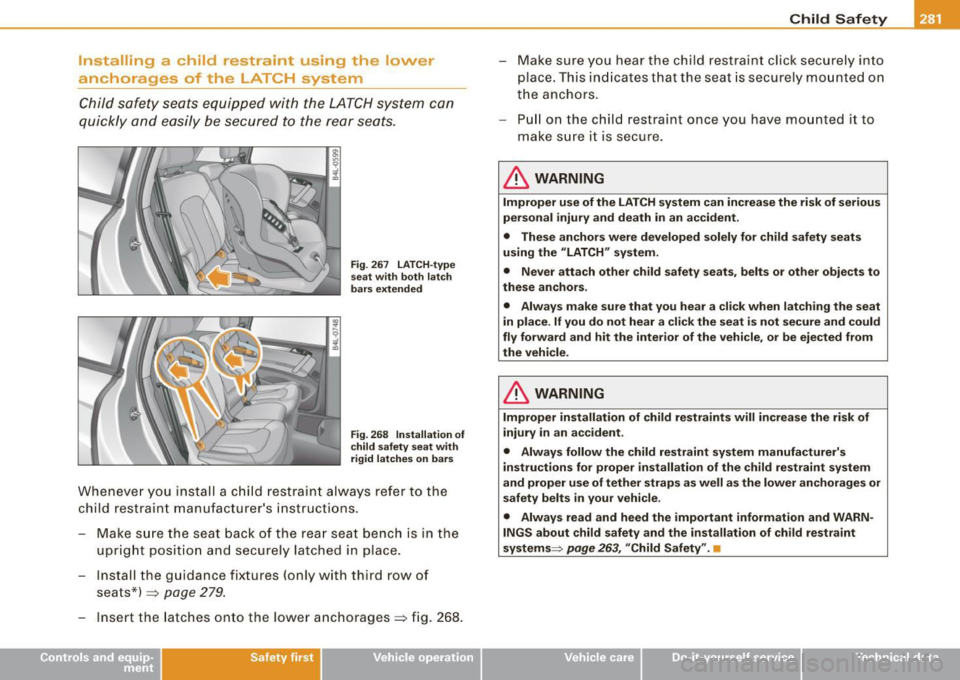
Child safety seats equipped with the LATCH system can
quickly and easily be secured to the rear
seats.
Fig . 267 LATCH-type
seat with both latch
bars extended
Fig. 268 Installation of
child safety seat with
rigid latches on bars
Whenever you install a child restraint always refer to the
child restraint manufacturer's instructions.
- Make sure the seat back of the rear seat bench is in the
upright position and securely latched in place.
- Install the guidance fixtures (only with third row of seats*) =>
page 279.
- Insert the latches onto the lower anchorages=> fig. 268.
Safety first
Child Safety
- Make sure you hear the child restraint click securely into
place. This indicates that the seat is securely mounted on
the anchors.
- Pull on the child restraint once you have mounted it to
make sure it is secure.
& WARNING
Improper use of the LATCH system can increase the risk of serious
personal injury and death in an accident.
• These anchors were developed solely for child safety seats
using the "LATCH" system.
• Never attach other child safety seats, belts or other objects to
these anchors.
• Always make sure that you hear a click when latching the seat
in place. If you do not hear a click the seat is not secure and could
fly forward and hit the interior of the vehicle, or be ejected from
the vehicle.
& WARNING
Improper installation of child restraints will increase the risk of
injury in an accident .
• Always follow the child restraint system manufacturer's
instructions for proper installation of the child restraint system
and proper use of tether straps as well as the lower anchorages or
safety belts in your vehicle.
• Always read and heed the important information and WARN
INGS about child safety and the installation of child restraint
systems ~
page 263, "Child Safety". •
Vehicle care
I I irechnical data
Page 284 of 426
___ C_h_ i_ld _ S_ a_ f_ e_ t-= y'------------------------------------------------
Mounting and releasing the anchorage hook
If you use a child restraint system with hooks or other
latches attached to adjustable strops.
Mounting
- Press the anchorage hook with the spring catch release
onto the lower anchorage so that the anchorage hook
locks into place.
Pull on the anchorage hook to make sure that it has
securely engaged the lower anchorage.
- Tighten the strap following the child restraint manufac
turer's instructions.
Releasing
Loosen the tension on the strap following the child
restraint manufacturer's instructions.
- Depress the spring catch on the hook.
- Hold the spring catch in depressed position.
- Move the hook in the direction of the vehicle floor so that
there is enough space to release the anchorage hook
from the lower anchorage.
& WARNING
• Improper installation of child restraints will increase the risk of
injuries in a crash.
• Always refer to the child restraints manufacturer's instructions
for proper installation of the child restraint and proper use of the
lower anchorages or safety belts in your vehicle. •
Tether anchors
Fig. 269 Tether
anchors for second
row of seats: attach
ment hook locations
Fig. 270 Tether
anchors for third row
of seats: attachment
hook locations
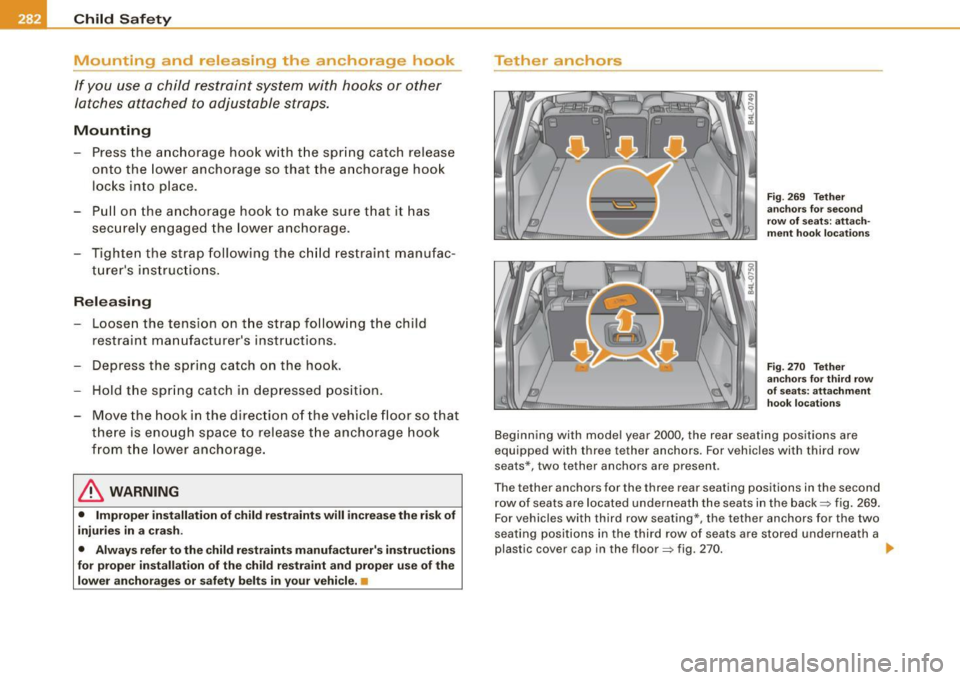
Beginning with model year 2000, the rear seating positions are
equipped with three tether anchors. For vehicles with third row
seats*, two tether anchors are present.
The tether anchors for the three rear seating positions in the second
row of seats are located underneath the seats in the back=> fig. 269.
For vehicles with third row seating*, the tether anchors for the two
seating positions in the third row of seats are stored underneath a
plastic cover cap in the floor=> fig. 270. .._
Page 285 of 426
& WARNING
Improper installation of child restraints will increase the risk of
injury and death in a crash.
• Improper use of child restraint anchors (tether anchors) could
lead to injury in a collision. The anchors are designed to withstand
only those loads imposed by correctly fitted child restraints .
• Never mount two child restraint systems on one LATCH lower
anchor point .
• Never attach two child restraint systems to one tether strap or
tether anchorage .
• Always follow the instructions provided by the manufacturer of
the child restraint you intend to install in your Audi .
• Never use child restraint tether anchorages to secure safety
belts or other kinds of occupant restraints.
• Never attach a tether strap to a tie-down hook in the luggage
compartment.
• Never secure or attach any luggage or other items to the LATCH
lower anchorages or to the tether anchors.
• If a tether or other strap is used to attach a child restraint to the
front passenger seat, make sure that it is not so tight, that it causes the weight-sensing mat to measure more weight than is
actually on the seat.
• The heavier weight registered can make the system work as
though an adult were on the seat and deploy the Advanced Airbag
when it must be suppressed causing serious or even fatal injury to
the child. •
Safety first
Child Safety
Tether strap
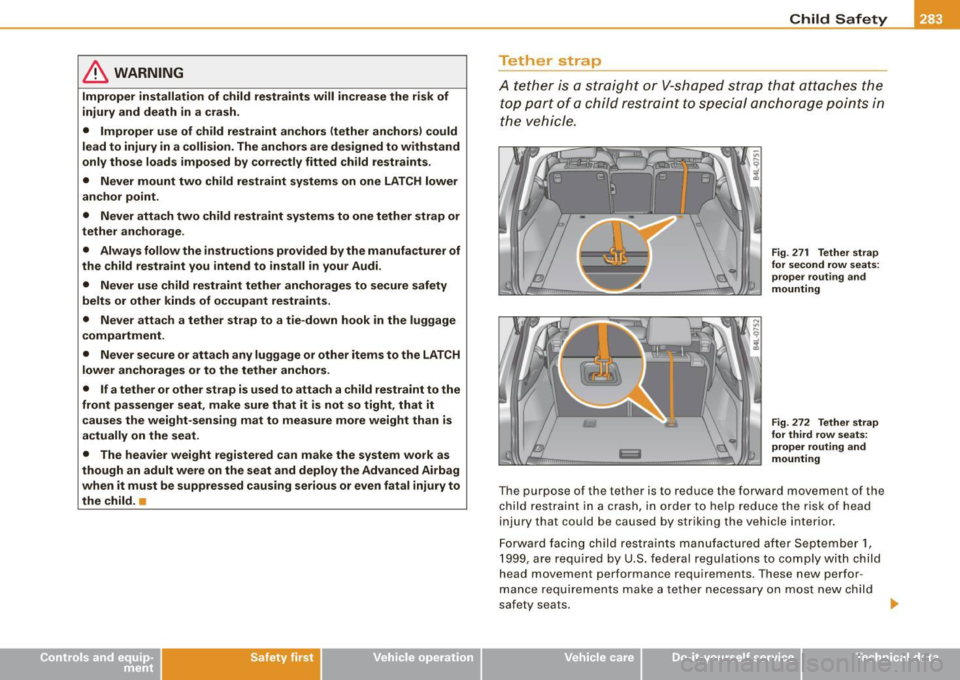
A tether is a straight or V-shaped strap that attaches the
top part of a child restraint to special anchorage points in
the vehicle.
Fig . 271 Tether strap
for second row seats:
proper routing and
mounting
Fig . 272 Tether strap
for third row seats:
proper routing and
mounting
Th e purpose of the tether is to reduce the forward movement of the
child restraint in a crash, in order to help reduce the risk of head
injury that could be caused by striking the vehicle interior.
Forward facing child restraints manufactured after September 1,
1999 , are required by U.S. federal regulations to comply with child
head movement performance requirements. These new perfor
mance requirements make a tether necessary on most new child
safety seats.
~
Vehicle care I I irechnical data
Page 290 of 426
llffl __ ln_ t _e_ ll-'"ig ...,_ e_ n_t _t_ e_ c_ h _ n_o _ l_o _,.g= y,_ __________________________________________ _
Intelligent technology
Notice about data recorded by
vehicle control modu les
Your vehicle is not equipped with an Event Data Recorder (EDR),
installed by some manufacturers for the express purpose of
capturing data for retrieval after an accident or crash event . EDR's
are sometimes called "crash recorders" .
Some state laws restrict the retrieva l or downloading of data stored
by EDR's that were insta lled in a vehicle for the express purpose of
retrieving data after an accident or crash event without the owner's
consent.
Although your vehicle is not equipped with an EDR, it is equipped
with a number of electronic control modules for various vehicle systems such as, for example, engine function, emission control, as
well as for the airbags and safety belts.
These electronic control modules also record vehicle-related data during norma l vehicle operation for diagnost ic and repair purposes .
The recording capacity of the electronic control modules is limited
to data (no sound is recorded) and only a small amount of data is
actually recorded over a very limited period of time and stored when
a system fault or other condition is sensed by a control unit. Some
of the data then stored may relate to vehicle speed, direction, braking as well as restraint system use and performance in the
event of a crash or other condition . Stored data can only be read and
down loaded with special equipment .•
Electron ic Stabilizat ion Program (ESP)
General =nformation
The ESP improves the vehicle stability.
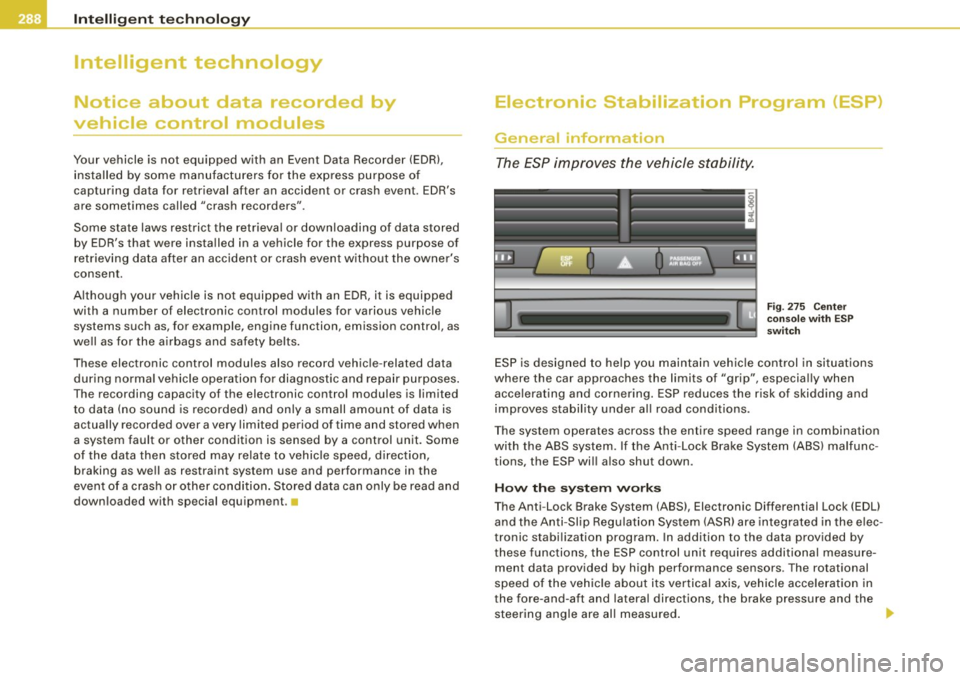
Fi g. 2 75 C ente r
co nso le w it h ES P
swi tch
ESP is designed to he lp you maintain vehic le control in situations
where the car approaches the limits of "grip", especia lly when
accelerating and cornering. ESP reduces the risk of skidding and
improves stabil ity under all road conditions .
T he system operates across the entire speed range in combination
with the ABS system. If the Anti-Lock Brake System (ABS) malfunc
tions, the ESP wil l also shut down .
How th e sys te m w ork s
The Anti -Lock Brake System (ABS) , Electronic Differential Lock (EDU
and the Anti-Slip Regulation System (ASR) are integrated in the e lec
tronic stabi lization program . In addition to the data provided by
these functions, the ESP control unit requires additional measure ment data provided by high performance sensors . The rotational
speed of the vehic le about its vertical axis, vehicle acce leration in
the fore-and-aft and lateral directions, the brake pressure and the steering angle are al l measured .
Page 323 of 426
Cleaning and protection IJI
----------------=-----=------
•
Applie s to vehicles: with natural leather
Natural leather
Audi makes great efforts to maintain the properties,
natural look and feel of interior leather.
General
We offer many different types of leather on our vehicles. Most are
different types of nappa leather, which has a smooth surface and
comes in various colors.
The intensity of the color determines the visua l characteristics and
appearance. If the surface of the leather has a typica l natural look,
then the leather is a nappa leather that has been left in a re latively
natural condition. This leather offers particular ly good comfort and
breathes well. Fine veins, closed grains, insect bites, skin folds, and
subtle variations in color remain visible. These characteristics
demonstrate that the material is natural.
Natura l nappa leather is not covered by a color finish. It is therefore
more sensitive to soiling and wear, which is something you need to
consider if children, animals or other factors might prove to be
particularly hard on the leather .
By contrast, leather types that are covered by a colored finish layer
are more durable. This has a positive effect on the leather's resis
tance to wear and soiling in daily use . On the other hand, the typical
characteristics of natural leather are barely or not apparent.
However, this does not mean that the leather itself is of inferior
quality.
Care and handling
Because of the exclusive nature of the types of leather that Audi
uses and their unique properties (such as sensitivity to oils, grease,
soiling, etc.l, you will need to be somewhat careful with these
leathers, and a certain type of care is required. For example, dark
clothing materials can discolor leather seats (especial ly if such
clothing is damp and was not dyed correctly) . Dust and dirt particles in pores, folds, and seams can have an abrasive effect and can
damage the leather surface as well as weaken seams
.
The leather should be cleaned regularly as needed . After having
been used for a relatively long time, your leather seats will acquire
a rich aged finish. This is a characteristic of natural leather and a
sign of true quality.
In order to maintain the value of this natural product over the life of
your vehicle, you should follow the recommendations below:
0 Note
• To keep your leather from bleaching out, do not allow it to be
exposed to bright sun light for long periods of time. If you have to
leave the vehicle parked outside for long periods, cover the leather
to protect it from direct exposure to sunlight.
• Sharp objects on clothing, such as zippers, rivets or sharp pieces
on belts can leave permanent scratches or scrape marks on the
surface of the leather.
[ i ] Tips
• After each time you clean the leather and at regular intervals, use
a leather preservative creme that contains UV -blockers and that
works into the leather . This creme wil l nourish and moisturize the
leather, helping it to breathe and stay supple. It also helps to build
up a protective coating on the surface .
• Clean the leather every 2 -3 months, and clean any areas that get
soiled.
• Remove fresh marks made by ballpoint pens, ink, lipstick, shoe
polish, etc. as soon as possible .
• Preserve the color of the leather as needed by using a special
colored leather care creme to touch up areas of uneven color. •
Vehicle care I t •
Page 325 of 426
--------------------------------------------~C ~ l~ e ~ a~ n~ in~ g~ a~n ~d~ p~ r ~o~ te~ c~t ~io ~ n~_IIIII
•
A pp lies to vehicles : w it h A lcantara up holste ry
Cleaning Alcantara ® (synthetic suede)
Removing dust and dirt
- Moisten a cloth, squeeze out excess water and wipe down
the seat surfaces.
Removing stains
- Moisten a cloth with lukewarm water or with diluted
ethyl (rubbing) alcohol.
Dab at the stain. Start at the outside and work inwards.
- Once the stain is no longer visible, use a soft dry cloth or
tissue to soak up the moisture.
Do not use leather cleaning products on Alcantara.
You may use a suitable shampoo for removing dust and dirt. Dust and grit in the pores and seams can scratch and damage th e
surface. If the car is left standing in the sun for long periods, the
Alcantara should be protected against direct sunlight to prevent it
from fading. Slight color variations will develop in normal use and
are not an indication of material deterioration.
0 Note
• Never use chemical solvents (e .g. lighte r fluid , tu rpen tine) ,
waxes, shoe polish or s imilar products on Alcantara ® surfaces.
• To avoid damage , have stubborn stains removed by a commer
cial cleaning specialist.
• Do no t use brushes, stif f spong es or similarly abras ive cleaning
aids. •
Safety belts
Only well-maintained safety belts work reliably when
needed.
Keep belts clean .
- For cleaning, use a mild soap and water solution. Let
belts dry thoroughly and away from direct sunl ight.
- Do not allow inertia reel safety belts to retract before
they are completely dry.
- Check the condition of your safety belts
regularly.
Heavily soiled safety belts may not retract properly.
& WARNING
Damaged safety belts can break in a crash.
• Anything that might damage your safety belts could mean that
you and your passengers would not be adequately protected in an
accident.
• Safety belt performance depends on correct installation. Never
remove belts from the vehicle to clean them.
• Do not use chemical cleaning agents, bleach or dyes. They have
corrosive properties which weaken the webbing.
• When cleaning your safety belts, inspect them for damage.
If
you discover damage, see your authorized Audi dealer.
• Always read and heed all WARNINGS and other information
~ page312. •
Vehicle care I t •
Page 334 of 426
-Checking and filling PW---=---------------
& WARNING (continued )
-Always u se extreme caution to prevent cloth ing , jewelry, or
long hair from getting caught in the radiator fan , V-belt s or
other moving parts , or from contacting hot parts . Tie back hair
before starting , and do not wear clothing that will hang or
droop into the engine .
• Minimize exposure to emis sion and chemical hazards
::::> & .
& WARNING
California Proposition 65 W arn ing :
• Engine exhaust , some of its constituents , and certain vehicle
c omponents cont ain or emit chemicals known to the State of Cali
fornia to cause cancer and birth defects and reproductive harm. In addition , certain fluids contained in vehi cles and certa in products
of component wear contain or emit chemicals known to the State
of California to cause cancer and birth defect s or other reprodu c
tive harm.
• Battery posts , terminals and related ac cessories conta in lead
and lead compounds , chemicals known to the State of California
to cause cancer and reproductive harms. Wash hands after
handling.
0 Note
When adding f luids, always make sure that they are poured into the
proper container or filler ope ning, otherwise serious damage to
vehic le systems wi ll occur.
ci> For the sake of the environment
To detect leaks in time, inspect the vehicle floor pan from under
n eath regu larly. If you see spots fro m oil o r o th e r v eh icle flu ids, hav e
your vehicle inspected by an author ized Audi dea ler. •
Engine compartment
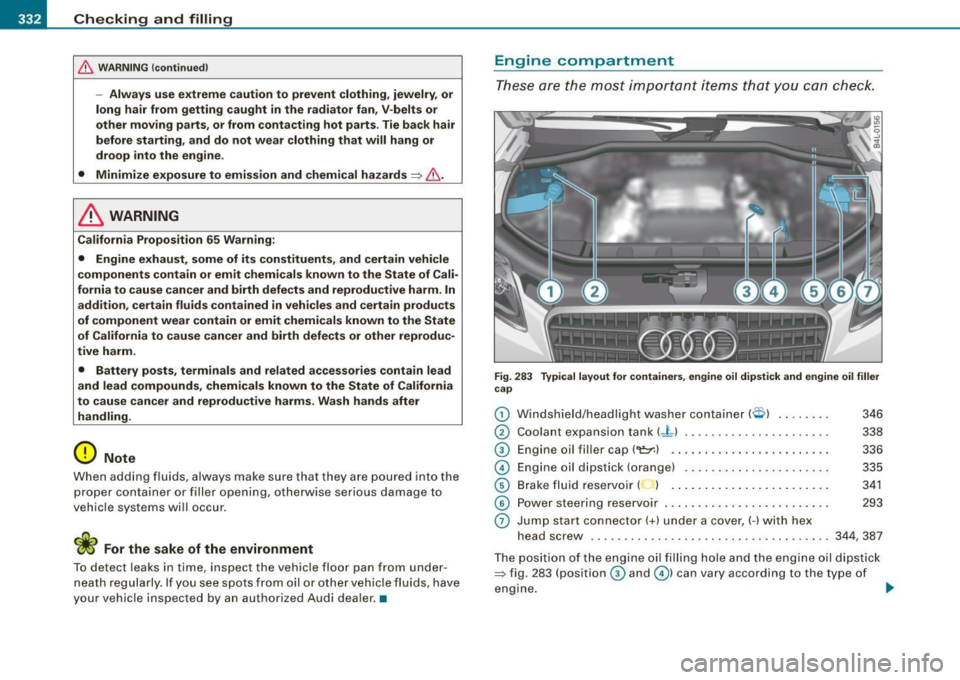
These are th e m ost im porta nt items th at you can ch ec k.
Fig. 283 Typical layout for containe rs, engine oi l d ipstick and engine oil filler
cap
0 W indsh ield/headligh t was her conta iner ( 9 ) . . . . . . . . 346
0 Coolant e xpansion tank (- L l . . . . . . . . . . . . . . . . . . . . . . 338
G) Engin e oil fi ller cap ("l::r.) . . . . • . . . . . . • • • • . . . • . . • . . 336
© Engine oil d ips tick (orange) . . . . . . . . . . . . . . . . . . . . . . 335
© Brake fluid reservo ir ( ) . . . . . . . . . . . . . . . . . . . . . . . . 341
© Pow er steer ing r eser voir . . . . . . . . . . . . . . . . . . . . . . . . . 2 93
0 Jump sta rt connector( +) u nder a cover,( -) w ith hex
head screw .... ... ..... .... ... .... ... ..... .... . 344 , 387
The positi on of t he e ngin e oil fi lling hole and t he engine oil dipstick
=> fig . 283 (position G) and ©l can vary according to the type of
eng ine. .,_
Page 342 of 426
-~_C_ h_e _c _ k_ i_n ...:::g::;...._ a_n_ d_ f_ i_ll _in -'g:::;.._ ___________________________________________ _
G12+ +, G12 + or G12 is not available, do not use a different addit ive .
Use p lain water ins tead until you ca n get the c orrec t additive and
can restore the correct ratio . This should be done as soon as
poss ible.
If you have los t a considerable amount o f coo lant, then you s hould
add co ld antifreeze and cold water only when the engine is cold .
A lways us e
new en gi ne c oolant when refi llin g .
Do not fi ll coo lant above the "MAX" mark. Excess coolant wil l be
forced out through the pressure relief valve in the cap when the
engine beco mes hot.
& WARNING
• The cooling sy stem is under pressure and can get very hot .
Reduce the risk of s calding from hot coolant by following these
steps .
- Turn off the engine and allow it to cool down.
- Protect your face, hands and arms from escaping fluid and
steam by covering the cap with a large, thick rag .
- Turn the cap slowly and very carefully in a counter -clockwise
dire ction while applying light , downward pressure on the top
of the cap .
- To avoid being burned , do not spill antifreeze or coolant on
the exhaust system or hot engine parts . Under certain condi
tions , the ethylene glycol in engine coolant can catch fire.
• Antifreeze is po isonous . Always store antifreeze in its original
container and well out of the reach of children.
• If you drain the coolant , it must be caught and safely stored in
a proper container clearly marked "poison ".
0 Note
• Coo lant po llutes t he e nviro nment and cou ld cause a n en gin e
fire. Excess coolant wi ll be forced out through the pressure re lief
va lve in the cap when the eng ine becomes hot.
• I f, in an emergency, on ly wate r can be added, the correct ratio
between wate r and ant ifree ze::::>
page 337 must be restored as soon
as possib le .
W For the sake of the environment
Drained coolant should not be reused. Always dispose of used
coo la nt whi le observ ing all env iro nmen tal reg ulat io n s. •
Radiator fan
The radiato r fan switches on au toma tic ally by i tself.
The radiator fa n is dr iven by the eng ine via th e V -belt. The visco us
clutch regulates the speed of the fan according to the temperature
o f t he coo la nt.
An auxiliary electric radiator fan * sw itches on and off depending on
coo la nt t empe rat ure a nd othe r vehic le operating c ondi tio ns.
A ft er you sw itch the e ngine o ff, the au xiliary fa n ca n conti nue
running for up to 10 m inutes- even with the ignition off. It can even
switch o n again lat er by itsel f::::> & , if
• the temperature of the eng ine coo lant rises due to the heat
bu ild -up from the eng ine in the eng ine compartment, or
• the engine compartment heats up because the vehic le is parked
in i ntense sun ligh t.
& WARNING
• To reduce the ri sk of personal injury never touch the radiator
fan .
~