change time AUDI Q7 2009 Owner´s Manual
[x] Cancel search | Manufacturer: AUDI, Model Year: 2009, Model line: Q7, Model: AUDI Q7 2009Pages: 426, PDF Size: 97.13 MB
Page 259 of 426
possible that an airbag will not deploy at a seating position where
the safety belt is being used but will inflate at the position where the
safety belt is not being used . It is important that nothing interfere
with the safety belt buckles so that the sensors can send the correct
information about safety belt use to the electronic control unit .
& WARNING
Changing the vehicle's suspension including use of unapproved
tire -rim combinations can change Advanced Airbag performance
and increase the risk of serious personal injury in a crash.
• Never install suspension components that do not have the
same performance characteristics as the components originally
installed on your vehicle.
• Never use tire-rim combinations that have not been approved
by Audi.
& WARNING
Items stored between the safety belt buckle and the center
console can cause the sensors in the buckle to send the wrong
information to the electronic control module and prevent the
Advanced Airbag System from working properly.
• Always make sure that nothing can interfere with the safety
belt buckles and that they are not obstructed.
as Perchlorate Material -special handling may apply, see
www.dtsc .ca.gov/ha zardouswaste/perchlorat e. When the vehicle or
parts of the restraint system including airbag modules and safety
belts with pretensioners are scrapped, all applicable laws and regu
lations must be observed. Your authorized Audi dealer is familiar
with these requiremen ts and we recommend that you have your
dealer perform this service for you.•
Safety first
Side airbags
Description of side airbags Airbag
system
The airbag system
can provide supplemental protection
to properly restrained occupants.
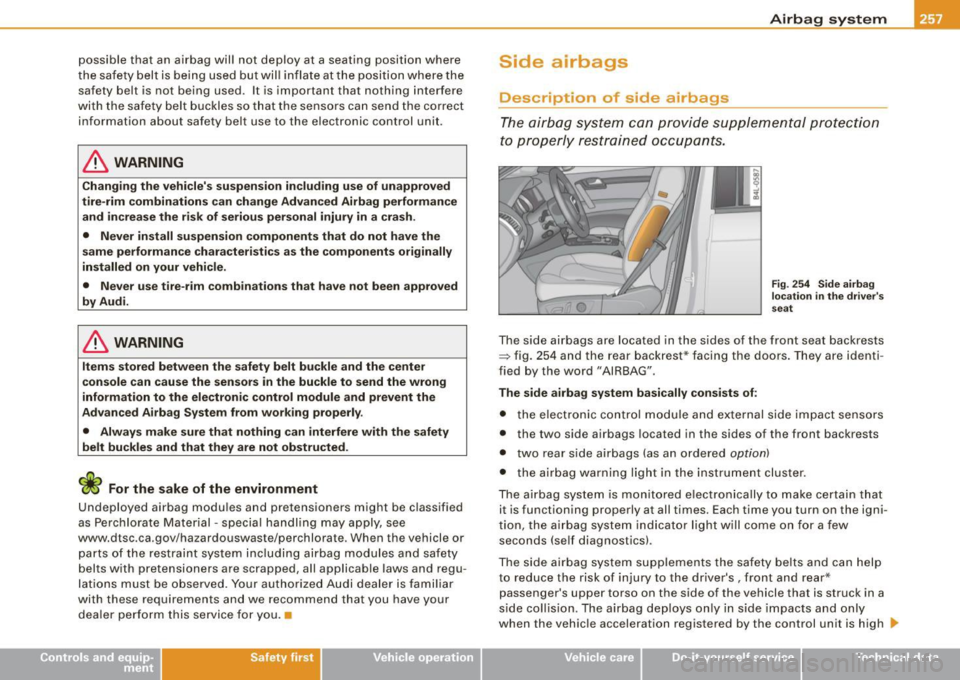
Fig . 254 Side airbag
location in the driver's
sea t
The side airbags are located in the sides of the front seat backrests
~ fig. 254 and the rear backrest * facing the doors . They are identi
fied by the word "AIRBAG" .
The side airbag system basically consists of:
• the electronic control module and external side i mpact sensors
• the two side airbags located in the sides of the front backrests
• two rear side airbags (as an ordered
option)
• the airbag warning light in the instrument cluster.
The airbag system is mon itored e lectronica lly to make certain that
it is functioning prop erly at all times. Each time you turn on the igni
tion, the airbag system indicator light will come on for a few
seconds (se lf diagnostics) .
The side airbag system supplements the safety belts and can help
to reduce the risk of injury to the driver's , front and rea r*
passenger's upper torso on the side of the vehicle that is struck in a
s ide collision . The airbag dep loys on ly in side impacts and only
when the vehicle acceleration registered by the control unit is high
~
Vehicle care I I irechnical data
Page 328 of 426

Fuel supply and filling your fuel tank
Blend of gasoline and ethanol (grain alcohol or ethyl alcohol}
• Anti-knock index must be 87 AKI or higher.
• Blend must not contain more than 10% ethanol.
Blend of gasoline and MTBE
• Anti-knock index must be 87 AKI or higher.
• Blend must contain not more than 15% MTBE.
Seasonally adjusted gasoline
Many gasoline grades are blended to perform especially well for
winter or summer driving. During seasonal change -over, we suggest
that you fill up at busy gas stations where the seasonal adjustment
is more likely to be made in time.
0 Note
• Methanol fuels which do not meet these requirements may
cause corrosion and damage to plastic and rubber components in
the fuel system.
• Do not use fuels that fail to meet the specified criteria in this
chapter.
• If you are unable to determine whether or not a particular fuel
blend meets the specifications, ask your service station or its fuel
supplier.
• Do not use fuel for which the contents cannot be identified.
• Fuel system damage and performance problems resulting from
the use of fuels different from those specified are not the responsi
bility of Audi and are not covered under the New Vehicle or the
Emission Control System Warranties.
• If you experience a loss of fuel economy or driveability and
performance problems due to the use of one of these fuel blends,
we recommend that you switch to unblended fuel. •
Gasoline additives
A major concern among many auto manufacturers is carbon
deposit build-up caused by the type of gasoline you use.
Although gasoline grades differ from one manufacturer to another,
they have certain things in common. All gasoline grades contain
substances that can cause deposits to collect on vital engine parts,
such as fuel injectors and intake valves. Although most gasoline
brands include additives to keep engine and fuel systems clean,
they are not equally effective.
Audi recommends using TOP TIER Detergent Gasoline. For more
information on TOP TIER Detergent Gasoline, please go to the offi
cial website (www.toptiergas.com).
After an extended period of using inadequate fuels, carbon deposit
build-ups can rob your engine of peak performance.
(D Note
Damage or malfunction due to poor fuel quality is not covered by
the Audi New Vehicle Limited Warranty. •
Fuel tank
Fuel filler neck
The fuel filler neck is located on the right rear side panel behind the
fuel filler flap.
If the power locking system should fail, you can still open the flap
manually - for detailed instructions see=>
page 329.
You can find the fuel tank capacity of your vehicle in Technical Data
=> page 399. .,_
Page 336 of 426
-~_C_ h_e _c _ k_ i_n ...:::g::;...._ a_n_ d_ f_ i_ll _in -'g:::;.._ ___________________________________________ _
current list of oils (manufacturers, brand names etc.) that conform
t o Audi oi l standard VW 502 00 .
Changin g the engine oil
The engine oil and oil filter must be changed according to the
mi leage (ki lometers) and time intervals specified in your vehicle's
Warranty
& Maintenance booklet. Do not exceed these interva ls -
harmful deposits from old engine oil can reduce engine perfor
mance and can lead to expensive engine repairs.
Changing the oi l at the recommended intervals is so very important
because the lubricating prope rties of oi l decrease gradual ly during
normal vehicle use . If you are not sure when you have your oil
changed, ask your author ized Audi Serv ice Advisor.
Under some circumstances the engine oil should even be changed
more frequently. Change oil more often if you dr ive mostly short
distances, operate the vehicle in dusty areas or mostly under stop
and -go t raffic conditions, or when you use your vehicle where
temperatures stay be low freezing point for long per iods.
Detergent additives in the oil will make fresh oil look dark after the
engine has been running for a short time . This is normal and is not
a reason to change the oil more often than recommended.
Damag e or malfunctions due to lack o f mainten anc e
It is essentia l that you change your oi l at the recommended interva ls
using on ly engine oil that complies with Audi oil standard
VW 502 00. Your Limited New Vehicle Warranty does not cover damage or ma lfunctions due to failure to follow recommended
main tenance and use requirements as set forth in the Aud i Owner's
Manual and Warranty
& Maintenance booklet. Your dealer wi ll have
t o deny warranty cove rage unless you present to the dealer p ro o f in
the form of Service or Repair Orders that all schedu led maintenance
was pe rformed in a timely manner. •
Engine oil consumption
The engine in your vehicle depends on an adeq uate
amount of oil t o lubric ate and c ool all of its m oving parts.
In order to provide effective lubrication and coo ling of interna l
engine components, al l interna l combustio n eng ines consume a
certain amount of oil. Oil consumption varies from engine to engine
and may change significant ly over the life of the engine . Typ ically,
engines with a specified break-in period (see=>
page 2971 consume
more oil du ring the break-in period than they consume after oil
consumption has stabi lized .
Unde r normal conditions, the rate of oil consumption depends on
the quality and v iscosity of the oil, the RPM (revolutions per minute)
at which the engine is operated, the ambient temperature and road
cond itions. Fur ther factors are the amount of oil di lu tion from wate r
condensation or fue l residue and the oxidation leve l of the oi l. As
any engine is subject to wear as mileage bu ilds up, t he oil consump
tion may increase over time until replacement of worn components
may become necessa ry .
With all these variables coming into play, no standard rate o f oi l
consumption can be established or specified . There is no alternative
t o regula r and frequent checking of the oil level, see
Note .
If the yel low engine oil level warning symbo l in the instrument
clus ter lights up, yo u should check the oil level as soon as
possible
with the oil dipstick=> page 335. Top off the oil at your
ea rliest convenience =>
page 336.
& WARNING
Before you check anything in the engine compartment , always
read and heed all WARNING S
=> & in "Working in the engine
compartment " on
page 331.
Page 338 of 426
___ C_h_ e_ c_k _in --== g'-- a_n _d_ f_il _li _n ..:::g:::..- ___________________________________________ _
Oil l ev el within r ange
©
- You must add oil. Afterwards, the oil level should be
within range @.
The oil level needs to be checked at regular intervals. The best times
to do this are whenever you refuel and prior to long tr ips.
Depending on the way the vehicle is driven and the operating condi
tions, oil consumption can be up to 1 quart per 1.200 miles (1 liter
per 2.000 km). Consumption may be higher within the first
3.000 miles (5.000 km) .•
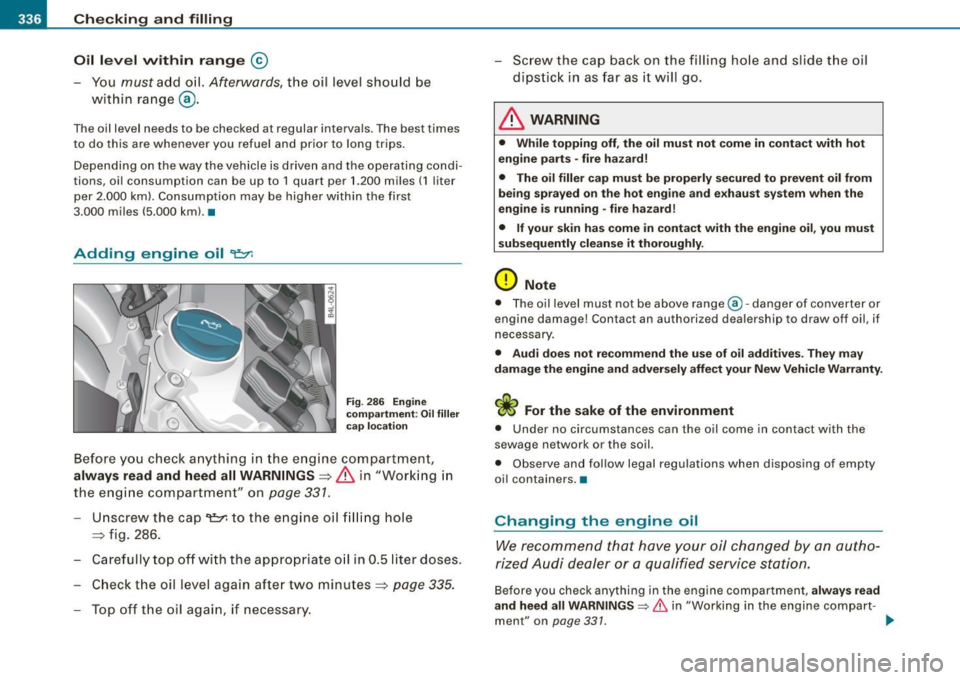
Adding engine oil "l=:7:
Fig . 28 6 Engine
co mp artm ent: Oil filler
ca p loc ation
Before you check anything in the engine compartment,
alw ay s read and h eed all WARNINGS ==> & in "Work ing in
the engi ne compartment" on
page 331.
- Unscrew the cap
Carefully top off with the approp riate o il in 0.5 liter doses .
- Check the oil level again after two minutes
==> page 335.
- Top off the oil again, if necessary . - Sc
rew the cap back on the filling hole and slide the oil
dipstick in as far as it will go .
& WARNING
• Whil e topping o ff, the oil mu st not come in cont act with h ot
eng ine p arts -fire haza rd!
• The oil filler cap mu st be properly se cured to pr eve nt oil from
b ei ng spr ayed on th e hot engi ne and e xhau st sy stem when the
engine i s running · fire ha zard !
• If you r skin has com e in contac t wit h th e eng ine oil, you mu st
s ub sequently clean se it thoroughly.
0 Not e
• The oil level must not be above range @- danger of converter or
engine damage! Contact an authori zed dealership to draw off oi l, if
necessary.
• Audi do es not re comm end the use of oil add it ives. They may
d a mage the engi ne and advers ely affe ct y ou r Ne w V ehicle W arra nty.
cj? For the sake of the environment
• Under no circumstances can the oil come in co ntact with the
sewage network or the soil.
• Observe and follow legal regulations when disposing of empty
oi l containers. •
Changing th e engin e oil
We recommend that have your oil changed by an autho
rized Audi dealer or a qualified service station.
Before you check anything in the engine compartment, a lways r ead
a nd h eed all W ARNIN GS=:>
& in "Working in the engine compart-
ment" on
page 331 . .,_
Page 339 of 426
___________________________________________ C_ h_e _c_ k_ i_n _g _ a_n _d_ f_il _li _n _g __ lll
•
T he engine oil must be changed according to the intervals specified
in your Warranty
& Maintenance book le t. This is very important
because the lubricating properties of oi l diminish gradually during
normal vehicle use .
Under some circumstances the engine oil should be changed more
frequently. Change oil more often if you drive most ly short
distances, opera te the vehic le in dusty areas or under predomi
nant ly stop-and-go traffic conditions, or have your vehicle where
t emperatures remain below free zing for extended periods.
Detergent additives in the oil wil l make fresh oi l look dark after the
engine has been running for a sh ort time . This is normal and is not
a reason to chan ge the oi l more often than recommended.
Because of the problem of proper disposal, along with the specia l
t ools and necessary expertise requ ired, we strongly recommend
that you have your oi l changed by an authorized
Audi de aler or a
qualified se rvice statio n.
If you choo se to change your oil yourself , please note the following
important information:
& WARNING
To reduce the risk of per sonal injury if you mu st ch ange the engine
o il in you r veh icle your self :
• Wear eye protection.
• To reduce the ri sk of burns from hot engine oil , let the eng ine
c ool down to the touch.
• Wh en remo ving the oil dra in plug with your fingers , stay a s far
aw ay as po ssible. Alway s keep your forearm parallel to the ground
to help prevent hot oil from ru nning do wn your arm .
• Drain t he o il into a container designed for thi s purpo se , one
large enough to hold at lea st the total amount of oil in your eng ine.
• Engine oil i s poi sonous . K eep it well out of the rea ch of children .
& WAR N IN G ( continued )
• Continuous contact with used engine oil i s harmful to your
sk in. Al way s prote ct your skin b y was hing oil off thorough ly w ith
soap and water .
0 Note
Never mix oil additives with your engine oil. These additives can
damage your engine and adversely affect your Aud i Limited New
Vehicle Warranty.
can properly dispose of the used oil.
• Always dispose of used engine oil properly. Do not dump it on
garden soil, wooded areas, into ope n strea ms or down sewage
drains .
• Recycle used engine oil by taking it to a used engine oil collec
tion facility in your area, or contact a service station. •
Engine cooling system
Coolant
The engine coolan t per for ms two functions: i t kee ps the
engine from ove rhe ating and it prot ects the e ngine from
freezing in the winter.
The cooling system is sea led and general ly requires litt le attention.
The coo ling system has been fi lled at the fac tory with a per manent
coolant which does not need to be changed. The coo lant consists of
a m ixture of water and the manufacturer's glycol -b asedco olant
additive G 12++ antifreeze with anti corrosion additives (50% for USA .-,
Vehicle care I t •
Page 343 of 426
_____________________________________________ C_h_ e_ c _ k_in -= g_a _ n_d _ f_il _li _n ..;::g =-- ____.•
& WA RNING ! continued )
• The auxiliary ele ctric fan is temperature controlled and can
s w itch on suddenly even wh en t he engine is not runn ing .
• The auxiliary radiator fan swit ches on automatic ally when the
engin e coolant rea che s a cer tain temperature and will con tinue to
run until the coolant temperature drop s. •
Brake f luid
Checking brake fluid level
The brake fluid level c an be checke d with a quick gl ance .
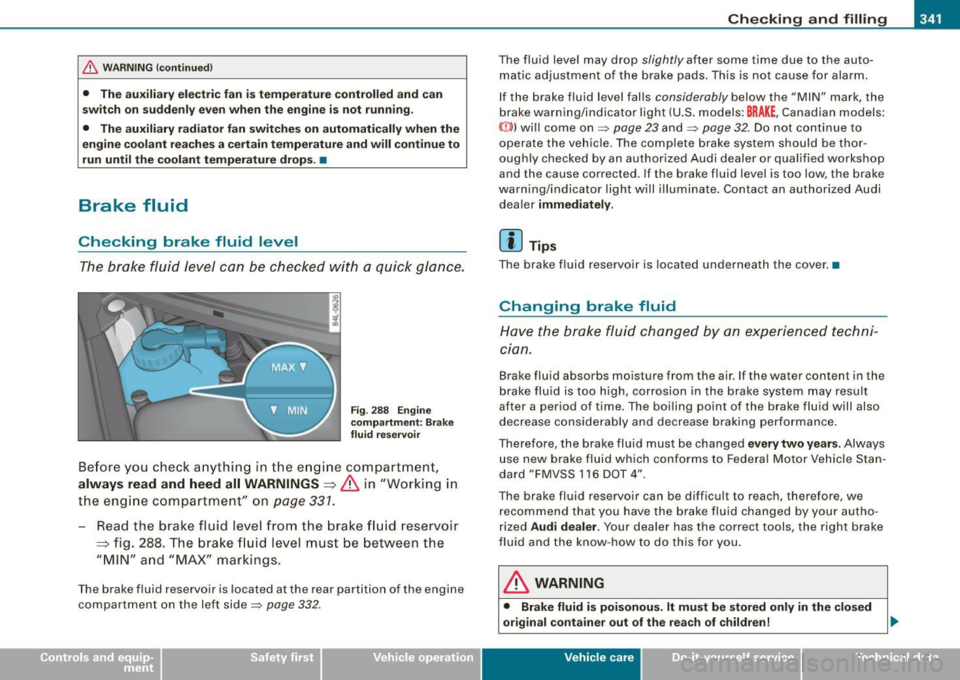
Fig. 288 E ngine
comp artm ent: B ra ke
flui d rese rvoir
Be fore you check a nything in th e en g in e co mpart ment,
always read and heed all WARNINGS=> & in "Working in
t h e eng ine compartment" on
page 331.
- Read the brake fluid l eve l from the brake fluid reservoir
=> fig. 288. The brake flu id level mus t be between the
"MIN" and "MAX" markings.
The brake fluid reservoir is locate d at the rear partition of the engine
compartment on the left side=>
page 332.
The fluid level may drop slightly after some time due to the auto
ma tic adjustment of the brake pads. This is not cause for alarm .
If the brake fluid leve l falls
considerably below the "MIN" mark , the
brake warning/indicator light (U.S. models:
BRAKE , Canadian models:
«D> l will come on=>
page 23 and=> page 32 . Do not continue to
operate the vehicle. The complete brake system should be thor
oughly checked
by an author ized Audi dealer or qua lif ied workshop
and the cause corrected . If th e brake fluid level is too low, the brake
warning/indicator light w ill illumi nate. Contact an authorized Audi
dea ler
immedi ately .
[ i ] Tips
The brake fluid reservoir is located underneath the cover .•
Changing brake fluid
Have the brake fluid changed by an experience d techni
cian.
Brak e fluid absorbs mois ture from the air. If the wate r conten t in the
brake fluid is too high, corrosion in the brake sys tem may res ult
after a period of time . The boiling point of the brake fluid will also
decrease conside rably and decrease braking performance .
Therefore , the brake fluid mus t be changed
every two year s. Always
use new brake fluid which conforms to Federal Motor Vehicle S tan
da rd "FMVSS 116 DOT 4".
The brake fluid reservoir can be difficul t to reach, therefore , we
recommend that y ou have the brake fluid changed by your autho
rized
Audi deal er. Your dealer has the correct tools, the right brake
fluid and the know -how to do this for you .
& WARNING
• Brak e fluid is poi sonou s. It mu st be stored only in the clo sed
o riginal conta iner out of the rea ch of children! ..,.
Vehicle care I I irechnical data
Page 344 of 426
-~_C_ h_e _c _ k_ i_n ...:::g::;...._ a_n_ d_ f_ i_ll _in -'g:::;.._ ___________________________________________ _
& WARN ING (c o ntinued )
• Brake failure can re sult from old or inappr opriate brake fluid .
Ob serve the se precautio ns:
- Use only brake fluid that meets SAE specific ation J 1703 and
c onform s to Fed era l Moto r Vehi cle St anda rd 116. Al ways c heck
with your authori zed Audi dealer to make sure you are u sin g
the corre ct brake fluid. The correct typ e of brake fluid i s also
indicated o n the brake fluid reser vo ir .
- The br ake flu id mu st be ne w. Heavy u se of the brake s can
c au se a vapor lock if the brake fluid i s left in the s ystem too
long. Thi s can seriou sly affect the effi cien cy of the brake s as
w ell a s your safet y. Thi s could re sult in an acci dent .
0 Note
Brake fluid will damage the paint of your vehicle .
For the sake of the environment
Because of the problem of proper disposal of brake fluid as well as
the special too ls required and the necessa ry expertise, we recom
mend that you have the brake fluid changed by your authorized Audi
dea ler .•
Battery
General information
Under normal operating condi tions, the battery in your Audi does
not need any maintenance. With
high outside temperatures or long
daily drives we recommend that you have the e lectrolyte level
checked by an au thorized Audi dealer or qualified workshop . The
e lectrolyte level should also be ch ecked each time the battery is
charged ~
page 344.
Have the battery checked when you take your vehicle in for service .
Yo u are well advised to replace a battery that is o lder than 5 years .
With certain types of airbag dep loyment, the battery is discon
nected from the vehicle electrical system for safety reasons~
& in
"Repair, care and disposal of the airbags" on
page 255.
Disconnecti ng th e batt ery termin als
Some vehicle functions (power window regulators , for example) are
lost if the battery termina ls are disconnected. These functions have
to be relearned after the battery terminals are connected again . To
prevent this, the battery should only be disconnected from the
vehic le electrical sys tem when abso lutely necessary for repairs .
Vehicles not driven for long per iods
If you do not drive your vehicle ove r a period of several days or
weeks, electrical components are gradually cut back or switched off .
T his reduces energy consumption and maintains starting capab ility
over a longer period
~ page 295 .
Take i nto consideration that whe n you u nlock your vehicle, some
convenience functions, such as the master key remote function or
powe r seat adjustme nt, may not be ava ilable. The convenience
functions will be available again when you turn on the ignition and
start the engine .
Wint er op erati on
Duri ng the winter mont hs, batte ry capacity tends to decrease as
temperatures drop . This is because more power is also consumed
whi le star tin g, and the headlights, rear window defogger, etc ., are
used more often.
Avoid unnecessary power consumption, particular ly in city traffic or
when trave li n g o nly short dis tances . Let your authorized Audi dea ler
check the capacity of the vehicle battery before winter sets in
~ page 344. A we ll cha rged battery w ill not only preven t starting
problems when the weather is cold, but will also last longer . ..,_
Page 346 of 426
•---=C:.:h..:. e=-= c..:.k :..:.in :..:.:= g:.....= a..:.n :.:d::....:. f.:.:il .:.:li ..:.n :..::g~ --------------------------------------------
& WARNING (continued )
battery to heat up very quickly, wh ich could lead to damage or
explosion and personal injury .
• When a battery is charged , it produces h ydrogen gas which i s
explosive and could cau se personal injury .
• Always keep the battery well out of the reach of children.
• Before work is done on the electrical system , disconnect the
negative ground cable .
• Before performing any work on the ele ctri cal system , switch off
the engine and ignition as well as any electrical equipment. The negative cable on the battery m ust be disconnected . If you are ju st
going to replace a light bulb , then it is enough to switch off the
lights .
• Before disconnecting the battery , switch off the anti -theft
alarm system! Otherwise you will set off the alarm .
• When disconne cting the battery , first disconnect the negative
c able and then the positive cable .
• Before reconnecting the battery , make sure all electrical
c onsumers are swit ched off . Reconnect the positive cable first and
then the negative cable. Never interchange the cables - this could start a fire !
• Never charge a frozen or a thawed -out battery. It could
explode! If a battery has frozen , then it must be replaced . A
discharged battery can freeze over at 32 °F (0 °Cl.
• Make sure the vent hose is always attached to the opening on
the side of the battery.
• Never use batteries whi ch are damaged . There is the danger of
an explosion! Always replace a damaged battery.
& WARNING
Californ ia Proposition 65 W arning :
& WARNING (continued )
• Battery posts, terminals and related accessories contain lead
and lead compounds, chemicals known to the State of California
to cause can cer and reproductive problems . Wash hands after
handling .
0 Note
• Do not disconnect t he veh icle battery w he n th e ign itio n is
switched on or when the engine is running , otherwise, you will
damage e le ctronic co mponents in the elec trical sys tem.
• I f your vehicle i s going to stand for a long period of time without
b ei ng dr iven, prot ec t the batte ry from "fr ee zing", otherwise it will
be damaged and will then have to be rep laced. •
Battery charging
Sta rti ng th e e ngin e req uires a well c harged ba tte ry.
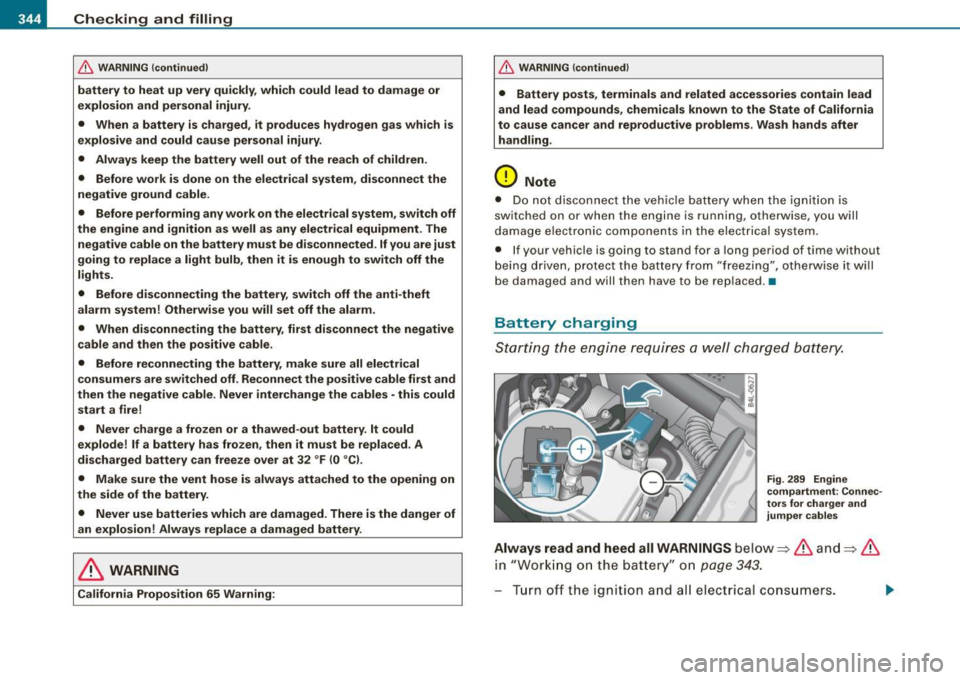
F ig . 289 Engine
compartment : Conne c
tors fo r charge r and
jumper cable s
Always read and heed all WARNINGS be low ~ & and::::} &
in "W orkin g on the b atte ry" on pa ge 34 3.
- Tur n off the ig ni tio n a nd a ll elec tric al co nsum ers.
Page 348 of 426
llftl __ C _h_ e_ c_k _in --== g'-- a_n _d_ f_il _li _n ..:::g:::..- ___________________________________________ _
Battery replacement
The new battery must have the same specffications and
dimensi ons as the original equipment battery.
Intel ligen t energy management in your vehicle is responsible for
distributing the e lectrica l ene rgy throughout your vehicle
::} page 295. The intelligent energy management system will keep
the engine battery charged bette r then vehicles wi thou t this system .
To make sure the additional electrical energy is available once again
after you have changed the batte ry, we recommend that you install
batteries of the same type and manufacture only (the same as those
installed at the time your vehicle was delivered). Specifications are
listed on the battery housing . Your authorized Audi dealer will then
code the battery management cont rol unit .
If i t is no t possib le to use a ba ttery o f this type, the new battery m ust
have the same capacity, vo ltage (12 volts), amperage, construction
and plug seal ing.
When installing the battery, make sure the ignition and all electrica l
consumers are turned off .
0 Note
Make sure the ventilation hose on the side of the bat tery is
connected, otherwise fumes or battery acid can leak out .
W For the sake of the environment
Because of the problem of proper d isposal of a battery , we recom
mend your authorized Aud i dea ler change the battery for you .
Ba tteries contain sulfuric acid a nd lead and must always be
disposed of properly in compliance with all environmental regula
tions. D isposi ng o f vehicle ba tteries i mproper ly is very dangerous to
the environment .•
Windshield/headlight washer
container
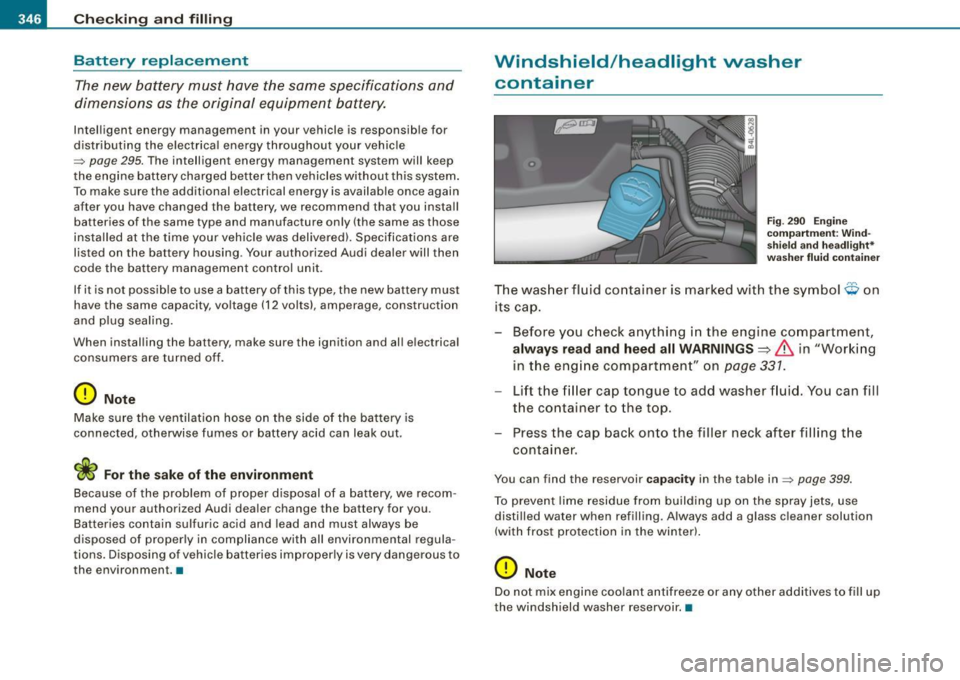
Fi g. 290 Engine
co mpartment : Wind
s hield and h eadli ght *
washer fluid container
T he w as her fluid co ntainer is m arke d with the sy mbol ¢' on
its cap .
- Before you c heck anything in the engine compartment,
always read and heed all WARNINGS~
& in "Wor kin g
in t he en gine comp artmen t" on
page 33 7.
- Lift the fi ller cap tongue to add washer fluid. You can fill
the containe r to the top.
- Press the cap bac k on to the filler neck after fi lling t he
contai ner .
You can find the reservoir capa city in the tab le in ::} page 399.
To prevent lim e residue from building up on the sp ray je ts, use
distilled water when refilling . Always add a glass cleaner solution
(with fr ost protection in the winter).
0 Note
Do no t mix engine coo lant antifreeze or any o ther additives to fill up
the windshield washer reservoir. •
Page 351 of 426
________________________________________________ T_ i _r_e _s_ a_n_ d_ w_ h_ e_e _ l_s __ lllll
•
Groove
means the space between two adjacent tread ribs.
L oad ra ting (code)
means the maximum load that a tire is rated to carry for a given
inflation pressure. You may not find this information on all tires
because it is not required by law.
M ax im um l oad ra tin g
means the load rating for a tire at the maximum permissib le infla
tion pressure for that tire.
Ma ximum l oaded v ehi cle weigh t
means the sum of:
(a) Curb weight
(b) Accessory weight
(c) Vehic le capacity weight, and
(ct) Production options weight
M ax im um (p er mi ssibl e) infl ati on pr essur e
means the maximum cold inflation pressure to wh ich a tire may be
inflated. Also ca lled "maximum inflation pressure."
Normal occ upa nt wei ght
means 150 lbs. (68 kilograms) times the number of occupants
seated in the vehicle up to the to tal seating capacity of your vehicle.
O ccupant di stributi on
means distribution of occupants in a vehicle .
Outer di am eter
means the overall diameter of an inflated new tire.
O ve rall wi dth
means the linear distance between the exteriors of the sidewa lls of
an inflated tire, includ ing elevations due to labeling, decorations, or
protective bands or ribs.
Pl y
means a layer of rubber -coated para lle l cords.
P rodu ction opt io ns wei ght
means the combined weight of those installed regular production
options weighing over 5 lbs . (2.3 kg) in excess of those standard
i t ems wh ich they replace, not previously considered in curb weigh t
or accessory weight, including heavy duty brakes, ride levelers, roof
rack, heavy duty battery, and specia l trim .
Radi al p ly tire
means a pneumatic tire in which the ply cords that extend to the
beads are laid at substantially 90 degrees to the centerline of the
tread .
Reco mm ended infl ati on pr essu re
see => page 348, "Cold tire inflation pressure".
Rein force d tir e
means a tire des ign to operate at higher loads and at higher infla
tion pressures than the corresponding standard tire. Reinforced
t ires may be identi fied as "XL", "x i", "EXTRA LOAD", or "RF" on the
sidewall.
R im
means a metal support for a tire or a tire and tube assembly upon
wh ich the t ire beads are seated.
Rim di amet er
means nominal diameter of the bead seat. If you change your whee l
size, you wi ll have to purchase new tires to match the new rim diam
eter .
Rim siz e de sig nation
means rim diameter and width.
Rim wid th
means nominal distance between rim flanges.
Vehicle care I t •