flat tire AUDI Q7 2009 Owner´s Manual
[x] Cancel search | Manufacturer: AUDI, Model Year: 2009, Model line: Q7, Model: AUDI Q7 2009Pages: 426, PDF Size: 97.13 MB
Page 358 of 426
-~_T_ ir_e _s_ a_n_ d_ w_ h _e_e_ l_ s _______________________________________________ _
The Gross Veh icl e We ight Rating and the Gross Axle Weight Rating
ar e l isted on th e safe ty comp lia nce st icker labe l located ei ther on
the driver's side 8 -p illar or on the inside of the fue l filler flap. Your
Audi has 5 seating positi ons, 2 in the fron t and 3 in the rea r for total
seating capacity of 5 . On vehicles with s ix seats*, your ve hicle has
two front seats, two seats in the second row seating an d two sea ts
i n t he t hir d row seating. On ve hic les w ith seven seats*, your ve hicle
has two front seats, three seats in the second row seating and two
seats in the th ir d row sea tin g. Eac h seat ing pos it ion has a seat belt
=>
page 231, " S afety belts".
T he fact that there is a n upper l imit to your ve hicle's Gro ss Vehic le
Weight Rating means that the total we ight of whatever is bein g
carried in the vehic le ( including the we ig ht of a t rai le r h itc h a nd the
t on gue wei ght o f the load ed trai ler) is lim ited. The more passen ge rs
in the ve hicle o r passe nger s w ho are heavier t han the s tanda rd
we ights assumed mea n th at l ess wei ght ca n be ca rri ed as lu gg age .
Th e tire pressure labe l on your Audi also lists the maximum
co mbi ned we igh t of all o f th e occ upa nts a nd luggage o r othe r ca rgo
that the vehicle can carry. For the location of the label=>
page 351,
fig . 291 .
LJ}. WARNING
Overloading a vehicle can cause loss of vehicle control , a crash or
other accident , serious personal injury , and even death .
• Carrying more weight than your vehicle was designed to carry
will prevent the vehicle from handl ing properly and increase the
ri sk of the loss of vehicle control.
• The brakes on a vehicle that has been overloaded may not be
able to stop the vehicle within a safe distance.
• Tires on a vehicle that has been overloaded can fail suddenly ,
including a blowout and sudden deflation , causing loss of control
and a crash .
• Always make sure that the total load being transported -
including the weight of a trailer hitch and the tongue weight of a
& WARNING (continued)
loaded trailer -does not make the vehicle heavier than the
vehicle's Gross Vehicle Weight Rating .•
Determining correct load limit
Use the example below to calculate the
total weight of the passengers and
luggage or other things that you plan to
transport so that you can make sure that
your vehicle will not be overloaded.
Steps for Determining Correct
Load Limit
1. Locate the statement "THE COMBINED WEIGHT OF OCCUPANTS AND CARGO SHOULD NEVER EXCEED XXX KG OR XXX LBS"on your vehicle's placard (tire infla
tion pressure label)=>
page 351, fig. 291.
2. Determine the combined weight of the driver and passengers that will be riding
in your vehicle.
~
Page 361 of 426
__________________________________________________ T_ ir_e _ s_ a_ n _ d_ w_ h_ e_ e_ls _ ____.11111
New tires and replacing tires and wheels
New tires and wheels have to be broken in.
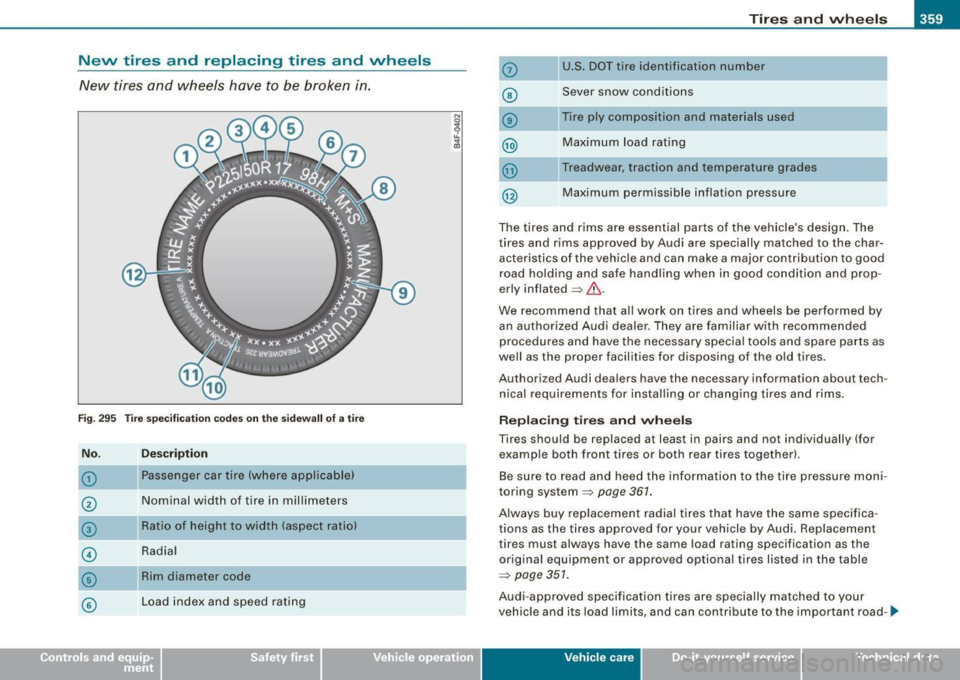
Fig. 295 Tire specification codes on the sidewall of a tire
No.
G)
@
©
©
©
©
Description
Passenger car tire (where appl icable)
Nominal width of tire in millimeters
Ratio of height to width (aspect ratio)
Radial
Rim diameter code
Load index and speed rating
0
©
U.S. DOT tire identificat ion number
Sever snow conditions
Tire ply composition and materials used
Maximum load rating
@ Treadwear, traction and temperature grades
@ Maximum permissible inflation pressure
The tires and rims are essential parts of the vehicle's design. The
tires and rims approved by Audi are specially matched to the char acteristics of the vehicle and can make a major contribution to good
road holding and safe handling when in good condition and prop
erly inflated =>& .
We recommend that all work on tires and wheels be performed by
an authorized Audi dealer. They are familiar with recommended
procedures and have the necessary special tools and spare parts as
well as the proper facilities for disposing of the old tires.
Authorized Audi dealers have the necessary information about tech
nical requirements for installing or changing tires and rims.
Replacing tires and wheels
Tires should be replaced at least in pairs and not individually (for
example both front tires or both rear tires together).
Be sure to read and heed the information to the tire pressure moni
toring system =>
page 361.
Always buy replacement radial tires that have the same specifica
tions as the tires approved for your vehicle by Audi. Replacement
tires must always have the same load rating specification as the original equipment or approved optional tires listed in the table
=> page 351.
Audi -approved specification tires are specially matched to your
vehicle and its load limits, and can contribute to the important road-.,_
Vehic le care I I irechnical data
Page 363 of 426
__________________________________________________ T_ ir_e_ s_ a_ n_d _ w_ h_ e_ e_l_s __ _
•
U.S. DOT Tire Identification Number (TIN) and tire
manufacture date
This is the tire's "serial number". It begins with the letters "DOT"
and indicates that the tire meets all federal standards . The next two
numbers or letters indicate the plant where it was manufactured,
and the last four numbers represent the week and year of manufac
ture . For example, the numbers 2208 mean that the tire was
produced in the 22th week of 2008. The other numbers are
marketing codes that may or may not be used by the tire manufac
turer. This information is used to contact consumers if a tire defect
requires a recall.
Tire ply composition and materials used
The number of plies indicates the number of layers of rubber-coated
fabric in the tire. In general, the greater the number of plies, the
more weight a tire can support. Tire manufacturers also must indi
cate the materials in the tire, which include steel, nylon, polyester,
and others.
Maximum Load Rating
This number indicates the maximum load in kilograms and pounds
that can be carried by the tire.
Tire quality grading for treadwear, traction, and
temperature resistance
Tread wear, traction and temperature grades~ page 363.
Maximum Permissible Inflation Pressure
This number is the greatest amount of air pressure that should ever
be put in the tire under normal driving conditions.
Replacing tires or rims on vehicles equipped with tire
pressure monitoring system
The wheels on your vehicle are equipped with a sensor which
constantly monitors the air pressure inside the tire, and then trans
mits this information to the tire pressure monitoring system. If you
are going to replace the wheel rims on your vehicle, make sure the new rims also have these sensors
. The sensors must be compatible
with the tire pressure monitoring system on your vehicle.
If you install rims, which do not have the sensors, or have sensors
which are not compatible, then the tire pressure monitoring system
will not work properly. In this case, the tire pressure monitoring
system would not be able to monitor the tire pressure or warn you
if it is necessary.
• The battery inside of the tire pressure sensor has a limited
service life.
• Always drive with the valve stem caps securely mounted. We
recommend using factory installed valve stem caps. Ask your autho
rized Audi dealer to replace lost valve stem caps .
The installation of replacement tires with steel cord body plies in
the tire sidewall may cause malfunction of the tire pressure moni
toring system, and is not recommended (cord material information
in molded on the tire sidewall).
Always check your tire pressure monitoring system indicator after replacing one or more tires on your vehicle. If the tire pressure
monitoring system indicator flashes, or is on, your system is not
working properly. Your replacement tire might be incompatible with
your tire pressure monitoring system, or some component of the
tire pressure monitoring system may be damaged.
& WARNING
• Using incorrect or unmatched tires and/ or wheels or improper
tire and wheel combinations can lead to loss of control, collision and serious personal injury.
• Always use tires, rims and wheel bolts that meet the specifica
tions of original factory-installed tires or other combinations that
have been specifically approved by the vehicle manufacturer .
• Tires age even if they are not being used and can fail suddenly,
especially at high speeds. Tires that are more than 6 years old can
only be used in an emergency and then with special care and at
lower speeds . .,.
Vehicle care
I t •
Page 364 of 426
_L_T~ i~ r ~e ~s '..... a ~ n~d ~ w~ h~e~ e::. l !.:s ~ ---------------------------------------------
& WARN ING (continued )
• Never mount used tire s on your vehicle if you are not sure of
their "pre vious history. " Old used tire s may have been damaged
even though the damage cannot be seen that c an lead to sudden
tire f ailure and los s of vehicle control .
• All four wheels must be fitted with radial tires of the same type,
s ize (rolling circumference ) and the same tread pattern. Driv ing
with different tires reduces veh icle handling and can lead to a loss
of cont rol.
• If the spare tire is not the same as the tires that are mounted
on the vehicle • for e xample with winter tires · only use the spare
tire for a short period of time and drive with extra care . Refit the
normal road wheel a s soon as safely possible.
• Never drive faster than the maximum speed for whi ch the tires
on your vehicle are rated because tires that are driven faster than
their rated speed can fail suddenly .
• Overloading tires cause heat build -up , sudden tire failure,
including a blowout and sudden deflation and lo ss of control.
• Temperature grades apply to tires that are properly inflated and
not over or underinflated.
• Fo r te chni cal reasons it is not always possible to use wheels
from other vehicles -in some cases not even wheels from the
same vehi cle model .
• If you install wheel trim di scs on the vehicle wheels , make sure
that the air flow to the brakes is not blo cked . Redu ced airflow to
the brakes can them to overheat , increasing stopping distances
and causing a collision .
• Run flat tires may only be used on vehicle s that were equipped
with them at the factory . The vehicle must have a chassis designed
for run flat tires and a factory -installed tire pressure monitoring
system that indi cates a loss of t ire pres sure . In corre ct u se of run
flat tires can lead to vehicle damage or accident s. Check with an
authorized Aud i dealer or tire specialist to see if your vehicle can
& WAR NING (continued )
be equipped with run flat tires . If run flat tires are used , they must
be installed on all four wheels . Mixing tire types is not permitted .
0 Note
• For tec hnical reas ons, it is not gen erally poss ible to use t he
whee l rims from other vehicles . T his can ho ld true for whee ls of the
sa me v ehicle type.
• I f the spare tire is different from the tires that you have mounted
o n yo ur vehicle ( for example wi nter tires or wide pro file tires), then
use the spare tire for a short period of time on ly and drive with extra
ca re. Replac e th e fl at t ire wi th the tire m atchi ng t he othe rs on you r
vehic le as soon as possib le .
• I f you should put different w heels and tires o n yo ur ve hic le (e. g.
winter wheels and t ires), you must be certain that the wheels and
t ires a re c omp atible with the tire pressure moni tor in g sys tem.
O therwise the system will register a malfunction and a fau lt
m es sage w ill be displayed . For more info rmation, c ontac t yo ur
authorized Audi dea ler.
0 Note
• When insta lling new tires, b e care fu l not to damage the va lv e s or
t ire p ressu re mon itoring syste m sensors .
• N ever drive without the valve stem cap . The va lves could get
damaged.
• I f the sensors must be replaced, then the valve must also be
r e pl ace d at t he same time .
'£> For the sake of the environment
Dispose o f old tires i n acco rdance wit h the local re qu ire ment s.•
Page 365 of 426
__________________________________________________ T_ ir_e_ s_ a_ n_d _ w_ h_ e_ e_l_s __ lllll
•
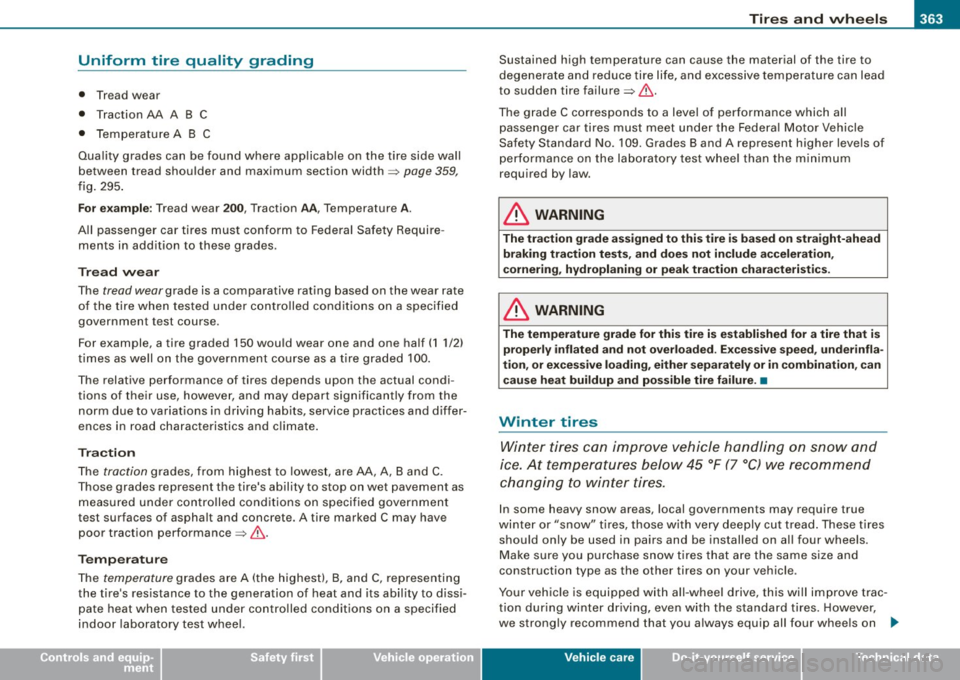
Uniform tire quality grading
• Tread wear
• Traction AA A B C
• Temperature A B C
Quality grades can be found where applicable on the tire side wall
between tread shoulder and maximum section width=>
page 359,
fig. 295.
For example: Tread wear 200, Traction AA, Temperature A.
All passenger car tires must conform to Federal Safety Require
ments in addition to these grades .
Tread wear
The tread wear grade is a comparative rating based on the wear rate
of the tire when tested under controlled conditions on a specified
government test course .
For example, a tire graded 150 would wear one and
one half (1 1/2)
times as well on the government course as a tire graded 100.
The relative performance of tires depends upon the actual condi
tions of their use, however, and may depart significantly from the
norm due to variations in driving habits, service practices and differ
ences in road characteristics and climate.
Traction
The traction grades, from highest to lowest, are AA, A, B and C.
Those grades represent the tire's ability to stop on wet pavement as measured under controlled conditions on specified government
test surfaces of asphalt and concrete. A tire marked C may have
poor traction performance => & .
Temperature
The temperature grades are A (the highest), B, and C, representing
the tire's resistance to the generation of heat and its ability to dissi
pate heat when tested under controlled conditions on a specified
indoor laboratory test wheel. Sustained high temperature can cause the material of the tire to
degenerate and reduce
tire life, and excessive temperature can lead
to sudden tire failure=>&.
The grade C corresponds to a level of performance which all passenger car tires must meet under the Federal Motor Vehicle
Safety Standard No. 109. Grades Band A represent higher levels of
performance on the laboratory test wheel than the minimum
required by law .
& WARNING
The traction grade assigned to this tire is based on straight-ahead
braking traction tests, and does not include acceleration,
cornering, hydroplaning or peak traction characteristics.
& WARNING
The temperature grade for this tire is established for a tire that is properly inflated and not overloaded. Excessive speed, underinfla
tion, or excessive loading, either separately or in combination, can
cause heat buildup and possible tire failure. •
Winter tires
Winter tires can improve vehicle handling on snow and
ice. At temperatures below 45 °F (7 °C) we recommend
changing to winter tires.
In some heavy snow areas, local governments may require true
winter or "snow" tires, those with very deeply cut tread. These tires
should only be used in pairs and be installed on all four wheels .
Make sure you purchase snow tires that are the same size and
construction type as the other tires on your vehicle .
Your vehicle is equipped with all -wheel drive, this will improve trac
tion during winter driving, even with the standard tires. However,
we strongly recommend that you always equip all four wheels on .,_
Vehicle care I t •
Page 366 of 426

_L_T~i~r~e~s'.....a~n~d~w~h~e~e::.l!.:s ~---------------------------------------------
your vehicle with correctly fitted winter tires or a ll- season tires,
w hen winter ro ad condit ions are e xpected. T his also i mproves the
vehic le 's brak ing performance and reduces stopp ing distances.
Summer tires provide less grip on ice and snow .
Winter tires (s now ti res) mus t always be fitted on a ll four whe els .
Compatible tire pressure monitoring sensors must be installed on
all f our winte r tires fo r th e tir e pres su re m onitori ng sy stem to f unc
tion properly=>
page 367 .
Ask your authorize d Audi dealer or qualified worksho p for permitted
winter tire sizes. Use on ly rad ial winter t ires .
Winter tires lose their effectiveness when the tread is worn down to a depth of 0 .157 inc h (4 m m).
O nl y dr ive w ith w in ter tires unde r winter co nditio ns. Su mmer tires
handle bette r when there is no snow o r ice on the roads and the
t emp eratur e i s abo ve 45 °F (7 °C) .
If you have a f la t t ire, see not es on spar e wh eel=> page 359 .
Please a lways reme mber that winte r tir e s may have a l owe r speed
rat ing t han th e tire s orig inal ly in sta lled o n your v ehic le at t he ti me
it wa s manufactured . Please see=>
page 3 60, "S pee d rating (letter
co de) " f or a list ing o f the spe ed rating letter c odes and t he
maximum speed at which the ti res can be driven .
T h e sp eed rating lette r co de( ::::>
page 350) is on t he sid e w all of the
tire=>
page 3 59.
& WARNING
Winter tires have maximum speed limits that may be lower than
your vehicle's maximum speed . Always know the maximum speed
before driving off . Never dr ive faster than the speed permitted for
your specific winter tires. This will cause damage to the tires
leading to an accident and serious personal injury to you and your
passengers .
& WARNING
Driving faster than the maximum speed for whi ch the winter tires
on your vehicle were designed can cause tire failure including a
blowout and sudden deflation , loss of control , crashes and serious
personal injuries. Have worn or damaged tires replaced immedi
ately.
• Winter tires have maximum speed rating that may be lower
than your vehicle's maximum speed .
• Never drive faster than the speed for which the winter or other
tires installed on your vehicle are rated.
& WARNING
Always adjust your driving to the road and traffic conditions .
Never let the good acceleration of the winter tires and all -wheel
dr ive tempt you into taking extra risks . Always remember :
• When braking , an all -wheel drive vehicle handle s in the same
way as a front drive vehicle .
• Drive carefully and reduce your speed on icy and slippery roads,
even winter tires cannot help under black ice conditions .
~ For the sake of the environment
Use summer tires when weather conditions permit . They are
q uieter, d o not wear as qu ick ly and re duce fue l c on sumption .•
Snow chains
S now c hains may be fitted on ly to t he rear w hee ls, and only to
certain tire sizes. Ask your autho rized A udi dea ler on which tire
s izes sn ow cha ins ca n be used .
T he snow chains must hav e low -prof ile links and must not be thicker
th an 0 .53 in ch (13 .5 mm), inc lu d in g the loc k. .,_
Page 368 of 426
-~_T_ ir_e_ s_ a_ n_d _ w_ h_ e_e _l_s _________________________________________________ _
0 Note
The specified torque for the wheel bolts is 120 ft lb (160 Nm) with a
tolerance of± 7,4 ft lb(± 10 Nm). Torque wheel bolts diagonally.
After changing a wheel, the torque must be checked as soon as
possible with a torque wrench -preferably by an authorized Audi
dealer or qualified workshop. •
Low aspect ratio tires
Your Audi is factory-equipped with low aspect ratio tires. These tires
have been thoroughly tested and been selected specifically for your
model for their superb performance, road feel and handling under
a variety of driving conditions . Ask your authorized Audi dealer for
more details.
The low aspect ratio of these tires is indicated by a numeral of
55 or
less
in the tire's size designation. The numeral represents the ratio
of the tire's sidewall height in relation to its tread width expressed
in percentage. Conventional tires have a height/width ratio of 60 or
more.
The performance of low-aspect-ratio tires is particularly sensitive to
improper inflation pressure. It is therefore important that low
aspect ratio tires are inflated to the specified pressure and that the
inflation pressure is regularly checked and maintained. Tire pres
sures should be checked at least once a month and always before a
long trip~
page 353, "Checking tire pressure".
What you can do to avoid tire and rim damage
Low aspect ratio tires can be damaged more easily by impact with
potholes, curbs, gullies or ridges on the road, particularly if the tire
is underinflated.
In order to minimize the occurrence of impact damage to the tires
of your vehicle, we recommend that you observe the following precautions: •
Always maintain recommended inflation pressures. Check your
tire pressure every 2,000 miles (3,000 km) and add air if necessary.
• Drive carefully on roads with potholes, deep gullies or ridges.
The impact from driving through or over such obstacles can
damage your tires. Impact with a curb may also cause damage to
your tires.
• After any impact, immediately inspect your tires or have them
inspected by the nearest authorized Audi dealer. Replace a
damaged tire as soon as possible.
• Inspect your tires every 2,000 miles (3,000 km) for damage and
wear. Damage is not always easy to see. Damage can lead to loss of
air and underinflation, which could eventually cause tire failure. If
you believe that a tire may have been damaged, replace the tire as
soon as possible.
• Th ese tires may wear more quickly than others.
• Please also remember that. while these tires deliver responsive
handling, they may ride less comfortably and make more noise than
other choices.
Reduced performance in winter/cold season
conditions
All tires are designed for certain purposes. The low aspect ratio,
ultra high performance tires originally installed on your vehicle are
intended for maximum dry and wet road performance and handling.
They are not suitable for cold, snowy or icy weather conditions. If
you drive under those circumstances, you should equip your vehicle
with all -season or winter tires, which offer better traction under
those conditions. We suggest you use the recommended snow or all -season tires specified for your vehicle, or their equivalent.
Refer to~
page 363for more detailed information regarding winter
tires. •
Page 372 of 426
lllffll.___W_ h_ a_t _d_ o_ l _d _o_ n_ o_ vv_ ? ______________________________________________ _
What do I do now?
Jack, tools and inflatable spare tire
Jack and folding chocks
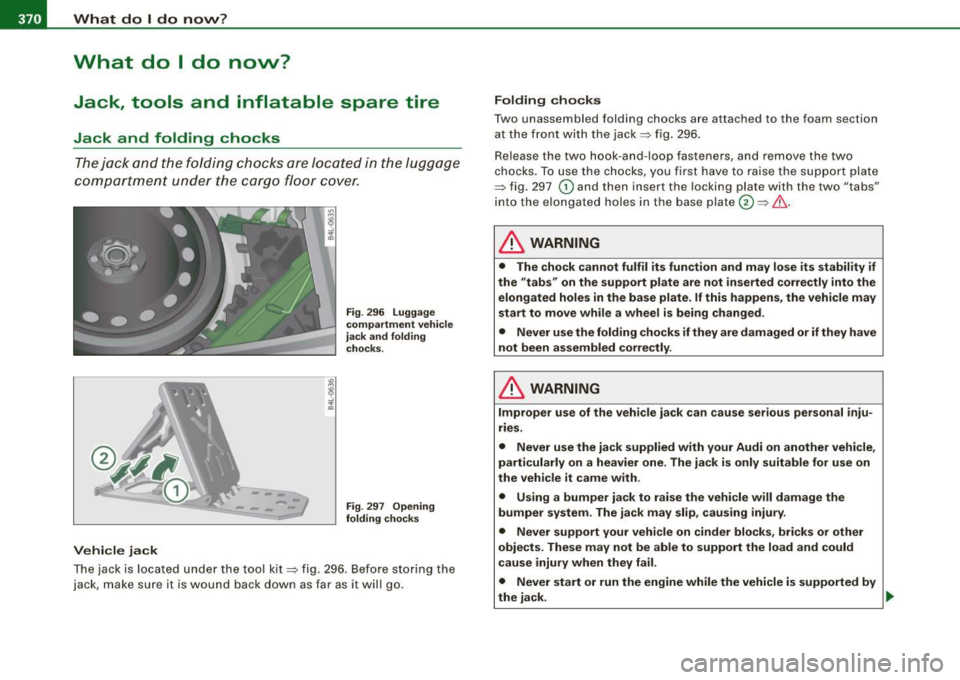
The jack and the folding chocks are located in the lug gage
comp artmen t under t he ca rgo floor co ver.
Vehicle jack
Fig . 296 Luggage
comp artment v ehi cle
jack and fold ing
c ho ck s.
Fig . 2 97 Opening
fold ing ch ocks
The jac k is located under the too l kit:::;, fig. 296 . B efore sto ring the
jack, ma ke su re it is wo und back down as fa r as it w il l go.
Folding chocks
Two unassembled fold ing chocks a re attached to the foam section
at the fron t w ith th e jack :::;, fig. 296 .
Release the two hook -and -loop fasteners, and remove the two
chocks . To use the chock s, you fi rst ha ve to raise the sup port pla te
:::;, fig. 297
G) and then insert the locking plate with the two "tabs"
into the e longated holes in the base plate@:::;,& .
& WARNING
• The chock cannot fulfil its fun ction and may lose its stability if
the "tabs " on the support plate are not inserted corre ctly into the
elongated holes in the base plate. If this happens , the vehicle may
sta rt to move while a wheel is being changed .
• Never u se the folding chocks if they are damaged or if they have
not been assembled co rre ctly .
& WARNING
Improper use of the vehi cle jack can cause serious pe rsonal inju
rie s.
• Never use the jack supplied with your Audi on another vehicle,
particularly on a heavier one. The jack is only suitable for use on
the veh icle it came with .
• Using a bumper jack to raise the veh icle will damage the
bumper system . The jack may slip , caus ing injury .
• Never support your vehicle on cinder blocks , bricks or other
objects. These may not be able to support the load and could
cause injury when they fail.
• Never start or run the engine while the vehicle is supported by
the jack .
~
Page 373 of 426
_____________________________________________ W.:..:..; h:..:.= a:.:t ..:.d=-= o:....:... I .::d :.:o :....:.. n:.:o::.. w.:...:.. ?:...___J -
& WARNING !continued)
• If you must work under the vehicle, always use safety stands
specifically designed for this purpose.
• Always make sure the inflatable spare tire and even a flat tire
are secured in place and not loose, otherwise they could fly
forward, causing personal injury to passengers in the vehicle in an
accident or sudden maneuver . •
Tools
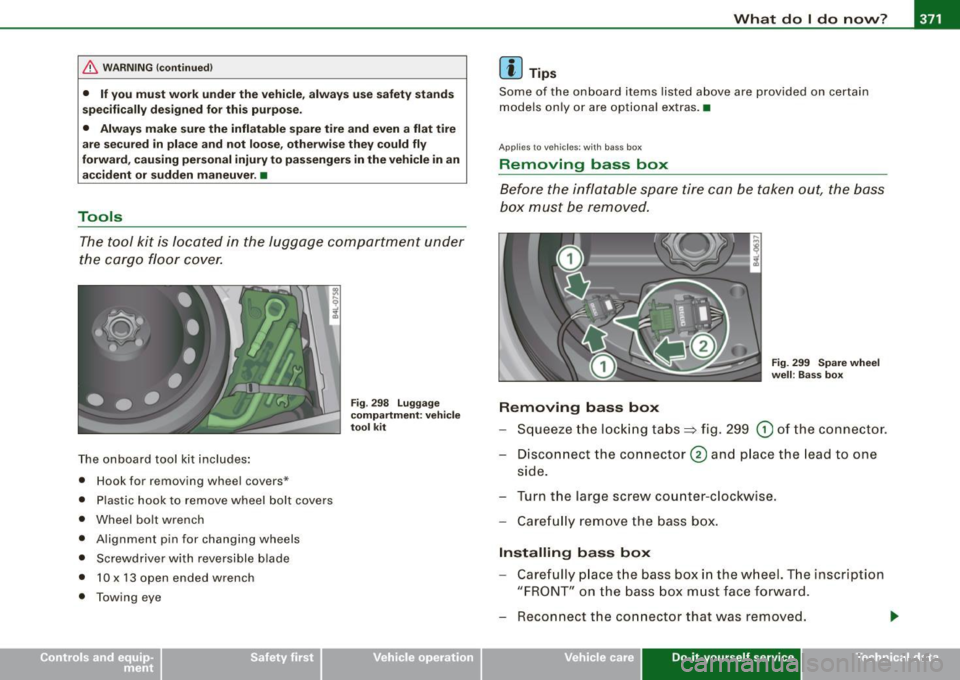
The tool kit is located in the luggage compartment under
the cargo floor cover.
The onboard tool kit includes:
• Hook for removing wheel covers *
• Plastic hook to remove wheel bolt covers
• Wheel bolt wr ench
• Alignment p in for changing wheels
• Screwdriver with reversible blade
• 10
x 13 open ended wrench
• Towing eye
Fig . 298 Luggage
compartment : vehicle
tool kit
[ i] Tips
Some of the on board items listed above are provided on certain
models only or are optional extras .•
A pp lies to ve hicles: w ith bass box
R emoving bass box
Before the inflatable spare tire can be taken out, the bass
box must be removed.
Fig . 299 Spare wheel
well : Bass box
Removing bass box
- Squeeze the locking tabs~ fig. 299 G) of the connector.
- Disconnect the connector @ and place the lead to one
side.
- Turn the large screw counter-clockwise.
- Carefully remove the bass box.
Installing bass box
-Carefully place the bass box in the wheel. The inscription
" FRONT " on the bass box must face forward.
- Reconnect the connector that was removed.
Vehicle care Do-it-yourself service irechnical data
Page 374 of 426

-What do I do novv? PV:f.,___ ______________ _
-Secu re th e bass b ox w it h t he larg e sc re w. •
Inflatable spare t ire
T he i nfla tab le sp are tir e ex pand s to its full di amet er wh en
it is inflated.
Removing inflatable spare tire
Fig . 300 Inflat able
spare t ire with
compres sor
Li ft up th e carg o floo r u sing the handl e.
- T urn t he l arg e scre w:::> fig. 300 coun ter-c loc kwi se.
Re move the bass bo x as req uir e d :::>
page 371.
- Take o ut th e inflatable s pare t ire.
Stowing the inflatable spare tire
Relea se th e air by un screwing the valve st em .
Sc re w the va lv e st em b ack in afte rwards.
Wait a few hours b efo re pl acin g the wh eel in th e sp are
w he el w ell :::>
& .
Install t he bass b ox as require d:::> page 371.
S ec ure the whe el wit h th e large s cre w. - Fo
ld the cargo floor bac k d own.
After using the inflatable spare wheel
The inflatab le spare ti re can be re-used as long as it is not damaged
an d is n ot worn d own to the tre ad wea r indi cato rs=> &.
When you l et the air out of the inflatabl e spare tir e, it do es not
a ss ume it s fo lded shape aga in for severa l hou rs . U ntil then, it
c annot be plac ed bac k in the sp are whe el well and s tow ed sec urel y.
& WARNING
• Never use the spare tire if it is damaged or if it is worn down to
the tread wear indicators.
• If the inflatable spare tire is more than 6 years old, use it only
in an emergency and with extreme caution and careful driving.
• The inflatable spare tire is intended only for temporary and
short-term use. It should be replaced as soon as possible with the
normal wheel and tire .
• Maximum inflation pressure for the inflatable spare tire is
50 PSI (3 .5 bar).
• Maximum permissible speed is 50 mph (80 km /h ).
• Avoid full -throttle acceleration , heavy braking, and fast
cornering .
• When the air is let out of the inflatable spare wheel , it does not
assume its folded shape for several hours . Until then , it cannot be
placed back in the spare wheel well and stowed securely .
• Never drive with more than one inflatable spare tire.
• For technical reasons , the use of tire chains on the inflatable
spare tire is not permitted . If it is necessary to drive with tire
chains, the inflatable spare wheel must be mounted on the front
axle in the event of a flat in a rear tire. The newly available front
wheel must then be installed in place of the rear wheel with the
flat tire . Installing the tire chain before mounting the wheel and
tire is recommended . .,.