seat adjustment AUDI Q7 2009 Owner´s Manual
[x] Cancel search | Manufacturer: AUDI, Model Year: 2009, Model line: Q7, Model: AUDI Q7 2009Pages: 426, PDF Size: 97.13 MB
Page 250 of 426
___ A_ ir_ b_ a-g _ s_y _s_ t_ e_ m _________________________________________________ _
& WARNING (continued)
• If you must install a rearward facing child safety seat on the
front passenger seat because of exceptional circumstances and
the PASSENGER AIR BAG OFF light does not come on and stay on,
immediately install the rear-facing child safety seat in a rear
seating position and have the airbag system inspected by your
authorized Audi dealer.
& WARNING
If, in exceptional circumstances, you must install a forward-facing
child restraint on the front passenger's seat:
• Always make sure the forward -facing seat has been designed
and certified by its manufacturer for use on a front seat with a
passenger front and side airbag.
• Never put the forward-facing child restraint up against or very
near the instrument panel.
• Always move the passenger seat into its rearmost position in
the seat's fore and aft adjustment range, as far away from the
airbag as possible, before installing the forward-facing child
restraint . The backrest must be adjusted to an upright position.
• Make sure that the PASSENGER AIR BAG OFF light comes on
and stays on all the time whenever the ignition is switched on. •
Advanced Airbag System components
The front passenger seat in your vehicle has a lot of very important
parts of the Advanced Airbag System in it. These parts include the
weight-sensing mat, sensors, wiring, brackets, and more. The func
tion of the system in the front passenger seat is checked by the elec
tronic control unit when the ignition is on. The control unit monitors
the Advanced Airbag System and turns the airbag indicator light on
when a malfunction in the system components is detected. The
function of the airbag indicator light is described in greater detail below
. Because the front passenger seat contains important parts
of the Advanced Airbag System, you must take care to prevent it
from being damaged. Damage to the seat may prevent the
Advanced Airbag for the front passenger seat from doing its job in
a crash .
The front Advanced Airbag System consists of the
following:
• Crash sensors in the front of the vehicle that measure vehicle
acceleration/deceleration to provide information to the Advanced
Airbag System about the severity of the crash.
• An electronic control unit, with integrated crash sensors for front
and side impacts. The control unit "decides" whether to fire the
front airbags based on the information received from the crash
sensors. The control unit also "decides" whether the safety belt
pretensioners should be activated.
• An Advanced Airbag with gas generator for the driver inside the
steering wheel hub .
• An Advanced Airbag with gas generator inside the instrument
panel for the front passenger.
• A weight-sensing mat under the upholstery padding of the front
passenger seat cushion that measures the total weight on the seat.
The information registered is sent continuously to the electronic
control unit to regulate deployment of the front Advanced Airbag on
the passenger side.
• An airbag monitoring system and indicator light in the instru
ment cluster ~
page 252.
• The PASSENGER AIR BAG OFF light comes on and stays on in the
center of the instrument panel~
page 253, fig. 253 and tells you
when the front Advanced Airbag on the passenger side has been
turned off.
• A sensor below the safety belt latch for the front seat passenger
to measure the tension on the safety belt. The tension on the safety
belt and the weight registered by the weight -sensing mat help the
control unit "decide" whether the front airbag for the front ..
Page 266 of 426
-Child Safety ------=---------------------------------
& WARNING (continued )
• Always install rear-facing child safety seats on the rear seat .
• If you must install a rearw ard fa cing child safety seat on the
front passenger seat in exceptional circumstances and the
PASSENGER AIR BAG OFF light does not come on and stay on,
immediately install the rear-facing child safety seat in a rear
seating posit ion and have the airbag system inspected immedi
ately by your authorized Audi dealer .
& WARNING
If, in exceptional circumstances, you must install a forward -facing
child restraint on the front passenger's seat :
• Always make sure the forward -facing seat has been designed
and certified by its manufacturer for use on a front seat with a
passenger front and side airbag.
• Always follow the manufacturer's instructions provided with
the child safety seat or carrier.
• Always move the passenger seat into its rearmost position in
the seat's fore and aft adjustment range , as far away from the
a irbag as possible before installing the child restraint . The back
rest must be adjusted to an upright position.
• Always make sure that the PASSENGER AIR BAG OFF light
comes on and stays on all the time whenever the ignition is
switched on . •
Advanced front airbag system and children
Y our vehicle is equipped with an " Advanced Airbag Syste m" in
co mplia n ce wi th Unit ed States F edera l Moto r Veh icle Saf ety S tan
dard ( FMVSS) 208 as appl icable at the time your vehicle was manu
f actu re d . T
he Advanced Airbag system in your vehicle has been certified to
m eet the " lo w -ris k" req uiremen ts for 3 and 6 year -ol d c hildren on
the passenger side a nd smal l adults on the driver side . The low risk
de ploymen t criteria a re i ntended to reduce the risk of i nju ry t hroug h
interaction with the airbag that can occur, for example, by bei ng too
close to the s tee rin g w heel and instrume nt panel whe n the ai rbag
i n fl ates. In add it ion, t he sys tem has been cer tified to co mply wi th
the "suppre ssion" req uirement s of the Safety Standa rd, to turn off
the front a irbag f or infants up to 12 month s who ar e restrai ned on
the front passenger seat in child restraints that are listed in the
S tan dard.
E ven though your vehicle is equipped with an Advanced Airbag
sy stem , a ll ch ildr en, especia lly those 12 yea rs and yo unge r, should
a lways ride i n the back seat prop erly re stra ined for t heir a ge and
s ize . The ai rbag on the pas se nger side make s th e fr on t sea t a poten
t ia lly dangero us p lace for a c hild to r ide. The front seat is no t the
safest p lace for a child in a forward -facing child safety seat. It can be
a ve ry da nger ous place for a n inf ant or a la rg er c hild i n a rea rward
facing seat. •
Advanced Airbags and the weight-sensing
mat in the front seat
Th e Ad vanced Ai rbag Sys te m in your vehic le de tec ts the prese nce
o f an inf ant or c hild in a chi ld rest raint on the front pass eng er s eat
us ing the weight -sensing mat in the seat cushion and the senso r
b elow t he safety be lt latch on t he front pass enger s eat that
measures the tension on the safety belt.
T he weig ht-se nsin g m at m easu res total weig ht of th e chi ld an d th e
c h ild safety s eat and a ch ild bl anket on the front passen ger seat . T he
w eig ht on th e front p assenge r seat is re la te d to th e des ig n of t he
c h ild re straint and its "footpr int", t he size and shap e of the bottom
of t he child restraint a s it sits on the seat . Th e w eight of a child
r e stra int and its "footprint" vary for diff ere nt k inds of c hild ..,.
Page 270 of 426
___ C_h_ i_ld _ S_ a_ f_ e_ t-= y'------------------------------------------------
& WARNING (continued)
-Always move the front passenger seat into the rearmost
position of the passenger seat's fore and aft adjustment range,
and as far away from the airbag as possible before installing
the child restraint.
- Always make sure that nothing prevents the front
passenger's seat from being moved to the rearmost position in
its fore and aft adjustment range .
- Always make sure that the backrest is in the upright posi
tion.
• Always buckle the child safety seat firmly in place even if a
child is not sitting in it. A loose child safety seat can fly around
during a sudden stop or in a collision.
• Always read and heed all WARNINGS whenever using a child
restrained in a vehicle is being used=>
page 231, "Safety belts",
=>
page 241, "Airbag system" and=> page 263, "Child Safety".
& WARNING
To reduce the risk of serious injury, make sure that the PASSENGER
AIR BAG OFF light comes on and stays on whenever a child
restraint is installed on the front passenger seat and the ignition
is switched on.
• Take the child restraint off the front passenger seat and install
it properly at one of the rear seat positions if the PASSENGER AIR
BAG OFF light does not stay on.
• Have the airbag system inspected by your authorized Audi
dealer immediately. •
Child safety seats
Infant seats
Babies and infants up to about one year old and 22 lbs or
10 kg need special rearward-facing child restraints that
support the back, neck and head in a crash.
Fig . 258 Rearward
facing infant seat,
properly installed on
the rear seat
-When using the vehicle safety belt to install a child safety
seat, you must first activate the convertible locking
retractor on the safety belt to prevent the child safety
seat from moving~
page 273 or install the seat using
the LATCH attachments.
- Push the child safety seat down with your full weight to
get the safety belt really tight so that the seat cannot
move forward or sideways more than one inch (2.5 cm).
Infants up to about one year (22 lbs. or 10 kg) are best protected in
special infant carriers and child safety seats designed for their age
group. Many experts believe that infants and small children should
ride only in special restraints in which the child faces the back of the
vehicle. These infant seats support the baby's back, neck and head
in a crash . These child safety seats must never be used in the front
seat because of the risk of serious injury or death should the airbag
deploy in a crash=> fig. 258. ..
Page 272 of 426
___ C_ h_ il_ d _S_ a_fe _ ty ______________________________________________ _
The airbag on the passenger side makes the front seat a potent ial ly
d an ge rous plac e for a c hild to ride. The front seat is not the s afest
place for a c hild in a forward -f a cin g ch ild safet y se at. It is a v ery
d ange ro us p lace f or an infa nt or a la rge r ch ild in a rea rward -f aci ng
s e at.
& WARNING
Not using a child safety seat, using the wrong child safety seat or
improperly installing a child restraint increases the risk of serious
personal injury and death in a collision or other emergency situa
tion.
• Children on the front seat of any car , even with Advanced
Airbags , can be seriously injured or even killed when an airbag
inflates . A child in a rearward -facing child safety seat installed on
the front passenger seat will be seriously injured and can be killed
if the front airbag inflates -even with an Advanced Airbag System .
• The inflating airbag will hit the child safety seat or infant
carrier with great force and will smash the child safety seat and
child against the backrest , center arm rest, or door .
• Always install rear -facing child safety seats on the rear seat .
• If you must install a rearward facing child safety seat on the
front passenger seat because of exceptional c ircumstances and
the PASSENGER AIR BAG OFF light does not come on and stay on ,
immediately install the rear -facing child safety seat in a rear
seating position and have the airbag system inspected by your
authorized Audi dealer.
• Always read and heed all WARNINGS whenever using a child
restrained in a vehicle is being used =:>
page 231, "Safety belts ",
=> page 241, "Airbag system" and=:> page 263, "Important things
to know ".
& WARNING
If exceptional c ircumstances require the use of a forward-facing
child restraint on the front passenger's seat , the child's safety and
well -being require that the following special precautions be taken:
• Make sure the forward -facing seat has been designed and certi
fied by its manufacturer for use on a front seat with a passenger
front and side airbag .
• Always follow the manufacturer's instructions provided with
the child safety seat or carrier.
• Always move the front passenger seat into the rearmost posi
tion of the passenger seat's fore and aft adjustment range, and as
far away from the airbag as poss ible before installing the child
restraint.
• Always make sure that nothing prevents the front passenger's
seat from being moved to the rearmost position in its fore and aft
adjustment range.
• Always make sure the backrest is in an upright position .
• Make sure that the PASSENGER AIR BAG OFF light comes on
and stays on all the time whenever the ignition is switched on.
• If the light does not stay on , perform the checks
=> page 252,
"Monitoring the Advanced Airbag System" .
• Take the child restraint off the front passenger seat and install
it properly at one of the rear seat positions if the PASSENGER AIR
BAG OFF light does not stay on whenever the ignition is switched
on .a
Page 276 of 426
___ C_h_ i_ ld _ S_ a_ f_ e_ t_y ____________________________________________ _
& WARNING (continued)
• If the backrest is not securely latched, the child and the child
restraint will be thrown forward together with the backrest and
will strike parts of the vehicle interior . The child can be seriously
injured or killed.
• Never install rear-facing child safety seats or infant carriers on
the front passenger seat. A child will be seriously injured and can be killed when the passenger airbag inflates .
• The inflating airbag will hit the child safety seat or infant
carrier with great force and will smash the child safety seat and
child against the backrest, center arm rest, door or roof.
• Always install rear-facing child safety seats or infant carriers on
the rear seat.
• Forward-facing child safety seats or infant carriers installed on
the front passenger's seat may interfere with the deployment of
the airbag and cause serious injury to the child.
• It is safer to install a forward-facing child safety seat on the rear
seat. • Always read and heed all WARNINGS whenever using a child
restrained in a vehicle is being used
~ page 263. Special precau
tions apply when installing a child safety seat on the front
passenger seat
~ page 243, "Child restraints on the front seat -
some important things to know ".
L1}. WARNING
Always take special precautions if you must install a forward or
rearward -facing child restraint on the front passenger's seat in
exceptional situations:
• Whenever a forward or rearward -facing child restraint is
installed on the front passenger seat, the PASSENGER AIR BAG
OFF light must come on and stay on whenever the ignition is
switched on .
& WARNING (continued)
• If the PASSENGER AIR BAG OFF light does not come on and stay
on, perform the checks described
~ page 252, "Monitoring the
Advanced Airbag System" .
• Take the child restraint off the front passenger seat and install
it properly at one of the rear seat positions if the PASSENGER AIR
BAG OFF light does not stay on whenever the ignition is switched
on .
• Improper installation of child restraints can reduce their effec
tiveness or even prevent them from providing any protection.
• An improperly installed child restraint can interfere with the
airbag as it deploys and seriously injure or even kill the child.
• Always carefully follow the manufacturer's instructions
provided with the child safety seat or carrier.
• Never place additional items on the seat that can increase the
total weight registered by the weight-sensing mat and can cause injury in a crash.
L1}. WARNING
Forward-facing child restraints:
• Always make sure the forward -facing seat has been designed
and certified by its manufacturer for use on a front seat with a
passenger front and side airbag.
• Never put the forward-facing child restraint up , against or very
near the instrument panel .
• Always move the passenger seat into its rearmost position in
the seat's fore and aft adjustment range, as far away from the airbag as possible before installing the forward-facing child
restraint . The backrest must be adjusted to an upright position.
• Make sure that the PASSENGER AIR BAG OFF light comes on
and stays on all the time whenever the ignition is switched on . _.
Page 298 of 426
llffl __ ln_ t _e_ ll-'"ig ...,_ e_ n_t _t_ e_ c_ h _ n_o _ l_o _,.g= y,_ __________________________________________ _
Vehicle stands for an extended period
If you do not drive your vehicle over a period of several days or
weeks, electrical components are gradually cut back or switched off.
This reduces energy consumption and maintains starting capability
over a longer period.
Take into consideration that when you unlock your vehicle, some
convenience functions, such as the remote key or power seat
adjustment, may not be available. The convenience functions will be
available again when you turn on the ignition and start the engine.
With the engine turned off
If you listen to the radio, for example, with the engine turned off or
use other MMI functions, the battery is being discharged.
If starting capability is jeopardized due to energy consumption, the
following warning appears in the MMI display:
Please start engine, otherwise system will switch off in
3 minutes.
The warning indicates that the system will be turned off automati
cally after 3 minutes. If you wish to continue using the functions,
you have to start the engine.
With the engine running
Although electrical energy is generated when the vehicle is being
driven, the battery can become discharged. This happens mostly
when little energy is being generated and a great deal consumed and the battery's state of charge is not optimal.
To bring the energy balance back into equilibrium, consumers
which require especially large amounts of energy are temporarily
cut back or switched off. Heating systems in particular require a
great deal of energy. If you notice, for example, that the heated
seats* or the heated rear window are not heating, they have been
temporarily cut back or switched off. These systems will be available
again as soon as the energy balance has been restored.
You will also notice that engine idle speed has been increased
slightly. This is normal and not a cause for concern. By increasing engine idle speed the additional energy required is generated and
the battery is charged. •
Driver notification in the instrument cluster
display
If battery power drops into the range where it can limit the ability of
the engine to start, this is shown in the instrument cluster display
with the following driver message:
C Low battery charge: battery will be charged while driving
This notification reminds you that the starting capability of the
engine may be limited. As soon as you start driving again, the
battery will be recharged and the notification will go out.
Driver notification appears and goes out again
If this driver notification appears after the ignition is turned on or
while driving and it goes out again after a while, the battery has
been adequately recharged.
Driver notification appears and does not go out again
If this driver notification appears after the ignition is turned on or
while driving and does not go out again, the battery's state of
charge is not in the optimal range. Starting ability is restricted. Have
the battery checked as soon as possible by an authorized Audi dealer or qualified workshop. •
Page 384 of 426
lllftl.,___F_ u_ s_ e_s _ a_n _ d_ b_ u_lb _ s _______________________________________________ _
[ i J Tips
You are well advised to keep a supply of spare fuses in your vehicle .
Fuses with the proper ampere ratings are available at your autho
rized Audi dealer. •
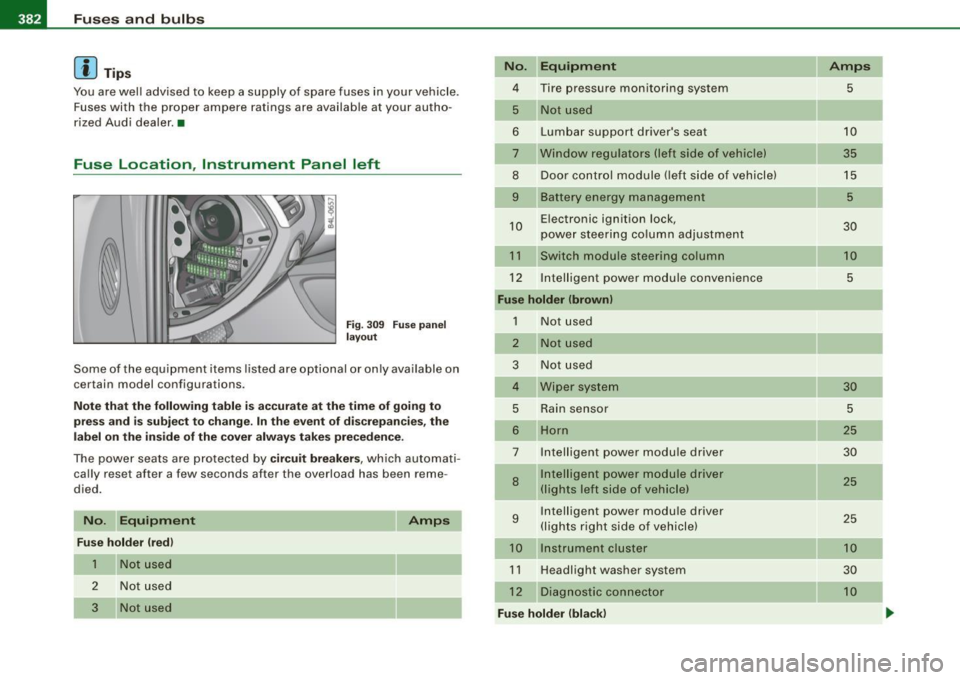
Fuse Location, Instrument Panel left
Fig . 309 Fuse panel
layout
Some of the equipment items listed are optional or only available on
certain model configurations .
Note that the following table is accurate at the time of going to
press and is subject to change. In the event of discrepancies, the
label on the inside of the cover always takes precedence.
The power seats are protected by circuit breakers, which automati
cally reset after a few seconds after the overload has been reme
died.
No.
Equipment
Fuse holder (red)
1
2
3
Not used
Not used
Not used
Amps
No. Equipment
4 Tire pressure monitoring system
5 Not used
6 Lumbar support driver's seat
7 Window regulators (left side of vehicle)
8 Door control module (left side of vehicle)
9 Battery energy management
10 Electronic ignition lock,
power steering column adjustment
11 Switch module steering column
12 Intelligent
power module convenience
Fuse holder (brown)
1
2
Not used
Not used
3 Not used
4 Wiper system
5 Rain sensor
6 Horn
7
8
9
Intelligent power module driver
Intelligent power module driver
(lights left side of vehicle)
Intelligent power module driver
(lights right side of vehicle)
10 Instrument cluster
11 Headlight washer system
12 Diagnostic connector
Fuse holder (black) Amps
5
10
35 15
5
30
10 5
30
5
25
30
25 25
10
30
10
-
Page 385 of 426
Fuses and bul bs 11111 ________________________________ ..:....:,:_=-.::..:....:.;.:_.:..:..,_,;__,;____,J
....
No.
1
-
2
3
4
5
6
Eq uipm ent
Headlight electronic system (left side of vehi -
cle)
Adaptive Cruise Control
Not used
Audi lane assis t
Not used
Terminal 15 (interior)
Oil level sensor
8 Diagnostic connector
9 Automatic dipping interior mirror
10 Homelink
1 1 Control module Gateway
12 Headlight range adjustment
Amps
10
5
10
5
5
5
5
5
5
5
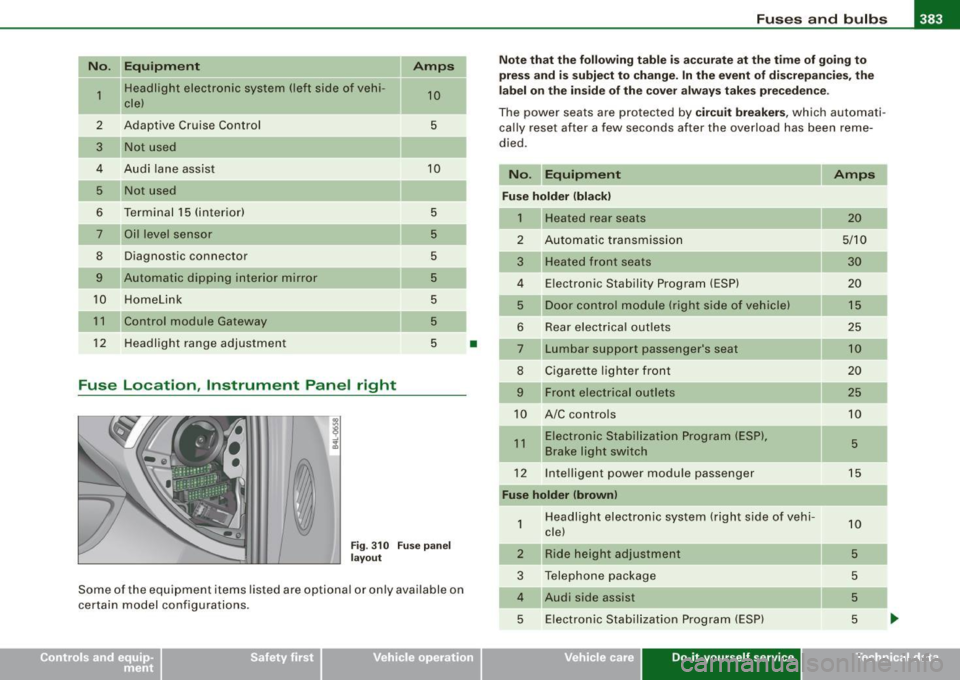
Fuse Location , Instrument Panel right
Fi g. 310 F use pane l
l ayo ut
Some of the equipment items listed are optional or only avai lable on
certain model configurations .
•
Note that th e fo llo wi ng ta ble is acc urate a t the time of goi ng to
pre ss and is subject to change. In th e event of di screpan cies, t he
l a b el on the ins ide o f th e cover a lw ays ta ke s prec eden ce.
The power seats are protected by circ uit breakers , which automati
ca lly reset af ter a few seconds after the overload has been reme
died .
No. Equipm ent
Fu se holder (bla ck )
1 Heated rear seats
2 Automatic transmission
3 Heated front seats
4 E lectronic Stability Program (ESP)
5 Door control module (right side of vehicle)
6 Rear electrical out
lets
7 Lumbar support passenger's seat
8 Cigarette lighter front
9 Front electrical outlets
10 A/C controls
1 1 Electronic Stabilization Prog ram (ESP),
Brake light switch
12 Inte lligent power modu le passenger
Fuse holder (brown )
1
2
3
Headlight electronic system (right side of vehi
cle)
Ride height adjustment
Telephone package
4 Audi side assist 5 E lectronic Stab ilizat ion Program (ESP)
Vehicle care Do-it-yourself service
Amps
20
5/10
30 20
15
25
10
20
25
10
5
15
1 0
5
5
5
5
-
irechnical data
Page 386 of 426
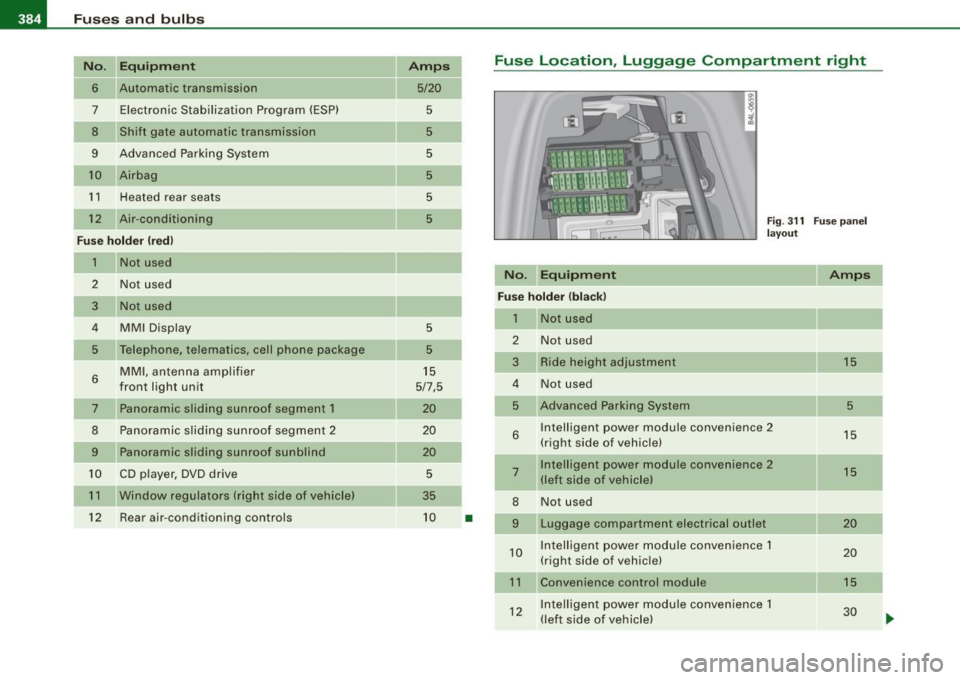
11111 Fuses and bulbs ..._ ____ .;__...;_;,;_ _______________________________ _
No. Equipment Amps
6 Automatic transmission
5/20
7 Electronic Stabilization Program (ESP) 5
8 Shift gate automatic transmission
5
9 Advanced Parking System 5
10 Airbag 5
1 1 Heated rear seats 5
12 Air-conditioning
5
Fuse holder (red)
1 Not used
2 Not used
3 Not used
4 MMI Display 5
5 Telephone, telematics, cell phone package
5
6 MMI, antenna amplifier
15
front light unit 5/7,5
7 Panoramic sliding sunroof segment 1 20
8 Panoramic sliding sunroof segment 2 20
9 Panoramic sliding sunroof sunblind 20
10 CD player, DVD drive
5
11 Window regulators (right side of vehicle) 35
12 Rear air-conditioning controls 10
•
Fuse Location, Luggage Compartment right
No. Equipment
Fig. 311 Fuse panel
layout
Amps
Fuse holder (black)
1 Not used
2 Not used
3 Ride height adjustment
15
4 Not used
5 Advanced Parking System 5
6 Intelligent power module convenience 2
15
(right side of vehicle)
7 Intelligent power module convenience 2
15
(left side of vehicle)
8 Not used
9 Luggage compartment electrical outlet 20
10 Intelligent
power module convenience 1
20
(right side of vehicle)
11 Convenience control module 15
12 Intelligent power module convenience 1
30
(left side of vehicle)
Page 414 of 426

lffl) __ A_l.:,. p _h_ a_ b_e _t _ic _ a_l _in _ d_e _x ____________________________________________ _
Data ........ .... .... ....... .... ... 399
Data recorder . ...... .... .... ...... . 288
Date display . . . . . . . . . . . . . . . . . . . . . . . . 14
Daytime running lights ... .... .... . 73, 74
Declaration of compliance
Adaptive Cruise Control ... .... ....
404
Audi side assist . . . . . . . . . . . . . . . . . . 404
Cell phone package . . . . . . . . . . . . . . 404
Convenience key . ...... ...... .... 404
Electronic immobilizer ..... .... ... 404
HomeLink® universal remote control 404
Remote control key . . . . . . . . . . . . . . . 404
Tire pressure monitoring system ... 404
def
What does this mean when it appears in the trip odometer display? ........
15
Defective light bulb warning ........... 27
Defrosting/defogging the windows ... .
127
Defrosting/defogging windows ....... 130
Determining correct load limit ........ 356
Digitalclock ..... .................... 14
Digital compass . .... .... .... ........ 89
Digital speedometer ...... ............ 27
Dimensions .. .... .... .... .... .... .. 398
Dipstick
Reading the dipstick properly
335
Distance control system
See Adaptive Cruise Control . . . . . . . 152
Doors
Power child safety lock . . . . . . . . . . . . .
61
Driver information system ... ... .. .... . 25
Digital speedometer . . . . . . . . . . . . . . .
27
Driver information messages ....... 30
Open door or rear lid warning ....... 27
Outside temperatur ,e display ........ 26
Sound system disp lay .... ... .. .... 26
Driver seat
See Seating position ......... .... . 222
Driver's seat . . . . . . . . . . . . . . . . . . . . . . . . . 93
Driver's seat memory . . . . . . . . . . . . . . . . . 97
Activating remote control key ....... 98
Recalling a sea t position ....... ... . 97
Storing a seat positiion ... .... .... .. 97
Driving messages .................... 30
Driving mode
See Adaptive Air Suspension .. ..... 208
Driving offroad
Driving through water ... .... ... ..
303
Driving tips ... ....... ...... ... ... 302
Rules of behavior ... .. .... .... ... 302
Sand and mud ................ ... 303
Snow -covered grou nd ............ 303
Unpaved roads .................. 303
Driving safely .... .... ...... ... .. ... 220
Driving through water .... .... ....... 303
Driving time ....... ....... .... ... .... 40
Dup licate key .... .... ... .... ........ . 48
Dust filter
Climate controls .. ........ .......
123
E
Easy entry feature . . . . . . . . . . . . . . . . . . . 142
ECON mode
Climate controls ... .... ... .... ...
126
Electric seat adjustment
See Power seat . . . . . . . . . . . . . . . . . . . . 93
Electronic differential lock (EDU
How the system works . . . . . . . . . . . .
290
Warning/indicator lights ... .. ...... . 22
Electronic immobilizer .... ........ .
15, 51
Electronic power control
(EPC) warning/indicator light ........
19
Electronic speed limiter .... ........... 29
Electronic stabilization program (ESP) Hill descent control . .... ...... ....
288
How the system works . . . . . . . . . . . . 288
Offroad mode . . . . . . . . . . . . . . . . . . . . 288
Warning/indicator lights ............ 19
Emergency flasher ................... 76
Warning/indicator lights ........... . 20
Emergency locking of doors . ...... .... 57
Emergency operation
Panoramic s liding sunroof ....
70, 71, 72
Rear lid ..... ...... .... ........... 60
Emergency starting ................. 387
Emergency towing ... .... .... .... ... 390
Energy management . .... ........... 295
Battery power . . . . . . . . . . . . . . . . . . .
296
Driver notification . . . . . . . . . . . . . . . . 296
Engine Compartment ....................
332
Coolant ...... ...... ...... .... ... 337
Hood ... ...... .... ....... .... ... 330
Starting ............... ...... 142, 143