airbag AUDI Q7 2009 Owner´s Manual
[x] Cancel search | Manufacturer: AUDI, Model Year: 2009, Model line: Q7, Model: AUDI Q7 2009Pages: 426, PDF Size: 97.13 MB
Page 285 of 426
& WARNING
Improper installation of child restraints will increase the risk of
injury and death in a crash.
• Improper use of child restraint anchors (tether anchors) could
lead to injury in a collision. The anchors are designed to withstand
only those loads imposed by correctly fitted child restraints .
• Never mount two child restraint systems on one LATCH lower
anchor point .
• Never attach two child restraint systems to one tether strap or
tether anchorage .
• Always follow the instructions provided by the manufacturer of
the child restraint you intend to install in your Audi .
• Never use child restraint tether anchorages to secure safety
belts or other kinds of occupant restraints.
• Never attach a tether strap to a tie-down hook in the luggage
compartment.
• Never secure or attach any luggage or other items to the LATCH
lower anchorages or to the tether anchors.
• If a tether or other strap is used to attach a child restraint to the
front passenger seat, make sure that it is not so tight, that it causes the weight-sensing mat to measure more weight than is
actually on the seat.
• The heavier weight registered can make the system work as
though an adult were on the seat and deploy the Advanced Airbag
when it must be suppressed causing serious or even fatal injury to
the child. •
Safety first
Child Safety
Tether strap
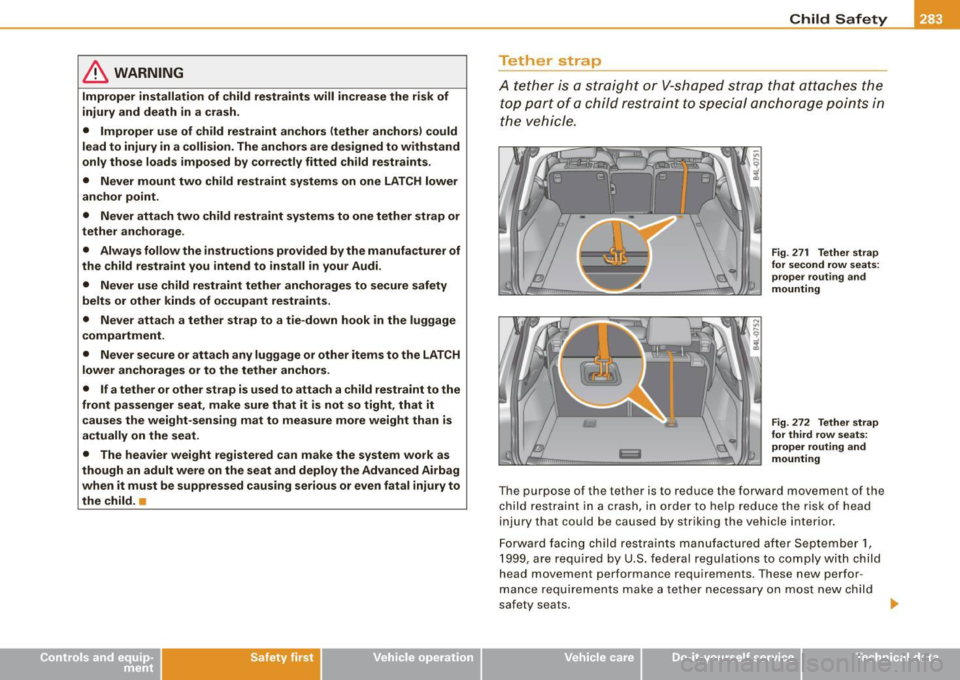
A tether is a straight or V-shaped strap that attaches the
top part of a child restraint to special anchorage points in
the vehicle.
Fig . 271 Tether strap
for second row seats:
proper routing and
mounting
Fig . 272 Tether strap
for third row seats:
proper routing and
mounting
Th e purpose of the tether is to reduce the forward movement of the
child restraint in a crash, in order to help reduce the risk of head
injury that could be caused by striking the vehicle interior.
Forward facing child restraints manufactured after September 1,
1999 , are required by U.S. federal regulations to comply with child
head movement performance requirements. These new perfor
mance requirements make a tether necessary on most new child
safety seats.
~
Vehicle care I I irechnical data
Page 286 of 426
__ _:::C:..:..h ::.i:..:: ld :...:: S:..::a :.:f .:::e :.::t .Ly ____________________________________________ _
& WARNING
Improper installation of child restraints will increase the risk of
injury in a crash .
• Never atta ch a child safety seat tether strap to a tie-down hook
in the luggage compartment.
• Never se cure or attach any luggage or other items to the LATCH
lower anchorages or to the tether.
• If a tether or other str ap is used to attach a child restraint to the
front passenger seat, make sure that it is not so tight , that it
causes the weight-sensing mat to measure more weight than is
actually on the seat.
• The heavier weight registered can make the system work as
though an adult were on the seat and deploy the Advanced Ai rbag
when it must be suppressed causing serious or even fatal injury to
the child .•
Using tethers on rear-facing c hild restraint
sys tems
Currently, few rear -facing child restraint systems come with a tether .
Please read and heed the child rest raint system manufacturer's
instructions careful ly to determine how to properly insta ll the
tether .
& WARNING
A child in a rearward -facing child safety seat installed on the front
passenger seat will be ser iously injured and can be killed if the
front airbag inflates - even with an Advanced Airbag System .
• The inflating airbag will hit the child safety seat or infant
carrier with great force and will smash the child safety seat and
child against the backrest , center arm rest , or door .
& WARNING (continued )
• A tight tether or other strap on a rearward-facing child restraint
attached to the front passenger seat can put too much pressure
on the weight-m at in the seat and register a heavier weight in the
Advan ced Airbag System . The heavier weight regi stered can m ake
the system wo rk as though an adult were on the seat and deploy
the Advanced Airbag when it must be suppressed causing serious or even fatal inju ry to the child .
• If you must install a rearward facing child safety seat on the
front passenger seat because of exceptional circumstances and
the PASSENGER AIR BAG OFF light does not come on and stay on ,
immed iately install the rear-facing child safety seat in a rear
seating position and have the airbag sy stem inspected by your
authorized Audi dealer . •
Securing the upper tether strap to the anchor
bracket
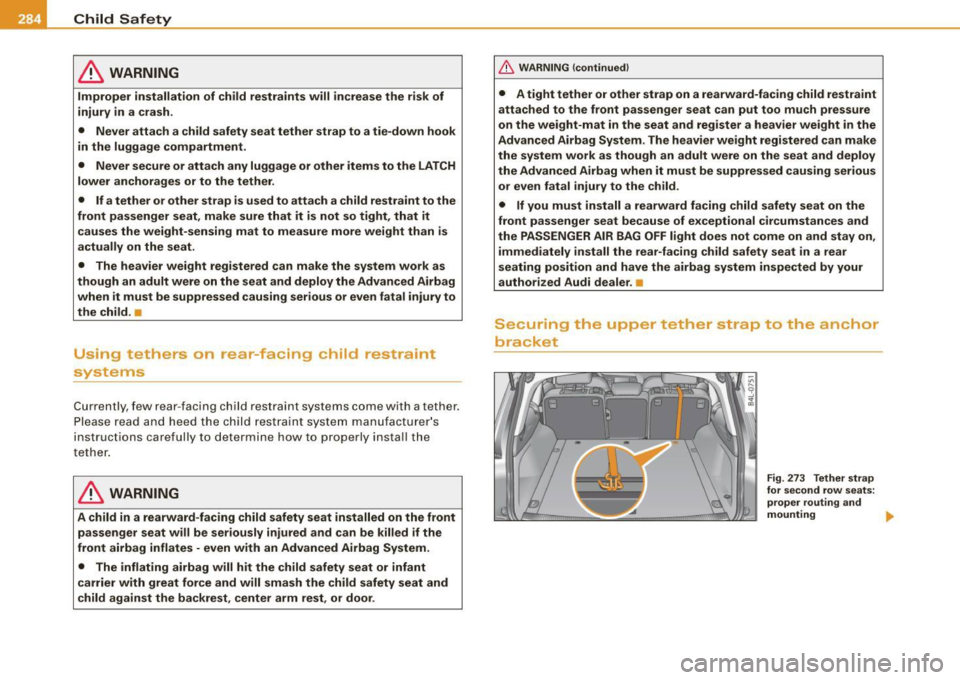
F ig . 2 73 Tether strap
for second row seat s:
proper r outing and
m ounting ..
Page 290 of 426
llffl __ ln_ t _e_ ll-'"ig ...,_ e_ n_t _t_ e_ c_ h _ n_o _ l_o _,.g= y,_ __________________________________________ _
Intelligent technology
Notice about data recorded by
vehicle control modu les
Your vehicle is not equipped with an Event Data Recorder (EDR),
installed by some manufacturers for the express purpose of
capturing data for retrieval after an accident or crash event . EDR's
are sometimes called "crash recorders" .
Some state laws restrict the retrieva l or downloading of data stored
by EDR's that were insta lled in a vehicle for the express purpose of
retrieving data after an accident or crash event without the owner's
consent.
Although your vehicle is not equipped with an EDR, it is equipped
with a number of electronic control modules for various vehicle systems such as, for example, engine function, emission control, as
well as for the airbags and safety belts.
These electronic control modules also record vehicle-related data during norma l vehicle operation for diagnost ic and repair purposes .
The recording capacity of the electronic control modules is limited
to data (no sound is recorded) and only a small amount of data is
actually recorded over a very limited period of time and stored when
a system fault or other condition is sensed by a control unit. Some
of the data then stored may relate to vehicle speed, direction, braking as well as restraint system use and performance in the
event of a crash or other condition . Stored data can only be read and
down loaded with special equipment .•
Electron ic Stabilizat ion Program (ESP)
General =nformation
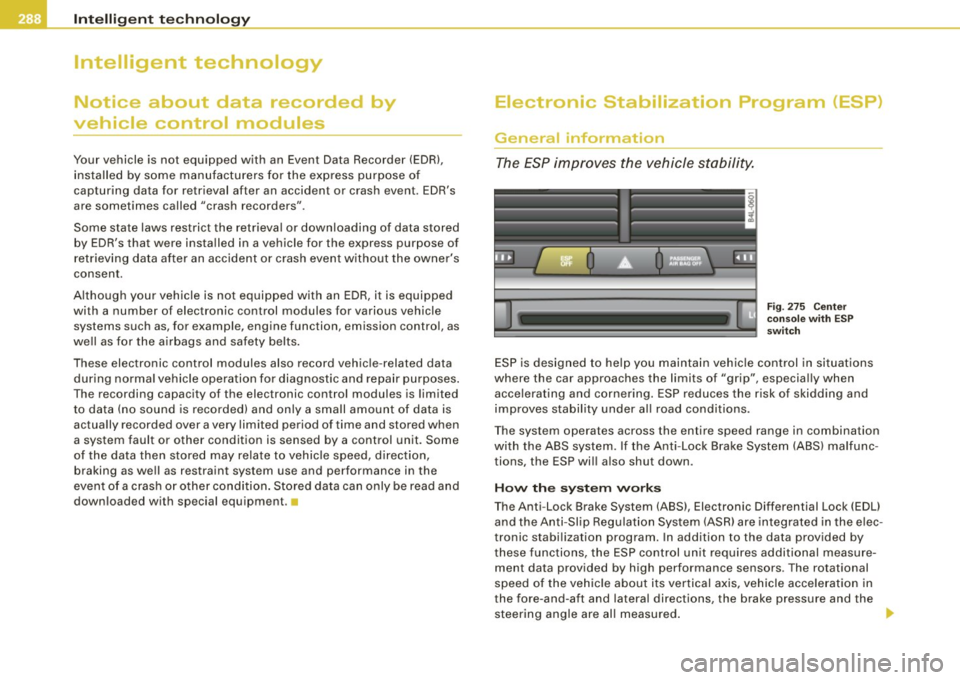
The ESP improves the vehicle stability.
Fi g. 2 75 C ente r
co nso le w it h ES P
swi tch
ESP is designed to he lp you maintain vehic le control in situations
where the car approaches the limits of "grip", especia lly when
accelerating and cornering. ESP reduces the risk of skidding and
improves stabil ity under all road conditions .
T he system operates across the entire speed range in combination
with the ABS system. If the Anti-Lock Brake System (ABS) malfunc
tions, the ESP wil l also shut down .
How th e sys te m w ork s
The Anti -Lock Brake System (ABS) , Electronic Differential Lock (EDU
and the Anti-Slip Regulation System (ASR) are integrated in the e lec
tronic stabi lization program . In addition to the data provided by
these functions, the ESP control unit requires additional measure ment data provided by high performance sensors . The rotational
speed of the vehic le about its vertical axis, vehicle acce leration in
the fore-and-aft and lateral directions, the brake pressure and the steering angle are al l measured .
Page 322 of 426
___ C_ le_ a _ n_i_n ~g _ a_ n_ d __ p_r _o _t _e _c_ t_ i_o _n ___________________________________________ _
Normal c lea ning
Genera lly, we recommend using a sof t sponge or a lint -free
microfiber cloth to the c lean fabric. Brushes should only be used for
carpets and floor mats, since other fabric surfaces cou ld be harmed
by brushes .
Normal surface stains can be cleaned using a commercially avail
able foam cleaner . Spread the foam on the surface of the fabric with
a soft sponge and work it in g ent ly. Do not saturat e the fabric. Then
pat the foam d ry using abs orbent, dry cl oths (e .g . micro fiber c loth)
and vacuum it after it has dried completely .
Cleaning stains
Stains caused by beverages (e.g. coffee , fruit juice, etc.) can be
treated w ith a mild detergent so luti on. Apply the detergent so lu tion
with a sponge . In the case of stubborn stains , a d etergent paste can
be applied di rectly t o the sta in and worked into the fabric . After
wards , use copious amounts of clean water to remove the
remaining detergen t. Apply the wa ter w ith a damp cloth or sponge
and pat the fabric dry with an absorbent, dry c loth.
Stains from chocolate or makeup should have detergent paste (e .g.
ox -ga ll soap) rubbed into them . Afterwards, remove the soap w ith
water (damp sponge).
A lcohol can be used to treat stains from grease, oil, lipstick o r a ba ll
point pen. Melted grease or dye must be patted off using absorbent material. It may be necessary to retreat the areas with detergent
paste and water.
In the case of genera l soiling of the upholstery and cover material,
we recommend hiring a specialist that has the eq uipment to c lean
the seat covers and other fabric surfaces by shampooing and spray
extraction .
& WARNING
Always read and heed all WARNINGS and th e information
=> page 31 2.
[ i ] T ips
Open Ve lcro fasteners on your clothing can damage the seat cover.
Please make su re that Ve lcro fasteners are c losed .•
Plastic parts and instrument panel
Always use a clean cloth moistened in clea r water to clean these
areas . For persistent dir t use an Audi approved
solvent -free plastic
cleaner/protecta nt.
& WARNING
Solvent s can change the propertie s of some plastics and make it
ha rder for the airbag to deploy .
• Never clean the instrument panel or the surface of airbag
module s with cleaning pr oduct s that contain so lvents .
• Product s containing solvent s w ill make the surface of this part
porou s.
• Seriou s injuries can result if pla stic parts come loo se when the
ai rbag is deployed .
• Alway s read and heed all WARNING S and other info rm ation
=> page 312 .
0 Note
Cleaning agents containing solvents wil l attack the material and can
change the way it behaves .•
Page 344 of 426
-~_C_ h_e _c _ k_ i_n ...:::g::;...._ a_n_ d_ f_ i_ll _in -'g:::;.._ ___________________________________________ _
& WARN ING (c o ntinued )
• Brake failure can re sult from old or inappr opriate brake fluid .
Ob serve the se precautio ns:
- Use only brake fluid that meets SAE specific ation J 1703 and
c onform s to Fed era l Moto r Vehi cle St anda rd 116. Al ways c heck
with your authori zed Audi dealer to make sure you are u sin g
the corre ct brake fluid. The correct typ e of brake fluid i s also
indicated o n the brake fluid reser vo ir .
- The br ake flu id mu st be ne w. Heavy u se of the brake s can
c au se a vapor lock if the brake fluid i s left in the s ystem too
long. Thi s can seriou sly affect the effi cien cy of the brake s as
w ell a s your safet y. Thi s could re sult in an acci dent .
0 Note
Brake fluid will damage the paint of your vehicle .
For the sake of the environment
Because of the problem of proper disposal of brake fluid as well as
the special too ls required and the necessa ry expertise, we recom
mend that you have the brake fluid changed by your authorized Audi
dea ler .•
Battery
General information
Under normal operating condi tions, the battery in your Audi does
not need any maintenance. With
high outside temperatures or long
daily drives we recommend that you have the e lectrolyte level
checked by an au thorized Audi dealer or qualified workshop . The
e lectrolyte level should also be ch ecked each time the battery is
charged ~
page 344.
Have the battery checked when you take your vehicle in for service .
Yo u are well advised to replace a battery that is o lder than 5 years .
With certain types of airbag dep loyment, the battery is discon
nected from the vehicle electrical system for safety reasons~
& in
"Repair, care and disposal of the airbags" on
page 255.
Disconnecti ng th e batt ery termin als
Some vehicle functions (power window regulators , for example) are
lost if the battery termina ls are disconnected. These functions have
to be relearned after the battery terminals are connected again . To
prevent this, the battery should only be disconnected from the
vehic le electrical sys tem when abso lutely necessary for repairs .
Vehicles not driven for long per iods
If you do not drive your vehicle ove r a period of several days or
weeks, electrical components are gradually cut back or switched off .
T his reduces energy consumption and maintains starting capab ility
over a longer period
~ page 295 .
Take i nto consideration that whe n you u nlock your vehicle, some
convenience functions, such as the master key remote function or
powe r seat adjustme nt, may not be ava ilable. The convenience
functions will be available again when you turn on the ignition and
start the engine .
Wint er op erati on
Duri ng the winter mont hs, batte ry capacity tends to decrease as
temperatures drop . This is because more power is also consumed
whi le star tin g, and the headlights, rear window defogger, etc ., are
used more often.
Avoid unnecessary power consumption, particular ly in city traffic or
when trave li n g o nly short dis tances . Let your authorized Audi dea ler
check the capacity of the vehicle battery before winter sets in
~ page 344. A we ll cha rged battery w ill not only preven t starting
problems when the weather is cold, but will also last longer . ..,_
Page 386 of 426
11111 Fuses and bulbs ..._ ____ .;__...;_;,;_ _______________________________ _
No. Equipment Amps
6 Automatic transmission
5/20
7 Electronic Stabilization Program (ESP) 5
8 Shift gate automatic transmission
5
9 Advanced Parking System 5
10 Airbag 5
1 1 Heated rear seats 5
12 Air-conditioning
5
Fuse holder (red)
1 Not used
2 Not used
3 Not used
4 MMI Display 5
5 Telephone, telematics, cell phone package
5
6 MMI, antenna amplifier
15
front light unit 5/7,5
7 Panoramic sliding sunroof segment 1 20
8 Panoramic sliding sunroof segment 2 20
9 Panoramic sliding sunroof sunblind 20
10 CD player, DVD drive
5
11 Window regulators (right side of vehicle) 35
12 Rear air-conditioning controls 10
•
Fuse Location, Luggage Compartment right
No. Equipment
Fig. 311 Fuse panel
layout
Amps
Fuse holder (black)
1 Not used
2 Not used
3 Ride height adjustment
15
4 Not used
5 Advanced Parking System 5
6 Intelligent power module convenience 2
15
(right side of vehicle)
7 Intelligent power module convenience 2
15
(left side of vehicle)
8 Not used
9 Luggage compartment electrical outlet 20
10 Intelligent
power module convenience 1
20
(right side of vehicle)
11 Convenience control module 15
12 Intelligent power module convenience 1
30
(left side of vehicle)
Page 405 of 426
__________________________________________________ C_o_ n _ s_u_ m_ e ___ r_l_ n _f_ o_ r _m...:....:.. a:.;..:. ti .... o:.. n ........ _llll
& WA RNIN G (continu ed )
• The engine compartment of any motor vehi cle i s a potentially
h az ardou s area. N ev er re ach into the are a arou nd or to uch the
r a di ator fan . It is temperature co ntrolled and can swi tc h o n
s uddenly -even wh en the engine i s off and the ignition key h as
been removed . The r adiator f an switches on autom atic all y w hen
the coolant reache s a certain temperature and will continue to run
until the coo lant t emper ature drop s.
• Alway s remov e th e ignition key befo re anyone get s under the
v ehi cle .
• Alway s s upport your vehi cle with safety sta nd s if it i s ne ces
sa ry to wor k unde rne ath the veh icle . The ja ck suppl ied with the
v ehic le i s not adequ ate for thi s purpo se and could coll ap se
c au sin g s eriou s per son al in jury .
• If you m ust w ork under neath the vehi cle with the wheel s on
the ground , alwa ys m ake sure the veh icle i s on l eve l ground , that
the wheels ar e always securely blocked and that the engine
ca nn ot be sta rted .
• Alway s mak e sure the tran sm iss ion selecto r leve r (automatic
tr ansmi ssion ) is in "P " (P a rk po sition ) and the park brake is firml y
applied .
c£> For the sake of the environment
• Changing the engine settings w ill adverse ly affect emission
levels . This is detrimenta l to the environment and increases fuel
consumption.
• Always observe environmenta l regu lations when disposing of
old engine oil, used brake fluid, dirty engine coolant, spent batteries
or worn out tires.
• Undeployed airbag modules and pretens ioners might be classi
fied as Perchlorate Material -specia l handling may apply, see
www .dtsc .ca .gov/hazardouswaste/perchlorate. When the vehicle or
parts of the restraint system including airbag modules safety belts
with pretens ioners are scrapped, all applicable laws and regu la-
Controls and equip
ment Safety first Vehicle operation
tions must be observed. Your authorized Audi dealer is familiar with
these requirements and we rec
ommend that you have your dea ler
perform this service for you .•
Additional accessories ,
modifications and parts replacement
Addition al a ccessori es and parts
replacement
Always c onsul t an authorized Audi dealer before
purchasing accessories.
Your vehicle incorporates the latest safety design features ensuring a high standard of act ive and passive safe ty .
This safety could be compromised by non -approved changes to the
vehic le . F or this reason, if par ts have to be replaced, please observe
the following points when insta lling additiona l accessories:
Approved Audi accessories and genuine Audi parts are avai lable
from authorized Audi dealers.
These dealers also have the necessary facilities, tools and trained specialis ts to install the parts and accessories prope rly.
& WARNING
Using the wrong spare part s or u sing non-approved acce ssorie s
can c ause seri ous persona l injur y.
• Use onl y acc essorie s ex pres sly approved by Audi and g enuine
Audi spare p art s
• The se p art s and acce ssorie s have been spe cia lly de signed to
be used on you r vehi cle .
• Nev er in stall acc ess orie s s uch a s telep hone cra d le s or
be ver age holder s on airb ag cover s or within th e airbag deploy-
Vehicle care Do-it-yourself service Tec hn ica l da ta
Page 410 of 426
lffll __ A_ l..:,. p _ h_ a_ b_e _t_ic_ a_l _in_ d_e_ x ____________________________________________ _
A
Accessories . . . . . . . . . . . . . . . . . . . . . . . . 403
Adaptive Air Suspension .... ... .. .... 206
Cargo mode in the MMI ....... .... 212
Controls . . . . . . . . . . . . . . . . . . . . . . . . 207
Description ... ...... ............ 206
High level . . . . . . . . . . . . . . . . . . . . . . . 207
Highway level . . . . . . . . . . . . . . . . . . . 207
Instrument cluster display .. .... ... 209
Jacking mode when changing a flat tire . 210
Low level ... ... ... .... ..... .. ... 207
Normal level . . . . . . . . . . . . . . . . . . . . 207
Segment display . . . . . . . . . . . . . . . . . 208
Setting the driving modes ......... 208
Trailer towing mode ... .... .... ... 211
Using sw itch for cargo mode .. .... 212
Warning/indicator lights . .......... 21
Adaptive Cruise Control .. .... ..... ... 152
Changing speed ................. 156
Driver information ............... 160
Driver intervention prompt ........ 164
Driving in traffic 154
Driving program .. .... .... .... ... 165
Error messages . . . . . . . . . . . . . . . . . . 163
Open road . . . . . . . . . . . . . . . . . . . . . . 154
Override . . . . . . . . . . . . . . . . . . . . . . . . 154
Request for driver to assume control 154
Save speed . . . . . . . . . . . . . . . . . . . . . . 156
Setting distance . . . . . . . . . . . . . . . . . 158
Setting time interval .............. 158
Settings ........................ 165
Specia l driving situations ......... 165 Status
messages . ....... ... .. ... . 163
Switching on and off .. ........... 155
System limits .. .................. 165
Temporarily turning off ......... .. 157
warn ing/indicator lights ........... 161
Adaptive Light .... ...... ...... ... ... . 76
defective ......................... 37
Adding Engine coolant ... ....... .... .... . 339
Engine oil ... .. .. . ... ....... .... . 336
Windshield washer fluid ...... .... . 346
Additiona l accessories .......... .... . 403
Additives Engine oil ....................... 336
Adjusting Instrument cluster i llumination . .... . 17
Steering column electrically ....... 141
Steering column manually ......... 140
Adjusting front seats .... .... .... . ... . 92
Advanced Parking System with rear view
camera
Adjusting the chimes -option 1 . ... 201
Adjusting the chimes -option 2 .... 202
front and back with visual display and
rear -view camera . . . . . . . . . . . . . . . 191
General information ......... ..... 191
Notes on distance information ... .. 200
Parking next to obstac les . . . . . . . . . . 199
Rear-view camera -parking mode 1 196
Rear -view camera -parking mode 2 . 198
Rear -view camera (Rear View) ... ... 194
Rear -view camera coverage area . . . . 195
Rear -view camera tips ............ 204 Special parking
situations ... .. .. .. 199
Switching the rear-view camera on and
off .... . ... .... .... ... .. .... ... 203
switching the visua l display on and off ..
203
System error message ............ 204
Towing hitch ...... .... ...... .... 201
Air conditioning
See Climate controls 123
Air distribution Climate controls ... ....... .... ... 127
Four -zone automatic comfort air
conditioning ................... 133
Air pol lutants fi lter
Climate controls ................. 123
Airbag Warning/indicator lights . ...... .... . 19
Airbag system .... .... .... ... ... 241, 258
Advanced Airbag System ...... .... 245
Advanced Airbag System components . ..
248
Care ........................ .... 255
Child restraints .................. 265
Children ... .... .... ... ...... ... . 264
Components (front airbags) . ....... 248
Danger of fitting a chi ld safety seat on the
front passenger seat . . . . . . . . . . . . 243
Disposal ............. ....... .... 255
Front airbags .. ........ ...... 245, 246
How do the front airbags work? . ... 250
How many airbags does my vehicle have? 248
How the Advanced Airbag System compo -
nents work together . ........ .... 249
Page 411 of 426

______________________________________________ A_ l_,_ p _h_ a_ b_e _t_ic _ a _ l _in _ d_e _ x __ lll
Important things to know . ... .. .... 241
Indi cator light ...... .. .... ... ..... 252
Monitoring ... .... .... ..... .. .... 252
PASSENGER AIR BAG OFF light ... .. 253
Repairs .. .... .... .... ... .... .... 255
Safety instructions ... .... ..... .. . 254
Side airbags ... .. .... .... ...... .. 257
Side curtain airbags ... .. .... .... . 260
Weight -sensing mat .... ........ .. 264
When must the system be inspected? ..
252
All Wheel Drive .. .... ....... ...... .. 294
Alloy wheels ... .. .... .... ..... .. .... 318
All-whee l drive
Winter tires .... .. .... ...... ... .. . 363
Alternator Malfunction . .... .... ........ ..... 32
Anti-freeze
See Engine coo lant system .. ...... . 337
Anti-glare inside day-night mirror .... 86, 87
Anti -lock brake system
How the ABS system works . .... ... 292
Warning/indicator lights .. .... .... .. 22
Anti-Slip Regulation System (ASR)
How the system works ........ .... 290
Anti-theft systems
Anti-theft alarm system ... ......... 63
Elec tronic immobilizer .. ... .... .... 51
Approach/departure angle ............ 302
Ashtray Front .. .... ... .. .... .... ...... .. 116
R ear .... ... .. .... .... ........... 116
Controls and equip
ment Safety first
ASR
How the Anti-Slip Regulation System
works ...... ............. ...... 290
Asterisk What does it mean when something is
marked with an asterisk? .. ....... .. 6
Audi braking guard ....... .... ... .... 168
Error messages ....... .... ... .... 170
Settings ........... ... .... .... ... 169
Status messages .......... .... ... 170
Switching on and off .. .... .... .... 169
Audi Service Repair Manuals and Literature
401
AUTO mode AC climate contro ls ..... ...... .... 126
Auto Safety Hotline ..... ... ... .. .... . 229
Auto -Check Control ...... ..... ... .... . 30
Automatic belt retractor ... .. .... .... . 235
Automatic car wash
See Washing ............... .... .. 313
Au tomatic mode
Four -zone automatic comfort air
conditioning .... ...... ...... ... 132
Automatic Shif t Lock (ASU ...... ... ... 186
Automatic transmission
6 -speed automatic transmission .... 184
Automatic Shift Lock (ASU ...... .. . 186
Driving ...... ....... ...... .... ... 1 84
Dynamic shift program .... ........ 187
Emergency release for selector lever 189
F ail-safe mode ...... ... .. .... ... . 189
Ignition key safety lock ..... .. .... . 143 Manua
l sh ift program .. .. ....... .. 188
Selector lever .................... 185
Shift buttons ...... .... .... ...... . 189
Steering wheel with tiptronic® ..... 189
Average speed ....................... 40
Avo id damaging the vehicle ... .... .... 299
B
Background lighting
Lighting profiles . ......... ......... 79
Bass box ........... ... .. .... ...... . 371
Battery ...... .... ... .... .... .... ... 342
Battery location .......... .... .... 343
Charging ........................ 344
Important warnings when working on the
battery ...... ....... .... ...... . 343
Jump starting ................ .... 387
Low ...... ........... ....... .. .. 295
Replacing the battery ............ . 346
State of charge ................... 295
Voltage ........... ...... .... .... . 36
Winter operation ............ ... .. 342
Working on the battery ... ....... .. 343
Before driving ... .... .... ...... .... . 221
Blended gasoline .................... 325
Body cavity sealing .. .... .... .... ... . 318
Booster seats ...... ... .. .... .... .... 271
How do I properly insta ll a booster seat in
my vehic le? . .... .... .... ... .... 271
Safety instructions .... .......... .. 271
Brake assistant .......... .... .... ... 293
K ick -down .... .... ...... ...... ... 187 Brake booster ....................... 292
Vehicle operation Vehicle care Do-it-yourself service Technical data
Page 416 of 426

-Alphabetical index
-----=-------------------------------------
Synchronization . ...... ... .. .. ... 135
Turning on/off .... .... ....... .... 132
Front airbags Description . ...... .... .......... 245
How they work . . . . . . . . . . . . . . . . . . . 250
Front arm rest Cup holder .. ...... .... ..... .. ... 103
Storage compar tmen t .... .... ... . 103
Front ashtray . . . . . . . . . . . . . . . . . . . . . . . 116
Front fog lights . . . . . . . . . . . . . . . . . . . . . . 75
Front seats . . . . . . . . . . . . . . . . . . . . . . . . . 92
Adjusting ....................... 223
Child restraints in the front seat .... 243
Frontal collisions and the laws of physics ...
232
Fuel Additives . . . . . . . . . . . . . . . . . . . . . . . 325
Blended gasoline ... .. .... ...... . 325
Consumption . . . . . . . . . . . . . . . . . . . . . 40
Fi ller neck ... .. .... .... .... .... .. 326
Fuel gauge . . . . . . . . . . . . . . . . . . . . . . . 15
Gasoline .. .... .... ....... .... ... 325
Gasoline additives .. ....... .... ... 326
Low fuel level . . . . . . . . . . . . . . . . . . 15, 36
Octane rating . ...... ......... .... 325
Recommendation . . . . . . . . . . . . . . . . 325
Refuel ling . .... .... .... ... .... ... 327
Reserve ... ....... .... .... .... .... 15
Tank capacity . . . . . . . . . . . . . . . . . . . . 399
Un locking the fue l filler flap by hand 329
Fuse arrangement . . . . . . . . . . . . . . . . . . 38 1 G
Garage door opener (HomeLink®l . .... 214
Gas discharge lamps ................ 385
Gauges Engine coolant temperature . ...... . 13
Fuel gauge . . . . . . . . . . . . . . . . . . . . . . . 15
Speedometer . . . . . . . . . . . . . . . . . . . . . 15
Tachometer ...................... 14
Trip odometer ....... ...... ..... .. 15
General illustration Instruments and controls . . . . . . . . . . . 11
General rules and driving tips ... ... ... 302
Before driving offro.ad . ...... .... . 302
Driving offroad .... .... .... .... .. 302
G lossary of tire and loading terminology .. .
348
Glove compartment .. .... .... .... ... 119
Cooling box . . . . . . . . . . . . . . . . . . . . . 120
Valet key function ... .. ...... .... .. 51
G love compartment -emergency unlocking .
120
Gradient angle ... ... .... .... .... ... 302
Gross Vehic le Weight Rating (GVWR) . .. 397
Ground clearance .... ... ... .. .... ... 302
H
Head restraints ..... .. .... .... .... .. 225
Adjusting ..... .. . ... ... ... .. . ... 225
Front seats . . . . . . . . . . . . . . . . . . . . . . 101
Rear seats .... ..... .. ..... .. 101, 102
Headlight washer reservoir . .... .... .. 346 Headlights
... ..... .. .... ........ .. . . 73
Adaptive Light ..... ... .... .... ... . 76
Defective . . . . . . . . . . . . . . . . . . . . . . . . . 27
Front fog lights .... ... .... .... .... 75
Headlight range control defective .... 37
Switching off ... .. .... .... .... .... 73
Switching on ...... .... ........... 73
Washer system . . . . . . . . . . . . . . . . . . . 83
Xenon headlights ..... .... .... .... 73
Heated outside mirrors ... .... .... .... 88
Heated seats Front ......... .... .... ... .... ... 136
Rear .. ..... ... .... .... ... .... ... 137
Rear seats (four -zone automatic comfort
air conditioning) ....... .. .... ... 137
Heated steering wheel . .... ... .... ... 138
Heated washer jets
Wiper and washer system .. .... .... 8 1
Heating Climate controls ...... .... .... ... 123
Heavy clothing and safety belts ....... 234
High beam ... .... .... .... ... .... . 73, 77
Warning/indicator lights .... ... .... . 22
High voltage warning label .. ...... ... 396
Hi ll descent control .... ... ...... .... 288
Hill hold assist
Starting on hills ... .... .... .... ... 148
HomeLink® universal remote control 214
Hood Opening ... .... .... ... .... .... .. 330
Release lever ..... ....... .. ...... 330
Horn ............................... 11