service AUDI Q7 2010 Owner´s Manual
[x] Cancel search | Manufacturer: AUDI, Model Year: 2010, Model line: Q7, Model: AUDI Q7 2010Pages: 390, PDF Size: 93.04 MB
Page 290 of 390
Fuel supply and filling your fuel tank
Blend of g asoline and ethanol (grain alcohol or ethyl alcohol )
• Anti-knock index must be 8 7 AKI o r higher .
• Blend must not conta in more than 10% ethanol.
Blend of gasoline and M TBE
• Anti-knoc k index must be 87 AKI o r highe r.
• Blend must conta in not more than 15% MTB E.
Sea sonally adjusted ga soline
Many gasoline grades are b lended to perform especially well for
w inte r or summer d riving. Duri ng seasonal change-ove r, we s uggest
that you fill up at busy gas stat ions where the seasonal adjus tment is
mor e likely to be made in time.
0 Note
• Methano l fuels which do not meet these requirements may cause
co rrosion and damage to plast ic and rubber component s in the fue l
system .
• Do not use fuels that fail to meet the specified c riteria in this
chapter.
• If you are unable to dete rm ine whether or not a part icu lar fuel
blend meets the specifications, ask your service stat ion or its fuel
supplier .
• Do not use f uel fo r which t he con tents cannot be iden tifie d.
• Fuel system damage and performance problems result ing from
t he use o f fuels differe nt from t hose s pecifie d are not t he responsi
bility of Aud i and are not covered u nder the New Ve hicle o r th e Em is
sion Cont ro l System Warranties .
• If you experience a loss of fuel economy or drivea b i lity and perfor
m ance problems d ue to the use o f one of these fue l blends , we
recommend that you switch to unblended fuel. •
App lies to veh ic les: with gaso line eng ine
Gasoline additives
A m ajor concer n amo ng many a uto m anufa ctu rers i s ca rb o n deposi t
build-up caused by the type of gasoline you use .
Altho ugh gaso line g rades differ from one manufacturer to another,
they have certain t hings in common . All gaso line grades contai n
substances that can cause deposits to collect on vita l engine pa rts,
su ch as fue l injecto rs an d inta ke valves. A lthough mos t gaso line
brands include additives to keep eng ine and fue l systems clean, they
are not equ ally effec tive.
Audi recommends us ing TOP TIER Detergent Gasoline . Fo r more
info rmation on TOP TI ER Detergent Gasoline, p lease go to t he off ic ia l
webs ite (www .toptiergas .com) .
After an extended period of using inadequate f uels, ca rbon deposit
build -ups ca n rob your e ngine of peak perfo rma nce .
0 Note
Damage o r malfunct ion d ue to p oo r fu e l quali ty is not covered by the
Audi New Vehicle Lim ited Warranty. •
Appli es to veh icles : with diesel e ngine
Diesel fuel
A lw ays us e ULS D (U ltra Low Sulfur Di esel) sulfur content
1 5 ppm or less .
The U LSD (Ul tra Low Sulfu r Die sel) meets t he AS TM- D-97S (grade 2) .
Diesel fuel w ith a higher concentration than ULSD-Diesel No. 2
ASTM D975 and Bio-die sel with a higher concentration than 5
%
like B11, B20 or B100 are strictly prohibited .
Serv ice station fue l pumps are labe led w it h the co rrect fuel informa
ti on fo r easy recogni tion by the user. If the diese l fuel pump is not ..,_
Page 291 of 390

labeled ask the station operator what fuel is being dispensed befo re
fi lling up yo ur vehicle.
Service stations offering Diesel f uel are generally loca ted on truck
routes or major hig hways. Directo ries of Diese l fue l stations are
usually availab le at Diese l fuel stations.
Some states in t he USA require permits to purchase Diesel fuel. Check
w ith your State Mo tor Vehicle De partment.
Diesel fuel may not be available outs ide the USA and Canada. Be sure
to check before trave ling to othe r countries .
Winter operation
At t empe ratures below 20° F (- 7° C), Die sel fue l No . 2 l oses its flu idity
due to wax separation, wh ich may clog the fuel filter or tank fi lter and
keep the engine from running .
T o help t he filte r from be ing clogged by wax, the fue l fi lter in your
vehicle is automatically preheated. Preheat ing the fuel f ilter makes
operat io n of yo ur vehicle possib le with Die sel fuel No. 2 dow n to -
10° F (-24° C).
If you expect temperat ures below 5° F (-1S° C) ask yo ur fuel dealer
whether their Diesel fuel No . 2 is suffic iently w interized for the
prevailing and expected temperat ures.
If not winterized or insuff ic ie ntly w inte riz ed Diese l fuel has already
thickened to the extent that the engine w ill not start, warm the
vehicle up by leaving i t in a heated garage.
It is normal that the eng ine noise level (dieseling) is louder during the
warm-up period in winte r. It is also normal when whitish -blue smoke
comes out of t he tailpipe afte r start ing and du ring warm-up. The
amount of smoke depends on the outside temperature .
Do not let your Diesel engine idle unnecessa rily af ter a co ld start.
Dr iv ing off slow ly w ill shorten the warm-up per iod.
Safety first
Fuel supply and filling your fuel tank
& WARNING
• Never use "starting as sist flu ids ." Th ey may be potentially
explo sive or cause a "run-away " engine condition . Thi s could
re sult in s eriou s engine damage and per sonal injury .
• Never u se fuel line anti -freeze off ered fo r ga soline engine s.
0 Note
• Your D iesel eng ine has been spec ifically desig ned to ope rate on ly
on Ultra Low Sulfur Diesel fue l. Therefore, never use home heating o il
or reg ular gasoline . The properties of these fuels may cause serious
damage to the fuel injection system and to t he engine . Using these
fue ls can cause expens ive eng ine repairs and will also adversely affect
your New Vehicle Lim ited Wa rranty.
• If Diese l fuel shou ld get on any rubber hose, it must be wiped off
immediately. Then wash the contaminated hose port ion w ith soap
and warm water . Do not allow Diesel fue l to remain on connecting
hoses. They may deve lop leaks and cause se rious damage. •
Fuel tank
Fuel filler neck
The f ue l fi ller neck is located o n the rig ht rea r side panel behind t he
fue l filler flap.
If the power locking system shou ld fai l, you can st ill open the flap
ma nually- for deta iled instructions see:::::>
page 292.
You can find the fue l tank capacity of your veh icle in
Technical Data
:::::, page 3 63.
The label on the inside of t he fuel filler flap tells you the correct fuel
for your veh icle. For more informat ion about fuel specifications, see
:::::>
page 287 . _,,
Vehicle care Technical data
Page 302 of 390
___ C_ h_e _c_ k_ i_ n _ g_ a_ n _ d_ f_il _l _in ____ g ___________________________________________ _
Applies to vehicles with diesel engine only : Only if the level of t he
oil is a t or be low the m inimum m ark o n the o il d ipstick -and no o il
that express ly conforms to A udi o il standard VW 507 00 spec ifica
tions is available -may you top off with a high q ua lity engine oil , that
meets ACEA C3 o r API CF spec ifications, but even then, on ly in
viscosity gra des SAE 5W- 40, SAE SW -30, or SAE OW -40 . However,
dur ing t he e ntire time between o il change i nte rvals, neve r top off
w ith more than a tota l of 0.5 qt/liter engine oil that does not
c onfor m to Audi o il specification VW 5 07 00.
For more information about eng ine oi l th at has been approved for
your vehicle, please con tact either your au thorized A udi dea le r or
Aud i Customer Relations at 1 (800) 822 -2834 or vis it our web site at
www.aud iusa .com or www .aud icanada.ca . He re yo u w ill also find a
cu rrent list of oils (manufactu rers, brand names e tc.) that co nform to
Audi oil standard VW 502 00 (vehicles with gaso line e ngine) or VW
507 00 (vehicles w it h die sel eng ine).
Changing the engine oil
The eng ine oil and oil fi lter mus t be changed according to the mileage
(kilome ters) and t ime intervals specified i n your vehicle 's Warranty &
Ma intenance booklet . Do not exceed these interva ls - harmful
deposi ts from o ld engi ne oil can reduce engine pe rfo rmance and ca n
lead to expensive engine repa irs.
C hangi ng the oil at the recommende d interva ls is so very imp ortant
because the lubricating properties of o il decrease gradually during
normal ve hicl e use. If yo u ar e not sure w hen you have yo ur oil
changed, ask your author ized Audi Service Adv isor .
Under some circumstances the eng ine o il should even be changed
more fr eq uent ly. Chang e oil mor e of ten if you d rive mostly short
distances, operate the veh icle in d usty areas or mostly under stop
and -go t raff ic condi tion s, or when you use yo ur vehicle where tempe r
atures stay be low free zing po int for long periods.
De tergen t ad dit ives in the o il wi ll m ake fres h oil look dark a fter the
eng ine has bee n ru nning for a short t ime . This is normal and is not a
reason to ch ang e the oil mo re of ten t han re commended.
Damage or malfunctions due to lack of maintenance
It is essentia l that you change your o il at the recommended intervals
using only en gine oil th at com plies wi th A udi o il st and ard VW 502 0 0
(vehicles w ith gasoline eng ine) o r VW 507 00 (vehicles with d iesel
eng ine) . Your Limited New Vehicle Wa rranty does not cover damage
or ma lfunct ions due to fa ilure to follow recomm ended maintena nce
and use requirements as set forth in t he Au di Owner's Man ua l and
W arranty
& M aintenance boo klet. Y ou r deale r will have to deny
wa rranty coverage unless yo u present to the dealer proof i n th e form
of Se rvice o r Rep air O rders tha t al l sche dul ed main tena nce was
performed in a time ly ma nner. •
Engine oil consumption
To provide effective lubr ication a nd cooling for interna l eng ine parts,
a ll in ter na l c omb ustion e ngines use some oil. Oil cons umption v aries
from engine to engine and may change over the life of the eng ine .
E ngines te nd to use m ore oi l dur ing the b re a k-i n period t han t hey do
after ward, when oil consumption has stab ilized. Depending on t he
way the vehicle is driven and the operatin g cond itions, oi l cons ump
tion ca n be up to a 1 quart per 1,200 miles
(I lite r per 2,000 km) .
Consumptio n may be higher withi n th e first 3,000 m iles (5, 000 km) .
Under nor mal co ndi tions, the rate o f oi l consu mptio n depe nds o n oil
quality as well as viscosity, engine speed ( rpm), o utside tempe rature,
roa d condi tion s, the amou nt of o il d ilution caused by co nde nsed
water or fu el residue, and oxidation of the oil. O il cons umption may
increase wi th en gine we ar ove r time, un til repl aceme nt of worn
eng ine pa rts may become necessa ry.
Because of all these var ia bles, there is no standa rd o r "norma l" rate
of oil consumption .
We urge you to check the engine oil level at
regular intervals, preferably every time you fill the fuel tank, and
always before a long trip .
The oil pressure warning light
~ is not an indicator of low eng ine
oil level. If the warning light does not go out after starting, or
flashes while driving (above 1500 rpm), a buzzer will sound . It
indicates that the oil pressure is too low. Stop the engine immedi- _.,,
Page 303 of 390

_____________________________________________ C_h _ e_ c_ k_in --= g'-- a_n _d_ f_i _ll _i_n -=g ::;__ ____.fflll
ately, check the engine oil level and add oil if necess ary. If the
engine oil level i s normal, but the light continues to flash , do not
keep driving or l et the engine idle , as damage may occur .
If you believe your engine uses too much oil, we recommend that you
cons ult your au thor ized Audi dealer so that the cause of yo ur conce rn
can be properly diagnosed. Keep in m ind that accurate measurement
of oil consump tion req uires gre at care a nd may ta ke some time. You r
Audi dealer has instructions for how to measure o il consumption
a ccu rately.
& WARNING
Stop! Befor e working in the engine compartment, alw ay s read and
heed all WARNINGS ~
& in "Working in the engine compart
ment " on
page 297. The engine compartment of any motor
vehicle is a potentially dangerous area and can cause ser ious
per sonal injury .
0 Note
• The engine depends on o il to lubr icate and coo l all of i ts mov ing
parts . The engine oil must be checked regularly and kept at the
req uire d level.
• Make it a hab it to have the engine oil level checked every t ime you
fill the f uel tank.
• Too little engine oil may cause severe eng ine damage .•
Vehicle OP-eration
Checking the engine oil level
The dipstick indi cates the engine oil level.
F ig. 232 Illu st rati on
o f prin ciple 1 : M arke rs
o n oil dipsti ck
Fig . 233 I llustration
o f prin ciple 2 : M arker s
o n oil dip sti ck
Before you check anyt hing i n th e eng ine compartment ,
always read and heed all WARNINGS=> & in " Workin g in
t h e e ng ine compa rtme nt" on
page 297.
Determining oil level
- Park you r veh ic le so tha t it is h orizo ntally lev el.
- While at operating state te mperature, briefly let the
engine ru n at id le and then shut it of f.
- W ait appro x. two minutes .
Vehicle care Do-it-yourselt service iTechnical data
Page 307 of 390
_____________________________________________ C_h _ e_ c_ k_in --= g:-. a_n _d_ f_i _ll _i_n -=g =-- ____.•
- We recommend using only coolant additive Gl2 ++ (check the
l a bel) for yo ur vehicle. This coolant ad dit ive is available at au tho·
r ized Audi dealers . Other types of antifreeze can s ignificantly
reduce corrosion protection. The resulting corrosion can cause a
loss of coolant and serious engine damage .
• Do not add any type of radiator leak sealant to your vehicle's
eng ine coo lant . Adding radiator repa ir fluid may adversely affect the
function and performance of your cooling system and could result in
damage not covered by your New Vehicle Limited Warranty .•
Checking the engine coolant Level
The engine coolant level can be checked with a quick
glance .
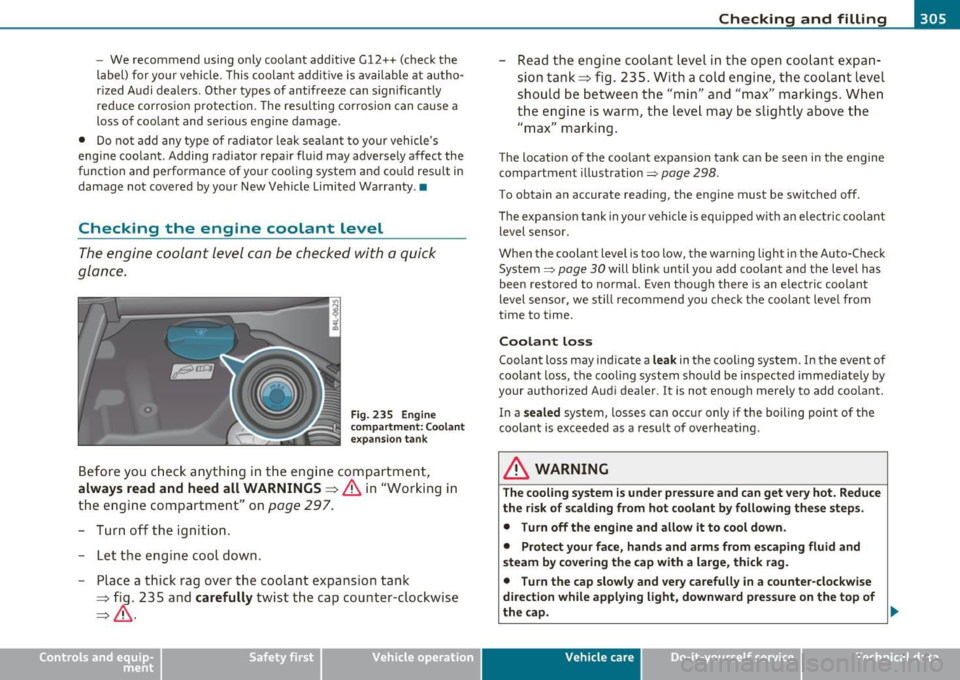
Fig. 2 35 En gin e
c o mpar tmen t: C oolant
ex pansion tank
Before you c heck anything in the eng ine compartment,
always read and heed all WARNINGS~ & in "Working in
the e ngine compartment" on
page 297.
- Turn off the ignit ion .
- Let t he eng ine cool down .
- Place a thick rag over the coolant expans ion tank
~ fig . 235 and carefully twist the cap counter ·clockwise
~ & -
Vehicle OP-eration
-Read the engine coolant level in th e open coo lant expan ·
sion tank ~ fig . 235 . With a cold engine, the coolant level
should be between the "min" and "max" ma rkings . Whe n
the engine is warm , the level may be slight ly above the
"max" marking .
The location o f the coo lant expansion tank can be seen in the engine
compartment illustration=>
page 298 .
To obt ain an accurate reading , the engine must be sw itched off.
Th e expans ion t an k in your vehicle is equippe d with an electric coolant
level sensor.
When the coolant lev el is too low, the warning light in the Auto·Check
System=>
page 30 will blink until you add coolant and t he level has
been resto red to normal. Even though there is an electric coolant
level sensor, we st ill recommend you check the coolant leve l from
time to time.
Coolant loss
Coolant loss may indicate a leak in the coo ling system . In the event of
coo lant loss , the cooling system sho uld be inspected immed iate ly by
your authorized Aud i dea ler . It is not enough mere ly to add coolant.
In a
s ealed system, losses can occu r only if the boiling point of the
coolant is exceeded as a result of ove rheating .
& WARNING
The cooling system is under pressure and can get ve ry hot. Reduce
the ri sk of scalding from hot coolant by following the se steps.
• Turn off the engine and allow it to cool down .
• Protect your face, hand s and arms from e scaping fluid and
s team b y co ve ring the cap with a large, thi ck r ag.
• Turn the cap slowly and ver y carefully in a counter-clo ckwise
direction whil e applying light , downward pre ssure on the top of
thecap .
~
Vehicle care Do-it-yourselt service iTechnical data
Page 309 of 390

___________________________________________ C_ h _ e_c _k _ i_n -=g .._ a_n _ d_ f_i _ll _i _ n -=g '-- ....... JIII
<£> For the sake of the environment
Dra ined coolant sho uld not be reused. A lways dispose of used coolan t
w hile observing a ll enviro nmental regulations .•
Radiator fan
T he radia tor fa n switc hes on a utoma tically by itself
The radiator fan is driven by the engine via the V-belt. The v iscous
cl utch reg ulates the spee d of t he fan accord ing to t he tem pera ture o f
the coolant.
An aux ili ar y e lec tric r adi ator fan* sw itches on and o ff depend ing o n
coo la nt temperat ure and other vehicle operating conditions.
After you switch the engine off, the auxiliary fan can continue r unning
for up to 10 minutes -eve n w it h t he igni tion o ff.
It can even swit ch on
again later by itse lf => & , if
• t he tem pera ture of the e ngi ne coola nt rises due to the hea t build
up from the eng ine in the engine compa rtment, o r
• th e engine compar tmen t heats up because the ve hicl e is parked in
intense s unlight.
& WARNING
• To reduce the risk of personal injury never touch the radiator
fan .
• The auxiliary electric fan is temperature cont rolled and can
switch on suddenly even when the engine i s not running.
• The auxiliary radiator fan switche s on automatically when the
engine coolant reaches a certain temperatu re and will continue to
run until the coolant temperature drops. •
~ehicle OP-eration
Brake fluid
Checking brake fluid level
The brake flu id l eve l can be checke d with a quick gl ance .
Fig . 236 Engine
compa rtment : Brake
fluid rese rvoir
Before you check a nyt hin g i n th e eng ine compa rtment ,
always read and heed all WARNINGS~ & in " Working in
the e ng ine co mpartmen t" on
page 297.
- Read the brake fluid level f rom t he bra ke flu id reservoir
~ fig. 2 36 . The bra ke fluid leve l must be between the
" MIN " and "MAX" markings.
Th e brake fl uid rese rvoir is located at the rear partition of t he engine
compartment on the left side=>
page 298.
The fluid level may drop slightly after some time due to the auto
m atic adjus tmen t of th e br ake pads. This is no t ca use for alarm .
If the brake fluid level falls
considerably below the "MIN" mark, t he
brake warn ing/i nd icator lig ht ( U.S. models :
BRAKE, Canadian mode ls:
ill ) will come on=> page 20 and=> page 29 . Do not continue to
operate the vehicle . The complete brake system s hould be thorough ly
che cked by an au thori zed Aud i dea le r o r q ua lified wor kshop a nd the
cause corrected.
If t h e brake fl uid leve l is too low, the brake .,,_
Vehicle care Do-it-yourselt service iTechnical data
Page 313 of 390
Checking and filling -
-------------------=------=:;______,.J,,...
Battery charging
Starting the engine requires a well charged battery.
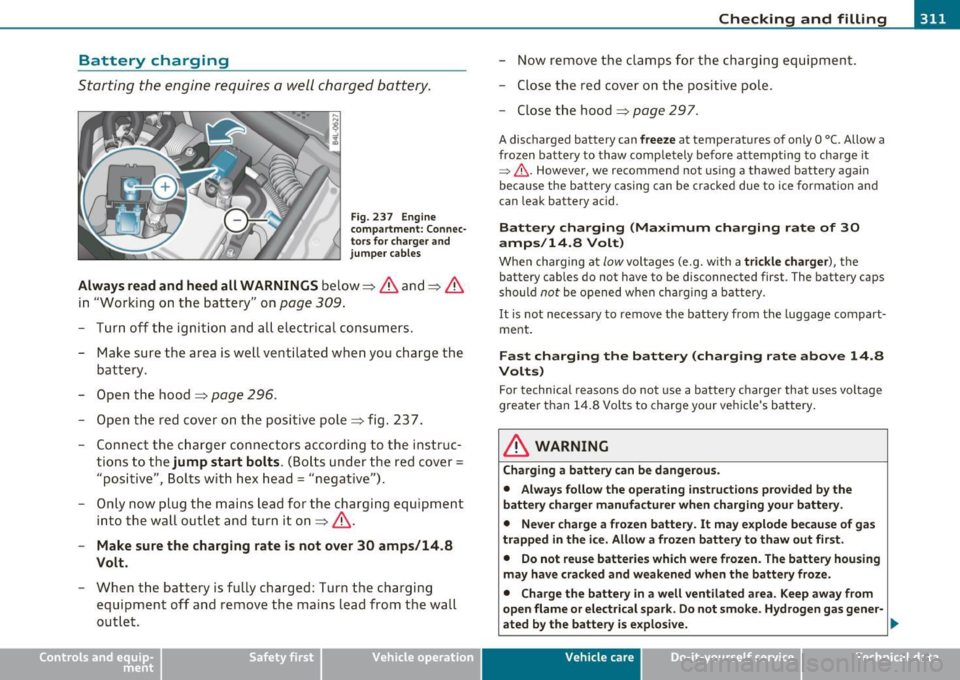
Fig. 237 Engine
compa rtment : Connec
tor s for charger and
jumper cables
Always read and heed all WARNINGS below=> & and => &
in "Working on the battery" on
page 309.
- Turn off the ignition and all electrical consumers.
- Make sure the area is well ventilated when you charge the
battery.
- Open the hood :::::,
page 296.
-Open the red cover on the positive pole =>fig. 23 7.
- Connect the charger connectors according to the instruc-
tions to the
jump start bolts . (Bolts under the red cover=
"positive", Bolts with hex head
= "negative") .
- Only now plug the mains lead for the charging equipment
into the wall outlet and turn it on =>& .
-Make sure the charging rate is not over 30 amps/14.8
Volt.
- When the battery is fully charged: Turn the charging
equipment off and remove the mains lead from the wall
outlet.
Vehicle OP-eration
-Now remove the clamps for the charging equipment.
- Close the red cover on the positive pole.
- Close the hood :::::,
page 297.
A discharged battery can freeze at temperatures of only O 0C. Allow a
frozen battery to thaw completely before attempting to charge it
~ & .However, we recommend not using a thawed battery again
because the battery casing can be cracked due to ice formation and
can leak battery acid.
Battery charging (Maximum charging rate of 30
amps/14.8 Volt)
When charging at low voltages (e.g. with a trickle charger ), the
battery cables do not have to be disconnected first . The battery caps
sho uld
not be opened when charging a battery.
It is not necessary to remove the battery from the luggage com part·
ment.
Fast charging the battery (charging rate above 14.8
Volts)
For technical reasons do not use a battery charger that uses voltage
greater than 14.8 Volts to charge your vehicle's battery .
& WARNING
Charging a battery can be dangerous.
• Always follow the operating instructions provided by the
battery charger manufacturer when charging your battery.
• Never charge a frozen battery. It may explode because of gas
trapped in the ice. Allow a frozen battery to thaw out first.
• Do not reuse batteries which were frozen. The battery housing
may have cracked and weakened when the battery froze.
• Charge the battery
in a well ventilated area. Keep away from
open flame or electrical spark. Do not smoke. Hydrogen gas gener-
ated by the battery is explosive. •
Vehicle care Do-it-yourselt service Technical data
Page 324 of 390
-Tires and wheels Pffl,.____ ______________ _
& WARNING (conti nu ed )
• Driv ing with underinflated tire s bend more , letting them get
too hot re sulting in tread separation , sudden tire failure and lo ss
of control.
• Exce ssive speed and /overloading can cause heat build-up,
s udden tire failure and loss of control.
• If the tire pressure is too low or too high , the tires will wear
prematurely and the vehicle will not handle well.
• If the tire is not flat and you do not have to change a wheel
immediately, drive at reduced speed to the nearest service station
to check the tire pressure and add air as required .
0 Note
Driving without valve s tem caps can cause damage to the tire valves .
T o prevent this, a lways make sure that factory ins talled valve stem
caps on al l wheels are secure ly mounted on the valve .
<£> For the sake of the environment
Underinflated t ires will also inc rease t he f uel consumption .•
Tires and vehicle load limits
T here are lim its to the amo unt of load or weight that any veh icle and
any tire can carry . A veh icle that is overloade d will not handle well and
is more difficult to stop . Overload ing can not on ly lead to loss of
vehicle contro l, but can also damage important parts of the vehicle
and can le ad t o su dden t ire failure, including a b lowo ut and s udden
def lation that can ca use the vehicle to c rash .
Yo ur safety a nd t hat of your passengers also de pends o n mak ing s ure
that load limits are not exceeded . Vehicle load incl udes everybody
and everything in and on the vehicle . These loa d limits are technically
referred to as the ve hicle's
Gross Vehicle Weight Rating ("GVWR") . The
"GVWR" includes the weight o f the basic vehicle, all factory
ins talled accessories, a f ull tank of f uel, oil, coolan t and other fl uids
plus maxim um load . The max imum load i ncludes the numbe r of
passenge rs that the vehicle is intended to carry ("seating capacity")
w ith an ass umed we ight of 150 lbs (68 kg) for each passenger at a
designate d seati ng position and the total weig ht of any luggage in
the vehicle. If yo u tow a trai le r, the weight of t he t railer hitch and the
tongue weight of the loaded trailer must be included as part of the
veh icle loa d.
The
Gross Axle We ight Rating ("GAWR") is the max imum load that
can be a pplied at each o f the ve hicle 's two axles .
Th e Gross Vehicle Weight Rat ing and the Gross Axle Weight Rat ing
are listed on the safety compliance sticker label located on the
dr iver 's side B-pillar. Your A udi has 5 seat ing pos it ions, 2 in the front
and 3 in the rear for tota l seat ing capacity of 5. On vehicles with six
sea ts*, yo ur vehicl e has two fron t seat s, two se a ts i n the se co nd row
seating and two seats in the t hird row seating. On ve hicles with seven
sea ts*, yo ur veh icle has two fron t se ats , th ree seats in the se cond row
seat ing and two seats in the third row seating. Eac h seating posit io n
has a seat belt=>
page 199, "Safety bel ts" .
Th e fact that there is an upper lim it to your veh icle 's Gross Vehicle
We ight Rating means that the total weight of whatever is being
c arried in t he veh icle ( inclu ding t he weight of a tra ile r hi tch and the
tongue weight of the loaded tra iler) is limited . The more passengers
in the vehi cle or passenge rs who are heavier th an the stan dard
we ights assumed mean that less we ight can be carried as luggage.
Th e tire pressure labe l on yo ur Audi a lso lis ts the max imum combined
we igh t of all of the occupants and luggage or o ther cargo that the
vehicle ca n carry. For t he locat ion of the label=>
page 318, fig. 239.
& WARNING
Overloading a vehicle can cause loss of vehicle control, a crash or
other accident, serious personal injury, and even death. ._
Page 326 of 390

-Tires and wheels
5. Determine the combined weight of
luggage and cargo being loaded on the
vehicle. That weight may not safely
exceed the available cargo and luggage
load capacity calculated in Step 4.
6. If your vehicle will be towing a trailer,
load from your trailer will be transferred
to your vehicle. Consult this manual to
determine how this reduces the available
cargo and luggage load capacity of your
vehicle.
Check the tire sidewall(=>
page 3267
fig. 243) to determine the designated
load rating for a specific tire .•
Tire service life
The service life of tires depends on a lot of different
things including proper installation and balancing,
correct tire pressure and driving style.
~------------~
Tread Wear Indicator (TWI)
Fig. 241 Tire tread:
tread wear indicators
(TWI)
Fig. 242 Rotating
tires for more even
wear
Th e original tires on your vehicle have 1/16 inch (1. 6 mm) high "wear
ind icators"~ fig. 241 ru nning across the tread . Depend ing on the
make, there will be six to eight of them even ly placed around the tire.
Marks on the tire sidewall (for example "TWI" or other symbols) indi
cate the positions of the tread wear indicators. Worn tires must be
replaced. Different figures may apply in other countries ~& . ._,.
Page 327 of 390
Tires and wheels -________________ f!:f'II
Tire pressure
Incorrect tire pressure cau se s prema ture we ar and c an cau se sudden
ti re blow-o ut. Fo r this reaso n, tir e press ure must be ch ecked at l eas t
once a mo nth ;:::,
page 320.
Driving style
Driv in g fast aro und curves, heavy a cce le ra ti on and hard bra kin g
increase tire wea r.
Rotating tires for more even wear
Fo r all fou r tir es on your ve hicle to have the same service life, we
re co mm end th at t he fron t and rear tire s ar e rotat ed acco rd ing t o the
tire ma nufact urer's s uggested tire rotation intervals. Please
remem be r th e fo llow ing:
• Tir e ro tat io n in terv als ma y differ from t he ve hicle serv ice in terv als
out lined in your Warranty
& Maintenance bo oklet .
• Th e long er o ne tire is used i n one location on t he veh icle, t he mo re
it wears at certa in po ints; t herefore, we recommend t hat you follow
th e tir e m an ufac ture r's sugges ted tire r ota tion in te rv a ls .
• Vehicles w ith fro nt-w hee l dr ive experience mo re tread wea r on the
fron t w heels compared to all-whe el driv e (qua ttro ®).
• P leas e ro tate tires as sh own ;:::, fig. 242.
• Extra care m ust be ta ken when rotat ing direction-specific tires
=:, p age 3 44 .
Wheel balancing
The w heels on new ve hicl es a re bala nced. However, v ario us sit uatio ns
dur ing everyday driving can cause them to become unba lanced,
re su lt ing in vibra tions yo u can usually fee l throug h the stee rin g
w hee l.
Unbalanced whee ls mus t be rebalanced to avoid excessive wear on
s t eer ing, suspension and t ir e s. A wheel must also b e rebalanced
w hen a new tire is installed.
Safety first
Incorrect wheel alignment
Incorrec t wheel a lignment can c ause excessive t ire wear, im pair ing
t he sa fety o f the ve hicle . If t ires s how exc essive wear, hav e the wheel
alignment checked by an author ized A udi dealer o r qualifie d wo rk
shop.
All Wheel Drive
Vehicles with quattro ® must a lways have tires of the same s ize,
constr uctio n an d trea d type . For details see ;:::,
page 258 .
& WARNING
Sudden tire failure can lead to loss of control, a crash and serious
personal injury!
• Never drive a vehicle when the tread on any tire is worn down
to the wear ind icators .
• Worn tires are a safety hazard, they do not grip well on wet
roads and increase your risk of "hydroplaning" and loss of control.
• Always keep chemicals that can cause tire damage, such as
grease, oil , gasoline and brake fluid away from tires.
• Tires age even if they are not being used and can fail suddenly,
especially at high speeds. Tires that are more than 6 years old can
only be used in an emergency and then with special care and at
lower speeds.
• Never mount used tires on your vehicle if you are not sure of
their "previous history." Old used tires may have been damaged
eventhoughthedamagecannotbeseenthatcanleadtosudden
tire failure and loss of vehicle control. •
Vehicle care Technical data