fold seats AUDI Q7 2010 Owner´s Manual
[x] Cancel search | Manufacturer: AUDI, Model Year: 2010, Model line: Q7, Model: AUDI Q7 2010Pages: 390, PDF Size: 93.04 MB
Page 220 of 390
___ A_ i_ r_b _ a_ g=- s_, y"-- s_t _e _m ______________________________________________ _
belt is not being used, t he first stage dep loys, followed by the second
stage a fter a mu ch later time in the c rash seq uence .
If the electronic control un it reg isters a crash of medium severity, the
first stage of the airbag deploys fo llowed by the second stage at a
much la ter t ime in the crash sequence -regard less of whethe r th e
safety belt is being used or not. In higher sever ity crashes as regis
t ere d by t he elect ronic con tro l u ni t, both the first and second stages
dep loy almost at the same time.
On the passenger side, regardless of safety be lt use, the a irbag will
be turned off if the we ight on the passenger seat is less than the
amount prog rammed in the electronic contro l unit. The front airbag
on the passenge r side w ill a lso be turned off if one of the ch ild safety
seats that has been certified under Federa l Moto r Vehicle Safety
Standar d 208 has bee n recognized o n th e seat. The
PASSENGER AIR
BAG OFF light comes on and stays on to tell you w hen the front
Advanced Airbag o n the passenger side has been tu rned off
~ page 211, "Ch ild restraints on the front seat -some important
t hings to know" .
& WARNING
To reduce the risk of injury when an airbag inflate s, always wear
safety belts properly .
• If you are unrestrained, leaning forward, sitting sidewa ys or
out of position in any way , you r risk of inju ry is mu ch higher.
• You will also receive serious injuries and could even be killed if
you are up against the airbag or too close to it when it inflates· even with an Advanced Airbag~
page 209. •
More important things to know about front
airbags
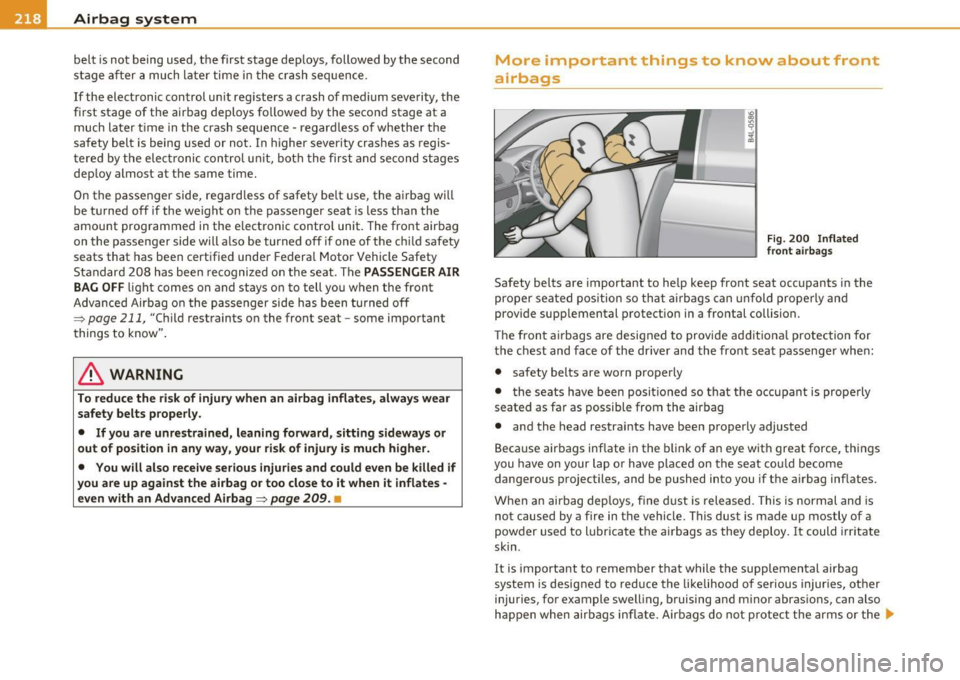
Fig. 2 00 Inflate d
front a irb ags
Safety belts are important to he lp keep front seat occupants in the
pro per seated pos ition so that a irbags can unfold prope rly and
prov ide supp lemental protect ion in a frontal collision.
Th e front airbags are designed to provide add itio na l protec tion for
the c hest and face of the driver and the front sea t passenge r when:
• safety belts are worn properly
• the seats have been posit ioned so that the occupant is prope rly
seated as far as possible from the airbag
• and the head restraints have been properly adjusted
Because air bags inflate in the b link of a n eye w it h great force, things
you have on your lap o r have place d on the seat cou ld become
dangerous projectiles, and be pushed into you if the a irbag inf lates.
When a n airbag dep loys, fine dust is released. This is normal and is
not caused by a fire in the vehicle. This dust is made up mostly of a
powder used to l ubricate the ai rbags as they deploy.
It could irritate
skin .
It is important to remember that while the supp lemental airbag
system is desig ned to reduce the li ke lihood of serious injur ies, other
injuries, for example swelling, b ruising and m inor abras ions, can also
happen when airbags infl ate. Airbags do not p rotect the arms or the ..,_
Page 221 of 390
Airbag system --------------------------------------------- -=---=----
lower parts of the body . Front a irbags s upplement the t hree-poi nt
sa fety belts o nly in some fro ntal collis ions in which the vehicle decel
eration is high enough to dep loy the a irbags .
Front airbags will not deploy:
• if the ignition is switched off when a crash occ urs
• in s ide collis ions
• in rea r-end collisions
• in rollovers
• when the crash decelerat io n me asured by the a irbag system is less
than the min imum threshold needed for a irbag deployment as reg is
tered by the e lectron ic con trol un it
The front passenger airbag also will not deploy:
• when t he fron t passenger sea t is no t oc cupied
• when the weight on the front passenger seat as sensed by the
Advanced Ai rbag System in dicates that the front airbag o n the
passenger side has to be turned off by the e lectronic control unit (the
PASSENGER AIR BAG OFF li ght comes on and stays on)
& WARNING
Sitting in the wrong position can increase the ri sk of ser iou s injury
in crashes.
• To redu ce the risk of injury when the airbags inflate, the driver
and pas sengers mu st always sit in an upright position , mu st not
lean against or place any part of th eir body too close to the area
where the airbags are lo cated.
• Occupants who are unbelted, out of position or too close to the
airbag can be seriou sly injured by an airbag a s it unfolds with
great force in th e blink of an eye =>
page 211 .
Controls and equip
ment Safety first Vehicle operation
& WARNING
A child in a rearward-facing child
safety se at installed on the front
pas senger seat will be seriously injured and can be killed if the
front airbag inflates - ev en with an Ad vanced Airbag System.
• The inflating airbag will hit the child safety seat or infant
c arrier with great force and will smash the child safety s eat and
c hild against the backre st, center armre st, d oor or roof .
• Always install rear -facing child safet y seats on the rear seat.
• If you must install a rearward-facing child safety seat on the
front passenger se at because of e xceptional circumstances and
the PASSENGER AIR BAG OFF light do es not come on and stay on ,
immediately install the rear -facing child s afety seat in a rear
s eating po sition and h ave the airbag system inspe cted by your
authoriz ed Audi d ealer.
& WARNING
Object s between you and the airbag will increase the r isk of inju ry
in a cra sh by int erfering with the way the airb ag unfold s or by
being pushed into you as the airbag inflates.
• Never hold things in your hand s or on your lap when the vehicle
i s in use.
• Never tran sport items on o r in the are a of the fr ont pa ssenger
seat. Obje ct s c ould move into the area of the front ai rbag s during
braking or other sudden maneu ver s and become dang erous
projectiles that can c au se se rious per sonal injury if the ai rbags
infl ate.
• Never pla ce o r attach accessories or othe r objects (such a s
cupholders, telephone brac kets, large , heavy or bulky object s) on
the doo rs, over o r near the are a marked
"AIRBAG " on the stee ring
wheel, in strum ent panel , se at ba ckre sts or between th ose area s
and yourself . These objects could cause injur y in a crash , especially
when the airbags infl ate .
9"'
Vehicle care Do-it-yourself service Technical data
Page 249 of 390
I
I I
I I
I I
0
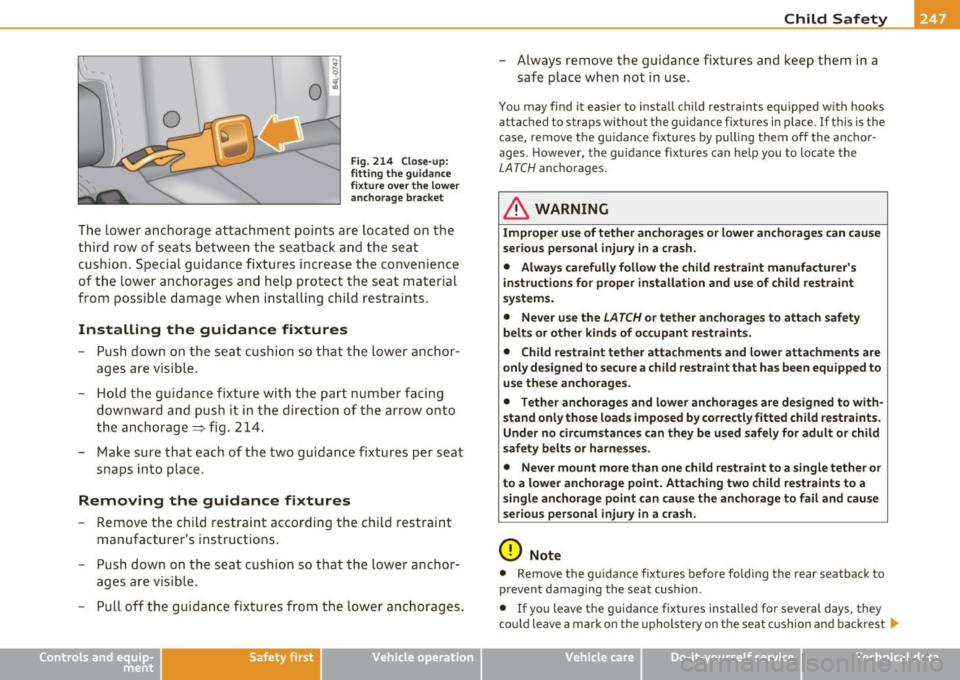
Fig. 214 Close-up:
fitting the guidance
fixture over the lower
anchorage bracket
The lower anchorage attachment points are located on the
third row of seats between the seatback and the seat
cushion. Special guidance fixtures increase the convenience
of the lower anchorages and help protect the seat material
from possible damage when installing child restraints.
Installing the guidance fixtures
- Push down on the seat cushion so that the lower anchor
ages are visible.
- Hold the guidance fixture with the part number facing
downward and push it in the direction of the arrow onto
the anchorage => fig. 214.
- Make sure that each of the two guidance fixtures per seat snaps into place.
Removing the guidance fixtures
- Remove the child restraint according the child restraint
manufacturer's instructions.
- Push down on the seat cushion so that the lower anchor
ages are visible.
- Pull off the guidance fixtures from the lower anchorages.
Safety first Vehicle OP-eration
Child Safety
-Always remove the guidance fixtures and keep them in a
safe place when not in use.
You may find it easier to install child restraints equipped with hooks
attached to straps without the guidance fixtures in place. If this is the
case , remove the guidance fixtures by pulling them off the anchor
ages. However , the guidance fixtures can help you to locate the
LATCH anchorages.
& WARNING
Improper use of tether anchorages or lower anchorages can cause
serious personal injury in a crash.
• Always carefully follow the child restraint manufacturer's
instructions for proper installation and use of child restraint
systems.
• Never use the
LATCH or tether anchorages to attach safety
belts or other kinds of occupant restraints.
• Child restraint tether attachments and lower attachments are
only designed to secure a child restraint that has been equipped to
use these anchorages.
• Tether anchorages and lower anchorages are designed to with
stand only those loads imposed by correctly fitted child restraints.
Under no circumstances can they be used safely for adult or child
safety belts or harnesses.
• Never mount more than one child restraint to a single tether or
to a lower anchorage point. Attaching two child restraints to a
single anchorage point can cause the anchorage to fail and cause
serious personal injury in a crash.
0 Note
• Remove the guidance fixtures before folding the rear seatback to
prevent damaging the seat cushion .
• If you leave the guidance fixtures installed for several days, they
could leave a mark on the upholstery on the seat cushion and backrest•
Vehicle care Do-it-yourselt service iTechnical data
Page 283 of 390
____________________________________________ C_l_e _a_ n_ i n--= g=--- a_n_ d----' p,__ r_o _t_ e_ c_ t_ i _o_ n __ _
& WARNING (co ntinued )
• Do not apply additional underco ating or rustproofing on or
near th e exhaust manifold, exhaust pipes, catalytic converter or
heat shields. While driv ing, the substance us ed for undercoating
could overheat and cause a fire .
• Always read and heed all WARNINGS and other information
:::>page 274. •
Exhaust tail pipes
Road salt and other co rrosive materials w ill damage the mate rial in
t he exhaus t tai l pipes if they a re not cleaned regula rly. Do no t clean
t he ta il pipes wi th whee l cleaner, pain t po lish , chrome polish o r ot her
abras ive cleaners. C lean the ta il pipes w it h car care products that are
suitable for sta in less stee l.
Your authori zed Audi dealer can provide clean ing products that have
bee n teste d an d a pproved for your ve hicle.•
Care of interior
MMI display
- Clean th e MM I dis pla y w ith a so ft clean clot h and an LCD
cleane r.
T he MM I display ca n be cleaned with a professiona lly available "LCD
cl eaner". The cloth sho uld be sligh tly dampened with the cleaning
fluid to clean t he d isp lay.
0 Note
T o avoid scra tch ing the MMI display, you should never clean it dry .•
Safety first
MMI control console
- First clean t he MMI co ntrol console w it h a bru sh to
r e mov e dust from th e h ousin g.
- Then wi pe the MMI co ntrol co nsole w ith a clea n, soft,
slightly da mp c loth .
The MMI control conso le sho uld be clea ned with a brush first so that
no dirt is trapped betwee n the buttons and the ho usin g. We re com
mend g iv ing t he M MI co ntro l co nsole a final w ipe wi th a cloth mo ist
ened w ith wate r and dish washing detergent .
0 Note
To prevent damage, make s ure that no fluid ever gets into the MMI
contr ol console. •
Aluminum trim
Use only neutral-pH products to remov e spo ts and deposits from
al uminum surfaces . Chrome care pro ducts and al ka line cleaners w ill
a tta ck al umi num su rfaces and c an damage them ove r time .
& WARNING
Always read and heed all WARNINGS and other information
=>page 274. •
Fabrics and fabric coverings
Fabrics and fabr ic coverings (e.g . seats , d oor trim p anels, et c.) s hou ld
be cleaned at regular interva ls with a vacuu m cleaner . T hi s removes
s u rface di rt part icles which co uld become embedded in the fabr ic _,,,
Vehicle care Technical data
Page 285 of 390
____________________________________________ C_l_e _a_ n_ i n--= g=--- a_n_ d----' p,__ r_o _t_ e_ c_ t_ i _o_ n __ _
Appli es to veh icles : with n atural leathe r
Natural leather
Audi makes great efforts to maintain the properties,
na tural look and feel of interior leather .
General
We offer many different types of leather on our vehicles . Most are
different types of nappa leather, which has a smooth s urface and
comes in various colors.
Th e intensity of the color determines the visual cha racter istics and
appearance .
If the surface of the leat her has a typical natural look,
then the leather is a nappa leather that has been left in a relatively
natura l condition. This leathe r offers pa rticu la rly good comfo rt and
breathes wel l. Fine veins, closed gra ins, insect b ites, sk in fo lds, and
s u btl e var iations in co lor remai n visible . These c harac ter istics demon
strate that the mater ial is natural.
N atural nappa leather is not covered by a color fin ish . It is the refore
more sensitive to soiling and wea r, which is something you need to
consider if children, animals or other factors might prove to be partic
ular ly hard on the leather .
By contrast, leather types that are covered by a colored fin ish layer
are more dur able. This h as a pos it ive e ffect on t he leather 's resist ance
to wear and so iling in daily use . On the other hand, the typical charac
t eris tics of na tura l leather are ba rely o r not app aren t. H oweve r, this
does not mean that the leather itself is of inferior quality.
Care and handling
Because of the exclusive nature of the types of leather that Audi uses
and the ir un ique properties (such as sensitivi ty to oils, gre ase, soiling,
etc.), you will need to be somewhat careful with these leathe rs, a nd
a ce rtain type of care is req uired. For example, dark clo thing mate
r ials can discolor leather seats (especially if such clothing is damp and
was not dyed cor rect ly). Dust and dirt particles in pores, folds, and
seams can have a n ab rasive effect and ca n damage the leathe r
surface as well as weaken seams.
Safety first
The leather should be cleaned regularly as needed . After having been
used for a rela tively long time, yo ur leat her seats w ill acq uire a rich
aged fi nish. This is a characteristic of natural leather and a s ign of
true quality .
I n orde r to maintain the va lue of this nat ural p rodu ct over t he life of
your vehicle, you should fo llow the recommendations be low:
0 Note
• To keep your leather from b leach ing out, do not allow it to be
exposed to b right s unl igh t fo r long pe riod s of time. If yo u have to
leave t he veh icle parked outside for long periods, cover the leather to
protect it from direct exposure to sunlight.
• Sharp objects on cloth ing, such as zippers, rivets or sharp pieces
on belts can le ave pe rm an ent sc ratches o r scrape mar ks on the
surface of the leather.
[I] Tips
• After each t ime you clean the leather and at regular intervals, use
a leathe r preservat ive creme that con tains UV -bloc ke rs and that
works into the leather. This creme will nourish and mo istur ize the
leather, helping it to b reathe and s tay supp le . It also he lps to build up
a p rotect ive coa ting on the surface .
• C lean the leather every 2 -3 months, a nd clean any areas that get
soiled .
• Remove fresh marks made by ballpoint pens, ink, lipstick, shoe
polish, etc . as soon as poss ible.
• P reserve t he colo r of t he lea ther as needed by us ing a specia l
co lored leather care creme to touch up areas of uneven color. •
Vehicle care Technical data
Page 379 of 390
___________________________________________ A_ l::.. p _h _a_ b_ e_t _ic _a_ l_ in_ d _ e_x __ __
Engine oil level .... ........ .. .. .. .. .. 34
Engine oil pressure
Malfunction .............. .. .. ... . 30
Engine oil sensor defective ............. 34
Engine speed limitation ........... .. .. 34
Entry assist
Rear seats ........ .. ..... .. .. .. .. 89
Environment Break-in per iod .. .. .............. 261
Catalytic converter ... .. .... .. ..... 262
Diesel particulate filter ... .. .. .. .. . 263
Disposing of your vehicle battery . .. . 312
Driv ing at high speeds .......... .. . 264
Driving to minimize pollution and noise .
263
Fuel ....... ...... ... .... ... .. .. . 290
Fuel economy .................... 263
Leaks under your vehicle ........ .. . 297
Letting the vehicle stand and warm up ..
264
Proper disposal of drained brake fluid 308
Proper disposal of dra ined engine coo lant
306
Proper disposal of drained engine oil 302,
303
Recycl ing used engine o il .......... 302
Unleaded fuel . ............... ... 287
What should I do with an old battery? ...
312
EPC
See E lectronic power control ........ 16
ESP
See Electronic stabilizat ion program ( ESP)
16
Controls and equip ment Safety first
Event
Data Recorder (EDR) ........ .... 252
Exhaust tail pipes
Cleaning ........................ 281
Expansion tank .................. ... 305
Exp lana tion of some technica l terms ... 266
Exterior lighting in the mirror housing .. . 68
Eyeglasses compartment .. .. .. .. .. ... 107
F
Fall line ........... ... .. .. ......... 266
Fan Four-zone automatic comfort air conditioning ........... ...... .. 117
Radiator ................ .. .. .. .. 307
Fastening Booster seats ............... ... .. 239
Convertib le child safety seats ....... 23 7
Infant seats .. ................... 236
Filler flap . .. .. .. .. ................. 294
Flat tire Changing .. .. .. ................. 339
Floor mats .................... ..... 194
Fog lights .................. ... .. .. . 67
Folding chocks .. .... ...... ...... ... 336
Folding master key with remote con trol . . 40
Foot pedals .... .................... 194
For the sake of the environment
Gasoline fumes and the env ironment 290
Letting you r engine warm up .. .. .. . 125
Reducing eng ine noise by early upshifting
10
Refueling .. ... ..... .. .. .. ... .... 290 Saving fuel by early upshifting
....... 10
Us ing the rear window defogger . ... 113
Four-zone automatic comfort air conditioning 116
Automatic mode in rear ........... 117
Heated rear seats ................ 120
Rear air distribution ....... .... .. . 117
Rear controls .......... ... .... .. . 116
R ear fan ............ .... ..... ... 117
Rear operation ........ .... .... ... 119
Rear temperature ................ 117
Synchronization .................. 118
Turning on/off ...... .. .. .. .... .. . 116
Front airbags
Description ........ ............ .. 213
How they work ................ .. . 218
Front fog lights ................ ...... 67
Front seats ......................... 83
Adjusting ....................... 191
Child restraints in the front seat .... 211
Fronta l co llisions and the laws of physics 200
Fuel Add itives ....... ........ ... . ... . 287
Blended gasoline . .. .... ......... . 287
Consumption ..................... 37
Filler neck . .. .................... 289
Fu el gauge ...... .. ............... 12
Gasoline ............ ... .. .... ... 287
Gasoline additives . ............... 288
Low fuel leve l . . . . . . . . . . . . . . . . . 12, 33
Octane rating .................... 287
Recommendation .. .............. 287
Refuelling .. ... ... .............. 290
Vehicle operation Vehicle care Do-it-yourself service Technical data
Page 383 of 390
Alphabetical index fflll ___________________________________ ____._ _______ _
Power locking system .. .. .... .... ... .. 44
Convenience close/open feature .. .... 58
Locking and unloc king the veh icle from
inside ..... .. .. ... .. .. .. .... .. ..
47
Opening and closing the windows . .. . 58
Rear lid/trunk lid .... .. .. .. .. .. .. .. 49
Remote control key .. ...... .. .... .. 41
Selective unlock feature .. ...... .. ..
47
Sett ings .. .. ... .... ..... .. .. . .... 47
Unlocking a nd lock ing vehicle .. .. .. .. 45
Power outlets ............. .. .. .. .. . 104
Power seat Con tro ls .. .. ........... ...... .. ..
84
Sea t adju stmen t .... ...... .. .. .. .. 85
Power steering ..... ... . .... ... .. .. . 257
Power window switches . ..... .. .. ..... 56
In the driver's door ........... .... . 56
In the front passenger 's door .... .. .. 57
Reactivating the system .. ...... .. .. 59
Pregnan t women
Special considerations when wearing a safety be lt ..... ... .. ... ... .. .. . 205
Programming the Homelink ® universa l re-
mote cont rol .......... .. .... .. . 183
Proper occupant seating pos it ions . .... . 190
Proper sa fe ty belt posi tion ......... .. . 2 04
Prope r seat ing position
Front passenge r .. .. .... ......... . 191
Oc cupants ......... .. .. .. ... ... . 190
Rear passe ngers .. ...... ....... ... 19 2
Protective tray ............... .. .. .. .. 97
Controls and equip
ment Safety first
Q
Quartz clock
...... .................. 11
quattro ®
See All Whee l Drive ....... .. .... .. 258
Ques tion
Wh at happe ns to u nbe lte d occ upan ts? . .
201
Why safety belts? ................ 199
R
Rad iator fan .. .... .... ......... .... 307
Rain sensor ... .. .. .... ... . ... .... .. . 72
Rain sensor defe ctive ........ ...... .. . 33
Readi ng lights
Front ........................... 70
Rear .. .. .. .. .. .... ... ... .... .. .. 70
Rear ashtray . ... .... .. .. .. .. .. .. ... 103
Rear fog lig hts .. ....... .... .. .. .. .. . 67
Rear lid Automatic operation ............ .. . 50
Emergency unlocking .. .. .. ... ... .. 52
Ope ning and closing .............. . 49
Valet key funct ion ...... ... ........ 43
Rear light Defective .. .. .. ... ... ............ 24
Rear ope ra tion
Four -zone automatic comfort air
conditioning ...... ... ... .... .. . 119 Rear park assist ..
... ..... ... ... .. .. . 168
Adjusting the display ....... .. .. ... 17 4
Adjusting the warning tones ........ 17
4
Trailer hitch . .. .. .. .. .. ... ..... .. 175
Rear seats Adjusting seat ...... ...... .. . ... .. 88
Entry assist . .. .. .. ............... 89
Folding seat back up and down .. .. ... 90
Rear view camera Parking mode 1 . ... ...... ... . ... . 172
Parking mode 2 . ... ...... .. .. ... . 173
Re ar view mir ror
I ns ide rear view m irro r . . . . . . . . . 7 7, 78
Rear window defogger ............. .. 113
Red symbols ... .. .. .. ...... .. .. ... .. 28
Ref ue lli ng ... .... ........... .... .. . 290
Gaso line inh ibitor fl ap ............ . 290
Release lever for hood . ....... .. .. .. . 296
Remote cont rol ga rage door o pener
(Homeli nk® ) .... ....... ... .. ... 183
Remote control key ... ... .... ... . .. ... 41
Unloc king and locking ... .. .. .. .. .. .
45
Remote rear lid release ............... 49
Repa ir manuals ..... .... ... .. .. .. ... 366
Repai rs
Airbag system ..... .. . .... .... .. . 223
Rep lacing a fuse ....... .. .. .. .. .. .. . 346
Replacing light bulbs .. .. .. .......... 350
Rep lacing tires and w heels .. .......... 3 26
Report ing Safety Defects . . . . . . . . 19 7, 198
Reset button ...... . .. .. .. .. ... .... .. 12
Residua l heat .. .. .. .. .............. 110
Vehicle operation Vehicle care Do-it-yourself service Technical data