fuel cap AUDI Q7 2010 Owner´s Manual
[x] Cancel search | Manufacturer: AUDI, Model Year: 2010, Model line: Q7, Model: AUDI Q7 2010Pages: 390, PDF Size: 93.04 MB
Page 296 of 390

Fuel supply and filling your fuel tank
When the minimum Ad Blue level has been reached, you must add at
least 1 gallon (3.8 liters) . This is equal to two bott les from the refill
conta iner available from authorized dealers=>
page 294. This is the
minimum amount required to ensure the system detects the refilling
and to start the engine .
Filling incorrectly
If the Ad Blue tank was filled with a different fluid than Ad Blue and
the system detects that it is incorrect, you will be notified as follows:
1 , I 110 J Check AdBlue ! No restart
in 600
miles (1000 km)
!
This message appears when it is only possible to drive the distance
indicated in the driver information system . You will also hear a
warning signal. Drive to the nearest qualified workshop to have the
malfunction repaired. Otherwise the engine will not start again if you
stop it once the distance indicated has been driven .
Ad Blue ,0 0 mi (0 km) Check Ad Blue ! No restart !
This message appears if the system detects it was filled incorrectly.
You will also hear three warning signals in a row. Drive immediately
to the nearest qualified workshop to have the malfunction repaired.
Otherwise you will not be able to start the engine again once you stop
it .•
A pp lies to vehicles : w ith diesel engine
Filling AdBlue
A special refill bottle must be used to fill the Ad Blue.
Fig . 227 Right rear
vehicle side: removing
the AdBlue cap
Fig . 228 Ad Blue filler
tube: inserting the refill bottle
The filler flap automatically unlocks or locks when the central
locking system is operated. The Ad Blue filler tube is located
at the right near the diesel filler tube.
Opening the filler tube and adding AdBlue
-Press the left side of the fuel filler flap to open it
=> page 290, fig. 222 -arrow- .
- Turn the cap counterclockwise with the lug wrench from
the vehicle tool ki t to remove it~ fig. 227.
~
Page 297 of 390
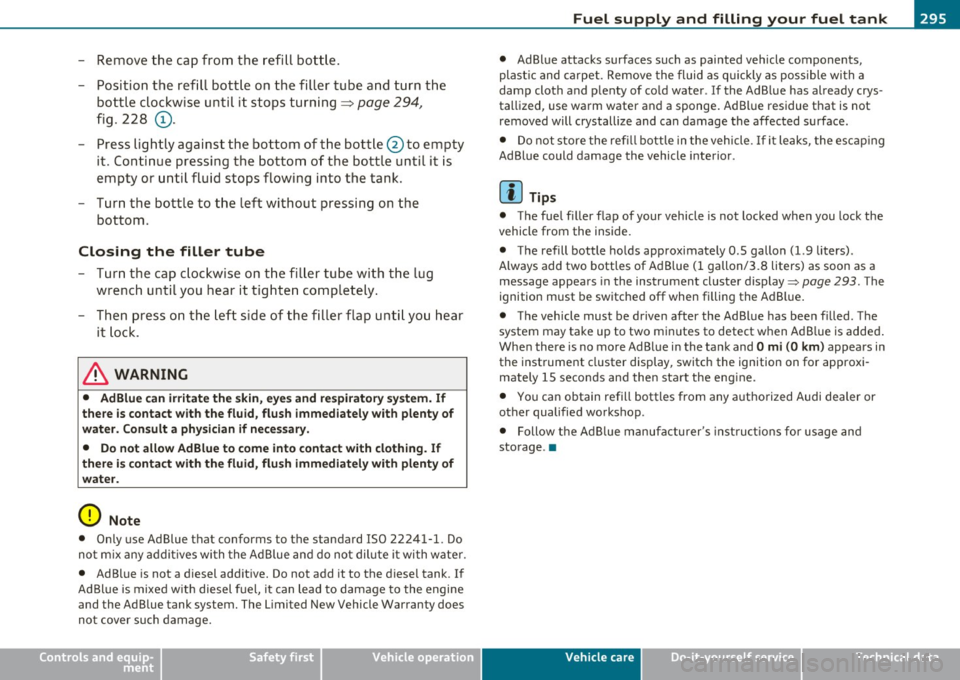
- Remove the cap from the refill bott le.
- Position t he refill bott le on the filler tube a nd turn the
bottle clockwise u ntil it stops turning~
page 294,
fig. 228 © -
- Press lightly against the bottom of the bottle@to em pty
it. Contin ue pressing the bottom o f the bott le until it is
empty or until fluid stops flowing into the tank.
- Turn the bottle to the left without pressing on the
bottom .
Closing the filler tube
- Turn t he cap clockw ise on t he fi ller t ube with t he lug
wrench un til you hear it t ighte n comp letely.
- Then press on the le ft side of the filler fla p un til yo u hear
i t lock.
& WARNING
• Ad B lu e can irritat e the skin, eye s and respiratory sy stem. If
the re is contact with the fluid , flush immed iately with plenty of
water. Con sult a phy sician if ne ce ss ary .
• Do not allow Ad Blue to come into contact with clothing. If
there is contact with the fluid , flush immediate ly with plenty of
water.
0 Note
• Only use Ad Blue that conforms to the standard ISO 22241-1. Do
no t m ix any addit ives wi th the Ad Blue an d do not dil ute it wi th water.
• Ad Blue is not a diesel add it ive. Do not add it to the diese l tank. If
Ad Blue is mixed w it h diesel f ue l, it can lead to damage to the engine
and the Ad Blue tank system. The L imited New Vehicle Warranty does
no t cover su ch damage.
Safety first
Fuel supply and filling your fuel tank
• Ad Blue attacks surfaces such as pai nted vehicle components,
plast ic and carpet. Remove the fluid as q uickly as poss ible wi th a
damp cloth and plenty of cold wate r. If the Ad Blue has already crys
tallized, use wa rm water and a sponge. Ad Bl ue residue that is not
removed will crystallize and can damage the affected s urface.
• Do not store the refi ll bott le in the veh icle . If it leaks, the esc aping
Ad Blue could damage the vehicle interior .
(I) Tips
• The fue l fil ler flap of your vehicle is not locked whe n you lock the
vehicle from the inside.
• The refill bottle ho lds approximate ly 0.5 gallon (1.9 liters) .
Always add two bottles of Ad Blue (1 gallon/3.8 liters) as soon as a
message appears in the instrument cluster display~
page 293. The
ignition must be switched off when filling the Ad B lue.
• The veh icle must be d riven after the Ad Blue has been fi lled. The
system may take up to two minutes to detect when Ad B lue is added .
Whe n there is no more Ad Blue in the ta nk and
O mi (0 km) appears in
the instrument cluster display, switch the ignition on for approxi
mately 15 seco nds and then sta rt the eng ine.
• You can obtain refill bottles from any a uthorized Audi dealer or
other qualified workshop .
• F ollow t he Ad Blue manufacturer 's inst ru ct io ns for usage and
storage .•
Vehicle care Technical data
Page 299 of 390
___________________________________________ C..:...._ h:....:e :....:c:..:. k.::..: i..:.. n .:..:g:!:....:: a....:. n..:.. d~ f:....:. i.:..ll :.:.i:....:n :.:g !....- _1!'11
Closing the engine hood
- Pull the hood down until the pressure from the struts is
reduced.
- Let the hood
drop down and latch in place. Do not try to
push it shut;
it may fail to engage=:> &.
& WARNING
A hood that is not completely latched could fly up and block your
view while driving.
• When you close the engine hood, check it to make sure the
safety catch has properly engaged. The hood should be flush with
the surrounding vehicle body parts.
• If you notice while driving that the hood is not secured prop
erly, stop at once and close it. •
Working in the engine compartment
Be especially careful whenever you work in the engine
compartment.
Whenever you must perform any work in the engine compartment,
for example checking and filling different fluids, there is a risk of injury, burns and accidents. To prevent personal injury always
observe the following WARNINGS. The engine compartment of any
vehicle is a hazardous area=>& .
& WARNING
To help avoid injury, before you check anything under the hood:
• Turn off the engine.
• Remove the ignition key.
• Apply the parking brake.
Safety first
& WARNING (continued)
• Move selector lever to "P" (Park).
• Always let the engine cool down. Hot components will burn
skin on contact.
• To reduce the risk of being burned, never open the hood if you
see or hear steam or coolant escaping from the engine compart
ment. Wait until no steam or coolant can be seen or heard before
carefully opening the hood.
• Keep children away from the engine compartment.
• Never spill fluids on hot engine components. They can cause a
fire. • Never touch the radiator fan. The auxiliary electric fan is
temperature controlled and can switch on suddenly.
• Never open the coolant reservoir cap when the engine is still
warm. The coolant system is pressurized and hot coolant could
spray out.
• Protect your face, hands and arm from steam or hot engine
coolant by placing a thick rag over the cap when you open the
coolant reservoir.
• If work on the fuel system or the electrical system is necessary:
- Always disconnect the battery.
- Never smoke or work near heaters or open flames. Fluids in
the engine compartment could start a fire.
- Keep an approved fire extinguisher immediately available.
• To avoid electrical shock and personal injury while the engine is
running or being started, never touch:
-Ignition cables
- Other components of the high voltage electronic ignition
system.
• If you must perform a check or repair with the engine running:
- First, fully apply the parking brake, move selector lever to
"P" (Park). .,
Vehicle care Technical data
Page 333 of 390

Tires and wheels Ill
----------------
& WARNING
Always adjust your driving to the road and traffic condit ions.
Never let the good a cceleration of the winter tires and all-wheel
drive t empt you into tak ing e xtra ri sks. Always rememb er:
• When braking , an all-wheel drive vehicle handle s in the same
way as a front drive vehicl e.
• Drive carefully and reduce your speed on icy and slippery road s,
even winter tires cannot help under black ice condit ions.
c£> For the sake of the environment
Use summer tires when weather co ndit ions permit. They are qu ieter,
do not wea r as qu ickly and r educe fuel consumpt ion. •
Snow chains
Snow c hains m ay be fi tted on ly to the rear w heels, and only to cer tain
tire sizes . Ask your authorized Audi dea ler on wh ich tire sizes snow
c hains can be used .
Th e snow chains must have low-profile links and m ust not be thicker
than 0.53 inch ( 13 .S mm), including the lock .
Remove wheel ce nter covers and trim discs before put ting snow
chains on your vehicle~
0. For safety reasons cover caps must then
be fi tted over t he wheel bolts . T hese a re av ail able fro m auth o rized
Audi dealers.
& WARNING
Using the wrong snow chains for your vehicle or installing them
in correctly can increa se the risk of loss of control leading to
serious personal injury.
Safety first
& WARNING (co ntinued )
• Snow chains are available in different sizes . Always make sure
to follow the instruction s provided by the snow chain manufac
turer.
• When driving with snow cha ins never drive fa ster than the
speed permitted for your specific snow chains .
• Always observe local regulat ions.
0 Note
• Remove snow chains before driving on roads not covered wit h
snow to avoid damaging t ires and wear ing the snow chains down
unnecessar i Ly .
• Snow chains, whi ch come into direc t contac t wi th the w heel rim,
can scratch o r damage it. Therefore, make s ure that the snow chai ns
are sui tably covered. Chec k the pos ition of the snow chains after
dr iv ing a few yards and correct if necessary . Follow the instruct ions
from the snow chain ma nufact urer when do ing so.
• If the Adaptive Air Suspension* should malfunct io n, do not mount
or use snow chai ns because the ve hicle w ill be extreme ly low. If you
do d rive with snow chains on while the vehicle is at this level, the
snow c hains m ight severe ly damage the whee lhouse and other parts
of t he ve hicle .
[ i ] Tips
Whe re snow c ha in s are mandatory on ce rtain roads, t his norm ally
also app lies to vehicles with All Whee l Dr ive. •
Vehicle care Technical data
Page 365 of 390
____________________________________________________ D_ a_t_ a __ _
Data
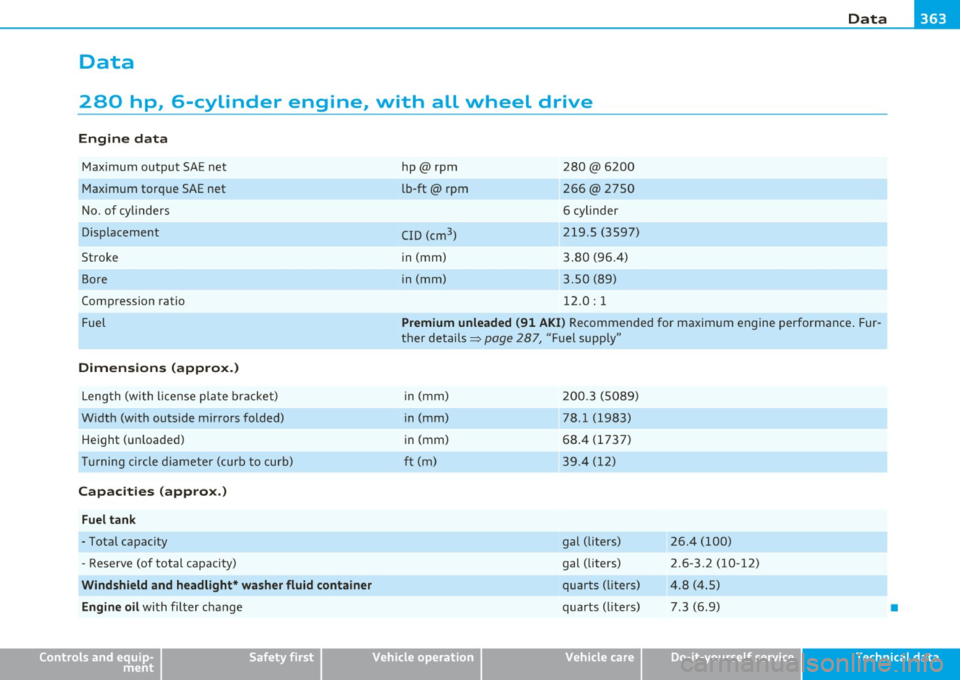
280 hp, 6-cylinder engine, with all wheel drive
Engin e data
Maximum output SAE net
Maximum torque SAE net
No. of cy linders
Displacement
Stroke Bore
Compression ratio
Fuel
Dimensions (approx.)
Leng th (wi th l ice nse p la te br acke t)
W idth (w ith outs ide mir rors folded)
He ight (un loaded)
Tu rning circle diameter (curb to curb)
Capacities (approx.)
Fuel tank
- Tota l capacity
- Reserve (of total capacity)
Windshield and headlight* wa sher fluid container
Engine oil
with filter change
Safety first
hp@rpm
lb-ft@ rpm
CID (cm
3 )
in (mm)
in (mm) 280@ 6200
266@2750
6 cylinder
219.5 (3597)
3
.80 (96.4)
3 .50 (89)
12.0: 1
Premium unleaded (91 AKI) Recommended for maximum engine perfo rmance . Fur
th er details~ pag e 287, "Fuel supply"
in (mm)
i n (mm)
in (mm)
f t (m) 2
00 .3 (5089)
78 .1 (1983)
68.4 (1737)
39. 4 (12)
gal (liters)
gal (liters)
quarts (l ite rs)
quarts ( lite rs) 26
.4 (100)
2.6-3.2 (10-12)
4.8 (4. 5)
7.3 (6 .9)
•
Do-it,yourself service Technical data
Page 366 of 390
___ D_ a_t _a _____________________________________________________ _
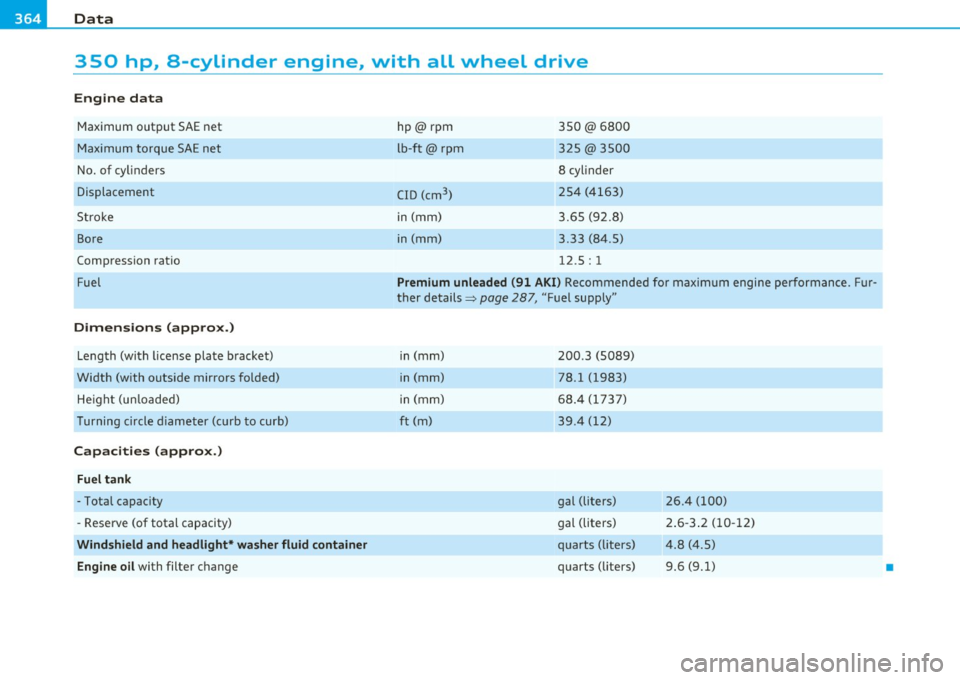
350 hp, a-cylinder engine, with all wheel drive
Engine data
Maximum output SAE net
Maximum torque SAE net
No. of cylinders
Displacement
Stroke
Bore
Compression ratio
Fuel
Dimensions (approx.)
Length (with license plate bracket)
Width (with outside mirrors folded) He ight (unloaded)
Turning circle diameter (curb to curb)
Capacities (approx.)
Fuel tank
-Total capacity
- Reserve (of total capacity)
Windshield and headlight* washer fluid container
Engine oil
with filter change hp @rpm
lb-ft@
rpm
CID (cm
3 )
in (mm)
in (mm) 350@ 6800
325
@3500
8 cylinder
254 (4163)
3.65 (92.8)
3 .33 (84 .5)
12.5: 1
Premium unleaded (91 AKI) Recommended for maximum engine pe rformance . Fur
ther details~
page 287, "Fuel supply"
in (mm)
in (mm)
in (mm)
ft (m) 200
.3 (5089)
78.1 (1983)
68.4 (1737)
39 .4 (12)
gal (liters)
gal (liters)
quarts ( liters)
quarts (liters) 26.4 (100)
2.6-3.2
(10-12)
4 .8 (4.5)
9.6 (9.1)
•
Page 367 of 390
____________________________________________________ D_ a_t_ a __ _
App lies to veh icles : with di esel e ngine
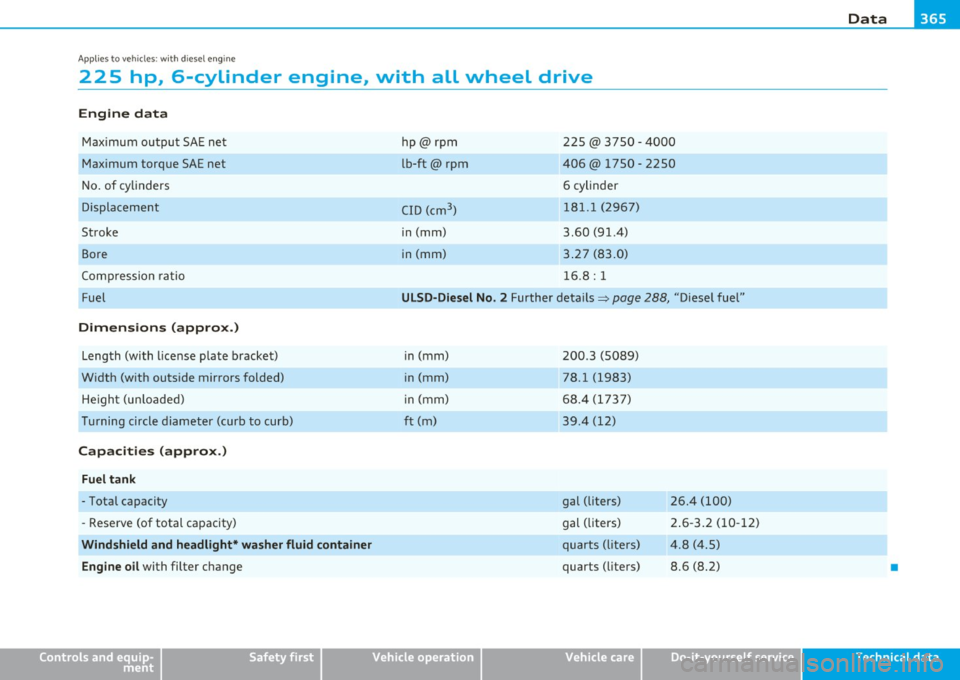
225 hp, 6-cylinder engine, with all wheel drive
Engine data
Max imum outpu t SA E net
Maximum torque SAE net
N o. of cy linders
Displaceme nt
Stroke Bore
Com pression ra tio
Fuel
Dimensions (approx.)
Leng th (with license p late bracke t)
W idth (w ith outs ide mirrors folded)
He igh t (u nloade d)
Turning circle diameter (curb to curb)
Capacities (approx.)
Fuel tank
- Tota l capacity
- R eserve (of total capacity)
Windshield and headlight* washer fluid container
Engine oil
with filter c hange
Safety first
hp@rpm
lb-ft@ rpm
C ID (cm
3
)
in (mm)
in (mm) 22
5@ 3750 - 4000
406@ 1750 - 2250
6 cylinder
181. 1 (2967)
3 .60 (91.4)
3 .27 (83.0)
16 .8: 1
ULSD-Diesel No . 2 Further details=> page 288, "Diese l fuel"
i n (mm)
in (mm)
i n (mm)
ft (m) 200
.3 (5089)
78 .l (1983)
68 .4 (17 37)
39 .4 (12)
gal (liters)
gal ( liters)
qu arts (lite rs)
quarts (liters) 26.4 (100)
2
.6- 3.2 (10 -12)
4.8 (4.5)
8.6 (8.2)
Do-it,yourself service
•
Technical data
Page 380 of 390
__ _:._A..:. l:.! p:.. h ::....:..:: a:.:b:.. e=-= t.:..:ic :.:a:.. l:.....:..: in~ d:...:e :..: x.:...._ ___________________________________________ _
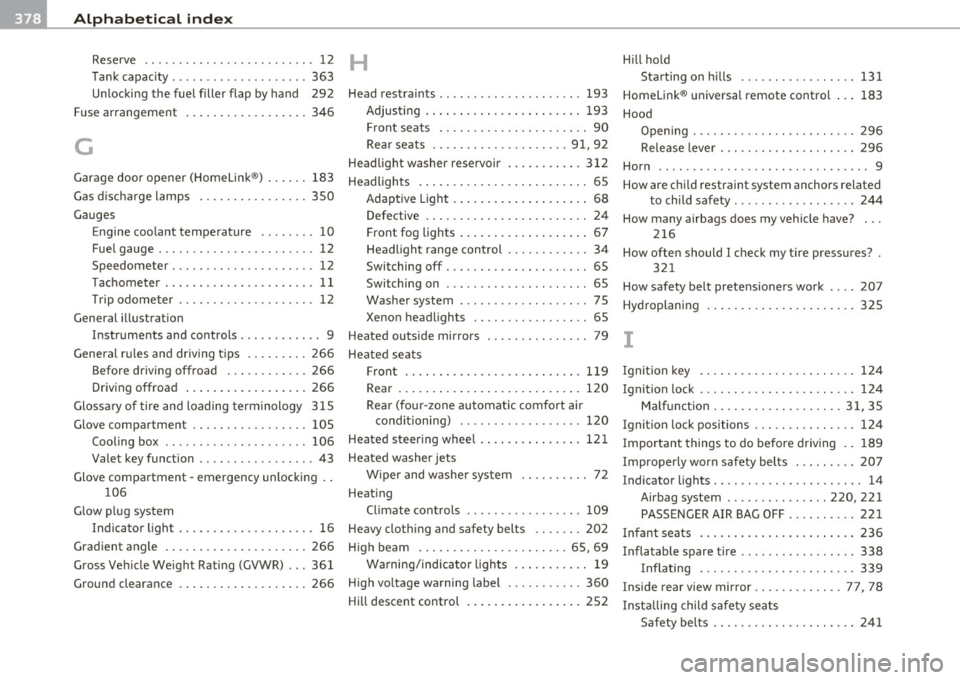
Reserve ..... .... ........ .... ... . 12
Tank capacity . .. .. .. ...... ... .. .. 363
Unlocking the fuel filler flap by hand 292
Fuse arrangement ... ............... 346
G
Garage door opener (Homelink®) ...... 183
Gas d ischarge lamps ........ .. .... .. 350
Gauges Engine coolant temperature . ... .... 10
Fuel gauge . .... .. .... .. .. .. .. .... 12
Speedometer ... .. .. ........ .. . ... 12
T achometer ...................... 11
Tr ip odometer ............. .... .. . 12
General illustration Instruments and controls ............ 9
General rules and driving tips ......... 266
Before driving offroad ........ .... 266
Driving offroad .................. 266
Glossa ry of tire and loading terminology 315
Glove compartment ........ ......... 105
Cooling box ..... ........ .... .. .. 106
Valet key function ......... ... .. .. . 43
Glove compartment -emergency unlocking ..
106
Glow plug system
Indicator light ............. .... .. . 16
Gradient angle .................. ... 266
Gross Vehicle We ight Rating (GVWR) ... 361
Ground clearance .. .. ............ ... 266
H
Head restraints ............... .... .. 193
Adjusting .. .. .... .. .... .. .. .. ... 193
Front seats . . . . . . . . . . . . . . . . . . . . . . 90
Rear seats .. .. ........... ..... 91, 92
Headlight washer reservoir ........... 312
Headlights ............ ... .. .. ... ... 65
Adaptive Light ............. .... .. . 68
Defective . . . . . . . . . . . . . . . . . . . . . . . . 24
Front fog lights ............ ... .. .. 67
Headlight range control . ........... 34
Switching
off ......... .. .. .. .. .. .. 65
Switching on ......... .... .. ...... 65
Washer system . ..... ... . ... .. .. .. 75
Xenon headlights .... ............. 65
Heated outside mirrors
79
Heated seats Front ................... .. .... . 119
Rear ............... ..... .. .. .. . 120
Rear (four-zone automatic comfort air
conditioning) ..... ...... .. .. .. . 120
Heated steering wheel ... ..... ....... 121
Heated washer jets
Wiper and washer system .... .. .. .. 72
Heating Climate controls ............... .. 109
Heavy clothing and safety belts ....... 202
H igh beam ......... .... .... .. .. . 65 , 69
Warning/indicator lights ..... .. .. .. 19
High voltage warning label .... .... ... 360
Hi ll descent control ..... ............ 252 Hill hold
Starting on hills 131
Homelink ® universal remote control ... 183
Hood Opening ............ .... .... .. .. 296
Release lever ... .. .. ..... .. .. .. .. 296
Horn .................. .... ... ... ... 9
How are child restraint system anchors related to child safety .... ....... ... .. .. 244
How many airbags does my vehicle have? ...
216
How often should I check my tire pressures? . 321
How safety belt pretensioners work .... 207
Hydroplaning ......... ............. 325
I
Ignition key ................ ..... .. 124
Ignition lock .. .. ............. .. .. .. 124
Ma lfunct ion .... .. .. .... ....... 31, 35
Ignition lock positions ... .. .. .. .... .. 124
Important things to do before driving .. 189
Improperly worn safety belts ... .. .. .. 207
Indicator lights . . . . . . . . . . . . . . . . . . . . . . 14
Airbag system ....... .. .. .. .. 220,221
PASSENGER AIR BAG OFF .... .... .. 221
Infant seats ................ ... .. .. 236
Inflatable spare tire .. .. .. .. .. .... ... 338
Inflating ........... .. .... .... .. 339
Inside rear view mirror .. ........... 77, 78
Installing child safety seats Safety belts ............... .. .. .. 241