inflation pressure AUDI Q7 2010 Owner´s Manual
[x] Cancel search | Manufacturer: AUDI, Model Year: 2010, Model line: Q7, Model: AUDI Q7 2010Pages: 390, PDF Size: 93.04 MB
Page 317 of 390
Tires and wheels -________________ fWII
& WARNING (co ntinued )
• Tires age even if they are not be ing used and can fail suddenly ,
e specially at high speeds . Tires that are more than 6 year s old can
only be used in an emergency and then with special care and at low
s peed .
Glossary of tire and loading terminology
Accessory weight
means the combined weigh t (in excess of those sta ndard items wh ich
may be replaced) of automatic transmission, power steer ing, power
bra kes, powe r win dows, power sea ts, radio, and heate r, to the exte nt
that these items are available as factory-insta lled equipment
(whet her i ns ta lled or no t).
Aspect ratio
means the r atio of t he he ight to t he widt h of the t ire in percent.
N umbers of 55 or lower indicate a low sidewa ll for improved steer ing
res ponse and bet ter over all h andling on dry p avemen t.
Bead
means the part of the t ire that is made of stee l wi res, w rapped or
re in forced by ply cords and that is shaped to fit the rim.
Bead separation
means a brea kdown of the bond between components in the bead.
Cord
means the st rands forming the plies in the ti re.
Safety first
& W ARNING (co ntinued )
• Never mount u sed tires on your vehicle if you are not sure of
their "previous history ." Old u sed tires may have been damaged
eventhoughthedamagecannotbeseenthatcanleadtosudden
tire failure and loss of vehicle control.
• If you notice unusual vibr ation or if the vehicle pulls to one side
when driving, always stop as soon as it is safe to do so and check
the wheels and tires for damage. •
Cold tire inflation pressure
means the t ire pressu re recom mended by the vehicle manufa ctu rer
for a tire of a desig nate d size that has not been driven for more than
a couple of m iles ( kilomete rs) a t low speeds in the t hree hour per io d
before the tire pressu re is measured or adjusted.
Curb weight
means the weight of a moto r vehicle wit h standard equipment
incl uding the max imum ca pac it y of fue l, o il, and coo lan t, air condi
tioning and additiona l weig ht of optional eq uipment.
Extra load tire
means a tire design to operate at higher loads and at higher inflat ion
pressures than t he co rresponding sta ndard t ire. Extra load tires may
be identif ied as "XL", "xl", "EXTRA LOAD", or "RF" on the sidewa ll.
Gross Axle Weight Rating ( "GAWR ")
means the loa d-carrying capac ity of a sing le ax le system, measure d at
the t ire-grou nd interfaces.
Gross Vehicle Weight Rating ("GVWR")
mea ns the maximum tota l loaded we ig ht of the vehicle .
Vehicle care Technical data
Page 318 of 390
-~_T_ ir_e_ s_ a_ n_ d_ w_ h_e_ e_ ls _______________________________________________ _
Groove
means the space between two adjacent tread ribs.
Load rating (code)
means the maximum load that a tire is rated to carry for a given infla
tion pressure. You may not find this information on all tires because
it is not required by law.
Maximum load rating
means the load rating fo r a tir e at the maximum permissible inflation
pressure for that tire.
Maximum loaded vehicle weight
means the sum of:
(a) Curb weight
(b) Accessory weight
(c) Vehicle capacity weight, and
(d) Production options weight
Maximum (permissible) inflation pressure
means the maximum cold inflation pressure to which a tire may be
inflated. Also called "maximum inflation pressure."
Normal occupant weight
means 150 lbs. (68 kilograms) times the number of occupants seated
in the vehicle up to the total seating capacity of your vehicle.
Occupant distribution
means distr ibution of occupants in a vehicle .
Outer diameter
means the overall diameter of an inflated new tire.
Overall width
means the linear distance between the exteriors of the sidewalls of
an inflated tire, including elevations due to labeling, decorations, or
protective bands or ribs.
Ply
means a layer of rubber -coated paralle l cords.
Production options weight
means the combined weight of those installed regular production
options weigh ing over 5 lbs. (2.3 kg) in excess of those standard
items which they replace, not previously considered in curb weight or
accessory weight, including heavy duty brakes, ride levelers, roof
rack, heavy duty battery, and special trim.
Radial ply tire
means a pneumatic tire in which the ply cords that extend to the
beads are laid at substantially 90 degrees to the centerline of the
tread .
Recommended inflation pressure
see=> page 315, "Cold tire inflation pressure".
Reinforced tire
means a tire design to operate at higher loads and at higher inflation
pressures than the corresponding standard tire. Reinforced t ires may
be identified as "XL ", "x l", "EXTRA LOAD", or "RF" on the sidewall.
Rim
means a metal support for a tire or a tire and tube assembly upon
wh ich the tire beads are seated .
Rim diameter
means nominal diameter of the bead seat . If you change your wheel
size, you w ill have to purchase new tires to match the new rim diam
eter .
Rim size designation
means rim diameter and width.
Rim width
means nom inal distance between rim flanges.
Page 320 of 390
___ T_ i_ r _e _s_ a_n_ d_ w_ h_ e_e_ l_ s _______________________________________________ _
Occ up ant loading and distribution for vehi cle normal load for various d esignated seating capacit ies
Designated seating capacity, num- Vehicle normal load, number of Occupant distribution in a nor
mally loaded vehicle
ber of occupants occupants
5/6*/7*
3 2 in front, 1 in second seat
Cold tire inflation pressure
Tire pressure affects the overall handling, performance and safety of a vehicle .
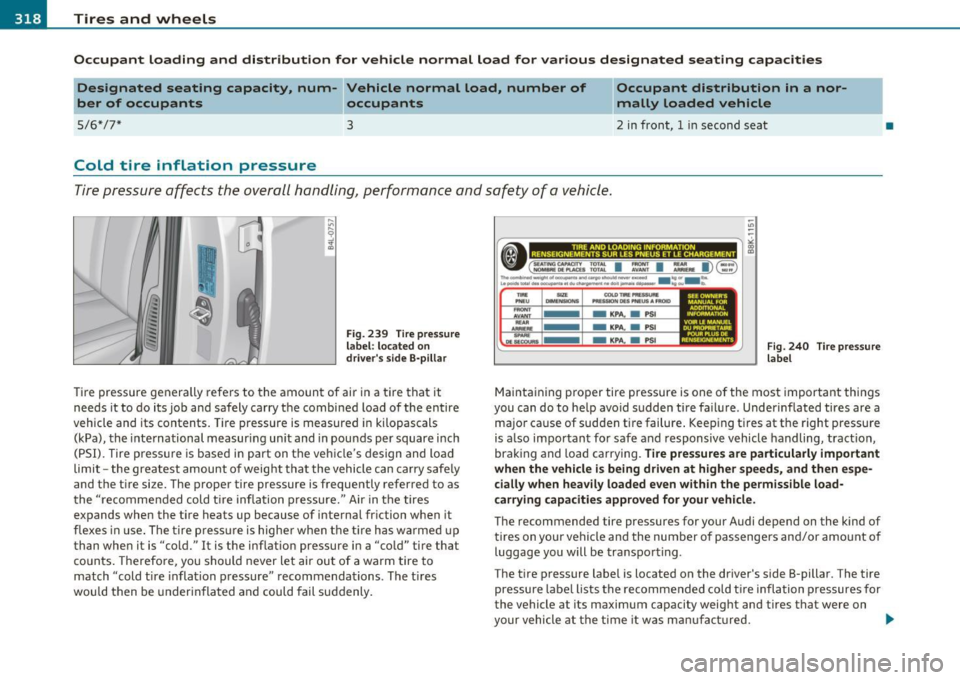
Fig. 239 Tire pre ssure
la bel: loc ate d on
d river 's si de B ·pillar
Tire pressure generally refers to the amount of air in a t ire that it
needs it to do its job and safely carry the combined load of the entire
vehicle and its contents . Tire pressure is measured in kilopascals
(kPa), the inte rnational measur ing un it and in pounds per square i nch
(PSI). Tire press ure is based in part on t he vehicle 's design and load
limit -the greatest amount of weight tha t the vehicle can carry safe ly
and the t ire si ze. The proper tire pressure is frequently referred to as
the "recommended cold t ire inflation pressure. " Air in t he tires
expands when the tire heats up because of internal friction when it
flexes in use . The tire p ress ure is highe r when the t ire has wa rmed up
than when it is "cold." It is the inflation pressure in a "cold" tire that c o unts . Therefo re, you should never let air ou t of a wa rm tire to
match "cold tire inflation pressure " recommendations . The t ires
wou ld then be underin flated and could fail suddenly .
SIZf COlD fflE PRESSUAf DIME NSION'S MfSSK)N DE$ l"NEV$ A fFIOiD
- KPA , . PSI
- KPA,. PSI
- KPA,. PSI
Fig. 240 Tir e pre ssure
label
Maintaining proper tire pressure is one of the most important things
you can do to he lp avoid sudden tire failure . Underinflated tires are a
ma jo r cause of sudden tire failure . Keep ing t ires at the right pressure
is a lso important fo r safe and responsive vehicle handling, t ract ion,
braking and load carrying.
Tire p ressures are particularl y important
when the vehicle i s being driven at higher speed s, and then e spe
cially when h eavily loaded even with in the permissible load
carrying capacitie s approved for your v ehicle .
The recommended tire pressures for your Audi depend on the kind o f
t ires on you r vehicle and the number o f passengers and/or amo unt of
luggage you will be transport ing .
The tire pressure label is located on the driver 's side 8-pillar . T he tire
pressure labe l lists the recommended cold t ire inflation p ressures for
the vehicle at its maximum capacity weig ht and tires that were on
•
your vehicle at the time it was m anufactured. .,
Page 321 of 390
________________________________________________ T_i_re _ s_ a _ n_d_ w_ h_ e_ e_l_s __ _
If you wish to improve comfort when operating the vehicle at
normal load (up to 3 o ccupant s), you can adjust tire pres sures to
those specified for normal vehicle load . Before operating the
vehicle at maximum lo ad, you must increase the tire p res sures to
those specified for maximum vehicle load=>& .
Bear in mind that the tire press ure monitor ing system can only
mon itor the t ire pressu re s you h ave sto red . T he sys tem does no t
recogn ize the load cond it ion of your vehicle.
Th e effectiveness of t he tire pressu re monitoring system will be
impa ired if you store normal load pressu res but then operate the
vehicle at its maxim um loa d=> & . See the
illustration=> fig. 239 for the location of the label on driver's
side B- pillar (colo r of the act ual la bel and ex act l ocation on the
vehicle will vary slig htly).
N ote that the fo llow ing tab le is accurate at the time of going to press
and is subjec t to change. I n the even t of discrepancies , the tire pres
sure label located on the dr iver's side B-pi llar a lways takes prece
dence .
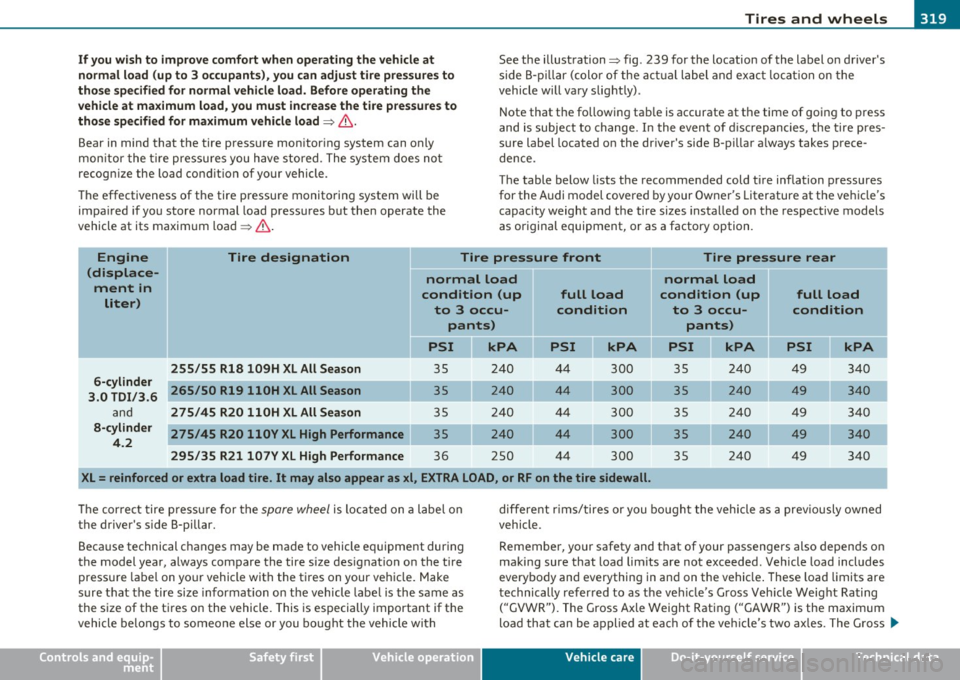
T he table below lists the recommended cold t ire inflation pressures
for the Audi model covered by your Owne r's Literature at t he ve hicle's
capac ity weight and the tire sizes insta lled on the respective models
as original equipment, or as a factory option .
Engine Tire designation Tire pressure front Tire pressure rear
(displace- normal load normal load
ment in
liter) condition
(up
full load condition (up
full load
to
3 occu- condition to 3 occu- condition
pants) pants)
PSI kPA PSI PSI kPA PSI kPA
255/55 R18 109H XL All Season 35 240 44 300
35 240 49 340
6-cylinder
265/50 R19 110H XL All Season
35 240 44 300 35 240 49 340 3.0 TDI/3
.6
and 275/45 R20 110H XL All Season 3 5 24 0 44 3 00 35 240 4 9 340
a-cylinder
275/45 R20 llOY XL High Performance 35 240
44 300
35 240 49 340 4
.2
295/35 R2110 7Y XL High Performance
36 250 44
300 35 240 49 340
XL= reinforced or extra load tire
. It may also appear as xi , EXTRA LOAD, or RF on the tire sidewall .
The correct tire p ress ure for t he spare wheel is loca ted on a labe l o n
the driver 's s ide B-pillar.
Beca use technical c hanges may be made to vehicle equipment dur ing
the model year, always compare the tire size des ignation on the t ire
pressu re labe l on yo ur vehicle with the t ires on your vehicle. Make
sure that the tire size informat ion on t he v ehicle labe l is the same as
the size of the t ires o n the vehicle. This is especially important if the
vehicle belongs to so meone else or you bo ug ht the vehicle with
Safety first
differe nt r im s/ tires or you bo ugh t the vehicle as a prev iously owned
vehicle.
Remember, yo ur safety and t hat of your passengers also depends o n
making sure that load limits are not exceeded. Vehicle load includes
everybody and everything in an d on the vehicle . These load limits are
t e chnically refer red to as the veh icle's G ross Veh icle Weig ht Rating
("GVW R"). The Gross Axle Weight Rati ng ("GAWR") is the maximum
load tha t can be applied at ea ch of the ve hicle's two ax les . T he G ross ..
Vehicle care Technical data
Page 322 of 390
-~_T_ i_ re _ s_ a_n _ d_ w_ h _e_ e_ls _________________________________________________ _
Vehicle Weight Rating and the G ross Ax le We ig ht Rating a re listed on
t he sa fe ty co mplianc e stick er la bel lo ca ted on t he dr ive r's side B
pillar. The tire press ure label on your Aud i lists the max imum
combine d weight of a ll of t he occ upants an d lugga ge or other cargo
that the veh icle can car ry . For the locat io n of the t ire pressure label
~ pa ge 318 , fig. 239 .
& WARNING
Overloading a vehicle can cause los s of vehicle control , a crash or
other accident, serious personal injury, and even death.
• Carrying more weight than your vehicle wa s designed to carry
will prevent the vehicle from handling properly and increase the
risk of a loss of vehicle control.
• The b rakes on a vehicle that has been overloaded may not be
able to stop the vehicle within a safe distan ce.
• Tires on a vehicle that has been overloaded can fail suddenly
causing loss of control and a crash.
• Always make sure that the total load being transported -
including the weight of a trailer hitch and the tongue weight of a
loaded trailer -does not make the vehicle heavier than the
vehicle 's Gro ss Vehicle Weight Rating.
& WARNING
• Incorrect tire pressures and /or underinflation can lead to a
serious or fatal accident.
• Incorrect tire pressures and /or underinflation cause increased
tire wear and can affect the handling of the vehicle.
• Incorrect tire pressures and/or underinflation can also lead to
sudden tire failure , including a blowout and sudden deflation,
c ausing loss of vehicle control. •
Checking tire pressure
The c orrec t t ire pre ssur e fo r th e tires origina lly insta lled
o n yo ur veh icle is listed on th e tir e p res su re l abe l lo cat ed
on driv er's side 8-pi llar.
Th e recommended tire pressures are on the tire p ress ure labe l an d in
t he table~
page 318, "Cold tire infla tion pressure" .This means that
the pressure m ust be chec ked an d adj usted w hen the tire has not
bee n driven for more tha n a co uple of m iles (kil om ete rs) at low
speeds dur ing the prev io us three hours . A ir in the tires expan ds when
t he tire heats up as a res ult of in ter nal fric tion as it flexes in use. The
t ire pressure is higher w hen the tire has warmed up than whe n it is
" ld "
c o .
It is the inflation pressu re in a "cold" tire that counts. Therefore, yo u
should never let air out of a wa rm tire to match "Col d tire inflat ion
pressu re" recomme ndat ions~
pag e 318. The t ir e s would t hen be
unde rinflated and co uld fail sudden ly .
Th e tire p ress ure label on your Aud i list s th e recommended co ld t ire
inflation pressures at maximum capacity fo r the new, o rigina l equip
ment tires tha t were on yo ur vehicle at the t ime it was man ufactu red.
For the location of the label~
page 318, fig. 239 .
Most tires lose a ir nat urally ove r time. They can a lso lose some a ir if
you drive over a potho le or hit a curb while pa rking.
It is usually not
possible to see whether the rad ia l tires used today are underinflated
jus t by loo king at them.
T herefore, be sure to check t ire pressures at least once a month and
always before going o n a long tri p. M ake sure to take the num be r of
peop le and the amount of luggage i nto account whe n ad justi ng tire
press ure for a t rip -even one tha t you would no t conside r to be
" lo ng." See~
pag e 322, "Tires and vehicle load lim its" for mo re
impo rtant i nformat ion.
Alw ays use an a ccu rat e t ire pres sure g auge whe n checki ng a nd
ad justing i nflat io n pressures. Check all of the tires and be sure not to
f o rge t the s pare tire. If the pre ssu re in any tir e is too h igh when the
t ir e is "co ld," let air out of t he tire slowly with t he edge of the ti re ..,_
Page 323 of 390
Tires and wheels Ill _____________ --=-=--=.:..:......:..::....:.=----
gauge and keep chec king the press ure until you reach t he press ure
th at i s cor rect fo r t he lo ad ( pass en ge rs and l uggage) and kind of
dr iving you plan to do .
If the press ure i n any t ire is too low, note the difference betwee n th e
pressu re in t he cold tire a nd the pressure you need and add the air
that you need to reach the correct pressure for t he ve hicle load
( pass enge rs and lugg age) f or th e tires on yo ur vehicle as l ist ed on t he
on your vehicle and in this manua l and the kind of driving you p lan to
do.
Never exceed the maximum inflation pressure listed on the tire
sidewall for any reason.
Remember that the ve hicle m anufac tur er, no t the tire manufa cture r,
determines t he correct tire press ure for the t ires on your veh icle.
It is important to check the tire pressure when the t ires a re co ld .
• Read the requ ired t ire pr essure from t he t ire pr essure lab el. T he
tire pressure labe l is locate d on t he driver's side 8- pillar. Th e tire pres
s u re labe l lists t he re com men ded col d tire inflat io n pr essures fo r the
vehicle at its maxim um capac ity we ight and the t ires t hat were on
yo ur vehicle at the t ime it was ma nufact ured. For r ecom mende d tire
pressures fo r norma l load cond it ions, please see chapter
=> page 318.
• Turn the valve stem cap co unter -clockw ise to remove it from the
t ire v alve.
• Place the air press ure gauge on the valve.
• The tire p ressures sho uld on ly be checked and adjusted wh en the
tires are cold. The slightly raised press ures of wa rm tires must not be
re du ced.
• Adjust the tire p ress ure to the loa d you are ca rry ing.
• Reinstall the valve stem cap o n the valve .
When should I check the tire pressure?
The correct tire press ure is especially important at high speeds. The
pressu re shoul d there fore be c hec ke d at least once a mo nth a nd
Safety first
always before start ing a journey . Do not forget to check t he t ire pres
s u re for the spare w heel.
When should I adjust the tire pressures?
Adju st the tir e pre ssure to the load y ou ar e carry ing. A fter ch anging a
wheel
or replac ing wheels you have to adjust t he t ire p ressures on all
w heels. I n addition , you m ust th en s tore the new tire press ures i n the
t ir e pressu re monitoring system=>
page 335.
& WARNING
Incorrect tire pressures and/or underinflation can lead sudden tire
failure, loss of control, collision, serious pers onal injury or even
death.
• When the warning symbol appears in the instrument
cluster, stop and inspect the tires.
• Incorrect tire pressure and/or underinflation can cause
increased tire wear and can affect the handling of the vehicle and
stopping ability.
• Incorrect tire pressure s and/or underinflation can also lead to
sudden tire failure, including a blowout and sudden deflation,
causing loss of vehicle control.
• The driver is responsible for the correct tire pressures for all
tires on the vehicle. The applicable pressure values are located on a sticker on the driver's side B-pillar.
• Only when all tires on the vehicle are filled to the correct pres
sure, the tire pressure monitoring system can work correctly.
• The use of incorrect tire pressure values can lead to accidents or
other damage. Therefore it is essential that the driver observe the
specified tire pressure values for the tire s and the correct pres
sures for the function of the tire pressure monitoring system.
• Always inflate tires to the recommended and correct tire pres-
sure before driving off. .,_
Vehicle care Technical data
Page 328 of 390
___ T_ i_ r _e _s_ a_n_ d_ w_ h_ e_e_ l_ s _______________________________________________ _
New tires and replacing tires and wheels
New tires and wheels have to be broken in.
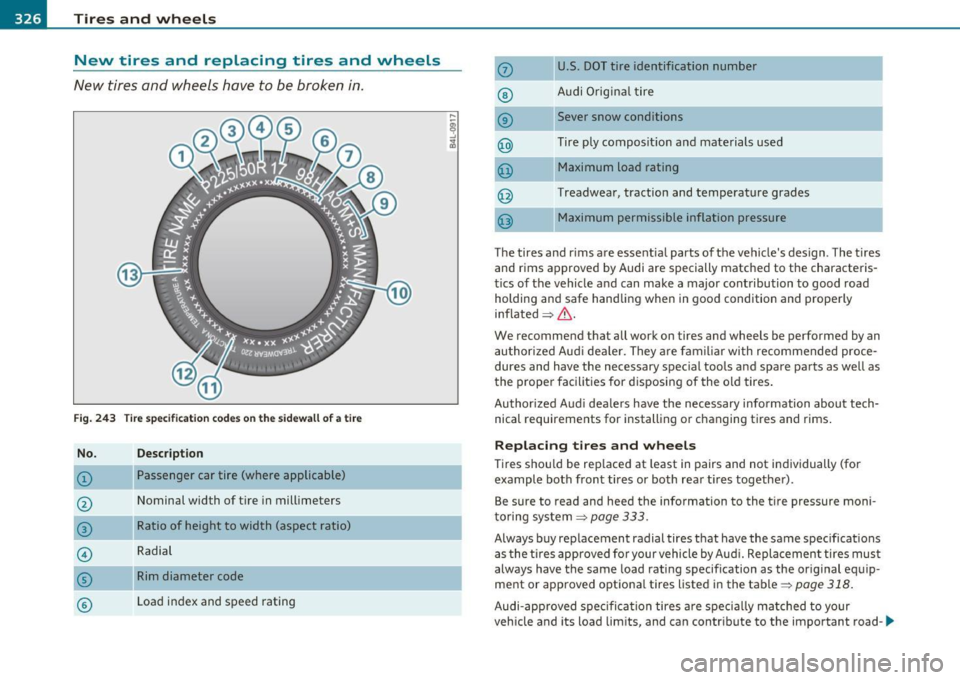
Fig. 24 3 Tire sp ecificat io n co des o n the side wall of a tire
No.
©
@
®
©
©
©
Des cript ion
Passenger car tire (where applicable)
Nominal width of t ire in mill imeters
Ra tio of height to width (aspect ratio)
Radial
Rim diameter code
Load index and speed rating
0
©
®
@
@
U.S . DOT tire identification number
A udi O rigi na l tire
Sever snow conditions
Tire ply composit io n and materials used
Maximum load rating
@ Treadwear, traction and temperature grades
@ Maximum permissible inflation pressure
The tires and r ims are essent ial parts of the vehicle's des ign. The t ires
and r ims approved by Audi are specially matched to the characteris
tics of the vehicle and can make a major contribution to good road holding and safe hand ling when in good condition and properly
inflated
~ & .
We recommend that all work on tires and wheels be performed by an
author ized Aud i dea le r. They a re fam iliar with recommended proce
dures and have the necessary special tools and spare parts as well as
the prope r facilit ies for d isposing of the old tires .
Author ized Aud i dea le rs have the necessary information about tech
nical requireme nts for installing or changing tires and rims .
Replacing tires and wheels
Tires shou ld be rep laced at least in pairs and not individually (for
example both front tires or both rear t ires togethe r) .
Be sure to read and heed the information to the t ire pressure moni
t oring system~
page 333.
Always buy replacement radial tires that have the same spec ificat ions
as the ti res approved fo r your vehicle by Aud i. Replacemen t tires must
always have the same load rating specif ication as the or iginal eq uip
me nt or approved opt iona l tires listed in the table~
page 318.
Audi -app roved spe cifi cati on tires are specia lly mat ched to yo ur
vehicle and its load lim its, and can contr ibute to the important road-..,_
Page 330 of 390

-~_T_ ir_e_ s_ a_ n_ d_ w_ h_e_ e_ ls _______________________________________________ _
the 22nd week of 2009. The other numbers are marketing codes that
may or may not be use d b y the ti re manu facture r. T his in format ion is
used to contact consumers if a tire de fect requires a recall.
Audi Original tire
T ires with the ident ificat ion "AO" or "RO" have been specially
m atche d w ith your Audi. We recommend using on ly these t ire s
because t hey meet the hig hest standards regard ing safety a nd
dr iving charac teris tics when used corre ctly. Your aut horize d Aud i
dea ler w ill glad ly provide you wi th mor e informatio n.
Tire ply composition and materials used
T he number of p lies indicates the number of layers of rubber-coated
f abr ic in the tire. In ge ne ral, the greate r the numbe r of p lies, the
more weig ht a tire ca n support. Tire manufac turers also mus t indi
c ate the materials in the t ire, which incl ude stee l, nylon, polyes ter,
and others .
Maximum Load Rating
This number ind icates the maximum load in k ilograms and pounds
t ha t can be carried by the tire .
Tire quality grading for treadwear, traction, and
temperature resistance
Tread wear, traction and temperat ure grades~ page 329.
Maximum Permissible Inflation Pressure
Th is number is the greatest amount o f air press ure t hat should eve r
be pu t in the tire under no rm al driv in g c ond ition s.
& WARNING
• Using incorrect or unmatched tires and/ or wheels or improper
tire and wheel combinations can lead to loss of control , collis ion
and seriou s personal injury.
& WARNING (co ntinued )
• Always use tires, rims and wheel bolts that meet the specifica
tions of original factory-installed tires or other combinations that have been specifically app roved by the vehicle manufacturer.
• Tires age even if they are not being used and can fail suddenly,
especially at high speeds . Tires that a re more than 6 years old can
only be used in an emergency and then with special care and at
lower speeds.
• Never mount used tires on your vehicle if you are not sure of
their "previous history ." Old used tires may have been damaged
eventhoughthedamagecannotbeseenthatcanleadtosudden
tire failure and loss of vehicle control.
• All four wheels must be fitted with radial tires of the same
type , size (rolling circumference) and the same tread pattern.
Driving with different tires reduces vehicle handling and can lead
to a loss of control.
• If the spare tire is not the same as the tires that are mounted
on the vehicle - for example with winter tires - only use the spare
tire for a short period of time and drive with extra care . Refit the
no rmal road wheel as soon as safely possible .
• Never drive faster than the maximum speed for which the tires
on your vehicle are rated because tires that are driven faster than
their rated speed can fail suddenly .
• Ove rloading tire s cause heat build-up, sudden tire failure,
including a blowout and sudden deflation and loss of control.
• Temperature grades apply to tires that are properly inflated
and not over or underinflated.
• For technical rea sons it is not always possible to use wheels
from other vehicles- in some cases not even wheels from the same
vehicle model.
• If you install wheel trim discs on the veh icle wheels, make sure
that the air flow to the brakes is not blocked . Reduced airflow to
the brakes can them to overheat , increasing stopp ing distances
and causing a colli sion.
~
Page 334 of 390
-Tires and wheels PW~---------------
Wheel bolts
Wheel bolts must al ways be tightened to the correct
torque .
The design of wheel bolts is matched to the factory installed rims. If
different r ims a re fitted, the cor rect wheel bolts with the r ig ht leng th
and correctly shaped bolt heads must be used. Th is ensures that
w heels are fitted secure ly and that t he br ake system func tion s
correctly .
In certain circ umstances, you may not use whee l bolts from a
different veh icle -even if it is the same model~
page 368.
&_ WARNING
Improperly tightened or maintained wheel bolts can become
loose causing lo ss of control , a c ollision and seriou s personal
injury .
• Always keep the wheel bol ts and the thread s in the wheel hub s
clean so the wheel bolts can turn easily and be properly t ighten ed .
• Never gr ease or oil the wheel bolt s and the threads in the wh eel
hubs. They can become loose while driving if greased or oiled, even
if tightened to the specified torque.
• Only use wheel bolts that belong to the rim being installed.
• Never use different wheels bolts on your vehicle .
• Alway s maintain the correct tightening torque for the wheel
bolt s to reduce the risk of a whee l los s. If the tightening torque of
the wheel bolts is too low , they can loosen and come out when the
vehicle is moving . If the tightening torque i s too h igh, the wheel
bolts and threads can be damaged and the wheel can become
loose .
0 Note
The spe cifie d torq ue for the whee l bolts is 120 ft lb (160 Nm) wi th a
tolerance of ± 7,4 ft lb( ± 10 Nm). Torque whee l bolts diagona lly. After changing a wheel, the torq
ue m ust be checked as soo n as
possible wi th a t orqu e w rench -prefer ably by an auth o riz ed Audi
dealer or qualified workshop. •
Low aspect ratio tires
Your Audi is factory-equipped with low aspect ratio tires. These tires
h ave bee n thorou ghly teste d and been se lec ted spe cifically fo r yo ur
model for their superb performance, road feel and hand ling u nder a
var iety of dr iving con ditions . Ask your authorized A udi dea le r for
more deta ils.
The low aspect ratio of these t ires is ind icated by a n umera l of
55 or
le ss
in t he tire 's s ize designation . T he numera l rep resents the ratio o f
the tire's sidewall he ight in relat ion to its tread width exp ressed in
pe rcen tage . Co nven tional ti res have a heig ht/w idth r atio o f 60 o r
more.
The performance of low-aspect-ratio tires i s particularly sensitive to
improper inflation pressure. It is therefore important that low
aspect ratio tires are inflated to the specified pressure and that the
inflation pre ssure is regularly checked and maintained. Tire pre s
sures should be checked at least once a month and always before a
long trip~
page 320, "Che cking t ire press ure".
What you can do to avoid tire and rim damage
Low aspe ct ratio tires ca n be damaged more eas ily by imp act wi th
potholes, curbs, gul lies or ridges on the road, part icu lar ly if the tire is
unde rinfl ated.
I n order to minimize the occu rrence of impact damage to the tires of
your vehicle, we recommend that yo u observe the follow ing p recau
tions:
• Always ma inta in recommen ded inflation p ressures. Check your
t ire press ure every 2,000 m iles (3,00 0 km) a nd a dd air i f ne cess ary.
• Drive ca ref ully on roads with potho les, dee p gullies or ridges. The
i m pact from d riving t hrough or over such obsta cles can damage you r
tires. Impact w it h a c urb may also cause damage to your tires . .,_
Page 335 of 390

Tires and wheels -________________ fWII
• After any impact, immediately inspect your tires or have them
inspected by the nearest authorized Audi dealer. Replace a damaged
tire as soon as possible.
• Inspect your tires every 2,000 miles (3,000 km) for damage and
wear . Damage is not always easy to see . Damage can lead to loss of
air and underinflation, wh ich could eventually cause tire failure. If
you believe that a tire may have been damaged, replace the tire as
soon as possible.
• These tires may wear more quickly than others .
• Please also remember that, while these tires deliver responsive
handling, they may ride less comfortably and make more noise than
other choices.
Reduced performance in winter/cold season
conditions
All tires are designed for certain purposes. The low aspect ratio, ultra high performance tires originally installed on your vehicle are
intended for maximum dry and wet road performance and handling.
Th ey are not su itable for cold, snowy or icy weather conditions. If you
drive under those circumstances, you should equip your vehicle with
all -season or winter tires, which offer better traction under those
conditions. We suggest you use the recommended snow or all-season
tires specified for your vehicle, or their equiva lent.
Refer to~
page 330 for more detailed i nformat ion regard ing w inter
tires. •
Tire pressure monitoring system
General notes I)
Each tire, including the spare (if prov ided), should be checked
month ly when cold and inflated to the inflation pressure recom
mended by the vehicle manufacturer on the vehicle placard or tire
inf lation pressure label. (If your vehicle has tires of a different size
than the size ind icated o n the vehicle p lacard o r tire inflation pressure
Safety first
label, you should determine the proper tire inflation pressure for
t hose tires.)
As an added safety feature, your vehicle has been equipped with a t ire
pressure monitoring system ( TPMS) that illuminates a low tire pres
s ur e telltale when one or more of your tires is significantly under
inflated. According ly, when the low tire pressure te lltale illuminates,
you should stop and check your tires as soon as possible, and inflate
them to the proper pressure. Driving on a sign ificantly under- inflated
tire causes the tire to overheat and can lead to tire failure. Unde r
inflation also reduces fuel efficiency and tire tread life, and may
affect the vehicle's handling and stopping ability.
Please note that the TPMS is not a substitute for proper t ire ma inte
nance, and it is the driver's responsibility to maintain correct tire
pressure, even if unde r-inflation has not reached the level to trigge r
illumination of the TPMS low tire pressure telltale.
Your vehicle has also been eq uipped with a TPMS mal function indi
cator to indicate when the system is not operating properly . The
TPM S malfunction indicator is combined with the low tire pressure
telltale . When the system detects a ma lfunct ion, the telltale will
flash for approximately one minute and then remain continuously
illuminated . T his sequence will continue upon subsequent vehicle
start-ups as long as the malfunction exists.
When the malfunction indica tor is illum inated, the system may not
be able to detect or signal low tire pressure as intended. TPMS
ma lfunctions may occur fo r a variety of reasons, including the instal
lat ion of replacement or alternate tires or wheels on the veh icle that
prevent the TPMS from functioning properly. Always check the TPMS
malfunction telltale after replac ing one or more tires or wheels on
your vehicle to ensure that the rep lacement or a lternate tires and
wheels allow the TPMS to continue to function properly .•
Vehicle care Technical data