transmission AUDI Q7 2010 Owner´s Manual
[x] Cancel search | Manufacturer: AUDI, Model Year: 2010, Model line: Q7, Model: AUDI Q7 2010Pages: 390, PDF Size: 93.04 MB
Page 288 of 390
-~_C_ le_ a_n_ i_ n_ g=- a_ n_d___. p_ ro_ t_e _c_ t_ i_o _n ___________________________________________ _
Engine compartment
Be especially careful when cleaning the engine compa rt
men t.
Always switch off the ignition before cleaning the engine=:>& .
Plenum panel
Remove leaves from the plenum panel in front of the win dshi eld
unde r th e eng ine hood . T hi s prevents the water d rain holes from
becoming b locked, and it prevents debris from entering the vehicle
inter io r th rough the heat ing and vent ilation ducts .
Corrosion protection
The eng ine compartment and transmission have been cor rosion
protected at the factory.
Good ant i-cor rosion treatment is very impo rtant , pa rtic ular ly in the
w inter . If the vehicle is frequently driven on sa lt treated roads, the
en tire eng ine compar tment and plenum p anel sho uld be thoroug hly
cleaned at the end of winter and retreated to prevent salt damage. At
t he same t ime, the underside of the vehi cle should be washed as well.
If the e ng ine compartment is clea ned at any t ime with grease
removing so lutions
2l , or i f you have the engine washed , the anti
co rros io n treatment is a lmost a lways removed as w ell.
It is t herefore
essential to have a long-last ing corrosion p rotect ion reapplied to all
surfa ces, seams, jo ints and compo nents in the engi ne co mpa rt ment .
& WARNING
Be aware: The engine compartment of any motor vehicle is a
potentially hazardous area .
• Before working in the engine compartment, be sur e to read the
information =:>
page 286.
2
l Use on ly th e co rr ect clean ing so lut ions. Never use gaso line or diese l fuel.
& WARNING (c on tinued )
• Before reaching into the front plenum panel , alway s remove
the ignition key. Otherwise, the windshield wiper system could unintentionally be switched on , possibly causing personal injury
from the moving wiper linkage.
• Never reach into the area around or touch the radiator fan. The
auxiliary fan is temperature controlled and can switch on suddenly
· ev en when the ignition is off.
• Do not wash, wax or dry the engine with th e engine running.
Moving or hot pa rts could injure you.
• Do not clean the underside of the chass is, fenders, wheel
covers, or other hard to reach part s without protecting your hands
and arm s. You may cut yourself on sharp-edged metal parts.
• Always read and heed all WARNINGS and other information
=:> page 274. •
Page 317 of 390
Tires and wheels -________________ fWII
& WARNING (co ntinued )
• Tires age even if they are not be ing used and can fail suddenly ,
e specially at high speeds . Tires that are more than 6 year s old can
only be used in an emergency and then with special care and at low
s peed .
Glossary of tire and loading terminology
Accessory weight
means the combined weigh t (in excess of those sta ndard items wh ich
may be replaced) of automatic transmission, power steer ing, power
bra kes, powe r win dows, power sea ts, radio, and heate r, to the exte nt
that these items are available as factory-insta lled equipment
(whet her i ns ta lled or no t).
Aspect ratio
means the r atio of t he he ight to t he widt h of the t ire in percent.
N umbers of 55 or lower indicate a low sidewa ll for improved steer ing
res ponse and bet ter over all h andling on dry p avemen t.
Bead
means the part of the t ire that is made of stee l wi res, w rapped or
re in forced by ply cords and that is shaped to fit the rim.
Bead separation
means a brea kdown of the bond between components in the bead.
Cord
means the st rands forming the plies in the ti re.
Safety first
& W ARNING (co ntinued )
• Never mount u sed tires on your vehicle if you are not sure of
their "previous history ." Old u sed tires may have been damaged
eventhoughthedamagecannotbeseenthatcanleadtosudden
tire failure and loss of vehicle control.
• If you notice unusual vibr ation or if the vehicle pulls to one side
when driving, always stop as soon as it is safe to do so and check
the wheels and tires for damage. •
Cold tire inflation pressure
means the t ire pressu re recom mended by the vehicle manufa ctu rer
for a tire of a desig nate d size that has not been driven for more than
a couple of m iles ( kilomete rs) a t low speeds in the t hree hour per io d
before the tire pressu re is measured or adjusted.
Curb weight
means the weight of a moto r vehicle wit h standard equipment
incl uding the max imum ca pac it y of fue l, o il, and coo lan t, air condi
tioning and additiona l weig ht of optional eq uipment.
Extra load tire
means a tire design to operate at higher loads and at higher inflat ion
pressures than t he co rresponding sta ndard t ire. Extra load tires may
be identif ied as "XL", "xl", "EXTRA LOAD", or "RF" on the sidewa ll.
Gross Axle Weight Rating ( "GAWR ")
means the loa d-carrying capac ity of a sing le ax le system, measure d at
the t ire-grou nd interfaces.
Gross Vehicle Weight Rating ("GVWR")
mea ns the maximum tota l loaded we ig ht of the vehicle .
Vehicle care Technical data
Page 342 of 390
111.___W_ h_ a_t _ d_ o_ I_d_ o_ n_o _w_ ? ____________________________________________ _
-Block the diagonally opposite wheel with the folding
chocks or other objects.
- Take the
jack and the inflatable spare tire out of the
luggage compartment =>
page 336.
& WARNING
You or your passengers could be injured while changing a wheel if
you do not follow these safety precautions:
• If you have a flat tire, move a safe distance off the road. Turn
off the engine, turn the emergency flashers on and use other
warning devices to alert other motorists.
• Make sure that passengers wait
in a safe place away from the
vehicle and well away from the road and traffic.
• To help prevent the vehicle from moving suddenly and possibly
slipping off the jack, always fully set the parking brake and block
the wheel diagonally opposite the wheel being changed with the
folding chocks or other objects. When one front wheel is lifted off
the ground, placing the Automatic Transmission in "P" (Park) will
not prevent the vehicle from moving.
• Before you change a wheel, be sure the ground is level and
firm. If necessary, use a sturdy board under the jack.
• After installing the inflatable spare tire, make sure that you
replace the flat tire/wheel in its storage area properly and tighten
the knurled retaining screw securely. •
Changing a wheel
When you change a wheel, follow the sequence described
below step-by-step and in exactly that order .
1. Activate the vehicle jack mode (only vehicles with Adaptive
Air Suspension) =>
page 180.
2. Remove the decorative wheel cover*. For more details see
also =>
page 341, "Decorative wheel covers" or
=>
page 341, "Wheels with wheel bolt caps".
3. Loosen the
wheel bolts=> page 342.
4. Locate the proper mounting point for the jack and align
the jack below that point=>
page 342.
5. Lift the car with the jack=> page 342.
6. Remove the wheel with the flat tire and then install the
inflatable spare tire=> page 344.
7. Tighten all wheel bolts lightly.
8.
Lower the veh icle with the jack .
9. Use the wheel bolt wrench and
firmly tighten all wheel
bolts =>
page 342.
10. Replace the decorative wheel cover*.
11. Deactivate the vehicle jack mode (only vehicles with
Adaptive Air Suspension)=>
page 180.
& WARNING
Always read and follow all WARNINGS and information:::::, & in
"Raising the vehicle" on
page 342 and=> page 345. •
After changing a wheel
A wheel change is not complete without the doing the
following.
- Store and secure the wh eel you replaced in the spare
wheel well.
- Replace the tools and the jack in their proper location .
Page 350 of 390

-Fuses and bulbs ..._ __________________________________________ _
No.
2
3
4
5
6
7
8
9
10
11
1 2
Equipment
Adaptive Cruise Control
N ot used
N ot used
Not used
T erminal
15 (interior)
O il level sensor
D iagnostic connector
Automatic dipping interior mirror H omelink
Control module Gateway
H eadlight range adj ustment
Amps
5
5
5
5
5
5
5
5
Fuse Location, Instrument Panel right
Fig . 260 Fuse pa nel
la yo ut
Some of the equipment i tems listed a re optiona l or only avai lab le on
certain model configu rations .
Note that the following table i s accurate at the time of going to
pre ss and is subject to change . In the ev ent of di screpancie s, the
label on the inside of the co ver always takes preceden ce.
•
The power seats are protected by circuit break ers , which automat i
cally reset aft e r a few seconds af ter the overload has been remed ied.
No . Equipment
Fuse holder (black)
1 Heated rear seats
2 Automat ic transm issio n
3 Front seat hating/seat ventilation (right)
4 Elect ronic Stability Program (ESP)
5 Door con trol module (right side of vehicle)
6 Rear electrical outlets
7 Lumbar support passenger's seat
8 C igarette ligh ter front
9 Front e lectrical outlets
Amps
20
2 0
1 5
25
10
20
25 __________ .__
10 A/C contro ls
11 Not used
12 Intelligent power module passenger
Fuse holder (brown )
1
2
Headlig ht ele ctronic s ystem (r ight side of vehi
cle)
Ride height adjustment
3 Telephone package
4 Audi side assist
5 Elect ronic Stabilization Prog ram (ES P)
6 Automatic transmission
7 Electronic Stabilization Program (ESP)
8 Shift gate automatic transmission
9 Pa rk ing system
10
15
1 0
5
5
5
5
5/20
5
5
5
Page 355 of 390
_____________________________________________ E_ m___;, e_r-=g ~ e_ n_c,_:!y:.__: s_i:..:t ..:..u :..:a;;,. t.:.; i...: o :..: n...:..:. s _ __,J_
& WARNING (continued)
• Before you check anything in the engine compartment, always
read and heed all WARNINGS~
page 286, "Engine compart
ment".
0 Note
• Applying a higher voltage booster battery will cause expensive
damage to sensitive electronic components, such as control units,
relays, radio, etc.
• There must be no electrical contact between the vehicles as other
wise current could already start to flow as soon as the positive(+)
terminals are connected.
[I] Tips
• The discharged battery must be properly connected to the
vehicle's electrical system . When jump starting or charging the
battery, never connect the negative ground cable to the battery nega
tive post because the battery manager system must be able to detect
the battery's state of charge. Always connect the negative ground
cable to the negative ground post of the battery manager control
unit. •
Vehicle OP-eration
Use of jumper cables
Make sure to connect the jumper cable clamps in exactly
the order described below!
Fig. 262 Engine
compartment: Connec
tors for jumper cables and charger
Fig. 263 Jump
starting with the
battery of another
vehicle: A -discharged
vehicle battery, B -
booster battery
The procedure described below for connecting jumper cables
is intended to provide a jump start for your vehicle.
Vehicle with discharged battery:
- Turn off lights and accessories, move lever of automatic
transmission to
N (Neutral) or P (Park) and set parking
brake.
~
Vehicle care Do-it-yourself service iTechnical data
Page 357 of 390
Emergency situations --------------=---:.-----JftPII
Emergency towing with
commercial tow truck
General hints
Your Audi requires special handling for towing.
The following information is to be used by commercial tow truck
operators who know how to operate their equipment safely.
• Never tow your Audi, towing will cause damage to the engine
and transmission.
• Never wrap the safety chains or winch cables around the brake
lines.
• To prevent unnecessary damage, your Audi must be transported
with a flat bed truck.
• To load the vehicle on to the flat bed, use the towing loop found
in the vehicle tools and attach to the front or rear anchorage
=> page 355 and=> page 356 .
& WARNING
A vehicle being towed is not safe for passengers. Never allow
anyone to ride in a vehicle being towed, for any reason. •
Vehicle OP-eration
Front towing loop
Do not install the front towing loop until it is needed.
Fig. 264 Right front
bumper: Removing the
cover
Fig. 265 Right front
bumper without cover:
Screwing in towing
loop
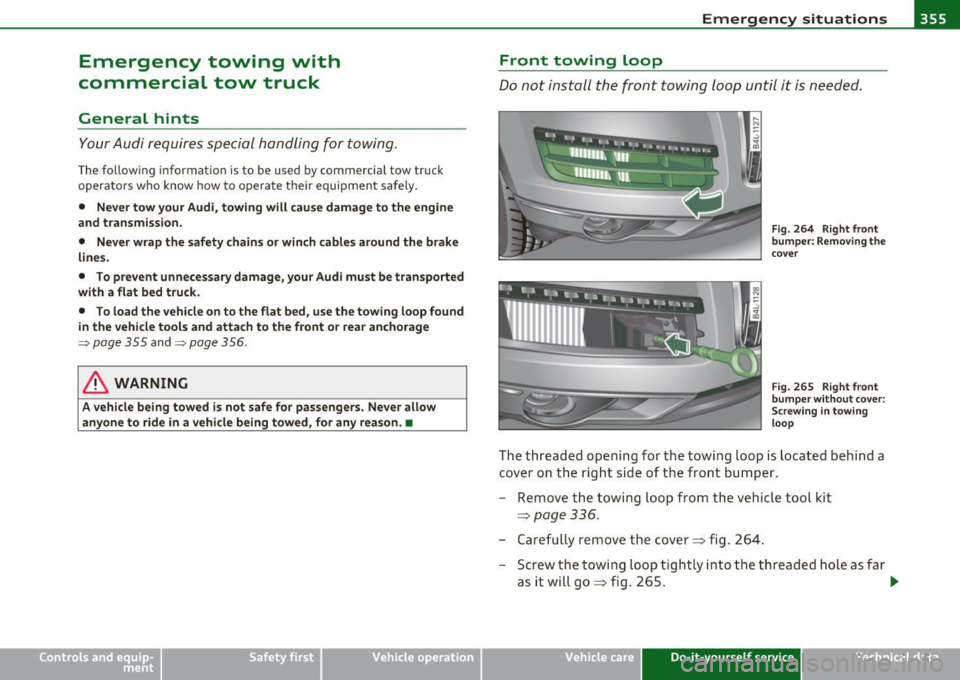
The threaded opening for the towing loop is located behind a
cover on the right side of the front bumper.
- Remove the towing loop from the vehicle tool kit
=> page 336.
-Carefully remove the cover:::::, fig. 264.
- Screw the towing loop tightly into the threaded hole as far
as it will go=:> fig. 265 .
~
Vehicle care Do-it-yourself service iTechnical data
Page 360 of 390
ffl.___E_ m_ e_ r-' g=- e_n_ c=-y _ s_it _ u _ a_t_ i_ o _ n_ s ______________________________________________ _
- Insert a rubber pad between the floor jack/workshop hoist
and the lifting points.
If you must lift your vehicle with a floor jack to work underneath,
be sure the vehicle is safely supported on stands intended for this
purpose.
Front lifting point
The lifting point is located on the floor pan reinforcement about at
t he same level as the jack mounting point::::;,
page 357, fig. 269. Do
not lift the vehicle at the vertical sill reinforcement.
Rear lifting point
The lifting point is located on the vertical reinforcement of the lower
sill fo r the onboa rd jack ::::;,
page 357, fig. 270 .
Lifting with vehicle jack
Refer to::::;, page 342.
& WARNING
• To reduce the risk of serious injury and vehicle damage.
-Always lift the vehicle only at the special workshop hoist and
floor jack lift points illustrated::::;,
page 357, fig. 269 and
::::;, page 357, fig. 270.
- Failure to lift the vehicle at these points could cause the
vehicle to tilt or fall from a lift if there is a change in vehicle weight distribution and balance. This might happen, for
example, when heavy components such as the engine block or
transmission are removed.
• When removing heavy components like these, anchor vehicle
to hoist or add corresponding weights to maintain the center of
gravity. Otherwise, the vehicle might tilt or slip off the hoist,
causing serious personal injury.
0 Note
• Be aware of the following points before lifting the vehicle:
- The vehicle should never be lifted or jacked up from under
neath the engine oil pan, the transmission housing, the front or
rear axle or the body side members. This could lead to serious
damage.
- To avoid damage to the underbody or chassis frame, a rubber
pad must be inserted between the floor jack and the lift points.
- Before driving over a workshop hoist, check that the vehicle
weight does not exceed the permissible lifting capacity of the
hoist.
- Before driving over a workshop hoist, ensure that there is sufficient clearance between the hoist and low parts of the
vehicle. •
Page 362 of 390
lffl!I __ G_ e_n_ e_r _a _ l_ in_ f_o _r_ m_ a_ t_io _ n _______________________________________________ _
General information
Explanation of technical data
Some of the technical data listed in this manual requires
further explanation.
The technical data for your vehicle is listed in the charts starting on
~ page 363 . This sect ion prov ides genera l information, notes and
restrictions which app ly to this data .•
Veh icle identification
The key data is given on the vehicle identification number
(VIN) plate and the vehicle data sticker.
F ig. 27 1 Vehi cle I den
t ifi ca tion Nu mbe r
(V IN ) plate: locat io n
o n d river's s id e d ash
p an el Fi
g. 272 The vehi cle
i d enti ficati on l abel -
in side the l ugga ge
co mpa rtme nt
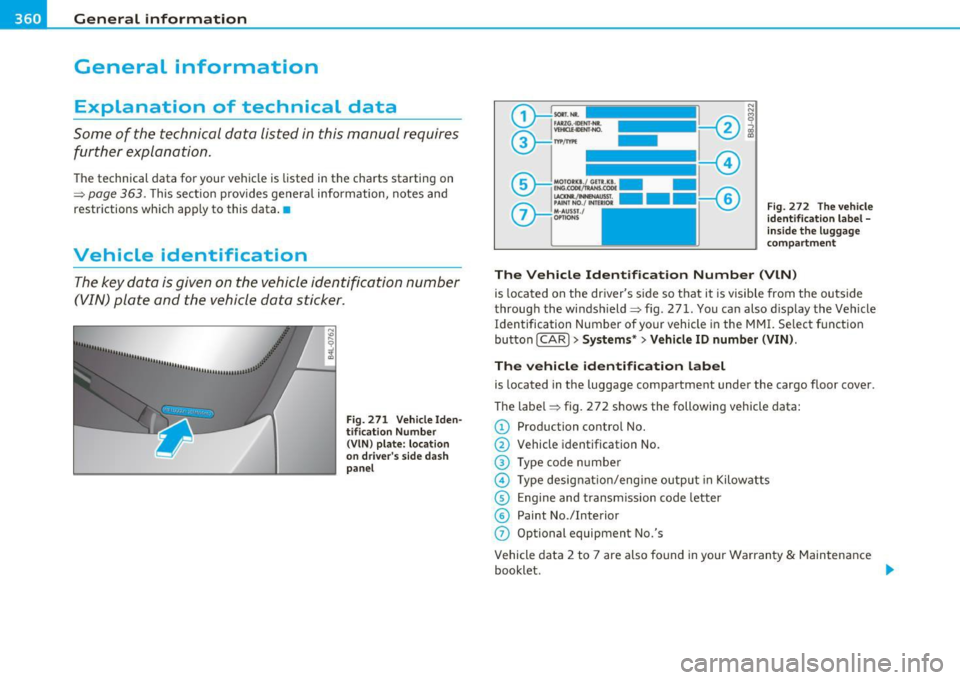
The Vehicle Id ent ifi cat ion Number (VlN )
is located on the driver's s ide so that it is visible from the outside
through the windshield ~ fig . 271. You can also d isp lay the Vehicle
Identification Number of your vehicle in the MMI. Se lect funct ion
button [CAR]>
S yst em s* > Vehicle ID number (VIN ).
The vehicle identifica tion lab el
is located in the luggage compartment under the cargo floor cover.
The label~ fig . 272 shows the following vehicle data:
© Production control No.
@ Vehicle identification No.
® Type code n umber
@ Type designat io n/eng ine output in Kilow atts
© Engine and transmission code letter
© Paint No./Interior
(j) Optional equipment No.'s
Vehicle data 2 to 7 are also found in your Warranty
& Maintenance
booklet . .,,
Page 375 of 390
Alphabetical index -________________ fWI
Alternator Auto-Check Control ..... .. .. .... ...... 27 Replacing the battery .. .... .. .. .. . 312
Malfunction ............. ........ . 29 Automatic belt retractor ............. 203 State of charge
.................. 259
Ambience lighting Lighting profiles ................. . 71
Anti -freeze
See Engine coolant system ......... 304
Anti-glare inside day-night mirror ... 77, 78
Anti -lock brake system
How the ABS system works ......... 256
Warning/indicator lights ... .. .... .. 19
Anti-S lip Regulation System (ASR)
How the system works ... .... .. .. . 254
Anti-theft systems
Anti-theft alarm system ........ .. .. 55
Electronic immobilizer ............. 43
Approach/departure angle ............ 266
Ashtray . ............. .. .. .. .. .... . 103
ASR How the Anti-Slip Regulation System works . ..... ... ... .. .. ......... 254
Asterisk What does it mean when something is
marked with an asterisk? ........... 6
Audi braking guard .................. 149
Error messages ............... ... 151
Settings ................ ..... ... 15 1
Status messages ................. 151
Switching on and off .............. 151
Audi Service Repair Manuals and Literature
366
AU TO mode
AC climate contro ls ...... .... .. .. . 112
Auto Safety Hotline .... ... ... ....... 197
Controls and equip
ment Safety first
Automatic car wash
See Washing
.................... 275
Automatic mode Four-zone automatic comfort air
conditioning ........... ...... .. 117
Automatic Sh ift Lock (ASL) ............ 163
Automatic transmission
6-speed automatic transmiss ion .. .. 161
Automatic Shift Lock (ASL) ......... 163
Driving ......................... 161
Dynamic shift program ............ 164
Emergency release for selector lever . 166
Fail-safe mode ................ ... 166
Ignition key safety lock .... ... .. .. . 125
Kick-down . ...... .. .. .. .. ....... 164
Manual shift program .. .. .. .. .. .. . 165
Selector lever ............ ........ 162
Shift buttons .................... 166
Steering wheel with tiptronic ® .... .. 166
Average speed ....................... 3 7
Avoid damaging the vehicle ........... 263
B
Bass box ... .. .. ................. .. 337
Battery . .. .. .. .. .. ........ ......... 308
Battery location .. ... ............. 309
Charging ................ .. ... ... 311
Important warnings when working on the battery . .. .... ....... ..... .. ... 309
Jump start ing ................. ... 352
Low . .. .... .. .. .... ... ...... .... 259 Voltage
............. .... ... ...... 33
Winter operation ............... .. 308
Work ing on the battery ............ 309
Before driving .. .... .. ...... ....... . 189
Blended gasoline . .. .. ...... ....... . 287
Body cavity sealing .................. 280
Booster seats .................... .. 239
Brake ass istant . .. .... .............. 257
Brake booster ..................... . 256
Brake fluid Changing the brake fluid ........... 308
Checking the brake fluid level ....... 307
Reservoir ...................... . 307
What is the correct brake fluid level? . 307
What should I do if the brake fl uid wa rning
light comes on? ... .. .. .. ........ 307
Brake light
Defective .... .................... 24
Brake system ..... .......... ...... .. 307
Anti -lock brake system ............. 19
Brake fluid .. ...... ...... ....... . 307
Brake fluid specificat ions for refill and
replacement ................. .. 308
Brake pads .. .. ................ .. 262
General information ............ .. 255
How does moisture or road salt affect the
brakes? . ...................... 255
Malfunction ........ ...... ...... .. 29
Parking b rake .................... 129
Warning/indicator lights ..... .. .. .. 20
Worn brake pads symbol ........... 34
Vehicle operation Vehicle care Do-it-yourself service Technical data
Page 382 of 390
___ A_ l_. p_ h _ a_b_ e_ t_ic _a_ l_ in_ d_e _ x ____________________________________________ _
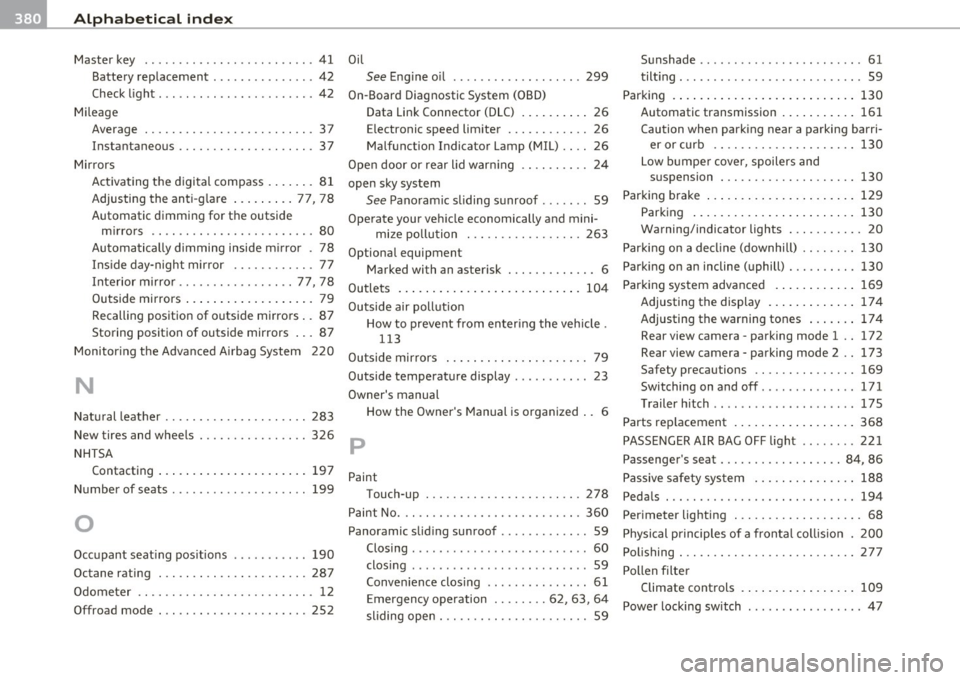
Master key ...... ..... .. .... ... .. .. . 4 1
Battery replacement ..... .. ........ 42
Check light ..... .. .. .. ...... ...... 42
Mileage Average ................ ...... .. . 37
Instantaneous ........... .. .... .. . 37
Mirrors Activating the digital compass ....... 81
Adjusting the anti-g lare .... ..... 77, 78
Automatic dimming for the outside m irrors .... .......... .......... 80
Automatically dimming inside m irror . 78
Ins ide day-night mirror .. .......... 77
Interior mirror ........... .. .. .. 77, 78
Outside mirrors ................... 79
Recalling position of outside mirrors .. 87
Storing position of outside mirrors ... 87
Monitor ing the Advanced A irbag System 220
N
Natural leather ............. .. .. .. .. 283
New tires and wheels .............. .. 326
NHTSA Contacting ...................... 197
Number of seats ............. .... ... 199
0
Occupant seating pos itions 190
Octane rating . .. .. .. .. .. .. .... ..... 287
Odometer ................... .... .. . 12
Offroad mode . .. .. .. .. .. .. ... .... .. 252 Oil
See Eng
ine o il ..... .... ... ... .... 299
On-Board Diagnostic System (OBD) Data Link Connector (DLC) ....... ... 26
Electronic speed Limiter ............ 26
Malfunction Indicator Lamp (MIL) .. .. 26
Open door or rear l id warn ing .. .. .. .. .. 24
open sky system
See Panoramic sliding sunroof ..... .. 59
Operate your vehicle economically and mini- mize pollution . .... .. .. ....... . 263
Optional equipment Marked with an asterisk . ... ........ . 6
Outlets ........................... 104
Outside air pollution How to prevent from entering the vehicle .
113
Outside mirrors ..................... 79
Outside temperature display ....... .. .. 23
Owner's manual How the Owner's Manual is organized .. 6
p
Paint
Touch-up ............ ... ... .. .. . 278
Paint No ... .... .. ........... ...... . 360
Panoramic sliding sunroof .......... .. . 59
Closing ............. ... ... ....... 60
clos ing ....... ... ... ... .. ... ..... 59
Conven ience closing ... ... ....... .. 61
Emergency operation ........ 62, 63, 64
sliding open . .. .. ........ ......... 59 Sunshade
.. .... .......... ... . ... . 61
tilt ing . ................ .......... 59
Parking . ... ....................... 130
Automatic transmission ........... 161 Caution when parking near a parking barri- er or curb .. .. .. .. ............. 130
Low bumper cover, spoilers and
suspension . ...... ............. 130
Parking brake ..... ................ . 129
Parking ............ .. .... .... .. 130
Warning/indicator lights . .......... 20
Parking on a decl ine (downhill) .. .... .. 130
Parking on an incline (uphill) ... .. .. .. . 130
Parking system advanced ........... . 169
Adjusting the display ...... ... .. .. 17 4
Adjusting the warning tones ....... 17 4
Rear view camera - parking mode l .. 172
Rear view camera - parking mode 2 .. 173
Safety precautions .. ............. 169
Switching on and off .......... .... 171
Trailer hitch .... .. ..... ..... ..... 175
Parts replacement .......... .. .. .. .. 368
PASSENGER AIR BAG OFF light .... .... 221
Passenger's seat .............. .... 84, 86
Passive safety system ............... 188
Pedals ................. ... .. .. .... 194
Perimeter lighting ..... ............. . 68
Physical principles of a frontal collision . 200
Polishing . .. .. ........ ............. 277
Pollen filter
Climate controls . ... ............. 109
Power locking switch ................. 47