weight AUDI Q7 2010 Owner´s Manual
[x] Cancel search | Manufacturer: AUDI, Model Year: 2010, Model line: Q7, Model: AUDI Q7 2010Pages: 390, PDF Size: 93.04 MB
Page 198 of 390
• ....__D_ r_iv _i_ n_, g=-- S_ a _ f_e _,Ly _ ______________________________________________ _
in. WARNING
Improperly stored luggage or other items can fly through the
vehicle causing serious personal injury in the event of hard braking
or an accident. To help reduce the risk of serious personal injury:
• Always put objects, for example, luggage or other heavy items
in the luggage compartment .
• Always secure objects in the luggage compartment using the
tie-down eyelets and suitable straps.
& WARNING
Heavy loads will influence the way your vehicle handles. To help
reduce the risk of a loss of control leading to serious personal
injury:
• Always keep in mind when transporting heavy objects, that a
change in the center of gravity can also cause changes in vehicle
handling:
-Always distribute the load as evenly as possible.
- Place heavy objects as far forward in the luggage compart-
ment as possible.
• Never exceed the Gross Axle Weight Rating or the Gross Vehicle
Weight Rating specified on the safety compliance sticker on the
left door jamb . Exceeding permissible weight standards can cause
the vehicle to slide and handle differently.
• Please observe information on safe driving
=> page 188 .
in. WARNING
To help prevent poisonous exhaust gas from being drawn into the
vehicle, always keep the rear lid closed while driving.
• Never transport objects larger than those fitting completely
into the luggage area because the rear lid cannot be fully closed.
& WARNING (continued)
• If you absolutely must drive with the rear lid open , observe the
following notes to reduce the risk of poisoning:
-Close all windows,
- Close the Panoramic sliding sunroof*,
- Open all air outlets in the instrument panel,
- Switch off the air recirculation,
- Set the fresh air fan to the highest speed.
in. WARNING
Always make sure that the doors, all windows, the Panoramic
sliding sunroof* and the rear lid are securely closed and locked to
reduce the risk of injury when the vehicle is not being used .
• After closing the rear lid, always make sure that it is properly
closed and locked.
• Never leave your vehicle unattended especially with the rear lid
left open. A child could crawl into the vehicle through the luggage
compartment and close the rear lid becoming trapped and unable
to get out. Being trapped in a vehicle can lead to serious personal
injury.
• Never let children play in or around the vehicle.
• Never let passengers ride in the luggage compartment. Vehicle
occupants must always be properly restrained in one of the
vehicle's seating positions .
(I) Tips
• Air circulation helps to re du ce win dow fogging. Stale air escap es
to the outside th rough vents in the trim panel. Be sure to keep t hese
slots free and open.
• Th e tire pressure must correspond to the load . The tire pressure is
shown on the tir e pressure label. The tire pressure label is located on .,_
Page 199 of 390
______________________________________________ D_ ri _v _ i_n _,,g ,c.._ S_a_ f_ e_ l..:: y __ l!'II
the driver's s ide B-pillar. The tire pressure label lists the recom
mended co ld tire in flatio n press ures fo r th e ve hicle at its max imum
capacity weight and the tires that were on your vehicle at the time it
was manufactured . For recommended tire press ures for normal loa d
conditions, p lease see chapte r=>
page 318. •
Tie-downs
The luggage compartment is equippe d with four tie
do wns to sec ure lu gga ge a nd oth er items.
Use the t ie-downs to sec ure yo ur cargo properly=> page 195,
"Lo ad ing t he lugg age comp artmen t".
In a co llision, the laws of physics mean that even sma ller it ems that
are loose in the vehicle will become heavy missiles that can cause
ser iou s injury. Ite ms i n t he vehi cle pos se ss e ne rgy w hich va ry w it h
vehicle speed and the we ight of the item. Vehicle speed is t he most
s ig nifi ca nt f acto r.
For examp le, in a frontal coll is io n at a speed of 30 mph (48 km/h),
the forces acting on a 1 0-lb (4. 5 kg) object are a bout 20 times t he
normal weig ht o f the item. T his means that t he weight o f the ite m
wou ld s uddenly be a bo ut 200 lbs. (90 kg) . You can imagine the inju
r ies tha t a 200 lbs . (9 0 kg) item fly ing free ly throug h the p ass enge r
compartment cou ld cause i n a collision lik e this .
& WARNING
Weak , damaged or improper straps used to secure item s to tie
downs can fail during hard braking or in a collision and cause
serious personal injury.
• Always use suitable mounting straps and properly secure items
to the tie-downs in the luggage compartment to help prevent
items from shifting or flying forward as dangerous missiles.
• When the rear seat backre st is folded down, always use suit
able mounting straps and properly secure items to the tie-downs
Controls and equip ment Safety first Vehicle operation
& WARNING
(co ntinued )
in the luggage compartment to help prevent items from flying
forward as dangerous missiles into the passenger compartment.
• Never attach a child safety seat tether strap to a tie -down. •
Reporting Safety Defects
Applicable to U.S.A.
If you believe that your vehi cle has a defect
which could cause a crash or could cause injury
or death , you should immediately inform the
National Highway Traffic Safety Administration
(NHTSA) in addition to notifying Audi of
America, Inc.
If NHTSA receives similar complaints, it may
open an investigation, and if it find s that a
safety defe cts exist s in a group of vehicles, it
may o rder a recall and remedy campaign.
However , NHTSA cannot become involved in
individual problems between you, your dealer,
or Audi of America, Inc.
To contact NHTSA, you may call the Vehicle
Safety Hotline toll-free at:
Tel.: 1-888-327-4236 (TTY: 1-800-424-9153)
or write to:
Administrator
Vehicle care Do-it-yourself service Technical data
Page 202 of 390
___ S_a_ f_ e_ t__, y,,__ b_ e _ lt_ s _______________________________________________ _
Before driving off, always:
- Fasten your safety belt and mak e sure you are wea ring i t
p roperly .
- Make sure that your passengers also buckle up and prop
erly wear their safety be lts.
- Prot ect ch ildren w ith a child rest raint system appropriate
for the size and age.
T he warning light -if. in the instrument cluster lights up when the igni
tion is sw itched on as a reminder to fasten the safety belts. In addi
tion, you will hear a warning tone .
After the ign ition is sw itched on, the wa rni ng ligh t in the in strument
cluster will always come o n for about 6 seconds and if the driver has
no t fas tened the safe ty belt, a wa rning tone will also s ound for abou t
6 seconds . As soon as t he d river has fastened the saf ety belt, the
wa rning tone will stop and the warn ing light will go out.
If the drive r or front seat passenger have not buc kled-up wi thin abo ut
10 seconds after the warn ing tone has stopped and the vehicle is
mov ing fas ter th an about 15 mph, the wa rning tone w ill sound aga in
for about 6 seconds and then stop for 24 seconds and then repeat
t his rem inder sequence for a max imum of 2 minutes. A t speed s
below 5 mph, the warning tone will not sound.
Fasten your safety belt and make sure that your passengers also
properly put on their safety belts.
& WARNING
• Safety belts are the single most effective means available to
reduce the risk of seriou s injury and death in automobile acci·
dents . For your protection and that of your passengers, always
correctly wear safety belts when the vehicle i s moving .
• Failure to pay attention to the warning light that come on,
could lead to personal injury .•
Why safety belts?
Frontal collisions and the law of physics
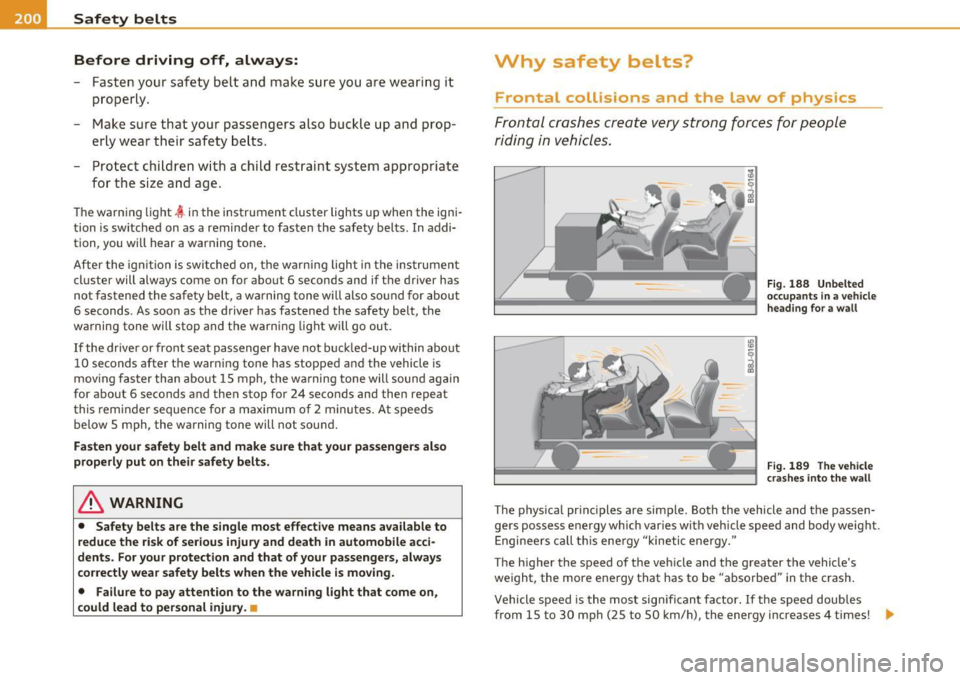
Frontal cr ashes c reate very stron g forc es for people
ri din g i n ve hic les.
Fig . 188 Unbelted
occupa nts in a v ehicle
heading f or a w all
Fig . 189 The vehicle
cra shes into the wall
T he p hys ica l pr inc iples are simple. Bot h the vehicle and the passen
gers possess energy wh ich var ies wit h veh icle speed and body weight.
E nginee rs cal l this ene rgy "kinetic energy."
The higher the speed of the veh icle and t he greater the vehicle's
we ight, the more energy that has to be "abso rbed" in the crash .
Vehicle speed is the most sig nifican t fa ctor. If t he speed doubles
from 15 to 30 mph (25 to 50 km/h), the energy increases 4 times! .,
Page 213 of 390
Airbag system -----------------=--=---
Child restraints on the front seat - some
important things to know
- Be su re to re ad t he i mpo rt a nt i nfo rmation a nd heed the
WA RNINGS fo r i mporta nt details about chil dre n and
Advanced Airbags ~
page 231.
Even t hough your ve hicle is eq uipped with an Advanced Airbag
System, ma ke ce rtain that a ll chi ld ren, especia lly those 12 years an d
younger, always r ide in the back seat prope rly rest rained fo r th eir age
and si ze. The airbag on the passenger side makes the front seat a
po tentially da ngerous place fo r a child to r ide. The fro nt seat is not
the safest place for a ch ild in a forward-facing child safety seat. It can
be a very dange rous place fo r an i nfan t or a child in a rearward-fac ing
seat.
Th e Advanced Ai rbag System in your vehicle has been cer tified to
comply with the req uirements of Un ited States Federa l Moto r Veh icle
Sa fety Standard 208 as applicable at the time your vehicle was manu
factured.
The Standard requires the front airbag on the passenger side to be
tu rne d off ("s uppressed") if a c hild up to abou t one ye ar of age
restra ined in o ne of the rear -facing or forward -fac ing infant
restra ints listed in Fed era l Moto r Vehicle Safety Standard 208 with
whic h the Advanced Airbag System in yo ur vehicle was cert ified has
been installed on the front passenger seat. For a listing of the ch ild
restra in ts that were used to certify compliance with the US Saf ety
Standard =>
page 233.
The PASSENGER AIR BAG OFF ligh t in th e in st rume nt p anel t ells you
when the front Advanced A irbag on the passenger side has been
tur ned off by the ele ct ronic con trol uni t.
Each time you t urn on the ignition, t he
PASSENGER AIR BAG OFF
light will come on for a few seconds and:
• will stay on if th e front passenger se at is no t oc cupied
Controls and equip
ment Safety first
Vehicle operation
• will stay on if there is a small ch ild or child restra int on the front
p assenge r se at
• will go off if the front passenger seat is occup ied by an adult as
reg iste red by t he weight -sens ing mat =>
page 220, "M oni tor ing t he
Advanced Airbag System" .
T he
PASSENGER AIR BAG OFF light comes o n when t he control unit
de tects a total weight on t he front passenger seat that req uires the
front airbag to be t urned off .
If th e total weight o n the front passenger seat is more than th at of a
typical 1 year-o ld child but less than the weight of a small adult, the
fr on t a ir bag on the passenge r si de c an deploy (t he
PASSENGER AIR
BAG OFF
light does not come on) . If the PASSENGER AIR BAG OFF
light does not come on, the front airbag on the passenger side has
not been turned off by the electronic co ntrol unit and can deploy if
the control unit senses an impact t hat meets the conditions stored in
its memory.
For example, the airbag may deploy if:
• a small child that is heavier than a typical 1 year -old child is on the
front passenger seat (regard less of whether the chi ld is in one of the
child safety seats listed =>
page 233), or
• a child who has outgrown child restraints is on the front passenger
sea t.
If the fro nt passenger a irbag is tur ned off, the
PASSENGER AIR BAG
OFF
lig ht comes on in the instr ument cluster an d stays on.
Th e fron t airbag on t he pa sse nger side may
not de ploy ( the
PASSENGER AIR BAG OFF li ght does not illum inate and stay lit) even
if a small a dult or teenager, o r a passenger who is no t sitti ng upright
with their back against a non-reclined backrest w ith the ir feet on the
vehicle floor in front of the seat is on the front passenger seat
=>
page 190, " P roper seat ing pos itio n for the dr iver".
If the front passenger ai rbag dep loys, the Federal Standard requires
t he a irbag to mee t the "low risk" deployme nt cr iter ia to reduce the
risk of inj ury through interaction with the a irbag. "Low r isk" deploy
me nt o ccurs in those cras hes t hat tak e pla ce a t lower decelerat io ns as
I),
Vehicle care Do-it-yourself service Technical data
Page 215 of 390
& WARNIN G (con tinued )
• Imprope r in stall ation of child re straints can redu ce their effec·
tiveness or even prevent them from providing any protection.
• An improperl y installed child restraint c an interfere with the
airbag a s it deploy s and seriously injure or even kill the child - even
with an Advanced Airbag Sy stem.
• Always carefully follow the manufacturer 's instruct ions
provided with the child safety seat or carrier.
• Never place additional items on the seat that can increase the
total weight regi stered by the weight-sen sing mat and can cause
injury in a crash .•
Front airbags
Description of front airbags
T he airbag system can p rovide supplemental protection
to properly r estrained front se at oc cupants .
Safety first
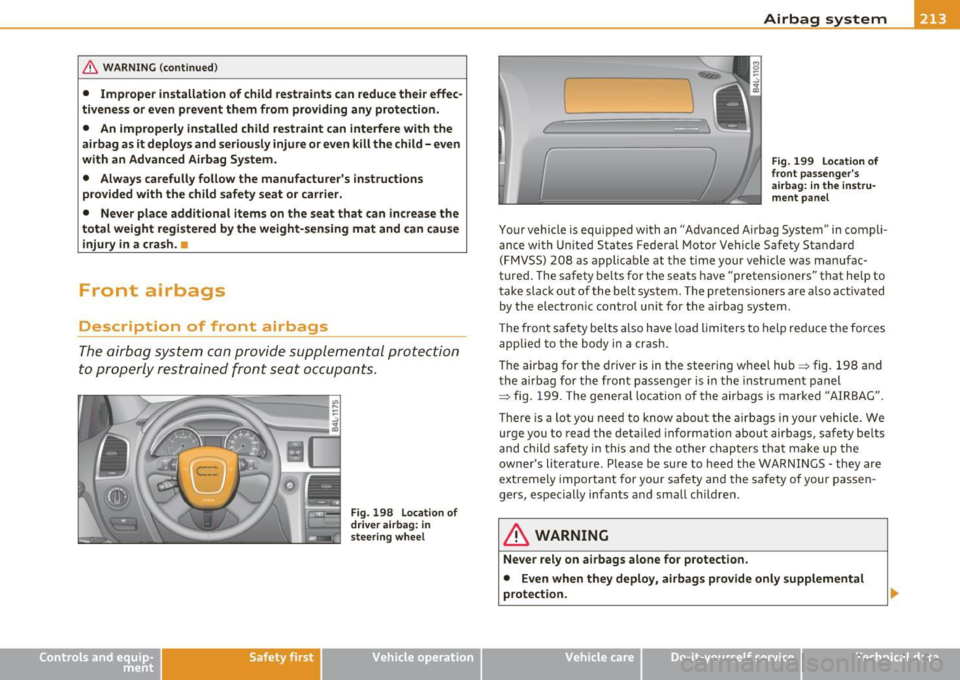
Fig . 19 8 Locatio n of
drive r airb ag : in
s tee ring whee l
Vehicle OP-eration
(
C
Airbag system
Fig. 199 Locati on of
fr on t pass enge r's
a ir bag: in the instru
me nt pa nel
Yo ur vehicle is equi pped with an "Advanced A irbag Syst em" in compli ·
ance with United States Fe dera l Moto r Vehicle Safety Sta ndard
(FMVSS) 2 08 as a pplicable at t he time your vehi cle was manufac
t u red . The safety belts for the seats have "pretensione rs" that help to
take slac k out of the belt sys tem. Th e prete nsion ers are a lso activ ate d
by the e lectron ic cont rol un it for the airbag system.
Th e front sa fe ty bel ts also have lo ad limi ters to help red uce the fo rces
applied to the body in a crash.
Th e airbag for the driver is in t he steering whee l hub ~ fig.
198 and
t h e airbag for th e front pass enger is i n the inst rum ent pa nel
~ fig. 199 . The general locat ion of the airbags is marked "AIRBAG".
Th ere is a lo t you nee d to know abo ut the air bags in your vehicle. We
urge yo u to read the detai led information about airbags, safety be lts
and c hild s afety in this and the other chap ters that make up the
own er's literature. Please be sure to heed the WAR NIN GS· they are
extremely importan t for your safety an d the sa fe ty of your p asse n
gers, es pecially infants a nd sma ll ch ildre n.
& WARNING
Never rely on airbags alone for protection.
• Even when they deploy, airbags provide only supplemental
protection.
Vehicle care Do-it-yourselt service iTechnical data
Page 216 of 390
........ _A_ ir_ b_ a-=g :..- s.:o.y _s _t _e_ m _______________________________________________ _
& WARNING (conti nued)
• Airbag work mo st effectivel y when us ed with p roperly worn
safety belts .
• Therefore, always wear your safety belts and make sure that
everybody in your veh icle is properly restrained .
& WARNING
A person on the front passenger seat , especially infants and small
c hildren, will receive seriou s injuries and can even be killed by
being too close to the a irbag when it inflates.
• Although the Advanced Airbag System in your vehicle is
designed to turn off the front passenger a irbag if an infant or a
small child is on the front passenger seat, nobody can absolutely
guarantee that deployment under these special conditions is
impossible in all conceivable situations that may happen during
the useful life of your vehicle.
• The Advanced Airbag System can deploy in a ccordance with the
" low risk" option under the U.S. Federal Standard if a child that is
hea vier than the t ypical one-year old child is on the front
passeng er seat and the other condition s for airbag deployment
are met.
• Accident statistics have shown that children are generally safer
in the rear seat area than in the front seating position .
• For their own safety, all children , especially 12 years and
younger, should always ride in the back properly res trained for
their age and size. •
Advanced front airbag system
Your vehicle is equipped with a front Advanced Airbag System in
compliance wit h Unit ed St ates Fe d er al Motor Vehi cle Safe ty Standar d
208 as applicab le at the time your vehicle was manufactured . The front Advanced A
irbag System supplements the safety belts to
prov ide ad ditional prote ct ion for th e d river's and front passenger's
heads and uppe r bodies in fro nta l crashes. The ai rbags i nflate only in
fronta l impacts when the vehicle dece leration is high enoug h.
Th e front Adva nced A irbag Sys tem for the fron t seat oc cupan ts is not
a s ubstitute for your safety be lts. Rathe r, it is part o f the overall occu
p an t restr aint sy stem in y our ve hicl e. Always remembe r that the
airbag system ca n only help to protect you, if you are sitting upr ight,
we aring your sa fe ty be lt and we aring it prope rly. T his is why you and
your passengers must always be properly restra ined, not just because
t he law requires you to be.
Th e A dvan ced A irbag Syst em in your veh icle has been c ertified to
meet the "low r isk" req uir ements fo r 3 an d 6 year-old c hildren on the
pas senge r side and ve ry small ad ults o n the dr ive r side. T he low r is k
dep loyment cr iteria a re intended to help reduce the risk of injury
t hroug h in teraction wi th the front a irbag tha t can oc cur, fo r ex am ple,
by being too close to the steering wheel and instrument panel whe n
t he air bag i nflates .
In add it ion , the system has been cert ified to comply with t he
"supp ression" requirements of the Safety Standa rd, to t urn off the
front airbag for infants 12 mont hs old and young er w ho are
restrained on the front passenger seat in child restra ints that are
listed in the Standard=>
pag e 233, "Child restra ints and A dvan ced
Airbags".
"Su pp ression" req uires t he front a irbag on the passenger side to be
t ur ned off if:
• a child up to about one year of age is restra ined on the front
passenge r seat in one of t he rear-faci ng or forwa rd-facing infant
restraints listed in Federa l Motor Vehicle Safety Standard 208 w it h
w hich the Adv anced Airbag Sys tem in yo ur vehicle w as ce rt ified. Fo r a
list ing of the child restra ints that were used to certify your vehicle's
c omp li a nce with the US Safety Stand ard =>
page 233,
• weight less than a thresho ld level stored in the contro l unit is
detec ted on t he fro nt p assenger se at.
Page 217 of 390
Airbag system Ill
----------------=--=---
When a person is detected on t he front passenger seat, weigh ing
more th an t he tot al we igh t of a ch ild t hat i s abo ut 1 ye ar old
restra ined in o ne of the rea r-facing or forward-fac ing infant
restra ints (liste d in Fed eral Moto r Ve hicl e Safety Stan dard
20 8 with
w hic h the Advanced Airbag System in your veh icle was c ert ified), the
front airbag on the passenge r side may o r may not dep loy.
Th e
PASSENGER AIR BAG OFF ligh t comes on when the ele ct ro nic
control u nit detects a total weig ht on t he front passenger seat that
re qui res t he fr on t air bag t o be tur ned o ff. If the
PASSENGER AIR
BAG OFF
lig ht does not come on, the fro nt airbag o n the passenger
s ide has not been turned of f by the con trol un it and can dep loy i f the
cont rol un it se nses an impact that meets the conditions stored in its
memory.
If the tota l weight on the fro nt passenger sea t is more than that of a
typical
1 year-o ld, but less than the weight of a small adult, t he front
a irbag o n the p assenge r si de may dep loy (t he
PASSENGER AIR BAG
OFF
light does not come on).
For example , the airbag may deploy if:
• a small child tha t is heav ie r th an a typical 1 year-old child is on t he
front passenger seat (regard less of whet he r the ch ild is in one of the
c hild s afe ty sea ts listed=>
page 233),
• a child who has outgrown child restraints is on the fro nt passenger
se at.
If the front passe nger a irbag is turned off, the
PASSENGER AIR BAG
OFF
ligh t in the center o f the i nstr ument pa nel will come on and s tay
on .
T he front airbag on the passenger side may
not dep loy (t he
PASSENGER AIR BAG OFF light do es not illum inate and s tay lit) if:
• a small adu lt or teenager is on the fro nt passenger seat
• a p assenge r w ho is not si tt ing upri ght w it h t hei r ba ck again st a
non -reclined backrest with their feet on the veh icle floo r in front of
t he seat is on the fro nt pa ssenge r seat .
If the fro nt passenger airbag deploys, the Federa l Standard requ ires
t he a irb ag to mee t the " low r is k " deployme nt c riter ia to help reduce
Controls and equip
ment Safety first Vehicle operation
the
risk of i njury t hrough interaction with t he a irbag. "Low r isk"
dep loyment o ccurs in t hose cra sh es t hat tak e p lace at lowe r decele r
ations as defi ned in the elect ronic contro l u ni t.=>
page 220
Always remember: Even thou gh your vehicle is eq uipped with
Advanced A irbag s, th e sa fe st pla ce for childre n is properly res trained
on the back seat. Please be sure to rea d th e important informat io n i n
t he sec tio ns tha t foll ow and be su re to heed all of the WAR NIN GS.
& WARNING
To reduce the risk of injury when an airbag inflates, always wear
safety belts p roperly .
• If you are unrestrained, leaning forward, sitting sideways or
out of position in any way , your ri sk of injury is much higher.
• You will also receive serious injuries and could even be killed if
you are up again st the airbag or too close to it when it inflates -
even with an Advanced Airbag
=> page 209.
& WARNING
A child in a rearward-facing child safety seat installed on the front
pas senger seat will be seriously injured and can be killed if the
front airbag inflates -even with an Advanced Airbag System.
• Although the Advanced Airbag System in your vehicle is
designed to turn off the front airbag when a rearward-facing child
restraint has been installed on the front passenger seat, nobody
can absolutely guarantee that deployment is impossible in all
c onceivable situations that may happen during the useful life of
your vehicle .
• The inflating airbag will hit the child safety seat or infant
carrier with great force and will smash the child safety seat and
c hild against the backre st, center armre st, door , or roof .
• Always install rearward-facing child restraints on the rear seat.
• If you must install a rearward facing child safety seat on the
front passenger seat because of exceptional circumstances and
IIJ,,
Vehicle care Do-it-yourself service Technical data
Page 218 of 390
........ _A_ i_rb _ a_,g,:;._ s_, y'- s_ t_e _m ________________________________________________ _
& WARNING (conti nued)
the PASSENGER AIR BAG OFF light does not come on and stay on,
immediately ins tall the rear-facing child safety seat in a rear
seating position and have the airbag system inspected by your
authorized Audi dealer .
& WARNING
If, in exceptional circumstances, you must install a forward-facing
child restraint on the front passenger 's seat:
• Always make sure the forward-facing seat has been designed
and certified by its manufacturer for use on a front seat with a
passenger front and side airbag.
• Never put the forward-facing child restraint up against or very
near the instrument panel.
• Always move the passenger seat into its rearmost position in
the seat 's fore and aft adjustment range, as far away from the
airbag as possible, before installing the forward-facing child
restraint. The backrest must be adjusted to an upright position.
• Make sure that the PASSENGER AIR BAG OFF light come s on
and stays on all the time whenever the ignit ion is switched on .•
Advanced Airbag System components
T he front passenger seat in your veh icle has a lot of very important
parts o f the Advanced A irba g System in it. These parts incl ude t he
we igh t-sens ing ma t, sensors, wiring, brackets, and more. The func
t ion o f th e sys tem in the fron t passenger sea t is chec ked by the elec
tron ic control unit w hen the ignit ion is on . The contro l u ni t mo nitors
the Advanced Airbag System and tu rns the airbag indicator light on
w hen a malfunct ion in t he system components is de tected. The func
tion of the a irbag indicator light is descr ibed in greater detail below.
Be cau se the fr ont p assenge r se at con tain s im po rt an t p arts of th e
Advanced Airbag System, you m ust take care to prevent it from being damaged. Damage to the seat may prevent the Advanced A
irbag for
t he fro nt passenge r se at from do ing its job in a cr ash.
The front Advanced Airbag System consists of the
following:
• Cras h sensors in the front of t he veh icle that measure vehicle
a cc ele ra tion/de ce le ra tion to prov ide i nform ation to the Adv ance d
Airbag System about the severity of the crash .
• An e lec tron ic contro l uni t, w it h in tegr ate d cr ash sensor s fo r fron t
and side impacts. T he control unit "dec ides" w het her to fire the front
a irbags based on the info rm at ion rece ive d fr om t he c rash se nso rs.
The contro l unit also "decides" whether the safety be lt prete nsione rs
shoul d be activa ted .
• An Advanced Airbag with gas generator for the driver inside the
s t eeri ng wheel hub.
• An Advanced Airbag with gas generator inside the inst rument
p an el f or the front p assenge r.
• A weight-sensin g mat under the upho lstery padd ing of the front
passe nge r seat c ushion t hat measu res the tota l we ight on the sea t.
T he informat io n registered is sent cont inuously to the elect ronic
con trol uni t to reg ula te deploymen t of t he fr ont Adv anced A irbag o n
the passenger side.
• An airbag mo nitoring syste m and indi cator light in the inst ru m ent
cl uster ~
page 220.
• Th e PASSENGER AIR BAG OFF light com es on an d stays on in t he
center of the instr ument pane l=>
page 221, fig . 201 a nd tells you
w hen the fron t Advan ced A irbag on t he passe nger side has been
turned off.
• A senso r below t he saf ety belt la tc h for the front s eat p ass enge r
to meas ure the tens ion on the safety be lt . The tension on the safety
be lt a nd the we igh t regis tere d by the weig ht-sensing mat help t he
cont rol un it "dec ide" w hethe r th e front airbag fo r th e front
p assenge r seat should be turned o ff or not~
page 2 11, "Ch ild
restraints on the front seat -some important th ings to know" . ._
Page 219 of 390
----------------------------------------------~A....::..:.... ir:....: b.::..:;; a..::g ~ s~y -=s:....: t:...: e:...: m...:....:.. __ lffll
• A se nsor in the safety belt latch for the d river a nd fo r th e front
sea t passenge r that senses w heth er that sa fe ty bel t is la tched or no t
and tra nsmits this information to t he e lectron ic co ntrol un it.
& WARNING
Damage to the front passenger seat can prevent the front airbag
from working properly.
• Imprope r repair or disassembly of the front passenger and
driver seat will prevent the Advan ced Airbag System from func
tioning properly.
• Repairs to the front passenger seat must be performed by qual
ified and properly trained workshop personnel.
• Never remove the front passenger or driver seat from the
vehicle.
• Never remove the upholstery from the front passenger seat.
• Never disassemble or remove parts from the seat or disconnect
wires from it .
• Never carry sharp objects in your pockets or place them on the
seat. If the weight-sensing mat in the passenger seat is punctured
it cannot work properly .
• Never carry th ings on your lap or carry objects on the passenger
seat . Such items can increase the weight regi stered by the weight
sensing mat and send the wrong information to the airbag control
unit.
• Never store items under the front passenger seat. Parts of the
Advanced Airbag System under the passenger seat could be damaged, preventing them and the airbag system from working
properly.
• Never place seat covers or replacement upholstery that have
not been specifically approved by Audi on the front seats .
• Seat covers can prevent the Advanced Airbag System from
recognizing child restraint s or occupants on the front passenger
seat and prevent the side airbag in the seat backrest from
deploying properly .
Controls and equip ment Safety first Vehicle operation
& WARNING
(co ntinued )
• Never use cushions , pillows, blankets or similar items on the
front passenger seat . The additional padding will prevent the
weight-sensing mat in the seat from accurately registering the
c hild restraint or person on the seat and prevent the Advanced
Airbag System from functioning prope rly.
• If you must use a child restraint on the front passenger seat
and the child restraint manufacturer's instructions require the use
of a towel, foam cushion or something else to properly pos ition
the child restraint, make certain that the PASSENGER AIR BAG
OFF light come s on and stays on whenever the child re straint is
installed on the front passenger seat.
• If the PASSENGER AIR BAG OFF light does not come on and
stay on, immediately install child restraint in a rear seating posi
tion and have the airbag system inspe cted by your authorized Audi
dealer. •
How the Advanced Airbag System
components work together
T he front Advanced A irbag System and the side airbags sup plement
t he p ro tect io n offered by the front three-po int safety belts w ith
pretens io ners and load limiters and t he adjustable head restra ints to
help red uce the risk of injury in a w ide range of acci den t and cras h
sit uat ions. Be sure to read the important informat ion about safety
and hee d the WAR NINGS in this ch ap ter.
Deployme nt of the Adva nced A irbag System and the act ivation of t he
safety belt pretens ione rs depen d on the dece le ration measure d by
the crash sensors a nd reg istered by the e lectro nic contro l un it . Crash
sever ity depends on speed and decele ration as well as the mass and
st iff ness of t he ve hicle or object invo lved in the cras h.
Whe n the electronic contro l unit registers a low sever ity crash and
t he safety be lt is being used , the air ba g w ill not dep loy . If the safety
~
Vehicle care Do-it-yourself service Technical data
Page 221 of 390
Airbag system --------------------------------------------- -=---=----
lower parts of the body . Front a irbags s upplement the t hree-poi nt
sa fety belts o nly in some fro ntal collis ions in which the vehicle decel
eration is high enough to dep loy the a irbags .
Front airbags will not deploy:
• if the ignition is switched off when a crash occ urs
• in s ide collis ions
• in rea r-end collisions
• in rollovers
• when the crash decelerat io n me asured by the a irbag system is less
than the min imum threshold needed for a irbag deployment as reg is
tered by the e lectron ic con trol un it
The front passenger airbag also will not deploy:
• when t he fron t passenger sea t is no t oc cupied
• when the weight on the front passenger seat as sensed by the
Advanced Ai rbag System in dicates that the front airbag o n the
passenger side has to be turned off by the e lectronic control unit (the
PASSENGER AIR BAG OFF li ght comes on and stays on)
& WARNING
Sitting in the wrong position can increase the ri sk of ser iou s injury
in crashes.
• To redu ce the risk of injury when the airbags inflate, the driver
and pas sengers mu st always sit in an upright position , mu st not
lean against or place any part of th eir body too close to the area
where the airbags are lo cated.
• Occupants who are unbelted, out of position or too close to the
airbag can be seriou sly injured by an airbag a s it unfolds with
great force in th e blink of an eye =>
page 211 .
Controls and equip
ment Safety first Vehicle operation
& WARNING
A child in a rearward-facing child
safety se at installed on the front
pas senger seat will be seriously injured and can be killed if the
front airbag inflates - ev en with an Ad vanced Airbag System.
• The inflating airbag will hit the child safety seat or infant
c arrier with great force and will smash the child safety s eat and
c hild against the backre st, center armre st, d oor or roof .
• Always install rear -facing child safet y seats on the rear seat.
• If you must install a rearward-facing child safety seat on the
front passenger se at because of e xceptional circumstances and
the PASSENGER AIR BAG OFF light do es not come on and stay on ,
immediately install the rear -facing child s afety seat in a rear
s eating po sition and h ave the airbag system inspe cted by your
authoriz ed Audi d ealer.
& WARNING
Object s between you and the airbag will increase the r isk of inju ry
in a cra sh by int erfering with the way the airb ag unfold s or by
being pushed into you as the airbag inflates.
• Never hold things in your hand s or on your lap when the vehicle
i s in use.
• Never tran sport items on o r in the are a of the fr ont pa ssenger
seat. Obje ct s c ould move into the area of the front ai rbag s during
braking or other sudden maneu ver s and become dang erous
projectiles that can c au se se rious per sonal injury if the ai rbags
infl ate.
• Never pla ce o r attach accessories or othe r objects (such a s
cupholders, telephone brac kets, large , heavy or bulky object s) on
the doo rs, over o r near the are a marked
"AIRBAG " on the stee ring
wheel, in strum ent panel , se at ba ckre sts or between th ose area s
and yourself . These objects could cause injur y in a crash , especially
when the airbags infl ate .
9"'
Vehicle care Do-it-yourself service Technical data