winter tires AUDI Q7 2010 Owner´s Manual
[x] Cancel search | Manufacturer: AUDI, Model Year: 2010, Model line: Q7, Model: AUDI Q7 2010Pages: 390, PDF Size: 93.04 MB
Page 335 of 390

Tires and wheels -________________ fWII
• After any impact, immediately inspect your tires or have them
inspected by the nearest authorized Audi dealer. Replace a damaged
tire as soon as possible.
• Inspect your tires every 2,000 miles (3,000 km) for damage and
wear . Damage is not always easy to see . Damage can lead to loss of
air and underinflation, wh ich could eventually cause tire failure. If
you believe that a tire may have been damaged, replace the tire as
soon as possible.
• These tires may wear more quickly than others .
• Please also remember that, while these tires deliver responsive
handling, they may ride less comfortably and make more noise than
other choices.
Reduced performance in winter/cold season
conditions
All tires are designed for certain purposes. The low aspect ratio, ultra high performance tires originally installed on your vehicle are
intended for maximum dry and wet road performance and handling.
Th ey are not su itable for cold, snowy or icy weather conditions. If you
drive under those circumstances, you should equip your vehicle with
all -season or winter tires, which offer better traction under those
conditions. We suggest you use the recommended snow or all-season
tires specified for your vehicle, or their equiva lent.
Refer to~
page 330 for more detailed i nformat ion regard ing w inter
tires. •
Tire pressure monitoring system
General notes I)
Each tire, including the spare (if prov ided), should be checked
month ly when cold and inflated to the inflation pressure recom
mended by the vehicle manufacturer on the vehicle placard or tire
inf lation pressure label. (If your vehicle has tires of a different size
than the size ind icated o n the vehicle p lacard o r tire inflation pressure
Safety first
label, you should determine the proper tire inflation pressure for
t hose tires.)
As an added safety feature, your vehicle has been equipped with a t ire
pressure monitoring system ( TPMS) that illuminates a low tire pres
s ur e telltale when one or more of your tires is significantly under
inflated. According ly, when the low tire pressure te lltale illuminates,
you should stop and check your tires as soon as possible, and inflate
them to the proper pressure. Driving on a sign ificantly under- inflated
tire causes the tire to overheat and can lead to tire failure. Unde r
inflation also reduces fuel efficiency and tire tread life, and may
affect the vehicle's handling and stopping ability.
Please note that the TPMS is not a substitute for proper t ire ma inte
nance, and it is the driver's responsibility to maintain correct tire
pressure, even if unde r-inflation has not reached the level to trigge r
illumination of the TPMS low tire pressure telltale.
Your vehicle has also been eq uipped with a TPMS mal function indi
cator to indicate when the system is not operating properly . The
TPM S malfunction indicator is combined with the low tire pressure
telltale . When the system detects a ma lfunct ion, the telltale will
flash for approximately one minute and then remain continuously
illuminated . T his sequence will continue upon subsequent vehicle
start-ups as long as the malfunction exists.
When the malfunction indica tor is illum inated, the system may not
be able to detect or signal low tire pressure as intended. TPMS
ma lfunctions may occur fo r a variety of reasons, including the instal
lat ion of replacement or alternate tires or wheels on the veh icle that
prevent the TPMS from functioning properly. Always check the TPMS
malfunction telltale after replac ing one or more tires or wheels on
your vehicle to ensure that the rep lacement or a lternate tires and
wheels allow the TPMS to continue to function properly .•
Vehicle care Technical data
Page 337 of 390
Tires and wheels -________________ fff'II
& WARNING (co ntinued )
• The driver is responsible for maintaining the correct tire pres
sure s. You must check the tire pressures regularly.
• Under certain conditions (such as a sport y driving style , winter
cond ition s or unpaved roads) , the pre ssure monitor indicator may
be delayed.
• Ask your authorized Audi dealer if run-flat t ires may be used on
your vehicle. Your vehicle registration becomes invalid if you use
the se tires when not permitted. Damage to your vehicle or acci
dents could al so result.
[ i ] Tips
• Th e tire pressure monito ring system stops wo rking when there is
an ESP/ABS ma lf u nct ion.
• Using snow cha ins may res ult in a sys tem malfunction.
• The tire press ure mon itor ing system on your Audi was calibrated
u sing t ires wi th the "AO" or "RO" identifi cat ion . W e recommend
using these tires. •
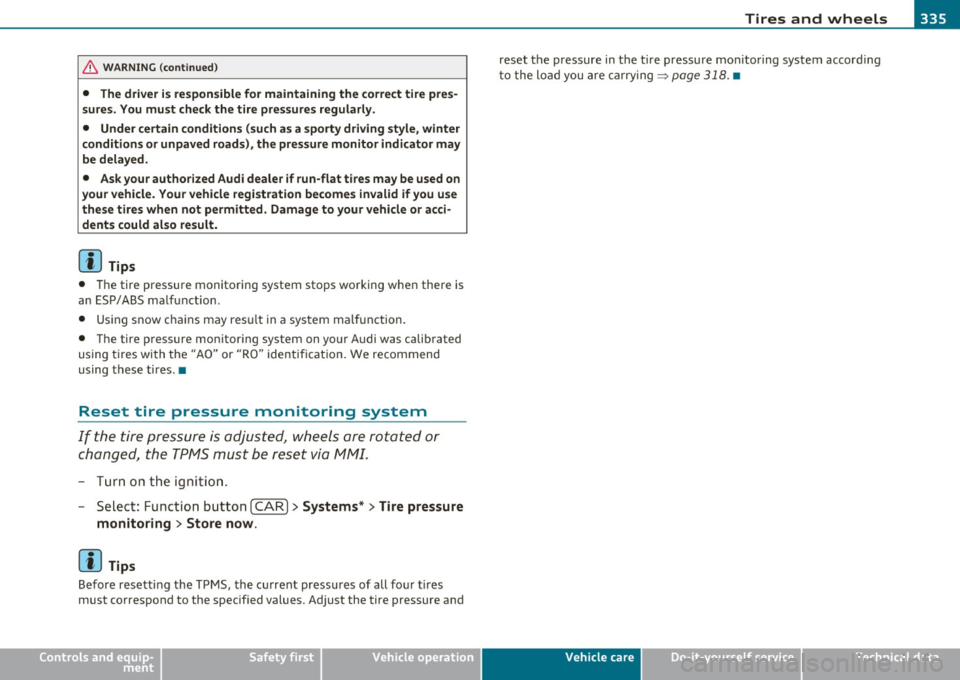
Reset tire pressure monitoring system
If the tire pres sur e is adjuste d, wheels ore ro tated o r
change d, th e TP MS mus t be rese t via MMI .
- Tur n on th e ig nit ion.
- Select : Func tion button [C AR]> Systems* > Tire pressure
monitoring > Store now .
[I) Tips
Before resetti ng the T PMS, the curr ent pr essures of all fo ur tires
must co rrespond to the specif ied values. Adjust the tire pressure and
Safety first
reset the pressure in the t ire p ressure mo nitoring system acco rd in g
t o the loa d you are carry ing ::::>
page 318. •
Vehicle care Technical data
Page 341 of 390

_____________________________________________ W __ h_a_ t_ d_o_ I_ d_o _ n_ o_ w _ ? __ _
& WARNING (continued)
-Never store the inflatable spare tire or jack and tools in the
passenger compartment.
- Always store all jacking equipment, tools, and the inflatable
spare tire in the luggage compartment.
- Tighten the knurled retaining screw for the inflatable spare
tire securely.
0 Note
• The inflatable spare tire has been developed specifically for this
vehicle model. It must not be exchanged or used for other vehicle
models . Similarly, inflatable tires from other vehicle models must
not be used.
• Normal summer or winter tires must not be installed on the inflat
able tire rim. •
Inflating inflatable spare tire
-Remove the compressor from the luggage compartment
~ page 338, fig. 250.
- Unscrew the valve stem from the spare tire.
- Screw the tire filler hose from the compressor firmly onto
the valve of the spare tire.
- Insert the plug from the compressor into a socket of the
vehicle ~
page 104.
- Switch the compressor on .
- Let the compressor run until it has reached SO PSI (3.5
bar). Switch the compressor off after running for
12 minutes at the most - danger of overheating!
Safety first
& WARNING
The compressor and the tire filler hose can become extremely hot
while they are running · danger of burns!
0 Note
Switch the compressor off after running for 12 minutes at the most
danger of overheating! Allow the compressor to cool down for a few
minutes before you use it again.
[ i] Tips
The compressor must not be connected to the cigarette lighter
socket, as this socket does not provide the required power.•
Changing a wheel
Before changing a wheel
Observe the following precautions for your own and your
passenger's safety when changing a wheel.
- After you experience a tire failure, pull the car well away
from moving traffic and try to reach
level ground before
you stop ~& -
- All passengers should
leave the car and move to a safe
location (for instance, behind the guardrail)~ &.
- Engage the
parking brake to prevent your vehicle from
rolling unintentionally~ &.
- Move
selector lever to position P ~ & .
- If you are tow ing a trailer: unhitch the trailer from your
vehicle. ..,_
Vehicle care Do-it-yourself service Technical data
Page 386 of 390
___ A_ l_. p_ h _ a_b_ e_ t_ic _a_ l_ in_ d_e _ x ____________________________________________ _
tiptronic ® . .... .... ..... ... .. ... . .. 161 T ires and vehicle load limits . .. .. .. . 322
Automatic Sh ift Lock (ASL) ...... ... 163 W heel bolts ................... .. 332
Dr iv ing .................. .... ... 161 Winte r tires ............... ... .. . 330
Dynamic shift program . .. .. ... . ... 164 T ires/Wheels
Fai l-safe mode . .. ............. ..
166 Low aspect ratio tires .. .. .. .. .. ... 332
Ki ck-down ... .. .. .. .. .. .... ..... 1 64 T ire pressure monitoring system . 19,333
Ma nual shift program .... ......... 1 6 5 Tools ............ .. .. .. .... .. .. ... 336
Selector lever .. .. ... . ..... .. . ... 162 Torn or frayed safety be lts .......... .. 202
Ti re pressure ........ ... ... ..... .... 320 Touch-up paint ... .. .... .. .. .. .... .. 278
Ti re pressure monitoring system . ... .. . 333
Loss of air press ure . .... ... ... . 19, 334
Ma lf u nct ion ................... .. 334
Resetting t ire pressures ......... .. 335
T ow ing
Front eye le t .............. ...... .
355
Rear eye let .............. .. .. .. . 356
T ow tr uck procedures .. .... .. ..... 355
Ti re service life .... .. .. .. .... ... .. .. 32 4 Tow ing a tra ile r
T ires ...... .............. ...... ...
3 14 Par king system . .. .... .... .. .... . 175
Service life ... .. .. .. .. ... .... .... 324 TPMS
speed rat ing let ter code ......... ..
3 27
Tir e m anufactur ing da te ..... ...... 3 2 7
Tir e spe cifica tions . .. ........... .. 3 27
Tr ead depth . ... .. .. ... ... .... ... 3 24
Uniform t ire quali ty g rading ... .. .. . 329
Winter tires . ... .... .. .. .. .. .. . .. 330
Tir es and vehicle load limits . .. .... ... 322
Tires and wheels T
ire pressure monitoring system . ... 334
Tr ailer towi ng .. .. ................. .
269
Ope rating instruc tions ...... .... .. 2 70
Tech nica l requirements ... .. .. 269,271
T ong ue load .... ... ...... .. .. ... 270
T railer towing tips . ... ...... .. ... . 272
Tr ailer turn sign al assembly
Wa rning/indicator l igh ts ... .. .... ..
1 7
Checking tire pressure ............ 320
Cold tire inflation pressure .. .... ... 318
Dimensions .. ............ .... ... 326
General notes ..... ...... .... .... 314
Gl f t.
d l d" t . l Tread We ar Indic a tor (lfWI) ... .... .. . 32 4 ossa ry o ,re an oa mg ermmo ogy .
315
Transm ission
t . t
. ® ,p ronic ............ ...... ... .
T ransport Cana da ...... ..... ... .. .. . 16 1
198
Trip computer
New tires and wheels .... .........
326 Fuel co nsump tion ........ ...... .. . 37
Rep lacing .. .. .. .. ...... ......... 326 Mileage ............ ... .. ... ..... 37
Snow chains .. ..... ....... .... . .. 331 Single-trip memory ................ 38
T otal -t rip me mory ........ .... .. .. 38
Trip odometer . . . . . . . . . . . . . . . . . . . . . . 12
What does it mean when dEF appears in
t he trip o dome ter display? . . . . . . . .
12
Trunk
See Rea r lid .. ... ... ........... 49 , 50
Turn s ignals .... ....... ...... .. .... . 69
Warning/indicator lights . .......... 17
T urning re ar air condit io ni ng on/off
F our -zone automatic comfort air
conditioning .. ................ .
116
u
Undercoating ... .. .. .. ... ..... .. .. . 280
Unfastening safety be lts ...... ... .. .. 206
Unidire ct io nal tires .. .. .. .. .... .. ... 314
Un iform t ire quali ty grading .......... 329
Unlocking
Power locking switch . ... ... ... .. ..
47
Rear lid/trun k lid ... .. .. .. ...... .. 49
Remote control key .. ............. . 45
Using the key .............. .... .. . 46
V
Valet key function
Activat ing and deact ivat ing ........ .
43
Vanity mirror ... .. .. .. ... .... ..... .. 71
Vehicle Identificat ion Numbe r (V IN) ... 360
Vehicle jack . .. .. ....... ...... .. 336, 342
Vehicle lite ratu re . . . . . . . . . . . . . . . . . . . . . 5
Vehicle-care products ...............
274
Page 387 of 390
Alphabetical index -___________________________________ ____._ _______ _
Ventilatio n Weights .. .. .. .. .. .... .. .. .... .. ... 361
Climate controls ................. 109 What happens if you wear your safety be lt too
w
Warning lights ............. .... .... . 14
Warning/indicator lights ... ... ... ... .. 10
Adaptive Air Suspension . .. . .... .. .. 18
Adaptive C ru ise Contro l ............ 143
Airbag system .................... 17
An ti-lock brake system (ABS) ........ 19
Brake system ............ ... ...... 20
Cru ise control ............ .... .... . 19
E lectronic power cont rol ... .. .. ... .. 16
E lectro nic stabil ization p rogram ( ESP) . 16
Glow pl ug sys tem ................. 16
H igh beam ....................... 19
Mal fu nction Indicator Lamp ( MIL) .... 17
Park ing brake ..... ....... ... . ... .. 20
Safety belt . ....... .. .. ... .. .. .. .. 18
T ir e pressure monito ring system ... .. 19
Trailer turn signa l assembly ......... 17
Turn signals ............ .. .. .. .. .. 17
Wa rran ty cover ages . ......... .... .. . 3 66
Washer reservo ir ............ ........ 312
Washing . ....... ... .. .. .. .. .. .. .. . 274
Automatic car wash ............... 275
by hand ...... ...... .. .. .. ... ... . 275
General informat ion .............. 274
w ith a power washer .............. 276
Waxing .... ..... ... .. .. .... .. .. .. . 27 7
Wea r indicator . .. .... ...... .... ... . 324
Weatherstrips ...................... 279 loose?
....................... . 204
What happe ns to unbelted occupants? . . 201
W hat impairs driv ing safety? . ........ . 189
What should I do after changing a wheel? ..
32 1
What should I do after replac ing whee ls? ...
32 1
Wheel bolts To rque .... .. ..... ...... ...... .. 332
W heels .. .. .. .. ... ................ 314
Cast alloy ...... .... .... ......... 280
Checking tire pressure ............. 320
Cold tire infla tion pressure ......... 318
General notes ............ .... ... 314
Glossa ry of tire and loading terminology .
315
New tires and whee ls ........... .. 326
Ti res and vehicle load limits ........ 322
W hen m ust a safe ty be lt be rep laced? . . 202
When m ust the a irbag system be inspected?
220
When should I adjus t th e tire press ures? 321
When should I check t he t ire pressures? . 321
Where are lower anchorages loca ted? .. . 24 5
Where can I find the tire pressures for my car? 320
W hy safety belts? ........... .. . 199, 200
Windows Clean ing .... ...... ....... .... .. . 279
Convenience close/open feature . ..... 58
Defogging ......... ... .......... 113 Defrost
ing ... .... ... .... ... ... .. 113
Rapid defrosting/defogg ing ........ 114
Win dshield washer fluid
Low level ... .. .. .. ..... ....... ... 33
W indshield wipers
Changi ng the rear w ipe r blade ....... 77
F aul ty ........................... 3S
I nte rm ittent wi ping .. .. ... .. . ... .. 72
One -tap wip ing . ... .. .. ... .. ... ... 72
Rain sensor ... .. .. ... ... ..... .... 72
Rear window wiper ...... ..... ... .. 74
Service position .. .. ............... 75
Washer reservo ir . .. ............. . 312
Winter ope ration
Battery ... .. ... .... . ..... .. .. .. . 308
Coolant system ...... .. ... .. .. .. . 30 4
Heated rear seats .......... ... .. . 120
Steering wheel heating .. .......... 121
Tires . ......................... . 258
Windows ... .. .................. 279
Winter ti res .... ... .. .. .. .. .. .. .. .. . 33 0
All-whee l drive ....... ... ...... .. . 330
W iper blades
I nsta lling new wiper b lades ....... .. 76
See also Windsh ie ld wipers . . . . . 76 , 7 7
X
Xeno n-Lig hts . .. ...... ...... ....... . 3 50
y
Yellow symbols . .. .. .. ...... ... .. .. .. 32
Controls and equip
ment Safety first Vehicle operation
Vehicle care Do-it-yourself service Technical data