battery AUDI Q7 2010 Owner´s Manual
[x] Cancel search | Manufacturer: AUDI, Model Year: 2010, Model line: Q7, Model: AUDI Q7 2010Pages: 390, PDF Size: 93.04 MB
Page 261 of 390
_________________________________________ I_ n_ t_ e_ ll_,igent technology ,__E~-
& WA RNING (c on tinued )
planing ). If this should occur, you will have no warning from a
sudden in crease in e ngine speed as with a front -wheel drive
veh icle. Always drive at speeds which are suited to the road condi
tions - risk of crash .•
Energy management
Starting ability is optimized
E nergy ma nagement co ntr ols the distribution of elec
trical energy and thus optimizes the availa bility of elec
trical energy for s tarting the engine.
If a vehicle with a convention al ene rgy sys tem is not driven fo r a lo ng
pe riod of time, the battery is d ischarged by idling cu rr ent consumers
(e.g. immo bilizer) . In ce rtain c ircumstances it can result i n there
being insufficien t energy avai lab le to start the engine .
Inte llige nt ene rgy management in your ve hicl e han dles the dist ribu
ti on of e lectr ica l energy. Sta rting ability is m arkedly improved a nd
the life of the battery is extended.
B as ically , energy managemen t consis ts of
battery diagno sis , idling
current management
and dynamic energy management .
Battery diagnosis
Battery d iagnosis continuously determ ines the state of the battery .
Sensors de term ine ba tte ry vo ltage, ba ttery curren t and batte ry
temperature. Th is determines t he current state of charge and the
powe r of th e battery .
Idling current management
Idli ng cu rrent m anageme nt reduc es ene rgy consu mptio n while the
vehicle is standing. W ith the ignition switc hed off, it controls the
ene rgy su ppl y to the v ari ou s ele ct rical com pone nts. Da ta fr om
battery diagnosis is considered .
Controls and equip
ment Safety first Vehicle operation
Depend
ing on the battery 's state of charge, individual consumers are
gr adu ally t urned o ff to prevent excess ive disch arge of the bat tery an d
t hus maintain start ing capability .
Dynamic energy management
While the vehicle is being dr iven, dynamic energy management
dis tributes the energy gene rated a ccording to the needs o f the in d i
vidua l compo nen ts. It regulates consumpt io n, so that more electr ica l
energy is no t be ing use d th an is being gene ra ted and ensures an
op timal state of charge for the battery .
(I) Tips
• But even energy ma nagement cannot negate the limits o f phys ics .
Consider that t he power and life o f a battery are limited.
• If starting ab ility is threatened, yo u are informed by a warn ing
~ page 260, "D river notification i n the instrument cluste r display" .
What you should know
The high est priorit y is g iv e n to maintaining starting capa
bility .
The b att ery i s seve rely t axed in short -dist ance d riving, in city t raffic
and dur ing the cold time of year . Ab undant electr ica l energy is
re quir ed, bu t on ly a li ttle is generate d. It is also crit ical if t he engine
is not run ning and electr ica l compone nts ar e turn ed on. In this
instance energy is being cons umed but none is being ge ne rated.
It is i n pre cise ly these s itu ations t hat yo u will notice energy m anage
ment act ive ly regulat ing the d istribut ion of ene rgy .
Vehicle stands for an extended period
If yo u do not drive your ve hicle over a period of several days or wee ks,
elect rical compo nents are g radually cut bac k or switched off. This
red uces ene rgy cons umption and ma inta ins start ing capability ove r a
l o nger pe riod.
Vehicle care Do-it-yourself service Technical data
Page 262 of 390
Intelligent technology
'-------------------------------------------------
Take into consideration that when you unlock your vehicle, some
convenience functions, such as the remote key or power seat adjust
me nt, may not be available. The convenience functions will be avail
able again when you turn on the ignition and start the engine.
With the engine turned off
If you listen to the radio, for example, with the engine turned off or
use other MMI functions, the battery is being discharged.
If start ing capability is jeopardized due to energy consumption, the
following warning appears in the MMI display:
Please start engine, otherwise system will switch off in
3 minutes .
The warning indicates that the system will be turned off automati
cally after 3 minutes. If you wish to continue using the functions, you
have to start the engine.
With the engine running
Although electrical energy is generated when the vehicle is being
driven, the battery can become discharged. This happens mostly
when little energy is being generated and a great deal consumed and
the battery's state of charge is not optimal.
To bring the energy balance back into equilibr ium, consumers which
require especially large amounts of energy are temporarily cut back
or switched off. Heat ing systems in particular require a great deal of
energy. If you notice, for example, that the heated seats* or the
heated rear window are not heating, they have been temporarily cut
back or switched off. These systems will be available again as soon as
the energy balance has been restored .
You will also notice that engine idle speed has been increased
slightly. This is norma l and not a cause for concern. By increasing
engine idle speed the additional energy required is generated and the
battery is charged.
Driver notification in the instrument
cluster display
If battery power drops into the range where it can limit the ability of
the engine to start, this is shown in the instrument cluster display
with the following driver message:
i...-3 Low battery charge: battery will be charged while driving
This notification reminds you that the starting capability of the
engine may be limited. As soon as you start driving again, the battery
w ill be recharged and the notification will go out.
Driver notification appears and goes out again
If th is driver notification appears after the ignition is turned on or
whi le driving and it goes out again after a while, the battery has been
adequately recharged.
Driver notification appears and does not go out
again
If this driver notification appears after the ignition is turned on o r
wh ile driving and does not go out again, the battery's state of charge
is not in the optimal range. Starting ability is restricted. Have the
battery checked as soon as possible by an authorized Audi dealer or
qualified workshop. •
Page 299 of 390
___________________________________________ C..:...._ h:....:e :....:c:..:. k.::..: i..:.. n .:..:g:!:....:: a....:. n..:.. d~ f:....:. i.:..ll :.:.i:....:n :.:g !....- _1!'11
Closing the engine hood
- Pull the hood down until the pressure from the struts is
reduced.
- Let the hood
drop down and latch in place. Do not try to
push it shut;
it may fail to engage=:> &.
& WARNING
A hood that is not completely latched could fly up and block your
view while driving.
• When you close the engine hood, check it to make sure the
safety catch has properly engaged. The hood should be flush with
the surrounding vehicle body parts.
• If you notice while driving that the hood is not secured prop
erly, stop at once and close it. •
Working in the engine compartment
Be especially careful whenever you work in the engine
compartment.
Whenever you must perform any work in the engine compartment,
for example checking and filling different fluids, there is a risk of injury, burns and accidents. To prevent personal injury always
observe the following WARNINGS. The engine compartment of any
vehicle is a hazardous area=>& .
& WARNING
To help avoid injury, before you check anything under the hood:
• Turn off the engine.
• Remove the ignition key.
• Apply the parking brake.
Safety first
& WARNING (continued)
• Move selector lever to "P" (Park).
• Always let the engine cool down. Hot components will burn
skin on contact.
• To reduce the risk of being burned, never open the hood if you
see or hear steam or coolant escaping from the engine compart
ment. Wait until no steam or coolant can be seen or heard before
carefully opening the hood.
• Keep children away from the engine compartment.
• Never spill fluids on hot engine components. They can cause a
fire. • Never touch the radiator fan. The auxiliary electric fan is
temperature controlled and can switch on suddenly.
• Never open the coolant reservoir cap when the engine is still
warm. The coolant system is pressurized and hot coolant could
spray out.
• Protect your face, hands and arm from steam or hot engine
coolant by placing a thick rag over the cap when you open the
coolant reservoir.
• If work on the fuel system or the electrical system is necessary:
- Always disconnect the battery.
- Never smoke or work near heaters or open flames. Fluids in
the engine compartment could start a fire.
- Keep an approved fire extinguisher immediately available.
• To avoid electrical shock and personal injury while the engine is
running or being started, never touch:
-Ignition cables
- Other components of the high voltage electronic ignition
system.
• If you must perform a check or repair with the engine running:
- First, fully apply the parking brake, move selector lever to
"P" (Park). .,
Vehicle care Technical data
Page 300 of 390

___ C_h_ e_c _k _i_n -=g :a,__ a_n_ d_ f_ i_ l _li _n _,g;._ __________________________________________ _
& WARNING (continued)
-Always use extreme caution to prevent clothing, jewelry, or
long hair from getting caught in the radiator fan, V-belts or
other moving parts, or from contacting hot parts. Tie back hair
before starting, and do not wear clothing that will hang or
droop into the engine.
• Minimize exposure to emission and chemical hazards=:>
/1::..
& WARNING
California Proposition 65 Warning:
• Engine exhaust, some of its constituents, and certain vehicle
components contain or emit chemicals known to the State of Cali
fornia to cause cancer and birth defects and reproductive harm. In
addition, certain fluids contained in vehicles and certain products
of component wear contain or emit chemicals known to the State
of California to cause cancer and birth defects or other reproduc
tive harm.
• Battery posts, terminals and related accessories contain lead
and lead compounds, chemicals known to the State of California
to cause cancer and reproductive harms. Wash hands after
handling.
0 Note
When adding fluids, a lways make sure that they are poured into the
proper container or filler open ing , otherwise serious damage to
vehicle systems wi ll occur.
ci> For the sake of the environment
To detect leaks in time, inspect the vehicle floor pan from underneath
reg ular ly. If yo u see spots from oil or other vehicle fl uids, have your
vehicle inspected by an authorized Audi dea ler .•
Engine compartment
These are the most important items that you can check.
Fig. 231 Typical layout for containers, engine oil dipstick and engine oil filler
cap
© Windshield/headlight washer container ( q ) . . . . . . . . 312
@ Coolant expansion tank (- L ) . . . . . . . . . . . . . . . . . . . . . 305
® Engine oil f iller cap
("l!::r.) . . . . . . . . . . . . . . . . . . . . . . . . 302
© Engine oil dipstick (orange) . . . . . . . . . . . . . . . . . . . . . . 301
® Brake fluid reservoir ( ) . . . . . . . . . . . . . . . . . . . . . . . . 307
© Power steering reservoir . . . . . . . . . . . . . . . . . . . . . . . . 257
0 Jump start connector( +) u nder a cover,(-) with hex head
screw .. ... ... ...... ........ ......... .... .. .. 311,352
The position of the engine oil filling hole and the engine oil dipstick
=:> fig. 231 (position ® and ©> can vary according to the type of
eng ine. .,_
Page 310 of 390
![AUDI Q7 2010 Owner´s Manual -Checking and filling
-------=------=---------------------------------------------------
warning/ind icator light will illum inate . Contac t an authorized Aud i
de aler
immediately .
[ i ]](/img/6/40275/w960_40275-309.png "AUDI Q7 2010 Owner´s Manual -Checking and filling
-------=------=---------------------------------------------------
warning/ind icator light will illum inate . Contac t an authorized Aud i
de aler
immediately .
[ i ]")
-Checking and filling
-------=------=---------------------------------------------------
warning/ind icator light will illum inate . Contac t an authorized Aud i
de aler
immediately .
[ i ] Tips
T he b rake fl uid reservoir is located unde rneath t he cover. •
Changing brake fluid
Have the b rake fluid chan ged by an exp eri enc ed t echni
cian.
B ra ke flui d absorbs mois ture fro m th e air . If the w ater con ten t in the
brake fl uid is too high, corros io n in th e brake system may result afte r
a p eriod of time. The boil ing po int of the br ake fl uid will also de cre as e
cons iderab ly and decr ease brak ing performa nce.
Th erefo re, the brake fl uid m ust be changed
every two years. Always
use new br ake fluid w hich conforms to Federal Motor Veh icle Stan
dard "FMVSS 1 16 DOT
4" .
The b rake fl uid reservo ir can be diffi cult to rea ch, there fore, we
recommend that you have the brake fluid c hanged by your author ized
Audi dealer. Your dea ler has the correct tools, the rig ht b rake f luid
and the k now-how to do t his for you .
& WARNING
• Brake fluid is poisonous. It must be stored only in the closed
original container out of the rea ch of children!
• Brake failure can result from old or inappropriate brake fluid.
Observe these precautions:
-Use only brake fluid that meets SAE specification
J 1703 and
conforms to Federal Motor Vehicle Standard 116. Alway s check
with your authorized Audi dealer to make sure you are using
the correct brake fluid. The correct type of brake fluid is also indicated on the brake fluid reservoir .
& WARNING (co ntinued )
-The brake fluid must be new. Heavy use of the brakes can
cause a vapor lock if the brake fluid is left in the system too
long . This can seriously affect the efficiency of the brakes as
well as your safety . This could result in an accident.
0 Note
B rak e fluid will dam age the pai nt of yo u r ve hicl e.
<£> For the sake of the environment
Beca u se of the pr oblem of pro per dispo sal o f b rak e fl uid as we ll a s
the spec ia l too ls req uired and the necessary expertise, we recom
me nd that you h ave t he brake f luid chan ged b y yo ur a uth oriz e d Audi
dea ler. •
Battery
General information
Under normal operat ing co ndit io ns, the battery in your Aud i does not
need any maintenance. With high outs ide temperatures or long daily
dr iv es we re comme nd that yo u have th e ele ct rolyte level checked by
an a uth orized Audi dealer o r qualified wor kshop. The electro lyte leve l
s ho uld a ls o be che cked e ach time the batte ry is ch arge d=>
page 311.
Have the batte ry chec ked when yo u take yo ur vehicle in for serv ice.
Yo u ar e well advised to rep lace a batte ry that is older th an 5 years .
W ith certa in types of airbag deployme nt, the ba ttery is disconnected
from the vehicle e lectrica l system for safety reasons=>
& in "Repair,
c are and dis posa l o f the air bag s" on
page 223. ~
Page 311 of 390

___________________________________________ C..:...._ h:....:e :....:c:..:. k.::..: i..:.. n .:..:g:!:....:: a....:. n..:.. d~ f:....:. i.:..ll :.:.i:....:n :.:g !....- __
Disconnecting the battery terminals
Some vehicle f unct ions (powe r window regula to rs, fo r ex am ple) are
lost if the batt ery t ermina ls are disconnec ted . These func tions hav e
to be re lea rne d after the battery term ina ls a re co nnecte d aga in . To
prev en t th is, t he battery should only b e disconn ecte d from th e
vehicle e lectr ica l system when absol ute ly necessary for repairs .
Vehicles not driven for long periods
If you do not drive your veh icle over a period of seve ra l days o r wee ks,
el ect rical compo nents are g radually cu t back or swi tched off . This
re duces ene rgy consumption an d maintains start in g ca pability ove r a
lo nger pe riod=>
pag e 259.
Take into consideration t hat when you unlock your vehicle, some
c onvenie nce func tions, such a s the m aster key remote function or
power seat ad justment , may not be ava ilab le. T he conven ience func
t ions wi ll be available again when you turn on the ignition and st art
t he engin e.
Winter operation
Dur ing the w inter months, batte ry capac ity tends to decrease as
t empe ra tures drop . This is beca use mo re powe r is also co nsu med
w hile starting, and the headlights, rear w indow defogger, etc ., are
used more often .
Avoid unnecessa ry power consu mptio n, part icularl y in city tra ffic o r
w hen trave ling on ly short distances . Let your author ized A udi deale r
ch eck t he capa city of the vehicle ba ttery before w inter sets in
=>
page 311. A well charged battery will not only prevent start ing
pro blems when the we ather is co ld, but wi ll a lso la st l onge r.
[ i J Tips
If you r ve hicl e is left s tandi ng for seve ral weeks at extremely low
tempe ratures, t he ve hicle battery should be removed and stored
w here it will no t free ze . T his will preven t it fr om being dam age d and
having to be replaced .•
Safety first
Working on the battery
B e es pec ially ca reful when workin g on o r nea r the
batt ery.
The battery is located un de r th e d rive r's se at . B efo re yo u
ch eck a nyth ing under the driv er's sea t,
read and heed all
WARNINGS =>& .
Always heed the safety warnings , when wo rking on the vehicle
battery or the ve hicle elect rical system to p reve nt injury .
The following WARNINGS are very important when
working on the battery:
Always heed the following WARNING SYMBOLS and safety pre
cautions when working on the battery.
@
Always wear eye protection.
Battery acid contains sulfuric acid. Always wear
gloves and eye protection.
No
- sparks
- flames
• smoking .
When a battery is charged, it produces hydrogen
gas which is explosive and could cause personal injury.
Always keep the battery well out of reach of chil
dren.
& WARNING
Whenever working on the battery or on the electrical system ,
there i s the risk of injury, accident and even fire. Read and heed
the following WARNINGS: .,_
Vehicle care Technical data
Page 312 of 390
llft!I __ C_ h_ e_c _k _i _ n _g ~ a_n _d_ f_il _l_in _ g _________________________________________ _
& WARNING (conti nu ed )
• Always wear eye protection. Do not let battery acid or any lead
particles get on your skin or clothing. Shield your eyes. Explo sive
gases can cause blindness or other injury.
• Battery acid contains sulfuric acid. Sulfuric acid can cause
blindnes s and severe burns .
- Always wear gloves and eye protect ion. Do not tilt the
battery because acid could leak out of the ventilation open
ings.
- If you get battery acid in your eyes or on your skin , immedi
atel y rinse with cold water for several minutes and get medical
attention.
- If you should ingest any battery acid, seek medical attention
immediately.
• Do not expose the battery to an open flame, elect ric sparks or
an open light .
• Do not smoke.
• Do not int erchange the positive and negative cab les .
• When working on the battery, be sure not to short-cir cuit the
terminals with tools or other metal obje cts. This would cause the
battery to heat up very quickly, which could lead to damage or
explosion and per sonal injury .
• When a battery is charged , it produces hydrogen gas which i s
e xplosive and could cause personal injury.
• Always keep the battery well out of the reach of children .
• Before work is done on the electrical system, disconnect the
negative ground cable.
• Befo re performing any work on the electrical system , swit ch
off the engine and ignition as well as any electrical equipment .
The negative cable on the battery must be disconnected. If you are
ju st going to replace a light bulb, then it is enough to switch off
the l ights.
& W ARNING (continued )
• Before di sconnecting the battery , switch off the anti-theft
alarm system! Otherwise you w ill set off the alarm .
• When disconnecting the battery, first disconnect the negative
cable and then the po sitive cable .
• Before reconnecting the battery , make su re all electri cal
consumers are sw itched off . Reconnect the positive cable first and
then the negative cable. Never interchange the cables - this could start a fire!
• Never charge a frozen or a thawed-out battery. It could
e x plode! If a battery has frozen, then it must be replaced. A
di scharged battery can freeze o ver at 32 °F (0 °C ).
• Make sure the vent hose is always attached to the open ing on
the side of the battery .
• Never use batte ries which are damaged . There is the danger of
an explosion! Alway s repla ce a damaged battery .
& WARNING
California Proposition 65 Warning:
• Battery posts , terminals and related accessorie s contain lead
and lead compounds, chemicals known to the State of California
to cause cancer and reproductive problems. Wash hands after
handling.
0 Note
• Do not disco nne ct the vehi cle battery when t he ign it ion is
switched on o r when the engine is running, otherwise, you wi ll
da mage e le ctronic compone nts in t he e lec trica l system .
• If your ve hicle is go ing to stan d for a long period of time witho ut
bei ng d rive n, protect the ba tte ry from "freezing", ot herwis e it w ill be
damaged and will then have to be replaced.•
Page 313 of 390
Checking and filling -
-------------------=------=:;______,.J,,...
Battery charging
Starting the engine requires a well charged battery.
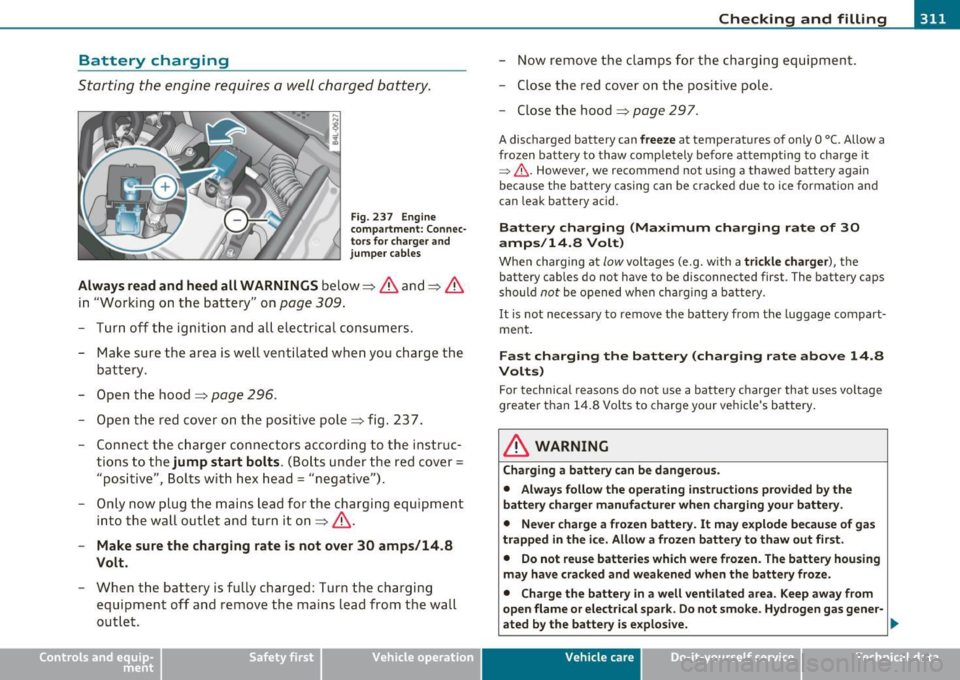
Fig. 237 Engine
compa rtment : Connec
tor s for charger and
jumper cables
Always read and heed all WARNINGS below=> & and => &
in "Working on the battery" on
page 309.
- Turn off the ignition and all electrical consumers.
- Make sure the area is well ventilated when you charge the
battery.
- Open the hood :::::,
page 296.
-Open the red cover on the positive pole =>fig. 23 7.
- Connect the charger connectors according to the instruc-
tions to the
jump start bolts . (Bolts under the red cover=
"positive", Bolts with hex head
= "negative") .
- Only now plug the mains lead for the charging equipment
into the wall outlet and turn it on =>& .
-Make sure the charging rate is not over 30 amps/14.8
Volt.
- When the battery is fully charged: Turn the charging
equipment off and remove the mains lead from the wall
outlet.
Vehicle OP-eration
-Now remove the clamps for the charging equipment.
- Close the red cover on the positive pole.
- Close the hood :::::,
page 297.
A discharged battery can freeze at temperatures of only O 0C. Allow a
frozen battery to thaw completely before attempting to charge it
~ & .However, we recommend not using a thawed battery again
because the battery casing can be cracked due to ice formation and
can leak battery acid.
Battery charging (Maximum charging rate of 30
amps/14.8 Volt)
When charging at low voltages (e.g. with a trickle charger ), the
battery cables do not have to be disconnected first . The battery caps
sho uld
not be opened when charging a battery.
It is not necessary to remove the battery from the luggage com part·
ment.
Fast charging the battery (charging rate above 14.8
Volts)
For technical reasons do not use a battery charger that uses voltage
greater than 14.8 Volts to charge your vehicle's battery .
& WARNING
Charging a battery can be dangerous.
• Always follow the operating instructions provided by the
battery charger manufacturer when charging your battery.
• Never charge a frozen battery. It may explode because of gas
trapped in the ice. Allow a frozen battery to thaw out first.
• Do not reuse batteries which were frozen. The battery housing
may have cracked and weakened when the battery froze.
• Charge the battery
in a well ventilated area. Keep away from
open flame or electrical spark. Do not smoke. Hydrogen gas gener-
ated by the battery is explosive. •
Vehicle care Do-it-yourselt service Technical data
Page 314 of 390
-Checking and filling .,,,, _ _..::::.__-=-----------------
& WARNING (continued)
• To reduce the danger of explosion, never connect or disconnect
charger cables while the charger is operating.
• Fast charging a battery is dangerous and should only be
attempted by a competent technician with the proper equipment.
• Battery acid that may spill during charging should be washed
off with a solution of warm water and baking soda to neutralize
the acid.
0 Note
Never use a fast charger as a booster to start the engine. This will seri
ously damage sens it ive electronic components, such as control units,
relays, radio, etc ., as well as the battery charger.•
Battery replacement
The new battery must have the same specifications and
dimensions as the original equipment battery.
Intelligent energy management in your veh icle is responsible for
distributing the electrical energy throughout your vehicle
~ page 259. T he intelligent energy management system will keep
the engine battery charged better then vehicles without this system .
To make sure the additional electrical energy is available once again
after you have changed the battery, we recommend that you install
batteries of the same type and manufacture only (the same as those
installed at the time your vehicle was delivered). Specifications are
listed on the battery housing. Your authorized Audi dealer will then
code the battery management control unit.
If it is not poss ible to use a battery of this type, the new battery must
have the same capacity, vo ltage (12 volts), amperage, construction
and plug sea ling .
When installing the battery, make sure the ignition and all electrica l
consumers are turned off.
0 Note
Make sure the vent ilation hose on the side of the battery is
connected, otherwise fumes or battery acid can leak out.
mend your authorized Audi dealer change the battery for you.
Batteries contain sulfuric acid and lead and must always be disposed
of properly in compliance with all environmental regulat ions.
Disposing of vehicle batteries improperly is very dangerous to the
environment. •
Windshield/headlight washer
container
Fig. 238 Engine
com partm ent : Wind·
shield and headlight"
wash er fluid container
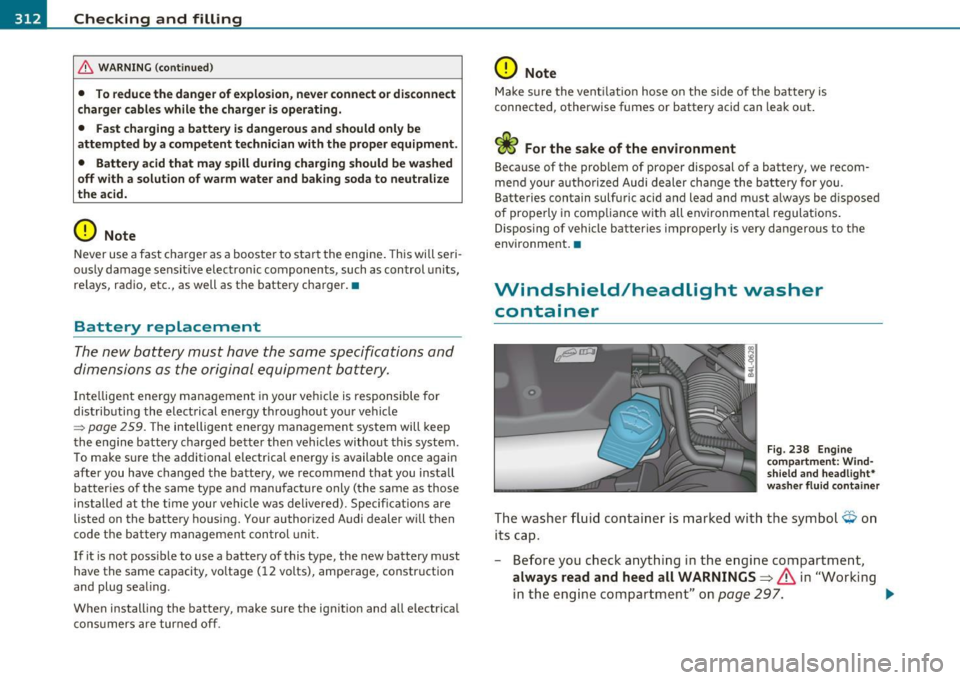
The washer fluid container is marked with the symbol~ on
its cap.
- Before you check anything in the engine compartment,
always read and heed all WARNINGS~ & in "Working
in the engine compartment" on page
297. ..,_
Page 318 of 390
-~_T_ ir_e_ s_ a_ n_ d_ w_ h_e_ e_ ls _______________________________________________ _
Groove
means the space between two adjacent tread ribs.
Load rating (code)
means the maximum load that a tire is rated to carry for a given infla
tion pressure. You may not find this information on all tires because
it is not required by law.
Maximum load rating
means the load rating fo r a tir e at the maximum permissible inflation
pressure for that tire.
Maximum loaded vehicle weight
means the sum of:
(a) Curb weight
(b) Accessory weight
(c) Vehicle capacity weight, and
(d) Production options weight
Maximum (permissible) inflation pressure
means the maximum cold inflation pressure to which a tire may be
inflated. Also called "maximum inflation pressure."
Normal occupant weight
means 150 lbs. (68 kilograms) times the number of occupants seated
in the vehicle up to the total seating capacity of your vehicle.
Occupant distribution
means distr ibution of occupants in a vehicle .
Outer diameter
means the overall diameter of an inflated new tire.
Overall width
means the linear distance between the exteriors of the sidewalls of
an inflated tire, including elevations due to labeling, decorations, or
protective bands or ribs.
Ply
means a layer of rubber -coated paralle l cords.
Production options weight
means the combined weight of those installed regular production
options weigh ing over 5 lbs. (2.3 kg) in excess of those standard
items which they replace, not previously considered in curb weight or
accessory weight, including heavy duty brakes, ride levelers, roof
rack, heavy duty battery, and special trim.
Radial ply tire
means a pneumatic tire in which the ply cords that extend to the
beads are laid at substantially 90 degrees to the centerline of the
tread .
Recommended inflation pressure
see=> page 315, "Cold tire inflation pressure".
Reinforced tire
means a tire design to operate at higher loads and at higher inflation
pressures than the corresponding standard tire. Reinforced t ires may
be identified as "XL ", "x l", "EXTRA LOAD", or "RF" on the sidewall.
Rim
means a metal support for a tire or a tire and tube assembly upon
wh ich the tire beads are seated .
Rim diameter
means nominal diameter of the bead seat . If you change your wheel
size, you w ill have to purchase new tires to match the new rim diam
eter .
Rim size designation
means rim diameter and width.
Rim width
means nom inal distance between rim flanges.