child lock AUDI Q7 2010 Owner´s Manual
[x] Cancel search | Manufacturer: AUDI, Model Year: 2010, Model line: Q7, Model: AUDI Q7 2010Pages: 390, PDF Size: 93.04 MB
Page 238 of 390
Ill Child Safety __ .,.___ ____________ _
& WARNING (continued )
-Always move the front passenger seat into the rearmost
position of the passenger seat's fore and aft adjustment range,
and as far away from the airbag as possible before installing
the child restraint.
- Always make sure that nothing prevents the front
pas senger' s seat from being moved to the rearmost position in
its fore and aft adjustment range.
- Always make sure that the backrest i s in the upright pos i
tion.
• Always buckle the child safety seat firmly in place even if a
child i s not sitting in it. A loo se child safety seat can fly around
during a sudden stop or in a collision .
• Always read and heed all WARNINGS whenever using a child
restrained in a vehicle is being used=>
page 199, "Safety belts",
=>
page 209 , "Airbag system " and => page 231, "Child Safety ".
& WARNING
To reduce the risk of seriou s injury, make sure that the
PASSENGER AIR BAG OFF light comes on and stays on whenever a
child restraint is installed on the front passenger seat and the
ign ition is switched on.
• Take the child re straint off the front pa ssenger seat and install
it prope rly at one of the rear seat positions if the PASSENGER AIR
BAG OFF light does not stay on.
• Have the airbag system inspected by your authorized Audi
dealer immediately .
& WARNING
A child in a child restraint installed with the LATCH lower anchor
ages or with the standard safety belt on the rear seat may play
& WARNING (cont inued )
with unused rear seat safety belts and become entangled
re sulting in serious personal injury and even death.
• Always buc kle unused rear se at safety belts out of reach of chil
dren in child seats and p roperly activate the convertible locking
retractor so that the child cannot unreel the safety belt from the
retractor. •
Child safety seats
Infant seats
Babi es an d infants up to about one year old and 20 lbs. or
9 k g n eed sp ecial r earward -facing child res traints tha t
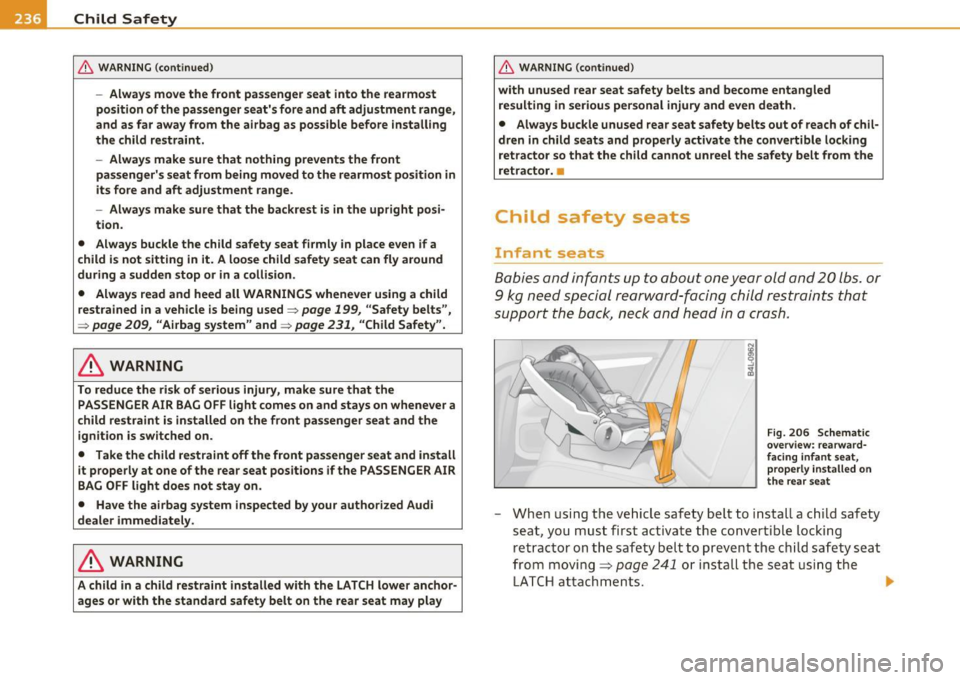
suppor t the back, neck and head in a cras h.
Fig. 206 Schemati c
ove rview : re arwa rd
facing infan t seat ,
prope rly installed o n
t he rear s eat
- W hen usi ng the ve hicle safety bel t to i nstall a c hild safety
seat, you must first activa te the co nvert ible locki ng
ret ractor on the safety belt to preven t the child sa fety seat
fro m mo ving=>
page 241 or install the seat usi ng the
L ATCH attach ments. ..,_
Page 240 of 390
___ C_h _i_ld _ S_ a_ f_ e_ t_,, y'-----------------------------------------------
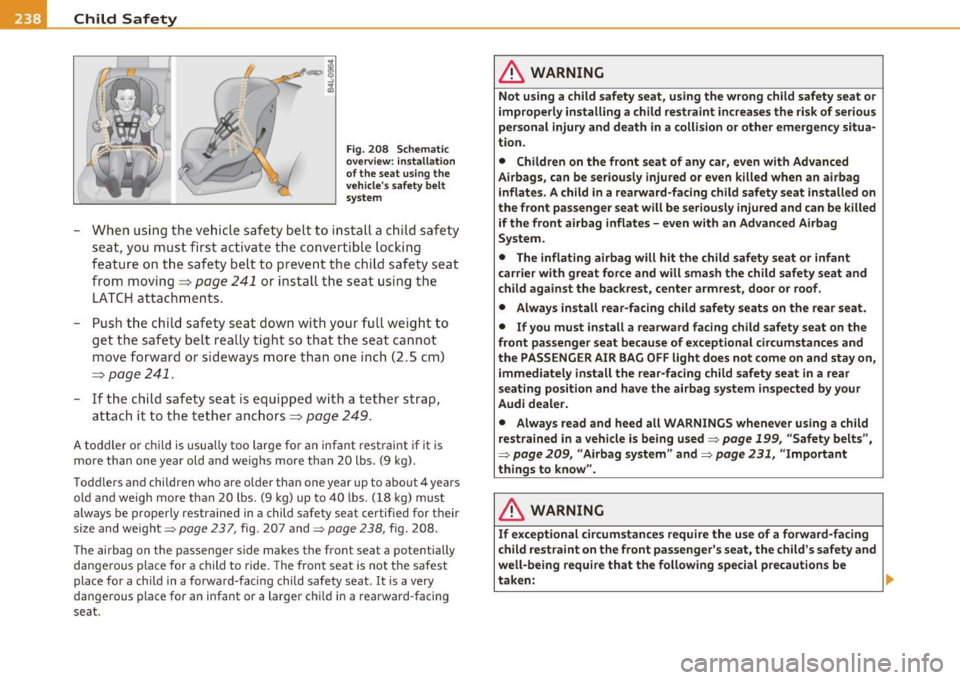
Fig. 208 Schematic
overview: installation
of the seat using the
vehicle's safety belt
system
- When using the vehicle safety belt to install a child safety
seat, you must first activate the convertible locking
feature on the safety belt to prevent the child safety seat
from moving~
page 241 or install the seat using the
LATCH attachments.
- Push the child safety seat down with your full weight to get the safety belt really tight so that the seat cannot
move forward or sideways more than one inch
(2.5 cm)
=>
page 241.
- If the child safety seat is equipped with a tether strap, attach it to the tether anchors=>
page 249.
A toddler or child is usually too large for an infant restraint if it is
more than one year old and weighs more than 20 lbs . (9 kg) .
Toddlers and children who are older than one year up to about 4 years old and weigh more than 20 lbs. (9 kg) up to 40 lbs. (18 kg) must
always be properly restrained in a child safety seat certified for their
size and weight~
page 237, fig. 207 and~ page 238 , fig. 208.
The airbag on the passenger side makes the front seat a poten tially
dangerous place for a child to ride. The front seat is not the safest
place for a child in a forward-facing child safety seat . It is a very
dangerous place for an infant or a larger child in a rearward-facing
seat .
& WARNING
Not using a child safety seat, using the wrong child safety seat or
improperly installing a child restraint increases the risk of serious
personal injury and death in a collision or other emergency situa
tion.
• Children on the front seat of any car, even with Advanced
Airbags, can be seriously injured or even killed when an airbag
inflates. A child in a rearward-facing child safety seat installed on
the front passenger seat will be seriously injured and can be killed
if the front airbag inflates -even with an Advanced Airbag
System.
• The inflating airbag will hit the child safety seat or infant
carrier with great force and will smash the child safety seat and
child against the backrest, center armrest, door or roof.
• Always install rear-facing child safety seats on the rear seat.
• If you must install a rearward facing child safety seat on the
front passenger seat because of exceptional circumstances and
the PASSENGER AIR BAG OFF light does not come on and stay on,
immediately install the rear-facing child safety seat in a rear
seating position and have the airbag system inspected by your
Audi dealer.
• Always read and heed all WARNINGS whenever using a child
restrained
in a vehicle is being used ~ page 199, "Safety belts",
~ page 209, "Airbag system" and ~ page 231, "Important
things to know".
& WARNING
If exceptional circumstances require the use of a forward-facing
child restraint on the front passenger's seat, the child's safety and
well-being require that the following special precautions be
taken:
11'-
Page 241 of 390
& WARNING (continued)
• Make sure the forward-facing seat has been designed and certi·
fied by its manufacturer for use
on a front seat with a passenger
front and side airbag.
• Always follow the manufacturer's instructions provided with
the child safety seat or infant carrier.
• Always move the front passenger seat into the rearmost posi
tion of the passenger seat's fore and aft adjustment range, and as
far away from the airbag as possible before installing the child
restraint.
• Always make sure that nothing prevents the front passenger's
seat from being moved to the rearmost position in its fore and aft
adjustment range.
• Always make sure the backrest is in an
upright position.
• Make sure that the PASSENGER AIR BAG
OFF light comes on
and stays on all the time whenever the ignition is switched
on.
• If the light does not stay on, perform the checks => page 220,
"Monitoring the Advanced Airbag System".
• Take the child restraint off the front passenger seat and install
it properly at one of the rear seat positions if the PASSENGER AIR
BAG
OFF light does not stay on whenever the ignition is switched
on. a
Safety first Vehicle OP-eration
Child Safety
Booster seats and safety belts
Properly used booster seats can help protect children
weighing between about 40 lbs. and 80 lbs. (18 kg and
36 kg) who are less than 4 ft.
9 in.
(57 inches/1.45 meters) tall .
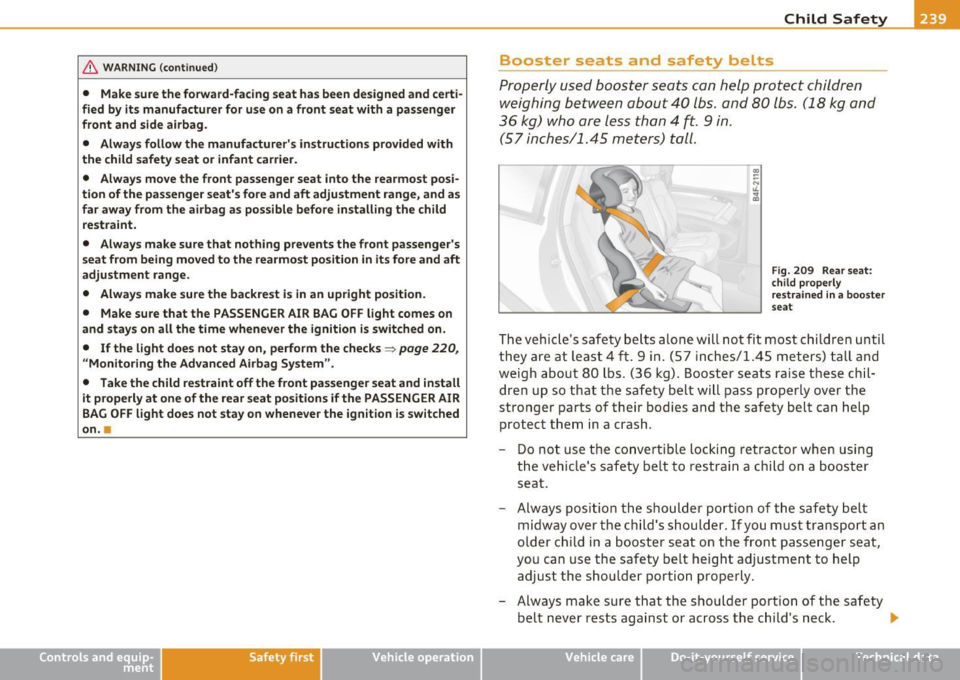
Fig. 209 Rear seat:
child properly
restrained in a booster
seat
The vehicle's safety belts alone will not fit most children until
they are at least 4 ft. 9 in. (57 inches/1.45 meters) tall and
weigh about 80 lbs. (36 kg). Booster seats raise these chil
dren up so that the safety belt will pass properly over the
stronger parts of their bodies and the safety belt can help
protect them in a crash.
- Do not use the convertible locking retractor when using
the vehicle's safety belt to restrain a child on a booster
seat.
- Always position the shoulder portion of the safety belt
midway over the child's shoulder. If you must transport an
older child in a booster seat on the front passenger seat,
you can use the safety belt height adjustment to help
adjust the shoulder portion prop erly.
- Always make sure that the shoulder portion of the safety
belt never rests against or across the child's neck.
9'>
Vehicle care Do-it-yourselt service iTechnical data
Page 243 of 390
_____________________________________________ C _h_i_ld _ S_ a_ f_ e_ t__. y'--- __
& WA RNING (c on tinued )
by a deploying airbag . This will result in se rious personal injury or
death.
• If you must install a booste r seat on the front passenger seat
because of exceptional cir cumstance s the PASSENGER AIR BAG
OF F light must come on and stay on , whenever the ign ition is
s wit ched on .
• If the PASSENGER
AIR BAG OFF light does not come on and
stay on, perform the checks described => page 220, " Monitoring
the Advanced Airbag System".
• Take the child re straint off the front passenger seat and install
it prope rly at one of the rear seat positions if the PASSENGER AIR
BAG OFF light does not stay on whenever the ignition i s sw itched
on.
• Always read and heed all WARNINGS whenever u sing a child
restrained in a vehicle is being used=>
page 199 , "Safety belts",
=> page 209, "Airbag sy ste m " and => page 231, "Important
things to know ".•
Installing a child safety seat
Securing a child safety seat using a safety
belt
S afet y belts f or t he rear se ats a nd the fr ont pa ssenger
can be l ocke d wit h the co nverti ble lockin g retract or to
p ro p erly sec ure chi ld safety seats .
The safety be lts emergency lo ck ing retractors for the rear seats
safety belts and fo r the fron t passe nger's seat safety belt have a
convertib le locking retractor for child restraints . The safety be lt must
be locked so that belt webbing cannot u nreel. The retractor can be
activated to lock the safety be lt and prevent the safety belt webbing
from loose ning up du ring normal dr iv ing. A child safety seat can only
Controls and equip ment Safety first Vehicle operation be properly
installed when the safety belt is locked so that the child
and child s afety se at will s tay in place.
Always remember: Even though yo ur vehicle is equipped w ith a n
Advanced Airbag system, all chi ldren, especia lly those 12 yea rs and
younger, should a lways ride in th e back sea t pro perly res train ed fo r
their age and size .
& WARNING
Improperly installed child safety seats increase the risk of serious
personal injury and death in a collision.
• Always make sure that the safety belt retractor is locked when
installing a child safety seat . An unlocked safety belt retractor
cannot hold the child safety seat in place during normal driving o r
in a crash.
• Always buckle the child safety seat firmly in place even if a
child is not sitting in it . A loose child safety seat can fly around
during a sudden stop or in a collision.
• Always make sure that the rear seat backrest to which the
center rear safety belt is attached is securely latched whenever the
rear center safety belt is being used to secure a child restraint .
• If the backrest is not securely latched, the child and the child
restraint will be thrown forward together with the backrest and
will strike parts of the vehicle interior. The child can be seriously
injured or killed.
• Never install rear -facing child safety seat s or infant carrier s on
the front passenger seat . A child will be seriously injured and can
be killed when the pa ssenger airbag inflates.
• The inflating airbag will hit the child safety seat or infant
carrier with great force and will sma sh the child safety seat and
child against the backrest, center armrest, door or roof .
• Always in stall rear-facing child safety seats or infant carrier s
on the rear seat. _,.
Vehicle care Do-it-yourself service Technical data
Page 245 of 390
_____________________________________________ C _h_i_ld _ S_ a_ f_ e_ t ... Y'--- __
& WARNING (continued)
the weight-mat in the seat and register a heavier weight in the
Advanced Airbag System. The heavier weight registered can make
the system work as though an adult were on the seat and deploy
the Advanced Airbag when it must be suppressed causing serious
or even fatal injury to the child.
• Make sure that the PASSENGER AIR BAG OFF light comes on
and stays on all the time whenever the ignition is switched on.
• If the PASSENGER AIR BAG OFF light does not come on and
stay on, immediately install the rear-facing child safety seat in a
rear seating position and have the airbag system inspected by
your Audi dealer. •
Activating the convertible locking retractor
Use the convertible locking retractor to secure a child
restraint.
Always heed the child safety seat manufacturer 's instruc
tions when installing a child restraint in your vehicle. To acti
vate the convertible locking retractor:
- Place the child restraint on a seat, preferably on the rear
seat .
- Slowly pull the belt
all the way out.
- Route it around or through the child restraint belt path
=>& .
- Push the child safety seat down with your full weight to
get the safety belt really tight.
- Insert the belt tongue into the buckle for that seating
position.
Controls and equip ment Safety first Vehicle operation
-
Guide the safety belt back into the retractor until the belt
lies flat and snug on the child safety seat.
- You should hear a "clicking" noise as the belt winds back into the inertia reel. Test the convertible lock ing retractor
by pulling on the belt. You should no longer be able to pull
the belt out of the retractor. The convertible lock ing
retractor is now activated.
- Make sure that the red release button is facing away from the child restraint so that it can be unbuckled quickly .
- Pull on the belt to make sure the safety belt is properly tight and fastened so that the seat cannot move forward
or sideways more than one inch (2 .5 cm) .
& WARNING
Using the wrong child restraint or an improperly installed child
restraint can cause serious personal injury or death in a crash.
• Always make sure that the safety belt retractor is locked when
installing a child safety seat. An unlocked safety belt retractor
cannot hold the child safety seat in place during normal driving or
in a crash.
• Always buckle the child safety seat firmly in place even if a
child is not sitting in it. A loose child safety seat can fly around
during a sudden stop or in a crash.
• Always make sure the seat backrest to which the child restraint
is installed is in an upright position and securely latched into place
and cannot fold forward. Otherwise, the seat back with the child
safety seat attached to it could fly forward in the event of an acci
dent or other emergency situation.
• Always read and heed all WARNINGS whenever using a child
restrained in a vehicle is being used=>
page 231. Special precau-
tions apply when installing a child safety seat on the front
lill-
Vehicle care Do-it-yourself service Technical data
Page 246 of 390
lffll,___C_ h_ il_d _ S_a _ f_ e _ t-= y ;....._ ____________________________________________ _
& WARNING (conti nued)
passenger seat => page 211, "Child restraints on the front seat -
s ome important thing s to know ".•
Deactivating the convertible locking
retractor
The convertible lockin g retractor for child restraints will
be d eac tiv a ted aut omatic all y when the bel t is wou nd all
t he wa y back in to the retrac tor.
-Press the r ed button on the sa fety belt buckl e. T he b elt
t o ngue will po p out of t he buckle .
- Guid e the safety belt a ll the way back into its stowe d posi-
t ion.
Always le t the sa fety be lt retrac t co mple tely i nto i ts s tow ed position .
The safety bel t can now be used as a n or dinary sa fe ty belt withou t the
convert ib le locking ret ractor fo r chi ld rest raints .
If the convertible locking retractor should be activated inadvertently,
t he s afety be lt mus t be unfa stened and guide d comple tely b ack in to
its stowed position to deactivate this feature. If t he convert ib le
lo ckin g ret ractor is no t d eactiv ated , the sa fe ty bel t w ill grad ually
become tighter and uncomfo rtable to wea r.
& WARNING
Imp roperly installed child safety seats increase the risk of serious
personal injury and death in a colli sion.
• Never unfasten the safety belt to deactivate the convertible
locking retractor for child restraints while the vehicle is moving.
You would not be restrained and could be seriously injured
in an
accident.
& WARNING (con tinued )
• Alway s read and heed all WARNINGS whenever u sing a child
restrained in a vehicle is being used
=> page 231. Special precau
tions apply when installing a child safety seat on the front
pass enger seat =:>
page 211, "Child restraints on the front seat -
some impo rtant things to know ".•
LATCH Lower anchorages and
tethers for children
Child Restraint System anchors and how
are they related to child safety
T o prov ide a simpler and more practicable way to attach the child
restrain t on the vehicle seat, Federa l regulat io ns re quire spe cial
lower ancho rages in ve hicles and devices o n new chi ld restraints to
at ta ch to the ve hicle an chor ages.
The combination of the tether anchorages and t he lower anchorages
is now gene rally called the
LATCH system fo r "Lowe r Ancho rages and
T ethers for Childre n."
Forward-fac ing c hild restraints manufactured after Se ptember 1,
199 9, are requ ired by U .S. feder al reg ulat ion s to comp ly w ith new
child head moveme nt performance requirements . These new perfor
m anc e req uire men ts ma ke a tether nece ssary on m ost new child
seats.
Insta lling a child restraint that req uires a top tether w ithout one can
ser iously impair t he p erf or mance of th e chi ld res tra int and its ab ility
to p rotect the ch ild in a collision. Insta llin g a c hild rest raint that
req uires a top te ther w ithout t he top tet her m ay be a v iol at ion of
state law. ..
Page 250 of 390
• .___C_ h_ il_d _ S_a _ f_ e _ t--= y '------------------------------------------------
in the area that the guidance fixtures were installed . The upholstery
would also be permanently stretched around the guidance fixtures.
This applies especially to leather seats .•
Installing a child restraint with LATCH
lower anchorages
Whenever you install a child restraint always follow the
child restraint manufacturer's instructions.
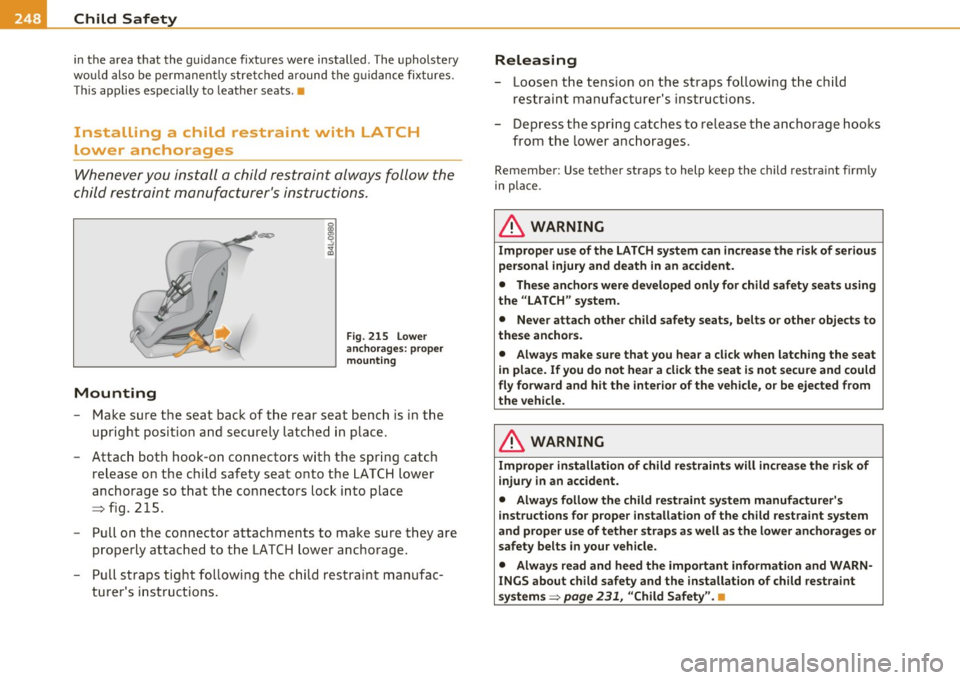
Mounting
Fig. 215 Lower
anchorages: proper
mounting
- Make sure the seat back of the rear seat bench is in the
upright position and securely latched in place.
- Attach both hook-on connectors with the spring catch
release on the child safety seat onto the LATCH lower
anchorage so that the connectors lock into place
~ fig. 215.
- Pull on the connector attachments to make sure they are
properly attached to the LATCH lower anchorage.
- Pull straps tight following the child restraint manufac
turer's instructions.
Releasing
- Loosen the tension on the straps following the child
restraint manufacturer's instructions.
- Depress the spring catches to release the anchorage hooks
from the lower anchorages.
Remember: Use tether straps to help keep the child restraint firmly
in place.
& WARNING
Improper use of the LATCH system can increase the risk of serious
personal injury and death in an accident.
• These anchors were developed only for child safety seats using
the "LATCH" system.
• Never attach other child safety seats, belts or other objects to
these anchors.
• Always make sure that you hear a click when latching the seat
in place. If you do not hear a click the seat is not secure and could
fly forward and hit the interior of the vehicle, or be ejected from
the vehicle.
& WARNING
Improper installation of child restraints will increase the risk of
injury in an accident.
• Always follow the child restraint system manufacturer's
instructions for proper installation of the child restraint system
and proper use of tether straps as well as the lower anchorages or
safety belts in your vehicle.
• Always read and heed the important information and WARN
INGS about child safety and the installation of child restraint
systems ~
page 231, "Child Safety". •
Page 299 of 390
___________________________________________ C..:...._ h:....:e :....:c:..:. k.::..: i..:.. n .:..:g:!:....:: a....:. n..:.. d~ f:....:. i.:..ll :.:.i:....:n :.:g !....- _1!'11
Closing the engine hood
- Pull the hood down until the pressure from the struts is
reduced.
- Let the hood
drop down and latch in place. Do not try to
push it shut;
it may fail to engage=:> &.
& WARNING
A hood that is not completely latched could fly up and block your
view while driving.
• When you close the engine hood, check it to make sure the
safety catch has properly engaged. The hood should be flush with
the surrounding vehicle body parts.
• If you notice while driving that the hood is not secured prop
erly, stop at once and close it. •
Working in the engine compartment
Be especially careful whenever you work in the engine
compartment.
Whenever you must perform any work in the engine compartment,
for example checking and filling different fluids, there is a risk of injury, burns and accidents. To prevent personal injury always
observe the following WARNINGS. The engine compartment of any
vehicle is a hazardous area=>& .
& WARNING
To help avoid injury, before you check anything under the hood:
• Turn off the engine.
• Remove the ignition key.
• Apply the parking brake.
Safety first
& WARNING (continued)
• Move selector lever to "P" (Park).
• Always let the engine cool down. Hot components will burn
skin on contact.
• To reduce the risk of being burned, never open the hood if you
see or hear steam or coolant escaping from the engine compart
ment. Wait until no steam or coolant can be seen or heard before
carefully opening the hood.
• Keep children away from the engine compartment.
• Never spill fluids on hot engine components. They can cause a
fire. • Never touch the radiator fan. The auxiliary electric fan is
temperature controlled and can switch on suddenly.
• Never open the coolant reservoir cap when the engine is still
warm. The coolant system is pressurized and hot coolant could
spray out.
• Protect your face, hands and arm from steam or hot engine
coolant by placing a thick rag over the cap when you open the
coolant reservoir.
• If work on the fuel system or the electrical system is necessary:
- Always disconnect the battery.
- Never smoke or work near heaters or open flames. Fluids in
the engine compartment could start a fire.
- Keep an approved fire extinguisher immediately available.
• To avoid electrical shock and personal injury while the engine is
running or being started, never touch:
-Ignition cables
- Other components of the high voltage electronic ignition
system.
• If you must perform a check or repair with the engine running:
- First, fully apply the parking brake, move selector lever to
"P" (Park). .,
Vehicle care Technical data
Page 308 of 390

___ C_ h_ e_c _k _i _ n _g ~ a_n _d_ f_il _l_in _ g _________________________________________ _
& WARNING (conti nu ed )
• To avoid being burned, do not spill antifreeze or coolant on the
exhaust system or hot engine part s. Under certain condit ion s, the
ethylene glycol in engine coolant can catch fire.
0 Note
Do not add any type of radiator leak sealant to yo ur vehicle's engine
c oo lant. Addi ng radia tor repa ir fluid m ay adverse ly affe ct the func
tion and performance of your cooling system and could result in
damage not cove red by y our New Vehicle Lim ited Warr anty. •
Adding coolant
Be very careful when adding engine coolant.
Before you check anyt hing in th e eng ine co mpart ment ,
always read and heed all WARNINGS => & in "Wor king i n
t h e e ngine compa rtment" on
page 297.
- Tur n off the eng ine.
- Let t he engi ne c ool d ow n.
- Place a thic k rag over th e coolan t expans ion tank
=> pag e 305, fig. 235 and carefully twist t he cap cou nter
cl ockwi se
=> &.
- Add coo lant.
- Tw ist the ca p on aga in
tightly .
Replacement eng ine coolant must conform to exact specifications
=>
page 304, "Coolant". Even in a n emergency, if coolant addi tive
Gl2 ++, Gl2 + or Gl2 is not available, do not use a different addit ive.
Use plain wate r in st ead until you can get the cor rec t additive an d can
restore the correct ratio. This shou ld be done as soon as possible. If
you have lost a considerable amount of coolant, then you sho uld
a d d c old an tifr ee ze and cold wa ter only when the e ngine is cold.
Always use
new engine coo la nt when refilling.
Do not fill coolant above the "MAX" mark. Excess coolant will be
fo rced o ut thr ough the p re ssur e relief v alve in the c ap w hen the
eng ine becomes hot.
& WARNING
• The cooling system is under pressure and can get very hot.
Reduce the risk of scalding from hot coolant by following these
steps.
-Turn off the engine and allow it to cool down.
- Protect your face , hands and arms from escaping fluid and
s team by covering the cap with a large, thi ck rag .
- Turn the cap slowly and very carefully in a counter-clockwise
direction while applying light, downward pre ssure on the top
of the cap.
- To avoid being burned, do not spill antifreeze or coolant on
the exh aust system or hot engine parts . Under certain condi
tions , the ethylene glycol in engine coolant can catch fire.
• Antifreeze is poisonous. Always store antifreeze in its original
container and well out of the reach of children.
• If you drain the coolant , it mu st be caught and safely stored in
a proper container clearly marked "poison ".
0 Note
• Coolant poll utes the environment and could cause an engine fire.
Excess coolant w ill be forced o ut thro ugh the pressure relief va lve in
t he c ap when t he e ngine becomes hot.
• If, i n an emergency, only water can be added, the co rrect ratio
between wate r and an tifreeze=>
page 304 mus t be res to red as soo n
as possib le. _..
Page 310 of 390
![AUDI Q7 2010 Owner´s Manual -Checking and filling
-------=------=---------------------------------------------------
warning/ind icator light will illum inate . Contac t an authorized Aud i
de aler
immediately .
[ i ]](/img/6/40275/w960_40275-309.png "AUDI Q7 2010 Owner´s Manual -Checking and filling
-------=------=---------------------------------------------------
warning/ind icator light will illum inate . Contac t an authorized Aud i
de aler
immediately .
[ i ]")
-Checking and filling
-------=------=---------------------------------------------------
warning/ind icator light will illum inate . Contac t an authorized Aud i
de aler
immediately .
[ i ] Tips
T he b rake fl uid reservoir is located unde rneath t he cover. •
Changing brake fluid
Have the b rake fluid chan ged by an exp eri enc ed t echni
cian.
B ra ke flui d absorbs mois ture fro m th e air . If the w ater con ten t in the
brake fl uid is too high, corros io n in th e brake system may result afte r
a p eriod of time. The boil ing po int of the br ake fl uid will also de cre as e
cons iderab ly and decr ease brak ing performa nce.
Th erefo re, the brake fl uid m ust be changed
every two years. Always
use new br ake fluid w hich conforms to Federal Motor Veh icle Stan
dard "FMVSS 1 16 DOT
4" .
The b rake fl uid reservo ir can be diffi cult to rea ch, there fore, we
recommend that you have the brake fluid c hanged by your author ized
Audi dealer. Your dea ler has the correct tools, the rig ht b rake f luid
and the k now-how to do t his for you .
& WARNING
• Brake fluid is poisonous. It must be stored only in the closed
original container out of the rea ch of children!
• Brake failure can result from old or inappropriate brake fluid.
Observe these precautions:
-Use only brake fluid that meets SAE specification
J 1703 and
conforms to Federal Motor Vehicle Standard 116. Alway s check
with your authorized Audi dealer to make sure you are using
the correct brake fluid. The correct type of brake fluid is also indicated on the brake fluid reservoir .
& WARNING (co ntinued )
-The brake fluid must be new. Heavy use of the brakes can
cause a vapor lock if the brake fluid is left in the system too
long . This can seriously affect the efficiency of the brakes as
well as your safety . This could result in an accident.
0 Note
B rak e fluid will dam age the pai nt of yo u r ve hicl e.
<£> For the sake of the environment
Beca u se of the pr oblem of pro per dispo sal o f b rak e fl uid as we ll a s
the spec ia l too ls req uired and the necessary expertise, we recom
me nd that you h ave t he brake f luid chan ged b y yo ur a uth oriz e d Audi
dea ler. •
Battery
General information
Under normal operat ing co ndit io ns, the battery in your Aud i does not
need any maintenance. With high outs ide temperatures or long daily
dr iv es we re comme nd that yo u have th e ele ct rolyte level checked by
an a uth orized Audi dealer o r qualified wor kshop. The electro lyte leve l
s ho uld a ls o be che cked e ach time the batte ry is ch arge d=>
page 311.
Have the batte ry chec ked when yo u take yo ur vehicle in for serv ice.
Yo u ar e well advised to rep lace a batte ry that is older th an 5 years .
W ith certa in types of airbag deployme nt, the ba ttery is disconnected
from the vehicle e lectrica l system for safety reasons=>
& in "Repair,
c are and dis posa l o f the air bag s" on
page 223. ~