heating AUDI Q7 2010 Owner´s Manual
[x] Cancel search | Manufacturer: AUDI, Model Year: 2010, Model line: Q7, Model: AUDI Q7 2010Pages: 390, PDF Size: 93.04 MB
Page 262 of 390
Intelligent technology
'-------------------------------------------------
Take into consideration that when you unlock your vehicle, some
convenience functions, such as the remote key or power seat adjust
me nt, may not be available. The convenience functions will be avail
able again when you turn on the ignition and start the engine.
With the engine turned off
If you listen to the radio, for example, with the engine turned off or
use other MMI functions, the battery is being discharged.
If start ing capability is jeopardized due to energy consumption, the
following warning appears in the MMI display:
Please start engine, otherwise system will switch off in
3 minutes .
The warning indicates that the system will be turned off automati
cally after 3 minutes. If you wish to continue using the functions, you
have to start the engine.
With the engine running
Although electrical energy is generated when the vehicle is being
driven, the battery can become discharged. This happens mostly
when little energy is being generated and a great deal consumed and
the battery's state of charge is not optimal.
To bring the energy balance back into equilibr ium, consumers which
require especially large amounts of energy are temporarily cut back
or switched off. Heat ing systems in particular require a great deal of
energy. If you notice, for example, that the heated seats* or the
heated rear window are not heating, they have been temporarily cut
back or switched off. These systems will be available again as soon as
the energy balance has been restored .
You will also notice that engine idle speed has been increased
slightly. This is norma l and not a cause for concern. By increasing
engine idle speed the additional energy required is generated and the
battery is charged.
Driver notification in the instrument
cluster display
If battery power drops into the range where it can limit the ability of
the engine to start, this is shown in the instrument cluster display
with the following driver message:
i...-3 Low battery charge: battery will be charged while driving
This notification reminds you that the starting capability of the
engine may be limited. As soon as you start driving again, the battery
w ill be recharged and the notification will go out.
Driver notification appears and goes out again
If th is driver notification appears after the ignition is turned on or
whi le driving and it goes out again after a while, the battery has been
adequately recharged.
Driver notification appears and does not go out
again
If this driver notification appears after the ignition is turned on o r
wh ile driving and does not go out again, the battery's state of charge
is not in the optimal range. Starting ability is restricted. Have the
battery checked as soon as possible by an authorized Audi dealer or
qualified workshop. •
Page 264 of 390
Driving and environment
New brake pads
Remember that new brake pads do not have a f ull braki ng
e ff e ct during the first 250 miles (400 kilometers) after they
are i nsta lle d.
New bra ke pads have to be "b urnished in" before they have opt ima l
grab=> &.
Dur ing the break -in period, you sho uld avoid putting severe loads on
the brakes. Severe loads incl ude, for example, sudden hard braki ng,
in particu lar at very high s peeds or, for examp le, on mountai n passes.
& WARNING
New brake pads don 't have the be st stopping power and must be
" broken -in " during the initial 100 to 150 miles (150 to 200 kilo
meters ) of normal cit y driving. You can compensate for thi s by
pressing th e brak e pedal more firmly. This also applies lat er wh en
new pad s are installed. n
Appli es to ve hicles : w it h g aso line eng ine
Catalytic converter
--
I t is very important th at your emission control system
(ca talytic co n verter) i s func tioning properly to e nsure
that you r vehicle is running in an environmentally sou nd
manner.
- Always us e lead-fr ee gasoli ne ~ page 287, "Gaso line" .
- Never run the tan k down a ll the way to empty.
- Never put too m uch motor oil in your engine~
page 302,
"Add ing e ngi ne o il "t::r.11
•
-Nev er try to p ush- or tow-sta rt yo ur veh icle.
The catalytic converter is an efficient "clean- up" device b uilt into the
exha ust sys te m of the ve hicle. The cat alytic converte r burns many of
t he polluta nts in the exhaust gas before they are released into the
atmosphe re.
Th e e xcl usive use of unleaded fuel is cr itic ally important for the life of
the catalytic converte r and proper f unction ing of the engine.
& WARNING
• Do not park or operate the vehicle in areas where the hot
exhaust system may come in contact with dry grass, brush, fuel
spill or other material which can cause a fire .
• Do not apply additional undercoating or rustproofing on or
near the exhaust manifold , exhaust pipes, catalytic conve rter or
heat shields. During driving, the substance used for undercoating
could overheat and cause a fire .
0 Note
• Be aware that just one tank fi lling wit h leaded fu el wi ll alrea dy
ser iou sly degrade the performan ce of the ca talyt ic co nve rter.
• Do not excee d the correct engine oil leve l=>
page 302 .
• Do not dr ive unti l the f uel tank becomes complete ly empty. The
eng ine could misfire . Unburned fuel could a lso get into the exha ust
system and th is could cause the catalytic converter to overheat.
• Do not t urn o ff the igni tion whi le the ve hicl e is moving.
• Do not contin ue to operate your vehicle under these conditions, as
o therwi se fuel c an reach the cat alytic c onve rter. Th is cou ld resu lt in
over heating of t he converte r, requir ing its rep lacement.
• T o ass ure eff ic ient opera tion of the Emi ssion C ontro l Sy stem:
- Have your vehicle maintaine d properly and in accordance with
t h e se rvice recommenda tions in your Warranty
& M ain tenance
booklet. •
Page 291 of 390

labeled ask the station operator what fuel is being dispensed befo re
fi lling up yo ur vehicle.
Service stations offering Diesel f uel are generally loca ted on truck
routes or major hig hways. Directo ries of Diese l fue l stations are
usually availab le at Diese l fuel stations.
Some states in t he USA require permits to purchase Diesel fuel. Check
w ith your State Mo tor Vehicle De partment.
Diesel fuel may not be available outs ide the USA and Canada. Be sure
to check before trave ling to othe r countries .
Winter operation
At t empe ratures below 20° F (- 7° C), Die sel fue l No . 2 l oses its flu idity
due to wax separation, wh ich may clog the fuel filter or tank fi lter and
keep the engine from running .
T o help t he filte r from be ing clogged by wax, the fue l fi lter in your
vehicle is automatically preheated. Preheat ing the fuel f ilter makes
operat io n of yo ur vehicle possib le with Die sel fuel No. 2 dow n to -
10° F (-24° C).
If you expect temperat ures below 5° F (-1S° C) ask yo ur fuel dealer
whether their Diesel fuel No . 2 is suffic iently w interized for the
prevailing and expected temperat ures.
If not winterized or insuff ic ie ntly w inte riz ed Diese l fuel has already
thickened to the extent that the engine w ill not start, warm the
vehicle up by leaving i t in a heated garage.
It is normal that the eng ine noise level (dieseling) is louder during the
warm-up period in winte r. It is also normal when whitish -blue smoke
comes out of t he tailpipe afte r start ing and du ring warm-up. The
amount of smoke depends on the outside temperature .
Do not let your Diesel engine idle unnecessa rily af ter a co ld start.
Dr iv ing off slow ly w ill shorten the warm-up per iod.
Safety first
Fuel supply and filling your fuel tank
& WARNING
• Never use "starting as sist flu ids ." Th ey may be potentially
explo sive or cause a "run-away " engine condition . Thi s could
re sult in s eriou s engine damage and per sonal injury .
• Never u se fuel line anti -freeze off ered fo r ga soline engine s.
0 Note
• Your D iesel eng ine has been spec ifically desig ned to ope rate on ly
on Ultra Low Sulfur Diesel fue l. Therefore, never use home heating o il
or reg ular gasoline . The properties of these fuels may cause serious
damage to the fuel injection system and to t he engine . Using these
fue ls can cause expens ive eng ine repairs and will also adversely affect
your New Vehicle Lim ited Wa rranty.
• If Diese l fuel shou ld get on any rubber hose, it must be wiped off
immediately. Then wash the contaminated hose port ion w ith soap
and warm water . Do not allow Diesel fue l to remain on connecting
hoses. They may deve lop leaks and cause se rious damage. •
Fuel tank
Fuel filler neck
The f ue l fi ller neck is located o n the rig ht rea r side panel behind t he
fue l filler flap.
If the power locking system shou ld fai l, you can st ill open the flap
ma nually- for deta iled instructions see:::::>
page 292.
You can find the fue l tank capacity of your veh icle in
Technical Data
:::::, page 3 63.
The label on the inside of t he fuel filler flap tells you the correct fuel
for your veh icle. For more informat ion about fuel specifications, see
:::::>
page 287 . _,,
Vehicle care Technical data
Page 306 of 390
lffll __ C_ h_ e_c _k _i _ n _g ~ a_n _d_ f_il _l_in _ g _________________________________________ _
& WARNING (conti nu ed )
• Engine oil is poisonous . Keep it well out of the reach of chil
dren .
• Continuous contact with u sed engine oil is harmful to your
skin . Alway s protect your skin by wa shing thoroughly with soap
and water.
0 Note
Never mix oi l additives wit h your engine oil. These additives can
damage your engine and adverse ly affect your Audi Limited New
Vehicle Warranty.
~ For the sake of the environment
• Before chang ing the oil, first make sure you know where you can
prope rly d is p ose of the o ld oil.
• Always dispose of used oi l proper ly. Never dump it o n garden soi l,
in wooded areas, i nto streams o r down sewage d rains.
• Recycle used oi l by taking it to a used engine oil co llection facility
in yo ur area, or contact a se rvice station .
• We st rongly recommend t hat you have you r oi l changed by an
authorized Audi dealer or a qualified workshop with the specia l tools
and expertise required, and proper means of disposa l.•
Engine cooling system
Coolant
The e ngine co o la nt per form s two functio ns: it keeps the
engine from ove rh eati ng and it protects t he engine from
free zing in the winter .
The cooling system is sealed an d genera lly req uir es little attention. The cooling system has been f
illed at the factory wit h a permanent
c oo lant whi ch does no t need to be c hanged . Th e coolan t cons ists o f a
mixt ure of water and the manufacturer's glycol-basedcoolant addi
tive G12+ + antifreeze with anticorrosion ad dit ives (50% for USA
mode ls; 60% for Ca nadian models) . This mixture both ass ures the
necessary frost protection and protects meta l components in the
eng ine's cooling system from co rrosion and scaling. It also raise s the
boiling point of the coo lant .
Do not re du ce the co ncent ration of the coo lant in the summer by
add ing p la in water .
The proportion of coolant add itive must be at
least 50% but not more than 60%
to mai ntain an tifreeze pro tection
and coo ling efficiency . If the coolant frost p rotect io n i s too low, the
coo lant co uld freeze an d damage t he veh icle heating and engine
coo ling system .
For year-round driving, antifree ze is added at the factory for temper
a tures dow n to:
• -31°F(-35°C)USA
• - 4 0 °F ( -40 °C) Canad a.
You can mix the G12 ++ coo lant addit ive w ith other additives (G12+ or
G 12). A lways check with yo ur autho rize d Audi dea ler.
& WARNING
Before you che ck anything in the engine compartment, always
read and heed all WARNINGS~
& in "Work ing in the engine
compartment" on
page 297 .
0 Note
• Before w inter sets in, have the coolan t checked to see i f the
coo lant add itive in yo ur vehicle is s uff ic ient to meet the cl ima te
conditions. This is especially important if yo u live in a region where
the winter is ext reme ly cold . If necessa ry, increase the proport ion of
coo lant add itive to 60%.
• When ad ding coolant add itive to you r cooling sys tem, remembe r:_.,
Page 307 of 390
_____________________________________________ C_h _ e_ c_ k_in --= g:-. a_n _d_ f_i _ll _i_n -=g =-- ____.•
- We recommend using only coolant additive Gl2 ++ (check the
l a bel) for yo ur vehicle. This coolant ad dit ive is available at au tho·
r ized Audi dealers . Other types of antifreeze can s ignificantly
reduce corrosion protection. The resulting corrosion can cause a
loss of coolant and serious engine damage .
• Do not add any type of radiator leak sealant to your vehicle's
eng ine coo lant . Adding radiator repa ir fluid may adversely affect the
function and performance of your cooling system and could result in
damage not covered by your New Vehicle Limited Warranty .•
Checking the engine coolant Level
The engine coolant level can be checked with a quick
glance .
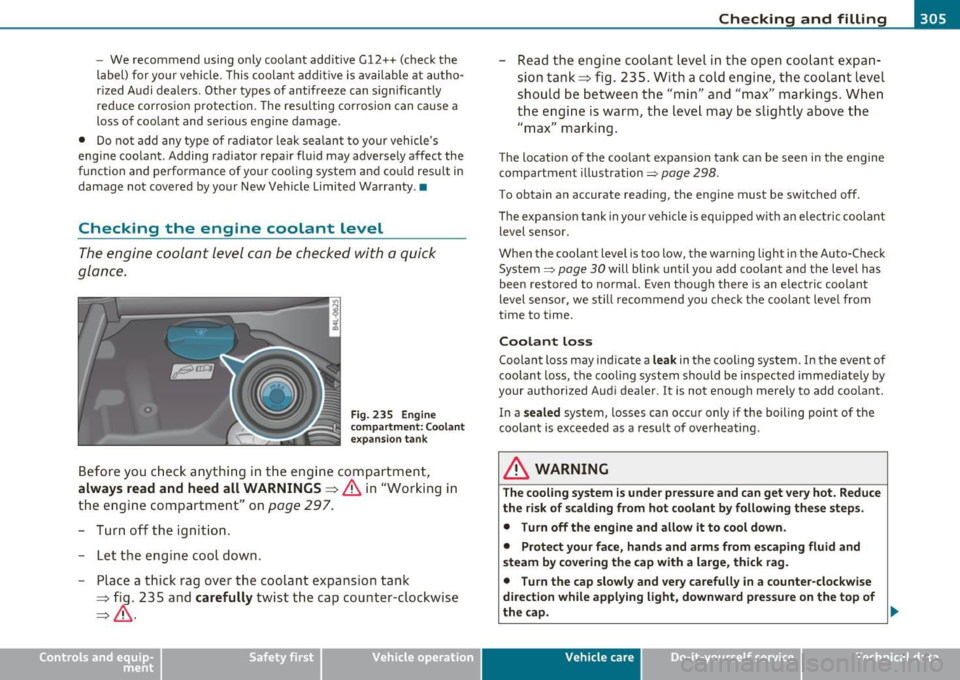
Fig. 2 35 En gin e
c o mpar tmen t: C oolant
ex pansion tank
Before you c heck anything in the eng ine compartment,
always read and heed all WARNINGS~ & in "Working in
the e ngine compartment" on
page 297.
- Turn off the ignit ion .
- Let t he eng ine cool down .
- Place a thick rag over the coolant expans ion tank
~ fig . 235 and carefully twist the cap counter ·clockwise
~ & -
Vehicle OP-eration
-Read the engine coolant level in th e open coo lant expan ·
sion tank ~ fig . 235 . With a cold engine, the coolant level
should be between the "min" and "max" ma rkings . Whe n
the engine is warm , the level may be slight ly above the
"max" marking .
The location o f the coo lant expansion tank can be seen in the engine
compartment illustration=>
page 298 .
To obt ain an accurate reading , the engine must be sw itched off.
Th e expans ion t an k in your vehicle is equippe d with an electric coolant
level sensor.
When the coolant lev el is too low, the warning light in the Auto·Check
System=>
page 30 will blink until you add coolant and t he level has
been resto red to normal. Even though there is an electric coolant
level sensor, we st ill recommend you check the coolant leve l from
time to time.
Coolant loss
Coolant loss may indicate a leak in the coo ling system . In the event of
coo lant loss , the cooling system sho uld be inspected immed iate ly by
your authorized Aud i dea ler . It is not enough mere ly to add coolant.
In a
s ealed system, losses can occu r only if the boiling point of the
coolant is exceeded as a result of ove rheating .
& WARNING
The cooling system is under pressure and can get ve ry hot. Reduce
the ri sk of scalding from hot coolant by following the se steps.
• Turn off the engine and allow it to cool down .
• Protect your face, hand s and arms from e scaping fluid and
s team b y co ve ring the cap with a large, thi ck r ag.
• Turn the cap slowly and ver y carefully in a counter-clo ckwise
direction whil e applying light , downward pre ssure on the top of
thecap .
~
Vehicle care Do-it-yourselt service iTechnical data
Page 341 of 390

_____________________________________________ W __ h_a_ t_ d_o_ I_ d_o _ n_ o_ w _ ? __ _
& WARNING (continued)
-Never store the inflatable spare tire or jack and tools in the
passenger compartment.
- Always store all jacking equipment, tools, and the inflatable
spare tire in the luggage compartment.
- Tighten the knurled retaining screw for the inflatable spare
tire securely.
0 Note
• The inflatable spare tire has been developed specifically for this
vehicle model. It must not be exchanged or used for other vehicle
models . Similarly, inflatable tires from other vehicle models must
not be used.
• Normal summer or winter tires must not be installed on the inflat
able tire rim. •
Inflating inflatable spare tire
-Remove the compressor from the luggage compartment
~ page 338, fig. 250.
- Unscrew the valve stem from the spare tire.
- Screw the tire filler hose from the compressor firmly onto
the valve of the spare tire.
- Insert the plug from the compressor into a socket of the
vehicle ~
page 104.
- Switch the compressor on .
- Let the compressor run until it has reached SO PSI (3.5
bar). Switch the compressor off after running for
12 minutes at the most - danger of overheating!
Safety first
& WARNING
The compressor and the tire filler hose can become extremely hot
while they are running · danger of burns!
0 Note
Switch the compressor off after running for 12 minutes at the most
danger of overheating! Allow the compressor to cool down for a few
minutes before you use it again.
[ i] Tips
The compressor must not be connected to the cigarette lighter
socket, as this socket does not provide the required power.•
Changing a wheel
Before changing a wheel
Observe the following precautions for your own and your
passenger's safety when changing a wheel.
- After you experience a tire failure, pull the car well away
from moving traffic and try to reach
level ground before
you stop ~& -
- All passengers should
leave the car and move to a safe
location (for instance, behind the guardrail)~ &.
- Engage the
parking brake to prevent your vehicle from
rolling unintentionally~ &.
- Move
selector lever to position P ~ & .
- If you are tow ing a trailer: unhitch the trailer from your
vehicle. ..,_
Vehicle care Do-it-yourself service Technical data
Page 380 of 390
__ _:._A..:. l:.! p:.. h ::....:..:: a:.:b:.. e=-= t.:..:ic :.:a:.. l:.....:..: in~ d:...:e :..: x.:...._ ___________________________________________ _
Reserve ..... .... ........ .... ... . 12
Tank capacity . .. .. .. ...... ... .. .. 363
Unlocking the fuel filler flap by hand 292
Fuse arrangement ... ............... 346
G
Garage door opener (Homelink®) ...... 183
Gas d ischarge lamps ........ .. .... .. 350
Gauges Engine coolant temperature . ... .... 10
Fuel gauge . .... .. .... .. .. .. .. .... 12
Speedometer ... .. .. ........ .. . ... 12
T achometer ...................... 11
Tr ip odometer ............. .... .. . 12
General illustration Instruments and controls ............ 9
General rules and driving tips ......... 266
Before driving offroad ........ .... 266
Driving offroad .................. 266
Glossa ry of tire and loading terminology 315
Glove compartment ........ ......... 105
Cooling box ..... ........ .... .. .. 106
Valet key function ......... ... .. .. . 43
Glove compartment -emergency unlocking ..
106
Glow plug system
Indicator light ............. .... .. . 16
Gradient angle .................. ... 266
Gross Vehicle We ight Rating (GVWR) ... 361
Ground clearance .. .. ............ ... 266
H
Head restraints ............... .... .. 193
Adjusting .. .. .... .. .... .. .. .. ... 193
Front seats . . . . . . . . . . . . . . . . . . . . . . 90
Rear seats .. .. ........... ..... 91, 92
Headlight washer reservoir ........... 312
Headlights ............ ... .. .. ... ... 65
Adaptive Light ............. .... .. . 68
Defective . . . . . . . . . . . . . . . . . . . . . . . . 24
Front fog lights ............ ... .. .. 67
Headlight range control . ........... 34
Switching
off ......... .. .. .. .. .. .. 65
Switching on ......... .... .. ...... 65
Washer system . ..... ... . ... .. .. .. 75
Xenon headlights .... ............. 65
Heated outside mirrors
79
Heated seats Front ................... .. .... . 119
Rear ............... ..... .. .. .. . 120
Rear (four-zone automatic comfort air
conditioning) ..... ...... .. .. .. . 120
Heated steering wheel ... ..... ....... 121
Heated washer jets
Wiper and washer system .... .. .. .. 72
Heating Climate controls ............... .. 109
Heavy clothing and safety belts ....... 202
H igh beam ......... .... .... .. .. . 65 , 69
Warning/indicator lights ..... .. .. .. 19
High voltage warning label .... .... ... 360
Hi ll descent control ..... ............ 252 Hill hold
Starting on hills 131
Homelink ® universal remote control ... 183
Hood Opening ............ .... .... .. .. 296
Release lever ... .. .. ..... .. .. .. .. 296
Horn .................. .... ... ... ... 9
How are child restraint system anchors related to child safety .... ....... ... .. .. 244
How many airbags does my vehicle have? ...
216
How often should I check my tire pressures? . 321
How safety belt pretensioners work .... 207
Hydroplaning ......... ............. 325
I
Ignition key ................ ..... .. 124
Ignition lock .. .. ............. .. .. .. 124
Ma lfunct ion .... .. .. .... ....... 31, 35
Ignition lock positions ... .. .. .. .... .. 124
Important things to do before driving .. 189
Improperly worn safety belts ... .. .. .. 207
Indicator lights . . . . . . . . . . . . . . . . . . . . . . 14
Airbag system ....... .. .. .. .. 220,221
PASSENGER AIR BAG OFF .... .... .. 221
Infant seats ................ ... .. .. 236
Inflatable spare tire .. .. .. .. .. .... ... 338
Inflating ........... .. .... .... .. 339
Inside rear view mirror .. ........... 77, 78
Installing child safety seats Safety belts ............... .. .. .. 241
Page 385 of 390
_____________________________________________ A_ L .... p_ h _ a_b_ e_ t_ ic_a_ l_ in_ d_e _ x __ _
Side curtain airbags
Description ............ ... ... .... 228
How they work ............... .... 229
Safety instructions .. .......... .. . 230
Side curtain airbags) .......... ... ... . 228
Side marke r lights ................ ... . 65
Sk i sack ......... ... ... ... .. .. ... ... 99
Snow chains .... ................ ... . 331
Sockets ..................... ... ... 104
Sound sys tem display
Driver information display .......... 23
Sources of information about child restraints
and their use ........... ... .. .. . 251
Speed control system
See Adaptive Cruise Control ........ 134
Speed rating letter code ........... .. . 327
Speed warning system ........... ... .. 35
Speedometer ... ... ............. ..... 12
Starting on hills
H ill hold ...... ...... ... ... ..... . 131
Starting the engine ........... .. 124, 125
What should I do if the engine does not start? ...... .. .... .. .... .. .... . 125
Steering . ............ .... ... ... .... 122
Easy entry feature . .. .. ........... 124
Electrically adjusting the steering whee l .
123
Locking the steering .... .. ... ..... 124
Malfunction .............. .. .. .. .. 31
Manually adjusting the steering wheel
122
Controls and equip ment Safety first
Steering wheel colum
n Symbols
Adjusting electrically ............ .. 123 Red ..... ........................ 28
Adjusting manually ............... 122 Yellow ................... .... ... 32
Steering wheel heating ........ ..... .. 121 Synchronization
Steps for determining correct load limit . 323 Climate controls ...
.............. 118
Stopping the engine .... .. .. .. .. .. .. . 126
Storage ...... .. ... ... ... .......... 105
(upholder .. . .. .... ... .......... 102 Four-
zone automatic comfort air
conditioning ............ .... .. . 118
Synchronizing climate control . ... .. .. . 110
(upholder door pockets ........... 103
(upholder in the rear center console . . 93
T
(upholder rear center armrest .... .. 102
Glove compartment ...... ...... .. 105
Storage compartment
Expanding ... ..... ............... 94
TOI clean diesel
See Ad Blue .. .. .. .. ............. . 292
Storage net
Footwell . .. .. .... ............... 108 Tachometer
.................. .... ... 11
T ank flap
Unlocking the fuel filler flap by hand . 292
Luggage compartment . .. .. .. ..... 108 Technical modifications
, , , .. , ..... ... 369
Seatbacks .... .. .... ............. 108 T
emperature
Sun shade .. ................ ... .. ... 72 Climate controls
................. 112
Sun visors . ................ .. .... ... 71
Sunroof
See Panoramic sliding sunroof .. .. .. . 59 Four-zone automatic comfort air
conditioning ............ .. .. .. . 117
Setting fo r the driver's and front passen-
ger's side .. .. .. .. .............. 112
Sunshade Tethe r anchors ... ................ .. 249
Panoramic sliding sunroof ......... . 61
Supplementary heater
Climate controls . ..... ........... 119 Tether strap
... .. ... ... ........ .... 249
The first
1,000 miles (1,500 km) and
afterwards ... ......... .. ... ... . 261
Suspension
See Adaptive A ir Suspension ...... .. 176 Tie-down rings
... .. .. .... ........... 95
T ie-downs ......................... 197
Switches
Emergency flashers ... ......... ... . 68
Rear window defogger . ...... ..... 113 Tips for the environment
Saving fuel .. .. .. ................
101
Using the air conditioner on ly when
necessary ............... ...... .
115
Vehicle operation Vehicle care Do-it-yourself service Technical data
Page 387 of 390
Alphabetical index -___________________________________ ____._ _______ _
Ventilatio n Weights .. .. .. .. .. .... .. .. .... .. ... 361
Climate controls ................. 109 What happens if you wear your safety be lt too
w
Warning lights ............. .... .... . 14
Warning/indicator lights ... ... ... ... .. 10
Adaptive Air Suspension . .. . .... .. .. 18
Adaptive C ru ise Contro l ............ 143
Airbag system .................... 17
An ti-lock brake system (ABS) ........ 19
Brake system ............ ... ...... 20
Cru ise control ............ .... .... . 19
E lectronic power cont rol ... .. .. ... .. 16
E lectro nic stabil ization p rogram ( ESP) . 16
Glow pl ug sys tem ................. 16
H igh beam ....................... 19
Mal fu nction Indicator Lamp ( MIL) .... 17
Park ing brake ..... ....... ... . ... .. 20
Safety belt . ....... .. .. ... .. .. .. .. 18
T ir e pressure monito ring system ... .. 19
Trailer turn signa l assembly ......... 17
Turn signals ............ .. .. .. .. .. 17
Wa rran ty cover ages . ......... .... .. . 3 66
Washer reservo ir ............ ........ 312
Washing . ....... ... .. .. .. .. .. .. .. . 274
Automatic car wash ............... 275
by hand ...... ...... .. .. .. ... ... . 275
General informat ion .............. 274
w ith a power washer .............. 276
Waxing .... ..... ... .. .. .... .. .. .. . 27 7
Wea r indicator . .. .... ...... .... ... . 324
Weatherstrips ...................... 279 loose?
....................... . 204
What happe ns to unbelted occupants? . . 201
W hat impairs driv ing safety? . ........ . 189
What should I do after changing a wheel? ..
32 1
What should I do after replac ing whee ls? ...
32 1
Wheel bolts To rque .... .. ..... ...... ...... .. 332
W heels .. .. .. .. ... ................ 314
Cast alloy ...... .... .... ......... 280
Checking tire pressure ............. 320
Cold tire infla tion pressure ......... 318
General notes ............ .... ... 314
Glossa ry of tire and loading terminology .
315
New tires and whee ls ........... .. 326
Ti res and vehicle load limits ........ 322
W hen m ust a safe ty be lt be rep laced? . . 202
When m ust the a irbag system be inspected?
220
When should I adjus t th e tire press ures? 321
When should I check t he t ire pressures? . 321
Where are lower anchorages loca ted? .. . 24 5
Where can I find the tire pressures for my car? 320
W hy safety belts? ........... .. . 199, 200
Windows Clean ing .... ...... ....... .... .. . 279
Convenience close/open feature . ..... 58
Defogging ......... ... .......... 113 Defrost
ing ... .... ... .... ... ... .. 113
Rapid defrosting/defogg ing ........ 114
Win dshield washer fluid
Low level ... .. .. .. ..... ....... ... 33
W indshield wipers
Changi ng the rear w ipe r blade ....... 77
F aul ty ........................... 3S
I nte rm ittent wi ping .. .. ... .. . ... .. 72
One -tap wip ing . ... .. .. ... .. ... ... 72
Rain sensor ... .. .. ... ... ..... .... 72
Rear window wiper ...... ..... ... .. 74
Service position .. .. ............... 75
Washer reservo ir . .. ............. . 312
Winter ope ration
Battery ... .. ... .... . ..... .. .. .. . 308
Coolant system ...... .. ... .. .. .. . 30 4
Heated rear seats .......... ... .. . 120
Steering wheel heating .. .......... 121
Tires . ......................... . 258
Windows ... .. .................. 279
Winter ti res .... ... .. .. .. .. .. .. .. .. . 33 0
All-whee l drive ....... ... ...... .. . 330
W iper blades
I nsta lling new wiper b lades ....... .. 76
See also Windsh ie ld wipers . . . . . 76 , 7 7
X
Xeno n-Lig hts . .. ...... ...... ....... . 3 50
y
Yellow symbols . .. .. .. ...... ... .. .. .. 32
Controls and equip
ment Safety first Vehicle operation
Vehicle care Do-it-yourself service Technical data