Ami AUDI Q7 2010 Owner´s Manual
[x] Cancel search | Manufacturer: AUDI, Model Year: 2010, Model line: Q7, Model: AUDI Q7 2010Pages: 390, PDF Size: 93.04 MB
Page 226 of 390
-L___!_A~ ir~b~ a ~ g!..-= s~y :_:s ~t ~e ~ m~ -----------------------------------------------
& WA RNING (conti nued)
ment, cellular telephones and CB radios, etc. ) must be performed
by a qualified technician who h as the training and special equip
ment necessary .
• For any work on the airbag system, we strongly recommend
that you see your authorized Audi dealer or qualified wo rkshop.
• Never modify the front bumper or parts of the vehicle body .
• Always make sure that the side airbag can inflate without
interference :
- Never in stall seat cover s or replacement upholstery over the
front seatbacks that have not been specifically approved by
Audi.
- Never use addit ional seat cushions that cover the areas
where the side airbags inflate.
- Damage to the or iginal seat covers or to the seam in the area
of the side airbag module mu st always be repaired immedi
ately by an authorized Audi dealer.
• The airbag sy stem can be activated only once . After an airbag
has inflated, it must be replaced by an authorized Audi dealer or
qualified technician who has the techni cal information, training
and special equipment necessary.
• The airbag sy stem can be deployed only once . After an airbag
has been deployed, it must be replaced w ith new replacement
parts designed and approved e specially for your Audi model
version. Replacement of complete airbag systems or a irbag
c omponents must be performed by qualified workshops onl y.
Make sure that any airbag service action is entered in you r Audi
Warranty
& Maintenance booklet under AIRBAG REPLACEMENT
RECORD .
• For safety reasons in severe accidents, the alternator and
starter are separated from the vehicle battery with a pyrotechnic
circuit interrupter.
-Work on the pyrotechnic circuit interrupter must only be
performed by a qualified dealer -risk of an accident!
& WARNING (c on tinued )
-If the vehicle or the circuit interrupter is scrapped , all appli
cable safety precautions must be followed.
c£' For the sake of the environment
Undep loyed a irbag mod ules and pretensione rs might be class ified as
Perch lorate Mate rial -special handling may apply, see
www.dt sc.ca.gov/ha zardou sw ast e/perc hlor ate. When the vehicle or
parts o f the restraint system including ai rbag modu les and sa fety
be lts with p rete nsioner s are sc rappe d, all app lic able laws and r egu la
tions m ust be observed. Yo ur authorized Aud i dealer is familiar w ith
t hese requi reme nts and we recommend th at you have yo ur dealer
per form t his service for you .•
Other things that can affect Advanced
Airbag performance
Chang ing the vehicle's suspension system can change the way that
th e Adva nced Airbag System pe rforms i n a cr ash. Fo r examp le, us in g
t ire-rim combinations not approved by Audi, lowering the vehicle,
c hang ing the stiffn e ss o f th e suspension, incl uding t he sp rings,
suspension struts , shock absorbers etc. can change t he forces that
are meas ured by the a irbag sensors an d sent to the elect ronic contro l
unit . Some suspension c hanges can, fo r example, increase the force
levels meas ure d by the senso rs and make the airbag system deploy in
crashes in which i t would not deploy if the changes had not been
ma de. Other ki nds of changes may reduce the force levels meas ure d
by th e sensors a nd p rev ent the airbag from dep loying when it should.
T he sensors in the safety belt b uckle for the drive r and front
p assenge r se at tell the e lec tron ic co ntrol mo dule if the safety bel t i s
latched or not. If the safety belt is being used, the front a irbag w ill
dep loy at a sligh tly higher rate o f vehicle deceler ation t han if t he
sa fety belt is not be ing used . Therefo re, in a pa rt icu lar collis io n, it is
possible that an a irbag w ill not dep loy at a seating posi tion where the .,_
Page 227 of 390

safety belt is being used but will inflate at the position where the
safety belt is not being used. It is impo rtant that nothing in terfere
with the safety belt buckles so that the sensors can send the correct information about safety belt use to the electronic control unit.
& WARNING
Changing the vehicle's suspension including use of unapproved
tire-rim combinations can change Advanced Airbag performance
and increase the risk of serious personal injury in a crash.
• Never install suspension components that do not have the
same performance characteristics as the components originally
installed on your vehicle.
• Never use tire-rim combinations that have not been approved
by Audi.
& WARNING
Items stored between the safety belt buckle and the center
console can cause the sensors in the buckle to send the wrong
information to the electronic control module and prevent the
Advanced Airbag System from working properly.
• Always make sure that nothing can interfere with the safety
belt buckles and that they are not obstructed .
W For the sake of the environment
Undeployed airbag modules and pretensioners might be classified as
Perchlorate Material -special handling may apply, see
www.dtsc.ca.gov/hazardouswas te/perchlorate . When the vehicle or
parts of the restraint system including airbag modules and safety
belts with pretensioners are scrapped, all applicable laws and regu la
tions mus t be observed. Your authorized Audi dealer is familiar w ith
these requirements and we recommend that you have your dealer
perform th is service for you .•
Safety first Vehicle OP-eration
Airbag system
Side airbags
Description of side airbags
The airbag system can provide supplemental protection
to properly restrained occupants.
Fig. 202 Side airbag
location in the driver's
seat
The side airbags are located in the sides of the front seat backrests
~ fig. 202 and the rear backrest* facing the doors . They are identi
fied by the word "AIRBAG" .
The side airbag system basically consists of:
• the electronic control module and external side impact se nsors
• the two side airbags located in the sides of the front backrests
• two rear side airbags (as an ordered
option)
• the airbag warning light in the instrument cluster.
Th e airbag system is monitored elect ronically to make certain that it
is functioning properly at all times. Each time you turn on the igni
tion, the airbag system indicator light will come on for a few seconds
(self d iagnostics).
The side airbag system supp lements the safety belts and can he lp to
reduce the risk of injury to the dr iver 's, front and rear* passenger 's
upper torso on the side of the vehicle that is struck in a side collision.
The airbag deploys on ly in s ide impacts and only when the vehicle
acceleration registered by the control unit is high enough. If this rate
~
Vehicle care Do-it-yourselt service iTechnical data
Page 261 of 390
_________________________________________ I_ n_ t_ e_ ll_,igent technology ,__E~-
& WA RNING (c on tinued )
planing ). If this should occur, you will have no warning from a
sudden in crease in e ngine speed as with a front -wheel drive
veh icle. Always drive at speeds which are suited to the road condi
tions - risk of crash .•
Energy management
Starting ability is optimized
E nergy ma nagement co ntr ols the distribution of elec
trical energy and thus optimizes the availa bility of elec
trical energy for s tarting the engine.
If a vehicle with a convention al ene rgy sys tem is not driven fo r a lo ng
pe riod of time, the battery is d ischarged by idling cu rr ent consumers
(e.g. immo bilizer) . In ce rtain c ircumstances it can result i n there
being insufficien t energy avai lab le to start the engine .
Inte llige nt ene rgy management in your ve hicl e han dles the dist ribu
ti on of e lectr ica l energy. Sta rting ability is m arkedly improved a nd
the life of the battery is extended.
B as ically , energy managemen t consis ts of
battery diagno sis , idling
current management
and dynamic energy management .
Battery diagnosis
Battery d iagnosis continuously determ ines the state of the battery .
Sensors de term ine ba tte ry vo ltage, ba ttery curren t and batte ry
temperature. Th is determines t he current state of charge and the
powe r of th e battery .
Idling current management
Idli ng cu rrent m anageme nt reduc es ene rgy consu mptio n while the
vehicle is standing. W ith the ignition switc hed off, it controls the
ene rgy su ppl y to the v ari ou s ele ct rical com pone nts. Da ta fr om
battery diagnosis is considered .
Controls and equip
ment Safety first Vehicle operation
Depend
ing on the battery 's state of charge, individual consumers are
gr adu ally t urned o ff to prevent excess ive disch arge of the bat tery an d
t hus maintain start ing capability .
Dynamic energy management
While the vehicle is being dr iven, dynamic energy management
dis tributes the energy gene rated a ccording to the needs o f the in d i
vidua l compo nen ts. It regulates consumpt io n, so that more electr ica l
energy is no t be ing use d th an is being gene ra ted and ensures an
op timal state of charge for the battery .
(I) Tips
• But even energy ma nagement cannot negate the limits o f phys ics .
Consider that t he power and life o f a battery are limited.
• If starting ab ility is threatened, yo u are informed by a warn ing
~ page 260, "D river notification i n the instrument cluste r display" .
What you should know
The high est priorit y is g iv e n to maintaining starting capa
bility .
The b att ery i s seve rely t axed in short -dist ance d riving, in city t raffic
and dur ing the cold time of year . Ab undant electr ica l energy is
re quir ed, bu t on ly a li ttle is generate d. It is also crit ical if t he engine
is not run ning and electr ica l compone nts ar e turn ed on. In this
instance energy is being cons umed but none is being ge ne rated.
It is i n pre cise ly these s itu ations t hat yo u will notice energy m anage
ment act ive ly regulat ing the d istribut ion of ene rgy .
Vehicle stands for an extended period
If yo u do not drive your ve hicle over a period of several days or wee ks,
elect rical compo nents are g radually cut bac k or switched off. This
red uces ene rgy cons umption and ma inta ins start ing capability ove r a
l o nger pe riod.
Vehicle care Do-it-yourself service Technical data
Page 270 of 390

Driving off road
- Activate the ESP offroad mode=> page 252 as needed .
- Use the
hill descent control => page 253 when driving
down steep sections on hills.
Unpaved roads and offroad
Drive slowly on unfamiliar roads and unknown offroad sections, and
loo k out for unexpected obstacles (e .g. potho les, rocks, t ree st umps,
etc.).
T o prevent the vehicle from bo ttoming and avoid dam age to the
underbody, you should drive straight across severe bumps in the
gro und with on ly one s ide of the vehicle so tha t on ly two of your
wheels cross the bumps.
Drive brisk ly throug h sandy or marshy offroad sections and do not
stop, if at all poss ible.
Driving through water
Your vehicle ca n drive at maximum wal king speed thro ugh stand ing
water if the gro und is firm enough . The
maximum water depth is
1 9. 7 in o r 500 mm (ve hicles w it h out air spr ings) or 2 1.1 in or
535 mm (vehicles with Adaptive Air Suspension*, at high level 2).
Driving on a slope
If you ever find yourself not able to climb a slope, do not try to t urn
around, drive bac k dow n in
rever se . Ot herw ise, you run t he ris k of
tipping over .
If the vehicle threaten s to tip over when driving a cross a slope , you
must immediately steer downh ill in the direction of the slope .
Do not park your vehicle on steep slopes or gra des .
T o red uce the risk of tipp ing ove r, d rive on s lopes in t he di re ct io n of
the downward slope (fall line) -
not crosswise .
Driving on snow-covered ground
T he standard tires fitted to your vehicle are not snow ti res. So you
should mo unt wheels with snow t ires in good t ime where winter road
conditions prevail. Before driving on unp lowed stretches o f deep snow, install tire chains
. For tech nica l reasons, t ire chains may only
be ins talle d on the re a r wheels - never on the front whee ls.
& WARNING
After driving through water , mud, slush, etc. , the brake s may be
slow to take effect because of wet brake rotors and pads.
Dry the
brake s first by braking carefully to re store the full braking effe ct.
0 Note
Vehicle components such as the engine, trans mission, s uspension or
electrical system can be severely damaged by dr iv ing through water.
W Tips
• Check the dept h of the water before dr iv in g through it.
• Do not stop the vehicle, dr ive in reverse or sw itch the e ngine off
when driving through water .
• Keep in m ind th at on coming vehicles m ay cre ate w aves t hat ra ise
the water level and make it too deep for your vehicle to drive through
safe ly .
• Avoid dr iving through sa lt water because it ca n cause corrosion .•
Page 272 of 390
Trailer towing
~-----------------------------------------
& WARNING (cont inued)
• The Gro ss Vehicle Weight Rating for your Audi Q7 vehicle,
found on the safety compliance label on the driver's side B-pillar, must never be exceeded under any circumstances . Exceeding the
Gross Vehicle Weight Rating of your vehicle is likely to damage
your vehicle, and such damage will not be covered by your Limited
New Vehicle Warranty. Exceeding the Gross Vehicle Weight
Rating will also change the performance and handling character
istics of your vehicle, whi ch could cause a crash resulting in serious
injury or death.
• The Gro ss Vehicle Weight Rating for your Audi Q7 would be
exceeded if your vehicle is simultaneously equipped with
Panoramic sliding sunroof; third-row seating ; trailer towing
equipment (factory or dealer-installed ), and running boards
(dealer-installed) . UNDER NO CIRCUMSTANCES MAY ALL SUCH
ITEMS BE INSTALLED ON THE SAME VEHICLE .•
Operating instructions
M AX 6 .9"
MA X
175mm
Trailer towing weights
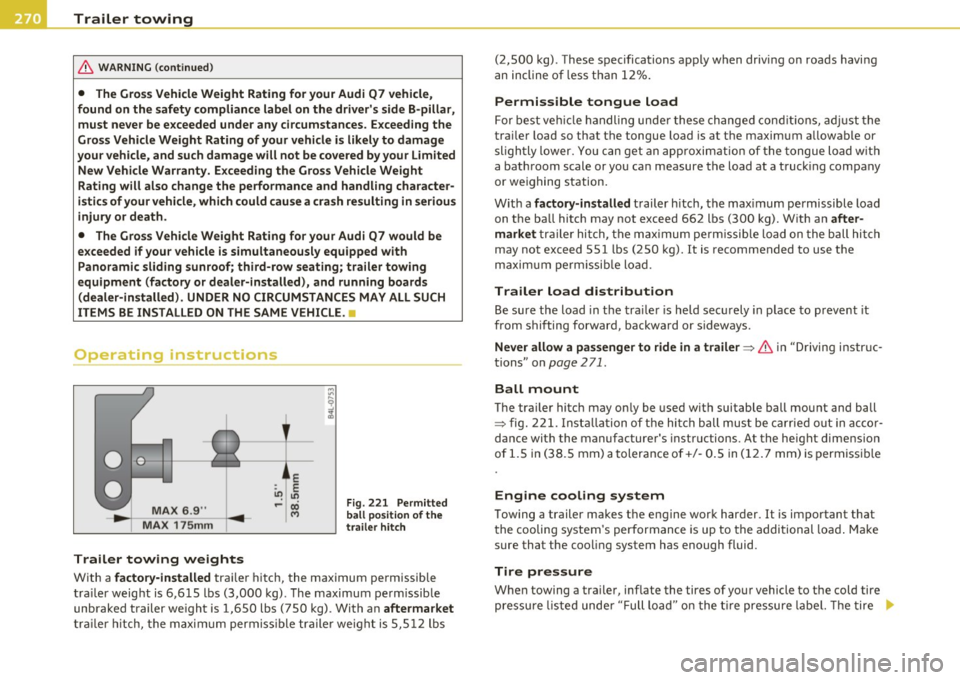
Fig. 221 Permitted
ball position of the
tra iler hit ch
With a factory -installed tra ile r hi tch, the maximum pe rmissib le
t ra iler weig ht is 6,615 lbs (3,000 kg). The maximum pe rmissib le
unbraked trailer we igh t is 1,650 lbs (750 kg) . With an
aftermarket
trail er hi tch, the m axi mum permissibl e traile r weig ht i s 5,5 12 lbs (2,500
kg) . These specifications app ly when driv ing on roads havi ng
an in cline o f less t han 12%.
Permissible tongue load
For best ve hicle handl ing un der t hese ch ange d co ndition s, adju st the
tra ile r l oad so that the tongue load is at the maxim um a llowab le or
sligh tly lower. You can get an app roxim atio n of the tongue load w it h
a bat hroom scale or you ca n measure the load at a t ruc king company
or we ighing st ation.
W it h a
factory-installed trailer h itch, the max imum pe rmissible load
on t he ba ll hitc h may not exceed 662 lbs (300 kg). W it h an
after
market
tra ile r hi tc h, t he ma ximum pe rm issi ble loa d on the b all hi tch
may not exceed 551 lbs (250 kg). It is recommended to use the
maxim um permi ssible loa d.
Trailer load distribution
Be su re the load in t he tra ile r i s held se curely in p lace to p revent it
from shi fting forward, backwa rd or sideways.
Never allow a passenger to ride in a trailer=> & in "Dr ivin g in struc
t ions" on
page 2 71.
Ball mount
The tra ile r hitch may on ly be used w ith suitable ball mount and ball
=> fi g. 221. I nstallat ion of the hi tch b all mus t be c arrie d out in acco r
dance with the manufacturer's instructions . At the height d imension
of 1. 5 in (38 .5 mm) a toler ance of+/- 0.5 in ( 12. 7 mm ) is per miss ible
Engine cooling system
Towing a trailer makes t he eng ine work harder. It is impo rtant that
t he cooling system 's performan ce is up to the addi tional loa d. Mak e
sure that the coo ling system has enough fluid .
Tire pressure
When towing a trailer, inf late the tires ofyourvehicle to the cold tire
pre ssure listed unde r "Full lo ad" on t he tire pre ssu re lab el. Th e tire ...
Page 274 of 390
Trailer towing
"---------------------------------------------------
in. WARNING
Anyone not properly restrained in a moving vehicle is at a much
greater risk in an a ccident . Never let an yone ride in y our car who i s
not prop erly wearing the re straints provided by Audi. •
Trailer towing tips
Important to know
Your vehicle handles differe ntly when tow ing a tra iler because of the
additiona l weight and different we ight distribution. Safety, perfor
man ce and economy w ill greatly depend on how ca refu lly yo u load
your trailer and operate your rig.
Be fore you actua lly tow your tra ile r, prac tice turning, stopp ing and
back ing u p in a n area away from traffic. Keep pract ic in g until you have
become completely familiar with the way your vehicle -trailer combi
nation behaves and responds .
Backing up is diff icult and requ ires pract ice. Backing up w ith a trailer
gene rally requires s teer ing a ction opposi te to th at when ba cki ng up
your vehicle witho ut a trailer.
Maintain a greate r d istance between your ve hicl e and the one in front
of yo u. You will need more room to stop . T o compensate fo r the
trai ler, you will need a larger than normal turning radius .
W hen p assing, remember that you c annot acceler ate as fast as yo u
normally wou ld because of the added load. Make sure yo u have
enoug h room to pass. After passi ng, allow plen ty of room fo r yo ur
tra iler before changing lanes again .
Avoid jerky starts, sharp turns or rapid lane changes .
[ i ] Tips
• Do not tow a trai ler d uring the brea k-in perio d of your vehicle. •
If you tow a tra iler, your Aud i may require more frequent mai nte
n an ce due to the ex tra load:::::>
page 366. •
Parking on a slope
Do not park on a slope with a trailer. If it cannot be
av oided, do so only after doing the following:
When parking:
- Apply the foot brak e.
- Have someone p lac e chocks un der bo th the vehicle and t he
traile r w he els .
- With c hoc ks i n place, slowly release the brakes u ntil the
wheel c hoc ks absorb t he load.
- Turn the w hee ls towards t he curb .
- A pply the parking brake.
- M ove th e selector le v er to
P.
When restarting after parking:
- A pply the foot brake .
- Start the engine .
- Mov e th e s elector lever to
D .
- Release the par king brake a nd s low ly pull o ut and away
fro m the w heel chocks.
- Stop a nd have someone retr ieve the w heel chocks .
(I) Tips
If you move the se lector lever of the a utomat ic t ransmiss ion to P
befo re applying t he par king br ake an d befo re blo cking the w heels, II-
Page 277 of 390
Cleaning and protection Ill
---------------=---------=----
Under certain circumsta nces, weekly was hing may be necessary .
Und er other c ond it ions, a monthl y w ashi ng and waxing m ay be
adequate.
After the winter, the unders ide of the vehicle s hou ld be t horoughly
w ashe d, p refe rably in a pr ofess ional ca r was h.
& WARNING
Always read and heed all WARNINGS and other information
~ page 274. •
Automatic car wash
The ve hicle ca n be w ashed in alm ost any mo dern auto
matic car w ash .
Th e ve hicl e p aint is so du ra ble th at t he vehicle c an nor mally be
washed w itho ut problems in an automatic car wash . H owever, the
effe ct on the pai nt de pend s to a large ex ten t on t he desig n of t he
facili ty, th e fil ter ing of the was h water, t he type of wash and care
material, etc . If t he pa int has a du ll appea rance a fter going throu gh
t he ca r wash o r is sc ratched, bri ng this to the a tte ntion of the ope r
ator immediately . If necessa ry, use a different car wash .
B efo re go ing throu gh a c ar wa sh, be sure to ta ke the us ual pr eca u
t ions such as clos ing the windows and the Panoramic s lid in g su nroof.
Fa ctor y in stall ed a ntenn as mu st not be re moved .
If you have ins talled addit ional accessories on the vehicle -su ch as
spoilers, roof rack, etc . - it is best to ask the car wash ope rato r if these
sho uld be removed.
& WARNING
Please take note of the following points before going through an
automatic car wash with your vehicle , so that you can avoid
damage to your vehicle.
Safety first
& WARNING (co ntinued )
• Compare the track of your vehicle with the distance between
the guide rails of the facility -there is a risk of damage to the
wheels and tires.
• Compare the height and width of your vehicle with the height
and width of the tunnel at the facility.
• Fold the exterior mirrors flat -there is a risk of damaging the
exterior mirrors . Power folding exterior mirrors* must not be
folded in or out by hand. Use the power function!
• Do not allow the wiper blade to fall onto the windshield after
the vehicle is dried · there is a risk of damaging the paint on the
hood .
• Always read and heed all WARNINGS and other information
~page 274. •
Washing the vehicle by hand
A lot of wat er is n eeded when washing a v ehicl e by hand.
- Before yo u sta rt wash ing , m ak e sure you have read and
u nd ers tood the WARN IN GS =>
& in "Gener al in forma
t io n" o n page
274.
- F ir s t soa k all dried dir t until it is soft, t hen rinse i t off.
- A s you cle an yo ur vehi cle, sta rt with the roof and work y our
way down to the bottom , us ing a sponge , a sp onge glove
or a cle an bru sh .
- Rin se the sp ong e or the sp o ng e glo ve often, flu shing it
cl ean each t im e.
- U se s pecia l car shampoo on ly for v ery pe rsiste nt dirt .
- R inse the car thoroug hly wi th wate r.
- U se a ch a m ois le ath er to gently w ipe t he ex ter ior dry. •
Vehicle care Technical data
Page 291 of 390

labeled ask the station operator what fuel is being dispensed befo re
fi lling up yo ur vehicle.
Service stations offering Diesel f uel are generally loca ted on truck
routes or major hig hways. Directo ries of Diese l fue l stations are
usually availab le at Diese l fuel stations.
Some states in t he USA require permits to purchase Diesel fuel. Check
w ith your State Mo tor Vehicle De partment.
Diesel fuel may not be available outs ide the USA and Canada. Be sure
to check before trave ling to othe r countries .
Winter operation
At t empe ratures below 20° F (- 7° C), Die sel fue l No . 2 l oses its flu idity
due to wax separation, wh ich may clog the fuel filter or tank fi lter and
keep the engine from running .
T o help t he filte r from be ing clogged by wax, the fue l fi lter in your
vehicle is automatically preheated. Preheat ing the fuel f ilter makes
operat io n of yo ur vehicle possib le with Die sel fuel No. 2 dow n to -
10° F (-24° C).
If you expect temperat ures below 5° F (-1S° C) ask yo ur fuel dealer
whether their Diesel fuel No . 2 is suffic iently w interized for the
prevailing and expected temperat ures.
If not winterized or insuff ic ie ntly w inte riz ed Diese l fuel has already
thickened to the extent that the engine w ill not start, warm the
vehicle up by leaving i t in a heated garage.
It is normal that the eng ine noise level (dieseling) is louder during the
warm-up period in winte r. It is also normal when whitish -blue smoke
comes out of t he tailpipe afte r start ing and du ring warm-up. The
amount of smoke depends on the outside temperature .
Do not let your Diesel engine idle unnecessa rily af ter a co ld start.
Dr iv ing off slow ly w ill shorten the warm-up per iod.
Safety first
Fuel supply and filling your fuel tank
& WARNING
• Never use "starting as sist flu ids ." Th ey may be potentially
explo sive or cause a "run-away " engine condition . Thi s could
re sult in s eriou s engine damage and per sonal injury .
• Never u se fuel line anti -freeze off ered fo r ga soline engine s.
0 Note
• Your D iesel eng ine has been spec ifically desig ned to ope rate on ly
on Ultra Low Sulfur Diesel fue l. Therefore, never use home heating o il
or reg ular gasoline . The properties of these fuels may cause serious
damage to the fuel injection system and to t he engine . Using these
fue ls can cause expens ive eng ine repairs and will also adversely affect
your New Vehicle Lim ited Wa rranty.
• If Diese l fuel shou ld get on any rubber hose, it must be wiped off
immediately. Then wash the contaminated hose port ion w ith soap
and warm water . Do not allow Diesel fue l to remain on connecting
hoses. They may deve lop leaks and cause se rious damage. •
Fuel tank
Fuel filler neck
The f ue l fi ller neck is located o n the rig ht rea r side panel behind t he
fue l filler flap.
If the power locking system shou ld fai l, you can st ill open the flap
ma nually- for deta iled instructions see:::::>
page 292.
You can find the fue l tank capacity of your veh icle in
Technical Data
:::::, page 3 63.
The label on the inside of t he fuel filler flap tells you the correct fuel
for your veh icle. For more informat ion about fuel specifications, see
:::::>
page 287 . _,,
Vehicle care Technical data
Page 348 of 390

lffll.,___F_ u_ s_e _ s_ a_n_ d_ b_u _ l_ b_ s _______________________________________________ _
Fuses and bulbs
Fuses
Replacing a fuse
A problem in the electrical system may be caused by a
blown fuse.
F ig . 2 57 Ins trum ent
pane l left: Face c over
Fig . 258 Instrument
p anel left : Content
Fac e co ver
- Locate the fuse which belongs to the component which
failed.
- Switch off the ignit ion and the electrical component
affected . - Carefu
lly pry the face cover off the instrument panel using
the ignit ion key or a screwdriver==> fig. 25 7.
- Re move the plast ic cl ip © from i ts re taine r in the face
cover=> fig. 2 58, place i t over t he ques tiona ble fuse and
remove t he f use .
- Rep lace a blown fuse (re cog niz able by the m elte d m etal
s tri p inside) wit h a fuse of the
same amp erag e.
T he ind ividu al c ircui ts are protec ted by fuses. The f use panels wi th
the fuses are located on the left and right front faces of the instru
ment pane l beh ind a cover and in t he righ t storage area in t he
luggage compartment .
Th ere is a plastic clip@ in the cover on the left side of the instrument
pane l, which ca n be used to remove the fuses . The crank @ is used for
eme rgency operat io n of the Pano ramic sliding s unroof *. You wi ll a lso
find a label o n both covers in the instrument panel w ith the fuse
layout © for the corresponding fuse panel.
& WARNING
Never replace a fuse with one that has a higher amperage rating.
• A fuse with a too high amperage could damage the electr ical
part and cau se a fire.
(D Note
• O n no account s houl d fuses be repaired (e .g. patched up with tin
foil o r wire) as th is may cause se rious damage elsewhe re in t he elec
trical circ uit or cause fire .
• If a fuse blows repeatedly, do not keep replacing i t. Instead, have
t he ca use o f the repeated short c ircu it or over load lo cate d an d fixed . .,_
Page 351 of 390

_______________________________________________ F_u .:..:s _e.:.... s:..._ a_ n_ d ___ b ;.:__:u.:..:l:.:..: b :..: s:...___,J-
No. I I Equipment Amps
10
Airbag
5
11 Heated rear seats
5
12 Air-conditioning
5
Fuse ho lder (re d)
1 Not used
Not used
Not used
4 MMI Display 5
5 Telephone, telematics, cell phone package
5
6 MMI, antenna amplifier 15
front light unit
7,5
7
Panoramic sliding sunroof segment 1 20
8 Panoramic sliding sunroof segment 2
20
Panoramic sliding sunroof sunblind 20
10 CD player, DVD drive
5
11 Window regulators (right side of vehicle)
35
12 Rear ai r-conditioning cont rols 10
•
Vehicle OP-eration
Fuse Location , Luggage Compartment
right
Fig. 261 Fuse panel
l ayo ut
Read numbers of the fuses in the luggage compartment starting
from right=> fig. 261.
No. Equipment
Fuse ho lder (black)
1 Not used
2 AdBlue heater
3 Ride height adjustment
4
6
Rear v iew camera
Parking system
Intelligent power module convenience 2 (right side of veh icle)
7
Jr Intelligent power module convenience 2 (left side of vehicle)
8
9
10 Not used
Luggage compartment electrical outlet
Intelligent power modu le convenience 1
(right side of veh icle)
Amps
30
15
5
5
15
15
20
20
-
Vehicle care Do-it-yourself service iTechnical data