air condition AUDI Q7 2010 Owner´s Manual
[x] Cancel search | Manufacturer: AUDI, Model Year: 2010, Model line: Q7, Model: AUDI Q7 2010Pages: 390, PDF Size: 93.04 MB
Page 233 of 390
Child Safety -
-------------------"'---
Child Safety
Important things to know
Introduction
The rear seat is generally the safest place in a collision.
The physical pr in ci ples o f wha t happens w hen yo ur vehicl e is in a crash
app ly a lso to children=>
page 201, "What happens to occupants not
wearing safety be lts?". But unlik e adu lts and teenagers, the ir
muscles and bones are not fully developed. In many respects c hildren
are at greate r risk of ser io us injury in cras hes than adults .
Because children 's bodies a re not f ully deve loped, they require
restraint systems especially designed fo r their size, weight, and body
st ruct ure. Many cou ntries and all states of t he Unite d States and
prov inces of Canada have laws req uiring the use of approved ch ild
restrain t sys tems for infan ts an d sm all ch ild ren .
I n a fronta l crash at a speed of 20 -35 mph (30-56 km/h) the forces
act ing o n a 13- pound (6 kg) infant w ill be more than 20 times the
we ight of the ch ild . This means the we ight of the child wo uld
suddenly be more than 260 po unds (120 kg). Unde r these conditions,
only a n app ropr iat e child restra int proper ly used can red uce the risk
of serious injury. Child restraints, like adult sa fety be lts, must be used
pro perl y to be effective. Use d imprope rly, they can i ncrease t he ris k
of serious injury in an accident.
C onsult the ch ild safety seat manufacturer's instr uctions in order to
be sure the seat is r ight for you r child's size=>
page 234, "Important
safety instructions fo r using child safety seats". P lease be s ure to
read and heed a ll of the important informa tion and WAR NINGS
about chi ld safety, Advanced Airbags, an d the installation of child
restra in ts in this chapte r.
There is a lot you need to know about the Advanced Airbags in your
vehicle and how t hey wo rk when inf ants and childre n in child
restra ints are on the front passenger seat. Beca use of t he large
Controls and equip
ment Safety first Vehicle operation
amou
nt of importa nt info rmation, we cannot repeat i t all he re. We
urge you to read the detailed information in th is owne r's man ua l
abou t airbags and t he Advanced A irbag Syste m in your vehicle and the
very important information abo ut transporting c hildren on the front
p assenger se at. P lea se be sure to heed the WARNIN GS - they a re
extremely important for your safety and the safety of your passe n
gers, especially infan ts and small ch il dre n.
& WARNING
• Accid ent statisti cs have shown that children are generally safer
in the rear seat area than in the front seating position. Always
re strain any child age 12 and under in the rear.
• All vehicle occupants and especially children must be
restrained properly when ever riding in a vehicle. An unre strained
or improperly restrained child could be injured by striking the
interior or by being ejected from the vehicle during a sudden
maneuver or impact. An unrestrained or improperly rest rained
child is also at greater risk of injury or death through contact with
an inflat ing airbag .
• A suitable child restraint properly installed and used at one of
the rear seating posi tions provides the highest degree of protec
tion for infants and small children in most accident situations.
& WARNING
Children on the front seat of any car even with Advanced Airbags
can be seriously injured or even killed when an airbag inflates. A
c hild in a rearward -facing child safety seat ins talled on the front
passenger seat will be seriously injured and can be killed if the
front airbag inflate s.
• The inflating airbag will hit the child safety seat or infant
c arrier with great force and will sma sh the child safety seat and
child aga inst the backrest, center armrest , or door . •
Vehicle care Do-it-yourself service Technical data
Page 254 of 390
Intelligent technology
'-----------------------------------------------
Intelligent technology
Notice about data recorded by
vehicle control modules
Your vehicle is not equipped with an Event Data Recorder (EDR),
installed by some manufacturers for the express purpose of
capturing data for retrieval after an accident or crash event. ED Rs are
sometimes called "crash recorders".
Some state laws restrict the retrieval or downloading of data stored
by ED Rs that were installed in a vehicle for the express purpose of
retrieving data after an accident or crash event without the owner's
consent.
Although your vehicle is not equipped with an EDR, it is equipped w ith
a number of electronic control modu les for various vehicle systems
such as, for example, engine function, emission control, as well as for
the airbags and safety belts.
T hese electronic contro l modules also record vehicle-re lated data
during normal vehicle operation for diagnostic and repair purposes .
Th e recording capacity of the e lectronic control modu les is limited to
data (no sound is recorded) and only a sma ll amount of data is actu
ally recorded over a very limited period of time and stored when a
system fault or other condition is sensed by a control unit. Some of
the data then stored may relate to vehicle speed, direction, braking
as well as restraint system use and performance in the event of a
crash or other condition. Stored data can only be read and down
loaded with special equipment.
Electronic Stabilization Program
(ESP)
General information
The ESP improves the vehicle stability.
Fig. 220 Center
console with ESP
switch
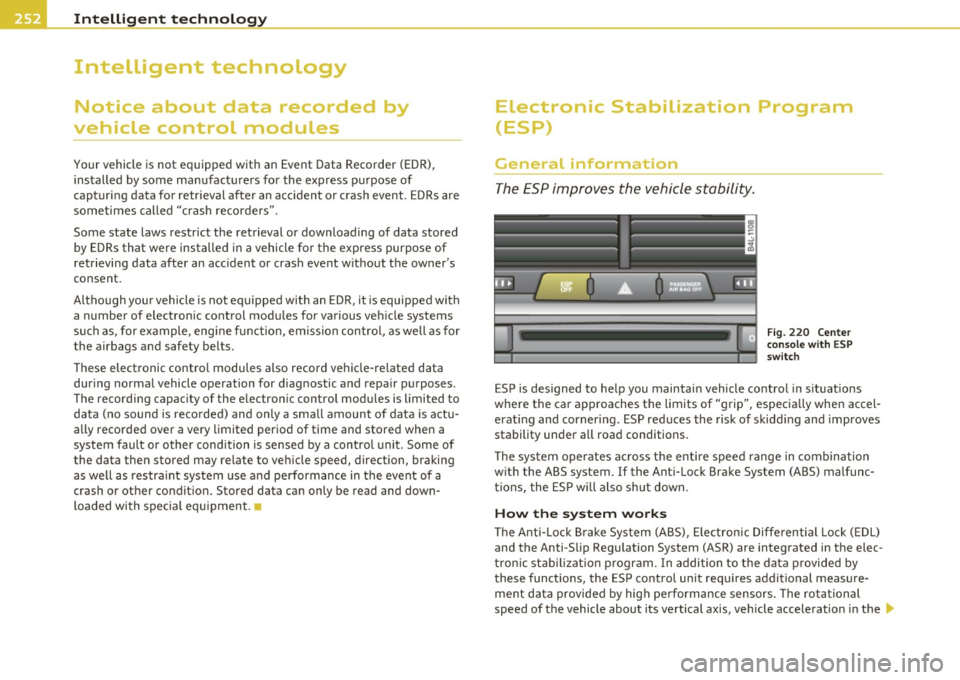
ESP is des igned to help you maintain vehicle control in situations
where the car approaches the limits of "grip", especia lly when accel
erat ing and cornering. ESP reduces the risk of skidd ing and imp roves
stability under all road conditions.
Th e system operates across the entire speed range in combination
with the ABS system. If the Anti-Lock Brake System (ABS) malfunc
tions, the ESP will also shut down.
How the system works
The Anti-Lock Brake System (ABS), Electronic Differential Lock (EDL)
and the Anti-Slip Regulation System (ASR) are integrated in the elec
tronic stabilization p rogram. In addition to the data provided by
these funct ions, the ESP control unit requires additional measure
ment data provided by high performance sensors. The rotational
speed of the vehicle about its vertical axis, veh icle acceleration in the ...
Page 258 of 390
lillill.a._...:I:..: n~ t .::.e::::..::.: ll~igent technology ,_ _______________________________________ _
in. WARNING
• You should perform braking maneuvers for the purpose of
cleaning the brake system only if road condition s permit. Other
road u sers must not b e put at r isk - you may cau se an ac cident!
• Before d esc ending a steep gr ade , redu ce speed and shift t ran s
mission into a lower gear or lower driving range. Do not ride the
brakes or hold the pedal down too long or too often . This could
c ause the brake s to get hot and diminish braking efficiency.
• Do not "ride the brakes " by re sting your foot on the pedal when
you do not intend to brake. Thi s may caus e the brakes to overheat ,
premature wear and increa sed stopping di stance.
• Under certain climatic and operating conditions such as
pas sing through water, driving in heavy rain or after washing the
vehicle, the effectiveness of the brake s can be reduced . In winter,
ice can accumulate on the brake pads , linings , disc s and drums .
Carefully apply brakes for a test. Brake s will dry and ice coatings
will be cleaned off after a few careful brake applications.
• Driving for an extended period of time on salt -cov ered roads
without using your brakes can al so affect braking efficiency. Clean
off accumulated salt coating from brake d iscs and pads with a few
careful brake applications.
• If you damage the front spoiler , or if you install a different
s poiler , be sure the air flow to the front brakes is not obstructed.
Otherwise the brake system could overheat reducing the effective
ness of the entire brake system.
• Failure of one brake circuit will impair the braking capability
resulting in an increased stopping distance. Avoid driving the
vehicle and have it towed to the nearest authorized Audi dealer or
qualified wo rkshop. •
Brake booster
The brake booster adds e xtra brakin g pow er .
The brake booster wor ks with vacuum pressure which is created on ly
w hen the en gine is ru nning =>& .
in. WARNING
• Never let the vehicle roll to a stop with the engine shut off .
• If the brake booster i s not working , for example when towing
your vehicle , or because the brake booster has somehow been
damaged , the b rake pedal must be p ressed considerably harder to
make up for the lack of booster assistan ce.
Functioning of Anti-Lock Brake System
(ABS)
AB S prevents the wheels from locking up under br aking.
T he ABS co ntribu tes effectively to vehicle co ntrol s ince it prevents t he
w hee ls from
locking when the b rakes are a pplied. This means t hat t he
veh icle rema ins steerable and is less likely to s kid .
W ith ABS you do not need to
pump the brake. Just hold the brake
pedal down .
However, do not expect the ABS to shorten braking distance u nder
all
circums tances. When driving on grave l or on newly fa llen snow on top
of icy su rfaces, braking dis tance may be even longer, therefore, under
these c irc umstances, it is especially important that you dr ive slowly
and w it h great care .
How the ABS system works
An automatic check is made when a speed of about 12 mph (20 km/h)
is reached . When this happens, a p umping noise can be hea rd. ._
Page 265 of 390
Driving and environment
------------------------------------------------'
- Lack of proper maintena nce as well as improper use of the
vehicle w ill imp air t he funct io n of t he emission con trol system and
could lead to damage.
<£> For the sake of the environment
Even when the Emiss ion Contro l System is operating properly, the
exhaust gas can have a sulfur-like exhaust gas sme ll under some
operat ing states. This depends on the s ulfur content of the fue l being
used. Using a differe nt brand of fuel may help, or filling the tank with
lead-free supe r grade gasoline. •
Applies to vehicles: w ith diesel eng ine
Diesel particulate filter
The d iese l part iculate filter fi lters nearly all of the soot particles out
of the exhaus t. T he filte r cleans i tself automa ticall y unde r no rm al
driving con dit io ns. If the f ilter cannot clea n itself (for example,
because yo u are on ly driving short dis tances), the f ilter becomes
clogged w it h soot and the symbo l for the diesel particulate fi lter
illuminates ~
page 35.
& WARNING
• Do not park your vehicle over flammable materials such as
grass or leaves because the high temperature of the diese l partic
ulate filter could start a fire .
• Do not apply an underbody protectant in the exhaust system
area or a fire could start .•
Controls and equip ment Safety first Vehicle operation
Avoid damaging the vehicle
Whe
n you are driving on poor roads, or over curbs, steep ramps, etc.,
m ake ce rtain that low-lying p art s s uch as spoilers and e xhaust system
parts do not bottom out and get damaged.
Thi s is espec ia lly t rue for vehicles with low-s lung chassis (sports
chass is) * and f ully loaded vehicles. •
Operate your vehicle economically
and minimize pollution
General
Your personal style of driving will det ermine the economy
of your vehicle, as well as exhaust and noise levels.
Fuel economy, env ironmenta l im pact , and wea r on your e ng ine,
brakes and tires largely depend on t hree factors:
• your person al driv in g style
• operating conditions
• techni cal lim itations
If you anticipate what you need to do next and drive economically,
you can e asily cut you r fu el consum ptio n by 10- 15 pe rcen t. T his
sect io n w ill give you some tips on how you can help the environment
and yo ur po cketbook.
rn Tips
Th e consumption est ima tes as published by E NVIRO NMEN TAL
PROT ECTION AGENCY ( EPA) and Transport Canada may not corre
spond to your act ual consumption on the roa d, which will vary
depend ing upon vehicle load and speed, road and weather co ndit ions,
trip length, etc.•
Vehicle care Do-it-yourself service Technical data
Page 269 of 390
• Driving off road
------------------------------------------------------'
vary. It is the driver's responsibility to decide whether a vehicle can
overcome a specific situation
=> &-
Gradient angle
The number of meters in altitude gained over a distance of 109 .4
yards or 100 meters (grade) are given as a percentage or degrees.
Information about the gradient the vehicle can climb under its own
power (depends in part on the road surface and engine power).
Maximum permitted grade: 31
°
Lateral angle (slope of vehicle)
Indicates the angle up to which the vehicl e can be driven diagonally
or across the fall line on a slope without the vehicle tipping over s ide
ways (depends on center of gravity). Maximum permitted late ral
angle: 35°
Breakover angle
Indicates the angle up to which the vehicle can dr ive over a ramp at
low speed without the underside of the vehicle hitting the edge of the
ramp.
• Vehicles without air springs: maximum breakove r angle: 21, 1 °
• Vehicles with adaptive air suspension*: maximum breakover
ang le: 19.1 ° (at normal leve l), 23.8° (at high level 2)
Approach /departure angle
Transition from the horizontal plane to a gradient or from a grade
back to level ground. Indicates the angle up to which the vehicle can
drive onto or off a slope at low speed without striking the bumper or
the underbody.
• Vehicles without air springs: maximum approach/departure
ang le: 21.9° (front), 23.4° (rear)
• Vehicles with adaptive air suspension*: maximum
approach/departure angle at normal level 20° (front), 21.9° (rear).
Maximum approach/departure angle at high level 2 (front) 24°,
(rea r) 25.4°
Controls and equip
ment Safety first Vehicle operation
Ground clearance
Th
e distance between the road surface and the lowest point of the
vehicle underbody.
• Vehicles without air springs: Ground clearance 8.1 in
(204 .8 mm)
• Vehicles with adaptive air suspension*: minimum ground clear
ance 7.1 in (179.8 mm) at normal level, maximum ground clearance
9.4 in (239.8 mm) at high level 2
_& WARNING
Exceeding the stated maximum figures can result in severe inju
ries or vehicle damage .
• All the information was gathered on level, firm and non-slip
pery road surfaces, and under dry weather conditions.
• Ideal conditions do not prevail offroad. Never utilize the
maximum readings to their fullest, always leave a safety
reserve. •
Driving tips
On poor road and off road, there is always only one
motto: Plan ahead and drive slowly!
Please observe the follow ing when driving away from paved
roads:
- Drive only on roads and offroad sections which match the
design of your veh icle and your abilities as a driver. Never
ta ke ris ks!
- Drive slowly and plan ahead!
- Take into consideration the
ground clearance of you r
vehicle.
Vehicle care Do-it-yourself service Technical data
Page 270 of 390

Driving off road
- Activate the ESP offroad mode=> page 252 as needed .
- Use the
hill descent control => page 253 when driving
down steep sections on hills.
Unpaved roads and offroad
Drive slowly on unfamiliar roads and unknown offroad sections, and
loo k out for unexpected obstacles (e .g. potho les, rocks, t ree st umps,
etc.).
T o prevent the vehicle from bo ttoming and avoid dam age to the
underbody, you should drive straight across severe bumps in the
gro und with on ly one s ide of the vehicle so tha t on ly two of your
wheels cross the bumps.
Drive brisk ly throug h sandy or marshy offroad sections and do not
stop, if at all poss ible.
Driving through water
Your vehicle ca n drive at maximum wal king speed thro ugh stand ing
water if the gro und is firm enough . The
maximum water depth is
1 9. 7 in o r 500 mm (ve hicles w it h out air spr ings) or 2 1.1 in or
535 mm (vehicles with Adaptive Air Suspension*, at high level 2).
Driving on a slope
If you ever find yourself not able to climb a slope, do not try to t urn
around, drive bac k dow n in
rever se . Ot herw ise, you run t he ris k of
tipping over .
If the vehicle threaten s to tip over when driving a cross a slope , you
must immediately steer downh ill in the direction of the slope .
Do not park your vehicle on steep slopes or gra des .
T o red uce the risk of tipp ing ove r, d rive on s lopes in t he di re ct io n of
the downward slope (fall line) -
not crosswise .
Driving on snow-covered ground
T he standard tires fitted to your vehicle are not snow ti res. So you
should mo unt wheels with snow t ires in good t ime where winter road
conditions prevail. Before driving on unp lowed stretches o f deep snow, install tire chains
. For tech nica l reasons, t ire chains may only
be ins talle d on the re a r wheels - never on the front whee ls.
& WARNING
After driving through water , mud, slush, etc. , the brake s may be
slow to take effect because of wet brake rotors and pads.
Dry the
brake s first by braking carefully to re store the full braking effe ct.
0 Note
Vehicle components such as the engine, trans mission, s uspension or
electrical system can be severely damaged by dr iv ing through water.
W Tips
• Check the dept h of the water before dr iv in g through it.
• Do not stop the vehicle, dr ive in reverse or sw itch the e ngine off
when driving through water .
• Keep in m ind th at on coming vehicles m ay cre ate w aves t hat ra ise
the water level and make it too deep for your vehicle to drive through
safe ly .
• Avoid dr iving through sa lt water because it ca n cause corrosion .•
Page 273 of 390

pressure label is located o n the dr iver's side B-pillar. Inflate trailer
t ires to tra ile r and t ire ma nufacturers' spec ifications.
Lights
T he headl ight settings shou ld be chec ked with the tr ailer attached
before driving off. Check to make sure both vehicle and trailer lights
are wo rking properly.
Safety chains
Be sure tra ile r safety cha ins are p roperly connected from the t rai ler
to the hitch on the vehicle. Leave enough slack in the chains to perm it
tu rning corners . When you install sa fe ty ch ains, ma ke sure they will
not drag on the road when you are driving.
T he chains should cross under the trai ler tongue to prevent it from
dropping in case of separation from the h itch .
0 Note
If you are goi ng to tow a trai ler , you must activate the trai ler opera
tion mode =>
page 180, "Towing a trailer". •
Driving instructior,s
Driving with a trailer always requires e xtra care and
consideration.
To obtain the best possib le handling of ve hicle a nd trailer ,
please note the following :
- Do not tow a loaded trailer when your car itself is not
loaded.
- Be especia lly careful when pass ing other vehicles .
- Observe speed limi ts.
- Do not drive at the maximum pe rmissible speed.
Controls and equip
ment Safety first Vehicle operation
- Always apply brakes early.
- Mo
nitor the temperature gauge.
Weight distri but ion
T owing a loaded trailer with an empty car results in a highly unstable
distribution of we ight . If t his cannot be avoided , drive at very low
speeds only to avoid the risk of losing steering control.
A "balanced" rig is easier to operate and control. This means that the
tow veh icle shou ld be loaded to the extent poss ible and permissib le,
wh ile keeping the tra ile r as lig ht as poss ible unde r the ci rc u mstances.
Whe never possible, transfer some cargo to the luggage compart
me nt o f the tow vehicle while observing tongue load requirements
and vehicle loading considerations.
Speed
The higher the speed, the more d ifficult it becomes for the driver to
control the r ig . Do not dr ive at the maxim um permiss ible speed .
Reduce your speed eve n more if load, weather or w ind conditions are
unfavorable -particular ly when going downhill.
Reduce vehicle speed
immed iately if the tra ile r shows the slightest
sign of swaying.
Do not tr y to stop the s wayi ng by a ccele rating .
Observe speed lim its. In some areas, speeds for veh icles towing
trailers are lowe r than for regular veh icles .
Always apply brakes early. When driving downhi ll, shift into a lower
gear to use the engine brak ing effect to slow t he ve hicle . Use of the
brakes alone can cause them to overheat and fa il.
Coolant temperatur e
The coo lant temperature gauge=> page 10 must be observed care
fu lly. If the needle moves close to the upper end of the sca le, reduce
speed immediately and/or turn off the air conditioner.
If the coo lant temperature warning light in the instrument clus ter
starts flash ing
- F- , pull off the road, stop and let the engine idle for
about two m inutes to prevent hea t buil d-up.
Vehicle care Do-it-yourself service Technical data
Page 276 of 390
-~_C_ le_ a_n_ i_ n_ g=- a_ n_d___. p_ ro_ t_e _c_ t_ i_o _n ___________________________________________ _
Cleaning and protection
General information
Regular care preserves vehicl e val ue.
Any automobile is exposed to industria l fumes, co rrosive road salt,
m ud dy dog fee t, e tc. A well c ared for Audi can look like new many
years after p urchase . Regular and correct care will contribute to
m aint aining the bea uty and val ue of your Audi.
Furthermore, good care may be a condition for substantiating a
warranty claim should corrosion damage or paint defects occur.
Y ou r au thor ized Audi d eale r h as a var iety of dedicated vehicle-care
products
and can advise w hich ones to use for clea ning the exterior
a n d inter io r of your ve hicle.
W het her you use products recommended by Aud i or o ther comme r
cia lly availab le cleaning agents , please ma ke sure yo u appl y them
co rrectly .
& WARNING
• Cleaning agents may be poisonous . Keep them out of the reach
of children.
• Heed all caution labels .
• Always read directions on the container before using any
product. Follow the directions carefully.
• Most chemical cleaners are concentrated and have to be
diluted .
• Use spot removing fluids only in well ventilated areas.
• Do not use gasoline, kero sene , diesel fuel , nail polish remover
or other volatile fluids . They may be toxic, flammable or
hazardous in other ways. Do not wash, wax or dry the vehicle with
the ignition on or the engine running.
& WARNING (co ntinued)
• Do not clean the under sides of chassi s, fenders , wheel covers,
etc. without protecting your hands and arms. You may cut your
self on sharp-edged metal parts.
• Moisture and ice on brakes may impair braking efficiency
~ page 255, "General information ". Test the brakes carefully
each time you wash the vehicle .
'£> For the sake of the environment
Select only envir onmenta lly fr iendly clea ning produc ts . Leftover
cleaning pro ducts sho uld not dis posed of i n the household waste .•
Care of exterior
Washing
F re qu ent w ashin g protec ts th e vehicl e.
T he best protection aga inst env ironmental influences is frequent
w ashi ng and w ax ing. How o ften t his is requ ired depen ds on:
• How m uch the vehicle is use d
• Whe re the ve hicle is parke d (gar age, in the o pen un der tr ees, e tc.)
• The seasona l and weather conditions
• E nviron mental influences
T he longer bi rd droppings , insects , tree resin, road and industria l
gr ime, t ar, soo t, road sa lt and o ther ma ter ia ls remain on the veh icle
body, the more lasti ng their destructive effects w ill be. H igh temper
atu res cause d by ex pos ure to intense s unlight int ensify the co rrosive
effect, part icu larly when humid ity is high as we ll.
~
Page 291 of 390

labeled ask the station operator what fuel is being dispensed befo re
fi lling up yo ur vehicle.
Service stations offering Diesel f uel are generally loca ted on truck
routes or major hig hways. Directo ries of Diese l fue l stations are
usually availab le at Diese l fuel stations.
Some states in t he USA require permits to purchase Diesel fuel. Check
w ith your State Mo tor Vehicle De partment.
Diesel fuel may not be available outs ide the USA and Canada. Be sure
to check before trave ling to othe r countries .
Winter operation
At t empe ratures below 20° F (- 7° C), Die sel fue l No . 2 l oses its flu idity
due to wax separation, wh ich may clog the fuel filter or tank fi lter and
keep the engine from running .
T o help t he filte r from be ing clogged by wax, the fue l fi lter in your
vehicle is automatically preheated. Preheat ing the fuel f ilter makes
operat io n of yo ur vehicle possib le with Die sel fuel No. 2 dow n to -
10° F (-24° C).
If you expect temperat ures below 5° F (-1S° C) ask yo ur fuel dealer
whether their Diesel fuel No . 2 is suffic iently w interized for the
prevailing and expected temperat ures.
If not winterized or insuff ic ie ntly w inte riz ed Diese l fuel has already
thickened to the extent that the engine w ill not start, warm the
vehicle up by leaving i t in a heated garage.
It is normal that the eng ine noise level (dieseling) is louder during the
warm-up period in winte r. It is also normal when whitish -blue smoke
comes out of t he tailpipe afte r start ing and du ring warm-up. The
amount of smoke depends on the outside temperature .
Do not let your Diesel engine idle unnecessa rily af ter a co ld start.
Dr iv ing off slow ly w ill shorten the warm-up per iod.
Safety first
Fuel supply and filling your fuel tank
& WARNING
• Never use "starting as sist flu ids ." Th ey may be potentially
explo sive or cause a "run-away " engine condition . Thi s could
re sult in s eriou s engine damage and per sonal injury .
• Never u se fuel line anti -freeze off ered fo r ga soline engine s.
0 Note
• Your D iesel eng ine has been spec ifically desig ned to ope rate on ly
on Ultra Low Sulfur Diesel fue l. Therefore, never use home heating o il
or reg ular gasoline . The properties of these fuels may cause serious
damage to the fuel injection system and to t he engine . Using these
fue ls can cause expens ive eng ine repairs and will also adversely affect
your New Vehicle Lim ited Wa rranty.
• If Diese l fuel shou ld get on any rubber hose, it must be wiped off
immediately. Then wash the contaminated hose port ion w ith soap
and warm water . Do not allow Diesel fue l to remain on connecting
hoses. They may deve lop leaks and cause se rious damage. •
Fuel tank
Fuel filler neck
The f ue l fi ller neck is located o n the rig ht rea r side panel behind t he
fue l filler flap.
If the power locking system shou ld fai l, you can st ill open the flap
ma nually- for deta iled instructions see:::::>
page 292.
You can find the fue l tank capacity of your veh icle in
Technical Data
:::::, page 3 63.
The label on the inside of t he fuel filler flap tells you the correct fuel
for your veh icle. For more informat ion about fuel specifications, see
:::::>
page 287 . _,,
Vehicle care Technical data
Page 301 of 390

________________________________________ ___:C=.: h:....:..:::: e~c ~k :..:.:in ~ g!....: a~ n~d ~ fi~l~li ~n ~gL __
& WARNING
Before you check anything in the engine compartment , always
read and heed all WARNINGS~
& in "Working in the engine
compartment " on
page 297. •
Engine oil
Engine oil specifications
The engin e oil used in your Audi needs the right kind of oil.
Th e e ng ine in your Aud i is a sophis ticated powerplant that was bui lt
to exacting spec ificat ions. This engine needs the r ight kind of engine
oil t hat meets spec ifi cat ions regarding qu ality a nd viscosity so t hat it
can run smooth ly and re liably. Choosing the right o il and changing oil
with in the time and mileage intervals pr in ted in your veh icle 's
Warranty
& Maintena nce book let matters a lot more today than it did
years ago . Audi has developed a specia l quality standard for engine oil
that w ill help assure that your veh icle's engine will get t he lubr ication
it needs fo r prope r operation.
M ode rn engine lubr ication has taken a quan tum leap in the last few
years. Many synthet ic oils available today provide better engine lubri
c at ion th at c an outlast tradit ional petro le u m-based o ils, making
them a smart choice for use throughout the life of your Aud i.
Whethe r you use synthetic or petroleum -based engine oi l, the o il th at
yo u use must confo rm to A ud i's o il quality sta ndard VW 502 00 (vehi
cles with gasoline engine) or VW 507 00 (vehicles with d iese l eng ine)
to he lp keep you r vehi cle's e ngine run ning smoothly and help p revent
the format ion of harmf ul deposits, somet imes called "sludge," that
over time can lea d to expens ive rep airs.
At the time of pr int ing, engine o ils avai lab le in the U .S . and Ca nada
t ha t meet the exacting spec ificat ions o f Audi o il standar d VW 502 0 0
(vehicles w it h gasoline eng ine) or VW 507 00 (vehicles w ith d iese l
eng ine) are synthetic engine oils . This does not mean, howeve r, that
Safety first
every synthetic engine oil w ill meet Audi o il standard VW 502 00
(vehicles wit h gasoline eng ine) or VW 507 00 (vehicles wi th di esel
engi ne). So a lways be sure that you use an approved oil.
T o help preve nt the format io n of harmfu l deposits use only oi l with
t he follow ing s peci fica tions p rin ted on the oil con tainer:
• Audi oil standard VW 502 00 (gasoline engine)
• Audi oil standard VW 507 00 (diesel engine)
Oil container labe ls may carry the specification s ingly or in comb ina
t ion wi th ot he r designa tions a nd o il quali ty stand ards.
Viscosity
Engine oils are g raded acco rding to the ir viscosity. The proper
vis cos ity gra de oi l for your engi ne depends o n clim actic or se ason al
conditions where you drive . You can use oil with a v iscosity grade of
SA E S W40 across a ll tempe rature ranges fo r norma l driv ing con di
tions .
However, if en gine oi l v iscosity grade SAE 5W 40 is not avai lab le, yo u
c an a lso use viscos ity grade SA E 5W-30 or SA E OW -40 as long as it
meets Audi o il quality standa rd VW 502 00 (vehicles w ith gasoline
engi ne) or VW 5 07 00 (vehicles w it h diese l engine) speci fications .
Beca use engine o il that meets the Aud i oil standard may not be avail
able everywhere when yo u nee d it, we strongly recommend t hat you
always carry w it h you an extra quart (liter) of o il that e xpress ly
conforms to the VW 502 00 (vehicles w ith gasoli ne engine) or VW
507 00 (vehicles w ith diesel engin e) specification, in case you have to
to p off t he oil while on the roa d.
Applies to vehicles with gasoline engine only: Only if th e leve l of the
oil is at or be low the minimum mark on the o il dipstick -and no oil
t ha t expressly conforms to Aud i oil st anda rd VW 5 02 00 specifica
tions is ava ilab le -may you top off w ith a high quality engine o il, pref
era bly syn the tic -b ase d, tha t mee ts AC EA A3 or A PI SM specificat ions,
bu t even the n, only in viscosi ty g rades SA E 5W- 40, SA E 5W-30, or
SAE OW -40. Howeve r, dur ing the entire time between o il change
in terva ls, never top off wi th m ore than a total of 0 .5 qt/ lite r engine
oil that does not conform to A udi oil spec ificat io n VW 502 00. ..,
Vehicle care Technical data