airbag AUDI Q7 2010 Owner´s Manual
[x] Cancel search | Manufacturer: AUDI, Model Year: 2010, Model line: Q7, Model: AUDI Q7 2010Pages: 390, PDF Size: 93.04 MB
Page 238 of 390
Ill Child Safety __ .,.___ ____________ _
& WARNING (continued )
-Always move the front passenger seat into the rearmost
position of the passenger seat's fore and aft adjustment range,
and as far away from the airbag as possible before installing
the child restraint.
- Always make sure that nothing prevents the front
pas senger' s seat from being moved to the rearmost position in
its fore and aft adjustment range.
- Always make sure that the backrest i s in the upright pos i
tion.
• Always buckle the child safety seat firmly in place even if a
child i s not sitting in it. A loo se child safety seat can fly around
during a sudden stop or in a collision .
• Always read and heed all WARNINGS whenever using a child
restrained in a vehicle is being used=>
page 199, "Safety belts",
=>
page 209 , "Airbag system " and => page 231, "Child Safety ".
& WARNING
To reduce the risk of seriou s injury, make sure that the
PASSENGER AIR BAG OFF light comes on and stays on whenever a
child restraint is installed on the front passenger seat and the
ign ition is switched on.
• Take the child re straint off the front pa ssenger seat and install
it prope rly at one of the rear seat positions if the PASSENGER AIR
BAG OFF light does not stay on.
• Have the airbag system inspected by your authorized Audi
dealer immediately .
& WARNING
A child in a child restraint installed with the LATCH lower anchor
ages or with the standard safety belt on the rear seat may play
& WARNING (cont inued )
with unused rear seat safety belts and become entangled
re sulting in serious personal injury and even death.
• Always buc kle unused rear se at safety belts out of reach of chil
dren in child seats and p roperly activate the convertible locking
retractor so that the child cannot unreel the safety belt from the
retractor. •
Child safety seats
Infant seats
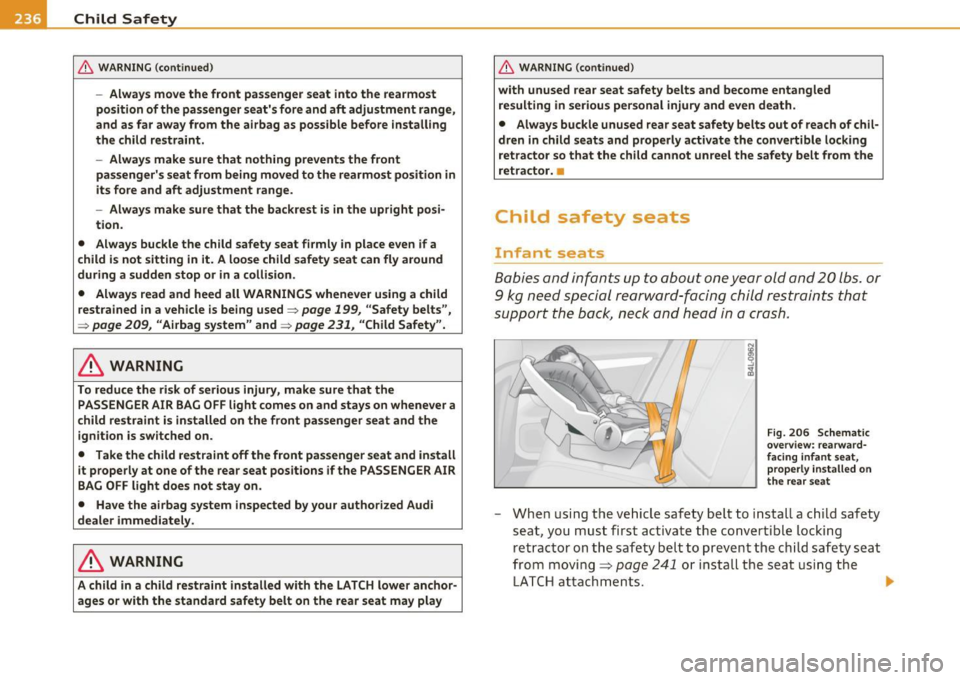
Babi es an d infants up to about one year old and 20 lbs. or
9 k g n eed sp ecial r earward -facing child res traints tha t
suppor t the back, neck and head in a cras h.
Fig. 206 Schemati c
ove rview : re arwa rd
facing infan t seat ,
prope rly installed o n
t he rear s eat
- W hen usi ng the ve hicle safety bel t to i nstall a c hild safety
seat, you must first activa te the co nvert ible locki ng
ret ractor on the safety belt to preven t the child sa fety seat
fro m mo ving=>
page 241 or install the seat usi ng the
L ATCH attach ments. ..,_
Page 239 of 390
-Push the child safety seat down with your full weight to
get the safety belt really tight so that the seat cannot
move forward or sideways more than one inch (2.5 cm).
Infants up to about one year (20 lbs. or 9 kg) are best protected in
special infant carriers and chi ld safety seats designed for t heir age
group. Many experts believe that infants and small childr en should
r ide only in spec ia l restra ints in w hich the child faces the back of the
vehicle. These infant seats support the baby's back, neck and head in
a crash=> fig. 206.
The airbag on the passenger side makes the front seat a potentially
dangerous place for a child to ride. The front seat is not the safest
place for a ch ild in a forward-facing child seat.
It is a very dangerous
place for an infant or a large r child in a rear ward-fac ing seat.
& WARNING
Not using a child safety seat, using the wrong child safety seat or
improperly installing a child restraint increases the risk of serious
personal injury and death in a crash.
• Never install rear-facing child safety seats or infant carriers on
the front passenger seat· even with an Advanced Airbag System.
A child will be seriously injured and can be killed when the
inflating airbag hits the child safety seat or infant carrier with
great force and smashes the child safety seat and child against the
backrest, center armrest, door or roof=>
page 211, "Child
restraints on the front seat -some important things to know".
• Always install rear-facing child safety seats or infant carriers
on the rear seat.
• Never install a rear-facing child rest raint in the forward-facing
direction. Such restraints are designed for the special needs of
infants and very small children and cannot protect them properly
if the seat is forward-facing.
• If you must install a rearward facing child safety seat on the
front passenger seat because of exceptional circumstances and
the PASSENGER AIR BAG
OFF light does not come on and stay on,
Safety
first Vehicle OP-eration
Child Safety
& WARNING (continued)
immediately install the rear-facing child safety seat in a rear
seating position and have the airbag system inspected by your
Audi dealer.
• Always read and heed all WARNINGS whenever using a child
restrained in a vehicle is being used=>
page 199, "Safety belts",
=>
page 209, "Airbag system" and => page 231, "Important
things to know ".•
Convertible child safety seat:s
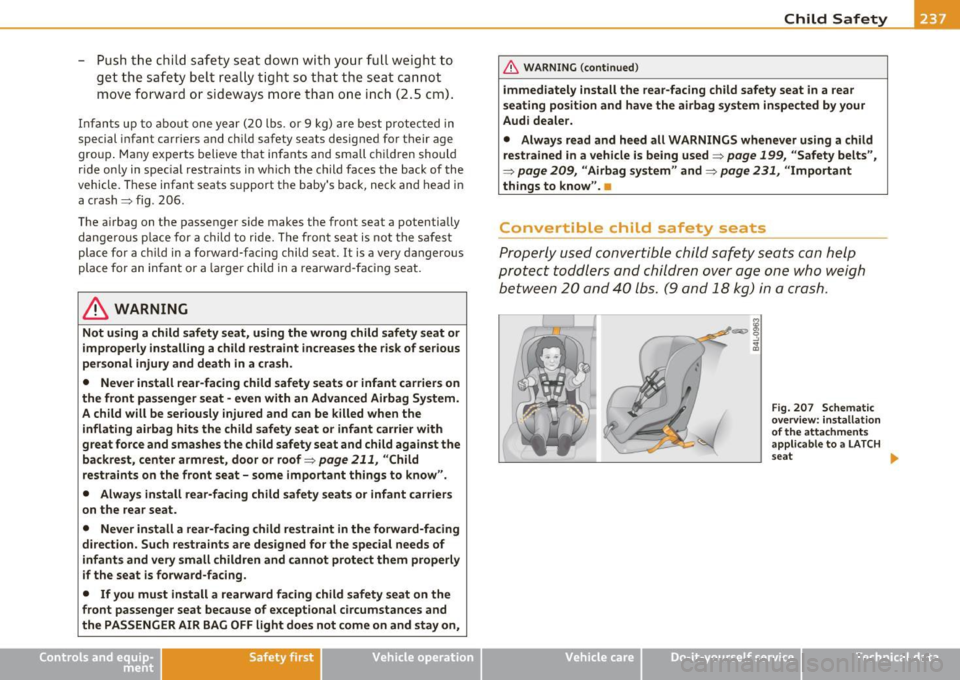
Properly used convertible child safety seats can help
protect toddlers and children over age one who weigh
b etween 20 and 40 lbs. (9 and 18 kg) in a crash.
Vehicle care
Fig . 207 Schematic
overview: installation
of the attachments
applicable to a LATCH
seat
ti,
Do-it-yourselt service iTechnical data
Page 240 of 390
___ C_h _i_ld _ S_ a_ f_ e_ t_,, y'-----------------------------------------------
Fig. 208 Schematic
overview: installation
of the seat using the
vehicle's safety belt
system
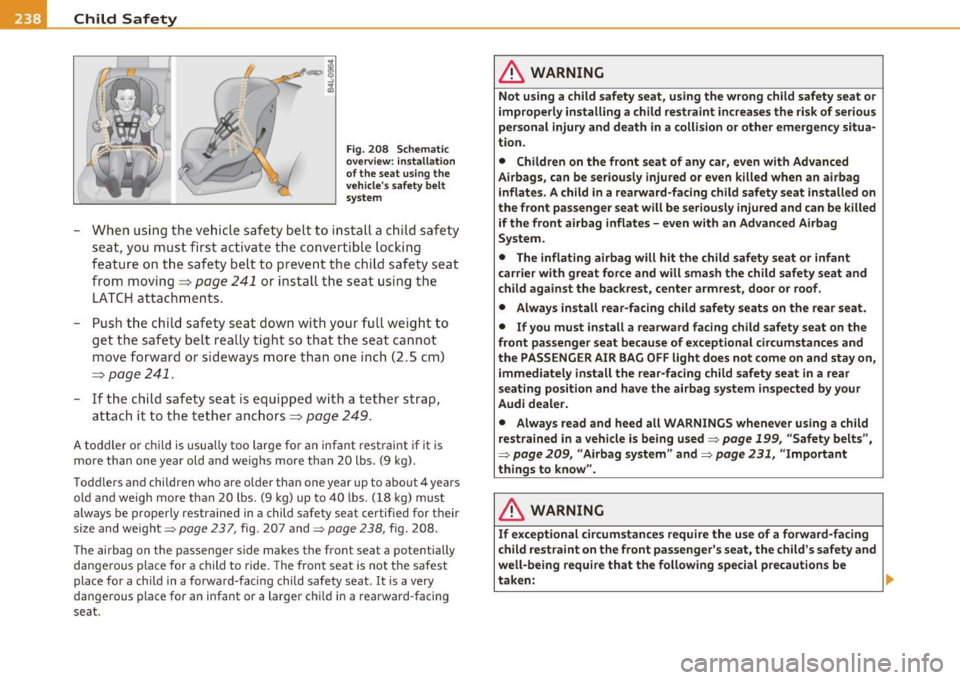
- When using the vehicle safety belt to install a child safety
seat, you must first activate the convertible locking
feature on the safety belt to prevent the child safety seat
from moving~
page 241 or install the seat using the
LATCH attachments.
- Push the child safety seat down with your full weight to get the safety belt really tight so that the seat cannot
move forward or sideways more than one inch
(2.5 cm)
=>
page 241.
- If the child safety seat is equipped with a tether strap, attach it to the tether anchors=>
page 249.
A toddler or child is usually too large for an infant restraint if it is
more than one year old and weighs more than 20 lbs . (9 kg) .
Toddlers and children who are older than one year up to about 4 years old and weigh more than 20 lbs. (9 kg) up to 40 lbs. (18 kg) must
always be properly restrained in a child safety seat certified for their
size and weight~
page 237, fig. 207 and~ page 238 , fig. 208.
The airbag on the passenger side makes the front seat a poten tially
dangerous place for a child to ride. The front seat is not the safest
place for a child in a forward-facing child safety seat . It is a very
dangerous place for an infant or a larger child in a rearward-facing
seat .
& WARNING
Not using a child safety seat, using the wrong child safety seat or
improperly installing a child restraint increases the risk of serious
personal injury and death in a collision or other emergency situa
tion.
• Children on the front seat of any car, even with Advanced
Airbags, can be seriously injured or even killed when an airbag
inflates. A child in a rearward-facing child safety seat installed on
the front passenger seat will be seriously injured and can be killed
if the front airbag inflates -even with an Advanced Airbag
System.
• The inflating airbag will hit the child safety seat or infant
carrier with great force and will smash the child safety seat and
child against the backrest, center armrest, door or roof.
• Always install rear-facing child safety seats on the rear seat.
• If you must install a rearward facing child safety seat on the
front passenger seat because of exceptional circumstances and
the PASSENGER AIR BAG OFF light does not come on and stay on,
immediately install the rear-facing child safety seat in a rear
seating position and have the airbag system inspected by your
Audi dealer.
• Always read and heed all WARNINGS whenever using a child
restrained
in a vehicle is being used ~ page 199, "Safety belts",
~ page 209, "Airbag system" and ~ page 231, "Important
things to know".
& WARNING
If exceptional circumstances require the use of a forward-facing
child restraint on the front passenger's seat, the child's safety and
well-being require that the following special precautions be
taken:
11'-
Page 241 of 390
& WARNING (continued)
• Make sure the forward-facing seat has been designed and certi·
fied by its manufacturer for use
on a front seat with a passenger
front and side airbag.
• Always follow the manufacturer's instructions provided with
the child safety seat or infant carrier.
• Always move the front passenger seat into the rearmost posi
tion of the passenger seat's fore and aft adjustment range, and as
far away from the airbag as possible before installing the child
restraint.
• Always make sure that nothing prevents the front passenger's
seat from being moved to the rearmost position in its fore and aft
adjustment range.
• Always make sure the backrest is in an
upright position.
• Make sure that the PASSENGER AIR BAG
OFF light comes on
and stays on all the time whenever the ignition is switched
on.
• If the light does not stay on, perform the checks => page 220,
"Monitoring the Advanced Airbag System".
• Take the child restraint off the front passenger seat and install
it properly at one of the rear seat positions if the PASSENGER AIR
BAG
OFF light does not stay on whenever the ignition is switched
on. a
Safety first Vehicle OP-eration
Child Safety
Booster seats and safety belts
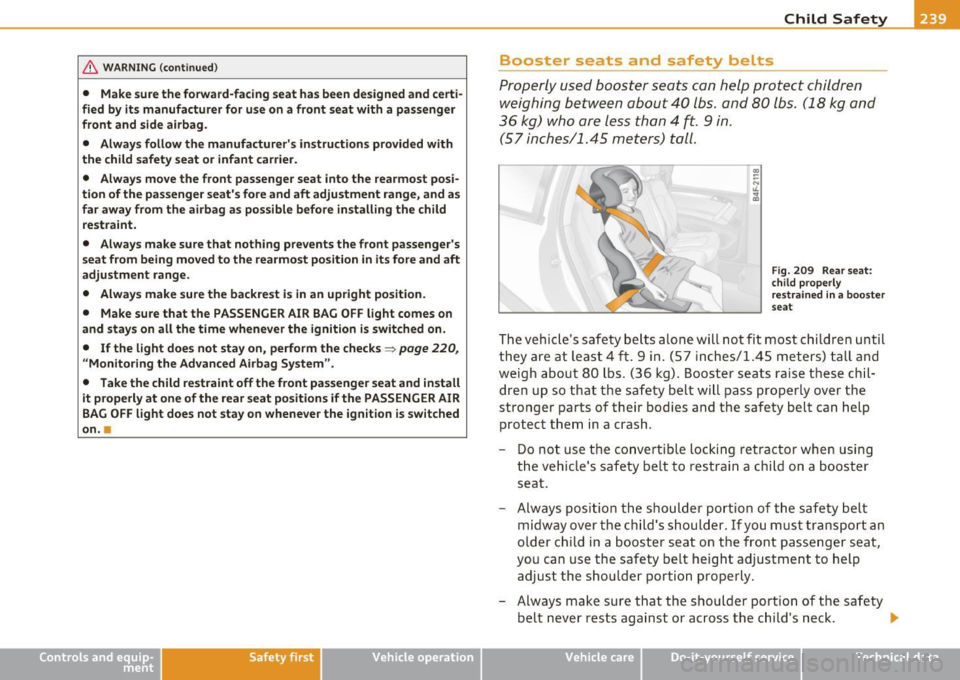
Properly used booster seats can help protect children
weighing between about 40 lbs. and 80 lbs. (18 kg and
36 kg) who are less than 4 ft.
9 in.
(57 inches/1.45 meters) tall .
Fig. 209 Rear seat:
child properly
restrained in a booster
seat
The vehicle's safety belts alone will not fit most children until
they are at least 4 ft. 9 in. (57 inches/1.45 meters) tall and
weigh about 80 lbs. (36 kg). Booster seats raise these chil
dren up so that the safety belt will pass properly over the
stronger parts of their bodies and the safety belt can help
protect them in a crash.
- Do not use the convertible locking retractor when using
the vehicle's safety belt to restrain a child on a booster
seat.
- Always position the shoulder portion of the safety belt
midway over the child's shoulder. If you must transport an
older child in a booster seat on the front passenger seat,
you can use the safety belt height adjustment to help
adjust the shoulder portion prop erly.
- Always make sure that the shoulder portion of the safety
belt never rests against or across the child's neck.
9'>
Vehicle care Do-it-yourselt service iTechnical data
Page 242 of 390
• .___C_ h_ il_d _ S_a _ f_ e _ t--= y '------------------------------------------------
- Always make sure that the child can properly wear the lap
portion of the belt low across the thighs or pelvis and
never over the stomach or abdomen.
Children up to at least 8 years old (over 40 lbs. or 18 kg) are best
protected in child safety seats designed for their age and we ight.
Experts say that the skeletal structure, particularly the pelvis, of
these children is not fully developed , and they must not use the
vehicle safety belts without a suitable child restraint .
It is usually best to put these children in appropriate booster seats.
Be sure the booster seat meets all appl icable safety standards.
Booster seats raise the seating position of the child and reposition
both the lap and shoulder parts of the safety belt so that they pass
across the child's body in the right places. The routing of the belt over
the child's body is very important for the child's protection, whether
or not a booster seat is used . Children age 12 and under must always
ride in the rear seat.
Chi ldren who are at least 4 ft. 9 in . (57 inches/1.45 meters) tall can
generally use the vehi cle's three point lap and shoulder belts. Never
use the lap belt portion of the vehicle's safety belt alone to restra in
any child, regardless of how big the child is. Always remember that
children do not have the pronounced pelvic structure required for the
proper function of lap belt portion of the vehicle 's three point lap and
shoulder belts . The chi ld's safety absolutely requires that a lap belt
portion of the safety belt be fastened snugly and as low as possible
around the pelvis . Never let the lap belt portion of the safety belt
pass over the child's stomach or abdomen.
In a crash , airbags must inflate within a blink of an eye and with
cons iderable force . In order to do its job, the airbag needs room to
inflate so that it will be there to protect the occupa nt as the occupant
moves forward into the a irbag .
A vehicle occupant who is out of position and too close to the airbag
ge ts in the way of an inflat ing airbag . When an occupant is too close,
he or she will be struck violently and will receive serious or possibly
even fatal injury. In order
for the airbag to offer protection, it is important t hat all
vehicle occupants, especially any children, who must be in the front
seat because of exceptional c ircumstances, be properly restrained
and as far away from the airbag as possible. By keeping room
between the child's body and the front of the passenger compart
ment, the airbag can inflate completely and provide supplemental
protection in certain frontal collisions.
& WARNING
Not using a booster seat, using the booster seat improperly, incor
rectly installing a booster seat or using the vehicle safety belt
improperly increases the risk of serious personal injury and death
in a collision or other emergency situation. To help reduce the risk
of serious personal injury and/or death:
• Always make sure to position the shoulder portion of the three
point belt over the middle of child's shoulder.
• Never let the shoulder portion of the belt rest against or across
the neck, face, chin, or throat of the child.
• Always make sure the lap belt portion of the three-point belt is
worn snug and passes as low as possible across the child's pelvis.
Never let the belt pass over the soft abdomen.
• Failure to properly route safety belts over a child's body will
cause severe injuries in an accident or other emergency situation
~ page 199.
• The rear side of the booster seat should be positioned as close
as possible to the backrest on the vehicle seat.
• Children on the front seat of any car, even with Advanced
Airbags, can be seriously injured or even killed when an airbag
inflates.
• Never let a child stand or kneel on any seat, for example the
front seat.
• Never let a child ride in the cargo area of your vehicle.
• Always remember that a child leaning forward, sitting side
ways or out of position in any way during an accident can be struck ._
Page 243 of 390
_____________________________________________ C _h_i_ld _ S_ a_ f_ e_ t__. y'--- __
& WA RNING (c on tinued )
by a deploying airbag . This will result in se rious personal injury or
death.
• If you must install a booste r seat on the front passenger seat
because of exceptional cir cumstance s the PASSENGER AIR BAG
OF F light must come on and stay on , whenever the ign ition is
s wit ched on .
• If the PASSENGER
AIR BAG OFF light does not come on and
stay on, perform the checks described => page 220, " Monitoring
the Advanced Airbag System".
• Take the child re straint off the front passenger seat and install
it prope rly at one of the rear seat positions if the PASSENGER AIR
BAG OFF light does not stay on whenever the ignition i s sw itched
on.
• Always read and heed all WARNINGS whenever u sing a child
restrained in a vehicle is being used=>
page 199 , "Safety belts",
=> page 209, "Airbag sy ste m " and => page 231, "Important
things to know ".•
Installing a child safety seat
Securing a child safety seat using a safety
belt
S afet y belts f or t he rear se ats a nd the fr ont pa ssenger
can be l ocke d wit h the co nverti ble lockin g retract or to
p ro p erly sec ure chi ld safety seats .
The safety be lts emergency lo ck ing retractors for the rear seats
safety belts and fo r the fron t passe nger's seat safety belt have a
convertib le locking retractor for child restraints . The safety be lt must
be locked so that belt webbing cannot u nreel. The retractor can be
activated to lock the safety be lt and prevent the safety belt webbing
from loose ning up du ring normal dr iv ing. A child safety seat can only
Controls and equip ment Safety first Vehicle operation be properly
installed when the safety belt is locked so that the child
and child s afety se at will s tay in place.
Always remember: Even though yo ur vehicle is equipped w ith a n
Advanced Airbag system, all chi ldren, especia lly those 12 yea rs and
younger, should a lways ride in th e back sea t pro perly res train ed fo r
their age and size .
& WARNING
Improperly installed child safety seats increase the risk of serious
personal injury and death in a collision.
• Always make sure that the safety belt retractor is locked when
installing a child safety seat . An unlocked safety belt retractor
cannot hold the child safety seat in place during normal driving o r
in a crash.
• Always buckle the child safety seat firmly in place even if a
child is not sitting in it . A loose child safety seat can fly around
during a sudden stop or in a collision.
• Always make sure that the rear seat backrest to which the
center rear safety belt is attached is securely latched whenever the
rear center safety belt is being used to secure a child restraint .
• If the backrest is not securely latched, the child and the child
restraint will be thrown forward together with the backrest and
will strike parts of the vehicle interior. The child can be seriously
injured or killed.
• Never install rear -facing child safety seat s or infant carrier s on
the front passenger seat . A child will be seriously injured and can
be killed when the pa ssenger airbag inflates.
• The inflating airbag will hit the child safety seat or infant
carrier with great force and will sma sh the child safety seat and
child against the backrest, center armrest, door or roof .
• Always in stall rear-facing child safety seats or infant carrier s
on the rear seat. _,.
Vehicle care Do-it-yourself service Technical data
Page 244 of 390
-L-___::C~h...:.: i:.:: l .:::d ~S:::.::: a..:..f .::. e ..::tY L- ___________________________________________ _
& WARNING (continued)
• Forward-facing child safety seats or infant carriers installed on
the front passenger's seat may interfere with the deployment of
the airbag and cause serious injury to the child.
• It is safer to install a forward-facing child safety seat on the
rear seat.
• Always read and heed all WARNINGS whenever using a child
restrained in a vehicle is being used~
page 231. Special precau
tions apply when installing a child safety seat on the front
passenger seat~
page 211, "Child restraints on the front seat -
some important things to know".
& WARNING
Always take special precautions if you must install a forward or rearward-facing child restraint on the front passenger's seat in
exceptional situations:
• Whenever a forward or rearward-facing child restraint is
installed on the front passenger seat, the PASSENGER AIR BAG
OFF light must come on and stay on whenever the ignition is
switched on.
• If the PASSENGER AIR BAG OFF light does not come on and
stay on, perform the checks described~
page 220, "Monitoring
the Advanced Airbag System".
• Take the child restraint off the front passenger seat and install
it properly at one of the rear seat positions if the PASSENGER AIR
BAG OFF light does not stay on whenever the ignition is switched
on.
• Improper installation of child restraints can reduce their effec
tiveness or even prevent them from providing any protection.
• An improperly installed child restraint can interfere with the
airbag as it deploys and seriously injure or even kill the child.
• Always carefully follow the manufacturer 's instructions
provided with the child safety seat or carrier.
& WARNING (continued)
• Never place additional items on the seat that can increase the
total weight registered by the weight-sensing mat and can cause injury in a crash.
& WARNING
Forward-facing child restraints:
• Always make sure the forward-facing seat has been designed
and certified by its manufacturer for use on a front seat with a
passenger front and side airbag.
• Never put the forward-facing child restraint up, against or very
near the instrument panel.
• Always move the passenger seat into its rearmost position in
the seat's fore and aft adjustment range, as far away from the
airbag as possible before installing the forward-facing child
restraint. The backrest must be adjusted to an upright position.
• Make sure that the PASSENGER AIR BAG OFF light comes on
and stays on all the time whenever the ignition is switched on.
& WARNING
Rearward-facing child restraints:
• A child in a rearward-facing child safety seat installed on the
front passenger seat will be seriously injured and can be killed if
the front airbag inflates - even with an Advanced Airbag System.
• The inflating airbag will hit the child safety seat or infant
carrier with great force and will smash the child safety seat and
child against the backrest, center armrest, door or roof.
• Always be especially careful if you must install a rearward
facing child safety seat on the front passenger seat in exceptional
circumstances.
• A tight tether strap on a rearward-facing child restraint
attached to the front passenger seat can put too much pressure on .,
Page 245 of 390
_____________________________________________ C _h_i_ld _ S_ a_ f_ e_ t ... Y'--- __
& WARNING (continued)
the weight-mat in the seat and register a heavier weight in the
Advanced Airbag System. The heavier weight registered can make
the system work as though an adult were on the seat and deploy
the Advanced Airbag when it must be suppressed causing serious
or even fatal injury to the child.
• Make sure that the PASSENGER AIR BAG OFF light comes on
and stays on all the time whenever the ignition is switched on.
• If the PASSENGER AIR BAG OFF light does not come on and
stay on, immediately install the rear-facing child safety seat in a
rear seating position and have the airbag system inspected by
your Audi dealer. •
Activating the convertible locking retractor
Use the convertible locking retractor to secure a child
restraint.
Always heed the child safety seat manufacturer 's instruc
tions when installing a child restraint in your vehicle. To acti
vate the convertible locking retractor:
- Place the child restraint on a seat, preferably on the rear
seat .
- Slowly pull the belt
all the way out.
- Route it around or through the child restraint belt path
=>& .
- Push the child safety seat down with your full weight to
get the safety belt really tight.
- Insert the belt tongue into the buckle for that seating
position.
Controls and equip ment Safety first Vehicle operation
-
Guide the safety belt back into the retractor until the belt
lies flat and snug on the child safety seat.
- You should hear a "clicking" noise as the belt winds back into the inertia reel. Test the convertible lock ing retractor
by pulling on the belt. You should no longer be able to pull
the belt out of the retractor. The convertible lock ing
retractor is now activated.
- Make sure that the red release button is facing away from the child restraint so that it can be unbuckled quickly .
- Pull on the belt to make sure the safety belt is properly tight and fastened so that the seat cannot move forward
or sideways more than one inch (2 .5 cm) .
& WARNING
Using the wrong child restraint or an improperly installed child
restraint can cause serious personal injury or death in a crash.
• Always make sure that the safety belt retractor is locked when
installing a child safety seat. An unlocked safety belt retractor
cannot hold the child safety seat in place during normal driving or
in a crash.
• Always buckle the child safety seat firmly in place even if a
child is not sitting in it. A loose child safety seat can fly around
during a sudden stop or in a crash.
• Always make sure the seat backrest to which the child restraint
is installed is in an upright position and securely latched into place
and cannot fold forward. Otherwise, the seat back with the child
safety seat attached to it could fly forward in the event of an acci
dent or other emergency situation.
• Always read and heed all WARNINGS whenever using a child
restrained in a vehicle is being used=>
page 231. Special precau-
tions apply when installing a child safety seat on the front
lill-
Vehicle care Do-it-yourself service Technical data
Page 251 of 390
Tether anchors and tether straps
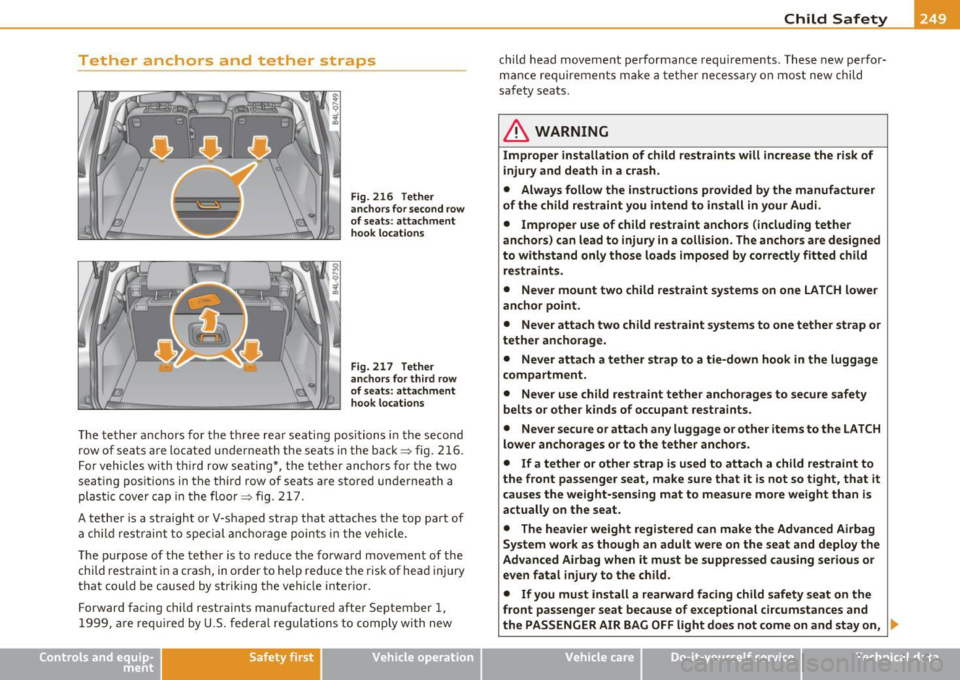
Fig. 216 Tether
anc hors fo r second row
of seats: attachment
h ook location s
Fig . 217 T ether
anch ors for third row
of seats: a tt ac hment
h ook location s
The tether anchors for the three rea r seating positions i n the s econd
row of seats are located u nderneath the seats in the back~ fig. 216.
For vehicles wi th t hir d row seating *, th e tet her anchors for the two
seating pos it io ns in th e third row of seats are stored un derneath a
p lastic co ve r cap in th e floor~ fig. 217 .
A tethe r is a straight o r V-shaped strap that attaches the top part of
a child restra int to special anch o rage points in t he vehicle .
Th e purpose of the te the r is to reduc e the fo rwa rd movemen t of t he
child rest raint in a cras h, in order to help reduce the risk of head injury
th at could be c au se d by striki ng the ve hicle in ter ior.
Forward facing child restraints man ufactured after September 1,
1 99 9, ar e re quir ed b y U.S. feder al regulat ions to co mply wi th new
Safety first Vehicle OP-eration
Child Safety
child head movem ent performance requ ireme nts . These new per for
ma nce re quiremen ts mak e a t eth er nece ssary on m ost new child
sa fety s eats .
& WARNING
Improper installation of child restraints will increase the risk of
injury and death in a crash.
• Always follow the instructions provided by the manufactu rer
of the child restraint you intend to install in your Audi.
• Improper use of child restraint anchors (including tether
anchors) can lead to injury in a collision . The anchors are designed
to withstand only those loads imposed by correctly fitted child
restraints.
• Never mount two child restraint systems on one LATCH lower
anchor point.
• Never attach two child restraint systems to one tether strap or
tether anchorage .
• Never attach a tether strap to a tie-down hook
in the luggage
compartment.
• Never use child restraint tether anchorages to secure safety
belts or other kinds of occupant restraints .
• Never secure or attach any luggage or other items to the LATCH
lower anchorages or to the tether anchors.
• If a tether or other strap is used to attach a child restraint to
the front passenger seat, make sure that it is not so tight, that it
causes the weight-sensing mat to measure more weight than is
actually on the seat.
• The heavier weight regi stered can make the Advanced Airbag
System work as though an adult were on the seat and deploy the
Advanced Airbag when it must be suppressed causing serious or
even fatal injury to the child.
• If you must install a rearward facing child safety seat on the
front passenger seat because of exceptional circumstances and
the PASSENGER AIR BAG
OFF light does not come on and stay on, ..
Vehicle care Do-it-yourselt service iTechnical data
Page 252 of 390
...,. Child Safety Pfl'I ____ _,.__ __________________________ _
& WARN ING (con tin ue d)
immediate ly install the re a r-facing child safe ty se at in a rear
se ating p osition and ha ve th e airbag system in spe cte d by your
Audi deal er. •
Installing the upper tether strap on the
anchorage
Installing the tether strap
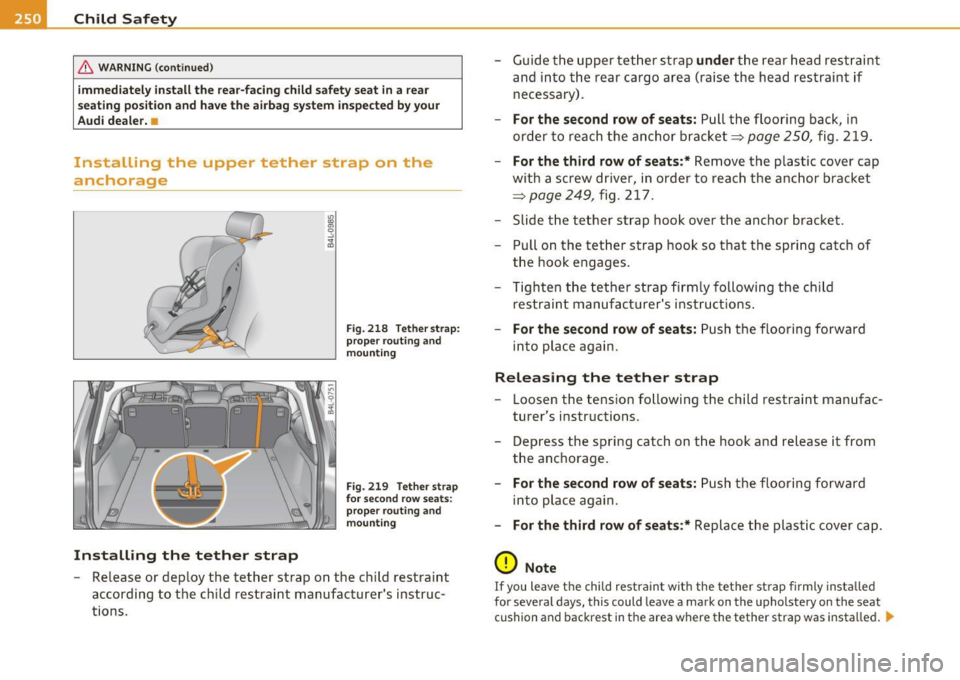
F ig. 218 Tethe r strap:
proper routin g and
m ounti ng
F ig. 219 Tether strap
f o r seco nd row s eats:
proper rout in g an d
moun ting
- Release or deploy the tether strap on the child restraint
according to the child restraint manufacturer's instruc
tions . -
Guide the upper tether strap
under the rear head restraint
and into the rear cargo area (raise the head res traint if
necessary).
- For the second row of seats: Pull the flooring back, in
order to reach the anchor bracket=>
page 250, fig. 219 .
-For the third row of seats:* Remove the plastic cover cap
with a screw driver, in order to reach the anchor bracket =>
page 249, f ig . 217 .
Slide the tether strap hook over the anchor bracket .
- Pull on the tether strap hook so that the spring catch of the hook engages .
- Tighten the tether strap firmly following the child
restraint manufacturer's i nstruct ions .
-For the second row of seats: Push the flooring forward
into place again.
Releasing the tether strap
- Loosen the tens ion following the child restraint manufac
turer's i nstructions.
- Depress the spring catch on the hoo k and release it from
the anchorage .
-For the second row of seats: Push the flooring forward
into place again.
- For the third row of seats :* Replace the plastic cover cap.
0 Note
If
you leave the chi ld restrain t with the tether st rap firmly insta lled
for severa l days, this could leave a mark on the upholstery on the seat
cushion and backrest in t he area where the tether strap was insta lled . .,.