ABS AUDI Q7 2010 Owner´s Manual
[x] Cancel search | Manufacturer: AUDI, Model Year: 2010, Model line: Q7, Model: AUDI Q7 2010Pages: 390, PDF Size: 93.04 MB
Page 17 of 390
-
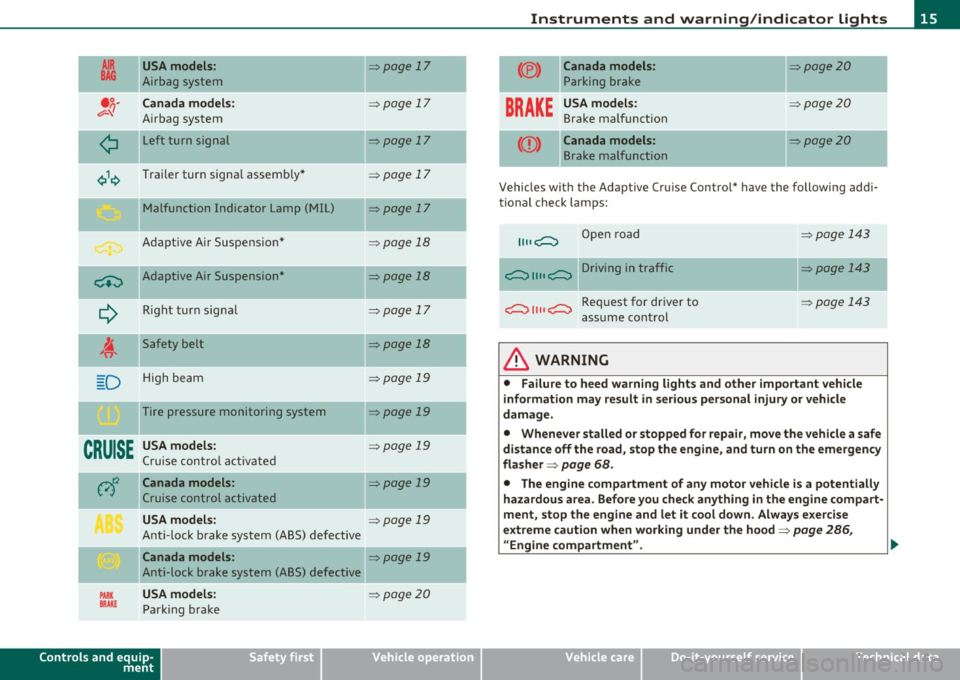
AIR
BAG
-
USA models:
Airbag system
Canada model s:
Airbag system
L eft turn signal
Trailer turn signa l assemb ly*
M alfunction Indicator Lamp (MIL)
Adapt ive Air Suspens ion*
ci::) Adaptive Air Suspension*
--
¢ Right turn sig na l
i Sa fety belt
D H igh beam
Tire pressure monitoring system
CRUISE
USA models:
C rui se contro l a ct ivate d
-
PARK
BRAKE
-
Canada models :
Cruise control activated
USA models:
Anti-lock brake system (ABS) defective
Canada models :
Anti-lock brake system (ABS) defective
USA models:
Park ing brake
Controls and equip
ment Safety first
=:>page 17
=:> page 17
=:>page 17
=:>
page 17
=:>page 17
=:>page 18
=> page 18
=:> page 17
=> page 18
=:> page 19
=> page 19
=> page 19
=:> page 19
=> page 19
=:> page 19
=> page 20
-
-
-
-
Instruments and warning /indicator lights
(® ) Canada models:
Parking br ake
=:>page20
---
BRAKE USA model s:
Brake ma lf u nct ion
:::::,page2 0
-- -
<
CD >
Canada models :
Brake malfunction
=:> page 20
Vehicles with the Adaptive Cru ise Control* have the following addi
ti onal check lamp s:
Open road
~ 1111 ~ Driving in traffic
~ 1111 ~ Request for dr iver to
assume con trol
& WARNING
=:> page 1 43
=:> page 143
=> page 143
• Failure to heed warning lights and other important vehicle
information may result in serious personal injury or vehicle
damage.
• Whenever stalled or stopped for repair, move the vehicle a safe
distan ce off the road, st op the engine, and turn on the emergency
flasher =:>
page 68.
• The engine compartment of any motor vehicle i s a potentially
hazardous area . Before you check anyth ing in the engine compart
ment, stop the engine and let it cool down. Always exercise
extreme caution when working under the hood=:>
page 286,
"Engine compartment".
Vehicle care Technical data
Page 18 of 390
![AUDI Q7 2010 Owner´s Manual Instruments and warning /indicator lights
(I] Tip s
Many fun ct ions a re mon itored by the Auto-Check system=> page 2 7.
Malfunctions or faults will be identified either with a re](/img/6/40275/w960_40275-17.png "AUDI Q7 2010 Owner´s Manual Instruments and warning /indicator lights
(I] Tip s
Many fun ct ions a re mon itored by the Auto-Check system=> page 2 7.
Malfunctions or faults will be identified either with a re")
Instruments and warning /indicator lights
(I] Tip s
Many fun ct ions a re mon itored by the Auto-Check system=> page 2 7.
Malfunctions or faults will be identified either with a red symbol
(pr iority
1-Dange r!) or w ith a ye llow symbo l (prio rity 2 -Warn ing). •
Applies to veh icles: w it h gasoline eng ine
Electronic power control ~
This warning/indicator light monitors the electronic
power control.
T he warning/indicator light (El ectronic Power Control) illumi-
nates when you turn o n the ignition as a function chec k.
[ i ] Tips
If this warning/indicato r light ill uminates while you are driving, then
there is a malfunct ion in the engine e lectron ics . Have the malfunct ion
co rrected as soon as possib le by yo ur autho rized Audi dealer or qua l
ified workshop .•
A pp lies to ve hicles : w ith d iese l en gi ne
Glow plug system
The control light illuminates when the glow plug system
is active.
If the indicato r ligh t illum inates, the g low p lug system is active .
You should start the eng ine immed iate ly after the ind icator light
switches off. The ind icator ligh t only illumina tes for approximately 1
second if the engine is warm or if the outside temperature is above 46
2F (8 2C).
(I] Tips
• If the glow plug indicator light illuminates while driving, there is
an engine control malfunction. The engine should be checked imme
diately .
• If the indicator light does not ill uminate at all when switching the
ign ition on, the re may be a ma lfunction in the glow plug system. The
engine should be checked .•
Electronic stabilization program (ESP) ;
This warning/indicator light monitors the electronic
stabilization program .
The warn ing/indicator light has the fo llowing funct ions:
• It blinks while you are driv ing when the ES P is wo rking.
• It illuminates when you switch on the ignition for approximate ly 2
seconds as a funct ion check .
• It ill uminates when there is a malfunction in the ESP .
• It illuminates when ESP or ASR (Ant i-Slip Regulation) is deacti
va ted .
• It illuminates if there is a malfunction in the ABS, s ince the ESP is
part of the ABS system.
If the battery terminals were disconnec ted and re-connected, the
vehicle was jump started or t he battery is very weak, the ESP sensor
system goes through a learning process for the fi rst few yards. The
warning/indicator light illuminates. The warning/indicator light goes
out as soon as the learning process is comp lete .
If the ESP warning/indicator light illuminates and stays on after you
have sta rted the e ngine, t his may mean that the control system has
temporarily switched off the ESP . If this is case, you ca n react ivate
t he ESP by turning the igni tion off and t hen on aga in . The
warning/indicator light should go out to show that the system is fully
functional again. _,,,
Page 21 of 390
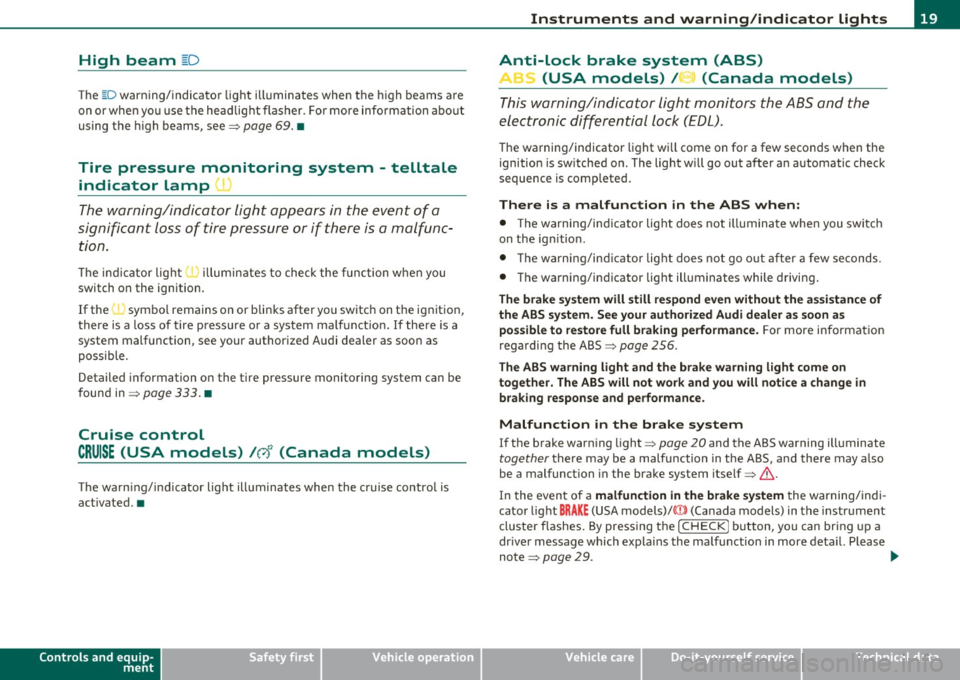
High beam ~D
The ~D warning/indicator light illuminates when the high beams are
on or when you use the headlight flasher. For more information about
using the high beams, see~
page 69. •
Tire pressure monitoring system - telltale
indicator lamp(.,
The warning/indicator light appears in the event of a
significant loss of tire pressure or if there is a malfunc
tion.
The indicator light 1.., illuminates to check the function when you
switch on the ignition.
If the
'll symbol remains on or blinks after you switch on the ignition,
there is a loss of tire pressure or a system malfunction. If there is a
system malfunction, see your authorized Audi dealer as soon as
possible.
Detailed information on the tire pressure monitoring system can be
found in~
page 333. •
Cruise control
CRUISE (USA models) /r,J' (Canada models)
The warning/indicator light illuminates when the cruise control is
activated. •
Controls and equip
ment Safety first
Instruments and warning/indicator lights
Anti-lock brake system (ABS)
A
.:> (USA models) / .... (Canada models)
This warning/indicator light monitors the ABS and the
electronic differential lock
(EDL).
The warning/indicator light will come on for a few seconds when the
ignition is switched on. The light will go out after an automatic check
sequence is completed.
There is a malfunction in the ABS when: • The warning/indicator light does not illuminate when you switch
on the ignition.
• The warning/indicator light does not go out after a few seconds .
• The warning/indicator light illuminates while driving.
The brake system will still respond even without the assistance of
the ABS system. See your authorized Audi dealer as soon as
possible to restore full braking performance.
For more information
regarding the ABS~
page 256.
The ABS warning light and the brake warning light come on
together. The ABS will not work and you will notice a change in
braking response and performance.
Malfunction in the brake system
If the brake warning light~ page 20 and the ABS warning illuminate
together there may be a malfunction in the ABS, and there may also
be a malfunction in the brake system itself~& .
In the event of a
malfunction in the brake system the warning/indi
cator light
BRAKE (USA models)/ ((D) (Canada models) in the instrument
cluster flashes. By pressing the [
CHECK! button, you can bring up a
driver message which explains the malfunction in more detail. Please
note ~
page 29. .,,_
Vehicle care Technical data
Page 22 of 390
Instruments and warning/indicator lights
Malfunction in the electronic differential lock (EDL)
The ED L works toge ther w ith the ABS. The ABS warn ing lig ht w ill
come on if there is a mal func tion in the EDL system=>
page 254 . See
your authorized A udi dea le r as soon as poss ible .
& WARNING
• If the .. (USA models )/ ...,. (Canada models ) wa rning light
does not go out , or if it comes on while driving, the ABS system is
not working properly. The vehicle can then be stopped only with
the standard brakes (without ABS ). You will not have the p rotec
tion ABS provides. Contact your authorized Audi dealer a s soon as
pos sible.
• USA models : If the BRAKE warning light and the M, warning
light come on together, the rear wheels could lock up fir st under
hard braking. Rea r wheel lock-up can cause loss of vehicle cont rol
and an accident . Have your vehicle repaired immediately by your
autho rized Audi dealer or a qualified work shop. Dri ve slowly and
avoid sudden, hard brake applications.
• Canada models: If the brake warning light 0 and the ABS
warning light come on together, the rear wheels could lock up
first under hard braking. Rear wheel lock -up can cause loss of
vehicle control and an accident . Have your vehicle repaired imme
diately by you r authorized Audi dealer or a qualified wo rkshop.
Drive slowly and avoid sudden , hard brake applications .•
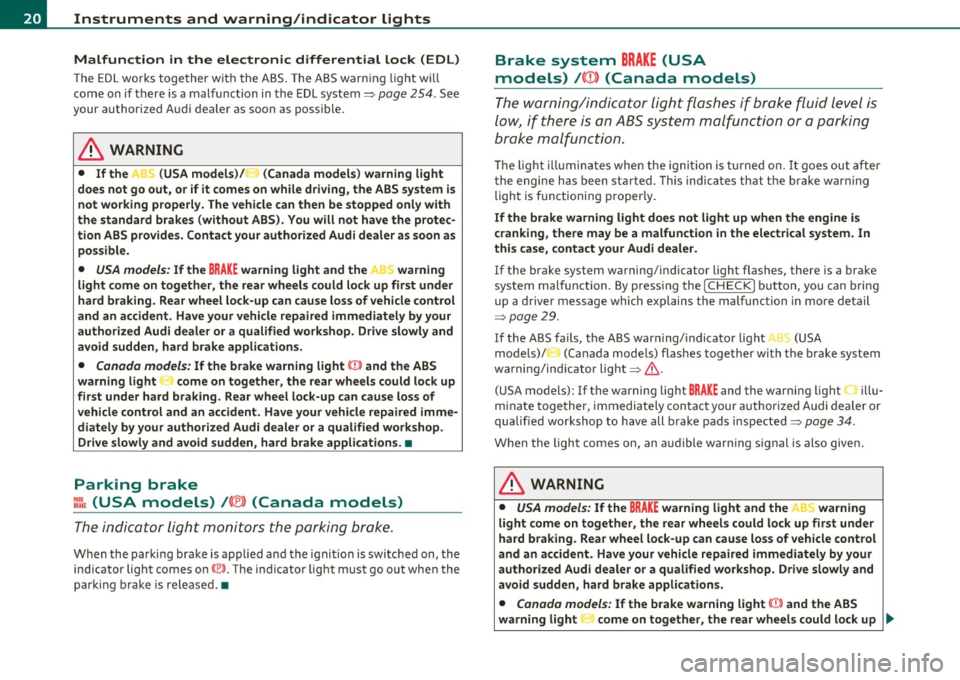
Parking brake
~[ (USA models)/ (®) (Canada models)
The indicator light monitors the p arking br ake.
W hen the parking br ake is app lied a nd the ignition is switched on, the
indicator light comes on©. The ind icator light must go out when the
par king b rake is released. •
Brake system BRAKE (USA
models)
/ ((D) (Canada models)
The warning/i ndica tor light flashes if b ra ke fluid le vel is
low, if there is an ABS system malfunction or a parking
brake malfunction.
Th e ligh t ill umin ates whe n the igni tio n is tur ned on. It goes out afte r
the engine has been started . This indicates that t he brake war ning
ligh t is functioni ng p roper ly .
If the brake warning light does not light up when the engine is
cranking , there may be a malfun ct ion in the electrical system. In
thi s ca se, contact your Audi dealer.
If the brake system warning/indicator light flashes , there is a brake
system mal function. By press ing the
I C H ECK ] button, yo u can bring
up a driver message which exp lains the malfunction in more detail
=>
page 29.
If th e ABS fa ils, t he ABS war ning/ indi cato r light
O (USA
mode ls)/ (Canada mode ls) flashes together with t he b rake system
wa rni ng/ind icator light=> & .
(USA models): If the warning light
BRA KE and the warning light illu
minate together, immedia tely contac t your author ized Audi dealer or
qualified workshop to have all brake pads inspected =>
page 34.
When the light comes on, an a udible warn ing signal is also given.
& WARNING
• USA models : If the BRAKE warning light and the I .. S warning
light come on together, the rear wheels could lock up first under
hard braking . Rear wheel lock-up can cause lo ss of vehicle control
and an accident . Have your vehicle repa ired immediately by your
authorized Audi dealer or a qualified workshop. Drive slowly and
avoid sudd en, hard brake application s.
• Canada model s: If the b rake warning light CCI» and the ABS
warning light come on together, the rear wheels could lock up
~
Page 31 of 390
• Speed warnings threshold 1 8 (USA models)/9 (Canada models)
and thresho ld 2
e , (USA mode ls)/ 0, (Canada models) are also s hown
as red symbols . The warning is always shown as a small symbol in the
upper area of the display ~
page 35. •
Alternator malfunction 0
If the D symbol in the instrument panel d isplay flashes, then there
is a malfunction in the alternator or the vehicle electronics . A warning
to the driver wi ll appear, too. The driver warning goes out after about
5 seconds, but it can be brought up at any time by pressing the
[CHECK] button again.
Us ua lly, you can sti ll d rive to the next dea le rship . T urn off all but the
most necessary e lectr ica l consumers, s ince these dra in the vehicle's
battery.
0 Note
If the _f-warning symbol (coolant system ma lfunction) a lso lights up
on the instrument panel during the trip~
page 30, then you have to
stop immediate ly and t urn off the engine. The coolant pump is no t
work ing anymore -danger of damage to the engine! •
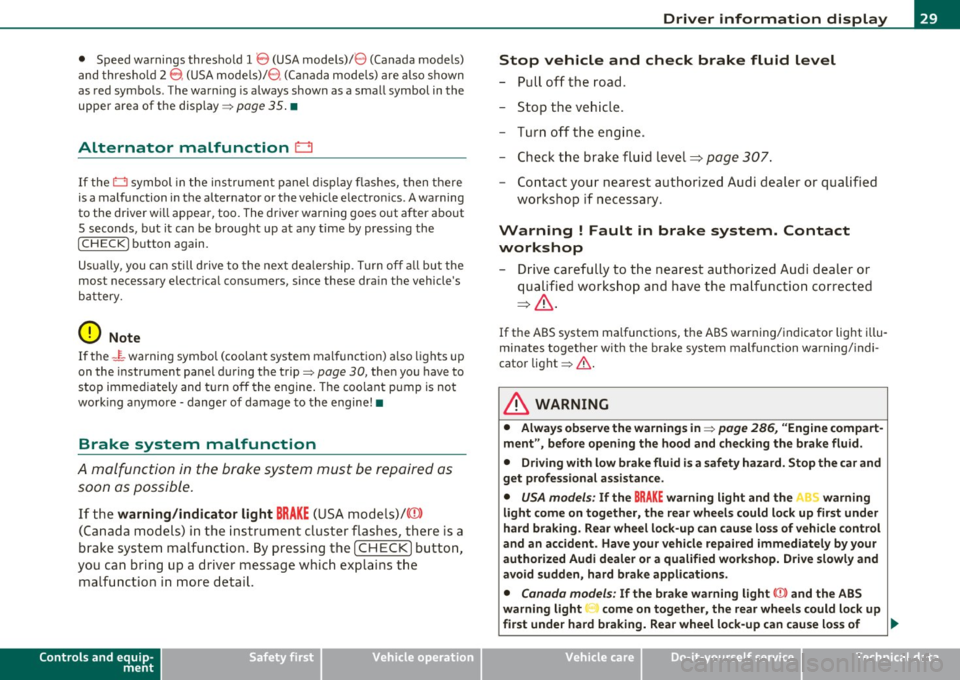
Brake system malfunction
A malfunction in the brake system must be repaired as
soon as possible.
If the warning /indicator light BRAKE (USA mode ls)/ CCD)
(Canada models) in the instrument cluster flashes, there is a
brake system ma lfunction. By press ing the
[CHECK ] button,
you can bring up a driver message which exp lains the
malfunction in more deta il.
Controls and equip
ment Safety first
Dri
ver information display
Stop vehicle and check brake fluid Level
- Pull off the road.
- Stop the veh icle .
- Turn off the eng ine .
- Check th e brake flui d level =>
page 307.
-Contact your nearest authorized Audi dea ler or qualified
workshop if necessary.
Warning ! Fault in brake system. Contact
workshop
- Drive carefully to the neares t author ized Audi dealer or
qualified works hop and have the malfunction corrected
=> & .
If the ABS system malfunctions, the ABS warning/indicato r light illu
minates together with the b rake system malfunction warning/ indi
cator light~& .
& WARNING
• Alw ay s ob serve the warning s in ~ page 28 6, "Engine c ompart
m ent ", before opening th e hood and che cking the b rake fluid .
• Driving with low brake fluid is a safety hazard. Stop th e car and
get profe ssional a ssistan ce.
• USA model s: If the BRAKE warning light an d the \6:> warning
light com e on together, the rea r wheel s could lo ck up fir st under
hard braking . R ear wh eel lo ck -up c an cau se lo ss of vehi cle control
and an a ccident . Have your v ehicl e repair ed immedia tely by your
authorized Audi dealer or a qualified work shop. Dr ive slowly and
avoid sudd en, hard brake applications .
• Canada model s: If the brake warning light CCI» and the ABS
warning light come on togeth er, the rear wheels could lo ck up
fir st unde r hard b raking. Rea r wheel loc k-up c an cause lo ss of
~
Vehicle care Technical data
Page 148 of 390

llffl..__A_ d_a_ p,__ t_iv _ e_ C_r _u _ i_ s _e _ C_ o_ n_t _ r_ o _ L ___________________________________________ _
tained. The ACC system is not switched off, and increased attention
to the traffic situation is absolutely necessary. The followi ng may be
reasons why the message
ACC functionality limited appears:
• The ACC sensor is dirty . The ACC system is not reacting, or is not
reacting correctly, to moving vehicles up ahead in yo ur la ne of travel.
• There may be very light traffic on and there is nothing that marks
the side of the road (for example , guard rai ls, traffic signs, trees). As
soon as a moving vehicle up ahead is detected aga in, ACC becomes
active again and the message disappears.
The ACC sensor is located behind the area to the right of the front
license plate.
If the ACC sensor is dirty or blocked, clean the area to
restore system operation .
Parking brake !
The text message Parking brake! appears, when the parking brake is
applied. ACC is turned off. A warning tone so unds as a reminder.
Stationary object ahead
The text message Stationary object ahead appears, when you want
to activate the system and there is a stationary vehicle or an object
immediately in front of you.
Gradient too steep
The text message Gradient too steep appears when the max imum
gradient for proper ACC operation has been exceeded. Adaptive
Cru ise Control is turned off . A warning tone also sounds as a
reminder.
ACC off: manual control !
The text message ACC off: manual control! appears after the vehicle
has been brought to a standst ill by the Adapt ive Cruise Control. In
this case you must depress the brake pedal to prevent the vehicle
from rolling . A warn ing tone sounds as a reminder.
Selector lever position I
Th e text message Selector lever position! appears when the selector
lever is moved to position
N. In th is position, Adaptive Cruise Cont rol
is not available. •
Applies to vehicles : w it h Adap tiv e Cru ise Control
Driver intervention prompt
The driver intervention prompt calls on the driver to take
over the situation.
Fig . 140 I nstrument
cluster: Driver inter·
vention prompt
In certain situations, the brak ing power of the Adaptive Cruise
Control is not enough to maintain an adequate distance to the vehicle
up ahead. In these situations, the Adaptive C ruise Control calls the
driver to take action.
The
driver intervention prompt a lerts you vis ually and aud ibly to take
over .
• A red vehicle is shown in the instrument cluster display
:::::,fig. 140.
• T he text
DISTANCE! appears in the status line.
• The indicator light
<::::>11, ,~ in the speedometer blinks red .
• A warning tone sounds.
Page 185 of 390
_____________________________________________________ H_ o_m_ e_ L_i_n _k_ ®_ • __ _
Homelink ®
Universal remote control
Applies to veh icles: w ith Hom eli nk ® universal remote control
General information
The Homelink ® feature can learn up to three radio
frequency codes for most current transmitters used for
operating garage doors, estate gates, home or outdoor
lighting systems, and other devices.
You must first program the Homelink ® transm itter before you can
use the system=>
page 184, "Programming the Home link® trans
mitter".
I n order to program the Homelink ® transmitter for devices utilizing
rolling code, a second person on a ladder who can safe ly reach the
garage door opener motor is recommended. It is also necessary to
locate the "learn" button on your garage door opener motor. Refer to
the operating instructions for the opener, as the location and color of
this button may vary by manufacturer.
You can still use the original remote control for the device at any
time.
& WARNING
• Never use the Homelink'"' transmitter with any garage door
opener that does have not the safety stop and reverse feature as
required by federal safety standards. This includes any garage
door opener model manufactured before Aprill, 1982.
• A garage door opener which cannot detect an object, signaling
the door to stop and reverse does not meet current federal safety
standards. Using a garage door opener without these features
increases risk of serious injury or death.
Controls and equip
ment Safety first
& WARNING
(continued)
• For safety reasons never release the parking brake or start the
engine while anyone is standing in front of the vehicle.
• A garage door or an estate gate may sometimes be set in
motion when the Homelink ® remote control is being
programmed. If the device is repeatedly activated, this can over
strain motor and damage its electrical components -an over
heated motor is a fire hazard!
• To avoid possible injuries or property damage, please always
make absolutely certain that no persons or objects are located in
the range of motion of any equipment being operated.
rn Tips
• If you would like more information on Homelink ®, where to
purchase the Homelink ® compatible products, or would like to
purchase the Homelink ® Home Lighting Package, please call toll
free: 1-800-355-3515.
• For Declaration of Compliance to United States FCC and Industry
Canada regulations=>
page 369. •
Vehicle care Technical data
Page 198 of 390
• ....__D_ r_iv _i_ n_, g=-- S_ a _ f_e _,Ly _ ______________________________________________ _
in. WARNING
Improperly stored luggage or other items can fly through the
vehicle causing serious personal injury in the event of hard braking
or an accident. To help reduce the risk of serious personal injury:
• Always put objects, for example, luggage or other heavy items
in the luggage compartment .
• Always secure objects in the luggage compartment using the
tie-down eyelets and suitable straps.
& WARNING
Heavy loads will influence the way your vehicle handles. To help
reduce the risk of a loss of control leading to serious personal
injury:
• Always keep in mind when transporting heavy objects, that a
change in the center of gravity can also cause changes in vehicle
handling:
-Always distribute the load as evenly as possible.
- Place heavy objects as far forward in the luggage compart-
ment as possible.
• Never exceed the Gross Axle Weight Rating or the Gross Vehicle
Weight Rating specified on the safety compliance sticker on the
left door jamb . Exceeding permissible weight standards can cause
the vehicle to slide and handle differently.
• Please observe information on safe driving
=> page 188 .
in. WARNING
To help prevent poisonous exhaust gas from being drawn into the
vehicle, always keep the rear lid closed while driving.
• Never transport objects larger than those fitting completely
into the luggage area because the rear lid cannot be fully closed.
& WARNING (continued)
• If you absolutely must drive with the rear lid open , observe the
following notes to reduce the risk of poisoning:
-Close all windows,
- Close the Panoramic sliding sunroof*,
- Open all air outlets in the instrument panel,
- Switch off the air recirculation,
- Set the fresh air fan to the highest speed.
in. WARNING
Always make sure that the doors, all windows, the Panoramic
sliding sunroof* and the rear lid are securely closed and locked to
reduce the risk of injury when the vehicle is not being used .
• After closing the rear lid, always make sure that it is properly
closed and locked.
• Never leave your vehicle unattended especially with the rear lid
left open. A child could crawl into the vehicle through the luggage
compartment and close the rear lid becoming trapped and unable
to get out. Being trapped in a vehicle can lead to serious personal
injury.
• Never let children play in or around the vehicle.
• Never let passengers ride in the luggage compartment. Vehicle
occupants must always be properly restrained in one of the
vehicle's seating positions .
(I) Tips
• Air circulation helps to re du ce win dow fogging. Stale air escap es
to the outside th rough vents in the trim panel. Be sure to keep t hese
slots free and open.
• Th e tire pressure must correspond to the load . The tire pressure is
shown on the tir e pressure label. The tire pressure label is located on .,_
Page 202 of 390
___ S_a_ f_ e_ t__, y,,__ b_ e _ lt_ s _______________________________________________ _
Before driving off, always:
- Fasten your safety belt and mak e sure you are wea ring i t
p roperly .
- Make sure that your passengers also buckle up and prop
erly wear their safety be lts.
- Prot ect ch ildren w ith a child rest raint system appropriate
for the size and age.
T he warning light -if. in the instrument cluster lights up when the igni
tion is sw itched on as a reminder to fasten the safety belts. In addi
tion, you will hear a warning tone .
After the ign ition is sw itched on, the wa rni ng ligh t in the in strument
cluster will always come o n for about 6 seconds and if the driver has
no t fas tened the safe ty belt, a wa rning tone will also s ound for abou t
6 seconds . As soon as t he d river has fastened the saf ety belt, the
wa rning tone will stop and the warn ing light will go out.
If the drive r or front seat passenger have not buc kled-up wi thin abo ut
10 seconds after the warn ing tone has stopped and the vehicle is
mov ing fas ter th an about 15 mph, the wa rning tone w ill sound aga in
for about 6 seconds and then stop for 24 seconds and then repeat
t his rem inder sequence for a max imum of 2 minutes. A t speed s
below 5 mph, the warning tone will not sound.
Fasten your safety belt and make sure that your passengers also
properly put on their safety belts.
& WARNING
• Safety belts are the single most effective means available to
reduce the risk of seriou s injury and death in automobile acci·
dents . For your protection and that of your passengers, always
correctly wear safety belts when the vehicle i s moving .
• Failure to pay attention to the warning light that come on,
could lead to personal injury .•
Why safety belts?
Frontal collisions and the law of physics
Frontal cr ashes c reate very stron g forc es for people
ri din g i n ve hic les.
Fig . 188 Unbelted
occupa nts in a v ehicle
heading f or a w all
Fig . 189 The vehicle
cra shes into the wall
T he p hys ica l pr inc iples are simple. Bot h the vehicle and the passen
gers possess energy wh ich var ies wit h veh icle speed and body weight.
E nginee rs cal l this ene rgy "kinetic energy."
The higher the speed of the veh icle and t he greater the vehicle's
we ight, the more energy that has to be "abso rbed" in the crash .
Vehicle speed is the most sig nifican t fa ctor. If t he speed doubles
from 15 to 30 mph (25 to 50 km/h), the energy increases 4 times! .,
Page 204 of 390
__ _:::S:.::a :..:f...:e :.:t::1y ~ b:..:e:.: l:.: t :.:s :._ ____________________________________________ _
Safety belts protect
People think it's possible to use the hands to brace the
body in a minor collision . It's simply n ot true!
F ig. 192 Dri ver is
correct ly re str ain ed in
a s udden b rakin g
m ane uver
Safe ty belts used properly can make a big d ifference. Safe ty belts
help to keep passengers in their seats, gradually reduce energy levels
applied to the body in an accident, an d help prevent the uncon trolled
movement that can cause serious injuries. In add it ion, safety belts
red uce the danger of be ing t hrown ou t of the vehicle .
Safety be lts attach passengers to the car and give them the benefit of
being slowed down more gently or "softly" through the "give" in the
safety belts, crush zones and othe r saf ety features engine ered into
today's vehicles. By "absorb ing" the kinetic energy over a longer
per iod of time , the safety belts m ake the forces on the body more
"tolerable" and less likely to cause injury.
Altho ugh these examples are based on a fronta l collision, safety belts
can also s ubstant ially red uce the risk of injury in other ki nds of
crashes. So, whether you're on a long trip or just going to the corner
sto re, always buckle up and make sure others do, too. Acc ident statis
tics show that vehicle occupants properly wear ing safety belts have a
lower ris k of bei ng inj ured and a mu ch better cha nce of s urviv ing an
acc ident . Properly using safety belts also greatly increases the ability
of the supp lemen tal air bags to do the ir job in a coll is ion. For this
reason, wearing a safety bel t is lega lly requ ired in most coun tries
including muc h of the Un ited States and Canada. Altho
ugh your Audi is equ ipped with a irbags, you still have to wear
t he safe ty belts provided. Fron t air bags, for ex ample, are a ctiv ate d
only in some frontal collisions . T he front a irbags are not act ivated in
all frontal co llisions, in s ide and rear coll isio ns, in roll overs or in cases
where there is not enough decelerat ion thro ugh impact to the front
of the vehicle . The same goes for the other airbag systems in yo ur
Audi. So, always wea r your safety be lt and make su re everybody in
your vehicle is properly restrained!
Important safety Instructions about safety
belts
Safety b elts must always be correctly positioned across
the strongest bones of your body .
-Always wear safety belts as illustrated and described in
this chapter .
- Make sure that your safety belts are always ready for use and are not damaged .
& WARNING
Not wearing safety belts o r wearing them improperly inc reases
the risk of s eriou s personal injury and death . Safety belts can work
only when u sed correctl y.
• Alway s fasten your safety belts correctly bef ore driving off and
make sure all passengers are corre ctly restrained.
• For ma ximum protection , safety belts must alw ays be posi
ti oned properly on the body.
• Never strap more than one person , including small children ,
into any belt .
• Never place a safety belt o ver a ch ild sitting on you r lap .
• Alway s keep feet in the footwell in front of the seat while the
vehicle is being driven.
~