clock AUDI Q7 2011 Owner´s Manual
[x] Cancel search | Manufacturer: AUDI, Model Year: 2011, Model line: Q7, Model: AUDI Q7 2011Pages: 392, PDF Size: 93.29 MB
Page 311 of 392

___________________________________________ C_ h _ e_c _k _ i_n -=g ~ a_n _ d_ f_i _ll _i _ n -=g =--- ......J•
-We recommend using only coolant additive Gl2 ++ (check the
l a bel) for yo ur vehicle. This coolant ad dit ive is available at au tho·
r ized Audi dealers . Other types of antifreeze can s ignificantly
reduce corrosion protection. The resulting corrosion can cause a
loss of coolant and serious engine damage .
• Do not add any type of radiator leak sealant to your vehicle's
eng ine coo lant . Adding radiator repa ir fluid may adversely affect the
function and performance of your cooling system and could result in
damage not covered by your New Vehicle Limited Warranty .•
Checking the engine coolant Level
The engine coolant level can be checked with a quick
glance .
Fig. 2 37 En gin e
c o mpar tmen t: C oolant
ex pansion tank
Before you c heck anything in the eng ine compartment,
always read and heed all WARNINGS~ & in "Working in
the e ngine compartment" on
page 301.
- Turn off the ignit ion .
- Let t he eng ine cool down .
- Place a thick rag over the coolant expans ion tank
~ fig . 237 and carefully twist the cap counter ·clockwise
~ & -
Vehicle OP-eration
-Read the engine coolant level in th e open coo lant expan ·
sion tank ~ fig . 2 3 7 . With a cold engine, th e coolant level
should be between the "min" and "max" ma rkings . Whe n
the engine is warm , the level may be slight ly above the
"max" marking .
The location o f the coo lant expans ion tank can be seen in the engine
compartment illustration=>
page 302 .
To obt ain an accurate reading , the engine must be sw itched off.
Th e expans ion t an k in your vehicle is equippe d with an electric coolant
level sensor.
When the coolant lev el is too low, the warning light in the Auto·Check
System=>
page 35 will blink until you add coolant and t he level has
been resto red to normal. Even though there is an electric coolant
level sensor, we st ill recommend you check the coolant leve l from
time to time.
Coolant loss
Coolant loss may indicate a leak in the coo ling system . In the event of
coo lant loss , the cooling system sho uld be inspected immed iate ly by
your authorized Aud i dea ler . It is not enough mere ly to add coolant.
In a
s ealed system, losses can oc cu r only if the boiling point of the
coolant is exceeded as a result of ove rheating .
& WARNING
The cooling system is under pressure and can get ve ry hot. Reduce
the ri sk of scalding from hot coolant by following the se steps.
• Turn off the engine and allow it to cool down .
• Protect your face, hand s and arms from e scaping fluid and
s team b y co ve ring the cap with a large, thi ck r ag.
• Turn the cap slowly and ver y carefully in a counter-clockwise
direction whil e applying light , downward pre ssure on the top of
thecap .
~
Vehicle care Do-it-yourselt service iTechnical data
Page 312 of 392
llft!I __ C_ h_ e_c _k _i _ n _g ~ a_n _d_ f_il _l_in _ g _________________________________________ _
& WARNING (conti nu ed )
• To avoid being burned, do not spill antifreeze or coolant on the
exhaust system or hot engine part s. Under certain condit ion s, the
ethylene glycol in engine coolant can catch fire.
0 Note
Do not add any type of radiator leak sealant to yo ur vehicle's engine
c oo lant. Addi ng radia tor repa ir fluid m ay adverse ly affe ct the func
tion and performance of your cooling system and could result in
damage not cove red by y our New Vehicle Lim ited Warr anty. •
Adding coolant
Be very careful when adding engine coolant.
Before you check anyt hing in th e eng ine co mpart ment ,
always read and heed all WARNINGS => & in "Wor king i n
t h e e ngine compa rtment" on
page 301.
- Tur n off the eng ine.
- Let t he engi ne c ool d ow n.
- Place a thic k rag over th e coolan t expans ion tank
=> pag e 309, fi g. 237 and carefully twist t he cap cou nter
cl ockwi se
=> &.
- Add coo lant.
- Tw ist the ca p on aga in
tightly .
Replacement eng ine coolant must conform to exact specifications
=>
page 308, "Coolant". Even in a n emergency, if coolant addi tive
Gl2 ++, Gl2 + or Gl2 is not available, do not use a different addit ive.
Use plain wate r in st ead until you can get the cor rec t additive an d can
restore the correct ratio. This shou ld be done as soon as possible. If
you have lost a considerable amount of coolant, then you sho uld
a d d c old an tifr ee ze and cold wa ter only when the e ngine is cold.
Always use
new engine coo la nt when refilling.
Do not fill coolant above the "MAX" mark. Excess coolant will be
fo rced o ut thr ough the p re ssur e relief v alve in the c ap w hen the
eng ine becomes hot.
& WARNING
• The cooling system is under pressure and can get very hot.
Reduce the risk of scalding from hot coolant by following these
steps.
-Turn off the engine and allow it to cool down.
- Protect your face , hands and arms from escaping fluid and
s team by covering the cap with a large, thi ck rag .
- Turn the cap slowly and very carefully
in a counter-clockwise
direction while applying light, downward pre ssure on the top
of the cap.
- To avoid being burned, do not spill antifreeze or coolant on
the exh aust system or hot engine parts . Under certain condi
tions , the ethylene glycol in engine coolant can catch fire.
• Antifreeze is poisonous. Always store antifreeze in its original
container and well out of the reach of children.
• If you drain the coolant , it mu st be caught and safely stored in
a proper container clearly marked "poison ".
0 Note
• Coolant poll utes the environment and could cause an engine fire.
Excess coolant w ill be forced o ut thro ugh the pressure relief va lve in
t he c ap when t he e ngine becomes hot.
• If, i n an emergency, only water can be added, the co rrect ratio
between wate r and an tifreeze=>
page 308 mus t be res to red as soo n
as possib le. _..
Page 327 of 392
Tires and wheels -_____________ --=-=--=.:..:......:..::....:.=----Vf'II
gauge and keep chec king the press ure until you reach t he press ure
th at i s cor rect fo r t he lo ad ( pass en ge rs and l uggage) and kind of
dr iving you plan to do .
If the press ure i n any t ire is too low, note the difference betwee n th e
pressu re in t he cold tire a nd the pressure you need and add the air
that you need to reach the correct pressure for t he ve hicle load
( pass enge rs and lugg age) f or th e tires on yo ur vehicle as l ist ed on t he
on your vehicle and in this manua l and the kind of driving you p lan to
do.
Never exceed the maximum inflation pressure listed on the tire
sidewall for any reason.
Remember that the ve hicle m anufac tur er, no t the tire manufa cture r,
determines t he correct tire press ure for the t ires on your veh icle.
It is important to check the tire pressure when the t ires a re co ld .
• Read the requ ired t ire pr essure from t he t ire pr essure lab el. T he
tire pressure labe l is locate d on t he driver's side 8- pillar. Th e tire pres
s u re labe l lists t he re com men ded col d tire inflat io n pr essures fo r the
vehicle at its maxim um capac ity we ight and the t ires t hat were on
yo ur vehicle at the t ime it was ma nufact ured. For r ecom mende d tire
pressures fo r norma l load cond it ions, please see chapter
=> page 322.
• Turn the valve stem cap co unter -clockw ise to remove it from the
t ire v alve.
• Place the air press ure gauge on the valve.
• The tire p ressures sho uld on ly be checked and adjusted wh en the
tires are cold. The slightly raised press ures of wa rm tires must not be
re du ced.
• Adjust the tire p ress ure to the loa d you are ca rry ing.
• Reinstall the valve stem cap o n the valve .
When should I check the tire pressure?
The correct tire press ure is especially important at high speeds. The
pressu re shoul d there fore be c hec ke d at least once a mo nth a nd
Safety first
always before start ing a journey . Do not forget to check t he t ire pres
s u re for the spare w heel.
When should I adjust the tire pressures?
Adju st the tir e pre ssure to the load y ou ar e carry ing. A fter ch anging a
wheel
or replac ing wheels you have to adjust t he t ire p ressures on all
w heels. I n addition , you m ust th en s tore the new tire press ures i n the
t ir e pressu re monitoring system=>
page 339.
& WARNING
Incorrect tire pressures and/or underinflation can lead sudden tire
failure, loss of control, collision, serious pers onal injury or even
death.
• When the warning symbol appears in the instrument
cluster, stop and inspect the tires.
• Incorrect tire pressure and/or underinflation can cause
increased tire wear and can affect the handling of the vehicle and
stopping ability.
• Incorrect tire pressure s and/or underinflation can also lead to
sudden tire failure, including a blowout and sudden deflation,
causing loss of vehicle control.
• The driver is responsible for the correct tire pressures for all
tires on the vehicle. The applicable pressure values are located on a sticker on the driver's side B-pillar.
• Only when all tires on the vehicle are filled to the correct pres
sure, the tire pressure monitoring system can work correctly.
• The use of incorrect tire pressure values can lead to accidents or
other damage. Therefore it is essential that the driver observe the
specified tire pressure values for the tire s and the correct pres
sures for the function of the tire pressure monitoring system.
• Always inflate tires to the recommended and correct tire pres-
sure before driving off. .,_
Vehicle care Technical data
Page 343 of 392

_______________________________________________ W __ h_a _t_ d_o_ I_ d_o_ n_ o_ w_ ? _ __._
Release the two hook-and-loop fasteners, and remove the two
chocks . To use the chocks, you first have to raise the support plate
=>
page 340, fig . 250 (D and then insert the locking plate with the
two "tabs" into the elongated holes in the base plate @=>& .
& WARNING
• The chock cannot fulfil its function and may lose its stability if
the "tabs" on the support plate are not inserted correctly into the
elo ngated holes in the base plate. If this happens, the vehicle may
start to move while a wheel is being changed.
• Never use the folding chocks if they are damaged or if they
have not been assembled correctly.
& WARNING
Improper use of the vehicle jack can cause serious personal inju
ries.
• Never use the jack supplied with your Audi on another vehicle,
particularly on a heavier one. The jack is only suitable for use on
the vehicle it came with.
• Using a bumper jack to raise the vehicle will damage the
bumper system. The jack may slip, causing injury.
• Never support your vehicle on cinder blocks, bricks or other
objects . These may not be able to support the load and could cause
injury when they fail.
• Never start or run the engine while the vehicle is supported by
the jack.
• If you must work under the vehicle, always use safety stands
specifically designed for this purpose.
• Always make sure the inflatable spare tire and even a flat tire
are secured in place and not loose, otherwise they could fly
forward, causing personal injury to passengers in the vehicle in an
accident or sudden maneuver. •
Vehicle OP-eration
Applies to vehicles : with bass box
Removing bass box
Before the inflatable spare tire can be taken out, the bass
box must be removed.
Fig. 251 Spare wheel
well: Bass box
Removing bass box
-Squeeze the locking tabs=> fig. 251 (D of the connector.
- Disconnect the connector @ and place the lead to one
side.
- Turn the large screw counter-clockwise.
- Carefully remove the bass box.
Installing bass box
-Carefully place the bass box in the wheel. The inscription
"FRONT" on the bass box must face forward.
- Reconnect the connector that was removed.
- Secure the bass box with the large screw. •
Vehicle care Do-it-yourself service iTechnical data
Page 344 of 392
lffll.,___W_ h_ a_t _ d_ o_ I_d_ o_ n_o _w_ ? ___________________________________________ _
Inflatable spare tire
The inflatable spare tire expands to its full diameter
when it is infl ated.
Removing inflatable spare tire
Fig. 252 I nfl ata ble
sp are tir e wi th
c ompr essor
- Lift up the cargo floor using the handle.
- Turn the large screw=> fig. 252 counter -clockwise .
- Remove the bass box as required==>
page 341.
Take out the in flatab le spare tire .
Stowing the inflatable spare tire
- Release the air by unscrewing the valve stem .
- Screw the valve stem back in afterwards.
- Wa it a few hou rs before placing the w hee l in the spare
wheel well=>
&-
- Install the bass box as required=> page 341.
- Secure the whee l with the large screw .
- Fold the cargo floor bac k down .
After using the inflatable spare wheel
The inflatable spare t ire can be re -used as long as it is not damaged
and is not worn down to the tread wear indica tors=>
& -
When you let the air out of the inflatab le spare tire, it does not
assume its folded shape again for severa l hours. Until then, it cannot
be placed back in t he spare wheel well and stowed secure ly.
& WARNING
• Never use the spare tire if it is d amaged or if it is worn down to
the tread wear indicators.
• If the infl atable spare tire is more than 6 years old , use it only
in an emergency and with extreme caution and careful driving.
• The inflatable spa re tire is intended only for temporary and
short-term use. It should be replaced a s soon as possible with the
n o rmal wheel and tire .
• The tire pressure value for the inflatable spare t ire is located on
the dri ver' s s ide B-pillar
=> page 322, fig. 242.
• Ma ximum permiss ible speed is SO mph (80 km /h ).
• Avo id full-throttle a cceleration, heavy braking, and fast
corne ring .
• When the air is let out of the inflatable spare wheel, it d oes not
assume its folded shape for se veral hours . Until then , it cannot be
pla ced back in the spare wheel w ell and stowed securel y.
• Never drive with more than one inflatable spare tire.
• For technical re asons , the use of tir e chains on the inflatabl e
spare tire i s not permitted. If it i s necessary to dri ve with tire
c ha in s, the inflatabl e spare whe el must be mounted on the front
axle in the event of a flat in a rea r tire. The newly a vailable front
whee l mu st then be installed in place of the re ar wheel with the
flat tire. Ins talling the tire chain before mounting the wheel and
tir e is recomm ended.
• Loo se items in the passenger compartment can cause serious
per sonal injury during hard braking or in an accident . .,,.
Page 348 of 392
lffll.,___W_ h_ a_t _ d_ o_ I_d_ o_ n_o _w_ ? ___________________________________________ _
Loosening and tightening the wheel bolts
The wheel bolts must be loosened before raising the
vehicle .
Loosening
Fig. 2 55 C hang in g a
w heel: loos eni ng t he
whe el b olt s
- Install the wheel bolt wrench over the wheel bolt and
push it down as far as it will go.
- Take tight hold of the
end of the wrench hand le and turn
the whee l bo lts
counter-clockwise ab out one single turn
in the direction of arrow:::::, fig. 255 .
Tightening
-Install the wheel bolt wrench over the w heel bo lt a nd
push i t down as far as it wi ll go .
- Tak e tight h old of the
end of the wr ench hand le and turn
eac h whee l bolt
clockwise u nti l it is seated.
& WARNING
• Do not use force or hurry when changing a wheel -you can
cause the vehicle to slip off the j ack and cause serious pe rsonal
injuries .
& WARNING (contin u ed )
• Do not loo sen the wheel bolt s more than one turn before you
raise the vehicle with the jack. -Y ou ri sk an injury.
(I] Tips
If a wheel bo lt is very tight, yo u may find it easier to loosen by ca re
fully push ing down on the end of the wheel bolt wrench with
one foot
only. A s you do s o, hold o n to the car to keep your balance and ta ke
care not to s lip. •
Raising the vehicle
The vehicle must be lif ted with the ja ck first before the
wheel can be removed.
Fig . 2 56 Ch angin g a
w heel: mount in g
poi nts for th e jack ..
Page 379 of 392
___________________________________________ A_ l::.. p _h _a_ b_ e_t _ic _a_ l_ in_ d _ e_x __ __
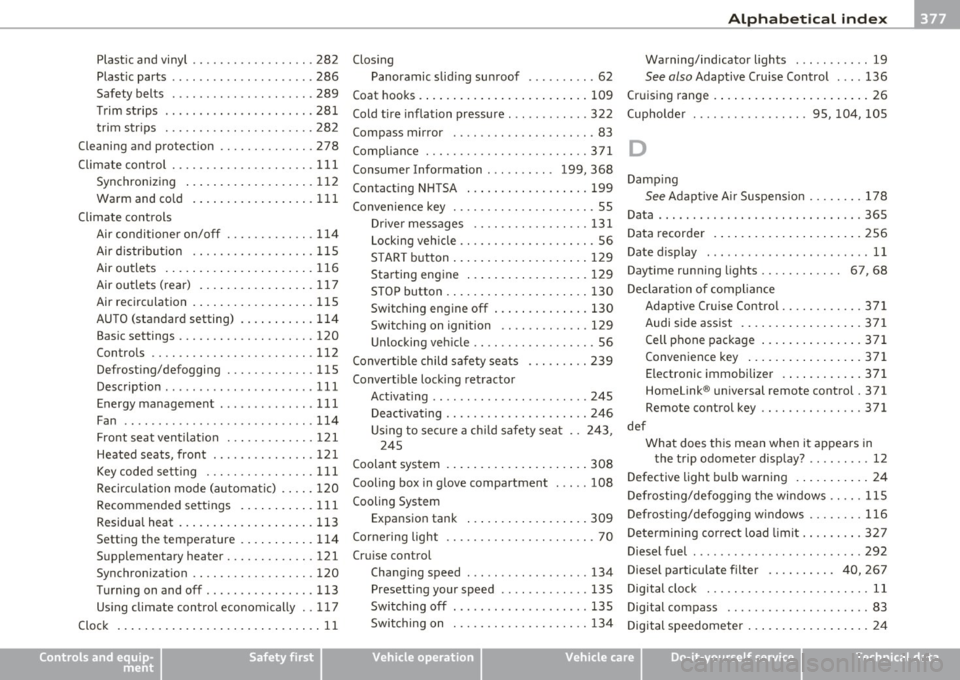
Plastic and vinyl .............. ... . 282
Plast ic parts ........... .......... 286
Safety belts ..................... 289
Trim strips ...................... 281
trim strips ... ...... .. ... ........ 282
Cleaning and protection .............. 278
Climate control ........ ........ .. .. . 111
Synchroniz ing ... .. .......... .... 112
Warm and co ld .............. .... 111
Climate controls
Air conditioner on/off .......... .. . 114
Air distr ibution .................. 115
Air outlets ........ ... .. .. .. ..... 116
Air outlets (rear) ........ .... .. .. . 117
Air recirculation .............. ... . 115
AUTO (standard setting) ... ... ..... 114
Basic settings ............. .. ..... 120
Controls ..................... .. . 112
Defrosting/defogging ... .......... 115
Description ............. .. ....... 111
Energy management .............. 111
Fan .. .. ... ....... .. ... .. .. .. .. . 114
Front seat ventilat ion ... .......... 121
Heated seats, front ............ .. . 121
Key coded setting ................ 111
Recircu lation mode (automatic) ..... 120
Recommended settings ... ... .. .. . 111
Residual heat ...... ... .. .. .. ..... 113
Setting the temperature ... ... .. .. . 114
Supplementary heater .......... ... 121
Synchronization .................. 120
Turning on and off ................ 113
Using climate control economically .. 117
Clock .................... .......... 11
Controls and equip
ment Safety first
Closing
Warning/indicator lights ... .. .. .. .. 19
Panoramic sliding sunroof .......... 62
See also Adaptive Cruise Control .... 136
Coat hooks .. .................... ... 109 Cruising range
... .... ................ 26
Cold tire inflation pressure ... ......... 322 (upholder ................. 95, 104, 105
Compass mirror ..................... 83
Compliance ........................ 371
D
Consumer Information ... .. .. .. . 199, 368
Contacting NH TSA .................. 199
Convenience key ....... ....... .. .. .. . 55
Dr iver messages ................. 131
Locking vehicle .. ............. .... . 56
START button ................. ... 129 Damp
ing
See Adapt ive A ir Suspens ion ........ 178
Data .............................. 36S
Data recorder .. .. .... ............ .. 256
Date display .... .................... 11
Starting engine .. .. . .. ........... 129 Daytime running
lights ............ 67, 68
STOP button ..................... 130 Declaration of compl
iance
Switching engine off ... .. ..... .... 130 Adaptive Cru
ise Control ............ 371
Switching on ignition ........ .. ... 129 Audi side assist ................
.. 371
Unlocking vehicle .................. 56 Cell phone package
............... 371
Convertible child safety seats ....... .. 239
Convertible locking retractor
Activating .......... .. .. ......... 245
Deactivating ..................... 246
Us ing to secure a chi ld safety seat .. 243,
245 Convenience
key ................ . 371
Electronic immobilizer .... ........ 371
Homelink ® universal remote control. 371
Remote control key .. .. .. .. .. . ... . 371
def What does this mean when it appears in
Coolant system .................. ... 308 the trip odometer display?
........ . 12
Cooling box in glove compartment ... .. 108
Cooling System Defective light bulb warning ........... 24
Defrosting/defogging the windows
..... 115
Expansion tank ..... .. .. ......... 309 Defrosting/defogging windows
........ 116
Cornering light ...................... 70 Determining correct load
limit ....... .. 327
Cruise control Diesel fuel
...... ........... ... .. .. . 292
Changing speed ..... .. .. .. .... ... 134 Diesel particulate filter
.... ...... 40, 267
Presetting your speed ............. 135 Digital
clock ......... ............... 11
Switching off .................... 135
Digital compass ..................... 83
Switching on .................... 134
Digital speedometer .................. 24
Vehicle operation Vehicle care Do-it-yourself service Technical data
Page 385 of 392
_____________________________________________ A_ L .... p_ h _ a_b_ e_ t_ ic_a_ l_ in_ d_e _ x __ _
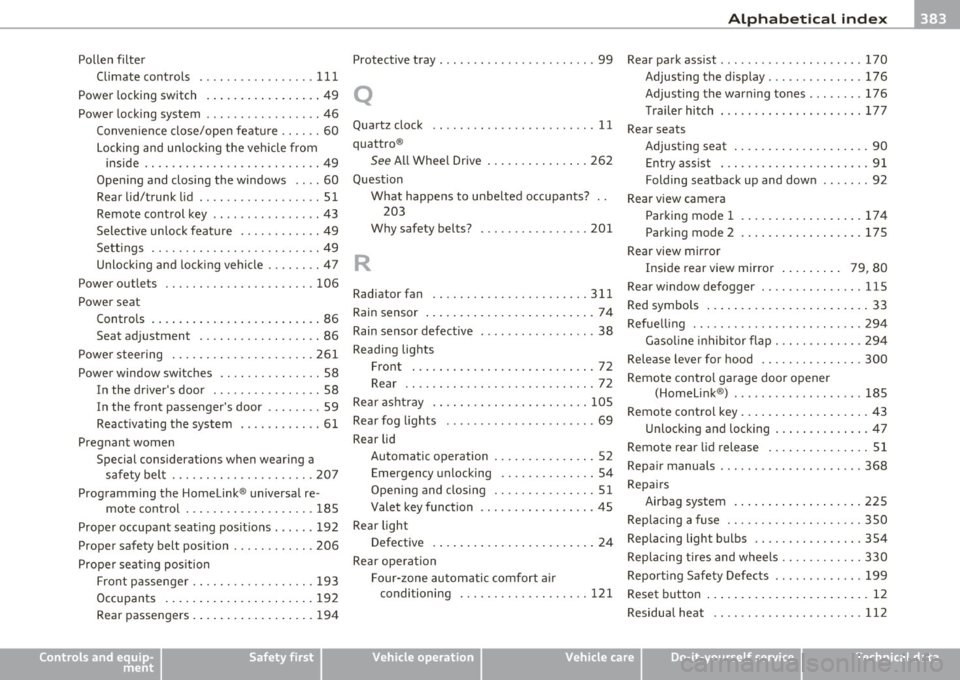
Pollen filter
Climate controls ......... ... ..... 111
Power locking switch ............ ... .. 49
Power locking system ................ . 46
Convenience close/open feature .. .. .. 60
Locking and unlocking the vehicle from
inside ...... ...... .. .. .. .. .... .. 49
Opening and closing the windows .... 60
Rear lid/trunk lid ......... ... ...... 51
Remote control key .......... ...... 43
Select ive unlock feature ........ .. .. 49
Sett ings ..................... .. .. 49
Unlocking and locking vehicle .... .. .. 47
Power outlets ............. .. .. .. .. . 106
Power seat Controls ... ................. ... .. 86
Seat adjustment ...... .... .. .. .. .. 86
Power steering .......... .. .. .. .... . 261
Power window switches .... .. ... ...... 58
In the driver 's door ....... .... ... .. 58
In the front passenger 's door ....... . 59
Reactivating the system ...... .. .. .. 61
Pregnant women Special considerations when wearing a safety belt .......... .. .. .. .... . 207
Programming the Homelink ® universal re-
mote control ................ ... 185
Proper occupant seating pos it ions . .. .. . 192
Proper safety belt position ....... .. .. . 206
Proper seating position
Front passenger .. .... .. .......... 193
Occupants ......... .. ... ..... ... 192
Rear passengers . ..... ........ .... 194
Controls and equip
ment Safety first
Protective tray
... .. ..... .... ... ..... . 99
Q
Quartz clock ...... .................. 11
quattro ®
See All Wheel Drive ............... 262
Question What happens to unbelted occupants? ..
203
Why safety belts? ................ 201
R
Radiator fan .. .. .. ................. 311
Rain sensor ................. ..... ... 7 4
Rain sensor defective ............. ... . 38
Reading lights Front . ................. .. .. .. .. . 72
Rear .. .. .. .. ... ........ ...... .. . 72
Rear ashtray .. .. .. .... ... .......... 105
Rear fog lights .. .. ... ...... .. .. .. .. . 69
Rear lid Automatic operation ............ .. . 52
Emergency unlocking .. .. .......... 54
Opening and closing ............ ... 51
Valet key function ...... ... ........ 45
Rear light
Defective .... .. ... ............... 24
Rear ope ration
Four-zone automatic comfort air
condi tioning ................. .. 121 Rear park assist ...
....... ... ... .. .. . 170
Adjusting the display ....... .. .. ... 176
Adjusting the warning tones ........ 176
Trailer hitch . .. .. .. .. .. ... ..... .. 177
Rear seats Adjusting seat ...... ...... .. . ... .. 90
Entry assist ... .. .. ............... 91
Folding seatback up and down .. ... .. 92
Rear view camera
Parking mode 1 ................ .. 174
Parking mode 2 ................ .. 175
Rear view mirror
Inside rear view mirror . . . . . . . . . 79, 80
Rear window defogger ............. .. 115
Red symbols ........................ 33
Refue lling ... .... ........... .... .. . 294
Gasoline inhibitor flap ............. 294
Release lever for hood . ....... .. .. .. . 300
Remote control garage door opener
(Homelink ®) ........... ... .. ... 185
Remote control key ................... 43
Unlocking and locking .............. 47
Remote rear lid release ............... 51
Repair manuals ..... .... ... .. .. .. ... 368
Repairs Airbag system ................ ... 225
Replacing a fuse ......... .. .. .. .. .. . 350
Replacing light bulbs .. .. .. .......... 354
Replacing tires and wheels ............ 330
Report ing Safety Defects ............. 199
Reset button ...... . .. ............... 12
Residual heat .. .. .. .. .............. 112
Vehicle operation Vehicle care Do-it-yourself service Technical data