engine oil AUDI Q7 2011 Owner´s Manual
[x] Cancel search | Manufacturer: AUDI, Model Year: 2011, Model line: Q7, Model: AUDI Q7 2011Pages: 392, PDF Size: 93.29 MB
Page 268 of 392
Driving and environment
New brake pads have to be "burnished in" before they have optimal
grab ~& .
Dur ing the break-in period, you should avoid putting severe loads on
the bra kes. Severe loads incl ude, for example, sudden hard braking,
in part icu lar at very high speeds or, for examp le, on mountain passes .
& WARNING
New brake pads don't have the be st stopping power and must be
" b roken-in " du ring the initial 100 to 150 miles (150 to 200 kilo
meters ) of normal city driving . You can compensate for this by
pressing the brake pedal more firml y. This also applies later when
new pad s are installed.
'1
Ap plies to veh icles : w it h gasoline eng ine
Catalyt·c converter
It is very important tha t your emission con trol system
(catalytic c onverte r) is f unctioning properly to ensure
that your vehicle is running in an environmentally sound
manner.
- Always use lead-free gasoline~ page 291, "Gasoline" .
- Never ru n the tan k down a ll the way to empty .
- Nev er put to o mu ch mot or oil in y our engin e~
pag e 306,
"Add ing engin e oil~" -
- Neve r try to push -or tow-start yo ur vehicle .
The catalytic converter is an efficient "clean-up" dev ice built into the
exhaust system of the ve hicle. The catalytic converter burns many of
the pollutants in the exhaust gas before they are released into the
atmosphere. The exclusive
use of unleaded fuel is critically important for the life of
t he c atal ytic converte r and proper f unct ion in g of t he engi ne.
& WARNING
• Do not park or operate the vehicle in areas where the hot
e x haust system may come in contact with dry grass , brush , fuel
s pill or other material whi ch can cau se a fire.
• Do not apply additional undercoating or rustp roofing on or
near the exhau st manifold, exhaust pipe s, catalytic converter or
heat shields. During driving , the substance used for undercoating
c ould overheat and cau se a fire .
0 Note
• Be aware th at just one tank fi lling wit h le aded fu el w ill alre ady
ser iously degrade the performance of the catalytic co nverter.
• Do not excee d the correct engine oil leve l~
page 306.
• Do not drive unti l the f uel tank becomes complete ly empty . The
eng ine could misfire. Unbu rned fuel could also ge t into the exha ust
system and th is could cause the catalytic converter to overheat.
• Do not tu rn off the igni tion whi le the veh icle is moving .
• Do not contin ue to operate your vehicle under these conditions, as
o therwise fuel can reach the cata lytic converter . This could result in
overheating of the converte r, requiring its rep lacement.
• To assu re eff icient operat ion of the Emission Co ntrol System:
- Have yo ur vehicle main taine d pr operly and in a ccordan ce wi th
the service recommendations in your Warranty
& Maintenance
booklet .
- Lack of p roper maintenance as well as improper use of the
veh icle w ill imp air the f unction of the emiss io n con trol syste m and
could lead to damage. ..
Page 269 of 392

• Driving and environment
------------------------------------------------'
ffi For the sake of the environment
Even when the Emission Control System is operating properly, the
exhaust gas can have a sulfur-like exhaust gas smell under some
operat ing states. This depends on the sulfur content of the fue l being
used. Using a different brand of fuel may help, or filling the tank with
lead-free supe r grade gasoline. •
Applies to vehicles: with d iesel engine
Diesel particulate filter
The diesel particulate filter filters nearly all of the soot particles out
of the exhaust. The filter cleans itself automatica lly under norma l
driving conditions. If the filter cannot clean itself (for example,
because you are only driving short distances), the fi lter becomes
clogged with soot and the symbol for the diesel particulate filter
illuminates ~
page 40.
& WARNING
• Do not park your vehicle over flammable materials such as
grass or leaves because the high temperature of the diesel partic
ulate filter could start a fire.
• Do not apply an underbody protectant in the exhaust system
area or a fire could start. •
Avoid damaging the vehicle
When you are driving on poor roads, or over curbs, steep ramps, etc.,
make certain that low-lying parts such as spoilers and exhaust system
parts do not bottom out and get damaged.
Thi s is espec ially true for vehicles with low-slung chassis (sports
chassis)" and fully loaded vehicles. •
Controls and equip
ment Safety first Vehicle operation
Operate your vehicle economically
and minimize pollution
General
Your personal
style of driving will determine the economy
of your vehicle, as well as exhaust and noise levels.
Fuel economy, environmental impact, and wear on your engine,
brakes and tires largely depend on three factors:
• your personal dr iv ing style
• operating conditions
• technical limitations
If you anticipate what you need to do next and drive economically,
you can easily cut your fuel consumption by 10-15 percent. This
section will give you some tips on how you can he lp the environment
and your pocketbook.
(I) Tips
The consumption est imates as published by ENVIRONMENTAL
PROTECTION AGENCY (EPA) and Transport Canada may not corre
spond to your actual consumption on the road, which will vary
depending upon vehicle load and speed, road and weather conditions,
trip length, etc.
Drive smoothly and keep a lookout ahead
Vehicles use the most fuel when they are accelerating.
-Avoid unnecessary accelerating and braking.
Vehicles use the most fuel when they are accelerating . If you antici
pate what is going to happen next, you will need to brake less and,
thus, accelerate less. Let the vehicle coast whenever possible - for
example when you see that the next traffic light is red. •
Vehicle care Do-it-yourself service Technical data
Page 270 of 392
Driving and environment
Avoid full throttle
Driving at moderate speeds saves fuel and improves your
mileage.
-Try and keep well below your car's maximum speed.
Accelerating gently reduces fuel consumption, engine wear, and does
not disturb the environment.
Fuel consumption , exhaust emiss ions and eng ine no ise increase
disproportionately at high speeds . If you drive at approximately three
quarte rs of top speed, fuel consumption will be reduced by one ha lf.
Never drive faster than the posted speed limit and weather condi
tions permit. •
Reducing unnecessary idling
Even when your car is just idling it burns up fuel.
- Shut the engine off when you are not driving the vehicle.
- Do not warm up the vehicle by letting the engine run at
idle .
It makes sense to shut off the engine in traffic jams, when waiting for
trains to pass at railroad crossings , or at traffic lights that have long
waits on red. Turning the engine off for just 30-40 seconds saves
more fuel than is burned starting the engine aga in.
It takes a long time for the engine to warm up fully when it is running
at idle . However, wea r and noxious emiss ions are especially high
when the engine is warming up. So you should drive away as soon as
you start the engine and avoid running at high rpms while the engine
is still warming up .
0 Note
Do not leave engine idling unattended after starting. If warning
lights should come on to indicate improper operation, they would go
unheeded. Extended idling also produces heat, which could result in
ove rheating or other damage to the vehicle or other property. •
Regular maintenance
A badly tuned engine unnecessarily wastes a lot of fuel .
-Have your vehicle serviced at regular intervals .
By having your vehicle regularly serv iced by an authorized Aud i dealer
helps to ensure that it runs properly and economically. The condition
of your vehicle not only affects its safety and ability to hold its value,
it a lso affects
fuel consumption.
Check your oil each time you fill your tank.
The amount of oil used is related to engine load and speed .
It is norma l for the oil consumption of a new engine to reach its
lowest value after a certain mileage has been d riven.
You must drive your vehicle about 3,000 miles (5,000 kilometers) befo re you can properly assess oi l consumption.
This also app lies to fuel consumption and engine output .
0 Note
• Have your veh icle ma inta ined properly and in accordance w ith the
service recommendations in your Warranty
& Maintenance booklet.
Lack of proper maintenance as well as im proper use of the vehicle will
impair the function of the emission control system and could lead to
damage .
• Do not alter or remove any component of the Emission Control
System un less approved by the manufacturer. ._
Page 304 of 392
., __ C_h_ e_c _k _i_n -=g :a,__ a_n_ d_ f_ i_ l _li _n _,g;._ __________________________________________ _
& WARNING (continued)
-Always use extreme caution to prevent clothing, jewelry, or
long hair from getting caught in the radiator fan, V-belts or
other moving parts, or from contacting hot parts. Tie back hair
before starting, and do not wear clothing that will hang or
droop into the engine.
• Minimize exposure to emission and chemical hazards=:>
/1::..
& WARNING
California Proposition 65 Warning:
• Engine exhaust, some of its constituents, and certain vehicle
components contain or emit chemicals known to the State of Cali
fornia to cause cancer and birth defects and reproductive harm. In
addition, certain fluids contained in vehicles and certain products
of component wear contain or emit chemicals known to the State
of California to cause cancer and birth defects or other reproduc
tive harm.
• Battery posts, terminals and related accessories contain lead
and lead compounds, chemicals known to the State of California
to cause cancer and reproductive harms. Wash hands after
handling.
0 Note
When adding fluids, a lways make sure that they are poured into the
proper container or filler open ing , otherwise serious damage to
vehicle systems wi ll occur.
ci> For the sake of the environment
To detect leaks in time, inspect the vehicle floor pan from underneath
reg ular ly. If yo u see spots from oil or other vehicle fl uids, have your
vehicle inspected by an authorized Audi dea ler .•
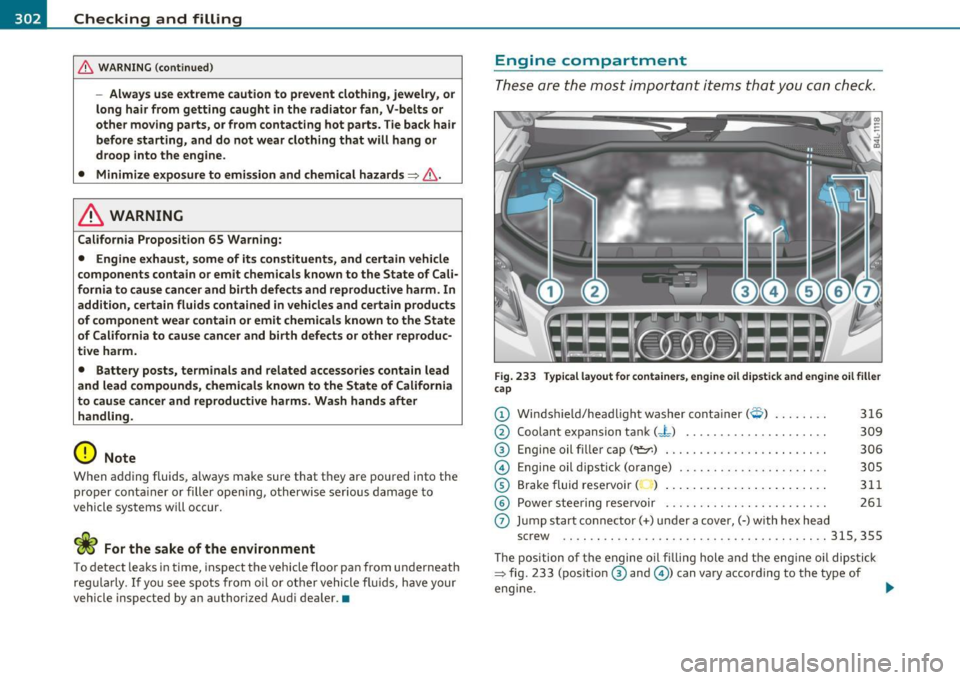
Engine compartment
These are the most important items that you can check.
Fig. 233 Typical layout for containers, engine oil dipstick and engine oil filler
cap
© Windshield/headlight washer container ( q ) ... .... .
@ Coolant expansion tank (- L ) ..... ......... ... .. . .
® Engine oil f iller cap ("l!::r.) .......... ...... .. .. .. . .
© Engine oil dipstick (orange) ... .. .... .. .. ... . .. .. .
® Brake fluid reservoir ( ) ................. ... .. . .
©
0
Power steering reservoir ... .... .. .... .. ... ..... .
Jump start connector( +) u nder a cover,(-) with hex head 316
309
306
305
311
261
screw .. ... ... ...... ........ ......... .... .. .. 315,355
The position of the engine oil filling hole and the engine oil dipstick
=:> fig. 233 (position ® and ©> can vary according to the type of
eng ine.
Page 305 of 392

__________________________________________ ....:C:::..:..: h:,.::e ~c:.:: k~ i..:.. n ~g~ a~ n~ d~ f~ i~ll ~i~n '.1:g L __
& WARNING
Before you check anything in the engine compartment , always
read and heed all WARNINGS~
& in "Working in the engine
compartment " on
page 301. •
Engine oil
Engine oil specifications
The engin e oil used in your Audi needs the right kind of oil.
Th e e ng ine in your Aud i is a sophis ticated powerplant that was bui lt
to exacting spec ificat ions. This engine needs the r ight kind of engine
oil t hat meets spec ifi cat ions regarding qu ality a nd viscosity so t hat it
can run smooth ly and re liably. Choosing the right o il and changing oil
with in the time and mileage intervals pr in ted in your veh icle 's
Warranty & Maintena nce book let matters a lot more today than it did
years ago . Audi has developed a specia l quality standard for engine oil
that w ill help assure that your veh icle's engine will get t he lubr ication
it needs fo r prope r operation.
M ode rn engine lubr ication has taken a quan tum leap in the last few
years. Many synthet ic oils available today provide better engine lubri
c at ion th at c an outlast tradit ional petro le u m-based o ils, making
them a smart choice for use throughout the life of your Aud i.
Whethe r you use synthetic or petroleum -based engine oi l, the o il th at
yo u use must confo rm to A ud i's o il quality sta ndard VW 502 00 (vehi
cles with gasoline engine) or VW 507 00 (vehicles with d iese l eng ine)
to he lp keep you r vehi cle's e ngine run ning smoothly and help p revent
the format ion of harmfu l deposits, somet imes called "sludge," that
over time can lea d to expens ive rep airs.
At the time of pr int ing, engine o ils avai lab le in the U .S . and Ca nada
t ha t meet the exacting spec ificat ions o f Audi o il standar d VW 502 00
(vehicles w it h gasoline eng ine) or VW 507 00 (vehicles w ith d iese l
eng ine) are synthetic engine oils . This does not mean, howeve r, that
Safety first
every synthetic engine oil w ill meet Audi o il standard VW 502 00
(vehicles wit h gasoline eng ine) or VW 507 00 (vehicles wi th di esel
engi ne). So a lways be sure that you use an approved oil.
T o help preve nt the format io n of harmfu l deposits use only oi l with
t he follow ing s peci fica tions p rin ted on the oil con tainer:
• Audi oil standard VW 502 00 (gasoline engine)
• Audi oil standard VW 507 00 (diesel engine )
Oil container labe ls may carry the specification s ingly or in comb ina
t ion wi th ot he r designa tions a nd o il quali ty stand ards.
Viscosity
Engine oils are g raded acco rding to the ir viscosity. The proper
vis cos ity gra de oi l for your engi ne depends o n clim actic or se ason al
conditions where you drive . You can use oil with a v iscosity grade of
SA E S W40 across a ll tempe rature ranges fo r norma l driv ing con di
tions .
However, if en gine oi l v iscosity grade SAE SW 40 is not avai lab le, you
c an a lso use viscos ity grade SA E SW-30 or SA E OW -40 as long as it
meets Audi o il quality standa rd VW 502 00 (vehicles w ith gasoline
engi ne) or VW 5 07 00 (vehicles w it h diese l engine) speci fications .
Beca use engine o il that meets the Aud i oil standard may not be avail
able everywhere when yo u nee d it, we strongly recommend t hat you
always carry w it h you an extra quart (liter) of o il that e xpress ly
conforms to the VW 502 00 (vehicles w ith gasoli ne engine) or VW
507 00 (vehicles w ith diesel engin e) specification, in case you have to
to p off t he oil while on the roa d.
Applies to vehicles with gasoline engine only: Only if th e leve l of the
oil is at or below the minimum mark on the o il dipstick -and no oil
t ha t expressly conforms to Aud i oil st anda rd VW 5 02 00 specifica
tions is ava ilab le -may you top off w ith a high quality engine o il, pref
era bly syn the tic -b ase d, tha t mee ts AC EA A3 or A PI SM specificat ions,
bu t even the n, only in viscosity g rades SA E SW- 40, SA E SW-30, or
SAE OW -40. Howeve r, dur ing the entire time between o il change
in terva ls, never top off wi th m ore than a total of 0 .5 qt/ lite r engine
oil that does not conform to A udi oil spec ificat io n VW 502 00. ..,
Vehicle care Technical data
Page 306 of 392

lffll __ C_ h_e _c_ k_ i_ n _ g_ a_ n _ d_ f_il _l _in ____ g ___________________________________________ _
Applies to vehicles with diesel engine only : Only if the level of t he
oil is a t or be low the m inimum m ark o n the o il d ipstick -and no o il
that express ly conforms to A udi o il standard VW 507 00 spec ifica
tions is available -may you top off with a high q ua lity engine oil , that
meets ACEA C3 o r API CF spec ifications, but even then, on ly in
viscosity gra des SAE 5W- 40, SAE SW -30, or SAE OW -40 . However,
dur ing t he e ntire time between o il change i nte rvals, neve r top off
w ith more than a tota l of 0.5 qt/liter engine oil that does not
c onfor m to Audi o il specification VW 5 07 00.
For more information about eng ine oi l th at has been approved for
your vehicle, please con tact either your au thorized A udi dea le r or
Aud i Customer Relations at 1 (800) 822 -2834 or vis it our web site at
www.aud iusa .com or www .aud icanada.ca . He re yo u w ill also find a
cu rrent list of oils (manufactu rers, brand names e tc.) that co nform to
Audi oil standard VW 502 00 (vehicles with gaso line e ngine) or VW
507 00 (vehicles w it h die sel eng ine).
Changing the engine oil
The eng ine oil and oil fi lter mus t be changed according to the mileage
(kilome ters) and t ime intervals specified i n your vehicle 's Warranty &
Ma intenance booklet . Do not exceed these interva ls - harmful
deposi ts from o ld engi ne oil can reduce engine pe rfo rmance and ca n
lead to expensive engine repa irs.
C hangi ng the oil at the recommende d interva ls is so very imp ortant
because the lubricating properties of o il decrease gradually during
normal ve hicl e use. If yo u ar e not sure w hen you have yo ur oil
changed, ask your author ized Audi Service Adv isor .
Under some circumstances the eng ine o il should even be changed
more fr eq uent ly. Chang e oil mor e of ten if you d rive mostly short
distances, operate the veh icle in d usty areas or mostly under stop
and -go t raff ic condi tion s, or when you use yo ur vehicle where tempe r
atures stay be low free zing po int for long periods.
De tergen t ad dit ives in the o il wi ll m ake fres h oil look dark a fter the
eng ine has bee n ru nning for a short t ime . This is normal and is not a
reason to ch ang e the oil mo re of ten t han re commended.
Damage or malfunctions due to lack of maintenance
It is essentia l that you change your o il at the recommended intervals
using only en gine oil th at com plies wi th A udi o il st and ard VW 502 0 0
(vehicles w ith gasoline eng ine) o r VW 507 00 (vehicles with d iesel
eng ine) . Your Limited New Vehicle Wa rranty does not cover damage
or ma lfunct ions due to fa ilure to follow recomm ended maintena nce
and use requirements as set forth in t he Au di Owner's Man ua l and
W arranty
& M aintenance boo klet. Y ou r deale r will have to deny
wa rranty coverage unless yo u present to the dealer proof i n th e form
of Se rvice o r Rep air O rders tha t al l sche dul ed main tena nce was
performed in a time ly ma nner. •
Engine oil consumption
To provide effective lubr ication a nd cooling for interna l eng ine parts,
a ll in ter na l c omb ustion e ngines use some oil. Oil cons umption v aries
from engine to engine and may change over the life of the eng ine .
E ngines te nd to use m ore oi l dur ing the b re a k-i n period t han t hey do
after ward, when oil consumption has stab ilized. Depending on t he
way the vehicle is driven and the operatin g cond itions, oi l cons ump
tion ca n be up to 1 qua rt pe r 1,200 m iles
(I liter per 2 ,000 km).
Consumption may be higher withi n th e first 3,0 00 miles (5,00 0 km).
Under nor mal co ndi tions, the rate o f oi l consu mptio n depe nds o n oil
quality as well as viscosity, engine speed ( rpm), o utside tempe rature,
roa d condi tion s, the amou nt of o il d ilution caused by co nde nsed
water or fu el residue, and oxidation of the oil. O il cons umption may
increase wi th en gine we ar ove r time, un til repl aceme nt of worn
eng ine pa rts may become necessa ry.
Because of all these var ia bles, there is no standa rd o r "norma l" rate
of oil consumption .
We urge you to check the engine oil level at
regular intervals, preferably every time you fill the fuel tank, and
always before a long trip .
The oil pressure warning light
~ is not an indicator of low eng ine
oil level. If the warning light does not go out after starting, or
flashes while driving (above 1500 rpm), a buzzer will sound . It
indicates that the oil pressure is too low. Stop the engine immedi- _.,,
Page 307 of 392

_____________________________________________ C_h _ e_ c_ k_in --= g'-- a_n _d_ f_i _ll _i_n -=g ::;__ ____..
ately, check the engine oil level and add oil if necess ary. If the
engine oil level i s normal, but the light continues to flash , do not
keep driving or l et the engine idle , as damage may occur .
If you believe your engine uses too much oil, we recommend that you
cons ult your au thor ized Audi dealer so that the cause of yo ur conce rn
can be properly diagnosed. Keep in m ind that accurate measurement
of oil consump tion req uires gre at care a nd may ta ke some time. You r
Audi dealer has instructions for how to measure o il consumption
a ccu rately.
& WARNING
Stop! Befor e working in the engine compartment, alw ay s read and
heed all WARNINGS ~
& in "Working in the engine compart
ment " on
page 301 . The engine compartment of any motor
vehicle is a potentially dangerous area and can cause ser ious
per sonal injury .
0 Note
• The engine depends on o il to lubr icate and coo l all of i ts mov ing
parts . The engine oil must be checked regularly and kept at the
req uire d level.
• Make it a hab it to have the engine oil level checked every t ime you
fill the f uel tank.
• Too little engine oil may cause severe eng ine damage .•
Vehicle OP-eration
Checking the engine oil level
The dipstick indi cates the engine oil level.
F ig. 234 Il lu st rati on
o f prin ciple 1 : M arke rs
o n oil dipsti ck
Fig . 235 I llustration
o f prin ciple 2 : M arker s
o n oil dip sti ck
Before you check anyt hing i n th e eng ine compartment ,
always read and heed all WARNINGS=> & in " Workin g in
t h e e ng ine compa rtme nt" on
page 301.
Determining oil level
- Park you r veh ic le so tha t it is h orizo ntally lev el.
- While at operating state te mperature, briefly let the
engine ru n at id le and then shut it of f.
- W ait appro x. two minutes .
Vehicle care Do-it-yourselt service iTechnical data
Page 308 of 392

___ C_h_ e_c _k _i_n -=g :a,__ a_n_ d_ f_ i_ l _li _n _,g;._ __________________________________________ _
-Pull out the oil dipstick. Wipe off the oil dipstick with a
clean c loth, and slide it back i n as far as it will go .
Pull it back out and read off the oil level=>
page 305,
fig. 234 or=> page 305, fig . 23 5. Top off the engine oil, i f
applicable =>
page 306.
Oil level within range @
-Do not add oil.
Oil level within range®
-You can add oil. Afterwards, the oil lev el should b e w ithi n
rang e@ .
Oil level within range ©
-You must add oil. A~erwards, the oil level should be
withi n range @.
The oil leve l needs to be checked at regular interva ls. The best times
to do this a re whenever yo u refue l and prior to long trips.
Depend ing on the way the vehicle is drive n and the operat ing condi
tions, oil consumpt ion can be up to 1 quart per 1,200 miles (1 liter
per 2,000 km) . Consumption may be higher wit hin the first
3,000 miles (5,000 km). •
Adding engine oil 't::7-
Fig. 236 En gin e
c ompartm ent: Oi l fi ller
c a p l ocation
B efore you check anyth ing i n the engin e compartment,
always read and heed all WARNINGS=> & in "Working in
the e ngin e compar tment " on
page 301 .
-Unscrew th e ca p "l=7': to th e engine oil fi lling hole
=> fig . 236.
- Care fully top o ff with the appropriate oil in 0.5 liter doses.
- Chec k the oil leve l again after two minutes=>
page 305 .
-Top off the oil aga in , if necessary .
- Screw th e cap ba ck on the filling hole and slide the oil
dips tic k in as far as i t wi ll go .
& WARNING
Stop! Befor e working in the engine compartment, alway s read and
heed all WARNINGS =>
& in "Working in the engine compart
ment " on
page 301 . The e ngine compartment of any motor
v eh icle is a potentially dange rous area and can cause serious
personal injury. •
Page 309 of 392
___________________________________________ C_ h_e _c _k_ i_n ~g_ a_n_ d_ f_ i_ll _i_n _g __ l!'II
& WARNING
Spilled oil is a fire hazard .
• The oil filler cap must be properly sec ured to prevent oil from
being sprayed on the hot eng ine and e xhaust system when the
engine i s running.
0 Note
• The oil leve l mus t not be above range @-danger of converte r o r
eng ine damage! Contact an author ized dealership to draw off oil, if
necessary .
• Audi does not recommend the use of oil addit ives . The y may
damage the engine and adver sely affect your New Vehicle
Warranty .
For the sake of the environment
• Under no c ircumstances can the o il come in contact with the
sewage netwo rk or the soil.
• Observe and fo llow legal regu lations when d isposing o f empty o il
containers. •
Changing the engine oil
Engine oil must be chang ed at int ervals listed in th e
W arranty
& Maintenance booklet.
Th e eng ine oil an d oi l filter mus t be c hanged accor ding to the mile age
and time interva ls spec ified in your vehicle's Warranty
& Maintena nce
book let. Do not ex ceed these interv als - ha rmfu l sl ud ge and de posi ts
from o ld eng ine oi l can reduce engine performance and can lead to
expensive engine repairs.
Chang ing o il at r egular intervals is so very important because the
L u br icating pro perties of o il decrease gradually d u ring normal veh icle
Safety first use
.
If you a re not sure whe n to have the oil changed, as k your autho
r iz ed A udi Serv ice Adv isor.
Under some circumstances t he e ng ine oi l should even be changed
more often than specified for no rma l use . Change oi l more often if
you often drive s ho rt dista nce s, ope ra te the vehicle in d usty a reas or
mostly unde r stop -and-go traffic cond itions, or when you use your
vehicle whe re te mper atures s tay be low free zing po int f or long
per iods.
Detergent addit ives i n the o il w ill make fresh oil look dark after the
engine has bee n running for a short time . This is normal and is not a
reason to chan ge the oil mo re often t han recommended.
& WARNING
Stop! Before working in the engine compartment, always read and
heed all WARNINGS =>
& in "Working in the engine compart
ment" on
page 301. The engine compartment of any motor
vehicle is a potentially dangerous area and can cause serious
personal injury .
& WARNING
If you must change the engine oil in your vehicle:
• Always wear eye protection .
• To reduce the risk of burns from hot engine oil let the eng ine
cool down to the touch.
• When removing the oil drain plug w ith your fingers, stay as far
away as possible. Always keep your forearm parallel to the ground
to help prevent hot oil from running down your arm .
• Drain the oil into a container designed for this purpose, one large enough to hold at least the total amount of oil in your
engine .
• To reduce the risk of poisoning, never use empty food or
beverage containers that might mislead someone into drinking
from them .
Vehicle care Technical data
Page 310 of 392

___ C_ h_ e_c _k _i _ n _g ~ a_n _d_ f_il _l_in _ g _________________________________________ _
& WARNING (conti nu ed )
• Engine oil is poisonous . Keep it well out of the reach of chil
dren .
• Continuous contact with u sed engine oil is harmful to your
skin . Alway s protect your skin by wa shing thoroughly with soap
and water.
0 Note
Never mix oi l additives wit h your engine oil. These additives can
damage your engine and adverse ly affect your Audi Limited New
Vehicle Warranty.
~ For the sake of the environment
• Before chang ing the oil, first make sure you know where you can
prope rly d is p ose of the o ld oil.
• Always dispose of used oi l proper ly. Never dump it o n garden soi l,
in wooded areas, i nto streams o r down sewage d rains.
• Recycle used oi l by taking it to a used engine oil co llection facility
in yo ur area, or contact a se rvice station .
• We st rongly recommend t hat you have you r oi l changed by an
authorized Audi dealer or a qualified workshop with the specia l tools
and expertise required, and proper means of disposa l.•
Engine cooling system
Coolant
The e ngine co o la nt per form s two functio ns: it keeps the
engine from ove rh eati ng and it protects t he engine from
free zing in the winter .
The cooling system is sealed an d genera lly req uir es little attention. The cooling system has been f
illed at the factory wit h a permanent
c oo lant whi ch does no t need to be c hanged . Th e coolan t cons ists o f a
mixt ure of water and the manufacturer's glycol-basedcoolant addi
tive G12+ + antifreeze with anticorrosion ad dit ives (50% for USA
mode ls; 60% for Ca nadian models) . This mixture both ass ures the
necessary frost protection and protects meta l components in the
eng ine's cooling system from co rrosion and scaling. It also raise s the
boiling point of the coo lant .
Do not re du ce the co ncent ration of the coo lant in the summer by
add ing p la in water .
The proportion of coolant add itive must be at
least 50% but not more than 60%
to mai ntain an tifreeze pro tection
and coo ling efficiency . If the coolant frost p rotect io n i s too low, the
coo lant co uld freeze an d damage t he veh icle heating and engine
coo ling system .
For year-round driving, antifree ze is added at the factory for temper
a tures dow n to:
• -31°F(-35°C)USA
• - 4 0 °F ( -40 °C) Canad a.
You can mix the G12 ++ coo lant addit ive w ith other additives (G12+ or
G 12). A lways check with yo ur autho rize d Audi dea ler.
& WARNING
Before you che ck anything in the engine compartment, always
read and heed all WARNINGS~
& in "Work ing in the engine
compartment" on
page 301 .
0 Note
• B efore w inter sets in, have the coolan t checked to see i f the
coo lant add itive in yo ur vehicle is s uff ic ient to meet the cl ima te
conditions. This is especially important if yo u live in a region where
the winter is ext reme ly cold . If necessa ry, increase the proport ion of
coo lant add itive to 60%.
• When ad ding coolant add itive to you r cooling sys tem, remembe r:_.,