flat tire AUDI Q7 2011 Owner´s Manual
[x] Cancel search | Manufacturer: AUDI, Model Year: 2011, Model line: Q7, Model: AUDI Q7 2011Pages: 392, PDF Size: 93.29 MB
Page 325 of 392
Tires and wheels -________________ f!ffl
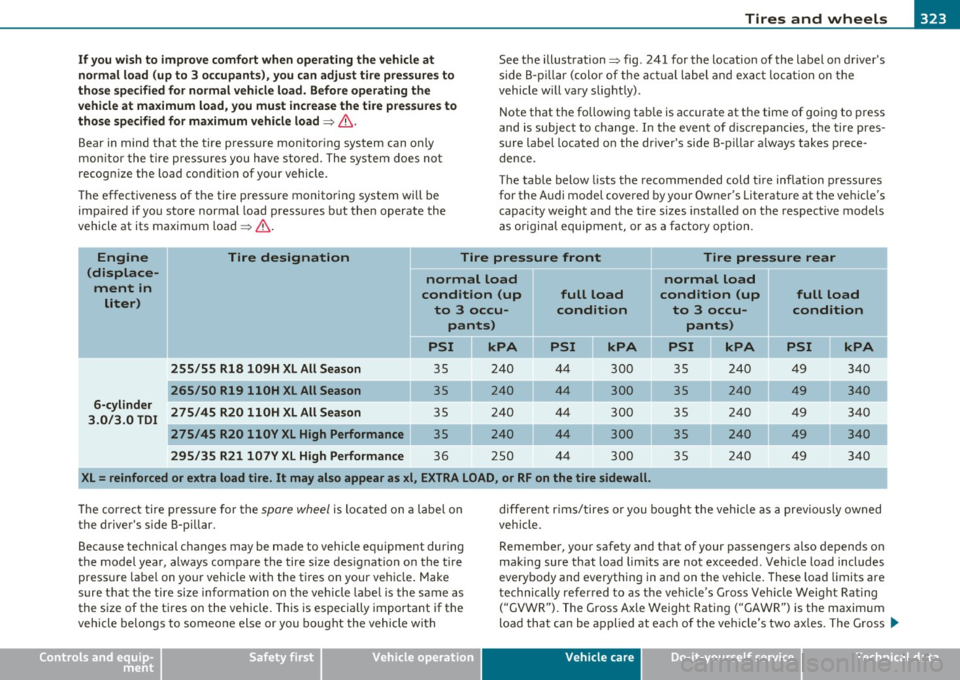
If you wish to improve comfort when operating the vehicle at
normal load (up to 3 occupant s), you can adjust tire pres sures to
those specified for normal vehicle load . Before operating the
vehicle at maximum lo ad, you must increase the tire p res sures to
those specified for maximum vehicle load=>& .
Bear in mind that the tire press ure monitor ing system can only
mon itor the t ire pressu re s you h ave sto red . T he sys tem does no t
recogn ize the load cond it ion of your vehicle.
Th e effectiveness of t he tire pressu re monitoring system will be
impa ired if you store normal load pressu res but then operate the
vehicle at its maxim um loa d=> & . See the
illustration=> fig. 241 for the location of the label on driver's
side B- pillar (colo r of the act ual la bel and ex act l ocation on the
vehicle will vary slig htly).
N ote that the fo llow ing tab le is accurate at the time of going to press
and is subjec t to change. I n the even t of discrepancies , the tire pres
sure label located on the dr iver's side B-pi llar a lways takes prece
dence .
T he table below lists the recommended cold t ire inflation pressures
for the Audi model covered by your Owne r's Literature at t he ve hicle's
capac ity weight and the tire sizes insta lled on the respective models
as original equipment, or as a factory option .
Engine Tire designation Tire pressure front Tire pressure rear
(displace- normal load normal load
ment in
liter) condition
(up
full load condition (up
full load
to
3 occu- condition to 3 occu- condition
pants) pants)
PSI kPA PSI PSI kPA PSI kPA
255/55 R18 109H XL All Season
35 240 44 300
35 240 49 340
265
/50 R19 110H XL All Season 35 240 44
300 35 240 49 340
6-cylinder 275/45 R20 110H XL All Season 35 24 0 44 3 00 35 240 4 9 340
3.0/3.0 TDI
275 /45 R20 llOY XL High Performance 35 240
44 300
35 240 49 340
295
/35 R2110 7Y XL High Performance 36 250 44
300 35 240 49 340
XL= reinforced or extra load tire
. It may also appear as xl , EXTRA LOAD, or RF on the tire sidewall .
The correct tire p ress ure for t he spare wheel is loca ted on a labe l o n
the driver 's s ide B-pillar.
Beca use technical c hanges may be made to vehicle equipment dur ing
the model year, always compare the tire size des ignation on the t ire
pressu re labe l on yo ur vehicle with the t ires on your vehicle. Make
sure that the tire size informat ion on t he v ehicle labe l is the same as
the size of the t ires o n the vehicle. This is especially important if the
vehicle belo ngs to so meone else or you bo ug ht the vehicle with
Safety first
differe nt r im s/ tires or you bo ugh t the vehicle as a prev iously owned
vehicle.
Remember, yo ur safety and t hat of your passengers also depends o n
making sure that load limits are not exceeded. Vehicle load includes
everybody and everything in an d on the vehi cle. These load limits are
t e chnically refer red to as the veh icle's G ross Veh icle Weig ht Rating
("GVW R"). The Gross Axle Weight Rati ng ("GAWR") is the maximum
load tha t can be applied at ea ch of the ve hicle's two ax les . T he G ross ..
Vehicle care Technical data
Page 326 of 392
-~_T_ ir_e_ s_ a_ n_ d_ w_ h_e_ e_ ls _______________________________________________ _
Vehicle Weight Rating and the G ross Ax le We ig ht Rating a re listed on
t he sa fe ty co mplianc e stick er la bel lo ca ted on t he dr ive r's side B
pillar. The tire press ure label on your Aud i lists the max imum
combine d weight of a ll of t he occ upants an d lugga ge or other cargo
that the veh icle can car ry . For the locat io n of the t ire pressure label
~ pa ge 32 2, fig . 241.
& WARNING
Overloading a vehicle can cause los s of vehicle control , a crash or
other accident, serious personal injury, and even death.
• Carrying more weight than your vehicle wa s designed to carry
will prevent the vehicle from handling properly and increase the
risk of a loss of vehicle control.
• The b rakes on a vehicle that has been overloaded may not be
able to stop the vehicle within a safe distan ce.
• Tires on a vehicle that has been overloaded can fail suddenly
causing loss of control and a crash.
• Always make sure that the total load being transported -
including the weight of a trailer hitch and the tongue weight of a
loaded trailer -does not make the vehicle heavier than the
vehicle 's Gro ss Vehicle Weight Rating.
& WARNING
• Incorrect tire pressures and /or underinflation can lead to a
serious or fatal accident.
• Incorrect tire pressures and /or underinflation cause increased
tire wear and can affect the handling of the vehicle.
• Incorrect tire pressures and/or underinflation can also lead to
sudden tire failure , including a blowout and sudden deflation,
c ausing loss of vehicle control. •
Checking tire pressure
The c orrec t t ire pre ssur e fo r th e tires origina lly insta lled
o n yo ur veh icle is listed on th e tir e p res su re l abe l lo cat ed
on driv er's side 8-pi llar.
Th e recommended tire pressures are on the tire p ress ure labe l an d in
t he table~
page 322, "Cold tire infla tion pressure" .This means that
the pressure m ust be chec ked an d adj usted w hen the tire has not
bee n driven for more tha n a co uple of m iles (kil om ete rs) at low
speeds dur ing the prev io us three hours . A ir in the tires expan ds when
t he tire heats up as a res ult of in ter nal fric tion as it flexes in use. The
t ire pressure is higher w hen the tire has warmed up than whe n it is
" ld "
c o .
It is the inflation pressu re in a "cold" tire that counts. Therefore, yo u
should never let air out of a wa rm tire to match "Col d tire inflat ion
pressu re" recomme ndat ions~
pag e 322. The t ir e s would t hen be
unde rinflated and co uld fail sudden ly .
Th e tire p ress ure label on your Aud i list s th e recommended co ld t ire
inflation pressures at maximum capacity fo r the new, o rigina l equip
ment tires tha t were on yo ur vehicle at the t ime it was man ufactu red.
For the location of the label~
page 322, fig. 241.
M ost tires lose a ir nat urally ove r time. They can a lso lose some a ir if
you drive over a potho le or hit a curb while pa rking.
It is usually not
possible to see whether the rad ia l tires used today are underinflated
jus t by loo king at them.
T herefore, be sure to check t ire pressures at least once a month and
always before going o n a long tri p. M ake sure to take the num be r of
peop le and the amount of luggage i nto account whe n ad justi ng tire
press ure for a t rip -even one tha t you would no t conside r to be
" lo ng." See~
pag e 326, "Tires and vehicle load lim its" for mo re
impo rtant i nformat ion.
Alw ays use an a ccu rat e t ire pres sure g auge whe n checki ng a nd
ad justing i nflat io n pressures. Check all of the tires and be sure not to
f o rge t the s pare tire. If the pre ssu re in any tir e is too h igh when the
t ir e is "co ld," let air out of t he tire slowly with t he edge of the ti re ..,_
Page 327 of 392
Tires and wheels -_____________ --=-=--=.:..:......:..::....:.=----Vf'II
gauge and keep chec king the press ure until you reach t he press ure
th at i s cor rect fo r t he lo ad ( pass en ge rs and l uggage) and kind of
dr iving you plan to do .
If the press ure i n any t ire is too low, note the difference betwee n th e
pressu re in t he cold tire a nd the pressure you need and add the air
that you need to reach the correct pressure for t he ve hicle load
( pass enge rs and lugg age) f or th e tires on yo ur vehicle as l ist ed on t he
on your vehicle and in this manua l and the kind of driving you p lan to
do.
Never exceed the maximum inflation pressure listed on the tire
sidewall for any reason.
Remember that the ve hicle m anufac tur er, no t the tire manufa cture r,
determines t he correct tire press ure for the t ires on your veh icle.
It is important to check the tire pressure when the t ires a re co ld .
• Read the requ ired t ire pr essure from t he t ire pr essure lab el. T he
tire pressure labe l is locate d on t he driver's side 8- pillar. Th e tire pres
s u re labe l lists t he re com men ded col d tire inflat io n pr essures fo r the
vehicle at its maxim um capac ity we ight and the t ires t hat were on
yo ur vehicle at the t ime it was ma nufact ured. For r ecom mende d tire
pressures fo r norma l load cond it ions, please see chapter
=> page 322.
• Turn the valve stem cap co unter -clockw ise to remove it from the
t ire v alve.
• Place the air press ure gauge on the valve.
• The tire p ressures sho uld on ly be checked and adjusted wh en the
tires are cold. The slightly raised press ures of wa rm tires must not be
re du ced.
• Adjust the tire p ress ure to the loa d you are ca rry ing.
• Reinstall the valve stem cap o n the valve .
When should I check the tire pressure?
The correct tire press ure is especially important at high speeds. The
pressu re shoul d there fore be c hec ke d at least once a mo nth a nd
Safety first
always before start ing a journey . Do not forget to check t he t ire pres
s u re for the spare w heel.
When should I adjust the tire pressures?
Adju st the tir e pre ssure to the load y ou ar e carry ing. A fter ch anging a
wheel
or replac ing wheels you have to adjust t he t ire p ressures on all
w heels. I n addition , you m ust th en s tore the new tire press ures i n the
t ir e pressu re monitoring system=>
page 339.
& WARNING
Incorrect tire pressures and/or underinflation can lead sudden tire
failure, loss of control, collision, serious pers onal injury or even
death.
• When the warning symbol appears in the instrument
cluster, stop and inspect the tires.
• Incorrect tire pressure and/or underinflation can cause
increased tire wear and can affect the handling of the vehicle and
stopping ability.
• Incorrect tire pressure s and/or underinflation can also lead to
sudden tire failure, including a blowout and sudden deflation,
causing loss of vehicle control.
• The driver is responsible for the correct tire pressures for all
tires on the vehicle. The applicable pressure values are located on a sticker on the driver's side B-pillar.
• Only when all tires on the vehicle are filled to the correct pres
sure, the tire pressure monitoring system can work correctly.
• The use of incorrect tire pressure values can lead to accidents or
other damage. Therefore it is essential that the driver observe the
specified tire pressure values for the tire s and the correct pres
sures for the function of the tire pressure monitoring system.
• Always inflate tires to the recommended and correct tire pres-
sure before driving off. .,_
Vehicle care Technical data
Page 328 of 392
,.,.___T_ ir_e_ s _ a_ n _ d_ w_ h_e_ e_ ls _______________________________________________ _
& WARNING (conti nu ed )
• Driv ing with underinflated tire s bend more , letting them get
too hot re sulting in tread separation , sudden tire failure and lo ss
of control.
• Exce ssive speed and /overloading can cause heat build-up,
s udden tire failure and loss of control.
• If the tire pressure is too low or too high , the tires will wear
prematurely and the vehicle will not handle well.
• If the tire is not flat and you do not have to change a wheel
immediately, drive at reduced speed to the nearest service station
to check the tire pressure and add air as required .
0 Note
Driving without valve s tem caps can cause damage to the tire valves .
T o prevent this, a lways make sure that factory ins talled valve stem
caps on al l wheels are secure ly mounted on the valve .
<£> For the sake of the environment
Underinflated t ires will also inc rease t he f uel consumption .•
Tires and vehicle load limits
T here are lim its to the amo unt of load or weight that any veh icle and
any tire can carry . A veh icle that is overloade d will not handle well and
is more difficult to stop . Overload ing can not on ly lead to loss of
vehicle contro l, but can also damage important parts of the vehicle
and can le ad t o su dden t ire failure, including a b lowo ut and s udden
def lation that can ca use the vehicle to c rash .
Yo ur safety a nd t hat of your passengers also de pends o n mak ing s ure
that load limits are not exceeded . Vehicle load incl udes everybody
and everything in and on the vehicle . These loa d limits are technically
referred to as the ve hicle's
Gross Vehicle Weight Rating ("GVWR") . The
"GVWR" includes the weight o f the basic vehicle, all factory
ins talled accessories, a f ull tank of f uel, oil, coolan t and other fl uids
plus maxim um load . The max imum load i ncludes the numbe r of
passenge rs that the vehicle is intended to carry ("seating capacity")
w ith an ass umed we ight of 150 lbs (68 kg) for each passenger at a
designate d seati ng position and the total weig ht of any luggage in
the vehicle. If yo u tow a trai le r, the weight of t he t railer hitch and the
tongue weight of the loaded trailer must be included as part of the
veh icle loa d.
The
Gross Axle We ight Rating ("GAWR") is the max imum load that
can be a pplied at each o f the ve hicle 's two axles .
Th e Gross Vehicle Weight Rat ing and the Gross Axle Weight Rat ing
are listed on the safety compliance sticker label located on the
dr iver 's side B-pillar. Your A udi has 5 seat ing pos it ions, 2 in the front
and 3 in the rear for tota l seat ing capacity of 5. On vehicles with six
sea ts*, yo ur vehicl e has two fron t seat s, two se a ts i n the se co nd row
seating and two seats in the t hird row seating. On ve hicles with seven
sea ts*, yo ur veh icle has two fron t se ats , th ree seats in the se cond row
seat ing and two seats in the third row seating. Eac h seating posit io n
has a seat belt=>
page 20 1, "Safety bel ts" .
Th e fact that there is an upper lim it to your veh icle 's Gross Vehicle
We ight Rating means that the total weight of whatever is being
c arried in t he veh icle ( inclu ding t he weight of a tra ile r hi tch and the
tongue weight of the loaded tra iler) is limited . The more passengers
in the vehi cle or passenge rs who are heavier th an the stan dard
we ights assumed mean that less we ight can be carried as luggage.
Th e tire pressure labe l on yo ur Audi a lso lis ts the max imum combined
we igh t of all of the occupants and luggage or o ther cargo that the
vehicle ca n carry. For t he locat ion of the label=>
page 322, fig. 241.
& WARNING
Overloading a vehicle can cause loss of vehicle control, a crash or
other accident, serious personal injury, and even death. ._
Page 329 of 392

& WARNING (continued)
• Carrying more weight than your vehicle was designed to carry
will prevent the vehicle from handling properly and increase the risk of the loss of vehicle control.
• The brakes on a vehicle that has been overloaded may not be
able to stop the vehicle within a safe distance.
• Tires on a vehicle that has been overloaded can fail suddenly,
including a blowout and sudden deflation, causing loss of control
and a crash.
• Always make sure that the total load being transported -
including the weight of a trailer hitch and the tongue weight of a
loaded trailer -does not make the vehicle heavier than the
vehicle's Gross Vehicle Weight Rating. •
Determining correct Load Limit
Use the example below to calculate the
total weight of the passengers and luggage or other things that you plan to transport so
that you can make sure that your vehicle
will not be overloaded.
Safety first
Tires and wheels 11111
Steps for Determining Correct
Load Limit
1.Locate the statement "THE COMBINED
WEIGHT OF OCCUPANTS AND CARGO
SHOULD NEVER EXCEED XXX KG OR XXX LBS"on your vehicle's placard (tire infla
tion pressure label)==>
page 322,
fig. 241.
2. Determine the combined weight of the driver and passengers that will be riding
in your vehicle.
3. Subtract the combined weight of the driver and passengers from
"XXX" kilo
grams or
"XXX" pounds shown on the
sticker==>
page 322, fig. 241.
4. The resulting figure equals the available amount of cargo and luggage load
capacity. For example, if the
"XXX"
amount equals 1400 lbs. and there will be five 150 lbs. passengers in your
vehicle, the amount of available cargo
and luggage load capacity is 650 lbs.
(1400-750 (5
X 150) = 650 lbs.) •
Vehicle care Technical data
Page 332 of 392
___ T_ i_ r _e _s_ a_n_ d_ w_ h_ e_e_ l_ s _______________________________________________ _
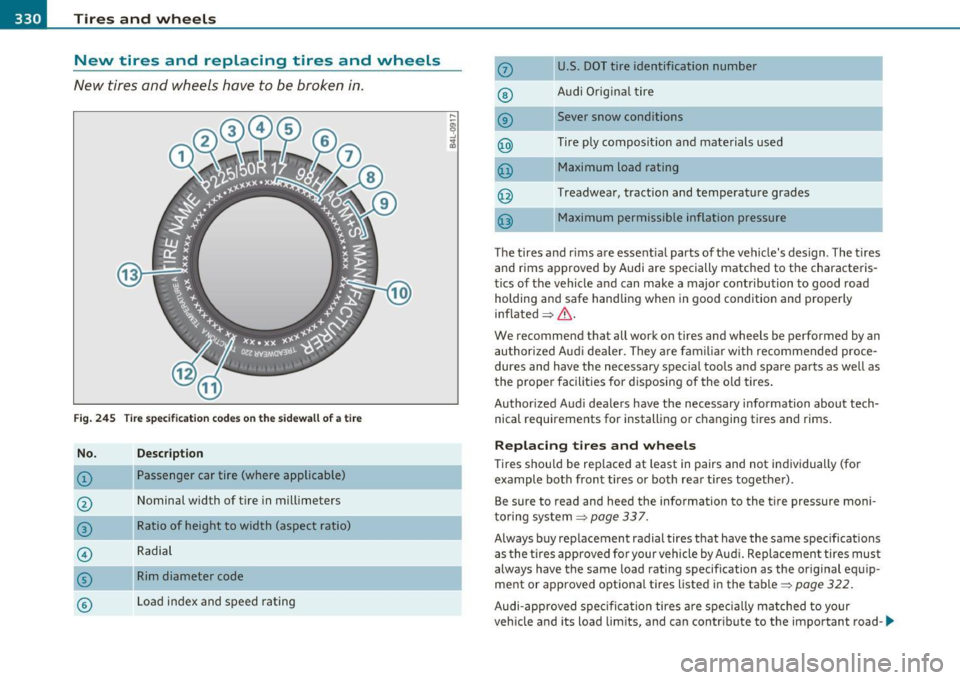
New tires and replacing tires and wheels
New tires and wheels have to be broken in.
Fig. 245 Tir e speci fication co des o n the sidew all of a tire
No.
©
@
®
©
©
©
Des cript ion
Passenger car tire (where applicable)
Nominal width of t ire in mill imeters
Ra tio of height to width (aspect ratio)
Radial
Rim diameter code
Load index and speed rating
0
©
®
@
@
U.S . DOT tire identification number
A udi O rigi na l tire
Sever snow conditions
Tire ply composit io n and materials used
Maximum load rating
@ Treadwear, traction and temperature grades
@ Maximum permissible inflation pressure
The tires and r ims are esse ntial parts of the vehicle's des ign. The tires
and r ims approved by Audi are specially matched to the characteris
tics of the vehicle and can make a major contribution to good road holding and safe hand ling when in good condition and properly
inflated
~ & .
We recommend that all work on tires and wheels be performed by an
author ized Aud i dea le r. They a re fam iliar with recommended proce
dures and have the necessary special tools and spare parts as well as
the prope r facilit ies for d isposing of the old tires .
Author ized Aud i dea le rs have the necessary information about tech
nical requireme nts for installing or changing tires and rims .
Replacing tires and wheels
Tires shou ld be rep laced at least in pairs and not individually (for
example both front tires or both rear t ires togethe r) .
Be sure to read and heed the information to the t ire pressure moni
t oring system~
page 33 7.
Always buy replacement radial tires that have the same spec ificat ions
as the ti res approved fo r your vehicle by Aud i. Replacemen t tires mus t
always have the same load rating specif ication as the or iginal eq uip
me nt or approved opt iona l tires listed i n the table ~
page 322.
Audi -app roved spe cifi cati on tires are spe cia lly mat ched to yo ur
vehicle and its load lim its, and can contr ibute to the important road-..,_
Page 334 of 392
-Tires and wheels PR:1-------------------
the 22nd week of 2010. The other numbers are marketing codes that
may or may not be use d b y the ti re manu facture r. T his in format ion is
used to contact consumers if a tire de fect requires a recall.
Audi Original tire
T ires with the ident ificat ion "AO" or "RO" have been specially
m atche d w ith your Audi. We recommend using on ly these t ire s
because t hey meet the hig hest standards regard ing safety a nd
dr iving charac teris tics when used corre ctly. Your aut horize d Aud i
dea ler w ill glad ly provide you wi th mor e informatio n.
Tire ply composition and materials used
T he number of p lies indicates the number of layers of rubber-coated
f abr ic in the tire. In ge ne ral, the greate r the numbe r of p lies, the
more weig ht a tire ca n support. Tire manufac turers also mus t indi
c ate the materials in the t ire, which incl ude stee l, nylon, polyes ter,
and others .
Maximum Load Rating
This number ind icates the maximum load in k ilograms and pounds
t ha t can be carried by the tire .
Tire quality grading for treadwear, traction, and
temperature resistance
Tread wear, traction and temperat ure grades~ page 333.
Maximum Permissible Inflation Pressure
Th is number is the greatest amount o f air press ure t hat should eve r
be pu t in the tire under no rm al driv in g c ond ition s.
& WARNING
• Using incorrect or unmatched tires and/ or wheels or improper
tire and wheel combinations can lead to loss of control , collis ion
and seriou s personal injury.
& WARNING (co ntinued )
• Always use tires, rims and wheel bolts that meet the specifica
tions of original factory-installed tires or other combinations that have been specifically app roved by the vehicle manufacturer.
• Tires age even if they are not being used and can fail suddenly,
especially at high speeds . Tires that a re more than 6 years old can
only be used in an emergency and then with special care and at
lower speeds.
• Never mount used tires on your vehicle if you are not sure of
their "previous history ." Old used tires may have been damaged
eventhoughthedamagecannotbeseenthatcanleadtosudden
tire failure and loss of vehicle control.
• All four wheels must be fitted with radial tires of the same
type , size (rolling circumference) and the same tread pattern.
Driving with different tires reduces vehicle handling and can lead
to a loss of control.
• If the spare tire is not the same as the tires that are mounted
on the vehicle - for example with winter tires - only use the spare
tire for a short period of time and drive with extra care . Refit the
no rmal road wheel as soon as safely possible .
• Never drive faster than the maximum speed for which the tires
on your vehicle are rated because tires that are driven faster than
their rated speed can fail suddenly .
• Ove rloading tire s cause heat build-up, sudden tire failure,
including a blowout and sudden deflation and loss of control.
• Temperature grades apply to tires that are properly inflated
and not over or underinflated.
• For technical rea sons it is not always possible to use wheels
from other vehicles- in some cases not even wheels from the same
vehicle model.
• If you install wheel trim discs on the veh icle wheels, make sure
that the air flow to the brakes is not blocked . Reduced airflow to
the brakes can them to overheat , increasing stopp ing distances
and causing a colli sion.
~
Page 335 of 392
Tires and wheels -________________ fWII
& WARNING (co ntinued )
• Run flat t ires may onl y be u sed on vehicles that were equipped
with them at the factory. The vehicle must have a chassi s de signed
for run flat tires. Incorrect use of run flat tires can lead to vehicle
damage or accident s. Check with an authorized Audi dealer or tire
specialist to see if your vehicle can be equipped w ith run flat tires .
If run flat tires are u sed, they mu st be in stalled on all four wheel s.
Mixing t ire types is not permitted.
0 Note
• For techn ical reaso ns, it is not generally poss ible to use the wheel
r ims from o ther vehicles. This c an hold t rue for wheels o f th e s ame
vehicle type.
• If the sp are tire is different from the tires t hat yo u have mo unted
on your vehicle (for examp le w inter t ires or wide profile tires), then
use the spare t ire for a short per io d of t ime on ly and d rive wi th ex tra
care . Replace the flat t ire with the tire matching the others on your
vehicle as soon as possible.
• Never dr ive without the valve stem cap . The valves could get
d amaged .
~ For the sake of the environment
Dispose of old t ires in accordance wit h the loca l req uirements .•
Uniform tire quality grading
• Tr ead we ar
• Tract ion AA A B C
• Temperatu re A B C
Quality g rades can be found where app licab le on the tire side wa ll
be tween tread s hou lde r an d max imum se ct io n w idt h~
page 330,
fig. 245 .
Safety first For example:
Tread wear 200
, Tract ion AA , Temperat ure A.
All passenger car ti res must confo rm to Federa l Safety Requirements
in addition to these grades.
Tread wear
T he tread wear grade is a compa rative rat ing based on the wear rate
o f th e tire when tested under contro lled conditions o n a specifie d
government test cou rse .
For example, a tire graded 150 would wear one and one half (1 1/2)
ti mes a s we ll on t he governme nt co urse a s a tire graded 10 0 .
The relat ive pe rformance o f tires depe nds upon the actua l conditions
o f their use, however, and m ay depar t sig nificantly from the norm
due to variations in d riving hab its, se rvice practices and differences in
road characte rist ics and cl imate.
Traction
Th e traction grades , from highes t to lowe st, are AA, A, Band C. Those
grades repr esen t the t ire's ability to stop on wet pavemen t as
measu red under con trolled con dit io ns on s pecified government test
surfaces of asphalt and conc rete. A tire marked C may have poor t rac
tion performance ~& .
Temperature
The tempera ture grades are A (the highest), B, an d C, represen ting
t he t ire's res ista nce to the gene ra tion of heat a nd its ab ility to d issi
pa te heat when teste d unde r contro lled condi tions on a spec ified
indoor laboratory tes t wheel.
S ustained h igh temperature ca n cause the material of the tire to
degene rate and red uce tire li fe, and excessive tem per at ure c an lead
to sudden tire failure ~& .
Th e grade C cor responds to a leve l of perfo rmance which a ll
passenger car tires mus t meet under the Federal Motor Veh icle
Sa fety Standa rd No. 1 09 . G rades Band A represent higher levels of
performance o n the labo ra tory test w hee l than the minim um
req uired by law . .,_
Vehicle care Technical data
Page 336 of 392

lffll,.___T_ ir_e_ s _ a_ n _ d_ w_ h_e_ e_ ls _______________________________________________ _
in. WARNING
The traction grade assigned to this tire is based on straight-ahead
braking traction test s, and d oes not include acceleration ,
cornering, hydroplaning or peak tra ction chara cteristics .
in. WARNING
The temperature grade fo r this tire is established for a tire that is
properly inflated and not overloaded. Ex cessive speed, underinfla
tion, or excessive load ing, either separately or in comb inat ion, can
c ause heat buildup and po ssible tire failure. •
Winter tires
Winter tires can improve v ehicl e handling on snow and
ice . At temper atures below 45 °F (7 °C) we recommend
ch anging to w inter tires.
In some heavy snow areas, loca l governme nts may requ ire true
w inter o r "snow" tires, those with very deep ly c ut trea d. These tires
sho uld only be used in pa irs and be installed on all four whee ls. Make
sure you p urchase snow tires that are the same size and construct ion
type as the ot her t ires on your ve hicle.
Your vehicle is equipped with a ll-wheel drive, th is will improve trac
tion dur ing wi nter dr iv ing, even w it h the standar d tires. Howeve r, we
strong ly recommend that you always eq uip a ll four wheels on yo ur
veh icle with correctly fitte d winter t ires or all-season ti res, when
w inte r road conditio ns are exp ect ed. This also imp roves th e veh icle's
bra king perfo rmance an d red uces stopping distances.
S um mer tir es p rovide le ss grip on ice and snow .
Winter tires (snow tires) m ust always be fitted on all four wheels.
Ask your aut horized Audi dealer or q ualified workshop for permitted
winter tire sizes . Use only ra dial w inter tires. W
inter tires lose the ir effectiveness when the tread is wor n down to
a dep th o f 0. 157 inch ( 4 mm).
On ly drive w ith w inter t ires under w inter cond it io ns. S umme r tires
han dle better when the re is no snow or ice on the roads and the
tempe ra ture is a bove 45 °F (7 °C).
If you have a flat tire, see notes on spare wheel=>
page 330.
Please always remember that winter tires may have a lower speed
rat ing than the tires originally installed on yo ur veh icle at t he time it
was man ufact ured . Please see=>
page 331, "Speed rating (letter
c ode)" for a list ing of t he speed ra ting le tte r c odes and the maxi mum
speed at which the tires can be driven .
Th e spee d rat ing let ter code (=>
page 3 21) is on the side w all of the
tire=>
page 330.
in. WARNING
Winter tires have maximum speed limits that may be lower than
your vehicle 's maximum speed . Always know the maximum speed
before dr iving off. Never drive faster than the speed permitted for
your specifi c winter tires . This will caus e damage to the tires
lead ing to an accident and serious personal injury to you and your
pa ssengers.
in. WARNING
Driving fa ster than the maximum speed for whi ch the winter tires
on your vehicle were designed can cause t ire failure including a
blowout and sudden deflation , lo ss of control , crash es and seriou s
personal injuries. Have worn or damaged tires replaced immedi
ately.
• Winter tires have maximum speed rating that may be lower
than your vehicle's maximum speed .
• Never drive faster than the speed for which the winter or other
tires installed on your vehicle are rated.
~
Page 338 of 392
-~_T_ ir_e_ s_ a_ n_ d_ w_ h_e_ e_ ls _______________________________________________ _
Wheel bolts
Wheel bolts must al ways be tightened to the correct
torque .
The design of wheel bolts is matched to the factory installed rims. If
different r ims a re fitted, the cor rect wheel bolts with the r ig ht leng th
and correctly shaped bolt heads must be used. Th is ensures that
w heels are fitted secure ly and that t he br ake system func tion s
correctly .
In certain circ umstances, you may not use whee l bolts from a
different veh icle -even if it is the same model~
page 370.
&_ WARNING
Improperly tightened or maintained wheel bolts can become
loose causing lo ss of control , a c ollision and seriou s personal
injury .
• Always keep the wheel bol ts and the thread s in the wheel hub s
clean so the wheel bolts can turn easily and be properly t ighten ed .
• Never gr ease or oil the wheel bolt s and the threads in the wh eel
hubs. They can become loose while driving if greased or oiled, even
if tightened to the specified torque.
• Only use wheel bolts that belong to the rim being installed.
• Never use different wheels bolts on your vehicle .
• Alway s maintain the correct tightening torque for the wheel
bolt s to reduce the risk of a whee l los s. If the tightening torque of
the wheel bolts is too low , they can loosen and come out when the
vehicle is moving . If the tightening torque i s too h igh, the wheel
bolts and threads can be damaged and the wheel can become
loose .
0 Note
The spe cifie d torq ue for the whee l bolts is 120 ft lb (160 Nm) wi th a
tolerance of ± 7,4 ft lb( ± 10 Nm). Torque whee l bolts diagona lly. After changing a wheel, the torq
ue m ust be checked as soo n as
possible wi th a t orqu e w rench -prefer ably by an auth o riz ed Audi
dealer or qualified workshop. •
Low aspect ratio tires
Your Audi is factory-equipped with low aspect ratio tires. These tires
h ave bee n thorou ghly teste d and been se lec ted spe cifically fo r yo ur
model for their superb performance, road feel and hand ling u nder a
var iety of dr iving con ditions . Ask your authorized A udi dea le r for
more deta ils.
The low aspect ratio of these t ires is ind icated by a n umera l of
55 or
le ss
in t he tire 's s ize designation . T he numera l rep resents the ratio o f
the tire's sidewall he ight in relat ion to its tread width exp ressed in
pe rcen tage . Co nven tional ti res have a heig ht/w idth r atio o f 60 o r
more.
The performance of low-aspect-ratio tires i s particularly sensitive to
improper inflation pressure. It is therefore important that low
aspect ratio tires are inflated to the specified pressure and that the
inflation pre ssure is regularly checked and maintained. Tire pre s
sures should be checked at least once a month and always before a
long trip~
page 324, "Che cking t ire press ure".
What you can do to avoid tire and rim damage
Low aspe ct ratio tires ca n be damaged more eas ily by imp act wi th
potholes, curbs, gul lies or ridges on the road, part icu lar ly if the tire is
unde rinfl ated.
I n order to minimize the occu rrence of impact damage to the tires of
your vehicle, we recommend that yo u observe the follow ing p recau
tions:
• Always ma inta in recommen ded inflation p ressures. Check your
t ire press ure every 2,000 m iles (3,00 0 km) a nd a dd air i f ne cess ary.
• Drive ca ref ully on roads with potho les, dee p gullies or ridges. The
i m pact from d riving t hrough or over such obsta cles can damage you r
tires. Impact w it h a c urb may also cause damage to your tires . .,_